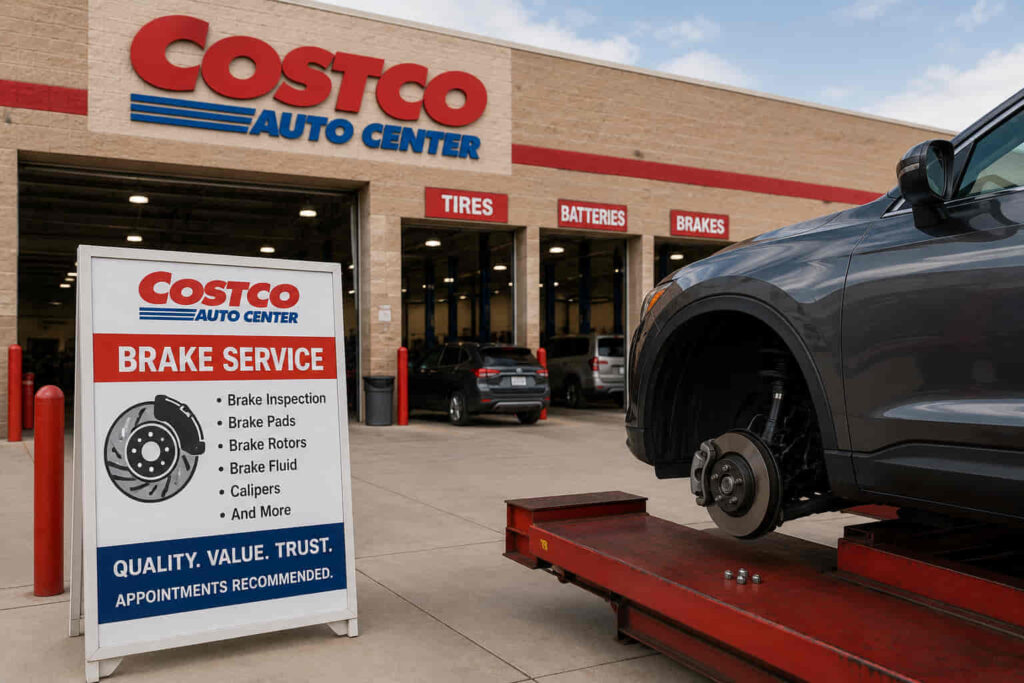
If you’re wondering “Does Costco do brakes?”, the short answer is no. Costco Tire Centers do not provide brake inspections, brake pad replacements, rotor resurfacing, or any other brake repair services. While Costco has earned a strong reputation for affordable tires, tire installation, and member-exclusive automotive benefits, its service centers are intentionally limited to tire-related maintenance rather than full mechanical repairs.
The confusion often comes from Costco’s extensive automotive offerings. Many drivers assume that because Costco operates Tire Centers and promotes the Costco Auto Program, it also performs routine vehicle maintenance such as brake replacement. In reality, these are separate services. Costco Tire Centers focus almost exclusively on tires, while the Costco Auto Program connects members with participating dealerships and repair facilities that may offer discounts on brake services and other vehicle repairs.
Understanding this distinction is important because delaying brake maintenance can compromise both vehicle performance and road safety. Whether you are hearing squealing noises, feeling vibrations during braking, or simply following your manufacturer’s maintenance schedule, knowing where Costco fits into the brake service process can save both time and money.
This guide explains exactly what Costco does and does not offer, why the company avoids brake repairs, how the Costco Auto Program may still help reduce repair costs, and which alternatives are worth considering when your vehicle needs professional brake service. By the end of this article, you will have a clear understanding of whether Costco is the right place for your automotive needs and where to go when brake maintenance becomes necessary.
Does Costco Do Brakes?
No, Costco does not perform brake services at its Tire Centers. If your vehicle needs new brake pads, brake rotors, brake calipers, brake fluid replacement, or a complete brake inspection, you will need to visit an automotive repair shop, dealership service center, or another qualified mechanic instead of a Costco Tire Center.
The primary reason is that Costco Tire Centers are designed to specialize in tire-related services rather than general automotive repair. Their technicians focus on installing new tires, balancing wheels, repairing punctures, rotating tires, and maintaining Tire Pressure Monitoring Systems (TPMS). Brake systems require different diagnostic equipment, specialized training, additional repair bays, and inventory for dozens of vehicle-specific components. By limiting the scope of services, Costco maintains a streamlined operation that allows its Tire Centers to process a high volume of tire appointments efficiently while maintaining consistent service quality.
Many drivers mistakenly believe Costco offers brake replacement because the company has a strong presence in automotive services. This misconception is understandable since customers can purchase tires, schedule tire installation, and participate in the Costco Auto Program through the same brand. However, these services serve different purposes. The Tire Center is responsible for tire maintenance, while the Costco Auto Program is a member benefit that connects customers with participating dealerships for vehicle purchases and, in some locations, discounts on maintenance and repair services. Brake repairs are not performed inside Costco warehouses by Tire Center technicians.
Another factor contributing to the confusion is that brake maintenance is often associated with tire replacement. During routine tire service, many repair shops recommend inspecting the brake system because the wheels are already removed from the vehicle. Independent repair facilities and dealership service departments frequently combine these services into a single appointment for convenience. Costco follows a different business model. Even when your vehicle is already at the Tire Center for new tires or tire rotation, technicians will not replace worn brake pads or machine brake rotors as part of the visit.
This specialization reflects Costco’s broader operating strategy. Rather than becoming a full-service automotive repair chain, Costco concentrates on delivering competitive pricing, efficient scheduling, and reliable installation for tire products. Restricting services to this niche reduces equipment costs, simplifies technician training, shortens service times, and helps maintain consistent standards across hundreds of warehouse locations. As a result, members receive a dependable tire service experience, but they must rely on dedicated repair facilities for mechanical work such as brake repairs.
If your vehicle shows common warning signs such as squealing noises, grinding sounds, reduced braking performance, vibrations in the steering wheel during braking, or a brake warning light on the dashboard, scheduling a brake inspection with a qualified repair facility should take priority. Continuing to drive with worn brake components can increase stopping distances, damage expensive parts such as the brake rotors and calipers, and lead to significantly higher repair costs. Replacing brake pads at the appropriate maintenance interval is considerably less expensive than waiting until excessive wear damages the entire braking system.
Although Costco does not replace brakes, the company can still play a role in your overall vehicle maintenance strategy. Many drivers purchase tires through Costco because of its competitive pricing, road hazard warranty, and included tire services, then visit a trusted repair shop or dealership for brake inspections and other mechanical repairs. Separating these services allows vehicle owners to benefit from Costco’s strengths while ensuring that specialized work is performed by technicians equipped to diagnose and repair complex braking systems.
For most drivers, the answer to “Does Costco do brakes?” is therefore straightforward. Costco Tire Centers are excellent for tire-related maintenance, but they are not licensed or equipped to perform brake repairs. Understanding this distinction helps you choose the right service provider, avoid unnecessary appointments, and ensure that one of your vehicle’s most important safety systems receives the professional attention it requires.
What Services Does Costco Tire Center Offer?
Although Costco does not perform brake repairs, its Tire Centers provide a focused range of tire-related services designed to help members maintain safe driving conditions while maximizing tire performance and lifespan. Rather than operating as full-service repair shops, Costco locations specialize in services directly associated with tires and wheels, allowing technicians to complete appointments efficiently while maintaining competitive pricing.
The most recognizable service offered by Costco Tire Centers is tire installation. Members can purchase tires from leading manufacturers such as Michelin, Bridgestone, and BFGoodrich before scheduling professional installation at a participating warehouse. The installation process typically includes mounting the tires onto the wheels, balancing each assembly, installing new valve stems when appropriate, inflating the tires to the manufacturer’s recommended pressure, and verifying that the vehicle is ready for safe operation. This comprehensive approach ensures the new tires deliver optimal ride quality, handling, and tread life from the first mile.
Another important service is tire rotation. Tires do not wear evenly because the weight distribution, drivetrain configuration, suspension geometry, and steering forces differ between the front and rear axles. Rotating tires at regular maintenance intervals helps distribute wear more evenly across all four tires, extending their usable life and preserving consistent traction. Drivers who routinely rotate their tires often experience improved fuel efficiency, quieter road noise, and more predictable handling throughout the lifespan of the tire set.
Wheel balancing is also a core service at Costco Tire Centers. Even small differences in weight around a wheel and tire assembly can create noticeable vibrations at highway speeds. During balancing, technicians attach precision weights to compensate for these variations, allowing the wheel to rotate smoothly. Proper balancing reduces steering wheel vibration, minimizes uneven tread wear, protects suspension components, and improves overall driving comfort. Because wheel balance gradually changes as tires wear, periodic rebalancing contributes to longer tire life and better vehicle stability.
Costco also provides flat tire repair for eligible tires that meet repair safety standards. Small punctures located within the repairable area of the tread can often be professionally patched or plugged, allowing the tire to return to service safely. However, tires with damage to the sidewall, excessive wear, or structural defects generally require replacement rather than repair. This approach prioritizes vehicle safety over short-term cost savings because compromised tire structures cannot reliably withstand normal driving conditions.
Tire Pressure Monitoring System (TPMS) support is another valuable part of Costco’s tire services. Modern vehicles rely on TPMS sensors to monitor inflation pressure and alert drivers when one or more tires fall below recommended levels. During tire installation, technicians can often service compatible TPMS components or reinstall existing sensors, depending on the vehicle and sensor condition. Maintaining accurate tire pressure improves braking performance, fuel economy, tread longevity, and overall driving safety while reducing the risk of premature tire failure.
Many Costco Tire Centers also perform inflation checks and routine tire pressure adjustments. Although this may appear to be a simple procedure, maintaining the correct inflation pressure has a direct impact on tire wear, vehicle handling, stopping distance, and fuel consumption. Underinflated tires generate excessive heat and increase rolling resistance, while overinflated tires reduce the tire’s contact patch and may lead to uneven tread wear. Regular pressure checks therefore represent one of the simplest and most effective forms of preventive vehicle maintenance.
It is equally important to understand what Costco Tire Centers do not provide. Customers should not expect services such as brake replacement, engine diagnostics, oil changes, suspension repairs, wheel alignment, transmission service, battery replacement at every location, or other mechanical repairs commonly offered by independent repair shops. This limited service menu is intentional rather than a limitation of technical capability. Costco’s business model emphasizes operational efficiency by concentrating on a narrow range of high-demand tire services instead of expanding into comprehensive automotive repair.
This specialization creates several advantages for Costco members. Because technicians focus exclusively on tire-related work, service procedures remain standardized across locations, appointments are generally more predictable, and inventory management becomes more efficient. Members also benefit from competitive tire pricing, manufacturer promotions, road hazard coverage on eligible purchases, and maintenance services designed specifically to maximize tire performance throughout their ownership period.
Understanding the role of the Costco Tire Center helps set realistic expectations before scheduling an appointment. If your vehicle requires new tires, tire rotation, balancing, puncture repair, or other tire-related maintenance, Costco remains one of the most trusted retailers in the automotive market. If the issue involves braking performance, engine components, steering systems, suspension, or other mechanical repairs, however, a dedicated automotive repair facility remains the appropriate destination.
Why Doesn’t Costco Replace Brakes?
Costco does not replace brakes because its automotive business is intentionally built around tire retail and tire-related maintenance rather than full-service vehicle repair. Instead of competing with repair chains or dealership service departments, Costco has developed a specialized operating model that prioritizes efficiency, standardized procedures, and high-volume tire services. This strategy allows the company to deliver competitive pricing while maintaining consistent service quality across hundreds of warehouse locations.
Brake repair is significantly more complex than tire installation. Replacing brake pads may appear straightforward, but every brake service begins with a complete inspection of the braking system. Technicians must evaluate brake pad thickness, rotor condition, caliper operation, brake hoses, brake fluid, slide pins, and hardware before determining the appropriate repair. In many cases, worn brake pads are only one part of the problem. Damaged rotors, seized calipers, leaking hydraulic components, or uneven wear patterns may require additional repairs that vary from one vehicle to another. This level of diagnostic work demands specialized equipment, experienced technicians, and a broader inventory of replacement parts than Costco’s Tire Centers are designed to maintain.
Vehicle diversity also makes brake service far more demanding than tire installation. While tire sizes can often fit multiple vehicle models, brake components are highly specific. A repair facility may need to stock hundreds or even thousands of brake pad compounds, rotor sizes, calipers, sensors, hardware kits, and hydraulic components to support different manufacturers and model years. Managing this inventory requires significant warehouse space, advanced parts distribution, and additional investment. Costco’s automotive operation avoids this complexity by focusing on a narrower range of products that can be standardized across most locations.
Another reason Costco avoids brake repairs is the amount of labor involved. Tire installation follows a relatively consistent workflow regardless of the vehicle, allowing technicians to schedule appointments efficiently and complete multiple jobs throughout the day. Brake replacement, however, varies considerably depending on vehicle design, corrosion levels, electronic parking brake systems, and the condition of surrounding components. Some brake jobs can be completed within an hour, while others require extensive disassembly, specialized diagnostic software, or unexpected repairs that increase service time. These variables make scheduling less predictable and reduce the operational efficiency that Costco seeks to maintain.
Liability also plays an important role in Costco’s business decision. The braking system is one of the vehicle’s most critical safety components. Improper installation, contaminated brake fluid, incorrectly torqued fasteners, or overlooked hydraulic issues can significantly reduce braking performance and increase the risk of accidents. Automotive repair businesses that perform brake work must invest heavily in technician certification, quality assurance procedures, insurance coverage, and ongoing technical training to manage these risks. By limiting services to tire-related maintenance, Costco reduces operational complexity while minimizing exposure to safety-related repair liability.
Costco’s membership-focused business model further explains why the company concentrates on tires. Tires represent one of the most frequently replaced automotive products, creating consistent demand among millions of members. By negotiating directly with major tire manufacturers and combining competitive pricing with installation services, road hazard warranties, and periodic promotions, Costco delivers a clear value proposition without expanding into mechanical repairs. This focused approach aligns with the company’s broader retail strategy of offering a carefully selected range of high-demand products instead of attempting to provide every possible automotive service.
The existence of the Costco Auto Program sometimes creates additional confusion. Many customers assume that because Costco promotes automotive benefits, its Tire Centers also perform repairs such as brake replacement. In reality, the Costco Auto Program operates independently from the Tire Center. It connects eligible members with participating dealerships and approved service providers that may offer discounted pricing on certain maintenance and repair services. The actual brake repair is completed by those participating facilities rather than by Costco employees inside warehouse service bays.
From a customer perspective, this specialization often creates a more efficient ownership experience rather than a limitation. Drivers can purchase competitively priced tires through Costco, benefit from professional tire installation and ongoing tire maintenance, then visit a dedicated automotive repair facility for specialized mechanical work such as brake service, suspension repairs, or engine diagnostics. Each provider focuses on its area of expertise, which often results in higher service quality than attempting to perform every type of automotive repair under one roof.
Ultimately, Costco’s decision not to replace brakes is a deliberate business strategy rather than a missing capability. The company has chosen to excel in tire sales and tire maintenance while leaving complex mechanical repairs to facilities specifically equipped for that purpose. Understanding this distinction helps drivers select the appropriate service provider, avoid unnecessary appointments, and ensure that brake systems receive the specialized inspection and repair required to maintain vehicle safety.
Can the Costco Auto Program Help With Brake Repairs?
Although Costco Tire Centers do not replace brakes, the Costco Auto Program may still help members reduce the overall cost of brake repairs through its network of participating dealerships and automotive service providers. This distinction is important because many drivers assume the Auto Program is another service offered directly by Costco Tire Centers. In reality, it functions as a referral and member-benefit program rather than an in-house repair operation.
The Costco Auto Program was originally created to help members purchase new and certified pre-owned vehicles at prearranged pricing through authorized dealerships. Over time, the program expanded to include discounts on selected maintenance and repair services at participating locations. Depending on your region and the participating dealership, these benefits may include savings on brake pad replacement, brake rotor replacement, brake inspections, brake fluid service, and other routine maintenance. The exact discounts vary because each participating service center determines which repair categories are eligible for member pricing.
Unlike traditional coupon programs, the Costco Auto Program does not assign technicians or operate repair facilities. Instead, it connects members with businesses that have agreed to participate in the program while meeting established customer service standards. Once a member schedules an appointment with a participating location, all inspections, diagnoses, parts selection, and repairs are completed by that independent dealership or repair center rather than Costco employees. This arrangement allows Costco to provide automotive value without expanding beyond its core retail and tire service business.
One of the biggest advantages of the Costco Auto Program is access to reputable service providers. Finding a trustworthy repair shop can be challenging because pricing, workmanship, warranty coverage, and customer service vary significantly between businesses. By maintaining relationships with participating dealerships and automotive centers, the program simplifies the search process for members who prefer working with established repair facilities instead of comparing dozens of local garages individually.
The financial benefit should also be viewed realistically. Membership in the Costco Auto Program does not guarantee the lowest brake repair price available in every market. Independent repair shops occasionally offer promotional pricing that is more competitive than dealership discounts, particularly during seasonal maintenance campaigns. However, participating service centers often combine member discounts with manufacturer-approved parts, factory-trained technicians, and repair warranties that provide additional value beyond the initial invoice. For many vehicle owners, the combination of transparent pricing and professional service is as important as achieving the absolute lowest repair cost.
Another advantage is the convenience of maintaining dealership service history. Drivers who own newer vehicles or those still covered under manufacturer warranties often prefer dealership maintenance because technicians have access to factory repair procedures, specialized diagnostic equipment, and original equipment (OEM) components. When those dealerships participate in the Costco Auto Program, members may receive discounted pricing without sacrificing manufacturer service standards. This can be particularly valuable for vehicles equipped with advanced braking technologies such as electronic parking brakes, adaptive cruise control systems, or integrated collision avoidance features that require specialized calibration during brake repairs.
Before relying on the Costco Auto Program for brake service, members should verify that a participating repair facility is available in their area. Coverage differs by location, and not every dealership or repair center participates in the program. It is also advisable to request a written estimate before authorizing repairs because brake replacement costs depend on several factors, including the vehicle’s make and model, the condition of the brake rotors, the type of replacement components selected, and the amount of labor required. Comparing estimates from multiple qualified providers remains one of the most effective ways to control repair costs while ensuring high-quality workmanship.
It is equally important to understand that the Costco Auto Program complements rather than replaces the services offered by Costco Tire Centers. A member may purchase tires through Costco, schedule installation at the Tire Center, and later use the Auto Program to locate a participating dealership for brake repairs. Although these services operate independently, together they provide a broader automotive ownership solution that combines competitive tire pricing with access to discounted maintenance opportunities through trusted service providers.
For drivers asking whether Costco can help with brake repairs, the answer is therefore more nuanced than a simple yes or no. Costco itself does not inspect or replace brakes inside its Tire Centers, but eligible members may still benefit from the Costco Auto Program by accessing participating repair facilities that offer discounted brake services. Understanding the distinction between these two programs allows vehicle owners to make informed maintenance decisions while maximizing the value of their Costco membership.
Where Should You Go Instead of Costco for Brake Service?
If your vehicle requires brake service, the best alternative to Costco depends on your vehicle, your budget, and the level of expertise required for the repair. Since Costco Tire Centers do not perform brake inspections or replacements, choosing the right repair facility becomes essential for maintaining both vehicle safety and long-term reliability. While many service providers offer brake repairs, they differ significantly in technician expertise, replacement parts, warranty coverage, turnaround time, and overall customer experience.
One of the most common alternatives is a national automotive repair chain such as Firestone Complete Auto Care. Firestone provides comprehensive brake services that include brake inspections, brake pad replacement, rotor resurfacing or replacement, brake fluid exchange, and hydraulic system diagnostics. Because the company operates hundreds of locations across the United States, many drivers appreciate the convenience of nationwide warranty support and standardized repair procedures. Firestone also frequently offers seasonal promotions, making it an attractive option for drivers seeking competitive pricing without sacrificing professional service.
Midas is another well-established brake service provider recognized for its expertise in braking systems. Unlike general repair facilities that divide their attention across every aspect of vehicle maintenance, Midas has built much of its reputation around brake repairs. Technicians routinely diagnose squeaking brakes, grinding noises, brake pedal pulsation, uneven braking performance, and worn hydraulic components. This experience often allows problems to be identified more efficiently, particularly when multiple brake components require replacement during the same service visit.
Pep Boys provides another practical solution for drivers looking for both convenience and comprehensive vehicle maintenance. In addition to brake pad and rotor replacement, many Pep Boys locations perform suspension repairs, tire installation, battery replacement, wheel alignment, and routine maintenance under one roof. This integrated service model benefits customers whose vehicles require multiple repairs during a single appointment, reducing the need to visit several different repair facilities.
Meineke is widely chosen by vehicle owners seeking affordable maintenance with transparent pricing. Many locations provide complimentary brake inspections before recommending repairs, allowing customers to understand the condition of their braking system before committing to replacement. Meineke technicians commonly inspect brake pads, rotors, calipers, brake hoses, and brake fluid while explaining which components genuinely require attention. This diagnostic-first approach helps customers distinguish between necessary repairs and optional maintenance recommendations.
For owners of newer vehicles, dealership service centers often represent the most appropriate choice. Manufacturer-certified technicians receive model-specific training and use factory repair procedures designed for each vehicle platform. They also install Original Equipment Manufacturer (OEM) brake components that meet the manufacturer’s engineering specifications for braking performance, durability, and noise reduction. Vehicles equipped with advanced driver assistance systems, electronic parking brakes, regenerative braking systems, or integrated safety technologies frequently benefit from dealership expertise because these systems sometimes require specialized calibration after brake repairs.
Independent repair shops remain one of the strongest alternatives for drivers seeking personalized service and competitive pricing. Many locally owned garages employ highly experienced technicians who have worked with multiple manufacturers throughout their careers. Because independent facilities generally have lower operating costs than dealerships, they are often able to offer comparable repairs at more affordable labor rates. Long-established local repair shops also depend heavily on customer satisfaction and community reputation, making quality workmanship a significant competitive advantage.
Choosing between these repair options should involve more than comparing prices alone. The quality of replacement parts plays a major role in braking performance, longevity, and driving comfort. Premium ceramic brake pads typically produce less dust and quieter operation than lower-cost alternatives, while high-quality rotors reduce vibration and improve heat dissipation under repeated braking. Reputable repair facilities should clearly explain the differences between Original Equipment (OEM) components and high-quality aftermarket replacements, allowing customers to make informed decisions based on performance expectations and budget.
Warranty coverage is another important consideration. Many national repair chains and dealership service departments provide warranties covering both replacement parts and labor for a specified period or mileage. This additional protection offers peace of mind because customers can return if issues such as abnormal brake noise, premature wear, or installation defects occur after the repair. Before authorizing any brake service, drivers should review warranty terms carefully and request written documentation describing exactly what is covered.
Regardless of where you choose to have your brakes serviced, obtaining multiple repair estimates remains a smart financial strategy. Brake replacement costs vary depending on vehicle design, labor rates, component quality, and regional pricing. Comparing estimates from two or three reputable repair facilities helps identify unusually high quotes while ensuring that recommended repairs are based on the actual condition of the braking system rather than unnecessary upselling.
Although Costco is an excellent destination for purchasing tires and maintaining tire performance, brake repairs require a different type of automotive expertise. Selecting a qualified repair facility with experienced technicians, high-quality replacement components, transparent pricing, and reliable warranty coverage will have a far greater impact on vehicle safety than simply choosing the lowest available price. Investing in professional brake service ensures consistent stopping performance, protects other braking components from premature wear, and contributes to safer driving throughout the life of the vehicle.
Read more: SofTex vs Leather
How Much Does Brake Replacement Cost?
The cost of brake replacement varies depending on the vehicle, the components being replaced, labor rates, and the quality of the replacement parts. While there is no universal price for every vehicle, understanding how brake repair costs are calculated helps drivers compare estimates more accurately and avoid paying for unnecessary services.
The least expensive brake repair is typically replacing worn brake pads before they damage other braking components. Brake pads are designed to wear gradually through normal use, making them the most frequently replaced part of the braking system. For most passenger vehicles in the United States, replacing brake pads on one axle generally costs between $150 and $400, including both parts and labor. Economy vehicles usually fall near the lower end of the range, while luxury vehicles, performance cars, and larger SUVs often require more expensive brake components and higher labor costs.
The total repair cost increases significantly when the brake rotors also require replacement. Brake rotors gradually wear as the brake pads create friction during every stop. Excessive heat, deep grooves, rust, or rotor thickness below the manufacturer’s minimum specification often make replacement necessary instead of resurfacing. A complete brake pad and rotor replacement for one axle commonly ranges from $300 to $800, while premium vehicles equipped with larger ventilated rotors or high-performance braking systems may exceed $1,000 for the same repair.
Labor represents another major component of brake replacement costs. Repair facilities charge different hourly labor rates depending on geographic location, technician expertise, and business type. Independent repair shops generally have lower labor rates than dealership service centers because of lower operating expenses. Dealerships, however, often justify their higher pricing through factory-trained technicians, manufacturer-specific diagnostic equipment, and the use of Original Equipment Manufacturer (OEM) components. The difference in labor rates can substantially affect the final invoice even when identical brake parts are installed.
The type of replacement parts selected also has a direct impact on pricing. Original Equipment Manufacturer brake pads are engineered specifically for the vehicle and are designed to match the braking performance, pedal feel, and noise characteristics intended by the manufacturer. High-quality aftermarket components may provide comparable or even superior durability at a lower price, while economy-grade brake pads often reduce initial repair costs but may produce increased brake dust, shorter service life, or additional noise under certain driving conditions. Choosing between OEM and premium aftermarket components should involve evaluating long-term value rather than focusing solely on the initial purchase price.
Vehicle design further influences repair costs. Compact sedans generally require smaller brake components that are relatively inexpensive to replace, whereas full-size pickup trucks, electric vehicles, luxury SUVs, and high-performance sports cars often use larger brake rotors, multi-piston calipers, or electronic parking brake systems that increase both parts and labor expenses. Some modern vehicles also require diagnostic software to retract electronic parking brakes or recalibrate braking systems after component replacement, adding additional labor time to the repair process.
Driving habits significantly affect how frequently brake replacement becomes necessary. Drivers who spend most of their time in urban traffic with frequent stop-and-go driving typically wear brake pads more quickly than those who primarily drive on highways. Mountainous terrain, towing heavy loads, aggressive braking, and carrying additional vehicle weight all generate higher braking temperatures that accelerate component wear. Conversely, smooth driving habits and maintaining greater following distances often extend brake pad lifespan by reducing unnecessary braking events.
Another cost consideration is whether only one axle requires service or whether both the front and rear brakes need replacement simultaneously. Front brakes generally wear faster because most vehicles transfer a greater percentage of braking force to the front axle during deceleration. However, delaying rear brake maintenance simply to reduce immediate costs may result in uneven braking performance and additional repairs later. A qualified technician should always inspect all four wheels before recommending which components require replacement.
Routine brake inspections remain one of the most effective ways to control long-term maintenance expenses. Replacing brake pads while sufficient rotor thickness remains can prevent the need for more expensive rotor replacement. Ignoring squealing noises, grinding sounds, brake pedal vibration, or warning lights often allows relatively minor wear to develop into costly repairs involving rotors, calipers, brake hoses, or hydraulic components. Addressing problems early not only improves vehicle safety but also reduces the likelihood of paying for multiple replacement parts during the same repair visit.
Drivers should also be cautious of unusually low brake repair quotes. Advertised prices sometimes include only the replacement of brake pads while excluding labor, rotor machining, hardware kits, brake fluid service, shop supplies, or applicable taxes. Requesting a detailed written estimate allows customers to compare repair facilities on an equal basis while ensuring they understand exactly which components will be replaced and which services are included in the final price.
Although Costco does not perform brake replacement, understanding typical repair costs makes it easier to evaluate estimates from dealerships, national repair chains, and independent mechanics. Rather than choosing a repair provider based solely on the lowest advertised price, drivers should consider technician experience, component quality, warranty coverage, and the completeness of the recommended repair. Investing in a properly performed brake service provides better long-term value than selecting the cheapest option if inferior parts or incomplete repairs lead to premature wear or additional maintenance.
Is Costco Still Worth Using for Car Maintenance?
Yes, Costco is still worth using for car maintenance, but only for the services it is specifically designed to provide. While Costco is not a full-service automotive repair center, it continues to deliver excellent value for tire purchases, tire maintenance, and member-exclusive automotive benefits. Understanding where Costco excels—and where it does not—allows vehicle owners to make better maintenance decisions while reducing overall ownership costs.
The strongest advantage of Costco’s automotive services is its focus on tires. Tire replacement is one of the most common maintenance expenses every driver will face, and Costco has built its reputation by offering competitive pricing on premium tire brands, professional installation, and valuable after-sale support. Members purchasing tires through Costco typically receive services such as lifetime inflation checks, tire rotations, balancing, and road hazard protection on eligible purchases. These benefits reduce long-term tire ownership costs while helping drivers maintain consistent vehicle performance throughout the life of the tires.
Another reason many drivers continue to choose Costco is pricing transparency. Unlike some repair facilities where estimates may change after a vehicle inspection, Costco’s tire pricing is generally straightforward and easy to compare. Promotional events from manufacturers such as Michelin and Bridgestone frequently provide additional savings, making Costco one of the most cost-effective places to purchase premium tires. When installation fees, included maintenance services, and warranty coverage are considered together, the overall ownership value often exceeds what is available from many competing tire retailers.
Costco also provides a consistent customer experience across its warehouse network. Standardized installation procedures, scheduled appointments, and trained tire technicians help create predictable service quality regardless of location. This consistency is particularly valuable for drivers who travel frequently or relocate because they can expect similar service standards at participating Costco Tire Centers throughout the country.
The Costco Auto Program further strengthens the company’s value proposition even though it operates independently from the Tire Center. Members may gain access to participating dealerships and approved automotive service providers offering discounted pricing on selected maintenance and repair services. Although brake repairs, suspension work, and engine diagnostics are not completed by Costco itself, the Auto Program can still help members locate trusted repair facilities while potentially reducing maintenance expenses.
However, Costco should not be viewed as a replacement for a comprehensive automotive repair shop. Vehicles require routine services that extend well beyond tire maintenance, including brake replacement, oil changes, transmission service, suspension repairs, cooling system maintenance, battery diagnostics, steering repairs, and engine troubleshooting. Because Costco intentionally limits its automotive operations to tire-related services, owners must establish relationships with qualified repair facilities for mechanical maintenance throughout the vehicle’s lifespan.
This specialization is not necessarily a disadvantage. In fact, many experienced vehicle owners intentionally divide maintenance responsibilities between multiple service providers. Tires are purchased and maintained through Costco because of the company’s competitive pricing and excellent warranty support, while mechanical repairs are performed by dealerships or trusted independent repair shops with specialized diagnostic equipment and certified technicians. This approach allows owners to benefit from the strengths of each provider rather than expecting one business to perform every automotive service equally well.
Cost efficiency also improves when drivers combine preventive maintenance with Costco’s tire services. Proper tire inflation, regular tire rotations, and correctly balanced wheels reduce uneven tread wear while improving fuel economy and handling stability. These maintenance practices place less stress on suspension and steering components, indirectly contributing to lower long-term repair costs. Although Costco does not repair these systems, its tire maintenance services support the overall health of the vehicle when performed at the recommended intervals.
Membership value extends beyond automotive services as well. Many Costco members already rely on the retailer for fuel, batteries, travel services, insurance products, and household purchases. When tire services are added to these existing membership benefits, the automotive offerings become part of a broader ownership experience rather than an isolated repair option. For many households, the cumulative savings across multiple categories justify maintaining an annual membership even if mechanical repairs are completed elsewhere.
Ultimately, Costco delivers exceptional value when its services are used for their intended purpose. Drivers seeking premium tires, reliable tire maintenance, transparent pricing, and member-exclusive automotive benefits are likely to find Costco among the best options available. Those requiring brake repairs, engine diagnostics, suspension work, or other mechanical services should instead rely on qualified repair facilities equipped for those specialized tasks. Rather than asking whether Costco can handle every aspect of vehicle maintenance, the better question is how Costco fits into a complete maintenance strategy. For most vehicle owners, combining Costco’s tire expertise with a trusted automotive repair shop provides the best balance of convenience, safety, and long-term ownership value.
How Can You Save Money on Brake Repairs?
Saving money on brake repairs is less about finding the cheapest repair shop and more about preventing unnecessary damage while choosing the right service provider. Many expensive brake repairs begin with minor issues that are ignored until they develop into larger mechanical problems. Understanding when to replace brake components and how repair estimates are calculated can significantly reduce long-term ownership costs without compromising safety.
One of the most effective ways to lower brake repair expenses is to replace brake pads before they wear completely. Brake pads are designed to act as sacrificial components, protecting the more expensive brake rotors from excessive wear. Once the friction material becomes too thin, the metal backing plate can contact the rotor surface, creating deep grooves that require rotor replacement rather than a simple pad replacement. Addressing brake wear early often reduces the repair bill by hundreds of dollars while preserving overall braking performance.
Regular brake inspections also help prevent unexpected expenses. Most manufacturers recommend inspecting the braking system during routine maintenance or tire service because technicians can measure brake pad thickness, evaluate rotor condition, inspect hydraulic components, and identify uneven wear patterns before they become serious. Early detection allows drivers to schedule repairs proactively instead of facing emergency replacements after a brake warning light appears or braking performance deteriorates.
Comparing repair estimates from multiple qualified service providers is another practical way to control costs. Labor rates, parts pricing, and warranty coverage vary considerably between dealerships, national repair chains, and independent repair shops. A written estimate should clearly identify which components require replacement, whether brake rotors will be resurfaced or replaced, what type of brake pads will be installed, and whether additional services such as brake fluid replacement or hardware installation are included. Transparent estimates make it easier to compare value rather than focusing only on the lowest advertised price.
The quality of replacement parts should also be considered carefully. Premium brake pads generally last longer, generate less brake dust, and produce quieter braking than low-cost alternatives. High-quality rotors often provide better heat dissipation and greater resistance to vibration during repeated braking. Although premium components may increase the initial repair cost, their longer service life frequently results in lower maintenance expenses over the lifespan of the vehicle. Choosing inexpensive components simply because they reduce the first invoice may lead to more frequent replacements and diminished braking performance.
Drivers should also take advantage of available promotions and membership programs whenever possible. National repair chains regularly offer seasonal discounts on brake services, while dealerships may provide manufacturer-sponsored maintenance campaigns for specific vehicle models. Costco members can also explore participating service providers through the Costco Auto Program, where eligible discounts on maintenance and repair services may help reduce the overall cost of brake replacement. Although the exact savings vary by location and participating dealership, these programs can contribute to meaningful long-term maintenance savings.
Driving habits have an equally important impact on brake life. Aggressive acceleration followed by sudden braking generates excessive heat that accelerates brake pad and rotor wear. Maintaining a safe following distance, anticipating traffic conditions, and braking gradually whenever possible reduce the amount of friction generated during each stop. Highway driving typically places less stress on braking components than continuous stop-and-go city traffic, allowing brake pads to last considerably longer under normal operating conditions.
Ignoring early warning signs is one of the most expensive mistakes vehicle owners can make. Squealing noises often indicate worn brake pads, while grinding sounds may signal metal-to-metal contact that can rapidly damage brake rotors. Brake pedal vibration frequently suggests rotor distortion, and a soft brake pedal may indicate hydraulic system issues that require immediate inspection. Addressing these symptoms promptly prevents additional component damage while preserving the effectiveness of the entire braking system.
Ultimately, reducing brake repair costs depends on preventive maintenance rather than delaying repairs. Drivers who inspect their brakes regularly, replace worn pads before secondary damage occurs, compare estimates from reputable repair facilities, and invest in quality replacement parts generally spend less on brake maintenance over the lifetime of their vehicle. Safe braking performance and long-term financial savings are closely connected, making preventive care one of the smartest investments any vehicle owner can make.
Frequently Asked Questions About Costco Brake Service
Many drivers continue searching for answers about Costco’s automotive services because the distinction between the Costco Tire Center and the Costco Auto Program is not always immediately clear. The following questions address some of the most common concerns surrounding brake service and Costco membership.
Costco does not replace brake pads at its Tire Centers. Brake pad replacement requires specialized mechanical repair equipment and certified technicians that fall outside the scope of Costco’s tire-focused operations. Customers needing new brake pads should schedule service with a dealership, national automotive repair chain, or qualified independent repair shop.
Costco also does not perform comprehensive brake inspections as part of its standard Tire Center services. While technicians may observe visible tire-related concerns during routine appointments, they do not diagnose braking systems or recommend brake repairs in the same manner as full-service automotive repair facilities.
Another common question involves brake parts. Costco warehouses generally do not maintain an inventory of aftermarket brake pads, brake rotors, calipers, or other replacement brake components for retail purchase. The company’s automotive inventory is primarily centered around tires, tire accessories, automotive batteries in selected locations, and related maintenance products.
Many members also ask whether the Costco Auto Program can reduce brake repair costs. Although Costco itself does not repair brakes, participating dealerships and service providers within the Auto Program may offer member discounts on qualifying maintenance and repair services. Availability depends on location and participating businesses, making it worthwhile for members to verify local offers before scheduling service.
Drivers often wonder whether they should choose a dealership or an independent repair shop for brake replacement. There is no single answer because the best option depends on the vehicle and the owner’s priorities. Dealerships provide manufacturer-trained technicians and Original Equipment Manufacturer parts, while experienced independent repair shops frequently offer comparable workmanship with lower labor costs. National repair chains occupy a middle ground by combining standardized procedures with broad geographic coverage and warranty support.
Finally, many vehicle owners ask whether they should replace brake pads and rotors at the same time. The correct decision depends on rotor condition rather than mileage alone. If the rotors remain within the manufacturer’s thickness specifications and show no excessive heat damage, scoring, or vibration, replacing only the brake pads may be appropriate. When the rotors are excessively worn or damaged, replacing both components together generally produces better braking performance and helps maximize the lifespan of the new brake pads.
The answer to the question “Does Costco do brakes?” ultimately remains simple: Costco Tire Centers do not perform brake repairs. However, understanding the broader range of automotive benefits available through Costco membership enables drivers to combine competitive tire services with qualified repair providers for comprehensive vehicle maintenance. By choosing the appropriate service provider for each type of repair, vehicle owners can improve safety, control maintenance costs, and extend the lifespan of critical braking components.