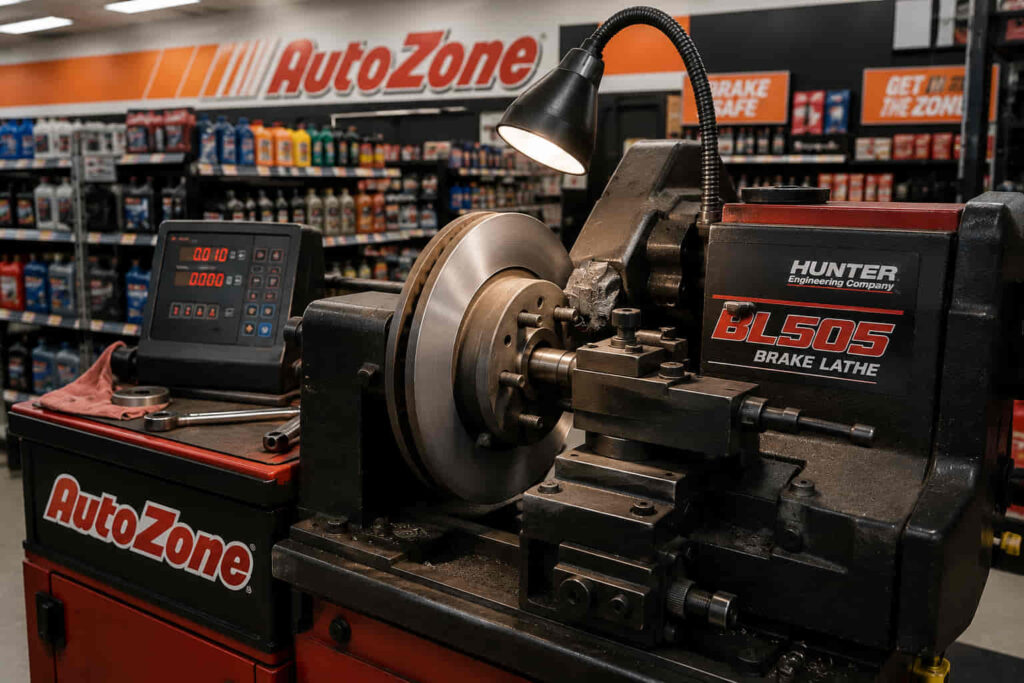
Many drivers searching “Does AutoZone turn rotors?” are trying to save money during a brake job, especially when replacing brake pads. The short answer is no—AutoZone does not provide brake rotor resurfacing or rotor turning services. Instead, the company operates as an automotive parts retailer, selling brake components, maintenance products, and specialty tools rather than performing vehicle repairs.
This often creates confusion because AutoZone offers a variety of automotive support services, including battery testing, battery charging, diagnostic code scanning, and its popular Loan-A-Tool Program. As a result, many customers assume brake services such as rotor resurfacing are also available. In reality, machining brake rotors requires specialized equipment, trained technicians, and repair shop facilities that fall outside AutoZone’s retail business model.
Understanding whether a brake rotor should be resurfaced or replaced is equally important. Modern brake rotors have strict minimum thickness specifications established by vehicle manufacturers, and many newer rotors are engineered to be replaced rather than machined after excessive wear. In some situations, resurfacing remains a practical and cost-effective solution, while in others, installing new rotors provides better braking performance, longer service life, and improved safety.
This guide explains everything you need to know before getting your brake rotors turned at AutoZone. You’ll learn why AutoZone does not offer rotor resurfacing, what brake-related services the company actually provides, where you can have rotors professionally machined instead, how much rotor resurfacing typically costs, when resurfacing is still recommended, and whether purchasing replacement brake rotors from AutoZone is the smarter long-term investment.
Does AutoZone Turn Brake Rotors?
No, AutoZone does not turn, resurface, or machine brake rotors at any of its retail locations. Although the company is one of the largest automotive parts retailers in North America, its business focuses on selling replacement parts, maintenance products, diagnostic tools, and accessories rather than performing mechanical repairs. Customers visiting an AutoZone store can purchase new brake rotors, brake pads, calipers, brake fluid, and other braking components, but they cannot have worn rotors resurfaced by store employees.
The confusion often arises because AutoZone offers several complimentary automotive services that resemble those provided by repair shops. Free battery testing, battery charging, check engine light scanning, and the Loan-A-Tool Program encourage many vehicle owners to perform their own maintenance. Since the company actively supports DIY repairs, some customers naturally assume brake machining is another available service. However, resurfacing a brake rotor requires specialized brake lathes, precision measuring equipment, and trained technicians capable of machining each rotor to the manufacturer’s specifications. These requirements are fundamentally different from the retail services AutoZone is designed to provide.
Another reason AutoZone does not offer rotor resurfacing is that brake machining involves significant safety and liability considerations. Every brake rotor has a manufacturer-specified minimum thickness that must remain after machining. Removing too much material reduces the rotor’s ability to absorb and dissipate heat, increasing the likelihood of brake fade, cracking, or premature warping during heavy braking. Before machining can begin, a technician must inspect the rotor for excessive wear, deep grooves, heat spots, structural cracks, and runout. If any of these conditions exceed acceptable limits, replacing the rotor is safer than resurfacing it. These inspection and machining procedures require professional repair equipment and quality control standards that extend beyond the operational scope of a retail auto parts store.
Changes in the automotive industry have also reduced demand for rotor resurfacing. Many modern passenger vehicles are equipped with thinner brake rotors that prioritize lower vehicle weight and manufacturing efficiency. Because these rotors have less excess material than older designs, machining them often leaves little usable thickness for future wear. In many cases, the labor cost of resurfacing approaches or even exceeds the price of purchasing new aftermarket rotors. As replacement rotors have become more affordable, both repair shops and consumers increasingly choose complete replacement instead of machining, especially during routine brake pad replacement.
Although AutoZone does not perform rotor resurfacing, the company remains an important resource for brake repairs. Customers can choose from a wide selection of replacement brake rotors ranging from economy options to premium coated rotors designed for improved corrosion resistance and longer service life. AutoZone also carries brake pads, hardware kits, calipers, brake cleaner, lubricants, and specialized tools required for complete brake service. Through the Loan-A-Tool Program, DIY mechanics can borrow equipment such as brake caliper tools, piston compressors, and torque wrenches that simplify installation without purchasing expensive specialty tools.
For drivers specifically looking to have existing rotors resurfaced, an independent repair shop or dedicated brake service center is generally the appropriate choice. These facilities possess brake lathes capable of restoring a smooth braking surface while verifying rotor thickness and overall structural integrity. In many situations, the technician will recommend either resurfacing or replacement after inspecting the rotor’s condition, allowing the repair decision to be based on safety, cost, and remaining service life rather than assumption alone.
Understanding AutoZone’s role as a parts supplier rather than a repair facility helps eliminate one of the most common misconceptions surrounding brake maintenance. While the company does not turn brake rotors, it provides nearly every component needed to complete a brake repair, whether the final solution involves resurfacing existing rotors at a professional shop or installing brand-new replacement rotors purchased directly from AutoZone.
Read more: Duramax LML Problems
Why Doesn’t AutoZone Offer Rotor Resurfacing?
AutoZone does not offer brake rotor resurfacing because the company operates as an automotive parts retailer rather than a vehicle repair shop. Its core business focuses on supplying replacement parts, maintenance products, diagnostic equipment, and repair tools for do-it-yourself customers and professional mechanics. Unlike full-service garages, AutoZone stores are not equipped with service bays, vehicle lifts, or machining equipment required to perform mechanical repairs. This business model allows the company to serve a high volume of customers efficiently while leaving installation and repair work to independent technicians and automotive service centers.
Rotor resurfacing is considerably more complex than many drivers realize. The process involves mounting the brake rotor on a precision brake lathe that removes a thin, uniform layer of metal from both friction surfaces. The objective is not simply to make the rotor look smooth but to restore a perfectly parallel braking surface while maintaining the manufacturer’s minimum thickness specification. Even a slight machining error can create excessive lateral runout, uneven rotor thickness, brake pedal pulsation, vibration during braking, accelerated pad wear, or increased stopping distances. Because braking performance directly affects vehicle safety, resurfacing requires specialized equipment that is regularly calibrated and operated by trained technicians.
Every brake rotor must also undergo a detailed inspection before machining begins. A technician measures rotor thickness with precision tools, checks for excessive runout, identifies heat spots caused by repeated heavy braking, evaluates deep scoring, and looks for structural defects such as cracks or severe corrosion. If the remaining thickness after machining would fall below the manufacturer’s minimum specification, resurfacing is no longer considered safe. In these cases, replacing the rotor is the only recommended solution because thinner rotors cannot dissipate heat effectively and are more susceptible to brake fade, distortion, and structural failure under demanding driving conditions.
Liability is another important reason why large retail chains avoid providing machining services. Brake systems are among the most critical safety components on any vehicle, and improper resurfacing can contribute to reduced braking efficiency or premature component failure. If a machined rotor later develops vibration, overheating, or structural damage because it no longer meets factory specifications, determining responsibility becomes significantly more complicated than simply selling a replacement part. By limiting its role to supplying components rather than performing repairs, AutoZone reduces operational risk while allowing licensed repair facilities to assume responsibility for inspection, machining, installation, and final quality verification.
Industry trends have also reduced the demand for rotor resurfacing over the past two decades. Older vehicles typically used thicker brake rotors that could be machined multiple times throughout their service life without compromising structural integrity. Modern passenger vehicles, however, are engineered with lighter brake components to improve fuel efficiency, reduce unsprung weight, and lower manufacturing costs. As a result, many contemporary rotors have relatively little excess material beyond their minimum service thickness. After normal wear occurs, there is often insufficient material remaining to safely machine the rotor, making replacement the preferred repair option during routine brake service.
Economics further supports this shift toward replacement instead of resurfacing. Advances in manufacturing have significantly reduced the cost of aftermarket brake rotors, making new components far more affordable than they were in previous decades. When labor costs for removing the rotor, measuring it, machining it on a brake lathe, reinstalling it, and verifying proper operation are combined, the total expense frequently approaches the price of purchasing a new rotor. For many vehicle owners, replacing the rotor provides greater long-term value because it restores full rotor thickness, maximizes heat capacity, extends service life, and often includes a manufacturer’s warranty.
AutoZone has adapted its product strategy to reflect these changes in the automotive repair industry. Rather than investing in machining equipment that fewer customers require each year, the company stocks a broad selection of replacement brake rotors covering thousands of vehicle applications. Customers can choose economy rotors for everyday driving, premium coated rotors that resist corrosion, heavy-duty options for trucks and SUVs, or performance-oriented products designed for improved thermal stability. This inventory-based approach aligns more closely with current repair practices, where complete rotor replacement has become the standard recommendation for many brake jobs.
Although AutoZone does not provide rotor resurfacing, it still plays an important role in the brake repair process. Customers can purchase virtually every component required for a complete brake service, including rotors, brake pads, calipers, hardware kits, lubricants, brake fluid, and specialty tools. DIY vehicle owners can also take advantage of the Loan-A-Tool Program to borrow equipment needed for brake repairs, reducing the overall cost of maintenance without requiring the company to perform the repair itself.
Ultimately, the absence of rotor resurfacing at AutoZone is not a limitation but a reflection of its specialized retail business model and the direction of the modern automotive industry. As brake rotor replacement has become more practical, more economical, and often safer than machining, parts retailers have focused on providing high-quality replacement components while professional repair facilities continue to perform the precision inspection and machining services that require dedicated equipment and technical expertise.
What Brake Services Does AutoZone Actually Offer?
Although AutoZone does not perform brake repairs or rotor resurfacing, the company provides a wide range of products and support services that help both DIY vehicle owners and professional technicians complete brake maintenance. Its primary role is to supply replacement parts, maintenance chemicals, specialty tools, and technical resources rather than servicing customer vehicles. Understanding exactly what AutoZone offers helps eliminate unrealistic expectations while allowing drivers to take full advantage of the services that are available.
One of AutoZone’s largest strengths is its extensive inventory of brake components. Customers can purchase replacement brake rotors, brake pads, brake calipers, brake drums, brake shoes, hardware kits, brake hoses, wheel bearings for certain applications, and hydraulic components required for complete brake system repairs. The company carries products for thousands of domestic, European, and Asian vehicle models, making it one of the most accessible sources for replacement brake parts in North America. Whether a customer needs standard replacement components for daily commuting or premium braking products designed for heavier workloads, AutoZone typically offers multiple options that fit different budgets and performance requirements.
Brake rotors remain one of the most commonly purchased products at AutoZone because modern brake service increasingly favors replacement over resurfacing. The company sells several rotor categories, including economy rotors for routine driving, coated rotors that resist corrosion, and premium designs engineered for improved heat dissipation and longer service life. Many of these products are manufactured to meet or exceed original equipment specifications, allowing customers to restore braking performance without purchasing factory parts from a dealership. Since replacement rotors have become relatively affordable, many repair shops and DIY mechanics now choose this solution instead of machining worn rotors.
Brake pads represent another major product category. AutoZone stocks ceramic, semi-metallic, and organic brake pads from both its private-label brands and nationally recognized manufacturers. Each friction material offers different characteristics regarding braking performance, operating noise, dust production, and service life. Ceramic pads generally produce less brake dust and quieter operation for passenger vehicles, while semi-metallic compounds provide improved heat resistance for trucks, SUVs, and vehicles that regularly tow heavy loads. Offering multiple friction materials allows customers to select brake pads that best match their driving habits and vehicle requirements rather than relying on a single replacement option.
Beyond replacement parts, AutoZone supplies nearly every maintenance product required during brake service. Brake cleaner removes grease, dust, and contaminants from braking surfaces before installation. High-temperature brake lubricant reduces noise by preventing metal-to-metal contact between moving components. Brake fluid supports hydraulic system maintenance and should be replaced periodically because it gradually absorbs moisture from the atmosphere, reducing boiling point and braking efficiency. Customers can also purchase anti-seize compounds, thread-locking products, shop supplies, and cleaning materials that contribute to a professional-quality brake installation.
One of AutoZone’s most valuable customer services is the Loan-A-Tool Program, which supports drivers performing repairs at home. Instead of purchasing expensive specialty equipment that may only be used once, customers can temporarily borrow tools by leaving a refundable deposit. For brake repairs, this program often includes brake caliper piston compressors, brake bleeding kits, bearing tools, torque wrenches, and other specialized equipment that simplifies installation. Although the program does not include professional brake lathes used for rotor resurfacing, it significantly lowers the cost of completing many brake maintenance tasks without requiring permanent investment in specialty tools.
AutoZone also provides several complimentary diagnostic services that indirectly assist with vehicle maintenance. Free battery testing, battery charging, charging system evaluations, and check engine light code scanning help drivers identify common electrical issues before replacing components unnecessarily. While these services are unrelated to rotor resurfacing, they demonstrate the company’s broader strategy of helping customers diagnose automotive problems while allowing actual repairs to be completed independently or by professional repair facilities. This distinction between diagnostic assistance and mechanical repair explains why some services are available free of charge while brake machining is not.
Digital support has become another important part of AutoZone’s customer experience. Through its website and mobile application, customers can search parts by vehicle, verify compatibility, access repair guides, read installation tips, and locate nearby store inventory before beginning a repair. This information reduces purchasing errors and helps DIY mechanics prepare for brake maintenance by ensuring they obtain the correct rotors, pads, hardware, and fluids before disassembling the braking system. Access to accurate parts information is particularly valuable because brake components often vary between trim levels, engine options, towing packages, and production dates.
Professional repair shops also rely on AutoZone as a parts supplier rather than a service provider. Through commercial accounts, many independent garages purchase brake components directly from AutoZone for same-day installation on customer vehicles. In this business relationship, AutoZone supplies the necessary replacement parts while trained technicians perform inspection, machining, installation, and final testing. This partnership further reinforces the company’s position within the automotive repair industry as a distributor of parts instead of a provider of repair labor.
Understanding the distinction between products and services is essential when evaluating what AutoZone can realistically do for a brake repair. The company supplies nearly every component, chemical, and specialty tool required to replace a braking system, but it does not inspect brake rotors, measure rotor thickness, machine braking surfaces, bleed hydraulic systems, or install replacement components. Those procedures require specialized equipment, certified technicians, and repair facilities specifically designed for mechanical service.
For drivers planning a brake job, AutoZone often serves as the starting point rather than the final destination. Customers can purchase quality replacement rotors, brake pads, maintenance supplies, and specialty tools in one location, then either complete the repair themselves or have the components installed by a trusted repair shop. This retail-focused approach explains why AutoZone remains one of the most popular automotive parts suppliers despite not offering brake repair or rotor resurfacing services directly.
Where Can You Get Brake Rotors Turned Instead?
If you’re specifically looking for brake rotor resurfacing, you’ll need to visit a professional repair facility rather than an auto parts retailer like AutoZone. Rotor resurfacing requires a precision brake lathe, accurate measuring equipment, and technicians who understand manufacturer specifications for rotor thickness, runout, and braking performance. While fewer repair shops offer this service today than they did a decade ago, several national service chains and many independent repair facilities still resurface brake rotors when the components remain within safe service limits.
Firestone Complete Auto Care is one of the most widely available options for rotor resurfacing. Because Firestone operates as a full-service automotive repair center rather than a parts retailer, its locations are equipped to inspect the entire braking system before recommending either resurfacing or replacement. Technicians measure rotor thickness, evaluate heat damage, inspect for excessive scoring, and determine whether machining will restore proper braking performance. This inspection-first approach helps ensure resurfacing is performed only when the rotor can safely remain in service after machining.
Midas is another repair chain that frequently offers brake rotor resurfacing as part of a complete brake service. Instead of automatically replacing every worn rotor, many Midas locations evaluate whether machining remains a practical solution based on the rotor’s condition and manufacturer specifications. Because brake repairs often include pad replacement, caliper inspection, and hydraulic system evaluation, resurfacing may become part of a larger maintenance procedure designed to restore balanced braking performance across the entire axle rather than addressing a single component in isolation.
Meineke Car Care Centers also continue to provide rotor resurfacing at many locations, although service availability may vary depending on equipment and regional demand. Before machining begins, technicians generally inspect both brake rotors and friction materials to determine whether resurfacing will provide sufficient remaining service life. If the rotor has already reached its minimum thickness, contains structural cracks, or has experienced excessive heat damage, replacement is normally recommended instead. This decision prioritizes braking safety over minimizing repair costs.
Pep Boys remains another national alternative for drivers searching for brake rotor machining. Similar to other full-service repair facilities, Pep Boys evaluates rotor condition before recommending resurfacing. The company also carries replacement brake components, allowing technicians to choose the most appropriate repair strategy without requiring customers to visit multiple locations. For many drivers, this combination of inspection, resurfacing, replacement, and installation simplifies the brake repair process while ensuring compatibility between new brake pads and rotor surfaces.
Independent local brake shops often represent one of the best choices for rotor resurfacing, particularly in communities where experienced technicians continue to perform precision machining. Unlike larger retail chains that follow standardized repair procedures, many independent shops evaluate each rotor individually based on its remaining thickness, overall condition, and intended vehicle use. Trucks used for towing, commercial vehicles, performance cars, and older models frequently benefit from technicians who possess extensive experience with brake system diagnosis beyond simple component replacement.
Some automotive machine shops also provide brake rotor resurfacing as a standalone service. These businesses specialize in precision machining and often possess commercial-grade brake lathes capable of restoring rotor surfaces to extremely tight tolerances. Customers typically remove the rotors from the vehicle themselves and bring them directly to the machine shop for resurfacing. This option can reduce labor costs for experienced DIY mechanics while still ensuring the machining itself is performed using professional equipment.
Vehicle dealership service departments remain another option, especially for newer vehicles still covered by factory warranties or requiring manufacturer-specific repair procedures. Dealership technicians have direct access to OEM service information, factory specifications, and original replacement components. Depending on the vehicle manufacturer, the dealership may recommend resurfacing when rotor dimensions permit or complete replacement if engineering guidelines discourage machining. Although dealership labor rates are often higher than independent repair shops, they provide repairs that closely follow manufacturer recommendations.
Choosing the right repair facility depends on more than whether rotor resurfacing is available. Modern brake systems are designed as integrated safety systems in which brake pads, rotors, calipers, hydraulic pressure, wheel bearings, and suspension components all influence braking performance. An experienced technician evaluates the complete system before recommending machining because brake vibration may result from excessive rotor runout, seized caliper slide pins, uneven pad wear, wheel bearing play, or suspension issues rather than rotor surface imperfections alone. Correct diagnosis prevents unnecessary machining while addressing the actual cause of braking problems.
Before scheduling rotor resurfacing, drivers should contact the repair facility to confirm that the service is still available. Many shops have gradually eliminated brake lathes because the declining cost of replacement rotors has reduced customer demand for machining. Others continue offering resurfacing only for specific vehicle types, heavy-duty trucks, or situations where replacement parts are temporarily unavailable. Verifying service availability in advance avoids unnecessary trips and allows customers to compare both resurfacing and replacement costs before authorizing repairs.
Although AutoZone does not turn brake rotors, drivers still have multiple professional alternatives capable of performing the service safely. National repair chains, dealership service departments, automotive machine shops, and experienced independent brake specialists all possess the equipment and technical expertise required to inspect, machine, or replace brake rotors according to manufacturer specifications. Selecting a facility that emphasizes accurate diagnosis rather than simply performing the requested service provides the best opportunity to restore safe, consistent, and reliable braking performance over the long term.
How Much Does It Cost to Turn Brake Rotors?
The cost to turn brake rotors typically ranges from $15 to $40 per rotor when resurfacing is performed as a standalone service. However, the total repair bill is usually higher because rotor machining often includes labor for removing and reinstalling the brake components. Depending on the repair facility, vehicle type, and local labor rates, most drivers can expect to pay between $80 and $200 for both front rotors when resurfacing is combined with a brake pad replacement. Understanding how these costs are calculated helps determine whether resurfacing remains a financially practical option or whether replacing the rotors provides better long-term value.
Labor represents one of the largest factors influencing the final price. Before a rotor can be resurfaced, the wheel, brake caliper, caliper bracket, and rotor must be removed from the vehicle. After machining is completed, every component must be reinstalled according to the manufacturer’s torque specifications before the braking system is inspected and road-tested. Although the machining process itself may only require several minutes on a precision brake lathe, the labor associated with disassembly, inspection, measurement, and reassembly accounts for a significant portion of the overall repair cost. For this reason, resurfacing is often most economical when it is performed during a scheduled brake pad replacement rather than as an independent repair.
Vehicle size also affects resurfacing costs. Compact passenger cars generally have smaller brake rotors that require less machining time and are easier to remove, resulting in lower labor charges. Full-size pickup trucks, SUVs, and heavy-duty vehicles often use larger and heavier brake components that require additional labor and may involve more expensive service equipment. Performance vehicles equipped with oversized vented or drilled rotors can also increase repair costs because some rotor designs require specialized machining procedures or may not be recommended for resurfacing at all.
Geographic location creates another noticeable difference in pricing. Independent repair shops located in smaller communities often charge lower labor rates than dealerships or service centers in major metropolitan areas. While the actual machining process remains relatively consistent, hourly labor rates vary significantly between regions. As a result, the same brake rotor resurfacing service may cost substantially more in areas with higher operating expenses even though identical equipment and repair procedures are used.
One reason rotor resurfacing has become less common is the declining price of replacement brake rotors. Advances in manufacturing and increased aftermarket competition have made many replacement rotors surprisingly affordable. For numerous passenger vehicles, a quality aftermarket rotor can cost between $40 and $100 per rotor, with economy models sometimes selling for even less. When the price of new components is compared with machining costs and labor, the difference is often much smaller than many drivers expect. In some cases, installing brand-new rotors increases the repair bill by only a modest amount while providing the full thickness and service life of a new braking surface.
Replacing brake rotors also eliminates several limitations associated with resurfacing. Machining removes material from the rotor to restore a smooth friction surface, but it cannot replace metal that has already been worn away through years of braking. A resurfaced rotor remains thinner than a new one, meaning it has a lower capacity to absorb and dissipate heat during repeated braking events. This difference becomes especially important for vehicles that regularly tow trailers, carry heavy payloads, travel through mountainous terrain, or experience frequent stop-and-go traffic. In these operating conditions, the additional thermal capacity of a new rotor often justifies the slightly higher replacement cost.
The condition of the existing rotor should always influence the financial decision. Rotors with only light scoring, minor brake pulsation, or surface glazing may still qualify for resurfacing if sufficient material remains above the manufacturer’s minimum thickness specification. However, rotors containing deep grooves, severe corrosion, excessive heat checking, structural cracks, or significant thickness variation usually require replacement regardless of machining cost. Attempting to resurface a rotor that no longer meets service specifications provides only a temporary solution and may compromise braking performance or safety.
Another cost consideration involves the lifespan of the repair. A new rotor typically lasts through multiple sets of brake pads when maintained properly, whereas a resurfaced rotor begins its remaining service life with less available material. Depending on driving habits and vehicle application, resurfaced rotors may require replacement sooner because there is less metal available to accommodate future wear. This shorter remaining lifespan can reduce the long-term value of resurfacing, particularly when replacement rotors are already competitively priced.
Many professional repair shops now evaluate brake service based on the total cost of ownership rather than the immediate repair invoice. Instead of focusing solely on saving money during a single brake job, technicians consider future maintenance intervals, expected rotor lifespan, braking performance, warranty coverage, and customer convenience. If replacing the rotors today reduces the likelihood of additional brake labor during the next pad replacement, the higher initial investment often becomes the more economical decision over several years of vehicle ownership.
For drivers seeking the lowest possible repair cost, resurfacing can still be an excellent solution when the rotors remain structurally sound and comfortably exceed minimum thickness requirements. However, when labor costs approach the price of new components, or when the rotors already exhibit significant wear, replacement generally provides better value, improved braking performance, and longer service life. This shift in cost-effectiveness explains why many modern repair facilities recommend installing new brake rotors instead of resurfacing existing ones, even when machining remains technically possible.
When Should You Turn Brake Rotors Instead of Replacing Them?
Brake rotors should only be resurfaced when they remain structurally sound, exceed the manufacturer’s minimum thickness specification after machining, and exhibit wear that can be corrected by removing a small amount of material. Rotor resurfacing is intended to restore a smooth, even braking surface rather than repair severe structural damage. When performed under the proper conditions, machining can eliminate minor brake vibration, remove light scoring, improve brake pad contact, and extend the service life of the existing rotors without compromising braking safety.
The first factor every technician evaluates is rotor thickness. Every brake rotor is manufactured with two important measurements: its original thickness and its minimum service thickness. During inspection, the rotor is measured using a precision micrometer to determine whether enough material remains for safe resurfacing. If machining would reduce the rotor below the manufacturer’s specified limit, resurfacing is no longer an option. This requirement exists because rotor thickness directly affects heat absorption and structural strength. A thinner rotor reaches higher operating temperatures more quickly, increasing the likelihood of brake fade, thermal distortion, and cracking during repeated or heavy braking.
Minor surface imperfections are often good candidates for resurfacing. Over thousands of miles, brake pads gradually create shallow grooves, glazing, and uneven wear patterns on the friction surface. Although these conditions may reduce braking smoothness or produce slight pedal pulsation, they usually do not indicate structural damage. Precision machining removes a thin layer of metal from both braking surfaces, restoring parallel contact between the brake pads and rotor. This creates a uniform friction surface that improves braking consistency while allowing new brake pads to bed in properly during the break-in period.
Brake pulsation is another situation where resurfacing may be appropriate, but only after identifying its actual cause. Many drivers assume pedal vibration automatically means the rotors are warped. In reality, true rotor warping is relatively uncommon on modern passenger vehicles. Brake pulsation is more frequently caused by uneven brake pad material deposited on the rotor surface or by excessive lateral runout that develops over time. If inspection confirms that the rotor remains within thickness specifications and no structural damage is present, resurfacing can remove these irregularities and restore smooth braking performance. However, machining should never be performed before confirming that wheel bearings, calipers, suspension components, and wheel mounting surfaces are functioning correctly, as these issues can produce similar symptoms.
Resurfacing is often recommended during brake pad replacement when the existing rotors remain in good condition. Installing new brake pads against worn or uneven rotor surfaces can reduce braking efficiency and accelerate premature pad wear because the friction materials cannot make uniform contact with the braking surface. By restoring a flat and consistent rotor finish, machining allows the new brake pads to wear evenly from the beginning of their service life. This improves braking feel, reduces the likelihood of noise, and helps maximize the lifespan of both the pads and the resurfaced rotors.
There are also situations in which resurfacing should never be considered. Rotors containing visible cracks, severe heat checking, excessive corrosion, broken cooling vanes, deep scoring, or heavy rust around the braking surface have already experienced damage that machining cannot safely repair. Likewise, rotors that have been resurfaced previously may no longer retain enough material for another machining operation. Removing additional metal from an already thin rotor significantly reduces its ability to withstand thermal stress, making complete replacement the only safe recommendation.
Vehicle application also influences whether resurfacing is practical. Passenger cars used primarily for commuting often generate relatively moderate braking temperatures, allowing properly maintained rotors to remain suitable candidates for machining. In contrast, heavy-duty pickup trucks, commercial vehicles, SUVs that regularly tow trailers, and performance vehicles operate under substantially greater thermal loads. These applications place continuous stress on the braking system, making full-thickness replacement rotors a more durable solution in many cases. The additional thermal capacity of a new rotor improves heat dissipation and reduces the likelihood of future brake fade during demanding driving conditions.
Modern brake rotor design has further shifted the industry toward replacement instead of resurfacing. Many manufacturers now produce lighter rotors with less excess material to reduce vehicle weight and improve fuel efficiency. While these designs perform well during normal operation, they leave less usable material available for future machining. Consequently, many newer rotors reach their minimum service thickness after only one set of brake pads, eliminating the possibility of safe resurfacing. This engineering trend explains why replacement has become increasingly common, even when rotor machining remains technically possible.
Cost should never be the only factor when deciding between resurfacing and replacement. Although machining usually costs less than installing new rotors, the difference has narrowed considerably as aftermarket rotor prices have decreased. If resurfacing saves only a small amount while leaving the vehicle with thinner brake components and a shorter remaining service life, replacement frequently delivers better long-term value. Conversely, if the existing rotors remain well above minimum thickness, exhibit only minor wear, and can be restored safely through machining, resurfacing continues to be an economical and technically sound repair.
Ultimately, the decision should always be based on measurable rotor condition rather than mileage or appearance alone. Professional technicians evaluate thickness, runout, heat damage, surface condition, structural integrity, and manufacturer specifications before recommending either resurfacing or replacement. This inspection-based approach ensures the repair restores braking performance without compromising safety. For most drivers, the best choice is the one that provides reliable stopping power, predictable brake performance, and the greatest long-term durability rather than simply the lowest immediate repair cost.
Is It Better to Buy New Rotors Instead?
For most modern vehicles, buying new brake rotors is often the better long-term solution than resurfacing existing ones. Although rotor resurfacing can restore a usable braking surface under the right conditions, replacing the rotors eliminates concerns about remaining thickness, previous heat damage, and future service life. Advances in brake rotor manufacturing have also made aftermarket replacements significantly more affordable than they were in the past, reducing the financial advantage that resurfacing once offered. As a result, many repair facilities now recommend replacement whenever the brake system is serviced, particularly if the vehicle has accumulated substantial mileage or the existing rotors show moderate wear.
One of the greatest advantages of installing new rotors is restoring the braking system to its full thermal capacity. Every time a brake rotor is resurfaced, a thin layer of metal is removed from both friction surfaces. Although this process improves surface finish, it also reduces the rotor’s overall mass. Rotor mass plays an essential role in absorbing and dissipating heat generated during braking. A brand-new rotor retains its original engineering dimensions, allowing it to manage repeated braking events more effectively than a resurfaced rotor with reduced thickness. This difference becomes particularly important for vehicles that tow trailers, carry heavy cargo, travel through mountainous terrain, or operate in congested urban traffic where frequent braking generates substantial heat.
New rotors also provide a completely fresh friction surface for new brake pads. During normal vehicle operation, brake pads gradually transfer microscopic layers of friction material onto the rotor surface. While this transfer layer contributes to braking performance, uneven deposits may eventually create brake vibration or inconsistent pedal feel. Installing new rotors removes this variable entirely, allowing the new brake pads to establish an even friction layer from the beginning of their service life. This process promotes smoother braking, more consistent stopping performance, quieter operation, and more uniform pad wear throughout the maintenance interval.
Durability represents another important advantage. A resurfaced rotor begins its remaining service life with less material than it had when new, leaving less capacity to accommodate future wear. If the rotor is already close to its minimum service thickness after machining, it may require replacement during the next brake pad service regardless of its current condition. A new rotor, by comparison, provides the maximum possible wear allowance established by the manufacturer. Under normal driving conditions, this additional material often allows the rotor to last through multiple brake pad replacement intervals while maintaining predictable braking performance.
Safety considerations also favor replacement in many situations. Brake rotors experience repeated heating and cooling cycles throughout their lifespan, causing gradual material fatigue that cannot always be identified through visual inspection alone. Even when resurfacing successfully removes grooves or glazing, it cannot reverse years of thermal stress experienced by the rotor. Replacing the component eliminates uncertainty regarding hidden fatigue, internal stress, or previous overheating events that may affect long-term reliability. For vehicles subjected to demanding operating conditions, this additional margin of safety often justifies the modest increase in repair cost.
Another reason replacement has become increasingly popular is the dramatic reduction in aftermarket rotor pricing. Manufacturing improvements, higher production volumes, and greater competition among aftermarket suppliers have significantly lowered retail prices. Today, many economy and mid-range replacement rotors cost only slightly more than the labor required to machine an existing rotor. When customers compare the relatively small difference in total repair cost against the benefits of a completely new braking surface, longer service life, and manufacturer warranty coverage, replacement frequently becomes the more attractive investment.
Warranty protection further distinguishes replacement from resurfacing. Most quality aftermarket brake rotors include some form of manufacturer’s warranty covering defects in materials or workmanship. Although warranty terms vary by brand, purchasing new components provides customers with additional confidence that defects discovered after installation may be addressed without paying for another replacement part. Rotor resurfacing, on the other hand, simply restores the existing component and generally does not provide equivalent long-term product protection because the original rotor has already accumulated years of service.
There are still situations where resurfacing remains the appropriate choice. Vehicles equipped with expensive performance rotors, oversized heavy-duty brake systems, or specialty OEM components may benefit from machining when the rotors remain well above minimum thickness and show only minor surface wear. In these cases, replacing the rotors can cost several times more than professional resurfacing, making machining a financially reasonable decision without compromising safety. Likewise, some classic vehicles or limited-production models use brake rotors that are difficult to source, making resurfacing the most practical option when replacement parts are unavailable.
The decision should also consider the vehicle owner’s long-term plans. Drivers intending to keep their vehicles for many years often benefit from replacing the rotors because the improved durability reduces the likelihood of additional brake labor during future maintenance. Conversely, owners preparing to sell a vehicle in the near future may determine that resurfacing provides sufficient braking performance at a lower immediate cost if the rotors remain fully serviceable. Neither approach is universally correct; the appropriate solution depends on rotor condition, repair costs, vehicle application, and ownership objectives.
Ultimately, replacing brake rotors has become the preferred repair strategy for many modern vehicles because it delivers the greatest combination of safety, durability, braking consistency, and long-term value. Rotor resurfacing continues to have a place in professional brake service, but only when careful inspection confirms that the existing components remain structurally sound and comfortably within manufacturer specifications. Rather than asking whether resurfacing is always cheaper, drivers should focus on which option restores the braking system to the highest level of reliability while minimizing future maintenance costs. In today’s automotive repair environment, that answer is increasingly likely to be a new set of quality brake rotors.
Can You Buy Quality Brake Rotors at AutoZone?
Yes, you can buy quality brake rotors at AutoZone. While the company does not perform rotor resurfacing or brake repairs, it is one of the largest automotive parts retailers in North America and offers a broad selection of replacement brake rotors for passenger cars, SUVs, pickup trucks, and commercial vehicles. Customers can choose from economy, mid-range, and premium rotor options that fit different budgets, driving habits, and performance requirements. For many vehicle owners, purchasing replacement rotors from AutoZone and having them installed by a qualified repair shop has become the most practical alternative to resurfacing worn rotors.
AutoZone carries brake rotors from both its private-label product lines and well-established aftermarket manufacturers. Depending on the vehicle application, customers may find brands such as Duralast, Duralast Gold, Duralast Elite, Bosch, Brembo, Raybestos, or other nationally recognized suppliers. Product availability varies by vehicle model and store location, but most popular passenger vehicles have multiple replacement options that meet or exceed original equipment specifications. This allows customers to compare features, warranty coverage, and price before selecting the rotor that best matches their driving needs.
Choosing the right brake rotor involves more than simply purchasing the least expensive option. Economy rotors are generally designed for everyday commuting and provide reliable braking performance under normal driving conditions. Premium rotors often include improvements such as corrosion-resistant coatings, tighter machining tolerances, higher-quality metallurgy, or enhanced cooling designs that improve durability and braking consistency. Drivers who regularly tow trailers, carry heavy loads, or drive in mountainous regions may benefit from these upgraded features because improved heat management helps maintain braking performance during repeated high-temperature braking events.
Rotor construction also influences long-term performance. Many premium replacement rotors feature protective coatings on non-friction surfaces that help reduce rust formation around the rotor hat and cooling vanes. Although the braking surface itself eventually becomes polished through normal pad contact, these coatings help preserve the appearance of exposed metal and slow corrosion in regions where vehicles are regularly exposed to rain, snow, or road salt. Improved corrosion resistance can also simplify future brake service by reducing rust buildup around wheel hubs and mounting surfaces.
Compatibility is another important advantage when purchasing brake rotors from AutoZone. Customers can search by year, make, model, engine size, drivetrain configuration, or VIN in many cases to ensure the correct components are selected. This process reduces the risk of ordering brake rotors with incorrect dimensions, bolt patterns, or braking system specifications. Because manufacturers often install different brake packages on the same vehicle platform depending on trim level or towing package, verifying compatibility before purchase helps avoid unnecessary returns and installation delays.
AutoZone’s online catalog further assists customers by providing product specifications, customer reviews, warranty information, installation guidance, and inventory availability. Instead of relying solely on price, vehicle owners can compare rotor diameter, thickness, vented versus solid construction, coating technology, and recommended vehicle applications. Access to this information allows customers to make more informed purchasing decisions based on how the vehicle is actually used rather than selecting parts based only on cost.
For DIY mechanics, purchasing brake rotors from AutoZone can also simplify the repair process because nearly every related component is available in the same location. Alongside replacement rotors, customers can purchase brake pads, hardware kits, brake cleaner, caliper lubricant, brake fluid, anti-seize compound, and specialized tools needed to complete the repair correctly. AutoZone’s Loan-A-Tool Program further supports home mechanics by providing temporary access to certain specialty brake service tools without requiring a permanent purchase. Although the program does not include brake lathes for resurfacing, it reduces the overall cost of performing many brake maintenance procedures.
Professional repair shops also purchase replacement brake rotors from AutoZone through commercial accounts. Independent garages frequently rely on same-day parts availability to complete customer repairs without waiting several days for shipments from warehouse distributors. This commercial supply network reflects the confidence many repair professionals have in the availability and quality of AutoZone’s replacement brake components, particularly for routine maintenance on common vehicle models.
Price remains one of AutoZone’s strongest advantages. Because the retailer stocks multiple rotor categories across a wide range of vehicle applications, customers can usually find an option that balances performance and budget. Economy rotors provide affordable replacement for older vehicles or daily commuters, while premium product lines offer additional durability and braking refinement for drivers seeking longer service life or improved performance. Frequent promotions, online discounts, and warranty programs can further improve the overall value of purchasing replacement rotors instead of paying to machine worn components.
For drivers asking whether AutoZone turns brake rotors, the answer remains no. However, the company still plays an important role in brake maintenance by supplying high-quality replacement rotors, brake pads, and related components for nearly every major vehicle manufacturer. As rotor replacement has become the preferred repair strategy across much of the automotive industry, AutoZone’s extensive inventory allows vehicle owners to purchase reliable replacement parts quickly and complete the repair through a trusted technician or as a properly equipped DIY project.
Frequently Asked Questions
Does AutoZone turn brake rotors for free?
No. AutoZone does not turn brake rotors, either as a free service or as a paid repair. The company operates as an automotive parts retailer and does not provide brake machining or mechanical repair services. If your rotors need resurfacing, you’ll need to visit a repair shop, dealership, or machine shop equipped with a brake lathe.
Does AutoZone have a brake lathe?
No. AutoZone stores are not equipped with brake lathes for customer rotor resurfacing. While some locations offer free diagnostic services and the Loan-A-Tool Program, brake lathes are typically found only in professional repair facilities that perform brake service.
Is it cheaper to turn rotors or replace them?
It depends on the vehicle, labor rates, and the price of replacement rotors. Rotor resurfacing is often less expensive when the existing rotors are still within manufacturer specifications. However, because many aftermarket rotors have become relatively affordable, replacing them frequently provides better long-term value with only a modest increase in total repair cost.
Can brake rotors be resurfaced more than once?
Sometimes, but only if enough material remains above the manufacturer’s minimum thickness specification after each machining process. Every resurfacing removes metal from the rotor, so many modern brake rotors can only be machined once or may not qualify for resurfacing at all.
How do I know if my rotors can be turned?
A qualified technician must inspect the rotors using precision measuring equipment. The inspection includes checking rotor thickness, lateral runout, surface condition, heat damage, and structural integrity. If the rotor remains above minimum thickness and has only minor wear, resurfacing may be possible. If cracks, severe scoring, excessive corrosion, or overheating are present, replacement is the safer option.
Should you replace brake pads when turning rotors?
Yes, in most cases. Installing new brake pads on freshly resurfaced rotors helps ensure proper pad bedding, even contact across the braking surface, and consistent stopping performance. Reusing worn brake pads on newly machined rotors can reduce braking efficiency and accelerate uneven wear.
Can I turn brake rotors myself?
In most cases, no. Rotor resurfacing requires a precision brake lathe and measuring equipment capable of maintaining extremely tight machining tolerances. These machines are expensive and typically found only in professional repair facilities. DIY mechanics generally replace brake rotors rather than machine them.
Does AutoZone sell replacement brake rotors?
Yes. AutoZone carries a wide selection of replacement brake rotors for thousands of vehicle applications. Customers can choose from economy, coated, and premium rotor options, along with compatible brake pads, hardware kits, brake fluid, and other brake system components needed for a complete repair.