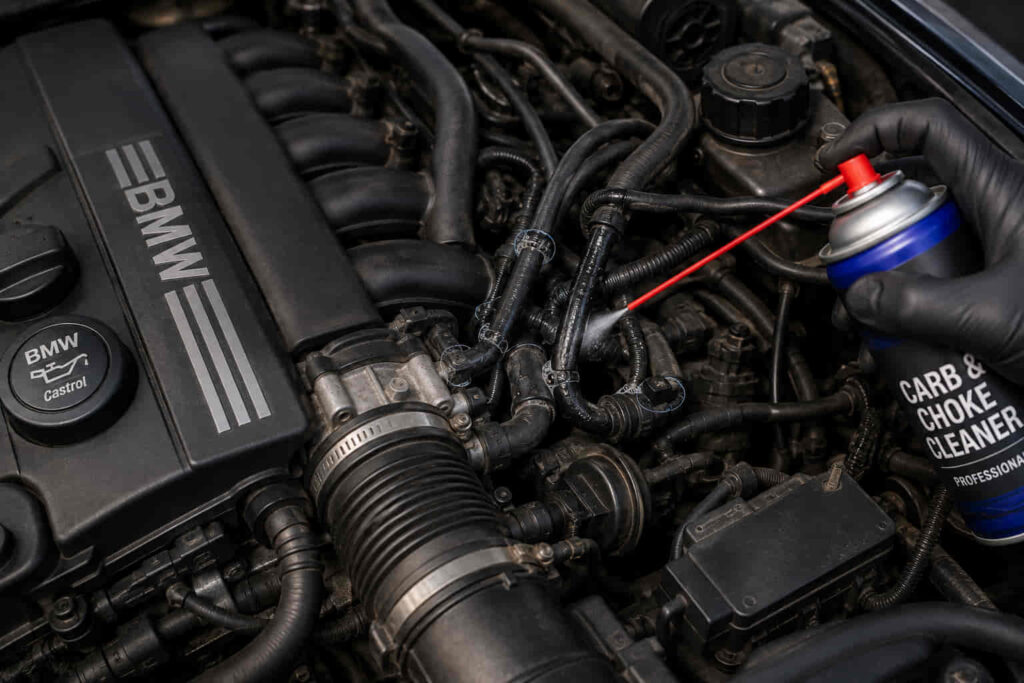
A BMW vacuum leak occurs when unmetered air enters the engine through a leak in the intake, crankcase ventilation, or vacuum system. This extra air can disrupt the air-fuel mixture calculated by the engine control system, forcing the DME to adjust fuel delivery to compensate. When the correction exceeds the system’s normal operating range, the engine may develop rough idle, lean mixture faults, misfires, hesitation, stalling, or reduced performance.
Vacuum leaks can originate from several areas of a BMW engine, including deteriorated vacuum hoses, intake connections, intake manifold seals, and components within the PCV or CCV system. The exact leak location varies by engine design, component condition, and failure point, so symptoms alone cannot confirm which part requires replacement. A rough idle, for example, can indicate a vacuum leak but can also result from ignition, fuel delivery, sensor, or other engine-management problems.
Diagnosing the problem therefore requires identifying how the engine behaves, checking relevant fault codes and fuel-trim data, inspecting potential leak points, and confirming the leak when necessary with a smoke test. This guide explains the symptoms and causes of a BMW vacuum leak, where leaks can occur, how they are diagnosed and repaired, what affects repair cost, and when continuing to drive the vehicle may create additional problems.
What Is a Vacuum Leak in a BMW?
A vacuum leak in a BMW is an unintended opening that allows air to enter the engine without being properly accounted for by the engine-management system. The leak can develop in the intake tract, vacuum lines, intake manifold connections, crankcase ventilation system, or another component exposed to intake vacuum. The result is an airflow condition that differs from what the DME expects when calculating fuel delivery.
The effect is most noticeable when the additional air changes the air-fuel mixture enough to require significant fuel correction. The DME uses information from engine sensors to monitor combustion and adjust injector operation. When unmetered air enters through a leak, the control system may increase fuel delivery to compensate for the lean condition. A small leak may remain within the available correction range, while a larger leak can produce excessive positive fuel trims, lean-mixture faults, unstable idle, or drivability problems.
Engine operating conditions also influence how strongly a vacuum leak affects a BMW. At idle, the engine consumes a relatively small amount of air, so air entering through a leak can represent a larger proportion of total airflow. This is why an engine may idle poorly yet behave differently as engine speed and airflow increase. The relationship between the leak and engine behavior makes idle quality and fuel-trim data useful diagnostic information, but neither should be treated as proof of a vacuum leak without further testing.
What Are the Symptoms of a Vacuum Leak in a BMW?
The main symptoms of a BMW vacuum leak are rough or unstable idle, lean-mixture faults, a check engine light, misfires, hesitation, stalling, abnormal idle speed, reduced performance, and unusual hissing or whistling noises. The exact combination depends on the size and location of the leak, the engine design, and how effectively the DME can compensate for the additional air.
Rough idle is one of the most relevant symptoms because an intake-side air leak can have a proportionally greater effect when airflow through the engine is low. The engine may shake, fluctuate in speed, or feel as though it is close to stalling. As engine speed increases, the same leak may represent a smaller percentage of total airflow, which can make the symptom less noticeable under some operating conditions. A BMW that idles roughly but becomes smoother above idle therefore warrants an inspection for intake and crankcase ventilation leaks, although this behavior is not exclusive to vacuum leaks.
A check engine light can appear when the DME detects mixture corrections or combustion behavior outside the expected range. Unmetered air can create a lean condition, causing the control system to add fuel. When the required correction becomes excessive, the vehicle may store lean-mixture or related fault codes. Diagnostic codes identify the condition detected by the control system; they do not automatically identify the failed component. Fuel-delivery faults, sensor problems, ignition issues, and other intake faults can produce overlapping symptoms and must be separated during diagnosis.
Misfires, hesitation, stalling, and reduced engine performance can occur when the leak interferes sufficiently with combustion. An unstable mixture can cause individual combustion events to become inconsistent, particularly during idle or transitions in engine load. A severe leak can make the engine difficult to keep running, while a smaller leak may produce only intermittent hesitation or an engine-management warning. Misfires should not automatically be attributed to a vacuum leak because spark plugs, ignition coils, injectors, compression problems, and other faults can create the same symptom.
An audible hissing or whistling sound can provide an additional clue when air is being drawn through a damaged hose, connection, seal, or crankcase ventilation component. The sound may change with engine speed or operating conditions, but not every vacuum leak produces a noise that can be heard without diagnostic equipment. Small leaks and leaks hidden beneath engine components can remain difficult to locate by sound or visual inspection alone, which is why symptom recognition should lead to systematic diagnosis rather than immediate parts replacement.
What Causes a Vacuum Leak in a BMW?
BMW vacuum leaks occur when a hose, seal, gasket, intake component, or crankcase ventilation component can no longer maintain an airtight connection where the engine requires one. Heat cycles, material deterioration, mechanical damage, loose connections, and component failure can create openings that allow unintended airflow into the system. The specific failure point depends on the BMW engine and its intake and crankcase ventilation design.
Vacuum hoses and their connections are potential leak points because they must remain sealed while being exposed to engine-bay heat and repeated operating cycles. A hose that develops a crack, split, damaged end, or poor connection can allow air to enter through the opening. Small cracks may be difficult to see when the component is installed, particularly when the damage develops on the underside of a hose or near a fitting. Replacing a hose based only on its age is not the same as diagnosing a leak; the failed area should be identified whenever practical.
The PCV or CCV system is another important area because crankcase ventilation is directly integrated with engine airflow on many BMW engines. A failed diaphragm, damaged hose, defective valve, or leak within an associated component can alter crankcase pressure and introduce unintended airflow. Depending on the engine design, parts of the crankcase ventilation system may be integrated into larger assemblies rather than existing as a single independent valve. Diagnosis must therefore follow the configuration of the specific BMW engine instead of assuming that every model uses the same PCV arrangement.
Intake manifold gaskets and other sealing surfaces can also create leaks when they no longer seal correctly. The intake manifold must maintain a controlled path between incoming air and the engine’s intake ports. Deteriorated sealing material, improper installation, component distortion, or damage at a mating surface can allow air to bypass the intended airflow path. Because these leaks can be concealed between assembled components, visual inspection alone may not reveal the source.
Intake boots, pipes, fittings, and related connections should also be considered when diagnosing unintended airflow. Cracks can develop in flexible components, while clamps or connections can become loose or fail to seal correctly. The location of the opening determines whether the problem functions as a vacuum leak, another type of intake leak, or, on a turbocharged engine under positive pressure, a boost leak. Identifying the operating condition and physical location of the leak is therefore more precise than treating every intake-system opening as the same fault.
The correct repair follows the failed component rather than the generic diagnosis of “vacuum leak.” A damaged hose requires correction at the hose or connection, a failed seal requires restoration of the sealing surface, and a crankcase ventilation fault requires repair of the component responsible for the pressure or airflow problem. This component-based approach prevents unnecessary parts replacement and establishes the foundation for confirming the leak through diagnostic testing.
Read more: BimmerCode vs BimmerLink
Where Are Vacuum Leaks Commonly Found on BMW Engines?
Vacuum leaks on BMW engines should be checked at the intake tract, vacuum hoses and connections, intake manifold sealing points, crankcase ventilation system, and components that connect these systems. The exact location depends on the engine configuration, because BMW engines do not share one identical vacuum, intake, or crankcase ventilation design. Diagnosis should therefore identify the physical leak instead of assuming that a component commonly associated with one BMW engine has failed on another.
The intake tract is an important inspection area because every connection that must remain sealed can become a potential path for unintended airflow. Flexible intake components can develop cracks or splits, while fittings and connections can lose their seal. Damage is not always visible from above. A split on the underside of a hose or boot, for example, can remain hidden until the component is inspected from multiple angles or tested under controlled conditions.
Vacuum hoses and their connection points can produce similar problems. A hose can leak through its body, at an end connection, or around a fitting. Engine heat and repeated thermal cycles can change the condition of flexible materials over time, while previous service work can leave a connection improperly seated. The diagnostic objective is to determine whether the component maintains the required seal rather than replacing every vacuum line simply because the engine has accumulated mileage.
The intake manifold and its sealing points require attention when accessible hoses and connections do not explain the symptoms. Air entering through a failed seal can bypass the intended airflow path and affect mixture control. These leaks can be difficult to identify visually because the relevant sealing surface is located between assembled components. A leak that cannot be seen should not be ruled out solely because the exterior of the intake manifold appears undamaged.
The PCV or CCV system is also closely connected to vacuum-leak diagnosis. BMW crankcase ventilation configurations vary by engine, and the failed element may be a hose, diaphragm, valve, seal, or a component integrated into a larger assembly. A failure can alter crankcase pressure and engine airflow at the same time. For this reason, abnormal crankcase behavior combined with rough idle or mixture-related faults can justify testing the ventilation system rather than concentrating exclusively on external vacuum hoses.
Turbocharged BMW engines add another diagnostic distinction. A leak in the air path does not operate identically under every engine condition because portions of the system can experience vacuum in one state and positive pressure in another. The technician must identify where the opening is located and under what pressure condition it produces the problem. This distinction prevents a vacuum leak, intake leak, and boost leak from being treated as interchangeable diagnoses.
How Do You Diagnose a Vacuum Leak in a BMW?
A BMW vacuum leak is diagnosed by combining engine symptoms, fault-code information, fuel-trim behavior, physical inspection, and leak testing to locate the unintended airflow path. No single symptom should be used as definitive proof. A systematic diagnosis first establishes that the engine behavior is consistent with an air or mixture-control problem and then identifies the component responsible for it.
Fault codes provide a useful starting point because they record conditions detected by the DME. Lean-mixture faults can support suspicion of unmetered air when the engine control system is adding fuel beyond its expected correction range. Misfire or mixture-related codes can provide additional context, but a code describes a detected condition rather than automatically identifying a vacuum hose, PCV component, or intake gasket as the cause. Diagnosis must separate an air leak from other faults capable of creating a lean condition or unstable combustion.
Fuel-trim data adds another layer of evidence by showing how the engine-management system is correcting the mixture. Positive fuel trim indicates that the control system is adding fuel relative to its calculated baseline. An intake-side vacuum leak can contribute to this behavior because additional air enters the engine without being accounted for as expected. The diagnostic value increases when fuel-trim behavior is compared across operating conditions rather than interpreted as an isolated number.
A vacuum leak can have a proportionally larger influence at idle because total engine airflow is relatively low. As airflow increases, the fixed amount entering through a particular leak can represent a smaller proportion of total airflow. A pattern in which positive fuel correction is more pronounced at idle and changes as engine speed increases can therefore support investigation of a vacuum-side air leak. This pattern remains diagnostic evidence rather than absolute confirmation because other engine faults can affect fuel trims.
Physical inspection should follow the available diagnostic evidence. Hoses, intake connections, fittings, seals, and accessible crankcase ventilation components should be examined for cracks, disconnected lines, damaged fittings, poor seating, or other conditions that compromise sealing. Listening for a hissing or whistling sound can help narrow the search area when the leak is large enough to be audible. However, a clean visual inspection and absence of noise do not prove that the system is sealed.
A smoke test is one of the most direct methods for locating an otherwise difficult-to-see air leak. The test introduces diagnostic smoke into a sealed portion of the relevant system so that smoke escaping from an unintended opening can reveal the leak location. This allows a technician to move from a general condition such as rough idle or positive fuel trim to a specific physical failure point. Small cracks, concealed gasket leaks, and leaks around connections are particularly suited to this type of confirmation because they may not be obvious during a visual inspection.
The smoke test must still be performed on the appropriate system and interpreted according to the engine’s design. Smoke appearing at a location does not automatically mean every nearby component requires replacement; the actual path of leakage must be identified. Engine-specific service information becomes important when valves, ventilation paths, or other components affect how the tested system is sealed.
A BMW vacuum leak can sometimes be found without a smoke test when the failure is visually obvious or diagnostic evidence points clearly to an accessible component. A disconnected hose, visibly split intake component, or damaged fitting may provide a direct explanation. Smaller or concealed leaks are less suitable for diagnosis by observation alone. In those cases, controlled leak testing reduces guesswork and helps prevent replacing functional components.
The diagnosis is complete when the evidence identifies a failed component or sealing point and the repair resolves the original condition. After the leak is corrected, engine operation, relevant fault information, and fuel-trim behavior should be reassessed when appropriate. This final verification distinguishes a confirmed repair from a parts-replacement attempt based only on symptoms.
How Do You Fix a Vacuum Leak in a BMW?
A BMW vacuum leak is fixed by locating the exact leak and repairing or replacing the component that no longer maintains an airtight seal. There is no single universal “vacuum leak repair” because the leak is a condition caused by another failure. A cracked hose requires a different repair from a leaking intake manifold seal, failed crankcase ventilation component, damaged intake connection, or defective valve-cover-related component.
The repair should therefore follow the diagnosis. A damaged vacuum hose or connection is corrected by replacing the failed component and restoring the sealed connection. A leaking gasket or seal requires replacement of the sealing component and inspection of its mating surfaces. When the PCV or CCV system is responsible, the repair depends on how crankcase ventilation is designed on that specific BMW engine. Some configurations integrate ventilation components into larger assemblies, which means repairing the underlying fault can require replacement of more than a standalone valve.
Replacing parts based only on rough idle or a lean fault code is less reliable than confirming the leak first. Both symptoms can result from faults outside the vacuum system, including fuel-delivery, ignition, sensor, and other air-management problems. A smoke test or other appropriate diagnostic method can identify the physical leak before parts are replaced, reducing the risk of repairing a component that was functioning correctly.
DIY repair is practical when the leak has been positively identified at an accessible hose, fitting, or connection and the required procedure does not involve substantial engine disassembly. More complex leaks require greater diagnostic and mechanical accuracy. Intake manifold sealing problems, integrated crankcase ventilation failures, concealed connections, and engine-specific components can require removal of surrounding parts and correct reassembly procedures. The difficulty of the repair is therefore determined by the failed component and its accessibility, not simply by the fact that the BMW has a vacuum leak.
Repair verification is the final part of the procedure. The repaired system should maintain its intended seal, and the original symptoms should be reassessed after the work is completed. When diagnostic data initially showed abnormal mixture correction, fuel trims and relevant fault information can also be rechecked. A repair is more convincingly confirmed when both the physical leak and the engine behavior that led to the diagnosis have been corrected.
How Much Does It Cost to Fix a BMW Vacuum Leak?
The cost to fix a BMW vacuum leak depends primarily on the diagnostic time, failed component, component price, labor required to reach it, and whether related parts must also be repaired. A vacuum leak does not have one accurate repair price because replacing an accessible hose and repairing a concealed intake or crankcase ventilation failure involve different parts and labor requirements.
Diagnosis represents the first part of the cost. When the leak is not visually obvious, the technician may need to retrieve fault information, examine fuel trims, inspect the intake and vacuum systems, and perform a smoke test. Diagnostic work is particularly valuable when several components could produce similar symptoms because identifying the leak before replacement prevents unnecessary parts costs.
The failed component creates the second major difference in repair price. An accessible hose, fitting, or seal can involve limited parts and labor, whereas a PCV-related failure or intake sealing problem may require more extensive component replacement. The engine configuration matters as well. If the failed ventilation component is integrated into a larger assembly, the repair scope can be greater than replacing a separate hose or valve.
Labor accessibility creates another substantial cost variable. Two leaks caused by similarly priced seals can produce different repair totals when one component is immediately accessible and the other requires removal of intake or engine-bay components. BMW model, engine, local labor rate, replacement-part selection, and additional damage discovered during diagnosis can further change the final invoice.
For these reasons, an accurate estimate should identify the leak source before assigning a repair price. A quote that only states a generic “BMW vacuum leak repair cost” without identifying the failed component provides limited information about the work actually required. Diagnosis converts the problem from a broad symptom category into a repair estimate based on a specific component and labor procedure.
Can You Drive a BMW With a Vacuum Leak?
A BMW with a minor vacuum leak may continue to run, but driving should depend on the severity of the leak and the engine symptoms it produces. A vehicle that still moves under its own power is not necessarily operating correctly. The leak can interfere with mixture control and combustion, so the relevant question is whether the engine remains stable enough to operate without severe drivability symptoms.
A small leak may initially produce rough idle, a check engine light, or abnormal fuel correction while the DME continues compensating for the additional air. This does not mean the leak should be ignored. The control system has a finite correction range, and deterioration of the failed hose, seal, or ventilation component can change the amount of unintended airflow. Diagnosing the problem early also helps distinguish a vacuum leak from another fault producing similar symptoms.
Driving becomes more concerning when the engine develops severe misfires, repeated stalling, substantial hesitation, or significant loss of power. These symptoms indicate that engine operation has moved beyond a minor idle-quality complaint and can affect the driver’s ability to operate the vehicle predictably. Continuing to drive a BMW that stalls or loses power can also create a practical road-safety problem regardless of which component caused the original air leak.
A flashing check engine light combined with active misfiring requires greater urgency than a stable vehicle with a stored mixture fault. Persistent misfires can allow unburned fuel to enter the exhaust and expose the catalytic converter to excessive heat. In that situation, the immediate concern is no longer limited to locating an intake leak; the misfire itself must be addressed before normal driving continues.
The appropriate response is therefore based on symptom severity rather than a universal mileage or time limit. A BMW with suspected vacuum leakage and mild symptoms should be diagnosed before the problem progresses. A BMW that stalls, misfires severely, runs extremely poorly, or cannot deliver predictable power should not be treated as suitable for routine driving until the underlying fault has been identified and corrected.
What Is the Difference Between a BMW Vacuum Leak and a Boost Leak?
A BMW vacuum leak and a boost leak both involve unintended airflow, but they differ primarily in system pressure, operating condition, and the location of the leak. A vacuum leak occurs where engine vacuum draws unintended air into a system that should remain sealed. A boost leak occurs when pressurized intake air escapes from the charge-air system of a turbocharged engine. Correctly distinguishing the two matters because their symptoms can overlap while their diagnostic conditions and repair locations differ.
A vacuum leak tends to have a strong relationship with engine operation when intake manifold pressure is below atmospheric pressure. Unmetered air entering under these conditions can alter mixture control and contribute to rough idle, positive fuel correction, lean-mixture faults, or unstable engine operation. The effect can be particularly noticeable at idle because the leaked air represents a greater proportion of total engine airflow.
A boost leak becomes relevant when a turbocharged BMW is producing positive pressure. Instead of outside air being drawn through an opening, compressed air can escape before reaching the engine. Depending on the engine-management strategy and location of the leak, the driver may experience reduced boost, hesitation, poor acceleration, abnormal airflow or pressure readings, or boost-related faults. A leak in charge-air plumbing therefore should not automatically be classified as a conventional vacuum leak.
The operating condition helps separate the two problems during diagnosis. An engine that behaves poorly primarily at idle and shows evidence consistent with unmetered air warrants investigation of vacuum-side and crankcase ventilation leaks. A turbocharged BMW that develops its most obvious symptoms when boost is requested requires examination of the pressurized intake path as well. Diagnostic testing should reproduce the pressure condition under which the suspected component normally operates rather than assuming every air leak will be revealed by the same test.
The distinction also prevents inaccurate parts replacement. Replacing vacuum hoses will not correct a damaged charge-air component, while replacing boost plumbing will not resolve an intake manifold seal or crankcase ventilation leak. The leak must first be classified by its physical location and operating pressure, followed by confirmation of the component that fails to maintain the required seal.
Where Can Vacuum Leaks Occur on Different BMW Engines?
Vacuum-leak locations vary between BMW engines because intake layouts, crankcase ventilation systems, vacuum circuits, and component integration differ between engine families. N20, N52, N54, N55, B48, and B58 engines should therefore not be treated as though they share one universal list of vacuum-leak failure points. The correct inspection path starts with the engine installed in the vehicle and the systems used by that specific configuration.
Older and newer BMW engine designs can place crankcase ventilation components in different locations or integrate them into different assemblies. The same principle applies to intake plumbing, vacuum-operated components, manifold connections, and turbocharging hardware. A diagnostic procedure developed around one engine family can consequently direct attention toward components that are absent, redesigned, or differently integrated on another engine.
This distinction becomes particularly important when online troubleshooting information identifies a component as a “common BMW vacuum leak.” A failure that is well documented on one BMW engine does not establish the same failure frequency across every model. Engine code, production configuration, component design, previous repairs, and the actual diagnostic evidence should take priority over a generic list of common BMW problems.
The most reliable engine-specific approach is to establish the symptom first and then follow the airflow and vacuum paths used by that engine. Fuel-trim behavior, fault codes, crankcase ventilation behavior, physical inspection, and smoke testing can progressively narrow the search. Once the leaking location has been confirmed, engine-specific service information determines how the affected component should be accessed, removed, replaced, and verified.
For this reason, identifying whether a BMW uses an N20, N52, N54, N55, B48, B58, or another engine is useful diagnostic context rather than proof of where the leak exists. Engine-specific vacuum-leak topics can be developed as separate supporting resources when sufficient technical evidence exists for each engine. This keeps the main BMW vacuum leak guide accurate while allowing deeper coverage of individual engine configurations.
How Can You Prevent Vacuum Leaks in a BMW?
BMW vacuum leaks cannot all be prevented, but inspecting deteriorating intake, vacuum, sealing, and crankcase ventilation components can reduce the chance that a developing leak remains undetected. Prevention is most effective when it focuses on the components responsible for maintaining controlled airflow rather than relying on a generic instruction to “maintain the vehicle.”
Flexible hoses, intake connections, and accessible fittings should be examined when there are signs of material deterioration, cracking, poor seating, or previous disturbance during engine service. A component does not need to be replaced merely because it is old, but visible damage or a compromised connection provides a specific reason for corrective work. Components removed during related repairs should also be correctly reseated and sealed during reassembly.
Crankcase ventilation problems should be investigated when engine behavior or diagnostic evidence indicates abnormal airflow or pressure. Because BMW engines use different PCV and CCV configurations, preventive attention should follow the design of the specific engine. Ignoring a developing ventilation fault until it creates substantial drivability symptoms can make the eventual diagnosis more difficult because rough idle, mixture faults, and misfires overlap with several other engine problems.
Early diagnosis is also a form of prevention. A persistent rough idle, lean-mixture fault, unexplained positive fuel correction, or hissing noise provides more diagnostic value when investigated before multiple symptoms develop. Finding a small failed seal or hose at this stage can prevent the troubleshooting process from becoming complicated by additional drivability problems.
Related engine work provides another opportunity to inspect sealing components that are already accessible. Intake connections, hoses, fittings, and seals disturbed during maintenance should be checked for correct installation before the engine is returned to service. A smoke test can provide additional confirmation when the repair involved a system in which maintaining an airtight connection is critical.
The most effective strategy is therefore to combine component inspection with symptom-based diagnosis. BMW owners do not need to replace every vacuum-related component according to an arbitrary interval. They need to respond to deterioration, abnormal engine behavior, relevant diagnostic data, and known service requirements for the specific engine. This approach keeps maintenance connected to the actual mechanism that causes a BMW vacuum leak rather than encouraging unnecessary preventive parts replacement.