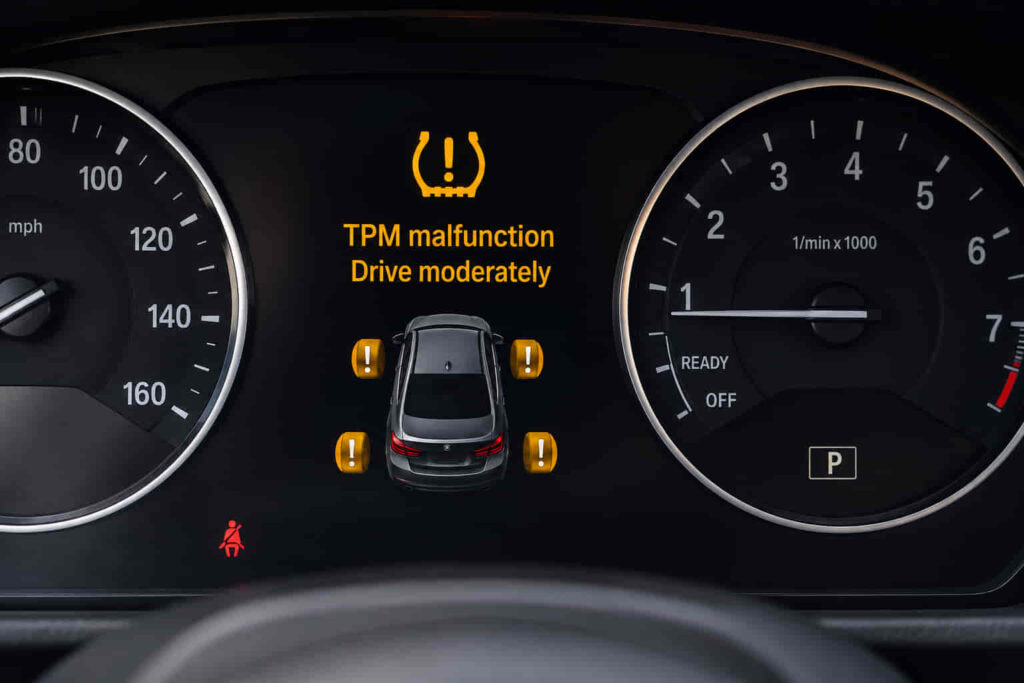
A BMW TPM malfunction means the tire pressure monitoring system cannot monitor or communicate tire pressure information correctly. The cause can originate from a tire pressure sensor, an internal sensor battery on applicable systems, an incompatible replacement sensor, incorrect initialization, or a communication or electrical problem elsewhere in the monitoring system. The warning identifies a system problem, but it does not identify the failed component by itself.
A TPM malfunction is also different from a normal low tire pressure warning. Low tire pressure indicates that tire pressure requires attention, while a TPM malfunction indicates that the monitoring system itself is not operating as expected. When the system has a fault, the driver should not assume that the absence of a separate low-pressure warning confirms that all tires are correctly inflated. Actual tire condition and pressure still need to be verified independently.
There are 7 common causes of a BMW TPM malfunction, and identifying the correct cause is more reliable than repeatedly resetting the system or replacing tire pressure sensors without diagnosis. A reset can resolve an initialization-related condition, but it cannot repair a failed sensor or an underlying communication fault. The correct repair therefore begins by separating sensor, initialization, wheel-service, and system-level problems before deciding whether the BMW needs a TPM reset, sensor replacement, or further diagnosis.
What Are the 7 Common Causes of a BMW TPM Malfunction?
The 7 common causes of a BMW TPM malfunction are a tire pressure sensor communication problem, a depleted sensor battery on applicable systems, a fault related to recent wheel or tire service, an incorrect or incompatible replacement sensor, incomplete TPM initialization, a communication or receiver-related problem, and an electrical or control-system fault. The warning alone does not establish which cause is present, so the system should be diagnosed before sensors or other components are replaced.
A tire pressure sensor that is not communicating correctly is one common cause of a BMW TPM malfunction. On BMW applications that monitor pressure through wheel-mounted sensors, the system depends on receiving usable information from the applicable sensors. If one sensor stops transmitting or its signal cannot be received correctly, the monitoring system may no longer have the information required to perform its function normally. This makes sensor communication an important diagnostic target when the malfunction can be associated with one wheel, but a dashboard warning alone does not prove that the sensor itself has failed.
A depleted internal sensor battery can also cause a TPM malfunction on systems that use battery-powered wheel sensors. The battery supplies the sensor electronics required to transmit information from the wheel, so loss of sufficient battery power can eventually result in missing sensor communication. Because these batteries are contained within the sensor assembly on applicable designs, a battery-related failure may lead to sensor replacement rather than a normal external battery change. Sensor age can provide useful diagnostic context, but age alone should not be used to condemn a sensor without confirming that it is no longer operating correctly.
A BMW TPM malfunction that appears after wheel or tire service can indicate that something changed within the monitoring-system context during the work. Tire replacement, wheel replacement, sensor handling, or installation of another wheel-and-sensor assembly can affect how the system receives and recognizes tire pressure information. The timing of the warning is therefore diagnostically useful. However, replacing tires does not inherently cause TPM failure; the relevant question is whether a sensor was damaged, changed, omitted, became incompatible, or requires the applicable system initialization after the service.
An incorrect or incompatible replacement sensor can prevent the BMW TPM system from receiving the information it expects. Physical fitment inside a wheel does not establish electronic compatibility with the vehicle. A replacement sensor must be appropriate for the TPM system used by that BMW application and capable of communicating in the required manner. This cause becomes particularly relevant when a malfunction begins after aftermarket wheels, replacement sensors, or a second wheel set is installed. In that context, verifying sensor compatibility is more precise than repeatedly attempting to reset the system.
Incomplete or incorrect TPM initialization can create another malfunction context, particularly after tire pressure adjustment or wheel and tire work. Initialization allows the applicable system to establish the operating state required for subsequent monitoring. If the process is not completed correctly, the vehicle may continue to indicate that the system is not ready or functioning as expected. Initialization should nevertheless remain separate from component repair. A reset can correct a system state that genuinely requires initialization, but it cannot restore communication from a failed or incompatible sensor.
A communication or receiver-related problem can cause a BMW TPM malfunction even when the wheel sensors themselves are functional. Tire pressure information must move from the sensing components through the applicable receiving and vehicle-control architecture before it can be used and displayed. A problem in that communication path can therefore create missing sensor information that resembles a wheel-sensor failure. This possibility becomes more important when diagnosis does not isolate the problem to one sensor or when several sensor signals are affected at the same time.
An electrical or control-system fault can also interfere with BMW TPM operation. The monitoring system depends on the applicable control electronics, electrical supply, connections, and communication environment to process tire pressure information correctly. A fault outside an individual wheel sensor can therefore produce a TPM malfunction message. This is why replacing multiple sensors without confirming sensor-level failures can add cost without resolving the underlying problem.
The pattern of the malfunction helps determine which of these causes deserves priority during diagnosis. A problem beginning immediately after one sensor was replaced creates a different diagnostic context from a warning that develops without recent wheel service, while loss of information from several wheels can point the investigation beyond one individual sensor. The warning itself is therefore the starting point rather than the diagnosis.
A BMW TPM malfunction identifies a problem with the tire pressure monitoring function, while diagnosis determines whether the root cause is a sensor, sensor battery, wheel-service issue, incompatible component, initialization condition, communication problem, or system-level electrical fault. Separating these causes before repair prevents a reset from being used as a substitute for diagnosis and prevents functional sensors from being replaced simply because the TPM warning is present.
Read more: Is BMW CPO Worth It
What Does BMW TPM Malfunction Mean?
A BMW TPM malfunction means the tire pressure monitoring system has detected a problem that prevents it from monitoring or communicating tire pressure information normally. The message describes the condition of the monitoring system rather than confirming that one or more tires are underinflated. This distinction is important because a system that cannot monitor correctly may also be unable to provide the driver with reliable tire pressure warnings until the malfunction is resolved.
A normal tire pressure warning and a TPM malfunction therefore represent different diagnostic conditions. A pressure warning directs attention to the actual pressure or condition of the tires because the monitoring system has detected information requiring attention. A malfunction directs attention to the monitoring function itself because the system cannot perform or complete its expected monitoring process correctly. The two conditions can exist independently, and a driver should not assume that a TPM malfunction automatically means a tire is low.
The warning also does not identify which component caused the problem. A wheel-mounted sensor may fail to communicate on applicable systems, but the same general malfunction context can result from an incompatible sensor, incomplete initialization, receiving or communication problems, or an electrical issue elsewhere in the system. The dashboard message therefore establishes the affected system but does not replace component-level diagnosis.
This distinction also explains why clearing or resetting the warning is not equivalent to repairing the malfunction. If the underlying problem is only an initialization condition, completing the appropriate initialization may restore normal monitoring. If a sensor cannot communicate or the system has another electrical or communication fault, resetting the TPM does not repair that component. A warning that returns or an initialization process that cannot complete provides evidence that further diagnosis is required.
BMW TPM malfunction should therefore be interpreted as a loss or impairment of the tire pressure monitoring function, not as a diagnosis of low tire pressure or a failed sensor. Actual tire pressure must be evaluated separately, while the monitoring-system fault must be diagnosed according to the sensor, initialization, communication, and electrical conditions associated with the vehicle.
Can You Drive With a BMW TPM Malfunction?
You should not rely on the tire pressure monitoring system while a BMW TPM malfunction is active, and whether the vehicle can continue to be driven depends primarily on the actual condition and pressure of the tires. A TPM malfunction does not by itself prove that a tire is flat or damaged, but it removes or reduces a monitoring function that normally helps alert the driver to tire-pressure problems.
The immediate priority is therefore the tires rather than the warning message alone. Tire pressure and visible tire condition should be checked independently because the malfunctioning system may not provide dependable information. If the tires are correctly inflated, show no obvious damage, and the vehicle has no other tire-related symptoms, the situation is different from a vehicle with rapidly decreasing pressure, visible tire damage, abnormal handling, or another indication that continued driving could be unsafe.
The absence of a low-pressure warning should not be used as evidence that tire pressure is correct while TPM itself is malfunctioning. This creates an important diagnostic limitation: the system that would normally provide information about pressure has already indicated that its monitoring capability is impaired. Physical verification therefore becomes more important until normal TPM operation is restored.
Driving behavior can also provide information that should not be ignored. Vibration, pulling, unusual steering response, tire noise, or another significant change after the TPM warning appears can indicate a condition beyond an electronic monitoring fault. In that situation, continuing to drive based only on the assumption that the TPM sensor has failed would confuse a system warning with confirmation that the tires themselves are safe.
If tire condition and pressure are verified but the TPM malfunction remains, the next step is to diagnose the monitoring system rather than repeatedly treating the tires as the source of the warning. Sensor communication, recent wheel or tire service, initialization status, sensor compatibility, and system-level faults can then be investigated according to the malfunction pattern.
A BMW TPM malfunction does not automatically mean the vehicle is unsafe to move, but it does mean the driver should not depend on TPM to verify tire pressure until the fault is corrected. Confirming actual tire condition first separates an immediate tire-safety problem from an electronic monitoring-system problem and determines whether the next action should focus on the tire itself or BMW TPM diagnosis.
How Do You Diagnose a BMW TPM Malfunction?
A BMW TPM malfunction should be diagnosed by first verifying the actual tire condition and pressure, then determining whether the system is receiving valid information from the applicable tire pressure sensors before investigating initialization, sensor compatibility, communication, or system-level faults. Diagnosis should identify the failed condition before parts are replaced because the same TPM malfunction message can result from several different causes.
Actual tire pressure should be established first because tire condition and monitoring-system condition are separate diagnostic variables. A malfunctioning TPM cannot be relied on to confirm that every tire is correctly inflated, so pressure should be checked independently and any visible tire problem should be addressed before the electronic monitoring fault becomes the primary focus. This prevents an actual tire problem from being overlooked simply because the dashboard also reports a TPM malfunction.
The next diagnostic question is whether the applicable wheel sensors are communicating correctly. On BMW systems that use individual tire pressure sensors, missing information from one wheel can direct attention toward that sensor, its internal power source, compatibility, or the communication path associated with it. A fault affecting several wheels creates a different pattern and can justify investigating initialization or system-level communication rather than assuming several sensors failed simultaneously.
Recent service history provides additional diagnostic evidence. A TPM malfunction that appears immediately after tire replacement, wheel installation, sensor replacement, or installation of another wheel set should be investigated in relation to that work. Sensor compatibility, sensor condition, installation effects, and required initialization become more relevant in this context. The timing does not prove which component is responsible, but it narrows the diagnostic search more effectively than replacing sensors without considering what changed immediately before the malfunction.
Initialization status should then be evaluated according to the applicable BMW system. If the vehicle requires TPM initialization after pressure adjustment or wheel-related service, an incomplete process can prevent normal monitoring from being established. However, a system that repeatedly fails to complete initialization can provide evidence of an underlying sensor or communication problem. Repeating the same reset without determining why initialization fails does not increase diagnostic certainty.
Diagnostic equipment becomes important when the visible warning and service context are insufficient to isolate the cause. System information can help establish whether a sensor is missing, whether communication is available, and whether the fault extends beyond one wheel. The objective is not simply to clear stored information but to connect diagnostic evidence with the physical system condition. A warning that disappears temporarily after being cleared has not been repaired if the underlying fault remains and causes the message to return.
BMW TPM diagnosis is complete when the evidence separates a tire problem from a sensor problem, an initialization condition, an incompatible component, or a system-level communication or electrical fault. This sequence prevents the common diagnostic shortcut of treating every TPM malfunction as proof that all tire pressure sensors need replacement.
Will Resetting BMW TPM Fix the Malfunction?
Resetting or initializing BMW TPM can resolve a problem when the system genuinely needs initialization, but it cannot repair a failed sensor, depleted sensor battery, incompatible sensor, communication fault, or electrical problem. A TPM reset is therefore a system procedure rather than a universal repair for every malfunction warning.
Initialization has a specific purpose within the monitoring process. After applicable tire-pressure adjustments, wheel changes, tire service, or other conditions defined by the vehicle’s TPM system, initialization allows the system to establish the information or operating state required for subsequent monitoring. When the underlying components are functional and the problem is limited to initialization, completing this process can restore normal operation.
A failed sensor creates a different condition because initialization depends on the system being able to receive the information it requires. If one sensor no longer communicates, repeating the reset does not restore the sensor’s ability to transmit. The same limitation applies when an internal sensor battery has failed on an applicable sensor design. Initialization can establish system state; it cannot restore electrical power inside a non-functioning sensor.
Sensor incompatibility produces a similar result. A replacement sensor that is not appropriate for the BMW TPM application may physically fit the wheel but still fail to provide the communication the vehicle expects. Attempting repeated resets in this situation addresses the system state rather than the incompatible component that caused the problem. The sensor application should therefore be verified when a malfunction begins after sensor or wheel replacement.
A system-level communication or electrical fault also falls outside the function of a TPM reset. If the receiving or control architecture cannot obtain or process the required information, initialization cannot repair the underlying communication path. This becomes particularly relevant when multiple sensors appear unavailable or when a reset repeatedly fails despite correct tire pressure and no obvious problem with an individual wheel.
The behavior of the system after initialization provides useful diagnostic evidence. If the procedure completes and normal TPM operation returns, an initialization-related condition becomes a reasonable explanation. If initialization cannot complete, the warning immediately returns, or the malfunction reappears after normal operation begins, the next step should be diagnosis of the underlying sensor or system condition rather than another identical reset attempt.
Resetting BMW TPM fixes an initialization problem, not a defective component. The practical distinction is straightforward: initialization should be used when the system needs to relearn or establish its operating state, while a confirmed sensor, compatibility, communication, or electrical fault requires correction at the source before normal tire pressure monitoring can be restored.
How Do You Reset BMW TPM After Tire or Wheel Service?
BMW TPM should be reset or initialized after applicable tire-pressure adjustments, tire service, wheel changes, or sensor-related work when the vehicle’s monitoring system requires initialization. The exact procedure can vary by BMW model, model year, and TPM system, so the vehicle-specific procedure should be followed rather than assuming that one button sequence or iDrive menu path applies to every BMW.
Before initialization begins, the actual tires should be in the appropriate condition and their pressures should be set according to the vehicle’s applicable specification. Resetting the system before correcting an actual pressure problem creates the wrong starting condition for subsequent monitoring. Initialization is intended to establish the monitoring system’s operating state after the physical tire conditions have been addressed; it is not a method for correcting tire pressure itself.
The applicable reset or initialization function can then be started through the vehicle’s TPM controls or interface, depending on the BMW application. Some systems may require additional vehicle operation before initialization completes. The important diagnostic point is not the exact menu wording but whether the system successfully completes the applicable initialization process and returns to normal monitoring.
A successful initialization provides useful evidence when the warning appeared because the system needed to establish its monitoring state after service. However, a reset that does not complete should not simply be restarted indefinitely. If the vehicle cannot establish normal TPM operation, the system may not be receiving the sensor information or communication it requires to complete the process.
The timing of the malfunction becomes particularly useful after wheel or tire work. If TPM operated normally before service but initialization fails immediately afterward, the components or conditions changed during that service deserve additional attention. A sensor may have been affected, another sensor may have been installed, compatibility may need verification, or the system may have another condition preventing successful communication.
A BMW TPM reset after tire or wheel service is successful when the applicable initialization completes and normal monitoring is restored. If the malfunction remains, the warning returns, or initialization repeatedly fails, further diagnosis is more appropriate than continuing to reset the system because the problem may exist in a sensor, compatibility issue, communication path, or another TPM component.
When Does a BMW TPM Sensor Need Replacement?
A BMW TPM sensor should be replaced when diagnosis confirms that the sensor itself can no longer perform or communicate correctly and the fault cannot be corrected through proper tire setup or system initialization. A TPM malfunction warning alone is not sufficient evidence for sensor replacement because several system-level conditions can produce a similar warning.
Loss of sensor communication is one of the strongest reasons to investigate replacement. On applicable direct-monitoring systems, each functioning sensor must provide the information required by the vehicle’s TPM architecture. When diagnosis isolates missing or defective communication to one wheel while the remaining system operates correctly, the sensor at that wheel becomes a stronger repair candidate than when all sensor information disappears simultaneously.
Internal sensor battery condition can also determine replacement. Battery-powered TPM sensors rely on their internal electrical supply to operate and transmit information. When that internal power source reaches the end of its usable life and is not separately serviceable within the applicable sensor design, replacing the sensor assembly can become the practical repair. The important diagnostic relationship is depleted internal power leading to loss of sensor operation, rather than sensor age alone automatically requiring replacement.
Physical damage can create another replacement condition. Tire removal, wheel service, impact, corrosion, or another physical event can affect a sensor or its associated components. A malfunction that begins directly after tire work therefore justifies examining the serviced wheel and sensor context. However, chronological sequence remains diagnostic evidence rather than proof; the sensor should still be confirmed as the failed component before replacement.
An incorrect sensor should be treated as a compatibility problem rather than a reset problem. A replacement component can fit mechanically while failing to communicate correctly with the BMW TPM system. In that situation, installing the correct compatible sensor may be necessary. Repeated initialization cannot make an electronically incompatible component appropriate for the vehicle.
Replacing every sensor is also not automatically required when one sensor fails. The appropriate repair depends on diagnostic findings, sensor condition, system design, and the service context of the vehicle. The age and condition of the remaining sensors may be relevant to a broader maintenance decision, but one confirmed failure should not be converted into four confirmed failures without supporting evidence.
BMW TPM sensor replacement is appropriate when diagnosis isolates the malfunction to a defective, non-communicating, physically damaged, depleted, or incompatible sensor. When several sensors appear unavailable or a replacement sensor still cannot be recognized, diagnosis should expand beyond the individual wheel before additional sensors are installed.
When Should You Have a BMW TPM Malfunction Professionally Diagnosed?
A BMW TPM malfunction should be professionally diagnosed when correct tire pressure and the applicable initialization do not restore normal monitoring, when a sensor cannot be recognized, when multiple wheels appear to lose communication, or when the warning repeatedly returns without a clear tire-related cause. These patterns indicate that the problem may require diagnostic information beyond what can be established from tire pressure and dashboard messages alone.
A malfunction that repeatedly returns after successful-looking initialization is one reason to move beyond basic reset attempts. If the underlying condition remains active, clearing or resetting the system can temporarily change the displayed state without repairing the cause. Diagnostic evaluation can determine whether the system is losing information from a specific sensor or whether the problem exists elsewhere in the monitoring architecture.
Multiple unavailable sensors create an especially important diagnostic distinction. Several wheel sensors can develop problems, but simultaneous loss of sensor information can also justify investigating a shared communication, receiving, electrical, or control-system condition. Replacing multiple sensors before establishing why their information is unavailable risks treating several symptoms while leaving one common cause unresolved.
Professional diagnosis is also useful when a malfunction begins after wheel, tire, or sensor work and normal initialization cannot be completed. Sensor compatibility, installation condition, communication, and the applicable BMW system can then be evaluated together. This is more precise than assuming the recent service either definitely caused the fault or is unrelated to it.
A sensor that has already been replaced but remains unrecognized creates another reason for deeper diagnosis. The replacement component may be incompatible, the initialization process may not be appropriate for the application, or the communication problem may exist outside the sensor. Installing another sensor without resolving those possibilities repeats the repair assumption rather than testing it.
The objective of professional diagnosis is therefore not simply to remove the TPM warning from the instrument display. It is to establish which part of the monitoring process has failed and correct that condition so the system can reliably monitor tire pressure again. A warning that has been cleared while the system remains unable to obtain required tire information does not represent a completed repair.
The correct BMW TPM malfunction repair path is to verify the tires first, initialize the system when initialization is actually required, replace a sensor when sensor failure is confirmed, and diagnose the broader TPM system when the evidence points beyond an individual wheel. This sequence prevents both repeated resets and unnecessary sensor replacement from being used as substitutes for identifying the root cause.