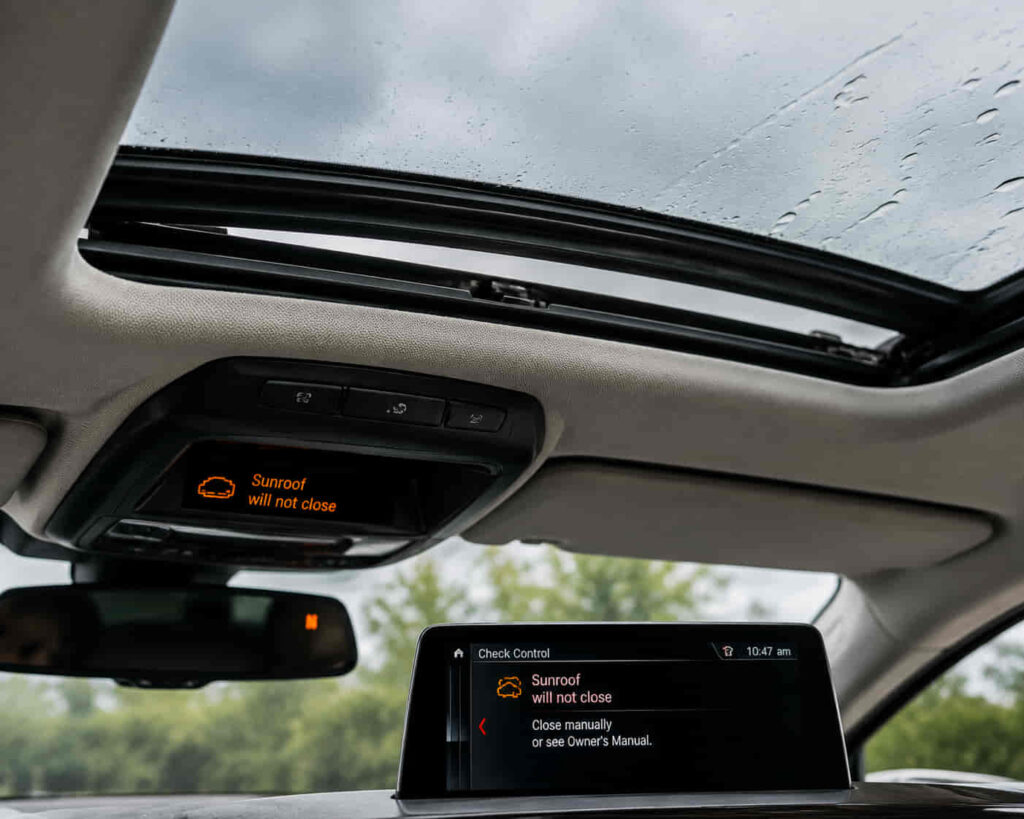
A BMW sunroof that will not close usually indicates a problem with the roof movement system, electronic controls, or safety mechanisms that prevent normal operation. The sunroof system is designed to provide convenience and protection, but it depends on multiple components working together correctly to control glass movement, detect obstacles, and maintain accurate roof positioning.
A common misunderstanding is that a BMW sunroof won’t close problem automatically means the sunroof motor has failed. The sunroof assembly is more complex than a simple electric window mechanism. It includes the motor, drive gears, sliding tracks, anti-trap sensors, control modules, switches, and position calibration data. A failure in any of these areas can prevent the roof from completing the closing cycle.
The BMW sunroof control system follows a specific operating process. When the driver presses the sunroof switch, the command is sent to the control module, which activates the motor and monitors movement through position sensors. If the system detects unusual resistance, incorrect positioning, or unreliable information, it may stop movement or reverse the glass as a safety response.
The cause of a BMW sunroof not closing can range from simple issues such as debris in the track to more complex problems involving electrical supply, sensor calibration, or mechanical wear. The same symptom can appear from different failures, which is why replacing components without diagnosis can lead to unnecessary repairs.
Understanding the relationship between the sunroof motor, mechanical movement system, electronic controls, and safety sensors is essential for finding the correct solution. This guide explains the common causes of BMW sunroof won’t close problems, how to diagnose each possible failure, when a reset may help, and when professional repair is required.
Can Obstructions Prevent a BMW Sunroof From Closing?
Physical obstructions can prevent a BMW sunroof from closing because the system is designed to detect resistance and stop movement when it identifies a possible blockage. BMW sunroof systems include safety mechanisms that monitor movement during operation, allowing the roof to stop or reverse when unusual resistance is detected.
The sunroof glass moves through a mechanical track system that must remain clear for smooth operation. Dirt, leaves, ice, small objects, or debris inside the guide rails can increase resistance and interfere with normal movement. When the control system detects that the motor requires more force than expected, it may interpret the condition as a safety risk and prevent the roof from completing the closing process.
A sunroof obstruction does not always mean that the track or motor has been damaged. In many cases, the problem is caused by a temporary blockage that prevents the system from moving correctly. However, repeatedly forcing the sunroof to close when resistance exists can increase stress on the motor, gears, and track components.
The location of the obstruction can also affect the symptoms. A BMW sunroof may stop at a specific position, close partially, reverse automatically, or produce unusual movement because the system detects resistance at a certain point in the track.
Diagnosing an obstruction-related BMW sunroof problem requires inspecting the glass movement path, checking the tracks, and confirming whether resistance disappears after removing the blockage. Identifying simple physical causes before replacing electronic or mechanical components prevents unnecessary repairs.
Can BMW Sunroof Track Problems Cause Closing Failure?
BMW sunroof track problems can prevent the roof from closing because the glass panel depends on precise mechanical movement through the guide rails and roof cassette assembly. The track system controls how the sunroof slides and tilts, meaning even small mechanical restrictions can affect the entire closing process.
The sunroof track contains moving components that guide the glass panel during operation. Over time, wear, contamination, insufficient lubrication, damaged guides, or misalignment can increase friction and prevent the motor from moving the roof smoothly. When the system encounters excessive resistance, the control module may stop operation to protect the mechanism.
A track-related failure does not automatically mean the entire sunroof assembly needs replacement. Some problems may involve lubrication, minor alignment issues, or damaged guide components rather than a complete mechanical failure. Accurate diagnosis is necessary because the symptoms of a track problem can look similar to motor or sensor issues.
Track problems often create noticeable operating symptoms. The sunroof may move slowly, make clicking or grinding sounds, become uneven during movement, or stop before reaching the fully closed position.
Diagnosing BMW sunroof track problems requires evaluating movement quality, mechanical resistance, track condition, and the interaction between the motor and sliding mechanism. Confirming the actual source of the restriction helps determine whether cleaning, adjustment, repair, or component replacement is required.
Read more: BMW Cruise Control Malfunction
Can a BMW Sunroof Motor Cause the Roof Not To Close?
A failing BMW sunroof motor can prevent the roof from closing because the motor provides the mechanical force required to move the glass panel through the opening and closing cycle. The sunroof motor works together with gears, drive cables, and the track system to convert electrical power into controlled mechanical movement.
When the motor operates correctly, it receives a command from the sunroof switch and control module, then moves the glass panel according to the stored position information. If the motor becomes weak, damaged, or unable to generate enough torque, the sunroof may move slowly, stop during operation, or fail to close completely.
A motor-related problem does not always mean the motor itself has completely failed. The issue may involve the electrical supply, damaged gears, mechanical resistance in the track, or incorrect signals from the control system. For example, a motor working against excessive track resistance may appear faulty even though the actual problem is mechanical restriction.
The symptoms of a failing sunroof motor can vary depending on the type of failure. Some BMW owners may hear clicking sounds without movement, experience intermittent operation, or notice that the sunroof only moves partially before stopping.
Diagnosing a BMW sunroof motor problem requires checking motor operation, electrical power supply, mechanical resistance, and communication with the control module. Confirming the actual cause prevents unnecessary replacement of the motor when another part of the system is responsible.
Can Anti-Trap Sensor Problems Stop BMW Sunroof Closing?
Anti-trap sensor problems can stop BMW sunroof closing because the safety system may interpret normal movement as an obstruction and prevent the glass from continuing its operation. BMW sunroof systems use anti-trap technology to protect occupants by detecting unexpected resistance during closing movement.
The anti-trap system monitors the force required to move the sunroof. If the system detects resistance above the expected level, it can immediately stop or reverse the glass movement to reduce the risk of injury or damage. This safety function is controlled through sensors, motor feedback, and position monitoring.
When the anti-trap system becomes inaccurate, the sunroof may stop even when no physical object is blocking the track. Possible causes include sensor calibration problems, incorrect initialization, mechanical resistance, or control module issues affecting how the system interprets movement.
A sunroof that closes and then immediately opens again is often related to the anti-trap function detecting abnormal resistance. However, this does not automatically confirm a sensor failure because mechanical issues such as track friction or misalignment can create the same behavior.
Diagnosing BMW sunroof anti-trap problems requires checking system calibration, movement resistance, stored faults, and the condition of mechanical components. Correct diagnosis ensures that the safety system is restored without disabling an important protection feature.
Can Sunroof Switch Problems Cause BMW Sunroof Failure?
Sunroof switch problems can prevent a BMW sunroof from operating because the control module depends on accurate driver input to activate the motor and control roof movement. The switch is the primary interface between the driver and the sunroof control system, sending commands that determine whether the glass should open, close, tilt, or stop.
When the driver presses the sunroof button, the signal travels through the vehicle’s electrical system to the relevant control module, which then activates the motor and monitors movement. If the switch does not send the correct signal, the system may not recognize the driver’s command, resulting in no movement or inconsistent operation.
A faulty sunroof switch does not always mean the physical button itself is damaged. The problem may involve wiring connections, electrical communication, control module input, or another condition preventing the command from reaching the motor correctly. This is why replacing the switch without testing the system can fail to resolve the actual problem.
Switch-related sunroof failures may appear in different ways. The sunroof may respond only intermittently, certain functions may stop working while others remain available, or the system may fail to react completely when the driver attempts to close the roof.
Diagnosing BMW sunroof switch problems requires checking switch signals, electrical connections, control module communication, and motor response. Confirming that the system receives the correct command helps determine whether the issue comes from the switch or another part of the sunroof control system.
Can Low Battery Voltage Cause BMW Sunroof Won’t Close?
Low battery voltage can affect BMW sunroof operation because the system requires stable electrical power to operate the motor, control modules, and position monitoring functions. BMW comfort systems, including the sunroof, depend on reliable voltage supply to ensure that electronic components can communicate and perform movement calculations correctly.
The sunroof control module uses electrical signals to activate the motor and monitor the roof position during operation. When battery voltage becomes unstable or drops below the expected level, the system may reduce functionality, interrupt movement, or prevent operation to protect electronic components.
A battery-related sunroof problem does not automatically mean the battery is the only cause. The issue may involve alternator performance, weak electrical connections, poor grounding, wiring problems, or another condition affecting the vehicle’s electrical supply.
Low voltage conditions can create confusing symptoms because the sunroof may work normally at some times and fail at others. The system may operate after the vehicle is running but fail after extended periods without use, depending on the available electrical power.
Diagnosing BMW sunroof problems related to battery voltage requires checking battery condition, charging system performance, electrical connections, and stored control module faults. Confirming the electrical condition prevents unnecessary replacement of the sunroof motor or other mechanical components when the actual issue is power instability.
Can BMW Sunroof Lose Initialization and Stop Closing?
A BMW sunroof can stop closing when the system loses initialization because the control module may no longer have accurate information about the roof position and movement limits. The sunroof control system relies on stored position data to understand where the glass panel is located and how far it can move during opening and closing operations.
Initialization allows the control module to learn the correct movement range of the sunroof. After situations such as battery disconnection, low voltage events, electrical interruptions, or certain control system faults, this stored position information may become incorrect or unavailable. As a result, the sunroof may stop before reaching the fully closed position, reverse unexpectedly, or fail to respond normally.
A lost initialization condition does not automatically mean that a mechanical component has failed. The motor, tracks, and sensors may still be physically functional, but the control module may need to relearn the correct operating position before normal operation can resume.
This issue is different from a damaged track or failed motor because the system often shows inconsistent behavior rather than complete mechanical failure. For example, the sunroof may operate partially, stop at the same position repeatedly, or work temporarily after certain electrical conditions change.
Diagnosing BMW sunroof initialization problems requires checking control module information, confirming mechanical movement, and performing the correct initialization procedure when appropriate. Restoring calibration can resolve control-related issues, but it will not repair physical damage within the sunroof mechanism.
How Do You Manually Close a BMW Sunroof?
A BMW sunroof can sometimes be manually closed in emergency situations, but the correct procedure depends on the vehicle model and the type of sunroof system installed. Manual closing methods are designed as temporary solutions when electrical operation is unavailable, not as a replacement for repairing the underlying problem.
BMW sunroof systems include mechanical components that allow emergency operation on certain models. However, forcing the glass panel closed by hand can damage the tracks, gears, motor mechanism, or alignment system because the assembly is designed to move with controlled mechanical assistance.
Before attempting manual operation, the cause of the failure should be considered. A sunroof blocked by debris, mechanical damage, or a failed motor may require a different repair approach than a system affected by lost initialization or electrical interruption.
The safest approach is to identify whether the issue is caused by a temporary control problem or a physical restriction. If the sunroof remains open and weather protection is required, following the manufacturer-specific emergency procedure is preferable to applying excessive force.
BMW sunroof manual closing should be treated as a temporary measure to protect the vehicle, while proper diagnosis is needed to restore normal operation.
How Do You Reset BMW Sunroof After It Stops Working?
Resetting a BMW sunroof can help resolve certain initialization or temporary control issues, but it does not repair mechanical failures or damaged components. The reset process allows the control module to relearn sunroof movement positions and restore communication between the switch, motor, and position sensors.
A reset may be useful after events such as battery replacement, electrical interruption, or situations where the sunroof operates incorrectly despite having no obvious mechanical obstruction. During initialization, the system recalculates movement limits and stores the correct operating positions.
However, a reset cannot fix problems caused by broken tracks, worn gears, failed motors, damaged wiring, or physical obstructions. If the system continues stopping, reversing, or failing to move after initialization, the underlying cause requires further inspection.
Repeatedly resetting the sunroof without identifying the reason for the failure can delay the correct repair. The reset process should be used as part of diagnosis rather than as a universal solution.
BMW sunroof reset is effective for control-related issues, but mechanical and electrical faults require proper testing and repair.
Why Does BMW Sunroof Open But Not Close?
A BMW sunroof that opens but does not close usually indicates that the system can receive commands and activate movement, but another condition prevents the closing cycle from completing. Opening and closing operations are not always identical because the system continuously monitors safety conditions during movement.
The closing process places greater importance on the anti-trap system because the vehicle must detect potential resistance while the glass moves toward the closed position. If the system detects unexpected force, it may stop or reverse the movement even when no visible obstruction exists.
Possible causes include track resistance, sensor calibration problems, incorrect initialization, weak motor performance, or control module issues. Since the motor can still operate in one direction, this symptom does not automatically confirm that the motor is defective.
Understanding this difference helps avoid incorrect repairs. A sunroof that opens normally but refuses to close requires evaluation of movement resistance, sensor feedback, and position data rather than immediate replacement of major components.
Diagnosing a BMW sunroof that opens but will not close requires checking the closing cycle, safety system response, mechanical movement, and control module information.
Why Does BMW Sunroof Close Then Open Again?
A BMW sunroof that closes and then opens again usually indicates that the anti-trap system has detected resistance or an incorrect closing condition. This safety feature is designed to prevent injury or damage by reversing the glass movement when the system believes something is blocking the closing path.
The system measures movement resistance through motor feedback and position monitoring. If the required force exceeds expected limits, the control module assumes that an obstruction may be present and automatically reverses the sunroof.
Although this behavior is commonly associated with obstructions, other conditions can create the same result. Track friction, poor lubrication, mechanical misalignment, sensor calibration issues, or lost initialization can cause the system to interpret normal movement as excessive resistance.
A repeated open-close cycle should not be ignored because continuing operation may increase stress on the motor and mechanical components.
Diagnosing BMW sunroof reversal problems requires checking for physical resistance, track condition, anti-trap operation, and system calibration. Identifying the reason behind the safety response is more effective than disabling the protection feature.
How Do You Diagnose BMW Sunroof Won’t Close?
Diagnosing a BMW sunroof that will not close requires identifying whether the problem comes from mechanical movement, electrical control, sensor feedback, or system calibration. The sunroof system contains multiple connected components, so the visible symptom alone cannot determine the failed part.
The diagnostic process begins by inspecting the movement path for obstructions and evaluating how the glass behaves during operation. The next steps involve checking switch commands, motor response, electrical supply, control module information, and sensor feedback.
A common mistake is replacing the sunroof motor immediately because the roof does not move. The actual cause may involve a restricted track, incorrect initialization, low voltage, or a control system issue preventing normal operation.
BMW-specific diagnostic tools can provide additional information from body electronics modules and help identify stored faults related to sunroof operation. This is especially useful when the problem involves intermittent operation or electronic communication issues.
The correct BMW sunroof diagnosis sequence is: inspect movement → check electrical conditions → evaluate control signals → verify mechanical components → perform repair or initialization → confirm operation.
How Much Does BMW Sunroof Repair Cost?
BMW sunroof repair costs depend on the component causing the failure, the complexity of access, and whether the repair involves mechanical parts, electrical components, or calibration procedures. The sunroof system contains several interconnected components, and each failure requires a different repair approach.
A minor issue involving cleaning, lubrication, initialization, or switch inspection requires a different level of repair compared with problems involving the motor, track assembly, roof cassette, or control module.
Accurate diagnosis is the most important factor affecting repair decisions. Replacing expensive components without confirming the actual cause can increase repair costs while failing to resolve the original problem.
The final repair requirement depends on whether the issue is related to movement resistance, electrical supply, sensor operation, or control system communication.
BMW sunroof repair costs are determined by the diagnosed cause rather than the symptom of the roof not closing alone.
When Should BMW Sunroof Problems Be Diagnosed Professionally?
Professional diagnosis is recommended when a BMW sunroof remains open, produces unusual mechanical sounds, repeatedly reverses during closing, or continues failing after a reset procedure. These symptoms indicate that the problem may involve components beyond a simple initialization issue.
Modern BMW sunroof systems combine mechanical movement with electronic monitoring, meaning accurate diagnosis requires checking the interaction between the motor, tracks, sensors, switches, and control modules. A professional evaluation becomes especially important when the glass is misaligned, water leakage appears, or the system shows repeated faults.
A correct diagnostic process identifies whether the problem comes from physical obstruction, mechanical wear, electrical supply, sensor calibration, or module communication. This prevents unnecessary replacement of functioning components and ensures that the repair addresses the actual cause.
The correct approach is:
sunroof problem appears → inspect movement → identify affected system → test components → repair cause → verify operation
BMW Sunroof Won’t Close is a symptom, not a specific component failure. Understanding the relationship between the motor, mechanical tracks, safety sensors, and control system is essential for restoring reliable sunroof operation.