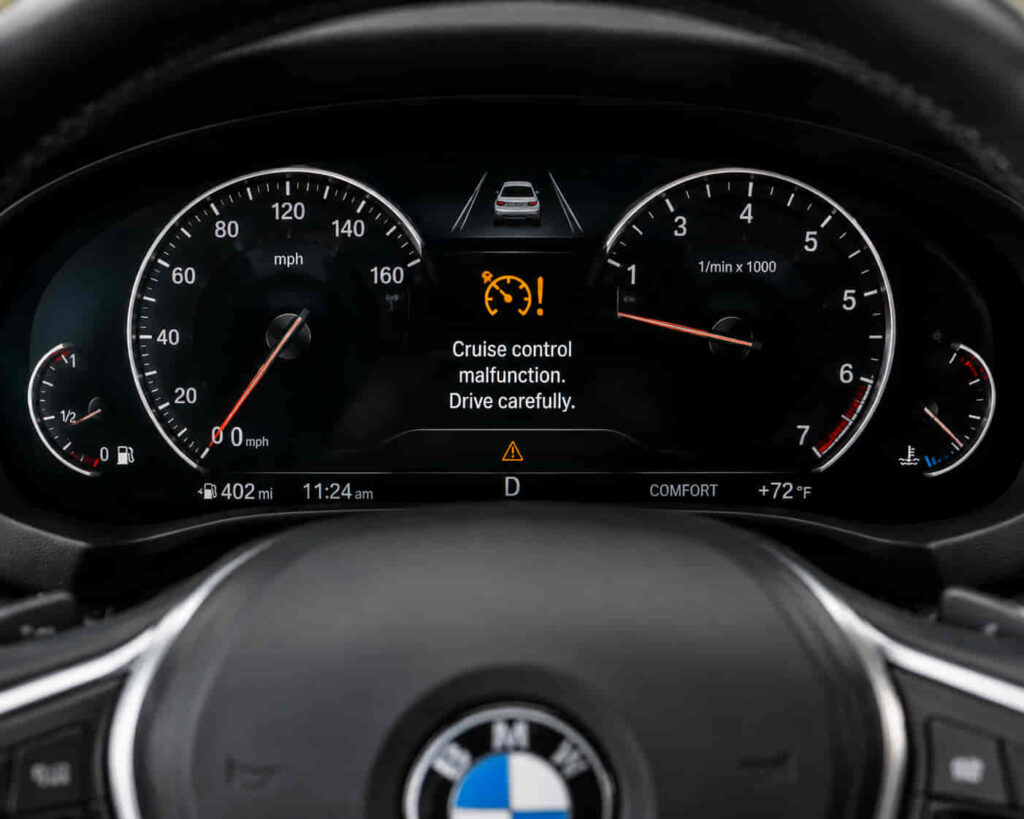
BMW Cruise Control Malfunction means the vehicle has detected a condition that prevents the cruise control system from operating normally. The warning indicates that the driver assistance system has identified an issue affecting speed regulation, sensor information, or communication between vehicle control modules.
BMW cruise control is not a single component. The system depends on multiple interconnected parts, including steering wheel controls, speed sensors, brake system signals, radar sensors, cameras, and electronic control modules. When one part provides incorrect information or communication becomes unreliable, the vehicle may disable cruise control as a safety response.
A common misunderstanding is that a BMW Cruise Control Malfunction warning indicates an engine or transmission problem. In most cases, cruise control issues are related to the driver assistance system itself rather than the engine producing power. The system is designed to deactivate when it cannot confidently calculate vehicle speed, distance, or driver input.
The exact cause of a cruise control malfunction can vary between BMW models and system configurations. Traditional cruise control systems depend mainly on vehicle speed information and driver controls, while Adaptive Cruise Control (ACC) systems rely on additional components such as radar sensors and cameras to maintain distance from other vehicles.
The warning message only identifies that the system has entered an unavailable state. It does not confirm that one specific component has failed. Accurate diagnosis requires identifying which sensor, module, electrical condition, or communication issue caused the system to disable itself.
This guide explains the common causes of BMW Cruise Control Malfunction, how different vehicle systems affect cruise operation, how to diagnose the problem correctly, and why resetting the warning alone may not permanently solve the issue.
Can Radar or Camera Problems Cause BMW Cruise Control Malfunction?
Radar and camera problems can cause BMW Cruise Control Malfunction because advanced cruise control systems depend on accurate environmental information to regulate vehicle speed and distance. BMW Adaptive Cruise Control (ACC) uses sensors to monitor surrounding vehicles, calculate distance, and determine whether the system can safely maintain the selected driving speed.
The radar sensor and front camera provide critical data for driver assistance functions. The radar system measures the distance and relative speed of vehicles ahead, while the camera helps identify road conditions and objects within the vehicle’s operating environment. When these systems provide unreliable information, the vehicle may disable cruise control to maintain safety.
A sensor-related cruise control malfunction does not automatically mean that the radar or camera hardware has failed. The problem may involve incorrect calibration, dirt or obstruction on the sensor surface, damaged wiring, communication issues, or software conditions affecting sensor operation.
This is why replacing expensive ADAS components without proper diagnosis can lead to unnecessary repairs. A sensor may appear faulty because it is incorrectly positioned, unable to communicate with the control module, or affected by another system problem.
Diagnosing BMW cruise control sensor problems requires checking fault codes, sensor condition, calibration status, and communication between driver assistance modules. The goal is to determine whether the issue comes from the sensor itself or from another condition preventing accurate system operation.
Can Brake Switch Problems Disable BMW Cruise Control?
Brake switch problems can disable BMW Cruise Control because the system depends on accurate brake input information to determine when cruise control should remain active or disengage. The brake system is directly connected to cruise control safety logic because the vehicle must immediately respond when the driver applies the brakes.
The brake switch communicates the driver’s braking action to vehicle control modules. When the system detects brake application, cruise control is designed to cancel automatically. If the brake signal becomes incorrect or inconsistent, the vehicle may prevent cruise control activation because it cannot confirm that the braking system information is reliable.
A brake-related cruise control malfunction does not always mean there is a problem with the physical braking system. The issue may involve the brake light switch, wiring, electrical connections, sensor signals, or communication between control modules.
This safety relationship explains why BMW may disable cruise control even when the vehicle can still be driven normally. The system prioritizes reliable safety inputs before allowing automated speed control functions to operate.
Diagnosing brake-related BMW cruise control problems requires checking brake switch signals, fault codes, brake system data, and module communication. Confirming the actual cause prevents unnecessary replacement of unrelated braking or cruise control components.
Can ABS or Wheel Speed Sensor Problems Cause BMW Cruise Control Malfunction?
ABS system and wheel speed sensor problems can cause BMW Cruise Control Malfunction because the cruise control system depends on accurate vehicle speed information to maintain safe speed regulation. BMW uses wheel speed data from the ABS and DSC systems to calculate vehicle movement, and incorrect information can cause cruise control to become unavailable.
The wheel speed sensors continuously monitor the rotation speed of each wheel and send this information to the vehicle control modules. These signals are used not only for ABS and stability control functions but also for systems that require accurate speed calculation, including cruise control.
When a wheel speed sensor provides incorrect data, the vehicle may detect an inconsistency between expected and actual vehicle speed. Because cruise control requires reliable speed information, the system may disable itself rather than operate with inaccurate data.
An ABS or wheel speed sensor fault does not automatically mean that the sensor itself has failed. Problems can also involve damaged wiring, connector issues, ABS module communication faults, sensor contamination, or other conditions affecting the speed signal.
This is why replacing a wheel speed sensor without proper diagnosis may not solve the issue. The diagnostic process must determine whether the incorrect speed information comes from the sensor, wiring, ABS system, or another related component.
Diagnosing BMW cruise control problems related to ABS or wheel speed sensors requires reviewing fault codes, wheel speed data, ABS system information, and communication between control modules. Accurate diagnosis identifies the actual source of the problem before parts are replaced.
Can Steering Wheel Control Problems Affect BMW Cruise Control?
Steering wheel control problems can prevent BMW cruise control from working because the system depends on accurate driver input from buttons and control interfaces. The cruise control function begins when the driver selects settings such as activation, speed adjustment, or cancellation through steering wheel controls.
The steering wheel control system sends commands through electronic modules that communicate with the vehicle’s network. When the driver presses a cruise control button, the system must correctly receive and interpret that signal before activating speed regulation.
If the steering wheel buttons, control module, wiring, or communication network develops a fault, the cruise control system may not respond correctly. Symptoms can include buttons that do not activate cruise control, incorrect system responses, or complete loss of cruise functionality.
A steering control issue does not always mean that the physical buttons are damaged. The problem may involve electronic communication, module faults, connector problems, or software-related conditions affecting how the input is processed.
Diagnosing BMW cruise control problems related to steering controls requires checking button operation, stored fault information, module communication, and input signals. Confirming the source of the incorrect command prevents unnecessary replacement of functioning components.
Read more: BMW Air Conditioning Problems
Can Low Battery Voltage Cause BMW Cruise Control Malfunction?
Low battery voltage can cause BMW Cruise Control Malfunction because driver assistance systems depend on stable electrical power and reliable communication between multiple electronic control modules. Cruise control is not an isolated feature; it operates as part of a larger vehicle network where different modules exchange information continuously.
BMW vehicles use electronic control systems to coordinate functions such as speed monitoring, braking input, stability control, and driver assistance features. When battery voltage becomes unstable, control modules may record communication errors, incorrect signals, or temporary faults that prevent cruise control from operating.
A battery-related cruise control malfunction does not automatically mean the battery itself is the only problem. The cause may involve alternator performance, weak electrical connections, damaged wiring, voltage fluctuations, or another issue affecting the vehicle’s electrical system.
Low voltage conditions can create confusing symptoms because multiple systems may display warnings at the same time. A vehicle may still start and drive normally while certain electronic features become unavailable because the control modules detect unreliable operating conditions.
Diagnosing voltage-related BMW cruise control problems requires checking battery condition, charging system performance, fault codes, and communication between vehicle modules. Confirming the electrical condition helps prevent unnecessary replacement of cruise control components when the actual issue comes from the power supply.
Can Software or Module Communication Problems Cause Cruise Control Failure?
Software or communication problems can disable BMW cruise control when vehicle control modules cannot exchange accurate information required for safe speed regulation. Modern BMW vehicles rely on complex electronic networks where systems such as DSC, ABS, engine management, and driver assistance modules communicate continuously.
Cruise control operation requires information from multiple systems. The vehicle must know accurate speed, braking status, stability conditions, and driver commands before allowing the function to activate. If communication between modules becomes unreliable, the system may disable cruise control as a safety precaution.
A software or communication-related malfunction does not automatically mean that a control module has failed. The issue may involve temporary software conditions, outdated module programming, network communication errors, voltage instability, or another system affecting data exchange.
This distinction is important because replacing electronic modules is a major repair decision. Proper diagnosis must confirm whether the problem comes from the module itself, software configuration, wiring, or communication between systems.
Diagnosing BMW cruise control communication problems requires retrieving fault codes from relevant modules, checking network communication, and verifying software conditions. Identifying the actual communication issue prevents unnecessary replacement of expensive electronic components.
Can Calibration Problems Cause BMW Adaptive Cruise Control Malfunction?
Calibration problems can cause BMW Adaptive Cruise Control malfunction because advanced cruise systems depend on accurately aligned radar sensors and cameras to measure distance, vehicle position, and surrounding traffic conditions. Unlike traditional cruise control, Adaptive Cruise Control requires precise environmental data before it can automatically adjust vehicle speed.
The radar sensor and front camera must operate within specific alignment parameters to calculate distance and movement accurately. If these components become misaligned after events such as windshield replacement, front-end repairs, bumper damage, suspension work, or sensor replacement, the system may detect unreliable information and disable adaptive cruise functions.
A calibration-related cruise control malfunction does not automatically mean that the radar sensor or camera is damaged. The components may be physically functional but unable to provide accurate data because their position or calibration values no longer match the required specifications.
This is why sensor replacement is not always the correct solution. Modern BMW driver assistance systems often require calibration procedures after certain repairs or component changes to restore accurate operation.
Diagnosing BMW Adaptive Cruise Control calibration problems requires checking stored fault codes, sensor alignment, calibration status, and driver assistance system data. Proper calibration ensures that the system can accurately measure distance and safely control vehicle speed.
Why Is BMW Cruise Control Not Turning On?
BMW cruise control may fail to activate when the vehicle detects a condition that prevents the system from operating safely. The system performs several checks before allowing cruise control to engage, including verifying sensor information, brake signals, vehicle speed data, and communication between control modules.
A cruise control system that does not turn on does not always indicate a failed cruise control component. The cause may involve an active fault code, incorrect sensor information, brake input signals, steering wheel controls, or a temporary communication issue.
BMW systems are designed to disable cruise control when important information is unavailable or unreliable. This safety strategy prevents the vehicle from activating automated speed control when the system cannot accurately monitor the conditions required for operation.
The difference between a simple activation issue and a system malfunction depends on the warning messages, stored faults, and vehicle behavior. A cruise control button problem, for example, has a different diagnostic path from a radar sensor or ABS communication fault.
Diagnosing why BMW cruise control does not turn on requires checking system status, fault codes, driver inputs, and related vehicle modules. Identifying the blocked activation condition is more effective than replacing parts without testing.
Can You Drive With BMW Cruise Control Malfunction?
A BMW Cruise Control Malfunction usually affects the driver assistance feature rather than the vehicle’s basic ability to drive. In many cases, the vehicle can still be operated normally because cruise control is a convenience and assistance system rather than a system required for basic engine or steering operation.
However, the meaning of the warning depends on what caused the malfunction. A cruise control issue caused by a simple control input problem is different from a fault involving ABS, DSC, radar sensors, or other safety-related systems.
Additional warning messages are important when evaluating the situation. If the cruise control warning appears together with ABS, stability control, braking system, or multiple driver assistance warnings, the vehicle should receive a more complete diagnostic evaluation.
Continuing to drive without understanding the cause may allow an unresolved electronic or sensor problem to remain active. Although cruise control may be unavailable, the underlying fault could affect other vehicle systems.
A BMW with cruise control malfunction can often be driven, but the warning should be diagnosed to confirm that no related safety systems are affected.
How Do You Diagnose BMW Cruise Control Malfunction?
BMW Cruise Control Malfunction diagnosis begins by retrieving fault codes from the vehicle’s control modules and identifying which system prevented normal cruise operation. The warning message itself does not identify the failed component, so diagnosis requires analyzing information from multiple vehicle systems.
The diagnostic process starts with scanning relevant modules, including driver assistance systems, DSC, ABS, and other connected control units. The stored fault information helps determine whether the issue involves sensors, communication, electrical supply, calibration, or driver input.
A common mistake is replacing parts based only on the warning message. For example, a cruise control malfunction may appear to be a radar sensor problem while the actual cause is a calibration issue, low voltage condition, or communication fault between modules.
BMW-specific diagnostic tools can provide deeper access to system information and calibration data compared with basic scanners. This is especially important for Adaptive Cruise Control systems that rely on radar and camera technology.
The correct diagnostic sequence is: retrieve fault codes → identify affected system → test related components → confirm root cause → repair → verify cruise operation. This approach prevents unnecessary replacement of expensive driver assistance components.
How Do You Reset BMW Cruise Control Malfunction?
Resetting BMW Cruise Control Malfunction may clear temporary system errors, but it does not repair the underlying condition that caused the system to disable itself. A reset only removes the warning status or restarts system communication; it cannot correct physical damage, sensor misalignment, electrical problems, or module failures.
A reset may help when the malfunction is caused by a temporary software condition or communication interruption. In these situations, restarting the vehicle or clearing stored faults after diagnosis may restore normal operation.
However, problems involving radar sensors, cameras, ABS signals, brake switches, calibration, or wiring require proper repair before the cruise system can operate reliably again.
Repeatedly resetting the system without identifying the cause can delay the correct repair and allow the same malfunction to return.
BMW cruise control reset should be considered a troubleshooting step after diagnosis, not a replacement for identifying and repairing the actual fault.
Why Does BMW Cruise Control Malfunction Keep Coming Back?
A BMW Cruise Control Malfunction that repeatedly returns usually indicates that the original fault condition has not been resolved or that another related system problem remains active. Recurring warnings provide important diagnostic information because they show that the vehicle continues detecting conditions that prevent safe cruise operation.
A repeated malfunction may result from unresolved sensor issues, incorrect calibration, communication problems, unstable voltage, or a component that continues sending unreliable information to the vehicle network.
For example, replacing a sensor without completing calibration may not restore system operation. Similarly, clearing communication faults without correcting the electrical condition can cause the warning to return.
The correct response to a recurring cruise control warning is additional diagnosis rather than repeated resets. The fault history and system data should be reviewed to determine why the vehicle continues disabling the function.
A returning BMW Cruise Control Malfunction warning indicates that the vehicle still detects an unresolved condition requiring proper system evaluation.
How Much Does BMW Cruise Control Repair Cost?
BMW cruise control repair costs depend on the component causing the malfunction, the diagnostic process required, and whether calibration or programming is necessary. Because cruise control systems involve multiple electronic and sensor-based components, repair complexity can vary significantly.
A simple issue involving a control switch, wiring connection, or temporary communication fault requires a different repair approach from problems involving radar sensors, cameras, control modules, or calibration procedures.
The most important factor affecting repair cost is accurate diagnosis. Replacing expensive driver assistance components without confirming the cause can result in unnecessary expenses.
The repair process should focus on identifying the failed system first. Once the actual cause is confirmed, the correct repair or calibration procedure can be performed.
BMW cruise control repair costs are determined by the diagnosed cause rather than the warning message alone.
When Should BMW Cruise Control Malfunction Be Diagnosed Professionally?
Professional diagnosis is recommended when BMW Cruise Control Malfunction warnings return, appear together with other driver assistance warnings, or involve Adaptive Cruise Control systems that require sensor calibration. Modern BMW cruise control systems depend on multiple connected technologies, including radar sensors, cameras, ABS data, stability control information, and electronic control modules. Because these systems communicate continuously to determine whether cruise control can operate safely, accurate diagnosis requires specialized tools and an understanding of how each component interacts.
A professional evaluation becomes especially important when the warning continues to return after being cleared, when multiple driver assistance functions become unavailable at the same time, when radar or camera calibration may be required after repairs, or when the vehicle displays related ABS or stability control warnings. These conditions indicate that the issue may involve a deeper sensor, communication, electrical, or module-related problem rather than a simple temporary fault.
The correct diagnostic process starts by retrieving stored fault codes, identifying the affected system, testing the related components, repairing the underlying cause, and verifying that cruise control operation has been restored. BMW Cruise Control Malfunction is a driver assistance system warning, not a specific component diagnosis. Understanding the relationship between sensors, control modules, and vehicle data is essential for restoring reliable cruise control performance.