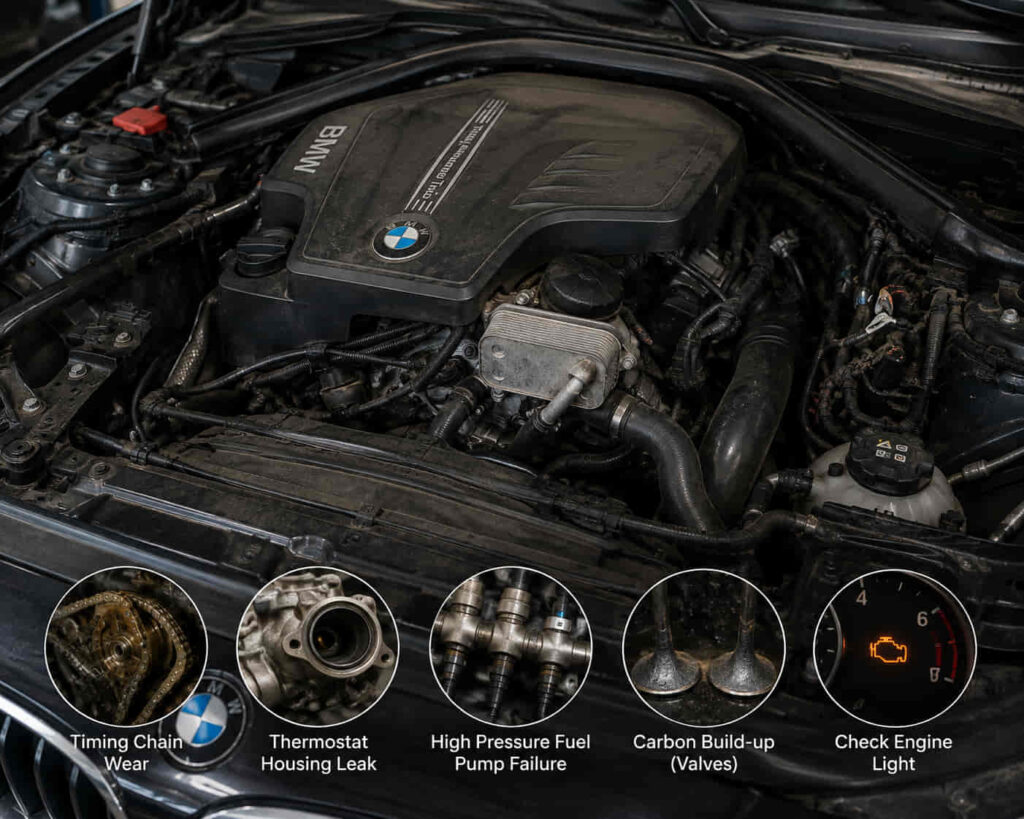
The BMW N20 has several known problem areas, with timing-chain-related issues being among the most important to understand when evaluating engine reliability. Other concerns can involve oil leaks around engine sealing points, valve cover problems, oil filter housing leaks, turbocharger-related faults, and cooling-system issues. These problems do not have the same cause or mechanical consequence, so an N20 should be evaluated according to the specific symptoms, service history, and condition of the engine rather than assuming every example will develop the same failures.
The severity of BMW N20 engine problems also varies substantially. An external oil leak can begin as a localized sealing issue, while a timing-system problem can create a greater mechanical risk if correct valve timing is affected. Turbocharger and cooling-system faults introduce different failure mechanisms again because they influence boost performance and engine-temperature control. A warning light, unusual noise, oil loss, reduced performance, or abnormal engine temperature therefore needs to be connected to the component actually responsible for the symptom before a repair decision is made.
This article explains seven common BMW N20 engine problems by examining what can fail, how each problem affects engine operation, which symptoms can indicate a developing fault, and why correct diagnosis matters. For owners and used-BMW buyers, understanding these distinctions provides a stronger basis for evaluating N20 reliability than treating the engine as either universally reliable or universally problematic.
Can timing chain problems affect the BMW N20 engine?
Yes, timing chain problems can seriously affect a BMW N20 because the timing system keeps the crankshaft and camshafts synchronized during engine operation. If the chain can no longer maintain correct timing, valve operation and piston movement may no longer remain properly coordinated. The severity therefore extends beyond abnormal engine noise; a sufficiently advanced timing problem can interfere with engine operation and create a risk of internal mechanical damage.
A developing timing-system problem can produce symptoms before complete failure occurs. Unusual whining, rattling, or other timing-area noises can justify further inspection, particularly when they appear consistently or change with engine operation. Engine-running problems or warning messages can also accompany timing faults, but these symptoms are not exclusive to the timing chain. Noise or a check-engine warning alone should therefore be treated as diagnostic evidence rather than proof that the chain itself has failed.
The condition of the components controlling the chain is also important. A timing chain does not operate independently; guides and tension-related components help maintain its intended path and control. Wear or failure elsewhere in this system can affect chain behavior even when the chain is not the original source of the problem. This is why diagnosing an N20 timing issue requires evaluating the timing system rather than assuming that replacing one component automatically addresses every related fault.
Timing-chain concerns also matter when evaluating a used BMW with an N20 engine. Service and repair documentation can establish whether timing-system work has previously been performed and provide context about the engine’s maintenance history. An undocumented vehicle should not automatically be classified as defective, but its current mechanical condition becomes more important because the buyer has less evidence about previous timing-system inspection or repair.
A suspected timing problem should be diagnosed before it progresses into a larger mechanical issue. The important relationship is timing-system fault → loss of timing control → abnormal engine operation → potential internal damage. This makes timing-chain condition more consequential than many external leaks that can initially remain localized to a sealing point.
Can timing chain guide problems damage a BMW N20 engine?
Yes, damaged or deteriorated timing chain guides can create a serious BMW N20 engine problem because the guides help control the chain as it travels through the timing system. When guide integrity is compromised, chain movement and control can be affected, increasing the risk that the timing system will no longer operate as intended.
The guide problem should be distinguished from the timing chain itself. Although the two components work within the same system, guide deterioration and chain condition describe different failure points. A timing-related symptom can therefore require inspection of the guides, chain, tensioning components, and overall timing operation rather than diagnosis based on one component name alone.
Changes in timing-system noise can provide a reason for investigation, but sound alone cannot identify which component has failed. A noise originating near the timing system can have more than one mechanical source, and its character can vary according to operating conditions. Correct diagnosis connects the symptom with physical or diagnostic evidence before determining whether the guide, chain, tensioning system, or another component requires repair.
The mechanical consequence becomes more significant if guide deterioration prevents the chain from remaining correctly controlled. Changes in chain position or timing can affect the synchronization required for normal engine operation. If timing is lost sufficiently, the resulting problem can extend beyond the guide itself and expose internal engine components to damage. This explains why timing guide concerns receive disproportionate attention compared with problems that cause only a minor external fluid leak.
For a used N20-powered BMW, documented timing-system work can therefore be relevant to the purchase decision. The value of that documentation comes from showing what was inspected or replaced and when the work occurred, rather than simply proving that the vehicle has received general maintenance. When records are incomplete, a pre-purchase evaluation of the engine provides more useful evidence than assuming either that the timing guides are healthy or that failure is inevitable.
Timing chain guide problems are important because a relatively localized component fault can affect the operation of the entire timing system. The appropriate response is to establish the condition of the timing components and correct the actual failure point before loss of timing creates a more extensive engine repair.
Are oil leaks common problems on the BMW N20?
Oil leaks are an important problem to check on a BMW N20 because several sealing areas around the engine can allow oil to escape as components and seals age. An oil leak should be treated as a symptom with a specific source rather than as one generic N20 failure. The location matters because a leak from the valve-cover area has a different repair path and potential consequence from oil escaping around the oil filter housing or another sealing point.
External oil leakage occurs when a gasket, seal, housing interface, or related component no longer contains engine oil correctly. Heat cycles can affect sealing materials over time, while oil that escapes from an upper part of the engine can travel across surrounding surfaces before becoming visible. The location where oil accumulates or drips therefore does not necessarily identify where the leak began. Correct diagnosis requires tracing the oil back to its source.
The amount of oil being lost also changes the significance of the problem. A minor seep can initially create residue without producing a substantial change in engine oil level, whereas a more active leak can require repeated oil additions and increase the risk of operating with insufficient lubrication if it is ignored. Oil reaching nearby components can create additional concerns depending on where the leak originates and where the fluid travels.
Oil consumption and an external oil leak should also be separated during diagnosis. Both conditions can cause the measured engine oil level to decrease, but they describe different mechanisms. An external leak allows oil to escape from the engine through a sealing point, while oil consumption involves oil being lost through processes occurring within the engine or related systems. A falling oil level alone does not establish which mechanism is responsible.
For a used N20-powered BMW, visible oil residue and a history of repeated oil-level corrections justify identifying the source before purchase. Previous repair records can also show whether a known leak has already been addressed. The useful diagnostic sequence is oil loss → identify whether the loss is external → trace the external leak → determine the failed sealing point → repair the actual source. This approach is more accurate than treating every oil-stained N20 as having the same engine problem.
Can the valve cover cause BMW N20 engine problems?
Yes, problems involving the BMW N20 valve cover or its sealing area can cause oil leakage and other engine-operation symptoms depending on the specific failure. The valve cover closes the upper portion of the cylinder head, while its sealing system prevents engine oil from escaping around the mating surfaces. When sealing integrity deteriorates, oil can begin leaking from the valve-cover area and spread onto surrounding parts of the engine.
A valve-cover gasket leak and a damaged valve cover are not automatically the same repair. If the sealing material is responsible for the leak, the failure point differs from a cover that is physically damaged or no longer provides the required sealing surface. Diagnosis should therefore identify whether the oil is escaping through the gasket area, the cover itself, or another nearby component before replacement parts are selected.
Heat cycles are relevant because the upper engine repeatedly experiences substantial temperature changes during operation. Over time, sealing performance can deteriorate and oil can begin appearing around the perimeter of the valve-cover area. Depending on the location of the leak, oil may travel downward and make the source appear to be lower on the engine than it actually is. Cleaning and tracing the affected area can therefore provide stronger evidence than identifying the source solely from the lowest visible oil deposit.
Valve-cover-related faults can also extend beyond a straightforward external oil leak when functions integrated into the cover or its associated ventilation system are affected. In those cases, the engine can exhibit operating symptoms that require diagnosis beyond simply checking for visible oil. A rough-running condition or another engine symptom should not, however, be assigned automatically to the valve cover because ignition, fueling, air-management, and other engine faults can produce overlapping behavior.
The repair decision should therefore follow the confirmed failure mechanism. A leaking gasket requires restoration of the sealing interface, while a damaged cover or associated component problem requires the defective part itself to be addressed. Treating these as separate instances prevents a general observation such as “the N20 has a valve-cover problem” from replacing an actual diagnosis.
For owners and used-BMW buyers, valve-cover-area inspection is useful because an existing leak can reveal a current repair requirement even when the engine otherwise appears to run normally. Service records showing previous valve-cover or gasket work add context, but current condition remains important because documentation of an earlier repair does not prove that every sealing point on the engine is presently leak-free.
Read more: BMW X3 Coolant Leak
Can the oil filter housing gasket leak on a BMW N20?
Yes, the oil filter housing gasket can become a source of an external oil leak on a BMW N20 when the sealing interface no longer contains engine oil correctly. The oil filter housing is part of the engine’s lubrication system, and the gasket creates a seal where the housing interfaces with the engine. Once that seal deteriorates, oil can escape and spread across nearby engine components.
An oil filter housing gasket leak can initially appear as oil residue around the housing rather than a major loss of engine oil. As leakage progresses, more oil can collect on adjacent surfaces and travel downward, making the source less obvious during a basic inspection. This is why the lowest visible oil deposit should not automatically be treated as the origin of the leak. The diagnostic objective is to trace the oil back to the highest confirmed point where it is escaping.
Location also helps distinguish an oil filter housing leak from a valve-cover-area leak. Both problems can leave oil on the exterior of the N20, and fluid originating higher on the engine can migrate across other components. Cleaning the affected area and observing where fresh oil appears can provide more useful evidence than replacing a gasket solely because oil is present near it.
The severity depends on the amount of oil being lost and where the escaping oil travels. A small leak can begin as a localized sealing problem, while continued leakage can reduce engine oil level and contaminate surrounding areas. An owner who repeatedly needs to correct the oil level should therefore determine whether oil is escaping externally instead of treating each low-level condition as an isolated maintenance event.
Repairing the oil filter housing gasket addresses the sealing point responsible for the leak; adding engine oil only replaces the quantity already lost. The causal relationship is gasket deterioration → loss of sealing integrity → external oil leakage → potential reduction in engine oil level. Identifying that mechanism prevents a general BMW N20 oil leak from being assigned to the wrong gasket or housing.
For a used BMW equipped with the N20, evidence of oil around the filter housing deserves inspection even when the engine currently runs normally. Service documentation showing previous gasket work can provide useful context, but current condition remains the deciding factor. A previous repair does not establish that the area is currently leak-free or that oil visible nearby originates from the same historical problem.
Can the turbocharger cause problems on a BMW N20?
Yes, turbocharger-related faults can affect BMW N20 engine performance because the turbocharger supplies compressed intake air that allows the engine to produce its intended boosted output. When the turbocharging system cannot generate or control boost correctly, the driver can experience reduced performance, abnormal boost behavior, warning messages, or other changes in engine operation. These symptoms require diagnosis because they do not identify the turbocharger itself as the failed component.
A loss of power illustrates this distinction. The N20 depends on several systems to manage airflow, boost pressure, fueling, ignition, and engine control. A boost leak, control-related fault, sensor problem, or another engine issue can therefore produce performance symptoms that resemble a defective turbocharger. Replacing the turbocharger based only on reduced acceleration can result in an expensive repair that does not correct the actual fault.
Oil-related symptoms require the same separation. A turbocharger operates with engine lubrication, so a turbo-related oil problem can have a different mechanism from an external valve cover or oil filter housing gasket leak. Oil loss, smoke, or residue should be traced to its source before it is attributed to the turbocharger. This keeps external engine sealing problems separate from faults involving the turbocharger and its associated oil supply or return system.
Noise can provide another diagnostic clue, but it should not be treated as standalone proof of turbocharger failure. Changes in turbo-related sound can justify inspection when they occur alongside reduced boost, performance changes, oil-related symptoms, or diagnostic faults. The useful relationship is abnormal symptom → verify boost and system operation → isolate the failed component, rather than unusual sound → replace turbocharger.
The consequence of a turbocharger problem also depends on the failure mechanism. A control or boost-related issue can primarily affect engine performance, while a mechanical or oil-related fault can require a different level of repair. Diagnosis should therefore establish whether the problem involves the turbocharger itself or one of the systems responsible for supplying, controlling, sealing, or measuring boosted airflow.
For a used N20-powered BMW, normal performance during a short test drive does not provide a complete assessment of turbocharger condition. Service history, diagnostic information, evidence of oil leakage, engine warning messages, and performance under appropriate operating conditions provide additional context. Turbocharger reliability should be evaluated as part of the complete N20 system rather than treating every boost-related symptom as proof that the turbo has failed.
Can cooling system problems affect BMW N20 reliability?
Yes, cooling system problems can affect BMW N20 reliability because the engine depends on controlled coolant circulation and temperature regulation to remain within its intended operating range. A cooling-system fault does not necessarily originate inside the N20 itself, but insufficient coolant flow, coolant loss, or inadequate temperature control can expose the engine to excessive heat. For this reason, cooling-system condition should be considered when evaluating the long-term reliability of an N20-powered BMW.
Coolant loss is one mechanism that can reduce cooling performance. A leak from a hose, connection, expansion tank, radiator, or another part of the cooling circuit can gradually lower the amount of coolant available to absorb and transfer engine heat. A small leak may initially appear only as a recurring low-coolant warning, while a faster loss can create a more immediate temperature-control problem. Adding coolant restores the fluid that has been lost but does not repair the component responsible for an active leak.
Water pump problems create a different failure mechanism because the pump is responsible for circulating coolant through the cooling system. A BMW can therefore contain coolant and still experience a temperature problem when circulation is inadequate. This distinction is important during diagnosis: coolant quantity and coolant circulation are separate conditions, and correcting one does not automatically correct the other.
Thermostat-related faults affect another part of the same process. The thermostat helps regulate coolant flow according to engine operating conditions, so a malfunction can interfere with normal temperature management even when the system contains the correct amount of coolant. Water pump and thermostat problems should therefore not be treated as interchangeable simply because both can produce cooling-system symptoms. Each component affects temperature control through a different mechanism.
Engine temperature provides critical context when a cooling-system problem develops. A low-coolant warning with stable engine temperature represents a different condition from a warning accompanied by abnormal temperature behavior or an overheating message. Once the system can no longer control engine heat correctly, continued operation can expose engine components to temperatures outside their intended range and increase the potential for more extensive damage.
This relationship explains why cooling-system maintenance matters to N20 reliability even when the original failure occurs outside the engine’s internal components. A coolant leak, water pump fault, or thermostat problem can begin as a supporting-system failure but become an engine reliability problem if it results in overheating. The mechanical consequence therefore depends not only on which component failed but also on whether the fault compromises engine-temperature control.
For owners, recurring coolant loss, temperature warnings, or abnormal cooling-system behavior should be diagnosed rather than repeatedly treated at the symptom level. For used-BMW buyers, service records showing cooling-system repairs provide useful context, but they should be considered alongside the vehicle’s present condition. A pre-purchase inspection can help establish whether coolant is being retained correctly, whether the cooling system is operating normally, and whether there is evidence of an unresolved temperature-control problem.
Cooling-system problems do not make every BMW N20 unreliable, but unresolved cooling faults can materially affect engine durability when they lead to overheating. Evaluating coolant condition, circulation, temperature regulation, maintenance history, and current engine behavior provides a stronger reliability assessment than judging the N20 solely by the presence or absence of one known problem.