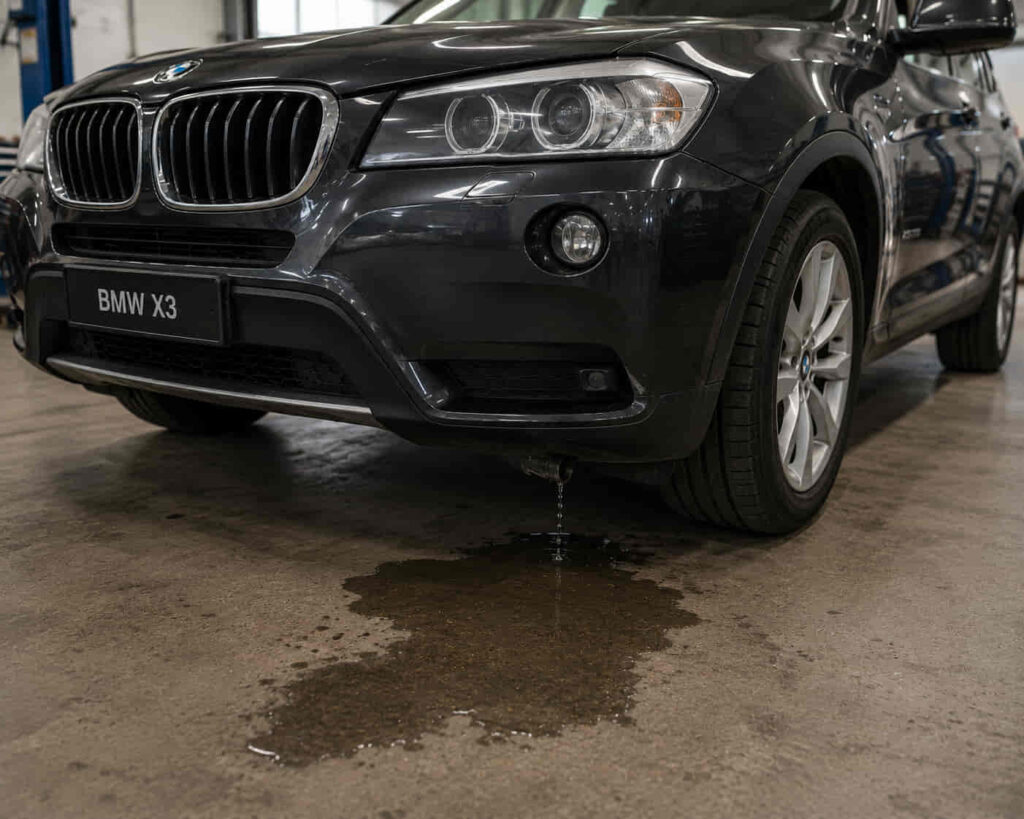
A BMW X3 coolant leak occurs when coolant escapes from the cooling system through a damaged component, connection, or sealing point. The leak can develop around parts such as the expansion tank, coolant hoses and connections, radiator, water pump, thermostat housing, or other sealing areas within the cooling circuit. The location and rate of coolant loss determine how quickly the problem affects coolant level and engine cooling.
A coolant leak should be distinguished from a low coolant level. Low coolant describes the amount of fluid remaining in the system, while a leak describes one mechanism that can cause that amount to decrease. As coolant escapes, the level can eventually fall enough to trigger a warning and reduce the cooling system’s ability to control engine temperature. A small leak may produce gradual coolant loss, whereas a larger leak can create a faster loss and increase the risk of overheating.
Adding coolant can restore the amount of fluid in the system, but it does not repair the component responsible for an active leak. A BMW X3 that repeatedly requires coolant therefore needs the source of the loss identified rather than relying on continued top-ups. This article explains seven common sources of a BMW X3 coolant leak, how each one can allow coolant to escape, and why identifying the actual leak location is necessary before deciding on the correct repair.
Can the expansion tank cause a BMW X3 coolant leak?
Yes, a damaged expansion tank can cause a BMW X3 coolant leak when a crack, seam, connection, or sealing area allows coolant to escape from the cooling system. The expansion tank contains coolant while accommodating changes in coolant volume as engine temperature changes. Because it forms part of the sealed cooling circuit, a loss of integrity at the tank can directly reduce the amount of coolant remaining in the system.
The expansion tank repeatedly experiences heating and cooling as the BMW X3 moves between cold starts and normal operating temperature. These temperature cycles change coolant volume and place the cooling system under different operating conditions. If the tank develops a damaged area, coolant can escape when the system is operating, gradually lowering the level even when the vehicle initially shows no obvious overheating symptoms.
The rate of coolant loss determines how the problem presents. A small leak can produce a gradual decrease that becomes noticeable only when the low-coolant warning returns after previous top-ups. A larger leak can remove coolant more quickly and create visible evidence around the tank or surrounding components. In either case, adding coolant restores the lost quantity but leaves the damaged area responsible for the leak unchanged.
Coolant residue near the expansion tank can provide useful diagnostic evidence, but its presence should not automatically lead to replacement of the tank. Coolant can travel from another leaking connection and collect around nearby components, making the apparent leak location different from its actual source. Diagnosis should establish where coolant first escapes before identifying the expansion tank as the failed component.
A leaking expansion tank becomes more serious when coolant loss begins affecting engine temperature. The leak itself reduces coolant quantity, while insufficient coolant can eventually reduce the system’s ability to transfer engine heat effectively. If the X3 develops an overheating warning or abnormal temperature behavior alongside rapid coolant loss, the condition requires more urgent attention than a slow leak with stable engine temperature.
Can the expansion tank cap cause a BMW X3 coolant leak?
Yes, an expansion tank cap can contribute to a BMW X3 coolant leak when it no longer seals or manages cooling-system pressure as intended. The cap is not simply a cover for the coolant reservoir. It forms part of the system that contains coolant under changing temperature and pressure conditions, so a sealing problem around this area can allow coolant to escape.
This leak mechanism differs from a cracked expansion tank. With tank damage, coolant escapes through the compromised tank structure or an associated connection. With a cap-related problem, coolant loss is associated with the sealing or pressure-management point at the reservoir opening. Keeping these mechanisms separate matters because coolant found around the top of the expansion tank does not by itself prove whether the tank or cap is responsible.
A cap-related leak can become more noticeable as the engine reaches operating temperature and conditions within the cooling system change. This helps explain why a BMW X3 can lose coolant during driving even when no obvious puddle appears beneath the vehicle after it has been parked. The operating conditions under which coolant escapes are therefore relevant when tracing the source.
Repeatedly adding coolant does not correct a cap that cannot maintain the required seal. The coolant level can return to normal immediately after a top-up and then decline again as coolant continues escaping. The correct causal relationship is sealing fault → coolant loss → declining coolant level → recurring warning, so repair needs to address the sealing problem rather than only its low-coolant consequence.
Coolant residue around the cap still requires diagnosis before the cap is identified as the cause. An overfilled system, leakage from an adjacent area, or another cooling-system problem can produce evidence in the same general location. Confirming the actual source prevents a visible symptom from being treated as proof that one specific component has failed.
Read more: BMW Coolant Light On
Can coolant hoses cause a BMW X3 coolant leak?
Yes, damaged coolant hoses or compromised hose connections can cause a BMW X3 coolant leak by allowing coolant to escape from the cooling circuit. Coolant hoses carry fluid between major cooling-system components, so the hoses and their connection points must remain sealed while exposed to changing temperatures and system pressure. A loss of integrity anywhere along this path can reduce the amount of coolant available for engine cooling.
A hose-related leak can develop in the hose itself or around the point where it connects to another component. Repeated heat cycles, material deterioration, physical damage, or a sealing problem at a connection can create a path for coolant to escape. The exact failure point matters because replacing a hose does not correct a leak that actually originates from an adjacent fitting, seal, or component.
Operating conditions can make some hose leaks easier to detect. A small leak may release little or no visible coolant while the BMW X3 is cold but become more apparent after the cooling system reaches operating temperature. This can create a pattern in which the owner notices a recurring drop in coolant level without consistently finding a puddle beneath the vehicle. The absence of visible coolant while parked therefore does not establish that every hose and connection is sealed.
The amount of coolant being lost determines the effect on the vehicle. A slow leak can initially produce recurring low-coolant warnings while engine temperature remains normal. A larger hose failure can reduce coolant quantity much faster and compromise the cooling system’s ability to control engine heat. Coolant loss accompanied by abnormal engine temperature or an overheating warning requires more urgent attention because the problem has progressed beyond coolant level alone.
Adding coolant can temporarily restore the correct level, but it cannot restore the integrity of a damaged hose or leaking connection. When the BMW X3 repeatedly loses coolant, diagnosis should trace the leak to its actual starting point before parts are replaced. This separates the observable symptom of low coolant from the physical defect responsible for it.
Can the radiator cause a BMW X3 coolant leak?
Yes, a damaged radiator can cause a BMW X3 coolant leak when coolant escapes through the radiator itself or one of its connection areas. The radiator forms part of the sealed coolant circuit and helps transfer engine heat to the surrounding air. A loss of integrity at the radiator can therefore create both coolant loss and, if the loss becomes substantial enough, reduced cooling-system performance.
A radiator leak should be distinguished from a radiator that is inefficient at transferring heat. Both conditions involve the same component, but they represent different attributes. A coolant leak concerns the radiator’s ability to contain coolant, whereas restricted or inefficient heat transfer concerns its ability to reject heat. For the BMW X3 coolant leak search intent, the relevant mechanism is radiator damage or sealing failure → coolant escape → declining coolant level.
The radiator’s location also exposes it to operating conditions that differ from components protected deeper within the engine compartment. Temperature changes, vibration, connections to the cooling circuit, and external damage can affect system integrity. The resulting leak can range from gradual seepage to more substantial coolant loss, so the presence of a radiator fault does not establish one universal rate of leakage.
Visible coolant or residue near the radiator can help locate the problem, but the first visible wet area is not necessarily the exact source. Coolant can move along adjacent surfaces before collecting or dripping from a lower point. A leak from a hose connection near the radiator can therefore resemble a radiator leak during a basic visual inspection. Correct diagnosis identifies where coolant begins escaping rather than where it eventually becomes visible.
Recurring coolant loss is particularly important when the reservoir has already been topped up. If the level drops again, adding more coolant only replaces the fluid that escaped. Repairing a radiator leak restores cooling-system integrity; topping up coolant restores only the quantity of coolant temporarily. This distinction explains why repeated top-ups are not a long-term solution for an active BMW X3 coolant leak.
A radiator leak becomes increasingly serious as coolant loss affects engine-temperature control. A BMW X3 that is losing coolant rapidly or showing an overheating warning should not be treated in the same way as a vehicle with a minor leak and stable engine temperature. The actual coolant level, rate of loss, and temperature behavior together determine the urgency of diagnosis and repair.
Can the water pump cause a BMW X3 coolant leak?
Yes, a BMW X3 water pump can cause a coolant leak when coolant escapes through a failed sealing point, pump housing area, or connection associated with the pump. The water pump circulates coolant through the engine’s cooling circuit, but circulation and leakage are two different attributes of the component. For a BMW X3 coolant leak, the relevant problem is a loss of system integrity that allows coolant to leave the circuit.
A pump-related leak can reduce coolant level gradually or more rapidly depending on the location and severity of the failure. A smaller leak can first appear as recurring coolant loss, requiring the owner to add coolant periodically even though the vehicle continues operating at a normal temperature. A larger loss can reduce coolant quantity more quickly and increase the risk that the cooling system will no longer control engine temperature effectively.
The location of the water pump can also make a leak harder to identify than coolant escaping from an easily visible reservoir or upper hose. Coolant can travel across surrounding components before reaching a point where it becomes visible beneath the vehicle. As a result, the location of a drip does not necessarily identify the component where the leak started. Diagnosis needs to trace the coolant back to its actual source.
A water pump problem also requires a distinction between leakage and inadequate coolant circulation. A pump can have an operating problem without necessarily leaking coolant, while a leak around the pump does not by itself establish that coolant circulation has stopped. These conditions can also occur together, making engine-temperature behavior an important part of diagnosis.
This distinction becomes particularly important when a BMW X3 shows both coolant loss and abnormal engine temperature. A leaking pump can reduce coolant quantity, while a circulation problem can interfere with heat transfer through the cooling system. When both conditions are present, the risk is greater than with a small leak that has not affected engine temperature.
Adding coolant cannot repair the failed sealing point responsible for a pump-related leak. It replaces the fluid that has already escaped and may temporarily restore the correct coolant level, but the system can begin losing coolant again during subsequent operation. A lasting repair requires correcting the water-pump-related source of the leak and then restoring the cooling system to its proper operating condition.
Can the thermostat housing cause a BMW X3 coolant leak?
Yes, a BMW X3 can leak coolant around the thermostat housing or an associated sealing and connection point when that area no longer contains coolant correctly. The thermostat itself regulates coolant flow according to engine temperature, whereas a coolant leak concerns the physical integrity of the housing, seal, or connection around the thermostat assembly. These functions should be separated when diagnosing coolant loss.
This distinction prevents a common diagnostic oversimplification. A thermostat that does not regulate coolant flow correctly is a temperature-control problem, but that condition alone does not mean coolant is leaking. For the BMW X3 coolant leak context, the relevant causal relationship is housing or sealing fault → coolant escape → declining coolant level, rather than thermostat malfunction automatically causing coolant loss.
Temperature cycles can affect the way a leak around this area presents. Cooling-system components repeatedly move between cold and normal operating temperatures, while coolant conditions change as the engine warms. A compromised sealing area can therefore produce leakage that is more noticeable under operating conditions than during a visual inspection of a cold vehicle.
Coolant found near the thermostat housing should still be traced before the housing is identified as the failed component. A leak originating from a nearby hose, connection, or another component can travel across surrounding surfaces and collect in the same area. Replacing the thermostat housing without confirming the source can leave the actual leak unresolved.
Recurring coolant loss provides stronger evidence that system integrity needs to be investigated. If an owner restores the coolant level and the BMW X3 becomes low again, the missing coolant has to be accounted for rather than treating each warning as an isolated event. Diagnosis should establish whether coolant is escaping externally and identify the specific component or sealing point responsible.
Repairing a thermostat-housing leak addresses coolant containment, while replacing or servicing a malfunctioning thermostat addresses coolant-flow and temperature regulation. Keeping these two attributes separate produces a more accurate diagnosis and prevents a general cooling-system symptom from being assigned to the wrong failure mechanism.
Can cooling system seals and connections cause a BMW X3 coolant leak?
Yes, damaged seals and compromised connections can cause a BMW X3 coolant leak by creating an escape path at the points where cooling-system components join together. The cooling circuit relies on multiple sealed interfaces to keep coolant contained as it moves between components. When one of these sealing points loses integrity, coolant can escape even when the major component connected to it remains functional.
A connection-related leak can develop differently from a visible crack in an expansion tank, radiator, or hose. The component itself may remain structurally intact while the interface between two parts no longer seals correctly. This distinction matters because replacing an entire component is not automatically necessary when the actual source of coolant loss is a seal or connection associated with it. The repair should address the specific point where system integrity has been lost.
Temperature and pressure conditions can influence when the leak becomes visible. A compromised connection can appear relatively dry while the BMW X3 is cold and begin leaking more noticeably after the cooling system reaches operating conditions. This creates a common diagnostic challenge: the coolant level continues declining, but an inspection performed when the vehicle is parked may not reveal an obvious puddle or continuously wet component.
Coolant can also travel away from the original leak before it becomes visible. Fluid escaping from a connection higher in the engine compartment can move across nearby surfaces and eventually drip from a lower location. The point where coolant reaches the ground therefore does not necessarily identify the failed seal or connection. Tracing the coolant toward its origin provides stronger diagnostic evidence than replacing the component closest to the visible drip.
This mechanism helps explain why a BMW X3 can keep losing coolant even when no obvious leak is immediately visible. A small sealing fault can release coolant gradually under specific operating conditions, producing recurring low-coolant warnings before the leak becomes easy to observe. The pattern of repeated coolant loss is therefore important evidence that the system should be checked for integrity even when the source is not apparent during a basic visual inspection.
Repeated topping up does not resolve this type of problem. Adding coolant restores the quantity in the system, while repairing the failed seal or connection restores the system’s ability to retain that coolant. If the level continues dropping after being corrected, the source of the loss needs to be identified rather than treating each low-coolant warning as a separate event.
The urgency increases when coolant loss begins affecting engine temperature. A minor leak with stable coolant level and normal engine temperature represents a different operating condition from rapid coolant loss accompanied by an overheating warning. If the BMW X3 cannot retain enough coolant to control engine heat correctly, continued operation can increase the risk of engine damage. The rate of coolant loss and engine-temperature behavior should therefore be evaluated together when determining how urgently the leak requires repair.