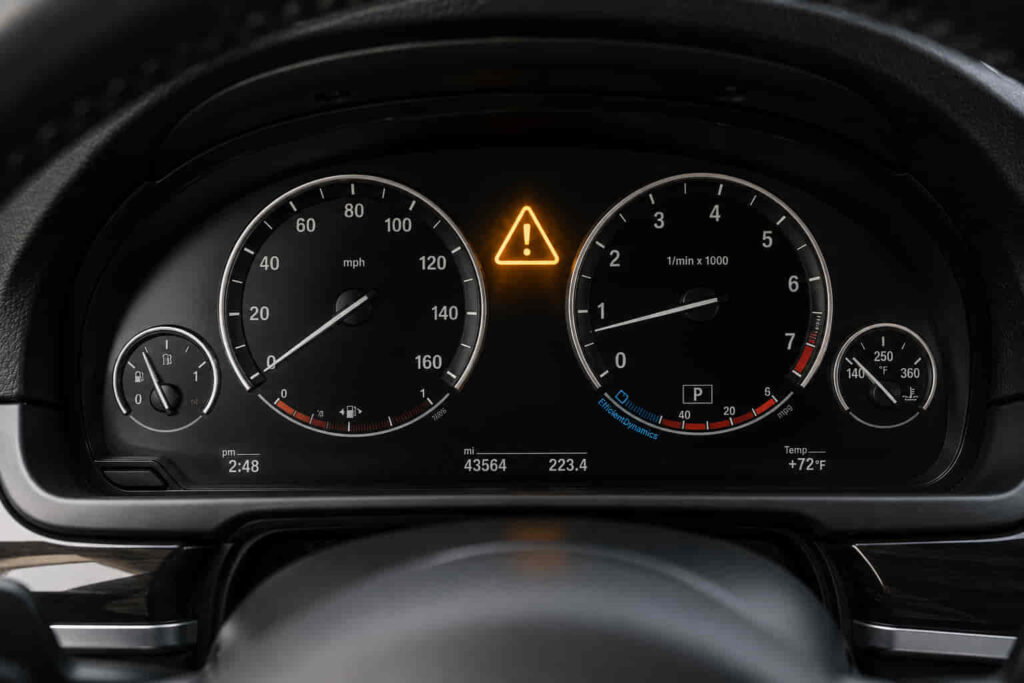
A BMW exclamation mark in a triangle indicates that the vehicle has a warning or Check Control notification requiring the driver’s attention. The triangle itself does not identify one specific mechanical failure. Instead, it acts as a general attention indicator, so the associated warning message provides the information needed to understand what the BMW is reporting.
The urgency of the warning therefore depends on the condition behind the symbol. A triangle can remain visible while a Check Control message or vehicle-status notification requires review, but the icon alone is not enough to determine whether the vehicle needs immediate repair. The correct first step is to retrieve and read the associated message through the vehicle’s available display or Check Control interface, then evaluate the condition described there.
Drivers should also avoid clearing the warning repeatedly without determining why it appeared. Removing an indicator from the display does not repair the condition that triggered it, and a warning that returns requires further investigation. This guide explains what the BMW triangle with an exclamation mark means, why it appears, how to find the associated warning, whether it is safe to continue driving, and how to diagnose and resolve the underlying condition.
What Does the Exclamation Mark in a Triangle Mean on a BMW?
The exclamation mark in a triangle on a BMW is an attention indicator that tells the driver to check an associated warning or Check Control message. The triangle is not a diagnosis of one specific component failure. Its purpose is to alert the driver that the vehicle has information about a condition that requires review, while the accompanying message provides the context needed to determine what the warning actually concerns.
This distinction is important because the same general warning symbol should not be interpreted as proof that a particular BMW system has failed. Seeing the triangle does not, by itself, confirm an engine, braking, transmission, tire, or electrical problem. The driver needs to read the associated vehicle message before connecting the symbol to a specific system. Treating the triangle itself as a fault code can lead to an incorrect diagnosis because the icon communicates attention, not the complete cause.
The information displayed with the warning is therefore more useful than the triangle alone. Depending on the BMW model, model year, and display system, the relevant information may appear in the instrument cluster or through the vehicle’s Check Control interface. The wording of that message narrows the warning from a general notification to a specific vehicle condition and provides a better basis for deciding what to do next.
The correct interpretation is therefore “check the associated BMW warning message,” not “replace a specific component.” Once the underlying message has been identified, the driver can determine whether the condition is informational, requires maintenance or inspection, or needs more immediate attention. This sequence prevents a generic dashboard symbol from being mistaken for a component-level diagnosis.
Why Is the Triangle With an Exclamation Mark Showing on My BMW?
The triangle with an exclamation mark appears because the BMW has an active warning, status condition, or Check Control notification that requires the driver’s attention. The underlying condition triggers the notification, while the triangle provides a visible indication that information needs to be reviewed. The actual reason for the warning must therefore be identified from the message associated with the symbol.
The warning can remain relevant even when the vehicle appears to drive normally. A BMW can detect or record a condition before the driver notices an obvious change in vehicle behavior. For this reason, the absence of unusual noise, reduced performance, or another physical symptom does not make the triangle meaningless. The associated message remains the primary piece of information for determining why the indicator is present.
The triangle can also be misunderstood when drivers focus on the symbol but overlook the notification connected to it. A BMW warning indicator communicates that attention is required, while the Check Control information explains what requires that attention. This relationship is why searching for a single universal “cause” of the triangle can be misleading. Different underlying conditions can produce a need for driver notification without representing the same mechanical problem.
If the triangle appears again after disappearing or being cleared, the underlying condition should be checked rather than assuming the warning itself is defective. A recurring notification indicates that the BMW continues to recognize a condition that meets the criteria for displaying the warning. The next diagnostic step is therefore to retrieve the associated message and use that information to determine which vehicle system or condition requires investigation.
How Do You Check the Warning Message Behind the BMW Triangle Symbol?
Check the message associated with the BMW triangle symbol through the instrument cluster or the vehicle’s available Check Control interface. The objective is to move from the generic triangle indicator to the specific information recorded or displayed by the vehicle. That message provides the context required to assess the cause and urgency of the warning.
The exact way to access Check Control information can vary between BMW models, model years, instrument clusters, and iDrive generations. For that reason, one menu sequence should not be treated as universal for every BMW. Some vehicles present the relevant information directly in the instrument display, while others provide additional vehicle-status or Check Control information through the central interface. The vehicle-specific display should be used to retrieve the warning rather than relying only on the appearance of the triangle.
Once the message is visible, its wording should guide the next action. A notification that identifies a particular vehicle condition provides substantially more diagnostic value than the triangle by itself. If the message describes a condition that can be checked directly, that condition should be evaluated first. If it identifies a fault that requires testing, the affected system becomes the focus of diagnosis.
Do not erase or repeatedly dismiss the message before recording what it says. The information can help connect the dashboard warning to the system that requires attention, especially when the triangle later disappears or the condition is intermittent. If the warning cannot be interpreted from the available display information, vehicle-specific diagnostic testing may be necessary to determine why the BMW generated the notification.
Is the BMW Triangle With an Exclamation Mark a Serious Warning?
The BMW triangle with an exclamation mark is not automatically a serious warning because its severity depends on the Check Control message or vehicle condition associated with it. The triangle tells the driver that attention is required, but the symbol alone does not establish whether the underlying condition is minor, maintenance-related, or serious enough to require immediate action.
Severity should therefore be assessed from the information accompanying the warning rather than from the triangle’s appearance alone. A notification concerning a condition that does not immediately affect vehicle operation requires a different response from a warning that indicates a safety-related or potentially damaging condition. This is why identifying the associated message is the first step before deciding how urgently the BMW needs attention.
Vehicle behavior provides additional context after the message has been identified. A triangle accompanied by abnormal engine operation, reduced vehicle performance, unusual noises, smoke, overheating, or another significant symptom deserves greater attention than an isolated notification with no change in how the vehicle operates. These symptoms do not change the meaning of the triangle itself; they change the risk associated with the underlying condition.
Do not use the triangle symbol alone to classify a BMW problem as safe or dangerous. Read the associated warning, determine which vehicle system it concerns, and follow any instructions displayed by the vehicle. If the message identifies a condition that requires immediate action, the urgency comes from that condition rather than from the generic triangle indicator.
Can You Drive With the Exclamation Mark in a Triangle on a BMW?
You can only determine whether it is safe to drive with the BMW exclamation mark in a triangle after checking the warning message associated with the symbol. The triangle alone does not provide enough information to make a reliable continue-driving or stop-driving decision because different vehicle conditions can generate notifications requiring different responses.
If the associated message indicates a condition that allows continued operation, the vehicle may still require monitoring, maintenance, or inspection even when it appears to drive normally. Continuing to drive does not mean the warning should be ignored. The underlying condition remains relevant until it is resolved or the vehicle confirms that the condition is no longer present.
Continued driving becomes a different decision when the warning is accompanied by a significant change in vehicle behavior or a message instructing the driver to stop, reduce operation, or seek assistance. Abnormal engine behavior, overheating, smoke, major loss of vehicle function, or another serious symptom should not be dismissed simply because the dashboard also displays a generic triangle. In this situation, the specific warning and physical symptoms determine the appropriate response.
Stop or limit vehicle operation when the associated BMW warning specifically requires it or when the vehicle shows symptoms that make continued driving unsafe. If the message does not clearly explain the condition, identifying the affected system should take priority over guessing whether the triangle is safe to ignore.
The same principle applies when the triangle disappears after the vehicle is restarted. A warning that is no longer visible does not necessarily prove that the underlying condition has been repaired. An intermittent condition can stop meeting the threshold for an active notification and later return. Checking available vehicle information and monitoring for recurrence provides a stronger basis for action than assuming that disappearance of the symbol means the problem has permanently resolved.
How Do You Diagnose the Cause of a BMW Triangle Warning?
Diagnosing a BMW triangle warning starts by identifying the associated Check Control message and then examining the vehicle system or condition referenced by that message. The triangle should not be used as the diagnostic endpoint because it indicates that attention is required without identifying a single failed component.
The diagnostic sequence begins with the information already provided by the vehicle. The message should be recorded and interpreted in the context of the BMW model, model year, current vehicle behavior, and any other warning indicators present at the same time. This creates a narrower diagnostic context than beginning with the triangle and checking unrelated vehicle components.
The next stage is to verify the condition described by the message. A warning linked to a specific system should direct inspection toward that system rather than toward every possible reason a dashboard warning could appear. This relationship between the warning message and the diagnostic process reduces unnecessary component replacement and prevents the general triangle indicator from being treated as evidence of a particular mechanical failure.
Vehicle-specific diagnostic testing becomes necessary when the displayed information does not identify the underlying problem with enough precision. Diagnostic data can then be evaluated together with the warning message and physical symptoms to determine whether a component, sensor, electrical circuit, maintenance condition, or another monitored function requires attention. The objective is to confirm the condition before recommending a repair.
A complete diagnosis identifies why the BMW generated the warning, not merely how to remove the triangle from the display. Once the underlying condition is confirmed, the appropriate repair or corrective action can be selected. Clearing the warning before this step can remove useful information without resolving the reason it appeared.
How Do You Fix the Exclamation Mark in a Triangle on a BMW?
You fix the BMW exclamation mark in a triangle by identifying and correcting the condition that triggered the associated warning message. The triangle itself is an indicator rather than a component that requires repair, so the correct fix depends on what the BMW Check Control system is reporting.
The repair process should begin with the warning information already available from the vehicle. Once the associated message identifies the affected condition or system, that information provides the direction for inspection. A maintenance-related notification requires a different response from a warning caused by a component or monitored vehicle system. Treating every triangle warning as the same fault can lead to unnecessary repairs because the symbol can represent different underlying conditions.
A warning linked to a confirmed vehicle fault requires correction of that fault before the problem can be considered resolved. This may involve servicing a system, repairing a failed component, correcting an electrical or monitored condition, or completing required maintenance, depending on what diagnosis confirms. The important relationship is underlying condition → diagnosis → corrective action → warning status. Removing the visible indicator without completing this sequence does not establish that the original problem has been fixed.
The BMW should be checked again after the corrective action to confirm that the triggering condition is no longer present. If the triangle or associated message returns, further diagnosis is necessary because the original condition may remain active, the repair may not have addressed its actual cause, or another related condition may be generating the notification.
The repair is complete when the condition responsible for the warning has been corrected and the BMW no longer detects the reason for that warning. This approach treats the Check Control information as diagnostic context rather than focusing only on making a dashboard symbol disappear.
How Do You Clear the Triangle With an Exclamation Mark on a BMW?
The BMW triangle with an exclamation mark should be cleared by resolving the condition behind its warning and then following the appropriate vehicle-specific procedure when a manual reset is required. Clearing and fixing are not the same action. A reset changes the warning status or display, while a repair addresses the reason the vehicle generated the warning.
Some warning states can disappear after the triggering condition is no longer present, while other notifications may involve a vehicle-specific reset or service procedure. The exact process can differ by BMW model, model year, instrument cluster, and iDrive generation. A single reset sequence should therefore not be presented as a universal procedure for every BMW.
Repeatedly dismissing or resetting an active warning is not an effective repair strategy. If the vehicle continues to detect the same condition, the notification can return even after it has temporarily disappeared from the display. This behavior is useful diagnostic information because it shows that attention should remain on the underlying condition rather than on the dashboard icon itself.
The associated message should also be recorded before attempting to clear it, particularly when the warning is intermittent. Once a notification disappears, the driver may lose useful context about what occurred and which system requires investigation. Preserving that information makes subsequent diagnosis more precise if the warning returns.
Do not use a reset as proof that a BMW warning has been repaired. Confirm that the underlying condition has been corrected and verify that the associated warning does not return during subsequent vehicle operation. If it does return, the cause requires further investigation.
Why Does the BMW Triangle Warning Keep Coming Back?
A BMW triangle warning keeps returning when the vehicle continues to detect, or detects again, the condition responsible for the associated notification. Clearing the visible warning does not prevent recurrence when its trigger remains present.
An unresolved underlying condition is one explanation for repeated warnings. If a driver clears a notification without correcting the condition behind it, the vehicle can generate the warning again when its monitoring system recognizes the same state. In this situation, repeated resets address the display rather than the cause.
An intermittent condition can create a different pattern. The triangle may appear while the condition is detected, disappear when it is no longer active, and return when the condition occurs again. This pattern makes the accompanying message and the circumstances surrounding each occurrence important diagnostic evidence. Recording when the warning appears can help connect the notification to the affected system.
A warning can also return after a repair when the original diagnosis did not identify the actual cause or when the vehicle continues to recognize a related problem. The correct response is to reassess the warning message and diagnostic evidence rather than repeatedly clearing the indicator.
A recurring BMW exclamation mark in a triangle should be treated as evidence that the warning condition requires further attention. The objective is to identify why the vehicle continues to generate the notification and resolve that condition so the warning no longer needs to be displayed.
Does the Triangle Exclamation Mark Mean the Same Thing on Every BMW?
The triangle with an exclamation mark does not necessarily appear or behave identically on every BMW because warning presentation can vary by model, model year, instrument cluster, and vehicle interface. The underlying principle remains similar: the symbol directs the driver’s attention to vehicle information that should be reviewed. However, the location of that information and the way the warning is displayed can differ between BMW vehicles.
This distinction matters because BMW has used different instrument clusters and generations of vehicle interfaces across its model range. A procedure used to retrieve warning information on one BMW should not automatically be applied to every 3 Series, 5 Series, X3, X5, or other model. The vehicle’s specific display and Check Control functions determine where the driver should look for additional information.
The same caution applies when interpreting screenshots or instructions found for another BMW model. Two vehicles can display visually similar triangle symbols while presenting the associated information differently. Model-specific context is therefore more reliable than identifying the icon and assuming that every BMW follows an identical menu sequence or warning behavior.
The associated message remains more important than the triangle’s appearance when identifying the actual condition. Regardless of how a particular BMW presents the warning, diagnosis should move from the general indicator to the specific vehicle information and then to the system or condition referenced by that information.
When Should a BMW Triangle Warning Be Checked by a Repair Shop?
A BMW triangle warning should be checked by a repair shop when the associated message identifies a fault requiring diagnosis, the warning repeatedly returns, vehicle behavior changes, or the driver cannot determine the underlying condition from the available Check Control information. Professional inspection becomes particularly important when the warning cannot be resolved through the action specified by the vehicle.
A recurring warning provides a clear reason for further diagnosis because the BMW continues to detect a condition that triggers the notification. Simply clearing the triangle each time removes the visible indication without establishing why it returns. A technician can use the associated message, vehicle symptoms, and diagnostic information together to narrow the problem to the relevant system.
Changes in vehicle operation increase the need for inspection. A triangle displayed alongside abnormal engine behavior, reduced performance, unusual noises, overheating, smoke, or another significant symptom should not be treated as an isolated dashboard notification. The physical symptom and associated warning provide additional context for determining whether continued operation is appropriate and which system requires attention.
Professional diagnosis is also appropriate when the Check Control message is too general to identify the failed component. A warning message can identify the affected system without proving which individual part caused the condition. Diagnostic testing is then used to move from system-level information to a confirmed cause before parts are replaced. This prevents unnecessary repairs based solely on the presence of a dashboard symbol.
The BMW exclamation mark in a triangle should ultimately be treated as the beginning of a diagnostic process rather than as the diagnosis itself. Read the associated message first, determine the severity of the condition, follow any vehicle instructions, and investigate warnings that remain active or repeatedly return. When the underlying cause cannot be confirmed from the available vehicle information, a BMW-specific diagnostic inspection provides the evidence needed to determine the appropriate repair.