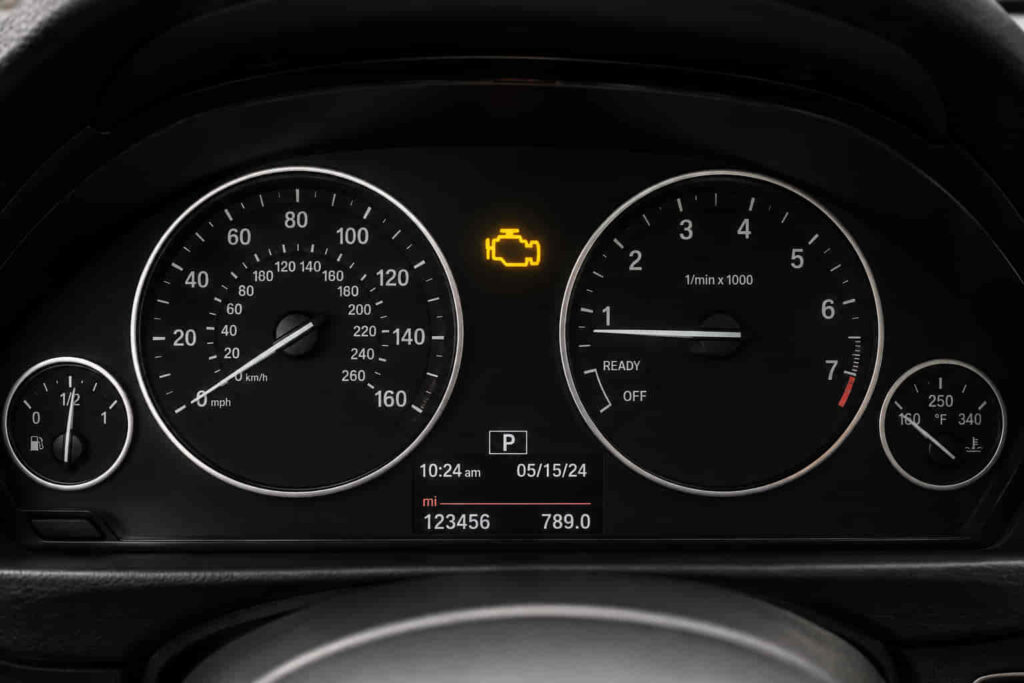
A BMW check engine light can come on even when the car drives normally because the engine management system can detect a fault before it causes noticeable symptoms. The light does not necessarily mean the engine has a serious mechanical problem, but it does mean the vehicle has detected a condition that requires attention. A loose or faulty gas cap, EVAP system fault, oxygen sensor issue, mass airflow sensor problem, intermittent ignition fault, or abnormal electrical voltage can trigger the warning while acceleration, idle quality, and fuel delivery still appear normal.
The warning should therefore not be ignored simply because the BMW feels fine. The DME, or Digital Motor Electronics control unit, continuously monitors engine and emissions-related systems. When monitored values fall outside an expected range, the system can store a diagnostic trouble code and illuminate the check engine light before the driver experiences rough idling, reduced power, poor acceleration, or other obvious symptoms.
The correct response depends on whether the check engine light is solid or flashing and whether other symptoms are present. A solid light with normal vehicle operation generally requires timely diagnosis, while a flashing light can indicate a more urgent fault. Reading the stored BMW fault codes is the most reliable starting point for identifying why the warning appeared and determining whether a repair is necessary.
Why Is My BMW Check Engine Light On When Nothing Seems Wrong?
Your BMW check engine light can be on even when nothing seems wrong because the Digital Motor Electronics (DME) can detect an engine or emissions-related fault before it produces noticeable driving symptoms. The warning light responds to information collected by the vehicle’s monitoring systems rather than to how normal the car feels from the driver’s seat. A BMW can therefore accelerate normally, maintain a stable idle, start without difficulty, and show no unusual noise while a diagnostic trouble code is already stored.
This happens because the DME continuously evaluates data from sensors and controlled systems involved in combustion, fuel delivery, ignition, airflow, and emissions. When a monitored value moves outside its expected operating range, the DME can register the condition as a fault. The problem may initially be too small or intermittent to affect engine performance enough for the driver to notice. For example, an emissions-related fault can trigger the check engine light even when engine power remains unchanged because the monitoring system has detected an abnormal condition rather than a major mechanical failure.
A BMW can also store a pending or intermittent fault before obvious symptoms develop. An electrical connection, sensor reading, ignition event, or emissions condition may fail only under a specific engine temperature, load, speed, or driving condition. The car can return to normal operation afterward, but diagnostic information from the event may remain available. This explains why a driver can see the check engine light after a journey while noticing no difference in acceleration, idle quality, or engine sound.
For this reason, a BMW check engine light should not be considered a warning that appeared “for no reason.” No noticeable symptoms and no detected fault are two different conditions. The warning may represent a relatively minor issue, an intermittent problem, or an early-stage fault that has not yet affected drivability. Reading the diagnostic trouble codes provides more useful evidence than assuming the BMW is problem-free because it still drives normally.
What Are the Most Common Causes of a BMW Check Engine Light With No Symptoms?
The most common causes of a BMW check engine light with no obvious symptoms involve the EVAP system, gas cap, oxygen sensors, mass airflow sensor, ignition components, electrical voltage, or another intermittent engine-management fault. These problems can affect values monitored by the DME without immediately producing rough running, power loss, hard starting, or another symptom the driver can feel.
A loose, damaged, or improperly sealing gas cap is one possible cause because the cap forms part of the evaporative emissions control system. The EVAP system is designed to contain fuel vapors rather than allowing them to escape into the atmosphere. A sealing problem can cause the vehicle to detect a leak in this system and store an emissions-related fault. Because this type of problem does not necessarily interfere directly with combustion, the BMW may continue to drive normally while the check engine light remains illuminated.
An EVAP fault can also originate elsewhere in the system rather than at the gas cap. A leak or malfunction affecting an EVAP component can cause the monitoring system to detect an unexpected pressure or vapor-control condition. The driver may notice no change in engine power because the detected problem primarily concerns emissions control. This is why checking the gas cap is a reasonable basic inspection, but replacing or tightening it should not be treated as a universal fix for a BMW check engine light.
An oxygen sensor can trigger the warning before the driver notices a significant change in performance. Oxygen sensors provide information that the engine-management system uses to monitor combustion and exhaust conditions. A sensor that responds incorrectly or produces readings outside the expected range can result in a fault code even while the DME continues to keep the engine running well enough that the problem is not obvious from the cabin. Diagnosis must distinguish between a sensor problem and another engine condition that caused the sensor to report an abnormal value.
A mass airflow sensor can produce a similar situation. The MAF sensor measures incoming air so the engine-management system can calculate appropriate operating parameters. Incorrect or inconsistent airflow information can trigger a diagnostic fault. A small deviation may initially be compensated for by the control system, leaving the driver with few noticeable symptoms. More substantial airflow measurement problems can eventually contribute to unstable idle, poor acceleration, or inefficient engine operation, but those symptoms do not have to appear at the same time as the warning light.
Ignition components such as spark plugs and ignition coils can also produce intermittent faults. A developing ignition problem may occur only under a particular engine load or operating condition and then disappear during normal driving. The DME can detect an abnormal combustion event and retain diagnostic information even though the engine feels smooth afterward. If the ignition problem progresses, more obvious symptoms such as misfiring, shaking, hesitation, or reduced power can develop.
Electrical voltage is another relevant diagnostic factor because modern BMW engine-management systems depend on stable electrical supply and communication between multiple electronic components. Abnormal voltage or an intermittent electrical condition can contribute to fault information being recorded even when the engine itself has no obvious mechanical symptom. This does not mean that every unexplained check engine light is caused by the battery; voltage should be evaluated as part of diagnosis when the stored faults or vehicle condition point in that direction.
The key distinction is that a fault code identifies a detected condition, not automatically a failed component. An oxygen-sensor-related code, for example, should not by itself be interpreted as an instruction to replace the oxygen sensor. The abnormal reading can have another underlying cause. Reading the code, examining the conditions associated with it, and testing the relevant system creates a more reliable diagnosis than replacing parts based solely on the component named in a code description.
Read more: How to Reset Ambient Temperature Sensor in BMW
Is It Safe to Drive a BMW When the Check Engine Light Is On but the Car Runs Fine?
A BMW is generally less urgent to drive when the check engine light is solid and the car runs normally than when the light is flashing, but the fault should still be diagnosed promptly. A solid warning can indicate that the DME has detected an engine-management or emissions-related condition without identifying an immediate loss of drivability. Normal acceleration, stable idle, normal engine temperature, and the absence of unusual noises reduce the signs of an acute problem, but they do not prove that the underlying fault is harmless.
The condition of the warning light is important because a solid and flashing check engine light can represent different levels of urgency. A solid light can accompany faults that do not immediately interfere with normal driving, including emissions-system or sensor-related problems. Continuing to drive for an extended period without diagnosis is still a poor strategy because an unresolved fault can persist, develop into a more noticeable problem, or make it harder to distinguish a new fault from the original one.
A flashing BMW check engine light requires more immediate attention because it can be associated with an active engine fault such as a significant misfire. A misfire means combustion is not occurring correctly in one or more cylinders. Depending on the underlying condition, continued operation can place additional stress on engine or emissions components. A BMW that begins shaking, hesitating, losing substantial power, or running severely rough while the check engine light flashes should not be treated like a vehicle with a steady warning and no symptoms.
The decision to keep driving should therefore be based on both the warning state and the vehicle’s behavior. Stop driving and arrange appropriate diagnosis when the check engine light is flashing and the engine is running badly, or when the warning is accompanied by severe shaking, major power loss, overheating, abnormal mechanical noise, smoke, or another sign of a serious malfunction. When the light remains solid and the BMW genuinely operates normally, the next step is to retrieve the stored diagnostic information rather than waiting for a noticeable symptom to appear.
What Should You Check First When a BMW Check Engine Light Comes On?
The first checks should establish whether the check engine light is solid or flashing, whether the BMW has developed any new symptoms, and which diagnostic trouble codes are stored in the DME. This sequence separates an urgent drivability problem from a warning that can be diagnosed systematically. It also prevents unnecessary component replacement based only on assumptions about what commonly causes the light.
Start by observing the warning itself and how the vehicle behaves. A solid light with a stable idle and normal acceleration presents a different diagnostic situation from a flashing light accompanied by shaking or hesitation. Engine temperature, starting behavior, acceleration, idle quality, unusual sounds, and noticeable changes in performance provide context for interpreting the warning. Recent events can also matter. For example, a warning that appears shortly after refueling gives a reason to inspect whether the fuel cap is installed and sealing correctly, but this observation alone does not confirm an EVAP fault.
The next important step is to retrieve the diagnostic trouble codes. A BMW should still be scanned when the check engine light is on even if the vehicle drives normally because the stored code provides evidence about the system in which the DME detected an abnormal condition. Without that information, diagnosing an apparently symptom-free warning becomes guesswork. The code can narrow the investigation toward areas such as emissions control, air measurement, fuel mixture, ignition, or another monitored engine-management function.
A generic OBD-II scanner can retrieve many standardized powertrain and emissions-related diagnostic trouble codes, making it useful as an initial diagnostic tool. BMW-specific diagnostic equipment can provide additional manufacturer-specific information where required. The amount of diagnostic detail matters when a generic code does not adequately identify the conditions surrounding a fault or when several related faults are stored.
A diagnostic trouble code should be interpreted as a starting point rather than a replacement instruction. For example, a code associated with an oxygen-sensor reading establishes that the DME detected a condition involving that monitored parameter; it does not prove by itself that the oxygen sensor is defective. Air leaks, combustion conditions, electrical problems, or other faults can influence the value being reported. Effective diagnosis connects the fault code with the relevant system, operating conditions, symptoms, and test results before identifying the component or condition responsible.
This distinction is particularly important when a BMW has a check engine light but appears to have nothing wrong. Replacing components based on code descriptions can temporarily change symptoms without addressing the actual cause. The correct diagnostic sequence is to retrieve the fault information, identify the affected system, test the likely causes, confirm the fault, and then perform the required repair. This approach turns an unexplained dashboard warning into a specific diagnostic problem instead of relying on trial-and-error parts replacement.
Can You Reset a BMW Check Engine Light When Nothing Seems Wrong?
You can reset a BMW check engine light, but clearing the warning does not diagnose or repair the fault that caused it. A reset removes diagnostic information or turns off the warning under certain conditions; it does not correct an EVAP leak, abnormal sensor signal, ignition fault, airflow problem, or another condition detected by the DME. If the underlying problem remains and the monitoring system detects it again, the check engine light can return.
This distinction matters when the BMW drives normally because the absence of symptoms can make clearing the light appear to have solved the problem. In reality, the vehicle may simply be between two stages of the diagnostic process. After fault information is cleared, the DME continues monitoring engine and emissions-related systems as the vehicle operates. When the conditions required to test the affected system occur again, an unresolved fault can be detected and recorded again. The warning can then return even though the driver never experienced rough idle, hesitation, power loss, or another obvious symptom.
For that reason, diagnostic trouble codes should ideally be retrieved before they are cleared. The stored information provides a starting point for identifying which system detected an abnormal condition. Clearing codes too early can remove useful diagnostic evidence and make an intermittent problem harder to investigate. This is particularly relevant when the warning appears only under specific conditions such as a certain engine temperature, load, driving cycle, or emissions-system test.
A BMW check engine light can also turn off without being manually reset when the system no longer detects the condition that originally triggered the warning. This can happen with temporary or intermittent faults. The disappearance of the warning, however, should not automatically be interpreted as proof that the underlying condition has been permanently corrected. Diagnostic information can remain relevant even after the dashboard light is no longer illuminated.
A check engine light that repeatedly disappears and returns provides a different diagnostic clue from a warning that remains continuously illuminated. Recurrence indicates that the DME is detecting the relevant condition again when particular monitoring requirements are met. Instead of repeatedly clearing the warning, the more useful approach is to identify the stored fault, determine when it occurs, test the affected system, and confirm the underlying cause.
Can a BMW Check Engine Light Be Intermittent?
A BMW check engine light can be intermittent when the DME detects a fault under specific operating conditions but does not detect the same condition continuously. The light may appear during one journey, disappear later, and return after several subsequent drives. This behavior does not mean the warning is random; it can indicate that the underlying fault itself occurs intermittently.
Intermittent faults can depend on engine temperature, electrical conditions, engine load, component operation, or the point at which a particular monitoring test is performed. A sensor signal, electrical connection, emissions-system condition, or ignition event may temporarily move outside its expected range and then return to normal. The BMW can consequently feel completely normal by the time the driver inspects it even though the DME previously recorded an abnormal event.
The timing of the warning can therefore provide useful diagnostic context. A light that repeatedly appears after refueling, during cold starts, under acceleration, or after the engine reaches operating temperature gives the diagnostic process more information than the warning light alone. The relationship does not establish the cause by itself, but it helps determine which operating conditions should be reproduced or examined when evaluating the stored fault codes.
Intermittent problems are also a reason not to diagnose a BMW solely from how it behaves during a short inspection. A vehicle may idle smoothly in a driveway while the fault occurs only during a different operating state. Stored fault information and the conditions surrounding the fault are therefore more reliable diagnostic evidence than the assumption that nothing is wrong because the BMW currently runs normally. When the warning repeatedly returns, the underlying condition should be identified rather than managed through repeated resets.
Can a BMW Battery Problem Cause the Check Engine Light to Come On?
A BMW battery or charging-system problem can contribute to engine-management fault codes when abnormal voltage affects electronic modules, sensors, or control-system operation. Modern BMW vehicles rely on stable electrical voltage for the DME and other electronic control units to communicate and process sensor signals correctly. When system voltage falls outside the expected operating range, the vehicle can record faults even though the engine still starts and appears to run normally.
Low voltage does not mean the battery is automatically responsible whenever a BMW check engine light appears. The warning can originate from numerous engine and emissions-related conditions, so battery replacement should not be treated as a default solution. Voltage becomes more relevant when diagnostic codes, starting behavior, electrical symptoms, battery condition, or charging-system measurements indicate an electrical supply problem. This follows the same diagnostic principle used for sensor-related codes: identify the detected condition first and confirm its cause before replacing a component.
Battery-related issues can also create confusing diagnostic situations because several faults may appear around the same period. A weak battery, charging-system problem, poor electrical connection, or voltage fluctuation can affect more than one electronic system. The resulting codes need to be interpreted together with voltage measurements and the circumstances in which they were recorded. A cluster of electrical faults therefore requires a different diagnostic approach from a single code consistently identifying one engine-management condition.
The correct approach is to test the electrical system when the evidence points toward voltage rather than assuming either that the battery is responsible or that it can be excluded because the BMW still starts. A vehicle can have sufficient electrical power to start and drive while still experiencing a voltage-related condition that deserves diagnosis. Confirming battery condition and charging-system performance can therefore form part of a BMW check engine light investigation when supported by the fault information.
How Much Does It Cost to Diagnose a BMW Check Engine Light?
The cost to diagnose a BMW check engine light depends on the diagnostic work required, and it should be separated from the cost of repairing the confirmed fault. Reading a diagnostic trouble code is only the beginning of diagnosis. Some warnings can be traced to a straightforward condition after code retrieval and basic testing, while intermittent or multi-system faults can require additional electrical tests, component measurements, live-data analysis, or reproduction of the conditions under which the fault occurs.
This distinction explains why a universal check engine light repair price is not meaningful. A warning caused by a sealing problem in the EVAP system requires different parts, labor, and testing from a warning associated with an ignition fault, airflow measurement problem, oxygen-sensor circuit, electrical issue, or another engine-management condition. Two BMWs displaying the same dashboard warning can therefore require completely different repairs.
Diagnostic cost can also vary according to the equipment and depth of testing required. A basic OBD-II code scan can identify standardized powertrain codes, but a complete BMW diagnosis may require manufacturer-specific fault information and additional testing. Paying only to retrieve a code is different from paying for a technician to determine why that code was stored. The second process provides the evidence needed to decide whether a component actually requires repair or replacement.
For this reason, the useful cost question is not simply “How much does it cost to turn off the BMW check engine light?” but “How much diagnosis is required to identify and confirm the underlying fault?” Once the cause is confirmed, an accurate repair estimate can be based on the affected component, required labor, replacement parts, and any additional testing needed to verify the repair.
When Should a BMW Check Engine Light Be Diagnosed by a Mechanic?
A BMW check engine light should be professionally diagnosed when it flashes, returns repeatedly, is accompanied by drivability problems, or cannot be explained through basic checks and fault-code retrieval. The urgency depends on the warning behavior and the symptoms occurring with it. A BMW that appears to drive normally with a solid check engine light presents a different level of urgency from one that shakes, loses power, overheats, or runs roughly while the warning flashes.
A flashing check engine light accompanied by severe engine symptoms requires prompt attention because the vehicle can be experiencing an active fault rather than a stored condition with no noticeable effect on drivability. Continuing to operate a BMW that is severely misfiring or showing other serious symptoms can allow the original problem to affect additional components. The appropriate response is therefore based on the complete vehicle condition, not solely on whether the car can physically continue moving.
A solid check engine light should also be diagnosed when it remains illuminated or repeatedly returns after being cleared. Repeated recurrence means the DME continues to detect a condition that meets the criteria for recording a fault. Clearing the code again changes the warning state but does not remove the reason the monitoring system detected the problem. Diagnosis becomes especially important when the fault is intermittent because the stored information can help identify operating conditions that are difficult to reproduce during a basic inspection.
Professional diagnosis is also appropriate when a scanner retrieves codes but the cause is unclear. A fault code narrows the diagnostic path; it does not always identify the component that must be replaced. A technician can combine the stored codes with BMW-specific diagnostic information, live data, electrical measurements, component tests, and the vehicle’s symptoms to determine what actually caused the warning.
A BMW check engine light with no noticeable symptoms is therefore not evidence that nothing is wrong. It indicates that the vehicle has detected a condition even though the driver may not yet feel its effects. A solid light on an otherwise normally operating BMW should be investigated in a timely manner, while a flashing light or warning accompanied by serious drivability symptoms requires substantially more urgent attention. In either case, identifying the stored fault and confirming its underlying cause is more reliable than ignoring the warning, repeatedly resetting it, or replacing parts through trial and error.