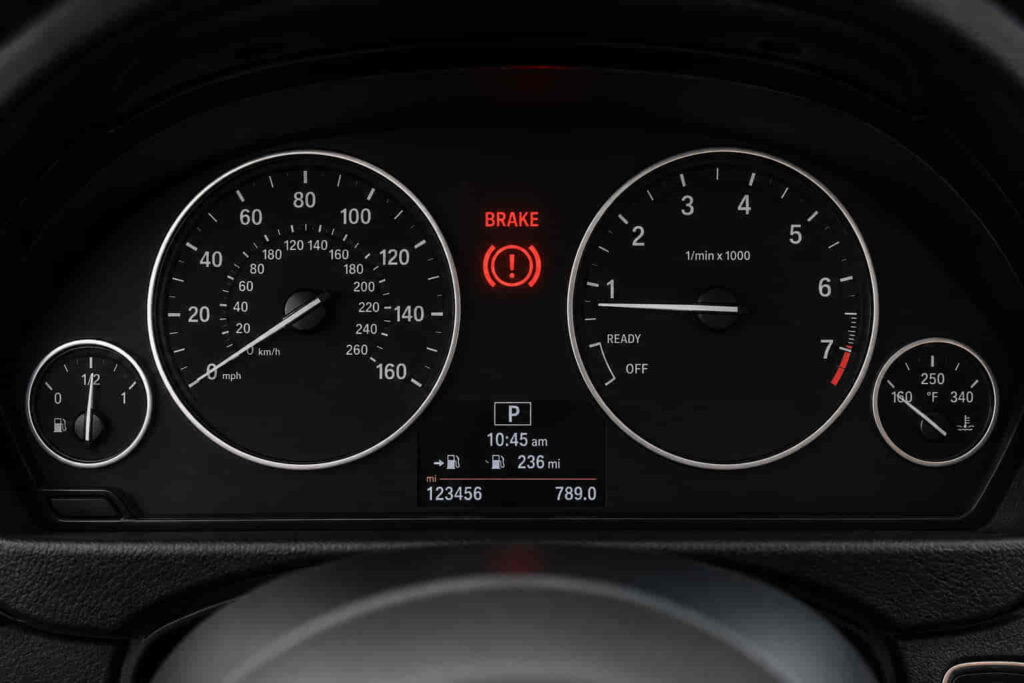
You can reset the brake service light on many BMW models through the instrument cluster after the brake service has been completed and the brake wear monitoring system is ready for a reset. The procedure typically involves switching on the ignition without starting the engine, opening the service menu, selecting the front or rear brake service item, and confirming the reset. The exact controls and menu sequence differ by BMW model, generation, and model year.
A BMW brake light should not be reset simply to remove a dashboard warning. BMW uses its Condition Based Service (CBS) system to track maintenance items such as front and rear brake service, while other brake warnings can indicate a worn brake pad sensor, low brake fluid, an engaged parking brake, or a fault that requires diagnosis. Resetting the service interval does not repair an unresolved brake problem.
This guide explains how to reset the brake light on a BMW, what to check before performing the reset, and why the system may display a reset failure after brake pad replacement. It also explains how to distinguish a brake service reminder from other brake warnings so you can determine whether a manual reset is appropriate or the braking system needs further inspection.
How Do You Reset the Brake Light on a BMW?
You can reset the brake service light on many BMW models by switching on the ignition without starting the engine, opening the service menu through the instrument cluster, selecting the front or rear brake service item, and confirming the reset. Perform the reset only after the required brake service has been completed. Resetting the reminder before correcting the underlying maintenance condition can clear or change service information without resolving the reason the warning appeared.
Start with the vehicle stationary and switch off unnecessary electrical accessories. Turn on the ignition without starting the engine. On BMW models equipped with a Start/Stop button, this generally means pressing the button without pressing the brake pedal. Allow the instrument cluster to complete its initial checks before attempting to enter the service menu. The exact control sequence varies between BMW generations, so the owner’s or service documentation for the specific model and model year takes priority when its procedure differs.
Access the service menu using the instrument cluster controls provided on the vehicle. On BMW models that support a cluster-based reset, holding the appropriate trip or odometer reset control brings up the service information menu. Navigate through the available service items until the brake symbol or relevant front or rear brake service entry appears. BMW’s Condition Based Service system can track front and rear brake maintenance separately, so select the service item that corresponds to the work that was actually completed.
Once the correct brake service item is displayed, activate the reset function and confirm it when the instrument cluster requests confirmation. Keep the ignition on while the reset is being processed. A successful reset updates the brake service information or service interval rather than merely making a warning disappear temporarily. Switch the ignition off after the process finishes, restart the vehicle, and check the instrument cluster again to confirm that the corresponding brake service reminder is no longer displayed.
A reset that fails or immediately returns should be treated as a diagnostic clue rather than a reason to repeatedly perform the same procedure. The brake pads, brake pad wear monitoring components, service data, or another part of the monitored system may still require attention. A manual service reset is designed to update maintenance information after the relevant work has been completed; it is not a repair method for an active brake-system fault.
Can You Reset a BMW Brake Light Without a Diagnostic Scanner?
Many BMW brake service reminders can be reset without a diagnostic scanner when the vehicle provides a reset function through its instrument cluster and the conditions for the reset have been satisfied. In these cases, the driver or technician uses the vehicle’s service menu to reset the relevant CBS brake service item. A scanner is therefore not automatically required simply because a brake service message remains visible after routine maintenance.
The distinction between a service reminder and a system fault determines whether a manual reset is appropriate. BMW’s CBS system stores maintenance information for monitored service items, and the instrument-cluster reset function provides a way to update eligible service data after maintenance. When the brake pads and related components have been serviced correctly and the vehicle accepts the new service state, the onboard controls may be sufficient to complete the reset.
A diagnostic scanner becomes more relevant when the vehicle refuses the manual reset, displays a reset failure, or continues to show a brake warning after the correct service procedure has been completed. Diagnostic equipment can provide information that a simple cluster reset cannot provide, including stored fault information and system data related to the warning. This distinction matters because repeatedly attempting a manual reset does not correct a component or monitoring fault that prevents the vehicle from accepting the reset.
The model and model year also affect the correct method. BMW has used different instrument clusters, controls, service interfaces, and electronic architectures across its vehicle generations. For that reason, a reset sequence that works on one BMW should not automatically be treated as a universal procedure for every BMW. The correct approach is to identify the exact vehicle and warning first, use the supported manual procedure when available, and move to diagnosis when the system does not accept the reset.
Read more: BMW Engine Light On But Nothing Wrong
Why Won’t My BMW Brake Light Reset?
A BMW brake light may not reset when the required brake service is incomplete, the brake pad wear monitoring system still detects a service condition, the wrong CBS service item is selected, or the vehicle has a fault that cannot be cleared through a manual service reset. A failed reset should therefore be used to identify what remains unresolved rather than treated as a dashboard problem that needs to be bypassed.
The first factor to check is whether the brake work associated with the warning has actually been completed. BMW can monitor front and rear brake service as separate Condition Based Service items, which means replacing or servicing one axle does not automatically satisfy the service condition for the other. The reset must correspond to the brake service that was performed. Selecting the wrong service item can leave the original reminder unchanged even when the reset sequence itself is performed correctly.
The brake pad wear monitoring system is another important factor when a warning remains after brake pad replacement. The wear sensor works with the brake service system to indicate brake pad condition and service requirements. If the relevant sensor or its associated circuit still indicates a wear condition, replacing the brake pads alone may not be sufficient to restore the system to a state in which the service information can be reset. This is why the brake pad, wear sensor, and displayed service item should be considered as parts of the same diagnostic context rather than as unrelated components.
The reset procedure itself can also cause a failed attempt. The vehicle must be placed in the correct ignition state, the appropriate service menu must be opened, and the correct front or rear brake item must be selected before the reset is confirmed. BMW models do not all use an identical sequence because instrument clusters, controls, and service interfaces differ between generations. Following a procedure intended for another model or model year can therefore produce a failed reset even when the braking components are functioning correctly.
A persistent warning requires diagnosis when the brake service has been completed and the correct manual reset procedure still fails. In that situation, repeatedly resetting the instrument cluster adds no diagnostic value. The next step is to inspect the relevant brake service components and use appropriate diagnostic equipment when necessary to determine whether the vehicle has stored faults or system information preventing the reset. A successful BMW brake light reset should follow a completed repair or maintenance procedure; it should not substitute for one.
Does the BMW Brake Pad Wear Sensor Need to Be Replaced Before Resetting the Light?
The BMW brake pad wear sensor should be inspected as part of brake service, and a sensor that has been triggered, worn, damaged, or otherwise requires replacement must be addressed before expecting the brake service warning to reset normally. Installing new brake pads while leaving an unresolved wear-sensor condition can result in the brake warning remaining active or the CBS brake service reset being rejected.
The brake pad wear sensor exists to connect the physical condition of the braking components with the vehicle’s monitoring system. As brake pad material wears down, the sensor can reach the point at which the monitoring circuit changes and the vehicle generates a service indication. The dashboard message is therefore not determined only by whether a new brake pad is physically present. The monitoring system must also receive information consistent with a serviced brake system.
This relationship explains a common situation in which the pads have already been changed but the BMW still displays a brake service message. New friction material resolves the mechanical wear of the pads, but it does not automatically resolve a sensor-related condition. The technician should inspect the sensor and its related connection rather than repeatedly attempting to clear the warning through the instrument cluster.
The sensor should not be assumed to be the cause of every failed reset. The correct diagnostic sequence is to confirm the brake work, identify whether the front or rear service item is involved, inspect the relevant monitoring components, verify that the proper reset procedure is being used, and investigate system faults when the warning persists. This keeps the diagnosis connected to the actual BMW brake service system instead of replacing parts solely because the service light remains illuminated.
Is a BMW Brake Service Light the Same as a Brake Warning Light?
A BMW brake service light is not necessarily the same as a brake system warning light. A brake service reminder generally relates to scheduled or condition-based maintenance, while another brake warning can indicate a condition involving the parking brake, brake fluid, brake pad wear monitoring, or the braking system itself. Identifying the exact warning is therefore necessary before attempting a reset.
BMW’s Condition Based Service system monitors maintenance requirements and can display service information for the front and rear brakes. When the displayed message specifically relates to brake service, the reminder may be eligible for a CBS reset after the required maintenance has been completed. This is the type of warning addressed by the instrument-cluster reset procedure described earlier. The purpose of that reset is to update the vehicle’s service information after maintenance, not to suppress an active braking-system problem.
A red brake warning requires a different approach because the color and message can represent a condition that needs immediate attention rather than routine service data. The exact meaning depends on the BMW model, model year, and message shown in the instrument cluster or vehicle information system. A driver should identify the displayed message and its cause before treating the warning as a resettable brake service reminder.
Brake fluid and the parking brake also belong to this distinction. A brake-related warning associated with low brake fluid should not be handled by resetting a brake pad service interval because the two conditions have different causes. Likewise, a parking-brake indication is not equivalent to a front or rear brake pad service reminder. Clearing one CBS service item does not repair or remove an unrelated condition elsewhere in the brake system.
This distinction explains why searching for “how to reset brake light on BMW” can produce different procedures for apparently similar dashboard lights. The phrase “brake light” can describe several indicators, but each indicator does not represent the same vehicle state. Confirm the exact BMW brake warning first, complete any required maintenance or repair second, and perform a service reset only when the displayed warning is an eligible service item.
Should You Drive a BMW With the Brake Warning Light On?
Whether you should continue driving a BMW with a brake warning light on depends on what the warning represents, but a warning that indicates an actual braking-system problem should not be treated as a service reminder and simply reset. The correct response is determined by the dashboard message, warning color, braking behavior, and the condition that caused the indicator to appear.
A routine brake service reminder indicates that the monitored brake service requires attention according to the vehicle’s maintenance system. Even in this situation, resetting the reminder before completing the required service is the wrong sequence. The maintenance condition should be addressed first, followed by the appropriate reset procedure. This preserves the purpose of the service information and prevents the dashboard from displaying a new service interval for work that was never completed.
A brake warning becomes more serious when it appears with signs that braking performance may be affected. Changes in brake-pedal response, noticeably reduced braking performance, unusual brake-system behavior, or a warning message indicating a brake-system malfunction require inspection rather than repeated reset attempts. Continuing to drive without identifying the cause can turn a dashboard warning into a safety issue because the reset function does not change the physical condition of the braking system.
The same principle applies when a warning returns immediately after a reset. A warning that repeatedly reappears provides evidence that the underlying condition has not been resolved or that the vehicle still detects a problem. In that situation, further diagnosis provides more value than another manual reset. The BMW brake light should be reset only when the relevant service has been completed and the vehicle is otherwise in a condition that supports the reset.
Does the BMW Brake Light Reset Procedure Differ by Model?
The BMW brake light reset procedure differs by model, generation, model year, instrument cluster, and the type of brake warning displayed. The general principle remains consistent: complete the required brake service, access the appropriate service function, select the correct brake service item, confirm the reset, and verify that the new service information has been accepted. The controls used to complete those steps are not identical across every BMW.
Older BMW models that support an instrument-cluster service reset commonly rely on physical dashboard controls, such as the trip or odometer reset button, to access and navigate service information. Newer vehicles can use different instrument clusters, steering-wheel controls, or vehicle interfaces. For this reason, instructions written for one BMW generation should not be presented as a universal button sequence for every 3 Series, 5 Series, X3, X5, or other BMW model.
The type of service item also determines which reset procedure is relevant. Front brake service and rear brake service can appear as separate CBS items because the two axles do not necessarily reach their service thresholds at the same time. A driver who has completed rear brake service should therefore identify the rear brake service entry rather than resetting another maintenance item simply because it appears in the same menu. The displayed brake symbol, service message, and completed repair should correspond with each other before the reset is confirmed.
The most reliable way to identify the correct BMW brake reset procedure is to establish the exact model, model year, and warning before following a button sequence. For example, “BMW 3 Series brake light” is less precise than identifying the generation, year, whether the warning concerns the front or rear brakes, and the exact message displayed by the vehicle. These details reduce the risk of applying instructions designed for a different instrument cluster or service system.
A different procedure may also be necessary when the warning is not a normal CBS brake service reminder. A brake-system fault, unresolved wear-sensor condition, or another brake-related warning should not be converted into a routine service-reset procedure merely because a brake symbol appears on the dashboard. When the manual procedure is unavailable or the vehicle repeatedly rejects the reset after the required service has been completed, model-specific service information and diagnostic testing provide the appropriate next step.
The correct BMW brake light reset sequence is therefore the sequence specified for the exact vehicle and warning being serviced. The instrument-cluster method provides a practical solution for compatible BMW brake service reminders, but model-specific differences determine the controls used to access and confirm that reset.