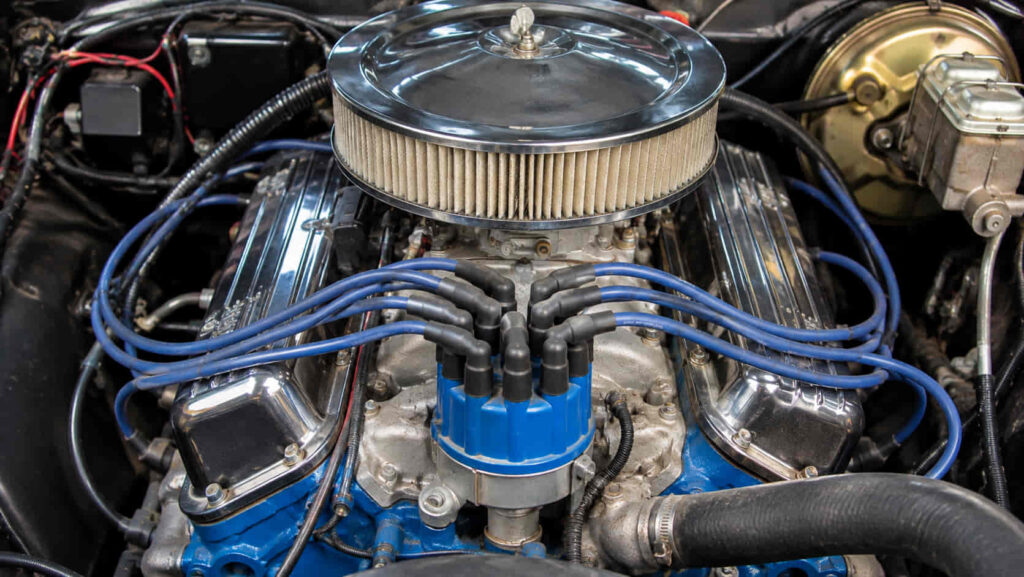
The Ford 302 firing order is 1-5-4-2-6-3-7-8 for standard 302 Windsor V8 engines and 1-3-7-2-6-5-4-8 for Ford 302 High Output (HO) engines. These two firing sequences are associated with different camshaft configurations, making it essential to identify the correct engine setup before installing spark plug wires or troubleshooting ignition problems. Although both engines share the same 302-cubic-inch displacement and basic cylinder numbering, their combustion sequences are not interchangeable.
The difference between the standard Ford 302 and 302 HO firing order comes from the camshaft’s valve-event arrangement. The camshaft determines when each cylinder’s valves open and close relative to crankshaft rotation, while the distributor delivers ignition events according to the required firing sequence. For example, connecting spark plug wires in the standard 302 sequence on an engine equipped with an HO firing-order camshaft can cause misfires, backfiring, rough idling, and poor engine performance. Engines that have undergone camshaft replacement or rebuilding require particular attention because their original factory specifications may no longer apply.
This guide explains both Ford 302 firing orders, cylinder numbering, distributor rotation, and spark plug wire routing. It also covers how to identify the correct firing sequence for Ford Mustang and F-150 applications, why the 302 HO shares its firing order with the 351 Windsor, and how to diagnose problems caused by incorrect ignition wiring.
What Is the Firing Order of a Ford 302 V8 Engine?
The Ford 302 V8 engine uses two primary firing orders: 1-5-4-2-6-3-7-8 for the standard 302 Windsor and 1-3-7-2-6-5-4-8 for the 302 High Output (HO). Both sequences identify the order in which the engine’s eight cylinders complete their power strokes during a four-stroke combustion cycle. The correct sequence depends on the camshaft configuration rather than engine displacement alone. A Ford 302 equipped with its original standard camshaft generally follows the first sequence, while an engine fitted with an HO-style firing-order camshaft follows the second.
The firing order determines the sequence of combustion events across the engine’s cylinders. In a four-stroke V8, the crankshaft completes two full revolutions, or 720 degrees, during one complete operating cycle. Each cylinder fires once during that cycle, producing eight combustion events separated by 90 degrees of crankshaft rotation in an even-firing engine. This arrangement distributes power delivery across the crankshaft and helps maintain consistent engine operation. The standard Ford 302 sequence begins with cylinder 1, followed by cylinders 5, 4, 2, 6, 3, 7, and 8 before repeating.
On a Ford 302 with a conventional distributor ignition system, the distributor rotor directs high voltage to the spark plug wires in the required firing sequence. The distributor rotates counterclockwise when viewed from above, so the wires must be arranged around the cap in that direction, starting from the terminal assigned to cylinder 1. For a standard 302, the connections follow 1-5-4-2-6-3-7-8. For a 302 HO, they follow 1-3-7-2-6-5-4-8. The physical location of the number 1 terminal can vary with distributor installation, so it should be verified rather than assumed from a generic diagram.
The firing order must also be distinguished from cylinder numbering and ignition timing. Cylinder numbering identifies each cylinder’s fixed physical position in the engine block, while firing order specifies the sequence in which those cylinders produce power. Ignition timing determines when the spark occurs relative to piston position, typically expressed in degrees before top dead center. These three specifications work together, but they describe different aspects of engine operation. Correctly identifying all three is necessary when installing a distributor, replacing spark plug wires, or diagnosing ignition-related problems on a Ford 302 V8.
What Is the Difference Between the Standard 302 and 302 HO Firing Order?
The main difference between the standard Ford 302 and the 302 HO firing order is the sequence in which six of the eight cylinders fire. The standard 302 uses 1-5-4-2-6-3-7-8, while the 302 HO uses 1-3-7-2-6-5-4-8. Both sequences begin with cylinder 1, include all eight cylinders exactly once, and end with cylinder 8. However, the combustion events between those two cylinders occur in different orders. The HO sequence is also associated with the Ford 351 Windsor V8, which is why it is sometimes called the 351W firing order.
This difference is determined by the camshaft’s arrangement of intake and exhaust valve events. In a four-stroke engine, each cylinder must complete its intake and compression strokes before combustion can occur. The camshaft controls valve operation in coordination with crankshaft position, establishing the cylinder sequence that the ignition system must follow. A standard 302 camshaft and an HO firing-order camshaft use different valve-event arrangements, so their ignition sequences must match the installed camshaft. Changing the spark plug wire arrangement alone cannot convert a standard-camshaft engine into an HO firing-order engine.
The Ford 302 HO firing order became particularly recognizable through 5.0L High Output applications, including Fox-body Mustang models. However, the HO designation should not be treated as a universal identifier for every 302 engine. A rebuilt engine may contain a replacement camshaft, and a performance camshaft may use either the standard 302 or HO firing-order configuration. For example, a standard 302 block fitted with a camshaft designed for the 1-3-7-2-6-5-4-8 sequence must use that sequence even if the engine originally left the factory with the standard firing order.
The firing-order difference also affects how spark plug wires are connected to the distributor cap. Since both configurations use the same basic Ford small-block cylinder numbering, the physical cylinder locations remain unchanged. What changes is the order in which their spark plugs must receive ignition events. Connecting wires according to 1-5-4-2-6-3-7-8 on an engine requiring 1-3-7-2-6-5-4-8 causes several cylinders to receive sparks at inappropriate points in their operating cycles. The result can include repeated misfires, backfiring, reduced power, and difficulty starting the engine.
The most reliable way to distinguish the two configurations is to identify the camshaft installed in the engine and confirm its specified firing order. Factory engine documentation is useful when the engine retains its original internal components, but camshaft manufacturer specifications take precedence when the camshaft has been replaced. This distinction is especially important for restored classic Mustangs, modified Ford trucks, and rebuilt 302 Windsor engines because the vehicle’s model year or engine block identification may not reflect its current mechanical configuration.
Read more: chevy 4.3 firing order
What Is the Cylinder Numbering on a Ford 302 V8?
The Ford 302 V8 cylinder numbering follows a fixed arrangement, with cylinders 1-2-3-4 on the passenger side and cylinders 5-6-7-8 on the driver side in conventional left-hand-drive Ford vehicles. Both cylinder banks are numbered from the front of the engine toward the rear, beginning near the radiator and ending near the firewall. This numbering system applies to the traditional Ford 302 Windsor small-block V8, including standard 302 and 5.0 High Output configurations.
Cylinder 1 is the frontmost cylinder on the passenger-side bank, followed by cylinders 2, 3, and 4 toward the rear of the engine. Cylinder 5 is the frontmost cylinder on the driver-side bank, followed by cylinders 6, 7, and 8. Unlike engines that number cylinders alternately between banks, the Ford 302 assigns four consecutive numbers to each side. For example, cylinder 3 is the third cylinder from the front on the passenger side, while cylinder 7 is the third cylinder from the front on the driver side.
Front of Engine / Radiator
Driver Side
5
6
7
8
Passenger Side
1
2
3
4
Rear of Engine / FirewallFord 302 Windsor V8 cylinder numbering — viewed from above, with the front of the engine at the top.
Cylinder numbering remains unchanged regardless of which firing order the engine uses. A standard Ford 302 with the 1-5-4-2-6-3-7-8 firing order and a 302 HO with the 1-3-7-2-6-5-4-8 firing order have identical physical cylinder locations. The difference lies in the sequence of combustion events, not the position of the cylinders. This distinction is essential when replacing spark plug wires because the distributor connections must match both the correct firing order and the actual cylinder locations.
Correct cylinder identification also supports ignition troubleshooting and engine diagnostics. If a technician identifies a problem with cylinder 6, the relevant spark plug and ignition wire are located at the second cylinder from the front on the driver-side bank. Checking the wrong bank or counting cylinders in the wrong direction can lead to unnecessary component replacement without resolving the original problem. Using the Ford 302 cylinder numbering diagram as a reference helps prevent these errors, particularly when working on an unfamiliar engine or a vehicle with modified ignition components.
How Do You Read a Ford 302 Firing Order Diagram?
A Ford 302 firing order diagram shows the sequence in which the eight cylinders fire and how that sequence corresponds to their physical locations and distributor connections. The standard Ford 302 uses 1-5-4-2-6-3-7-8, while the Ford 302 HO uses 1-3-7-2-6-5-4-8. Each number represents a specific cylinder, and the sequence repeats after cylinder 8. The diagram must therefore be interpreted as a combustion sequence rather than a map of cylinder positions.
To interpret the standard 302 sequence, begin with cylinder 1 at the front of the passenger-side bank. The next combustion event occurs in cylinder 5 at the front of the driver-side bank, followed by cylinder 4 at the rear of the passenger-side bank. The sequence then continues through cylinders 2, 6, 3, 7, and 8. This means the firing order moves between cylinder banks according to the engine’s mechanical design rather than following the physical arrangement of cylinders from front to rear.
The 302 HO diagram uses the same cylinder numbering but changes the order of combustion events. After cylinder 1 fires, the next cylinder is 3, followed by 7, 2, 6, 5, 4, and 8. For example, the second ignition event in a standard 302 occurs in cylinder 5, while the second ignition event in a 302 HO occurs in cylinder 3. This difference matters when arranging spark plug wires because the distributor must send ignition voltage to the cylinder scheduled to fire at each point in the engine cycle.
When reading a distributor firing order diagram, the viewing direction is particularly important. The Ford 302 distributor rotor rotates counterclockwise when viewed from above. Once the number 1 distributor terminal has been correctly identified, the remaining spark plug wires are connected around the cap in the appropriate firing sequence, following that counterclockwise rotation. A diagram that shows only the cylinder numbers does not establish the physical location of the number 1 terminal on every installed distributor, since distributor indexing and installation can vary.
The most reliable approach is to use the cylinder layout and firing sequence together. The cylinder layout identifies where each spark plug is located, while the firing order determines which distributor terminal should connect to it. For example, on a standard 302, the distributor terminal immediately following cylinder 1 in the rotor’s direction of rotation must connect to cylinder 5. On a 302 HO, that same next position must connect to cylinder 3. Matching these two references ensures that spark plug wires are routed according to the camshaft’s required combustion sequence.
How Do You Connect Spark Plug Wires on a Ford 302 Distributor?
To connect spark plug wires on a Ford 302 distributor, identify the number 1 distributor cap terminal and install the remaining wires counterclockwise in the firing order required by the engine’s camshaft. A standard Ford 302 uses 1-5-4-2-6-3-7-8, while a Ford 302 HO uses 1-3-7-2-6-5-4-8. The distributor rotor rotates counterclockwise when viewed from above, so the wire arrangement must follow that direction around the cap. Connecting the wires clockwise or using the wrong firing sequence can prevent the spark plugs from firing during their cylinders’ compression strokes.
Before changing the spark plug wires, the number 1 distributor terminal must be identified correctly. On an engine with a known, properly functioning ignition setup, the existing cylinder 1 wire provides a useful reference. If the distributor has been removed, replaced, or installed incorrectly, the engine should be positioned with cylinder 1 at top dead center on its compression stroke. Both valves should be closed at this point, and the timing marks can be used to establish the crankshaft position. With the distributor correctly installed, the rotor should point toward the cap terminal assigned to cylinder 1. Top dead center must be verified on the compression stroke because the piston also reaches top dead center during the transition between the exhaust and intake strokes.
Once the number 1 terminal is established, each remaining distributor cap terminal is assigned according to the appropriate firing order. On a standard 302, the terminal immediately counterclockwise from number 1 connects to cylinder 5, followed by cylinders 4, 2, 6, 3, 7, and 8. On a 302 HO, the next terminal connects to cylinder 3, followed by cylinders 7, 2, 6, 5, 4, and 8. The distributor cap terminals must correspond to the physical cylinder locations: cylinders 1 through 4 are on the passenger-side bank, while cylinders 5 through 8 are on the driver-side bank in conventional Ford Windsor installations.
The physical position of the number 1 terminal should not be assumed from a generic distributor diagram. Although factory service diagrams may show a conventional cap orientation, distributor installation and indexing can change the terminal’s position relative to the engine. What matters is that the rotor points to the correct number 1 terminal at the appropriate crankshaft position and that the remaining wires follow the required firing order. A distributor installed one tooth away from its intended position may still be made to run if the cap connections and ignition timing are correctly established, but its orientation can create clearance problems or limit timing adjustment.
Spark plug wire routing also affects ignition reliability. Each wire should be fully seated on its distributor terminal and spark plug, kept away from hot exhaust components, and secured to prevent contact with moving engine parts. On Ford small-block engines, particular attention should be paid to wires serving cylinders 7 and 8 because their routing can contribute to unwanted inductive coupling when the wires run closely together for extended distances. Separating or appropriately routing these wires helps reduce the risk of crossfire, in which electrical interference contributes to an unintended ignition event.
After the wires are connected, the engine’s ignition timing should be checked using the procedure specified for its distributor and ignition control system. Correct spark plug wire placement establishes which cylinder receives each ignition event, while ignition timing determines when that event occurs relative to crankshaft position. An engine can have the correct firing order and still run poorly if its base timing is incorrect. Verifying both specifications is necessary to complete a distributor installation or ignition system repair.
How Can You Tell Which Firing Order Your Ford 302 Uses?
The most reliable way to determine which Ford 302 firing order an engine uses is to identify its installed camshaft and confirm the firing sequence specified for that camshaft. A standard 302 firing-order camshaft requires 1-5-4-2-6-3-7-8, while an HO-style firing-order camshaft requires 1-3-7-2-6-5-4-8. The engine block itself does not establish the firing order because Ford 302 Windsor blocks can be assembled with different camshaft configurations. This distinction becomes especially important when the engine has been rebuilt, modified, or installed in a vehicle other than its original application.
For an unmodified engine, factory service documentation is the appropriate starting point. The vehicle’s model year, original engine designation, and manufacturer specifications can identify the firing order associated with its factory camshaft. Many traditional Ford 302 applications use the standard sequence, while numerous 5.0 High Output applications use the HO sequence. However, these associations should be treated as identification clues rather than universal rules. An engine’s current internal components determine the required firing order, even when its external appearance matches a factory configuration.
When an aftermarket camshaft has been installed, the camshaft manufacturer’s documentation provides the most useful evidence. The camshaft part number, specification card, installation instructions, or engine build records should identify whether it uses the standard 302 or 351W/HO firing-order arrangement. For example, a performance camshaft described as having a 351W firing order generally requires the 1-3-7-2-6-5-4-8 sequence, even when installed in a 302-cubic-inch engine. A replacement camshaft designed for the original 302 sequence requires 1-5-4-2-6-3-7-8 instead.
The distributor cap and existing spark plug wire arrangement can provide additional clues, but they do not independently prove which firing order the engine requires. If an engine runs smoothly and its ignition system has not been disturbed, tracing the installed wires around the distributor cap may reveal the sequence currently in use. However, an engine with incorrect wiring may still start and run poorly, so the existing connections should not be accepted as authoritative when investigating a misfire or backfiring problem. Similarly, the presence of an aftermarket distributor, intake manifold, or valve covers does not establish the installed camshaft’s firing order.
If the engine’s history is unknown and reliable camshaft documentation is unavailable, mechanical inspection may be necessary. A qualified technician can determine the camshaft’s valve-event sequence by observing valve operation relative to crankshaft position. This requires more than identifying cylinder 1 at top dead center because both firing-order configurations use cylinder 1 as their starting reference. The technician must establish which cylinder reaches its compression and combustion phase next in the engine’s operating cycle. This procedure can distinguish the standard sequence from the HO sequence without relying on vehicle identification alone.
Engine swaps and rebuilt Ford 302 engines require particular care because their factory identification information may no longer describe the installed components. A classic Mustang originally equipped with a standard 302 may now contain an HO camshaft, while a 5.0 HO engine may have received an aftermarket camshaft with the standard firing order. In either case, the correct distributor wiring must follow the camshaft currently installed. Confirming that configuration before rearranging spark plug wires prevents unnecessary ignition troubleshooting and reduces the risk of introducing additional running problems.
What Is the Firing Order of a Ford Mustang 302?
The Ford Mustang 302 firing order is 1-5-4-2-6-3-7-8 for standard 302 V8 engines and 1-3-7-2-6-5-4-8 for Mustang 5.0 High Output (HO) engines. The correct sequence depends on the engine’s original configuration and installed camshaft. Classic Mustangs equipped with a conventional 302 Windsor generally use the standard firing order, while Fox-body Mustangs equipped with the factory 5.0 HO engine use the HO sequence. Both engines share the same basic cylinder numbering, but their distributor connections must follow different combustion sequences.
The standard 302 firing order applies to many first-generation Mustang applications, including 1968–1973 models equipped with the 302-cubic-inch V8. In these engines, the distributor delivers ignition events in the sequence 1-5-4-2-6-3-7-8. Cylinder 1 is located at the front of the passenger-side cylinder bank, and the distributor rotor rotates counterclockwise when viewed from above. These details establish the reference points needed to connect the spark plug wires correctly. However, a restored Mustang may contain a replacement engine or aftermarket camshaft, so its original model year should not be treated as conclusive evidence of its current firing order.
The 5.0 HO firing order became especially relevant to Mustang owners during the Fox-body era. The 1982 Mustang GT introduced a 5.0L High Output V8 configuration that used the 1-3-7-2-6-5-4-8 firing sequence, and this arrangement continued in later factory 5.0 HO Mustang applications, including the 1986–1993 fuel-injected models. The HO sequence matches the traditional Ford 351 Windsor firing order, even though the two engines have different displacements. This shared sequence reflects their camshaft firing-order arrangement rather than identical engine construction.
For example, a 1990 Mustang GT with its original 5.0 HO camshaft requires the 1-3-7-2-6-5-4-8 sequence. Connecting its spark plug wires according to the standard 302 order can produce rough idling, backfiring, and repeated misfires because the ignition events no longer correspond to the required combustion sequence. Conversely, a classic Mustang fitted with a standard 302 camshaft must retain the 1-5-4-2-6-3-7-8 order unless its internal engine configuration has changed.
Mustang owners should also distinguish the traditional 302 Windsor from later Ford engines marketed as 5.0L V8s. The modern 5.0L Coyote engine, introduced in the 2011 Mustang GT, uses a different engine architecture and ignition system. Its specifications should not be inferred from a classic 302 Windsor distributor diagram. When identifying the firing order of a Mustang, the engine family, camshaft configuration, and ignition system provide a more reliable reference than the 5.0L displacement designation alone.
What Is the Firing Order of a Ford F-150 302?
The Ford F-150 302 firing order depends on the model year and the specific 5.0L Windsor engine configuration. Many earlier F-150 trucks equipped with the traditional 302 V8 use 1-5-4-2-6-3-7-8, while later 5.0L Windsor truck applications may use 1-3-7-2-6-5-4-8. The firing sequence must match the installed camshaft and the engine management system’s ignition configuration. Assuming that every Ford F-150 with a 302 engine uses the same firing order can lead to incorrect spark plug wire installation.
Earlier F-150 models with conventional 302 Windsor engines commonly use the standard firing sequence. Their distributor systems route ignition voltage to the cylinders in the order 1-5-4-2-6-3-7-8, following the distributor rotor’s counterclockwise rotation. Later Ford truck applications adopted different camshaft and engine management configurations, including 5.0L Windsor engines using the 1-3-7-2-6-5-4-8 sequence. For this reason, a firing order taken from an older F-150 repair manual should not automatically be applied to a newer Windsor-powered truck.
The distinction is particularly important when working with fuel-injected Ford 5.0L truck engines. Electronic fuel injection does not eliminate the need for the correct firing order, and distributor-equipped versions still require proper spark plug wire routing. Depending on the system, the engine control module also coordinates fuel delivery and ignition timing using crankshaft-related position information. If the ignition wires are connected according to a sequence that does not match the installed camshaft, the engine may experience misfires, hesitation, reduced power, or difficulty starting.
A truck’s engine history can further complicate identification. Ford F-150 engines are frequently rebuilt or replaced after years of service, and a replacement 302 may not retain the camshaft configuration originally supplied with the vehicle. For example, a truck that originally used a standard 302 firing order may receive a rebuilt engine containing an HO-style camshaft. In that situation, the correct firing order becomes 1-3-7-2-6-5-4-8, regardless of the truck’s original factory specification.
Owners should also avoid confusing the Windsor 302 with the modern 5.0L Coyote V8 used in newer F-150 models. Although both engines are commonly described as Ford 5.0L V8s, they have different cylinder head designs, ignition systems, and engine management strategies. The Windsor 302 uses a distributor-based ignition arrangement in its conventional configurations, while the Coyote uses electronically controlled individual ignition coils. A distributor wiring diagram for a 302 Windsor therefore does not apply to a Coyote-powered F-150.
The correct approach is to verify the truck’s model year, engine identification, factory service specifications, and any documented camshaft modifications. If the engine retains its original components, manufacturer service information provides the appropriate firing order. If the engine has been rebuilt or modified, the installed camshaft’s specifications take priority. This verification ensures that distributor wiring matches the engine’s actual mechanical configuration rather than an assumed firing order based solely on the F-150 nameplate.
Is the Ford 302 Firing Order the Same as the 351 Windsor?
The Ford 302 High Output (HO) and Ford 351 Windsor share the same firing order of 1-3-7-2-6-5-4-8, but the standard Ford 302 uses 1-5-4-2-6-3-7-8. This distinction is important because all three engines belong to the Ford Windsor small-block family, yet they do not necessarily use identical combustion sequences. The shared firing order between the 302 HO and 351W is associated with their camshaft configurations, not simply their engine displacement or external appearance.
The Ford 351 Windsor uses the 1-3-7-2-6-5-4-8 firing sequence in its conventional factory configurations. This order begins with cylinder 1, continues through cylinders 3, 7, 2, 6, 5, and 4, and ends with cylinder 8 before repeating. The Ford 302 HO follows the same sequence, allowing both engines to use the same basic distributor firing-order arrangement. However, the engines have different crankshaft strokes, block dimensions, and other mechanical specifications. Sharing a firing order does not make their internal components universally interchangeable.
The relationship between these engines becomes particularly relevant when selecting an aftermarket camshaft for a Ford 302. Camshaft manufacturers may describe a product as having a 351W firing order, even when the camshaft is intended for installation in a 302 Windsor. This designation identifies the required combustion sequence rather than the engine’s displacement. For example, a 302 fitted with a compatible aftermarket camshaft specified for the 351W firing order must use 1-3-7-2-6-5-4-8, regardless of whether the engine originally used the standard 302 sequence.
Cylinder numbering remains consistent across these traditional Windsor V8 configurations. Cylinders 1 through 4 occupy one bank, while cylinders 5 through 8 occupy the opposite bank, with numbering progressing from the front of the engine toward the rear. The distributor also rotates counterclockwise when viewed from above. Therefore, a Ford 302 HO and a conventional 351W use the same sequence of cylinder connections around their respective distributor caps, although the actual position of the number 1 terminal must still be established for each installation.
The most important distinction is that the 351W firing order is not the universal Ford 302 firing order. A standard 302 camshaft requires 1-5-4-2-6-3-7-8, while a 302 HO or a 302 equipped with a compatible 351W-style firing-order camshaft requires 1-3-7-2-6-5-4-8. Using the wrong sequence when connecting spark plug wires can produce ignition events that do not match the engine’s valve timing and compression strokes. Confirming the installed camshaft specification is therefore more reliable than selecting a firing order based only on the Windsor engine family.
What Happens If the Ford 302 Firing Order Is Wrong?
An incorrect Ford 302 firing order can cause engine misfires, rough idling, backfiring, reduced power, difficult starting, or a complete failure to start. These symptoms occur when spark plug wires deliver ignition voltage to cylinders at the wrong points in the engine’s operating cycle. A Ford 302 requires each spark plug to fire near the end of its cylinder’s compression stroke, when the air-fuel mixture is ready for combustion. If the distributor sends a spark to a cylinder that is not in the correct phase, the ignition event cannot produce the intended power stroke.
The severity of the symptoms depends on how many spark plug wires are incorrectly connected and which cylinders are affected. If two wires are accidentally exchanged, the engine may continue running on the remaining cylinders while producing noticeable vibration, hesitation, and reduced power. If the entire distributor cap is wired using the standard 302 sequence on an engine requiring the HO sequence, multiple cylinders will receive ignition events at incorrect points in their cycles. The engine may crank without starting, start briefly and stall, or run extremely poorly.
Backfiring is another possible consequence of incorrect ignition wiring. When combustion occurs at an inappropriate point in the engine cycle, the pressure event may interact with an open intake or exhaust valve, producing a sharp report through the intake or exhaust system. For example, an ignition event delivered to a cylinder during an unsuitable valve phase can contribute to combustion occurring outside the intended combustion interval. However, backfiring is not exclusive to an incorrect firing order; excessively advanced or retarded ignition timing, fuel mixture problems, and mechanical valve-timing faults can produce similar symptoms.
An incorrect firing order must also be distinguished from incorrect ignition timing. Firing order determines which cylinder receives the next ignition event, while ignition timing determines when that event occurs relative to crankshaft position. A Ford 302 can have all eight spark plug wires connected in the correct sequence but still run poorly if the distributor timing is significantly advanced or retarded. Conversely, adjusting distributor timing will not correct wires connected in the wrong sequence. Both conditions require separate verification during ignition troubleshooting.
When diagnosing a Ford 302 that begins misfiring immediately after distributor replacement or spark plug wire service, the distributor connections should be checked against the firing order specified for the installed camshaft. Cylinder 1 must be identified correctly, and the remaining wires must follow the required sequence counterclockwise around the distributor cap. The technician should also confirm that the distributor is correctly installed, the plug wires are securely connected, and the engine’s base ignition timing matches its applicable service procedure.
Persistent misfires should not be ignored because unburned fuel entering the exhaust system can increase exhaust temperatures and damage components, particularly catalytic converters on equipped vehicles. A severely misfiring engine should not be driven until the underlying problem is identified. If the spark plug wiring and ignition timing are correct, further diagnosis should examine ignition components, fuel delivery, compression, and mechanical valve timing rather than assuming the firing order is responsible for every combustion problem.
The correct firing order for a Ford 302 is determined by its installed camshaft: 1-5-4-2-6-3-7-8 for the standard configuration or 1-3-7-2-6-5-4-8 for the HO-style configuration. Matching the distributor wiring to that sequence is essential for normal combustion, reliable starting, and consistent engine performance.