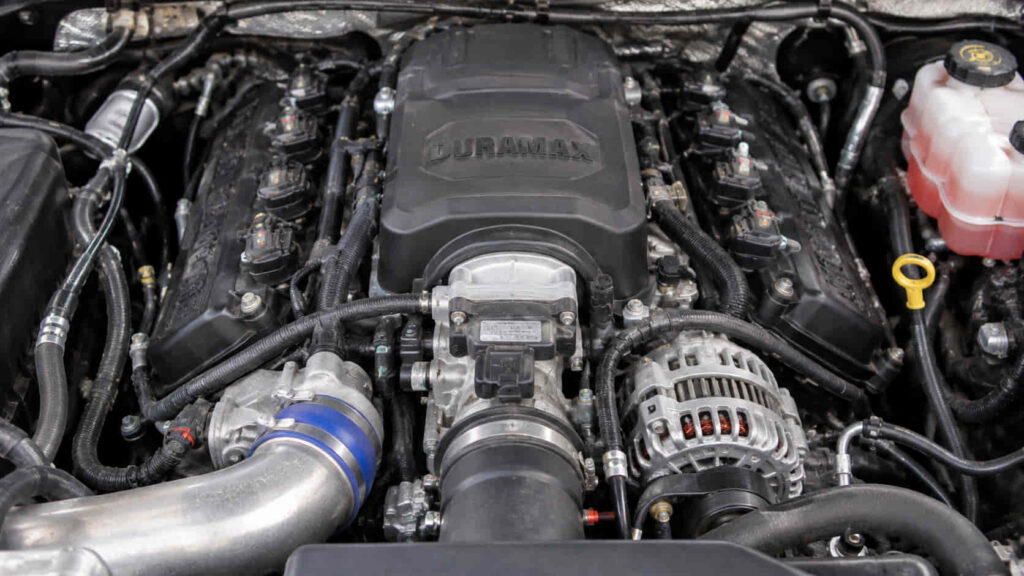
The Duramax firing order is 1-2-7-8-4-5-6-3 for the 6.6L V8 diesel engine and 1-5-3-6-2-4 for the 3.0L inline-six diesel engine. These sequences identify the order in which individual cylinders produce their power strokes during engine operation. Knowing the correct firing order is essential for identifying cylinders, understanding combustion timing, and diagnosing engine performance problems.
General Motors produces Duramax diesel engines in different configurations, including the 6.6L V8 used in Chevrolet Silverado HD and GMC Sierra HD trucks and the 3.0L inline-six available in certain Silverado 1500 and Sierra 1500 models. Although both engines belong to the Duramax family, their cylinder arrangements and firing sequences are different. The 6.6L V8 uses two cylinder banks, while the 3.0L engine positions all six cylinders in a single row.
Unlike gasoline engines that rely on spark plugs to ignite the air-fuel mixture, Duramax diesel engines use compression ignition and electronically controlled fuel injection. Their firing orders describe the combustion sequence rather than a spark plug wire arrangement. Correctly identifying the engine version is therefore necessary before interpreting a cylinder diagram or investigating an injector-related fault.
This guide explains the Duramax firing order for both engine configurations, cylinder numbering diagrams, differences between engine generations, and how firing order relates to fuel injection timing and cylinder diagnostics.
What Is the Firing Order of a 6.6L Duramax V8?
The 6.6L Duramax V8 firing order is 1-2-7-8-4-5-6-3, which defines the sequence in which the engine’s eight cylinders produce their power strokes. Cylinder 1 fires first, followed by cylinders 2, 7, 8, 4, 5, 6, and 3 before the sequence repeats. This firing order is used across the major 6.6L Duramax generations, including the LB7, LLY, LBZ, LMM, LML, and L5P engines found in Chevrolet Silverado HD and GMC Sierra HD trucks.
The 6.6L Duramax is a four-stroke diesel engine, meaning each cylinder completes its intake, compression, power, and exhaust strokes over two crankshaft revolutions. These revolutions represent 720 degrees of crankshaft rotation. Because the V8 produces eight evenly spaced firing events during this cycle, a new power stroke begins every 90 degrees of crankshaft rotation. The firing order determines which cylinder produces each successive power stroke, while the crankshaft and valve timing establish the mechanical sequence required for combustion.
The 1-2-7-8-4-5-6-3 sequence is not the same as the physical arrangement of the cylinders. On a 6.6L Duramax V8, the passenger-side cylinder bank contains cylinders 1, 3, 5, and 7, while the driver’s-side bank contains cylinders 2, 4, 6, and 8. The firing sequence alternates between these banks at different points rather than following the cylinders in numerical order. For example, cylinder 2 fires immediately after cylinder 1, but cylinder 7 fires next, even though it is positioned farther toward the rear of the opposite bank.
Unlike a gasoline V8, the Duramax diesel engine does not use spark plugs to initiate combustion. Air is compressed until its temperature becomes high enough to ignite injected diesel fuel. The engine control system manages fuel injection according to operating conditions, while the mechanical engine design establishes the cylinder firing sequence. Changing injection timing does not change the firing order because the order of the cylinders’ compression and power strokes is determined by the engine’s mechanical configuration.
The firing order is particularly useful when identifying cylinder-specific performance problems. If a diagnostic procedure indicates that cylinder 7 is contributing insufficient power, the firing order identifies its position in the combustion sequence, while the cylinder numbering diagram identifies its physical location. Technicians can then inspect the appropriate injector, fuel delivery components, or mechanical condition without confusing cylinder identification with the order of combustion events.
What Is the Firing Order of a 3.0L Duramax Inline-Six?
The 3.0L Duramax inline-six firing order is 1-5-3-6-2-4, which differs from the 1-2-7-8-4-5-6-3 sequence used by the 6.6L Duramax V8. This firing order applies to the 3.0L Duramax LM2 and LZ0 diesel engines used in compatible Chevrolet and GMC vehicles, including certain Silverado 1500 and Sierra 1500 models. The sequence begins with cylinder 1, continues through cylinders 5, 3, 6, 2, and 4, and then repeats.
The 3.0L Duramax uses an inline-six configuration, meaning all six cylinders are arranged in a single row rather than divided between two cylinder banks. This layout changes the engine’s crankshaft design, cylinder arrangement, and combustion sequence. Although the cylinders are physically numbered from 1 through 6 along the engine, they do not produce their power strokes in numerical order. The firing order specifies the actual sequence required by the engine’s mechanical design.
Like the 6.6L V8, the 3.0L Duramax operates on a four-stroke cycle that requires 720 degrees of crankshaft rotation. However, the inline-six has six firing events instead of eight. With evenly spaced combustion events, each successive cylinder begins its power stroke after 120 degrees of crankshaft rotation. This interval is a defining characteristic of the engine’s firing sequence and contributes to the smooth power delivery associated with a properly balanced inline-six configuration.
The LM2 and LZ0 engines share the same 1-5-3-6-2-4 firing order despite differences in their engineering and performance specifications. The LZ0 introduced revisions to the 3.0L Duramax platform, but those changes did not establish a different cylinder firing sequence. Consequently, the firing order can be used as a common reference for these engines, while component locations, diagnostic procedures, and service specifications must still be matched to the correct engine version.
For example, if a technician identifies a problem associated with cylinder 5 on a 3.0L Duramax, the firing order shows that cylinder 5 fires immediately after cylinder 1 and before cylinder 3. However, the physical location of cylinder 5 must be determined from the inline-six cylinder numbering diagram. This distinction is essential when inspecting a specific fuel injector or evaluating cylinder contribution.
The correct Duramax firing order must always be matched to the engine configuration. The 6.6L V8 uses 1-2-7-8-4-5-6-3, while the 3.0L inline-six uses 1-5-3-6-2-4. Applying the V8 sequence to the inline-six would produce an incorrect interpretation of cylinder operation and could lead to errors during engine diagnosis.
Read more: ford 3.7 firing order
How Are the Cylinders Numbered on a 6.6L Duramax V8?
The 6.6L Duramax V8 uses odd-numbered cylinders on the passenger-side bank and even-numbered cylinders on the driver’s-side bank. When viewed from the front of the engine toward the rear, the passenger-side cylinders are numbered 1, 3, 5, and 7, while the driver’s-side cylinders are numbered 2, 4, 6, and 8. This arrangement applies to the major 6.6L Duramax generations, including LB7, LLY, LBZ, LMM, LML, and L5P.
Cylinder 1 is located at the front of the passenger-side bank, making it the reference point for identifying the remaining cylinders. Cylinder 3 sits directly behind cylinder 1, followed by cylinders 5 and 7 toward the rear of the engine. On the driver’s side, cylinder 2 occupies the front position, followed by cylinders 4, 6, and 8. Consequently, cylinders 7 and 8 are positioned closest to the rear of their respective banks, near the transmission end of the engine.
Cylinder numbering describes physical location, not combustion order. The numbers identify individual cylinders so that technicians can associate diagnostic information with the correct mechanical components. For example, cylinder 7 is the rearmost cylinder on the passenger side, even though it is the third cylinder in the 6.6L Duramax firing sequence. Similarly, cylinder 8 is positioned at the rear of the driver’s-side bank but fires immediately after cylinder 7. Understanding this distinction prevents technicians from confusing a cylinder’s location with its position in the firing order.
The orientation of a cylinder numbering diagram is particularly important because the passenger and driver sides can appear reversed depending on the viewing direction. In a Chevrolet Silverado HD or GMC Sierra HD, the passenger side refers to the vehicle’s right side when facing forward from the driver’s seat. A person standing in front of the truck and looking into the engine compartment will see the passenger-side bank on their left. The front of the engine is the accessory-drive end, while the rear connects to the transmission.
Correct cylinder identification supports injector diagnostics, compression testing, and cylinder-specific repair procedures. If a diagnostic test identifies a problem with cylinder 4, the technician should inspect the second cylinder from the front on the driver’s-side bank. Checking the second cylinder in the firing sequence instead would lead to the wrong location. Matching the cylinder number to its physical position is therefore essential before removing components or performing further tests.
How Are the Cylinders Numbered on a 3.0L Duramax?
The 3.0L Duramax inline-six has six cylinders numbered consecutively from 1 at the front of the engine to 6 at the rear. Unlike the 6.6L V8, which divides its cylinders between two banks, the 3.0L Duramax positions all six cylinders in a single longitudinal row. This numbering arrangement applies to the LM2 and LZ0 engine configurations used in compatible Chevrolet and GMC vehicles.
Cylinder 1 is located at the front of the engine, near the accessory-drive end, followed by cylinders 2, 3, 4, and 5 along the engine block. Cylinder 6 occupies the rearmost position, closest to the transmission. Because the cylinders are arranged in one row, identifying a particular cylinder does not require determining whether it belongs to the passenger-side or driver’s-side bank. Instead, the technician counts from the front of the engine toward the rear.
The physical numbering sequence must not be confused with the engine’s 1-5-3-6-2-4 firing order. Although cylinder 2 is immediately behind cylinder 1, it is not the next cylinder to produce a power stroke. Cylinder 5 fires after cylinder 1, followed by cylinder 3. This difference exists because the crankshaft and valve timing establish the combustion sequence independently of the cylinders’ numerical positions along the engine block.
For example, if a diagnostic procedure identifies an injector-related issue involving cylinder 5, the relevant cylinder is the fifth one from the front of the engine. Its position as the second cylinder in the firing order does not change its physical location. Using the cylinder numbering diagram allows the technician to identify the correct injector and related components before beginning a repair.
The distinction between cylinder numbering and firing order becomes especially important when comparing the 3.0L and 6.6L Duramax engines. Both use cylinder numbers to identify specific combustion chambers, but their different engine configurations require different diagrams. A 6.6L V8 cylinder layout cannot be used to locate cylinders on a 3.0L inline-six, even when the same cylinder number appears in both engines.
How Do You Read a Duramax Firing Order Diagram?
A Duramax firing order diagram shows the relationship between cylinder locations and the sequence in which those cylinders produce power strokes. To interpret the diagram correctly, identify the engine configuration, establish the front of the engine, and then follow the firing sequence using the numbered cylinder positions. The cylinder layout identifies where each cylinder is located, while the firing order identifies when it produces its power stroke relative to the others.
On a 6.6L Duramax V8 diagram, the two cylinder banks are shown on opposite sides of the engine. The passenger-side bank contains the odd-numbered cylinders, while the driver’s-side bank contains the even-numbered cylinders. The firing sequence begins at cylinder 1 and continues to cylinder 2, then cylinder 7, cylinder 8, cylinder 4, cylinder 5, cylinder 6, and finally cylinder 3. Following these numbers on the cylinder layout reveals how successive combustion events move between different positions in the engine rather than progressing from front to rear.
For example, the transition from cylinder 2 to cylinder 7 represents a firing event moving from the front of the driver’s-side bank to the rear of the passenger-side bank. The next event occurs in cylinder 8 at the rear of the driver’s-side bank. This sequence demonstrates why a firing order diagram cannot be interpreted simply by reading the cylinder numbers in their physical arrangement. The diagram must connect each numbered cylinder to its position in the combustion sequence.
A 3.0L Duramax firing order diagram follows the same principle but uses a different cylinder arrangement. All six cylinders are positioned in a single row, with cylinder 1 at the front and cylinder 6 at the rear. The firing sequence is 1-5-3-6-2-4, so the diagram connects cylinders that are separated by different distances along the engine block. For instance, cylinder 5 fires immediately after cylinder 1, even though three other cylinders are physically positioned between them.
A firing order diagram does not identify the exact moment when a fuel injector opens. It represents the order of the cylinders’ power strokes, whereas injection timing is controlled according to crankshaft position, engine load, speed, and other operating conditions. Modern Duramax engines can use multiple injection events during a combustion cycle, so the firing order should not be treated as a complete fuel injection timing chart.
When using a diagram for diagnosis, the correct procedure is to match the engine’s firing sequence with its cylinder numbering layout before identifying the component that requires inspection. This distinction is particularly important when interpreting cylinder-specific diagnostic information, because an error in diagram orientation can lead to testing the wrong injector or cylinder.
Does the Duramax Firing Order Change Between LB7, LLY, LBZ, LMM, LML, and L5P?
The firing order does not change between the LB7, LLY, LBZ, LMM, LML, and L5P versions of the 6.6L Duramax V8. All six engine generations use the same 1-2-7-8-4-5-6-3 combustion sequence. Although General Motors introduced substantial changes to the engine’s fuel injection system, emissions equipment, electronic controls, and mechanical components over successive generations, these developments did not alter the established firing order.
The LB7 introduced the 6.6L Duramax V8 platform, while the later LLY and LBZ incorporated changes to engine management, performance, and supporting hardware. The LMM and LML generations introduced additional emissions-control and fuel-system developments. The L5P brought a more extensively redesigned engine architecture with updated fuel delivery and electronic control systems. Despite these differences, the cylinder combustion sequence remained consistent across the six generations.
This consistency exists because the firing order is established by the engine’s crankshaft arrangement and valve timing rather than by its fuel injection hardware. Electronic control modules determine when and how fuel is delivered, but they operate within the mechanical cycle established by the engine. Changes to injector design, injection pressure, or control strategies do not independently change which cylinder reaches its power stroke next.
For example, a technician working on an LB7 can use the same 1-2-7-8-4-5-6-3 firing sequence when identifying the order of combustion events on an L5P. However, this shared firing order does not mean the engines use interchangeable injectors, identical wiring arrangements, or the same diagnostic procedures. Each generation has its own service requirements, component specifications, and control-system characteristics.
The distinction between firing order compatibility and component compatibility is essential during engine repair. A cylinder numbering diagram can help identify the same numbered cylinder across these 6.6L Duramax generations, but an injector replacement procedure or electrical diagnostic test must follow the specifications for the exact engine code. Using the correct firing order alongside generation-specific service information provides a reliable foundation for identifying cylinders without assuming that every Duramax V8 uses identical hardware.
Why Do the 6.6L and 3.0L Duramax Engines Have Different Firing Orders?
The 6.6L and 3.0L Duramax engines have different firing orders because they use different cylinder configurations, crankshaft designs, and valve timing arrangements. The 6.6L Duramax is a V8 with eight cylinders distributed across two banks, while the 3.0L Duramax is an inline-six with six cylinders arranged in a single row. These structural differences determine how the cylinders move through their compression and power strokes.
The crankshaft plays a central role in establishing the firing sequence. Its crankpin arrangement determines the relative positions of the pistons throughout each engine cycle, while the camshaft timing controls when the intake and exhaust valves operate. Together, these mechanical relationships determine which cylinder is ready to produce the next power stroke. The firing order must match this arrangement to maintain the intended combustion sequence and engine operation.
The number of cylinders also affects how frequently power strokes occur. A four-stroke V8 produces eight firing events over a complete engine cycle, whereas a four-stroke inline-six produces six. The crankshaft and valve timing arrangements distribute these events according to each engine’s design. As a result, the two engines cannot share the same firing sequence because their cylinder counts and mechanical configurations are fundamentally different.
Firing order also influences how combustion forces act on the crankshaft and engine structure. Engineers select the sequence in conjunction with crankshaft geometry, engine balance, vibration characteristics, and other design requirements. In the Duramax V8, combustion events occur across two cylinder banks, while the inline-six produces its power strokes along a single cylinder row. Each arrangement has different mechanical characteristics that must be considered during engine development.
Changing fuel injection timing does not convert one Duramax firing order into another. The engine control module can adjust injection timing and fuel quantity to manage combustion, emissions, and performance, but it must synchronize those adjustments with the mechanical positions of the pistons. For example, the 3.0L Duramax cannot use the 6.6L V8 firing sequence through an electronic calibration change because it lacks the V8’s cylinder arrangement and crankshaft configuration.
How Do You Identify Which Duramax Engine Your Vehicle Has?
The most reliable way to identify a Duramax engine is to verify its engine code using the vehicle identification number, manufacturer documentation, or engine identification information. The Duramax name covers multiple diesel engine configurations, so identifying the exact engine is necessary before selecting a firing order diagram, service procedure, or diagnostic reference.
Vehicle model and model year provide useful starting points. Chevrolet Silverado HD and GMC Sierra HD trucks equipped with the 6.6L Duramax diesel use a V8 configuration, while certain Silverado 1500 and Sierra 1500 models use the 3.0L Duramax inline-six. The 3.0L engine has also been offered in selected Chevrolet and GMC SUVs. However, a vehicle’s model name alone does not establish which engine is installed because engine availability varies by model year and configuration.
The engine code provides more precise identification. The LB7, LLY, LBZ, LMM, LML, and L5P designations identify major generations of the 6.6L Duramax V8. The LM2 and LZ0 designations identify versions of the 3.0L Duramax inline-six. These codes are particularly useful because they connect the engine to its specifications, electronic control systems, and applicable repair information.
A VIN can also help establish the factory-installed engine when decoded using the correct manufacturer information for the vehicle’s model year. The VIN’s engine identification details must be interpreted with the appropriate reference rather than assuming that a particular character has the same meaning across every vehicle. If an engine has been replaced or modified, the installed engine’s identification and physical configuration should be verified independently.
Visual inspection provides an additional way to distinguish the two engine families. The 6.6L V8 has two cylinder banks arranged in a V configuration, while the 3.0L inline-six has a single longitudinal cylinder arrangement. However, engine covers and surrounding components can obstruct the view, making official identification information more dependable than appearance alone.
Once the engine code has been confirmed, the correct firing order and cylinder diagram can be selected. This prevents a technician from applying 6.6L V8 specifications to a 3.0L inline-six and ensures that subsequent diagnostic procedures correspond to the engine actually installed in the vehicle.
What Causes a Duramax Diesel Cylinder to Misfire?
A Duramax diesel cylinder can misfire when fuel delivery, compression, airflow, or engine control problems prevent it from producing the expected power during combustion. Unlike a gasoline engine, which relies on an ignition spark, a Duramax engine ignites diesel fuel using the heat generated by compressed air. A misfire or cylinder contribution problem therefore requires investigation of the conditions needed for diesel combustion rather than spark plugs or ignition coils.
Fuel delivery faults are a major category of potential causes. A malfunctioning injector may deliver too little fuel, produce an unsuitable spray pattern, or fail to respond correctly to an electrical command. These conditions can interfere with fuel atomization and combustion, reducing the affected cylinder’s power output. Problems involving fuel pressure, contaminated fuel, or air entering the fuel system can also affect combustion, although system-wide fuel supply faults may produce symptoms across multiple cylinders rather than one isolated cylinder.
Mechanical compression problems can produce similar symptoms even when the fuel injection system operates correctly. Diesel combustion depends on the temperature generated as air is compressed inside the cylinder. Worn piston rings, damaged valves, cylinder wall damage, or valve sealing problems can reduce compression and prevent the cylinder from reaching the conditions required for efficient combustion. For example, a cylinder with a leaking exhaust valve may produce insufficient power despite receiving the commanded amount of fuel.
Airflow and engine management faults can also contribute to irregular combustion. Restrictions in the intake system, problems with exhaust gas recirculation, incorrect sensor information, or faults affecting fuel injection control can disrupt the conditions required for normal engine operation. However, an airflow problem affecting the entire engine should not automatically be treated as the cause of a single-cylinder misfire. The diagnostic approach must account for whether the symptoms involve one cylinder, several cylinders, or the engine as a whole.
The symptoms of a Duramax misfire can include rough idle, excessive vibration, hesitation, reduced power, and abnormal exhaust smoke. The severity depends on the underlying problem and operating conditions. A fault may be most noticeable at idle when individual cylinder contribution differences are easier to detect, while another problem may become more apparent under acceleration or load. These symptoms are not exclusive to misfires, so they must be evaluated alongside diagnostic information.
For example, if a 6.6L Duramax exhibits persistent rough idle and diagnostic testing identifies low contribution from cylinder 4, the technician should locate that cylinder using the correct numbering diagram before evaluating its injector circuit, fuel delivery, and mechanical condition. Replacing the injector solely because cylinder 4 shows reduced contribution would be premature. A compression problem or another cylinder-specific fault could produce similar evidence.
Accurate diagnosis requires matching the observed symptoms with engine-specific test results. Fuel system measurements, injector electrical checks, approved cylinder contribution procedures, and mechanical compression testing can help distinguish between possible causes. The correct testing sequence depends on the Duramax generation and the diagnostic information available for that engine.
How Do You Confirm the Correct Firing Order for Your Duramax Engine?
The correct Duramax firing order is confirmed by identifying the installed engine and checking its specifications against manufacturer service information. The 6.6L Duramax V8 uses the 1-2-7-8-4-5-6-3 sequence, while the 3.0L Duramax inline-six uses 1-5-3-6-2-4. Because these engines have different cylinder configurations, the firing order must be matched to the engine rather than selected from a diagram labeled only as Duramax.
The first step is to establish the exact engine designation. Vehicle identification information, factory documentation, and engine identification markings can help determine whether the vehicle has a 6.6L V8 or 3.0L inline-six. The engine code provides a more specific reference for locating the correct service specifications. If the vehicle has undergone an engine replacement, the installed engine should be verified rather than relying exclusively on the vehicle’s original equipment information.
Manufacturer service documentation should then be used to confirm the firing sequence and cylinder numbering arrangement. General Motors service information provides engine-specific references for cylinder identification, diagnostic procedures, and component locations. These details matter because engines that share a firing order can still differ in fuel system design, electronic controls, and repair requirements.
The firing order should be checked together with the cylinder numbering diagram. A firing sequence identifies the order of combustion events, but it does not show where the individual cylinders are located. For the 6.6L V8, the correct diagram must identify the two cylinder banks and their numbered positions. For the 3.0L inline-six, it must show the six cylinders arranged consecutively along the engine. Using both references prevents confusion when interpreting cylinder-specific diagnostic results.
Online diagrams can be useful for preliminary identification, but they should be checked for engine compatibility and correct orientation. A diagram intended for a gasoline Chevrolet V8, a different diesel engine, or another Duramax configuration may provide misleading information. The presence of a familiar cylinder number does not establish that the diagram applies to the vehicle being serviced.
For example, a technician diagnosing an L5P Duramax should confirm the 6.6L V8 firing order and use L5P-specific service procedures when investigating an injector or cylinder contribution fault. A technician working on an LZ0 should instead use the 3.0L inline-six firing sequence and the corresponding cylinder layout. Although both engines carry the Duramax name, their different configurations require separate technical references.
The most reliable approach is to use the firing order as an engine specification, the cylinder diagram as a location reference, and the manufacturer service manual as the authority for diagnostic procedures. This combination allows technicians and vehicle owners to identify the correct cylinders, interpret combustion sequence information, and avoid applying repair instructions intended for a different Duramax engine.