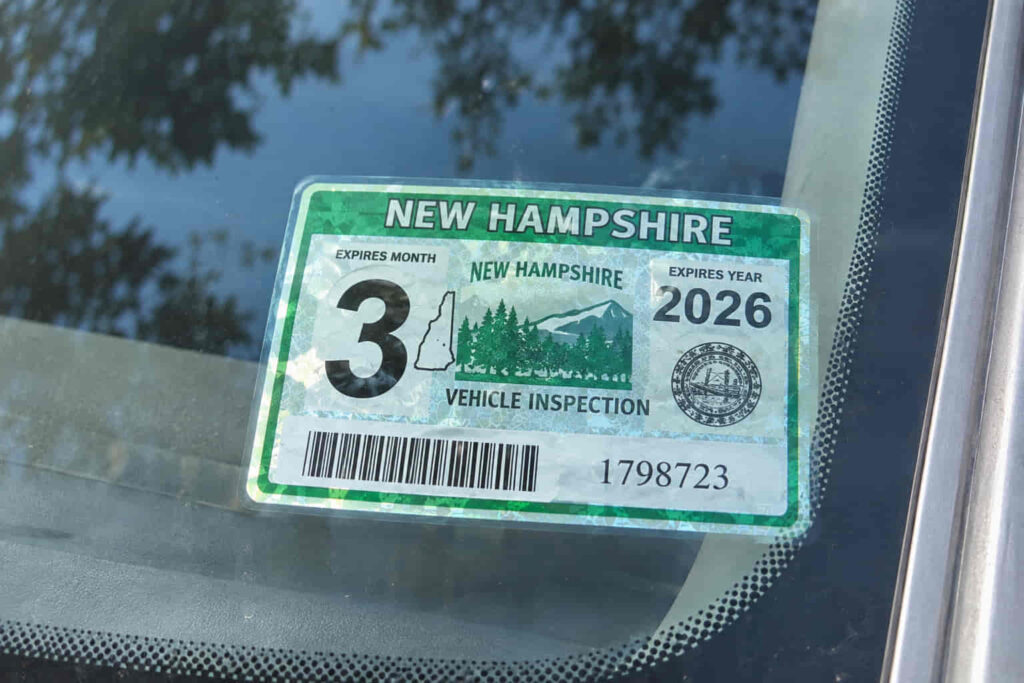
An NH inspection sticker is no longer required for most passenger vehicles under New Hampshire’s vehicle inspection program suspension announced on February 13, 2026. The New Hampshire Department of Safety and Department of Justice directed inspection stations to stop issuing state inspection stickers and informed vehicle owners that annual inspections were not required while the program remained suspended. This change affects drivers who previously needed a valid inspection sticker to demonstrate compliance with the state’s periodic vehicle inspection requirements.
The suspension followed legislative changes and federal litigation concerning New Hampshire’s vehicle inspection program, including its emissions testing requirements. Although the state stopped requiring routine inspections during the suspension, the change did not eliminate vehicle safety obligations. Drivers must still maintain roadworthy vehicles with properly functioning brakes, lights, tires, and other required equipment. Certain commercial vehicles also remain subject to separate federal inspection requirements, regardless of the status of New Hampshire’s state inspection program.
This guide explains the NH inspection sticker requirements for 2026, including whether expired stickers are acceptable, whether inspection stations can issue new stickers, and how the changes affect vehicle registration and emissions testing. It also covers commercial vehicle exceptions, used-car purchases, and the possibility of future regulatory changes. Because the program’s status has been affected by legal proceedings, drivers should verify the latest guidance from New Hampshire authorities before relying on an older inspection deadline.
Do You Need an NH Inspection Sticker in 2026?
Most passenger vehicle owners in New Hampshire do not need a new NH inspection sticker while the state’s vehicle inspection program remains suspended. On February 13, 2026, the New Hampshire Department of Safety and Department of Justice announced that the state inspection program was suspended until further notice. Under that guidance, vehicle owners were no longer required to complete the state’s annual inspection process, and authorized inspection stations were instructed to stop issuing state inspection stickers. This change applies to the state’s routine inspection program rather than every inspection requirement that might affect a vehicle.
Before the suspension, New Hampshire required registered vehicles covered by the program to undergo periodic safety inspections. The process involved checking components such as brakes, steering, tires, lights, and other equipment needed for safe operation. Eligible vehicles were also subject to emissions-related testing. After passing the applicable inspection, a vehicle received an inspection sticker displaying its expiration information. The sticker served as visible evidence that the vehicle had satisfied the state’s inspection requirements at the time of testing.
The February 2026 guidance changed that process by suspending the requirement to obtain a current state inspection sticker. For example, a driver whose passenger vehicle previously required an inspection in March 2026 would not need to obtain a replacement sticker while the suspension remained in effect. However, the suspension should not be interpreted as a permanent guarantee that inspections will never return. The program’s status has been affected by legislation, federal litigation, and regulatory questions involving emissions testing. Any subsequent official order or policy change could alter the requirements applicable to vehicle owners.
Not needing an inspection sticker does not mean a vehicle is exempt from New Hampshire’s equipment and safety laws. Drivers remain responsible for maintaining roadworthy vehicles, including functioning brakes, required lighting, adequate tires, and other legally mandated equipment. A vehicle with dangerously worn tires or defective brakes does not become lawful or safe simply because the state has suspended routine inspections. Commercial vehicles subject to federal inspection regulations may also have separate obligations that continue regardless of the state program’s status.
Because inspection requirements can change, drivers should distinguish the February 13 suspension announcement from the rules in effect on the date they intend to register or operate a vehicle. The New Hampshire Division of Motor Vehicles and Department of Safety are the appropriate sources for confirming whether the suspension remains active and whether a particular vehicle category is covered.
What Happened to the New Hampshire Vehicle Inspection Program in 2026?
New Hampshire’s vehicle inspection program was suspended on February 13, 2026, following a dispute over the state’s effort to end mandatory vehicle inspections. The situation developed from legislative changes intended to discontinue the inspection program and legal questions about whether New Hampshire could eliminate emissions testing without first satisfying federal air-quality requirements. As a result, the state’s inspection rules underwent several significant developments within the first weeks of 2026.
The legislative changes were intended to end the state’s mandatory vehicle inspection program effective January 31, 2026. Historically, the program combined vehicle safety inspections with emissions-related testing for eligible vehicles. The emissions component was especially important because federal Clean Air Act requirements can affect how a state modifies an inspection and maintenance program included in its air-quality compliance framework. Eliminating a state inspection requirement therefore involved more than simply stopping the issuance of windshield stickers.
Federal litigation complicated the planned transition. The legal dispute concerned the relationship between New Hampshire’s legislative decision and its obligations under federal environmental law. A federal court order affected implementation of the inspection program changes, creating uncertainty for inspection stations and vehicle owners. The existence of that dispute is important because state legislation, federal court orders, and Environmental Protection Agency decisions can each influence whether particular inspection requirements remain enforceable.
On February 13, 2026, the New Hampshire Department of Justice and Department of Safety issued public guidance announcing that the vehicle inspection program was suspended until further notice. Inspection stations were instructed to stop performing state inspections and issuing inspection stickers under the suspended program. Vehicle owners were informed that they did not need to obtain annual inspections during that period. This guidance provided an operational answer for drivers and inspection businesses while the broader legal and regulatory questions continued to develop.
The emissions testing issue remained distinct from ordinary vehicle safety requirements. Vehicle safety inspections evaluate whether equipment such as brakes, steering components, and lights meets applicable standards. Emissions inspections assess whether covered vehicles satisfy requirements related to air pollution, often using onboard diagnostic systems. Although both functions had operated within New Hampshire’s inspection program, the legal authority governing each was not identical. Federal environmental obligations could therefore remain relevant even after the state decided to discontinue its routine inspection system.
For drivers, the practical consequence was that an NH inspection sticker was no longer being issued under the suspended state program, but the suspension did not cancel vehicle registration requirements or authorize unsafe vehicles to operate on public roads. It also did not automatically eliminate separate federal inspection obligations for qualifying commercial motor vehicles. Understanding these distinctions helps vehicle owners avoid confusing the suspension of a state administrative program with the removal of every law governing vehicle condition and operation.
The key point is that the February 2026 suspension was an official change in how New Hampshire administered vehicle inspections, not merely an extension of existing sticker expiration dates. Because subsequent court decisions, environmental approvals, or state guidance could change the program’s status, the latest official information should be checked before treating the suspension as a permanent exemption.
Read more: duramax firing order
Can You Drive With an Expired NH Inspection Sticker?
You can generally drive a passenger vehicle with an expired NH inspection sticker while New Hampshire’s state vehicle inspection program remains suspended, provided the vehicle is properly registered, legally equipped, and safe to operate. Under the February 13, 2026 guidance issued by the New Hampshire Department of Safety and Department of Justice, vehicle owners were not required to obtain annual state inspections during the suspension. Consequently, an expired inspection sticker does not, by itself, create an obligation to obtain a replacement sticker while that guidance remains in effect.
Before the program was suspended, New Hampshire inspection stickers displayed expiration information that indicated when a vehicle needed its next inspection. A driver whose sticker expired was ordinarily expected to complete the required inspection within the applicable deadline. The February 2026 suspension changed that obligation by stopping the state’s routine inspection process. For example, if a passenger vehicle’s inspection sticker expired in April 2026, its owner would not need to schedule another state inspection solely to replace the expired sticker during the suspension.
However, an expired inspection sticker and an unsafe vehicle are two different legal issues. The suspension of mandatory inspections does not remove New Hampshire’s requirements for essential vehicle equipment. A car with defective brakes, nonfunctioning required lights, or dangerously worn tires may still violate applicable safety laws, even if its inspection sticker is no longer required. Drivers remain responsible for identifying and correcting conditions that make their vehicles unsafe for public roads.
Vehicle registration also remains a separate requirement. An expired inspection sticker does not automatically mean a vehicle’s registration has expired, just as a valid registration does not establish that every safety component is functioning correctly. Drivers should verify their registration status independently and maintain the insurance or financial responsibility arrangements applicable to their circumstances. The inspection program suspension should not be interpreted as permission to operate an unregistered vehicle.
Drivers traveling outside New Hampshire should also distinguish their home state’s inspection requirements from the laws governing vehicle operation elsewhere. An inspection sticker issued by New Hampshire is not a substitute for registration, and another state’s vehicle equipment rules may still apply while driving on its roads. For vehicles subject to separate commercial inspection requirements, the state suspension may not eliminate the need for current inspection documentation.
The practical answer is that an expired NH inspection sticker generally does not need to be renewed during the announced suspension, but the vehicle must still comply with applicable registration and safety requirements. Because the program has been affected by legal and regulatory proceedings, drivers should confirm that the suspension remains in effect before relying on it for a future inspection deadline.
Can You Still Get a New NH Inspection Sticker?
New Hampshire inspection stations were instructed to stop issuing state vehicle inspection stickers when the inspection program was suspended on February 13, 2026. As a result, vehicle owners could not obtain a new official NH inspection sticker through the suspended state inspection process. The change applied to the state-administered program rather than to every automotive inspection or maintenance service offered by repair businesses.
Before the suspension, authorized inspection stations examined vehicles according to New Hampshire’s inspection standards and issued stickers after the applicable requirements were satisfied. The inspection process could include checks of braking systems, steering components, suspension, lighting, tires, and emissions-related systems. Once the state suspended the program, those stations were no longer authorized to issue new state inspection stickers under the suspended procedures. A garage’s previous status as an authorized inspection station did not independently permit it to continue issuing official stickers.
Vehicle owners can still arrange voluntary mechanical inspections through qualified automotive repair facilities. These services are useful for evaluating a vehicle’s condition, particularly when purchasing a used car, preparing for a long trip, or investigating symptoms such as brake vibration, uneven tire wear, or steering problems. For example, a technician can inspect brake pad thickness, examine tires for structural damage, and check suspension components for excessive wear without performing an official state inspection. The resulting service report documents the vehicle’s condition but does not function as an NH inspection sticker.
A voluntary safety inspection also differs from a federally required commercial vehicle inspection. Certain commercial motor vehicles must satisfy federal inspection standards independently of New Hampshire’s suspended passenger vehicle inspection program. A qualifying commercial vehicle operator may therefore need an annual inspection report or other required documentation even when an ordinary passenger vehicle owner does not need a state inspection sticker.
Drivers should be cautious about businesses or individuals offering replacement NH inspection stickers outside an officially authorized program. An unofficial sticker does not establish compliance with state requirements and should not be treated as valid inspection documentation. If New Hampshire reinstates or modifies its inspection program, the Department of Safety and Division of Motor Vehicles would be the appropriate authorities for confirming when inspections resume, which vehicles are covered, and where official stickers may be issued.
The distinction is straightforward: vehicle owners can still obtain professional safety inspections, but those services do not produce an official NH inspection sticker while state sticker issuance remains suspended. Maintaining a vehicle through regular inspections and repairs remains valuable even when an annual government inspection is not required.
What Vehicle Safety Requirements Still Apply in New Hampshire?
New Hampshire drivers must maintain vehicles that comply with applicable safety and equipment laws, even while the state’s annual vehicle inspection program is suspended. The suspension announced on February 13, 2026, removed the routine state inspection requirement under the guidance issued at that time, but it did not eliminate the legal standards governing vehicle condition. New Hampshire Revised Statutes Annotated (RSA) Chapter 266 continues to address vehicle equipment and operating requirements, including brakes, lighting, tires, and other components essential to safe road use.
Braking systems remain a fundamental vehicle safety requirement because they determine whether a driver can slow or stop a vehicle under normal operating conditions. A vehicle with severely worn brake pads, leaking brake lines, or a malfunctioning braking system may be unsafe regardless of its inspection sticker status. For example, a driver who notices a brake pedal sinking toward the floor or a significant reduction in braking performance should arrange an immediate mechanical assessment rather than waiting for a government inspection deadline. Eliminating periodic inspections does not make defective brakes acceptable for public-road operation.
Vehicle lighting and tire condition also remain important. Required headlights, brake lights, turn signals, and other lighting equipment must function according to applicable laws because they allow drivers to see road conditions and communicate their intentions to other road users. Tires must also meet relevant legal and safety standards. Excessive tread wear, exposed reinforcing material, sidewall damage, and improper inflation can reduce traction or increase the risk of tire failure. These defects are especially consequential during New Hampshire winters, when snow, ice, and wet pavement increase the demands placed on tires and braking systems.
Steering and suspension components are another part of vehicle roadworthiness. Worn steering joints, damaged suspension components, or excessive mechanical play can affect directional control and vehicle stability. A driver experiencing unusual steering looseness, persistent vibration, or abnormal tire wear should have the affected systems inspected by a qualified technician. Although these problems might previously have been discovered during an annual inspection, the absence of that requirement places greater practical importance on routine maintenance and responding promptly to warning signs.
The suspension of NH inspection sticker requirements changes how compliance is checked periodically; it does not remove the underlying obligation to operate a legally equipped vehicle. Law enforcement may still address equipment violations under applicable statutes, and drivers remain responsible for correcting defects that make their vehicles unsafe. A voluntary inspection by a qualified repair facility can help identify developing problems before they result in a breakdown, collision, or violation.
For example, a vehicle owner who previously scheduled maintenance around an annual inspection appointment may now choose to arrange a safety assessment before winter. That assessment can include examining brake condition, checking exterior lighting, measuring tire tread depth, and inspecting steering or suspension components. The inspection would not produce an official state sticker during the suspension, but it would provide information needed to maintain the vehicle’s roadworthiness.
Is Emissions Testing Still Required in New Hampshire?
Routine emissions testing under New Hampshire’s state vehicle inspection program was suspended along with the broader inspection program under the February 13, 2026 public guidance. However, the legal status of emissions testing requires additional explanation because New Hampshire’s emissions inspection requirements have been connected to federal air-quality obligations. The state’s decision to discontinue its inspection program and the federal government’s approval of changes to an emissions control program are separate legal matters.
Before the suspension, New Hampshire’s inspection system included emissions-related testing for eligible vehicles. Modern vehicles were commonly evaluated through their onboard diagnostic systems, which monitor the performance of emissions-related components. During an OBD-based inspection, diagnostic equipment communicates with the vehicle’s computer to check information such as malfunction indicator light status, stored diagnostic trouble codes, and emissions-monitor readiness. For example, a vehicle with an illuminated check engine light caused by an emissions-related fault could fail the applicable emissions portion of an inspection even if its brakes and lights were functioning properly.
The federal Clean Air Act is relevant because states must maintain approved plans for meeting applicable air-quality requirements. These plans, known as State Implementation Plans (SIPs), can include vehicle inspection and maintenance programs. When a state proposes removing an emissions inspection program that forms part of its approved plan, the change may require review by the U.S. Environmental Protection Agency. A state law ending inspections does not, by itself, establish that every associated federal environmental obligation has been removed.
This distinction contributed to the legal uncertainty surrounding New Hampshire’s 2026 inspection changes. The state’s effort to discontinue mandatory inspections raised questions about the continued status of emissions testing under federal law. Subsequent regulatory review could affect how those requirements are administered. An EPA proposal to approve a change is not the same as a final approval, and neither should be described as conclusively resolving the issue without checking the relevant final agency action.
For ordinary passenger vehicle owners, the practical guidance issued on February 13 was that the state inspection program had been suspended and inspection stations were not to continue issuing state inspection stickers. Nevertheless, vehicle owners should not interpret that suspension as permission to remove emissions control equipment or ignore other applicable environmental requirements. Federal and state rules governing emissions-related equipment can remain relevant independently of whether a periodic emissions test is being conducted.
A malfunctioning emissions system can also affect vehicle performance and operating costs. For example, an oxygen sensor fault, evaporative emissions leak, or catalytic converter problem may trigger the check engine light. Although an annual emissions inspection may not be required during the suspension, diagnosing and repairing the underlying fault can still be important for fuel efficiency, engine operation, and compliance with applicable equipment laws. A diagnostic scan performed by a repair facility is a maintenance service, not an official emissions inspection under the suspended state program.
The central distinction is between the suspension of routine emissions inspections and the legal process governing New Hampshire’s emissions program. The February 2026 guidance addressed what inspection stations and drivers were required to do at that time, while federal regulatory proceedings could influence future requirements. Because this issue is legally time-sensitive, vehicle owners should consult current announcements from the New Hampshire Department of Safety, the New Hampshire DMV, and the EPA before assuming that emissions testing has been permanently eliminated.
Do You Need an Inspection Sticker to Register a Car in NH?
You do not need to obtain a new NH inspection sticker as a separate requirement for registering a passenger vehicle while New Hampshire’s state inspection program remains suspended. Vehicle registration and vehicle inspection are different legal processes. Registration establishes a vehicle’s authorization to operate on public roads, while the former state inspection program evaluated whether covered vehicles met periodic safety and emissions testing requirements. The February 13, 2026 suspension affected the inspection process but did not eliminate the obligation to register vehicles.
In New Hampshire, vehicle registration is administered through the appropriate municipal registration office and the New Hampshire Division of Motor Vehicles. Depending on the transaction, an owner may need to provide proof of ownership, applicable title documents, identification, and payment of registration fees. The exact requirements depend on whether the vehicle is newly purchased, transferred from another state, or undergoing registration renewal. These administrative obligations remain separate from the availability of state inspection stickers.
Before the 2026 suspension, vehicle owners generally had to complete applicable inspections within deadlines associated with registration and vehicle ownership. However, the inspection process was not identical to registration itself. A vehicle could have valid registration while its inspection sticker had expired, creating a separate compliance issue under the former inspection rules. During the announced suspension, the absence of a new state inspection sticker does not, by itself, prevent an otherwise eligible passenger vehicle from completing its registration process.
For example, a New Hampshire resident purchasing a used Ford F-150 must still complete the applicable ownership and registration procedures before operating the truck on public roads. However, if the vehicle falls within the suspended state inspection program, the owner is not required to obtain a new NH inspection sticker solely because the truck has changed ownership. The vehicle must nevertheless satisfy applicable safety and equipment laws, and additional requirements may apply if it is operated as a regulated commercial motor vehicle.
Vehicle owners should also distinguish registration expiration dates from inspection sticker expiration dates. Registration must be renewed according to the applicable state schedule, regardless of whether annual inspections are being conducted. An old inspection sticker does not extend an expired registration, and the suspension of inspections does not create a general exemption from registration fees or documentation requirements.
The practical rule is that New Hampshire vehicle registration continues independently of the suspended inspection program. Owners should follow current NH DMV registration procedures and verify any updated inspection guidance before completing a transaction, particularly if subsequent legal or regulatory decisions change the state’s inspection requirements.
Do Commercial Vehicles Still Need Annual Inspections in NH?
Certain commercial motor vehicles operating in New Hampshire must continue to meet federal annual inspection requirements even while the state’s vehicle inspection program is suspended. The federal inspection obligation is separate from the NH inspection sticker system and applies to commercial vehicles that fall within the scope of the Federal Motor Carrier Safety Regulations. The state suspension does not automatically eliminate inspection duties established under federal law.
Under 49 CFR § 396.17, motor carriers must ensure that covered commercial motor vehicles receive a periodic inspection at least once every 12 months. The inspection must address the applicable minimum standards established by federal regulations, including safety-critical components such as braking systems, steering mechanisms, tires, wheels, lighting equipment, and other required vehicle systems. The purpose is to identify mechanical defects that could compromise the safe operation of commercial vehicles.
Federal inspection requirements do not apply to every vehicle used for business purposes. Coverage depends on factors such as vehicle weight, passenger capacity, type of operation, and whether the vehicle falls within the relevant federal regulatory definitions. For example, a qualifying commercial truck operating in interstate commerce may be subject to federal periodic inspection requirements, while an ordinary passenger car used for personal transportation generally is not. Some intrastate commercial operations may also be subject to applicable state-adopted motor carrier safety rules, making the vehicle’s operating classification important.
The inspection documentation also differs from a conventional NH inspection sticker. Federal regulations generally require evidence of a qualifying periodic inspection, which may take the form of an inspection report or other permitted documentation. Under 49 CFR § 396.21, the motor carrier must retain the required inspection report for the prescribed period. A federal inspection record establishes compliance with the applicable commercial vehicle inspection rules; it is not the same document as a New Hampshire passenger vehicle inspection sticker.
For example, a qualifying commercial delivery truck that regularly crosses from New Hampshire into Massachusetts must continue to satisfy applicable federal inspection requirements even if New Hampshire inspection stations are no longer issuing state stickers. The carrier cannot rely on the suspension of the state program as a substitute for the required annual commercial vehicle inspection. In addition, commercial motor vehicles may be subject to driver vehicle inspection obligations, maintenance record requirements, and roadside safety inspections under separate regulations.
Commercial vehicle operators should verify whether their vehicles are covered by federal motor carrier rules and whether any additional New Hampshire requirements apply to their operations. Vehicle classification, operating authority, and interstate or intrastate use can affect the applicable compliance framework. A business that operates both passenger vehicles and regulated commercial trucks should not assume that the same inspection rules apply to its entire fleet.
The distinction is that New Hampshire’s suspended state inspection sticker program and federal commercial vehicle inspection requirements operate under different legal authorities. While most private passenger vehicle owners are not required to obtain new state inspection stickers during the suspension, covered commercial motor carriers must continue meeting their independent inspection and maintenance obligations.
What Should You Do When Buying or Registering a Used Car in New Hampshire?
When buying or registering a used car in New Hampshire, you should verify the vehicle’s ownership documents, complete the applicable registration process, and arrange an independent safety inspection even if an NH inspection sticker is not required. Under the vehicle inspection program suspension announced on February 13, 2026, ordinary passenger vehicles were no longer required to undergo the state’s annual inspection process. However, the suspension did not eliminate registration requirements or guarantee that a used vehicle was mechanically safe.
A used vehicle’s inspection history provides limited information about its current condition. Before the suspension, an NH inspection sticker indicated that the vehicle had satisfied the applicable inspection standards at the time of testing. It did not guarantee that every component would remain functional until the sticker expired. For example, a car that passed an inspection several months earlier could subsequently develop worn brake pads, damaged tires, or suspension problems. A valid or expired sticker should therefore not replace a current mechanical assessment when evaluating a used vehicle.
A pre-purchase inspection by an independent automotive technician can identify problems that are difficult to detect during a short test drive. The technician should evaluate braking performance, steering and suspension components, tire condition, fluid leaks, exterior lighting, and visible structural corrosion. New Hampshire’s winter conditions make underbody corrosion particularly relevant because repeated exposure to road salt and moisture can damage brake lines, suspension mounting points, and structural components. Discovering these defects before purchasing a vehicle can help the buyer assess repair costs and determine whether the vehicle is suitable for safe operation.
Vehicle ownership and registration documents require separate attention. A buyer should verify the vehicle identification number against the available title or ownership paperwork, confirm the seller’s authority to transfer the vehicle, and determine which documents are required for the transaction. New Hampshire registration procedures depend on factors such as vehicle age, ownership status, and whether the vehicle was previously registered in another state. The buyer must complete the applicable municipal and state registration requirements before operating the vehicle where registration is required.
For example, a New Hampshire resident purchasing a used 2018 Honda Accord should not assume that an expired inspection sticker makes the vehicle unsuitable for registration during the announced suspension. The more important questions are whether the ownership documents are valid, whether the registration requirements can be satisfied, and whether the vehicle is safe to drive. A voluntary inspection can reveal mechanical problems without producing an official state inspection sticker.
The absence of a mandatory NH inspection sticker does not reduce the value of a professional pre-purchase inspection. Buyers should treat registration compliance and vehicle condition as separate responsibilities. Because New Hampshire’s inspection rules have been affected by legal proceedings, they should also confirm the latest NH DMV guidance before completing a purchase or registration transaction.
Could New Hampshire Bring Back Vehicle Inspections?
New Hampshire could reinstate or modify vehicle inspection requirements if future legislation, court decisions, federal regulatory actions, or official state guidance changes the status of the suspended program. The February 13, 2026 announcement suspended the state’s inspection program until further notice. That language is important because a suspension describes the program’s operational status at a particular time; it does not, by itself, establish that every legal question surrounding vehicle inspections has been permanently resolved.
The possibility of future changes is connected partly to the distinction between vehicle safety inspections and emissions testing. New Hampshire’s legislative effort to discontinue mandatory inspections raised questions about the emissions inspection program’s relationship with federal air-quality requirements. Under the Clean Air Act, changes to certain state emissions control measures may require review through the Environmental Protection Agency’s State Implementation Plan process. A final federal regulatory decision could affect the legal framework for emissions inspections, although it would not necessarily require New Hampshire to restore every element of its former safety inspection program.
State legislation and judicial decisions could also influence future requirements. For example, lawmakers could establish a revised inspection program with different vehicle categories, inspection intervals, or testing procedures. Alternatively, a court ruling could affect how an existing statutory requirement is implemented. These are possible regulatory outcomes rather than confirmed plans. Vehicle owners should not assume that a particular inspection schedule, sticker design, or enforcement deadline will return unless an authorized agency announces those details.
If inspections resume, the practical requirements would depend on the terms of the new guidance. State authorities would need to clarify which vehicles are covered, when inspections must be completed, whether previously expired stickers require replacement, and which inspection stations are authorized to issue new stickers. The treatment of emissions testing might also differ from the treatment of general safety inspections. Drivers should therefore avoid relying on inspection deadlines published before the February 2026 suspension without checking whether those instructions remain applicable.
The most reliable sources for future updates are the New Hampshire Department of Safety, the New Hampshire Division of Motor Vehicles, and official state legal announcements. EPA publications are also relevant when the question concerns emissions inspection requirements or changes to the state’s federally approved air-quality plan. Information from automotive repair shops and inspection stations can help explain how new procedures are implemented, but official agency guidance should take priority when determining legal obligations.
For New Hampshire drivers, the practical approach is to follow the inspection rules currently in effect, maintain a roadworthy vehicle, and monitor official announcements before assuming that the suspension is permanent. An NH inspection sticker requirement could return in a revised form, but any future obligation should be based on a confirmed legal or administrative change rather than speculation.