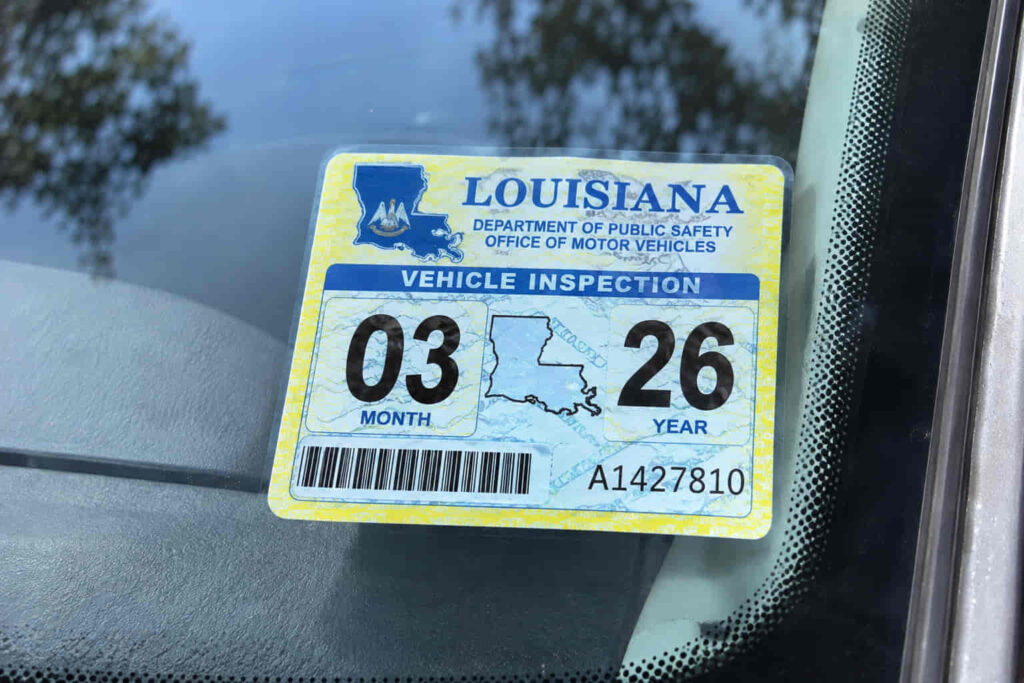
Louisiana inspection sticker requirements are changing under Act 701, a law enacted in 2026 that eliminates routine safety inspections for most personal vehicles beginning January 1, 2027, in parishes where the change is not dependent on federal approval. The law also establishes a transition period during which law enforcement officers cannot issue citations solely because a driver fails to display or produce a vehicle inspection certificate. That enforcement restriction began June 30, 2026, but it does not eliminate other vehicle safety requirements.
The changes do not mean every Louisiana vehicle will become exempt from inspection. Certain commercial vehicles and student transportation vehicles remain subject to safety inspection requirements. Emissions inspections also remain relevant in designated areas, where changes depend on approval from the U.S. Environmental Protection Agency. Louisiana is additionally introducing the Louisiana Vehicle Identification Program (LVIP), which uses a vehicle identification sticker rather than the traditional safety inspection approval sticker.
For Louisiana drivers, the requirements depend on the vehicle’s classification, registration location, and the date the applicable provisions take effect. This guide explains whether inspection stickers are still required in 2026, what changes in 2027, which vehicles must continue inspections, how the new LVIP sticker works, and what drivers should know about expired stickers, inspection costs, and local rules.
Are Louisiana Inspection Stickers Still Required in 2026?
Yes, Louisiana’s existing vehicle inspection requirements generally remain in effect during 2026, although Act 701 significantly restricts enforcement of inspection certificate display requirements. The state has enacted legislation to eliminate routine safety inspections for most personal vehicles, but the principal changes do not automatically take effect when the law is signed. For parishes outside the federally regulated emissions inspection program, the new requirements begin January 1, 2027. Until the applicable effective date, Louisiana Revised Statutes §32:1304 continues to govern periodic vehicle inspections.
Under the existing inspection system, Louisiana requires covered registered vehicles to undergo safety inspections and obtain official certificates of inspection and approval. Authorized inspection stations examine designated vehicle equipment, including braking systems, lights, tires, and other components affecting safe operation. Vehicle owners generally choose between one-year and two-year inspection certificates, depending on the inspection category and applicable rules. A valid Louisiana inspection sticker serves as visible evidence that the vehicle has completed the required inspection.
The most important change for drivers in late 2026 is the restriction on inspection certificate citations. Section 5 of Act 701 prohibits law enforcement officers from issuing citations to motor vehicles for failing to produce or display an inspection certificate from June 30, 2026, to January 1, 2027. This provision applies during the transition before the broader inspection reforms take effect. For example, a driver whose passenger vehicle does not display a current inspection sticker cannot be cited solely for failing to produce or display the certificate during that statutory period.
However, the citation restriction should not be interpreted as a blanket exemption from vehicle safety laws. Louisiana Revised Statutes §32:1301 requires vehicles operated on public highways to have equipment in proper working condition and to be mechanically safe. Officers retain authority under §32:1302 to address vehicles that appear unsafe or lack required equipment. A vehicle with defective brakes, unsafe tires, or nonfunctioning required lights can therefore face enforcement action regardless of the temporary inspection certificate restriction.
Whether a driver must obtain another inspection in 2026 depends on the vehicle’s classification, location, and applicable inspection rules. A privately owned passenger car and a commercial truck may be subject to different inspection obligations, particularly as the state transitions toward the new system. Drivers should distinguish the temporary restriction on sticker-related citations from the underlying requirement to maintain a roadworthy vehicle and from inspection programs that continue under state or federal law.
What Does Louisiana Act 701 Change About Vehicle Inspection Stickers?
Louisiana Act 701, enacted through House Bill 1085 in 2026, replaces the state’s broad periodic safety inspection requirement with a narrower inspection system and establishes the Louisiana Vehicle Identification Program. The legislation amends several provisions of Louisiana law, including Revised Statutes §§32:1301, 32:1302, 32:1304, and 32:1306, while creating §32:1304.1. Its central effect is to separate routine vehicle safety inspections from vehicle identification and federally required emissions compliance.
The previous version of §32:1304 generally authorized periodic inspections for registered motor vehicles and several trailer classifications. Under the amended provision, routine safety inspections focus on specified commercial motor vehicles, covered farm vehicles exceeding the statutory weight threshold, and student transportation vehicles. This means that most ordinary passenger cars, SUVs, and personal-use pickup trucks will no longer be subject to the same statewide periodic safety inspection requirement once the new law becomes effective in their parish.
Act 701 does not eliminate the obligation to operate a mechanically safe vehicle. The amended §32:1301 continues to prohibit operating vehicles with equipment that is not in proper working condition or with mechanical defects that endanger occupants or other highway users. The law also preserves inspection requirements connected to federal emissions regulations. Consequently, removing a routine safety inspection requirement does not authorize driving with defective safety equipment or bypassing an applicable emissions inspection.
Another major change is the creation of the Louisiana Vehicle Identification Program, commonly called LVIP. Under §32:1304.1, registered motor vehicles and low-speed vehicles covered by the provision must display an identification sticker containing the vehicle identification number. The program is designed to make vehicle identification information accessible to law enforcement. Unlike the traditional inspection sticker, an LVIP sticker identifies the vehicle rather than certifying that its brakes, tires, lights, and other equipment have passed a periodic safety examination.
The implementation of Act 701 also depends on where a vehicle is registered. Section 6 establishes January 1, 2027, as the effective date for parishes outside the federally required inspection and maintenance program. In parishes subject to those federal requirements, the law takes effect only if and when the U.S. Environmental Protection Agency adopts the relevant State Implementation Plan amendments submitted by the Louisiana Department of Environmental Quality. This distinction prevents the state’s inspection reforms from automatically overriding federal air-quality obligations.
For Louisiana vehicle owners, Act 701 therefore changes three separate aspects of compliance: which vehicles must undergo periodic safety inspections, how registered vehicles are identified through LVIP, and how inspection requirements interact with federal emissions regulations. Understanding these distinctions is essential because the elimination of a traditional safety inspection sticker does not necessarily eliminate every inspection or identification requirement associated with a vehicle.
When Does Louisiana’s New Inspection Sticker Law Take Effect?
Louisiana’s new inspection sticker law takes effect on January 1, 2027, in parishes that are not subject to the federally required vehicle inspection and maintenance program. This effective date is established in Section 6 of Act 701, which distinguishes between parishes covered by federal emissions requirements and those outside that program. As a result, the elimination of routine safety inspections for most personal vehicles does not necessarily begin on the same date throughout Louisiana.
For parishes outside the federally regulated inspection and maintenance program, January 1, 2027, marks the transition from the traditional statewide safety inspection system to the narrower requirements established by Act 701. Most privately owned passenger vehicles will no longer need periodic safety inspection approval solely because they are registered in Louisiana. However, vehicles specifically identified in the amended inspection law will remain subject to their applicable inspection requirements.
The effective date is different for parishes subject to federal Clean Air Act inspection and maintenance requirements. Section 6 provides that Act 701 takes effect in those parishes if and when the U.S. Environmental Protection Agency adopts the proposed State Implementation Plan amendments submitted by the Louisiana Department of Environmental Quality. This condition is significant because vehicle emissions programs are connected to federal air-quality obligations that cannot be eliminated through state legislation alone.
For example, a privately owned passenger car registered in a parish outside the federally required emissions program falls under the January 1, 2027, effective date. A comparable vehicle registered in an affected emissions-program parish must be evaluated under the EPA-dependent effective-date provision. The vehicle’s registration location therefore determines which implementation rule applies, even when both vehicles are used for the same personal transportation purposes.
The January 1, 2027, implementation date must also be distinguished from the earlier enforcement change. Section 5 of Act 701 restricts citations for failure to produce or display an inspection certificate during the period beginning June 30, 2026, and ending January 1, 2027. That restriction addresses inspection certificate enforcement during the transition; it is not the effective date of every substantive amendment to Louisiana’s inspection laws.
Vehicle owners should therefore evaluate two separate questions: whether the transition-period citation restriction applies and whether the revised inspection requirements have taken effect in their parish. This distinction is especially important for drivers in emissions-program areas, where the statutory effective date depends on federal approval rather than the statewide January 1 deadline.
Which Louisiana Vehicles Will No Longer Need a Safety Inspection Sticker?
Most privately owned passenger vehicles registered in Louisiana will no longer require a periodic safety inspection sticker once Act 701 takes effect in their parish. The amended Louisiana Revised Statutes §32:1304 narrows the categories of vehicles subject to routine safety inspections instead of requiring periodic inspections across the broad range of registered vehicles covered by the previous system.
The change primarily affects personal-use passenger cars, SUVs, minivans, and pickup trucks that do not fall within a vehicle classification specifically retained under the amended inspection requirements. For example, a privately owned sedan used for commuting and family transportation will generally no longer need to obtain an annual or biennial safety inspection approval sticker after the applicable provisions take effect. The same principle applies to a personal-use SUV that is not classified as a commercial motor vehicle subject to the retained inspection requirements.
The exemption depends on the vehicle’s legal classification, not simply its appearance or ownership. A pickup truck used for personal transportation may fall outside the revised periodic safety inspection requirement, while a commercial motor vehicle subject to 49 CFR Part 396 remains within the inspection system. Similarly, certain covered farm vehicles exceeding the statutory weight threshold and qualifying student transportation vehicles continue to have specific inspection obligations. These distinctions prevent the new law from being interpreted as a universal exemption for every vehicle registered in Louisiana.
The elimination of routine safety inspections also does not remove existing equipment safety standards. Louisiana Revised Statutes §32:1301 requires vehicles operated on public highways to remain in safe mechanical condition, with required equipment functioning properly. A passenger car may no longer need a periodic safety inspection sticker, but its owner must still maintain safe brakes, serviceable tires, functioning lights, and other equipment required by law.
A safety inspection exemption is also separate from emissions compliance and vehicle identification requirements. Vehicles registered in areas covered by federally required emissions inspections remain subject to the applicable inspection and maintenance program. In addition, Act 701 establishes the Louisiana Vehicle Identification Program, which requires covered registered motor vehicles and low-speed vehicles to display a vehicle identification sticker. That identification requirement serves a different purpose from the traditional safety inspection approval.
For Louisiana drivers, the practical result is that most personal vehicles will no longer need to visit an inspection station solely to obtain a routine safety approval sticker once the relevant legal changes take effect. However, owners must still determine whether their vehicle falls into a retained inspection category, whether emissions testing applies in their registration parish, and whether the new vehicle identification requirements have been implemented.
Read more: nh inspection sticker
Which Louisiana Vehicles Will Still Require Safety Inspections?
Louisiana Act 701 preserves periodic safety inspections for three principal vehicle categories: qualifying commercial motor vehicles, certain heavy covered farm vehicles, and student transportation vehicles. The amended Louisiana Revised Statutes §32:1304(A)(1) identifies these categories rather than applying routine inspections to nearly every registered passenger vehicle. Once the revised law takes effect in the relevant parish, the requirement to obtain an official safety inspection certificate will depend on the vehicle’s classification and the regulations governing its operation.
Commercial motor vehicles registered in Louisiana remain subject to periodic inspections when they are required to be inspected under 49 CFR Part 396, including §396.17 and Appendix G. These federal standards address the mechanical condition of commercial vehicles and establish minimum inspection requirements for equipment such as brakes, steering systems, tires, wheels, lighting, and suspension components. For example, a commercial truck that falls within the federal inspection rules must continue meeting those requirements even though a privately owned passenger car may no longer need a routine Louisiana safety inspection sticker. The federal inspection obligation cannot be avoided simply because Louisiana has narrowed its general passenger vehicle inspection program.
Covered farm vehicles also remain subject to inspection when their gross vehicle weight rating or gross combination weight rating exceeds 26,000 pounds. This threshold is expressly identified in the amended statute. The distinction matters because a vehicle’s use in agriculture does not automatically determine whether it is included or excluded from Louisiana’s inspection requirements. Owners must consider both the vehicle’s covered farm vehicle classification and its rated weight. For instance, a qualifying farm vehicle with a gross combination weight rating of 30,000 pounds falls within the statutory category, while a lighter agricultural vehicle must be evaluated under the other rules applicable to its classification.
Student transportation vehicles represent another retained inspection category. Louisiana Act 701 requires inspections for student transportation vehicles registered in the state and covered by LAC 28.701(A)(3) and related regulations. These vehicles transport students and are subject to equipment and operational standards intended to protect passengers. Their inspection requirements therefore remain distinct from those governing ordinary family vehicles. A school transportation vehicle covered by the cited regulation cannot rely on the general passenger vehicle exemption to avoid its required safety examination.
The revised inspection law also preserves enforcement authority over unsafe vehicles that are not subject to periodic inspections. Under Louisiana Revised Statutes §32:1302, authorized officers may require an inspection when there is reasonable cause to believe a vehicle is unsafe or lacks legally required equipment. This means a passenger car exempt from routine inspection can still be examined when defective brakes, damaged tires, or another safety problem creates grounds for enforcement. The exemption removes a recurring inspection obligation; it does not eliminate the legal responsibility to maintain safe vehicle equipment.
Vehicle owners should therefore determine whether their vehicle falls under 49 CFR Part 396, the statutory covered farm vehicle category, or the applicable student transportation regulations. These classifications establish whether periodic safety inspections remain mandatory under Act 701 and prevent confusion between the general passenger vehicle exemption and the requirements retained for specialized vehicles.
Will Louisiana Still Require Emissions Inspections in 2027?
Yes, Louisiana’s vehicle emissions inspection requirements remain applicable in federally regulated areas unless the necessary federal approval allows the program to change or end. Act 701 does not automatically eliminate emissions testing when it removes routine safety inspections for most personal vehicles. The legislation preserves inspection and maintenance obligations connected to the federal Clean Air Act and makes implementation in affected parishes dependent on approval of the relevant State Implementation Plan amendments by the U.S. Environmental Protection Agency.
Louisiana’s existing vehicle Inspection and Maintenance (I/M) program covers five parishes in the Greater Baton Rouge area: Ascension, East Baton Rouge, Iberville, Livingston, and West Baton Rouge. According to the Louisiana Department of Environmental Quality, the program applies to qualifying gasoline-powered passenger cars and trucks registered in these parishes with a gross vehicle weight rating of 10,000 pounds or less. The established program covers applicable vehicles from model year 1980 onward, subject to the testing rules and exemptions for particular vehicles. A vehicle registered in East Baton Rouge Parish may therefore have an emissions inspection obligation that does not apply to an otherwise comparable vehicle registered outside the five-parish program area.
An emissions inspection evaluates pollution-control equipment rather than the mechanical safety systems examined during a traditional safety inspection. Louisiana’s I/M program includes checks for tampering with emissions-control components, gas cap integrity testing, and onboard diagnostics testing for vehicles subject to those procedures. An onboard diagnostics inspection examines information from the vehicle’s electronic emissions monitoring system to identify malfunctions that can increase pollutant emissions. For example, a gasoline-powered car with a malfunctioning catalytic converter or an emissions-related diagnostic fault may fail the applicable emissions test even when its brakes, tires, and lights are in acceptable condition.
The relationship between emissions testing and safety inspection stickers is particularly important during the 2026–2027 transition. Historically, Louisiana’s five-parish emissions program operated alongside the annual vehicle safety inspection process. Act 701 changes the broader safety inspection framework, but Section 6 conditions its implementation in federally regulated inspection and maintenance parishes on EPA adoption of the relevant State Implementation Plan amendments. Consequently, drivers should not assume that the January 1, 2027, effective date for other parishes automatically ends emissions inspections or changes the testing process in the Greater Baton Rouge area.
The Louisiana Department of Environmental Quality oversees the emissions program, while the Louisiana Department of Public Safety and State Police administer inspection-related operations and enforcement. Qualifying vehicles must be tested at inspection stations authorized to perform the required emissions procedures. A general automotive repair shop is not automatically qualified to conduct an official I/M inspection. The Louisiana Department of Environmental Quality identifies approved emissions inspection services within the five participating parishes and provides guidance on test failures, repair documentation, and retesting.
For example, a qualifying gasoline-powered passenger car registered in Livingston Parish should continue following the applicable emissions inspection rules until the responsible agencies confirm an approved change. A comparable vehicle registered in Lafayette Parish is outside the existing five-parish emissions program, although it must still comply with Louisiana’s general vehicle equipment laws. The determining factors are the vehicle’s registration parish, fuel type, weight classification, model year, and the emissions rules in effect when testing is due.
What Is the Louisiana Vehicle Identification Program Sticker?
The Louisiana Vehicle Identification Program (LVIP) sticker is a vehicle identification decal established by Act 701 to replace the identification function of Louisiana’s traditional inspection sticker system. Under Louisiana Revised Statutes §32:1304.1, motor vehicles and low-speed vehicles registered in Louisiana must display an LVIP sticker when the applicable provisions take effect. Unlike a safety inspection certificate, the new sticker identifies a registered vehicle without certifying that its mechanical components have passed a periodic safety examination.
The central feature of an LVIP sticker is the vehicle identification number (VIN). Section 1304.1 requires the sticker to contain the VIN and remain visible to law enforcement. A VIN is a unique identifier assigned to a vehicle by its manufacturer, allowing authorities to distinguish one vehicle from another even when vehicles share the same make, model, and exterior appearance. For example, two identical pickup trucks registered in Louisiana have different VINs, allowing their identification records to be distinguished through the information displayed on their respective LVIP stickers.
The LVIP requirement is broader than the revised periodic safety inspection requirement. Act 701 limits routine safety inspections to specified vehicle categories, but §32:1304.1 applies to registered motor vehicles and low-speed vehicles generally. Consequently, a personal-use passenger car that no longer needs a routine safety inspection may still be required to display an LVIP sticker. A commercial motor vehicle can also be subject to the identification program while continuing to meet its separate safety inspection obligations.
The distinction between identification and inspection approval is essential. A traditional Louisiana inspection sticker documents compliance with an inspection requirement at the time the vehicle passes the applicable examination. An LVIP sticker, by contrast, provides vehicle identification information for law enforcement. Its presence does not establish that the vehicle has functioning brakes, compliant tires, or properly maintained emissions equipment. Vehicle owners remain responsible for satisfying the safety and emissions requirements that apply to their vehicles.
The LVIP sticker is therefore a separate legal requirement rather than a new form of mechanical inspection certification. Drivers should not treat an LVIP decal as evidence that a vehicle has passed an inspection, nor should they assume that an existing safety inspection sticker automatically fulfills the new identification requirement. The practical transition between the two systems depends on the implementation rules adopted by Louisiana’s responsible agencies.
How Will the New Louisiana LVIP Sticker Work?
Louisiana’s LVIP sticker will identify registered vehicles through their VINs, with additional electronic identification features established through administrative regulations. Section 1304.1 authorizes the secretary to adopt rules governing how the program operates, including where the sticker must be attached and how vehicle identification information is displayed. The law specifically requires the implementing regulations to address the inclusion of a barcode, quick response (QR) code, or comparable electronic identifier.
This electronic identification feature is intended to make vehicle information accessible through a standardized identifier. A barcode or QR code can encode information in a format that compatible equipment can read, reducing the need to manually transcribe an identifier. However, Act 701 does not establish that every LVIP sticker must use a QR code specifically. The final format may use a barcode, QR code, or comparable electronic technology, depending on the rules adopted for the program.
The LVIP fee cannot exceed $6 per year under Louisiana Revised Statutes §32:1304.1(C). The statute also permits the fee to be assessed and collected on a biennial basis. This means the law allows a two-year collection cycle, but the actual payment procedure and collection schedule must follow the implementing regulations. The LVIP charge is separate from fees for safety inspections that remain mandatory for certain vehicles and from any applicable emissions inspection charges.
Act 701 assigns responsibility for adopting implementation rules to the commissioner of the Louisiana Office of Motor Vehicles. Section 4 requires those regulations to be adopted no later than December 31, 2026, and authorizes emergency rulemaking when necessary. These rules are important because the statute establishes the program’s basic requirements without specifying every administrative detail. For example, the law requires the regulations to address sticker placement, but drivers should rely on the final official instructions rather than assume that the LVIP decal belongs in the same windshield position as the former safety inspection sticker.
The date on which drivers must comply with LVIP also depends on the effective-date provisions of Act 701. In parishes outside the federally regulated inspection and maintenance program, the legislation takes effect January 1, 2027. In parishes subject to the relevant federal emissions requirements, implementation is conditional on EPA approval of the State Implementation Plan amendments. Drivers should therefore verify the applicable start date and official issuance instructions before attempting to obtain or display a new identification sticker.
For vehicle owners, the practical requirement is to follow the Louisiana Office of Motor Vehicles’ published procedures for obtaining the correct LVIP sticker and displaying it in the designated location. The program establishes a new identification obligation, but it does not replace vehicle registration, insurance requirements, or any safety and emissions inspections that remain legally applicable.
Can You Get a Ticket for an Expired Louisiana Inspection Sticker in 2026?
Louisiana law prohibits citations solely for failing to produce or display a vehicle inspection certificate between June 30, 2026, and January 1, 2027. This temporary restriction is established in Section 5 of Act 701 and applies during the transition to the state’s revised inspection system. However, the provision addresses failure to produce or display an inspection certificate. It should not be interpreted as a general exemption from every inspection-related requirement or vehicle safety violation.
Before the transition period, Louisiana’s inspection laws required covered vehicles to display a valid inspection certificate and provided enforcement mechanisms for noncompliance. The previous version of Louisiana Revised Statutes §32:1304 also contained a provision protecting drivers whose inspection certificates had been expired for less than one calendar month. Act 701 repeals that provision as part of its broader restructuring of periodic inspection requirements. The temporary citation restriction in Section 5 therefore serves a different legal purpose from the former expiration allowance.
An expired inspection sticker does not protect a driver from citations for defective or unsafe vehicle equipment. Louisiana Revised Statutes §32:1301 requires vehicles operated on public highways to remain in safe mechanical condition. Under §32:1302, authorized officers may inspect vehicles when they have reasonable cause to believe that required equipment is missing, defective, or improperly maintained. For example, a driver with an expired inspection sticker may be protected from a citation based solely on failure to display a valid inspection certificate during the statutory transition period, but the same driver can still face enforcement action for defective brake lights or unsafe tires.
The distinction becomes especially important for vehicles that remain subject to periodic inspections under the revised law. Commercial motor vehicles covered by federal inspection requirements and qualifying student transportation vehicles must continue meeting their applicable safety standards. Similarly, drivers in federally regulated emissions inspection areas should not assume that the temporary restriction on inspection certificate citations eliminates emissions testing obligations. Those programs have separate compliance requirements that must be evaluated under the applicable law.
After January 1, 2027, inspection certificate enforcement depends on the vehicle category and the effective date of Act 701 in the relevant parish. Most personal vehicles outside the federally regulated inspection and maintenance areas will no longer be subject to routine safety inspection requirements. Vehicles remaining within mandatory inspection programs must continue complying with the rules governing their classifications. Drivers should therefore distinguish an expired traditional safety inspection sticker from a missing required inspection certificate or another violation after the transition period ends.
How Much Does a Louisiana Inspection Sticker Cost in 2026 and 2027?
A standard Louisiana safety inspection sticker costs $10 for a one-year certificate or $20 for a two-year certificate under the inspection fee structure in effect before Act 701’s principal changes. Louisiana Revised Statutes §32:1306(C) establishes a $10 charge for each year of certificate validity and allows eligible vehicle owners to choose between one-year and two-year inspection certificates. These charges apply to the traditional inspection system and should not be confused with the new Louisiana Vehicle Identification Program fee.
For vehicles subject to the federally required emissions inspection and maintenance program, the existing fee structure includes an additional $8 charge for an inspection involving emissions testing. A qualifying vehicle receiving a one-year inspection certificate in the five-parish emissions program therefore has a combined inspection charge of $18 under the pre-reform structure. The additional amount supports the emissions testing program, with a portion retained by the inspection station and the remainder allocated to the Louisiana Department of Environmental Quality.
Act 701 changes the fee structure when its revised inspection provisions take effect. The legislation removes the general $10-per-year safety inspection charge from §32:1306(C) and retains an $8 fee for inspections conducted under the federally required emissions inspection and maintenance program. This distinction matters because the $8 emissions charge becomes a standalone statutory inspection fee rather than an additional charge added to the former statewide safety inspection fee. Its continued application depends on the emissions program remaining legally required.
Commercial motor vehicle inspections have a separate statutory fee. Under the amended §32:1306(C), the annual inspection charge for commercial motor vehicles subject to 49 CFR Part 396 is $30. The statute specifies that no additional inspection fee may be charged for the commercial motor vehicle inspection covered by that provision. For example, a qualifying commercial truck that remains subject to periodic inspection under Act 701 continues to incur the applicable $30 inspection charge even though most personal passenger vehicles will no longer require routine safety inspection stickers.
Student transportation vehicles subject to the retained inspection requirement have a statutory inspection fee of $20. This amount applies to vehicles inspected under LAC 28.701(A)(3), as referenced in Louisiana Revised Statutes §32:1306(C). The law also requires necessary headlight adjustments to be included in the applicable student transportation vehicle inspection without an additional charge. Repair work needed to correct defective equipment is a separate expense from the statutory inspection fee.
The Louisiana Vehicle Identification Program introduces another distinct charge. Under §32:1304.1(C), the LVIP fee cannot exceed $6 per year and may be assessed and collected on a biennial basis. This charge supports the identification sticker program rather than a mechanical safety inspection. For example, a personal-use passenger car exempt from periodic safety inspections after Act 701 takes effect may still be subject to the LVIP identification requirement and its associated fee.
Louisiana drivers should identify the specific program before estimating inspection-related costs. The traditional safety inspection fee, the federally required emissions inspection fee, the retained commercial or student transportation inspection charges, and the LVIP fee apply to different legal requirements. The amount owed depends on the vehicle’s classification, registration parish, and the provisions in effect when the inspection or identification requirement applies.
What Should You Do With an Existing Louisiana Inspection Sticker After 2026?
Louisiana drivers should keep their existing inspection stickers in place until the applicable requirements change or an authorized agency provides instructions for removing or replacing them. Act 701 eliminates routine safety inspection requirements for most personal vehicles once its provisions take effect, but the legislation does not establish a universal deadline for removing previously issued inspection stickers. An existing certificate and a future Louisiana Vehicle Identification Program (LVIP) sticker serve different purposes, so vehicle owners should not assume that one automatically replaces the other.
For personal vehicles registered in parishes where the revised inspection law takes effect on January 1, 2027, the traditional safety inspection sticker will no longer be required as evidence of a recurring safety examination. This change does not necessarily invalidate a sticker that was lawfully issued before that date. For example, a passenger car with a two-year inspection certificate extending into 2027 does not need another routine safety inspection merely because the calendar reaches January, provided the vehicle is outside the categories that remain subject to inspection and the revised law has taken effect in its parish.
Vehicles that remain subject to mandatory inspections must continue maintaining the certificates required for their classification. A commercial motor vehicle covered by 49 CFR Part 396 cannot rely on the general passenger vehicle exemption, while a vehicle registered in a federally regulated emissions-program parish must follow the inspection rules applicable to that location. Owners should therefore verify their vehicle’s classification before treating an existing inspection sticker as unnecessary.
The physical condition of an existing sticker also matters when determining whether any action is needed. Louisiana State Police previously identified a manufacturing defect affecting certain 2026 inspection stickers whose yellow backgrounds could fade to white or clear after prolonged sunlight exposure. The agency stated that these stickers remain valid despite the discoloration and that affected vehicle owners do not need to replace them solely because of fading. This guidance illustrates why drivers should rely on official instructions rather than assume that a sticker’s appearance automatically makes it invalid.
The introduction of LVIP creates a separate identification requirement that drivers must address through the official implementation process. Act 701 requires covered registered vehicles to display an identification sticker containing the vehicle identification number, but the law leaves administrative details, including placement and implementation procedures, to agency regulations. Owners should not attempt to modify an existing inspection sticker, add their own QR code, or purchase an unofficial replacement to satisfy the new requirement.
For most personal vehicle owners, the appropriate approach is to retain existing inspection documentation, monitor Louisiana Office of Motor Vehicles announcements, and follow the rules applicable to their registration parish. This avoids unnecessary inspections or sticker purchases while preserving compliance with any requirements that remain in effect.
Does New Orleans Still Require Brake Tags in 2026 and 2027?
New Orleans has suspended the issuance of new brake tags and stopped issuing citations solely for failure to display or produce a brake tag for the remainder of 2026. The City of New Orleans announced the change on July 31, 2026, as part of its response to Louisiana Act 701. The suspension applies to the city’s vehicle inspection stickers, commonly known as brake tags, and means motorists are not required to update their existing brake tags during the remainder of 2026.
Before the suspension, New Orleans operated a municipal vehicle inspection program separate from the statewide inspection system. Vehicles registered and domiciled in Orleans Parish were generally required to pass an inspection administered through stations licensed by the city’s Motor Vehicle Inspection Bureau. These inspections evaluated safety-related equipment, including brakes, lights, tires, windshield condition, and other components. The municipal program also had its own inspection fees and administrative requirements, making a New Orleans brake tag distinct from a standard Louisiana state inspection sticker.
The July 2026 announcement changes brake tag enforcement without eliminating other vehicle safety obligations. The New Orleans Police Department was instructed to stop issuing citations for failure to display or produce a vehicle inspection sticker, and the city paused new brake tag issuance while reviewing how its program should align with state law. However, the city explicitly stated that enforcement of other traffic laws and vehicle-equipment requirements would continue. A vehicle with defective brakes, unsafe tires, or nonfunctioning required lights can therefore still be subject to enforcement even when its brake tag is expired or missing.
The city’s announcement also addressed uncertainty about the relationship between its local inspection program and the statewide changes. New Orleans officials stated that they were evaluating the effect of Act 701 on the city’s separate vehicle inspection and emissions requirements. The administration indicated that updated procedures for 2027 would be announced before the end of 2026. Until those procedures are formally published, drivers should not assume that every former municipal inspection requirement has been permanently eliminated or that the new LVIP sticker automatically satisfies every local requirement.
For 2027, New Orleans drivers should follow the city’s latest published rules rather than rely on older brake tag instructions. Existing municipal webpages may still describe the previous inspection process, including station locations, inspection fees, and the requirement to display a current brake tag. Those instructions must be read alongside the city’s more recent suspension announcement. The official Motor Vehicle Inspection Bureau and the City of New Orleans website are the appropriate sources for determining whether inspections resume, which vehicles remain covered, and how the city will administer any revised requirements.
For example, a New Orleans resident whose brake tag expires in November 2026 does not need to obtain a replacement during the city’s announced suspension period. The resident must still maintain the vehicle in safe operating condition and should check for updated municipal instructions before 2027. This distinction prevents confusion between the temporary suspension of local brake tag administration and the longer-term changes introduced by Louisiana’s statewide inspection law.
How Can You Check Whether Your Louisiana Vehicle Still Needs an Inspection?
To determine whether a Louisiana vehicle still needs an inspection, check its legal classification, parish of registration, and the effective date of the inspection rules that apply to it. These three factors establish whether the vehicle is exempt from routine safety inspections, remains subject to a specialized inspection requirement, or must comply with the federally regulated emissions program. A vehicle’s registration status alone does not establish that every inspection requirement has been satisfied.
The first consideration is vehicle classification. Owners of personal-use passenger cars, SUVs, and pickup trucks should determine whether their vehicles fall outside the categories retained under Louisiana Revised Statutes §32:1304 after Act 701 takes effect. Commercial vehicle owners must establish whether federal inspection requirements under 49 CFR Part 396 apply. Operators of qualifying heavy covered farm vehicles and student transportation vehicles must also check their specific inspection obligations. For example, a family sedan and a commercial delivery truck registered in the same parish may have different safety inspection requirements because their legal classifications differ.
The second consideration is the vehicle’s registration parish. Louisiana’s five-parish emissions inspection program covers Ascension, East Baton Rouge, Iberville, Livingston, and West Baton Rouge. Owners of qualifying vehicles registered in these areas must verify whether emissions testing remains required and whether EPA approval has changed the implementation of Act 701. Drivers registered outside the federally regulated program should apply the January 1, 2027, effective-date provision, subject to any subsequent legal changes.
The third consideration is the type of compliance document required. A traditional safety inspection certificate, an emissions inspection record, and a Louisiana Vehicle Identification Program sticker serve different purposes. A vehicle may be exempt from periodic safety inspections while still needing emissions testing or an LVIP identification sticker. Drivers should consult the Louisiana Office of Motor Vehicles for LVIP implementation instructions, Louisiana State Police for safety inspection requirements, and the Louisiana Department of Environmental Quality for emissions program guidance.
Drivers should also check local government announcements when their vehicles are subject to municipal inspection rules. New Orleans, for example, suspended brake tag issuance and related display enforcement for the remainder of 2026 while reviewing its inspection program. Vehicle owners should verify the city’s published requirements for 2027 rather than assume the earlier suspension continues indefinitely.
The most reliable approach is to confirm the vehicle’s classification and registration parish against the latest official rules before paying for an inspection or identification sticker. This ensures compliance with the requirements that actually apply to the vehicle without obtaining an unnecessary inspection certificate.