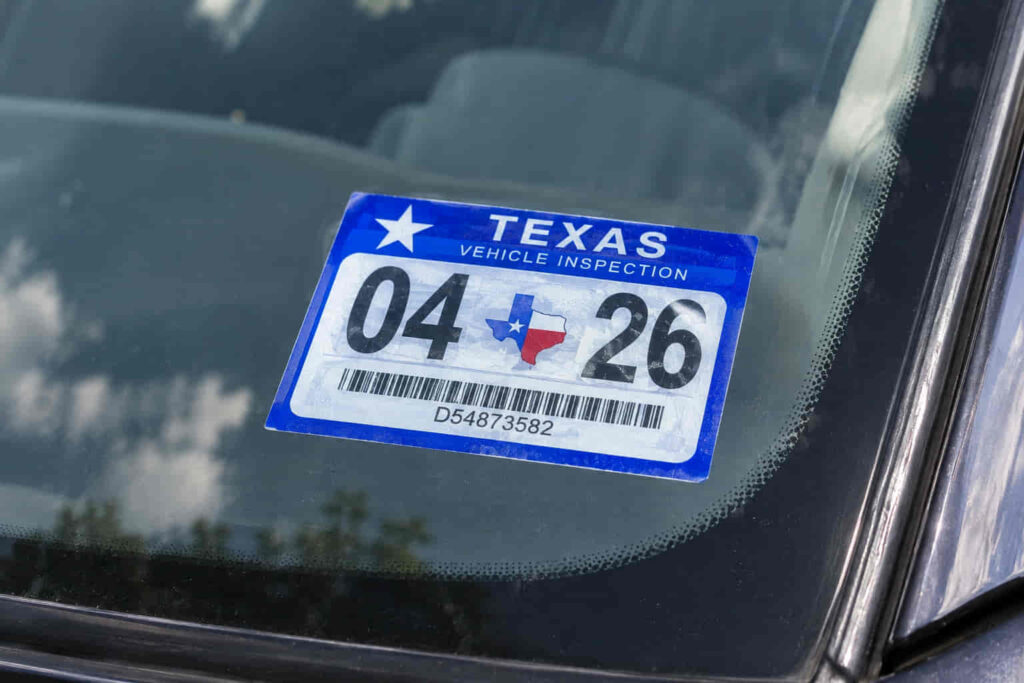
Texas no longer requires an annual safety inspection for most non-commercial vehicles, meaning most drivers do not need a Texas inspection sticker in 2026. The change took effect on January 1, 2025, under Texas House Bill 3297, which eliminated mandatory safety inspections for most privately owned passenger vehicles. However, the law did not eliminate all vehicle inspection requirements. Certain vehicles must still pass emissions testing, and qualifying commercial vehicles remain subject to separate safety inspection regulations.
For Texas drivers, the most important distinction is between a vehicle inspection and a vehicle registration sticker. Although routine safety inspections have been removed for most non-commercial vehicles, registration remains mandatory. Drivers must continue renewing their vehicle registration, paying applicable fees, and displaying a valid registration sticker when required. Vehicles registered in counties covered by the emissions inspection program must also satisfy the applicable testing requirements before registration renewal.
The changes also introduced an inspection program replacement fee for affected vehicle owners, making it important to understand which costs remain even without an annual safety inspection. This guide explains the Texas inspection sticker rules for 2026, including emissions testing requirements, vehicle registration, inspection fees, expired stickers, commercial vehicle exceptions, and the safety standards that continue to apply on Texas roads.
Do You Need a Texas Inspection Sticker in 2026?
Most Texas drivers do not need a vehicle inspection sticker in 2026 because the state eliminated annual safety inspections for most non-commercial vehicles on January 1, 2025. Under Texas House Bill 3297, privately owned passenger cars, SUVs, pickup trucks, and other qualifying non-commercial vehicles are no longer required to pass a routine state safety inspection before registration renewal. However, this exemption does not apply to every vehicle inspection requirement, particularly emissions testing and commercial vehicle safety inspections.
Texas previously operated a vehicle inspection system that required eligible vehicles to pass safety checks covering components such as brakes, tires, steering, lighting, and windshield equipment. Since 2015, Texas has used the Two Steps, One Sticker system, which combined inspection verification and vehicle registration into a single windshield registration sticker. Consequently, the term “Texas inspection sticker” is frequently used to describe a sticker that actually represents vehicle registration rather than a separate inspection certificate.
A Texas registration sticker is still required for vehicles subject to the state’s registration display rules. Eliminating annual safety inspections did not eliminate vehicle registration, registration renewal deadlines, or applicable fees. For example, a driver who owns a privately registered 2020 Toyota Camry in a county without emissions testing requirements can generally renew the vehicle’s registration without obtaining an annual safety inspection. The driver must still complete the registration process and maintain the vehicle in a legally compliant condition.
Vehicles registered in counties subject to emissions testing follow different procedures. Eligible gasoline-powered vehicles must continue passing the required emissions inspection before registration renewal, even though the routine safety inspection requirement has been removed. Commercial vehicles subject to state or federal safety inspection rules also remain outside the general exemption for non-commercial vehicles.
The practical distinction is that Texas eliminated most annual safety inspections, not every vehicle inspection or registration requirement. Whether a particular vehicle still needs an inspection depends on its classification, registration county, fuel type, model year, and applicable exemptions.
When Did Texas Stop Requiring Vehicle Inspection Stickers?
Texas stopped requiring annual safety inspections for most non-commercial vehicles on January 1, 2025, when House Bill 3297 took effect. The legislation was passed during the 88th Texas Legislature in 2023 and amended the state’s vehicle inspection framework. Its central change was removing the routine safety inspection requirement for most non-commercial vehicles while preserving other obligations, including emissions inspections in designated counties and safety inspections for qualifying commercial vehicles.
Before January 2025, Texas vehicle owners generally had to complete an applicable inspection before renewing their registration. Inspection stations checked safety-related equipment according to state standards, and the inspection result was recorded electronically. Under the Two Steps, One Sticker system, vehicle owners then completed registration through the Texas Department of Motor Vehicles, which issued the registration sticker displayed on the windshield. This arrangement explains why drivers continue searching for information about Texas inspection stickers even though separate inspection stickers had already been replaced by the combined system years earlier.
House Bill 3297 changed the safety inspection requirement rather than abolishing the registration system. Beginning in 2025, most qualifying non-commercial vehicle owners no longer needed to visit an inspection station solely for an annual safety inspection. Instead, they could complete registration renewal through the applicable TxDMV procedures, provided they satisfied any remaining requirements. Vehicles subject to emissions testing still needed a qualifying emissions inspection, while commercial vehicles continued to follow the inspection rules applicable to their operations.
The legislation also established an inspection program replacement fee, allowing the state to collect a fee through vehicle registration even though most non-commercial vehicles no longer undergo annual safety inspections. This means the elimination of the inspection appointment does not necessarily eliminate every inspection-related charge from the registration process. The amount and application of the fee depend on the vehicle’s registration circumstances, including special provisions for certain newly registered vehicles.
For example, a Texas resident renewing registration for a qualifying non-commercial pickup truck in 2026 generally does not need to schedule a routine safety inspection. If that truck is registered in a county requiring emissions testing and falls within the covered vehicle category, the owner must still obtain a passing emissions result. The registration sticker remains part of the vehicle registration process regardless of whether a safety inspection is required.
The January 1, 2025 change therefore marked the end of routine annual safety inspections for most non-commercial vehicles, not the end of Texas vehicle registration or all inspection programs. Understanding this distinction is essential when determining which requirements apply to a vehicle in 2026.
What Is the Difference Between a Texas Inspection Sticker and a Registration Sticker?
A Texas inspection sticker represents a vehicle’s inspection status, while a Texas registration sticker confirms that the vehicle has completed the state’s registration process. These two concepts serve different legal purposes, although Texas combined their administration under the Two Steps, One Sticker program in 2015. Understanding this distinction is essential because the elimination of most annual safety inspections in 2025 did not eliminate vehicle registration stickers.
Before March 2015, Texas used separate windshield stickers for vehicle inspection and registration. Drivers had to maintain a current inspection sticker showing that their vehicle had passed the applicable inspection requirements and a registration sticker confirming that the vehicle was legally registered. The Two Steps, One Sticker program replaced this arrangement with a single registration sticker. Inspection results were recorded electronically and checked during registration rather than displayed through a separate inspection decal.
The Texas Department of Motor Vehicles (TxDMV) administers vehicle registration, while the Texas Department of Public Safety (DPS) oversees the state’s vehicle inspection program. These agencies perform different functions within the vehicle compliance system. The registration sticker identifies the vehicle’s registration status and expiration period, whereas an inspection result documents compliance with applicable safety or emissions testing requirements. A passing inspection does not independently renew a vehicle’s registration, and a registration sticker does not establish that every mechanical component is functioning correctly.
House Bill 3297 further changed this relationship on January 1, 2025, by eliminating annual safety inspections for most non-commercial vehicles. For example, a driver registering a qualifying passenger car in a Texas county without emissions testing requirements no longer needs a routine safety inspection before renewal. However, the driver must still renew the vehicle’s registration and display the required registration sticker. In an emissions-testing county, a covered vehicle must still pass the applicable emissions inspection before registration can be completed.
The key distinction in 2026 is that Texas generally requires a registration sticker, not a separate annual safety inspection sticker, for ordinary non-commercial passenger vehicles. Drivers should therefore check their registration expiration date and any applicable emissions testing requirements instead of assuming that the absence of a separate inspection sticker means the vehicle is exempt from registration.
Is Emissions Testing Still Required in Texas in 2026?
Yes, emissions testing remains mandatory in 2026 for eligible vehicles registered in Texas counties covered by the state’s emissions inspection program. House Bill 3297 eliminated routine safety inspections for most non-commercial vehicles but preserved emissions testing requirements in designated areas. Whether a vehicle needs an emissions inspection depends primarily on its registration county, fuel type, model year, vehicle classification, and applicable exemptions.
Texas uses emissions inspections to identify vehicles with malfunctioning pollution-control systems. For most covered modern gasoline-powered vehicles, the inspection relies on the onboard diagnostics system, commonly called OBD-II. This system monitors emissions-related components, including oxygen sensors, catalytic converter performance, evaporative emissions controls, and engine management functions. During an OBD-based inspection, testing equipment communicates with the vehicle’s computer to evaluate the malfunction indicator light, diagnostic trouble codes, and emissions-monitor readiness.
A vehicle may fail an emissions inspection when its onboard diagnostic system identifies a qualifying emissions-related malfunction or when required monitors are not ready for evaluation. For example, a gasoline-powered passenger car with an illuminated check engine light caused by a catalytic converter efficiency fault may fail even if its brakes, tires, and exterior lights are in good condition. Similarly, disconnecting the battery shortly before testing can reset emissions monitors, potentially preventing the vehicle from completing the inspection until the required driving conditions have been met.
Not every vehicle registered in an emissions-testing county must undergo the same inspection. Texas provides exemptions based on vehicle characteristics and applicable program rules. Electric vehicles do not produce tailpipe emissions and are not subject to conventional gasoline-engine emissions testing. Diesel-powered vehicles are also treated differently under the state’s emissions inspection framework. In addition, vehicle age and model year affect whether gasoline-powered vehicles fall within the testing requirements. Owners should verify the current eligibility criteria rather than assuming that every passenger vehicle in a covered county must be tested.
For example, an eligible gasoline-powered 2020 Honda Civic registered in Dallas County generally must satisfy the applicable emissions inspection requirement before registration renewal. A comparable vehicle registered in a Texas county outside the emissions program would not need the same routine emissions test solely for registration. This geographic distinction explains why two Texas drivers with similar vehicles may face different inspection requirements despite the statewide elimination of most annual safety inspections.
An emissions inspection is also different from a voluntary mechanical inspection. A repair shop may examine brakes, steering components, suspension, and tires to evaluate roadworthiness, but that service does not replace a required emissions test. Likewise, a passing emissions result does not certify that the vehicle is mechanically safe in every respect. The two processes assess different aspects of vehicle condition.
For Texas vehicle owners in 2026, the correct approach is to determine whether their registration county participates in emissions testing and whether their vehicle falls within the covered category. Drivers who are subject to testing must obtain a passing result through an authorized inspection station before completing the applicable registration process. The next section identifies the Texas counties where emissions testing requirements apply.
Read more: virginia state inspection sticker
Which Texas Counties Still Require Emissions Testing?
Texas requires emissions testing in 17 counties in 2026, even though annual safety inspections have been eliminated for most non-commercial vehicles. These counties participate in the state’s vehicle emissions inspection and maintenance program, which is designed to identify gasoline-powered vehicles with malfunctioning pollution-control systems. The requirement is determined primarily by the vehicle’s county of registration and whether the vehicle falls within the applicable emissions testing category.
The Dallas–Fort Worth area includes Collin, Dallas, Denton, Ellis, Johnson, Kaufman, Parker, Rockwall, and Tarrant counties. The Houston–Galveston area includes Brazoria, Fort Bend, Galveston, Harris, and Montgomery counties. Travis and Williamson counties participate in the Austin-area emissions inspection program. Bexar County, which includes San Antonio, joined the program on November 1, 2026, bringing the statewide total to 17 counties.
For eligible vehicles registered in these counties, an emissions inspection remains part of the registration process. Most covered gasoline-powered vehicles undergo an onboard diagnostics inspection that evaluates emissions-related fault information and monitor readiness. A passing result is recorded electronically and used to establish compliance with the applicable inspection requirement. Eliminating the annual safety inspection does not exempt a covered vehicle from this emissions test.
For example, an eligible gasoline-powered 2021 Chevrolet Silverado registered in Harris County must satisfy the applicable emissions testing requirement before registration renewal. A comparable truck registered in a county outside the emissions program generally does not need a routine emissions inspection. However, the county alone does not determine eligibility. Fuel type, vehicle age, weight classification, and statutory exemptions also affect whether testing is required.
The addition of Bexar County is particularly important for drivers searching for Texas inspection sticker requirements in late 2026. A vehicle owner relying on an older list of 16 emissions-testing counties could incorrectly conclude that San Antonio-area vehicles are exempt. Drivers should therefore use current Texas Department of Public Safety guidance when determining whether an emissions inspection is required.
The key rule is that Texas emissions testing remains geographically limited, while the elimination of most non-commercial safety inspections applies statewide. Vehicle owners should verify their registration county and vehicle eligibility before renewing registration or scheduling an emissions inspection.
Đính chính thông tin cho H2 vừa viết: Theo danh sách hiện hành của Texas DPS và TxDMV, Texas có 18 quận yêu cầu emissions testing kể từ ngày 01/11/2026, không phải 17. Danh sách ở trên còn thiếu El Paso County. Cần bổ sung El Paso vào nhóm khu vực riêng và sửa cả hai lần xuất hiện của con số 17 thành 18. Department of Public Safety+2
Can You Register a Car in Texas Without an Inspection?
You can register most non-commercial vehicles in Texas without a safety inspection in 2026, but vehicles covered by the state’s emissions testing program must still pass the applicable emissions inspection before registration. This distinction follows House Bill 3297, which removed mandatory safety inspections for non-commercial vehicles beginning January 1, 2025. The change simplified registration for many drivers without eliminating registration requirements or the emissions testing program. TxDMV.gov+1
For a qualifying passenger vehicle registered outside the 18 emissions-testing counties, the owner generally does not need an annual inspection before renewing registration. The Texas Department of Motor Vehicles continues to administer the registration process, which includes verifying the vehicle’s registration information and collecting applicable fees. For example, an owner renewing registration for a privately used 2020 Toyota Corolla in Lubbock County generally does not need a routine safety or emissions inspection. The owner must still complete registration renewal and maintain a valid registration sticker.
The process differs for eligible gasoline-powered vehicles registered in emissions-testing counties. These vehicles generally must pass an emissions inspection before initial registration or renewal. The inspection result is transmitted electronically, allowing registration authorities to verify compliance. If the result cannot be confirmed electronically, the owner may be able to present the Vehicle Inspection Report issued by the inspection station. For example, a qualifying 2021 Honda Accord registered in Travis County must satisfy the emissions requirement even though it no longer needs an annual non-commercial safety inspection. TxDMV.gov+1
Bexar County illustrates why the date of registration matters. Beginning November 1, 2026, covered gasoline-powered vehicles aged 2 through 24 years must pass an emissions inspection before registration or renewal. The requirement applies when the vehicle’s registration is due, rather than automatically requiring every affected driver to obtain a test on the program’s first day. Texas also permits registration renewal up to 90 days before expiration, subject to applicable inspection timing rules. Department of Public Safety+1
Commercial vehicles remain a separate category because Texas continues to require applicable commercial safety inspections. Their owners should not rely on the non-commercial exemption when completing registration. Likewise, a passing emissions inspection does not replace a commercial safety inspection where both requirements apply. TxDMV.gov+1
The practical rule is that Texas registration remains mandatory, but the inspection required before registration depends on the vehicle and its operating location. Drivers should confirm whether their vehicle is subject to emissions testing or commercial inspection requirements before starting the registration process.
How Much Is the Texas Inspection Program Replacement Fee?
The Texas inspection program replacement fee is $7.50 for most non-commercial vehicles registered or renewed in 2026. This fee took effect on January 1, 2025, under House Bill 3297, when Texas eliminated mandatory annual safety inspections for most non-commercial vehicles. Although these vehicles no longer need a routine safety inspection, the state continues collecting the replacement fee through the vehicle registration process.
The replacement fee is different from a vehicle inspection charge. Before 2025, Texas drivers generally paid for a safety inspection at an authorized inspection station, with the applicable state portion collected through registration. Under the revised system, qualifying non-commercial vehicle owners pay the inspection program replacement fee directly as part of their registration costs without undergoing an annual safety inspection. This arrangement allows the state to continue collecting inspection-related revenue while removing the routine inspection appointment for most private vehicles.
New non-commercial vehicles registered for the first time may be subject to a $16.75 initial inspection program replacement fee when they qualify for the two-year initial registration period. This amount differs from the standard $7.50 annual fee because the initial registration covers a longer period. The applicable fee depends on the vehicle’s eligibility and registration circumstances, so owners should review the charges shown on their registration documents rather than assuming that every vehicle pays the same amount.
For example, a Texas resident renewing the registration of a privately owned 2020 Ford F-150 generally pays the $7.50 inspection program replacement fee as part of the registration transaction. If the truck is registered in a county requiring emissions testing and falls within the covered vehicle category, the owner must also pay the applicable emissions inspection charges. The replacement fee does not cover the cost of an emissions test, and paying it does not exempt a vehicle from an inspection that remains legally required.
Vehicle registration fees are also separate from the inspection program replacement fee. The total amount due may include the base registration fee, local county charges, applicable processing fees, and other authorized assessments. Consequently, a driver should not interpret the $7.50 replacement fee as the total cost of renewing a Texas registration.
The essential distinction is that the inspection program replacement fee is a registration-related charge, not payment for a completed vehicle inspection. Most qualifying non-commercial vehicle owners must pay it even though they no longer need annual safety inspections. Owners of vehicles subject to emissions testing or separate commercial inspection requirements must account for those obligations independently.
Do Commercial Vehicles Still Need Inspections in Texas?
Yes, commercial vehicles covered by Texas inspection regulations must continue to undergo applicable safety inspections in 2026, despite the elimination of annual safety inspections for most non-commercial vehicles. House Bill 3297 preserved inspection requirements for qualifying commercial motor vehicles, meaning the exemption available to ordinary passenger cars and privately operated light-duty vehicles does not automatically extend to trucks, buses, and other regulated commercial vehicles.
Texas commercial vehicle inspection requirements are connected to vehicle classification, operating characteristics, and applicable state and federal motor carrier safety regulations. A vehicle’s commercial status is not determined solely by whether its owner uses it for business. Factors such as gross vehicle weight rating, passenger capacity, transportation purpose, and interstate or intrastate operation can determine which inspection requirements apply. For example, a qualifying heavy-duty delivery truck may remain subject to mandatory safety inspections, while a privately operated passenger car generally does not.
A commercial vehicle safety inspection evaluates mechanical systems that directly affect roadworthiness. These include service brakes, parking brakes, steering mechanisms, suspension components, tires, wheels, lighting equipment, and other required safety systems. The inspection process is intended to identify defects that could increase the risk of mechanical failure or loss of vehicle control. A truck with defective brakes or damaged steering components cannot satisfy the applicable inspection standards merely because Texas has eliminated routine inspections for most non-commercial vehicles.
Commercial vehicles subject to the Federal Motor Carrier Safety Regulations may also have independent periodic inspection obligations. Under 49 CFR § 396.17, covered commercial motor vehicles must receive a qualifying periodic inspection at least once every 12 months. Federal rules also establish requirements for inspection documentation and record retention. These obligations operate separately from Texas’s general non-commercial vehicle inspection exemption.
For example, a commercial truck transporting freight between Dallas and Oklahoma may be subject to federal annual inspection requirements because it operates in interstate commerce and meets the applicable commercial motor vehicle definition. Its operator must maintain the required inspection compliance even though a privately registered passenger vehicle in Dallas no longer needs an annual safety inspection. If the commercial vehicle also falls within a Texas emissions testing category, the operator must determine whether additional emissions requirements apply.
Texas commercial inspection requirements and federal annual inspection requirements should not be treated as interchangeable without verifying the applicable rules. A qualifying federal inspection may satisfy certain periodic inspection obligations, but commercial operators must still determine whether Texas requires additional inspection procedures or documentation for their vehicles. Inspection compliance depends on the vehicle’s classification and the regulations governing its operation.
Commercial fleet owners should therefore verify their vehicles’ weight ratings, operating categories, and inspection schedules before registration or continued operation. Maintaining accurate inspection records and addressing identified mechanical defects helps establish regulatory compliance and supports safe vehicle operation.
The central rule is that Texas removed routine safety inspections for most non-commercial vehicles, not for every vehicle operating on its roads. Commercial motor vehicles that remain subject to state or federal inspection regulations must continue meeting those requirements regardless of the changes introduced by House Bill 3297.
What Happens if Your Texas Inspection Sticker Is Expired?
An expired Texas inspection sticker does not require renewal for most non-commercial vehicles in 2026 because Texas eliminated their annual safety inspection requirement on January 1, 2025. Under House Bill 3297, qualifying passenger cars, SUVs, and privately operated pickup trucks no longer need routine safety inspections to renew registration. However, drivers must distinguish an expired inspection sticker from an expired registration sticker because these represent different legal obligations.
Texas stopped issuing separate vehicle inspection stickers when it introduced the Two Steps, One Sticker program in March 2015. Since then, the windshield sticker issued through the Texas Department of Motor Vehicles has represented vehicle registration rather than a standalone inspection certificate. As a result, a Texas driver who notices an expired sticker on the windshield is generally looking at an expired registration sticker, not an inspection sticker. The elimination of annual safety inspections does not extend the registration expiration date or eliminate the obligation to renew registration.
For example, a driver with a privately registered 2019 Toyota Camry in Lubbock County does not need an annual safety inspection before renewing registration in 2026. However, if the vehicle’s registration sticker expired in September 2026, the owner must still complete the applicable registration renewal process. The driver cannot rely on House Bill 3297 to justify operating a vehicle with expired registration.
The situation differs for vehicles that remain subject to inspection requirements. An eligible gasoline-powered vehicle registered in Harris County must still satisfy the applicable emissions testing requirement before registration renewal. Similarly, qualifying commercial motor vehicles must comply with their applicable safety inspection rules. Eliminating routine non-commercial safety inspections does not excuse a missed emissions inspection or a required commercial vehicle inspection.
Drivers should also distinguish an expired registration from an outdated inspection record. A vehicle that previously passed a safety inspection does not automatically receive an extension of its registration, and an old inspection result does not replace a current emissions test when one is required. Registration compliance depends on completing the applicable renewal requirements, including any mandatory inspection and fee obligations.
The practical rule is that most Texas drivers no longer need to renew a safety inspection sticker, but they must maintain valid registration and complete any inspections that still apply to their vehicles. When a windshield sticker expires, the first step is to verify the registration status through the Texas Department of Motor Vehicles rather than assume that the expiration relates to the discontinued safety inspection program.
What Should You Do When Buying or Registering a Used Car in Texas?
When buying or registering a used car in Texas in 2026, you must complete the applicable title transfer and registration requirements, determine whether emissions testing applies, and verify the vehicle’s mechanical condition. The elimination of annual safety inspections for most non-commercial vehicles simplifies the registration process, but it does not remove ownership documentation requirements or guarantee that a used vehicle is safe to operate.
A buyer should first verify that the seller has the legal authority to transfer the vehicle. The vehicle identification number should match the title and supporting ownership documents, and the buyer should review the title for information about ownership status or recorded liens. Texas title transfer procedures generally involve submitting the required application and ownership documents, paying applicable taxes and fees, and completing the transaction through the appropriate county tax assessor-collector’s office. Texas generally requires buyers to apply for title transfer within 30 days of the sale to avoid applicable penalties.
The vehicle’s registration county determines whether an emissions inspection is necessary. For example, a buyer purchasing an eligible gasoline-powered 2020 Honda Civic for registration in Dallas County must account for the county’s emissions testing requirement. A comparable vehicle registered in a county outside the emissions program generally does not need a routine emissions inspection or annual non-commercial safety inspection. However, both buyers must satisfy the applicable title and registration requirements before operating their vehicles.
Used vehicles also require careful mechanical evaluation because the absence of mandatory annual safety inspections does not establish roadworthiness. A pre-purchase inspection by an independent automotive technician should assess braking performance, tire condition, steering components, suspension, fluid leaks, and visible structural damage. For example, a used pickup truck may have worn brake components, damaged suspension joints, or evidence of previous collision repairs that are not immediately apparent during a short test drive. Identifying these problems before purchase helps the buyer evaluate repair costs and potential safety risks.
Vehicle history information provides additional context but should not replace a physical inspection. A history report may identify recorded accidents, title brands, ownership changes, or odometer discrepancies, while a technician can evaluate the vehicle’s present mechanical condition. These sources serve different purposes. A clean history report does not prove that a vehicle has no hidden defects, and a mechanically sound vehicle may still have unresolved title or registration problems.
Buyers should also account for registration-related charges, including the inspection program replacement fee applicable to qualifying non-commercial vehicles. If the vehicle requires emissions testing, the inspection cost is separate from the replacement fee. The total amount due depends on the vehicle, registration circumstances, and applicable state and county charges.
The most effective approach is to treat title verification, registration compliance, emissions eligibility, and mechanical condition as separate parts of the used-car purchase process. Texas no longer requires routine safety inspections for most non-commercial vehicles, but buyers remain responsible for completing the legal transfer and ensuring that the vehicle is suitable for safe operation.
Do Texas Drivers Still Have to Maintain Vehicle Safety Equipment?
Texas drivers must maintain legally required vehicle safety equipment even though the state eliminated annual safety inspections for most non-commercial vehicles on January 1, 2025. House Bill 3297 removed the routine inspection requirement for qualifying passenger cars, SUVs, and privately operated light-duty trucks, but it did not repeal the equipment standards established under Texas transportation laws. A vehicle can therefore be exempt from annual safety inspections while still violating the law because of defective brakes, malfunctioning lights, unsafe tires, or other equipment problems.
Texas Transportation Code Chapter 547 establishes requirements for vehicle equipment, including lighting devices, braking systems, and other components necessary for safe operation. These requirements apply independently of the annual inspection process. For example, a driver whose brake lights stop working must address the defect even if the vehicle no longer needs a yearly safety inspection. Similarly, a vehicle with dangerously worn tires or defective brakes may present a safety hazard and violate applicable equipment requirements regardless of its registration status.
The elimination of mandatory safety inspections also changes how vehicle owners identify mechanical problems. Previously, an annual inspection provided a scheduled opportunity for technicians to examine essential safety components. Without that requirement, drivers must rely more heavily on routine maintenance, manufacturer-recommended service intervals, and professional inspections when warning signs appear. A qualified technician can evaluate brake wear, tire condition, steering response, suspension components, and exterior lighting before defects become serious safety concerns.
For example, a Texas driver who notices steering vibration, uneven tire wear, or reduced braking performance should arrange a mechanical inspection rather than wait for the next registration renewal. These symptoms may indicate worn suspension components, alignment problems, or deteriorating braking equipment. Correcting the underlying issue helps maintain vehicle control and reduces the likelihood of a mechanical failure on public roads.
The central distinction is that Texas eliminated a recurring inspection procedure, not the driver’s responsibility to operate a legally equipped and roadworthy vehicle. Most non-commercial vehicle owners no longer need an annual safety inspection sticker, but they must still maintain required safety equipment, renew their registration, and complete emissions testing when applicable.