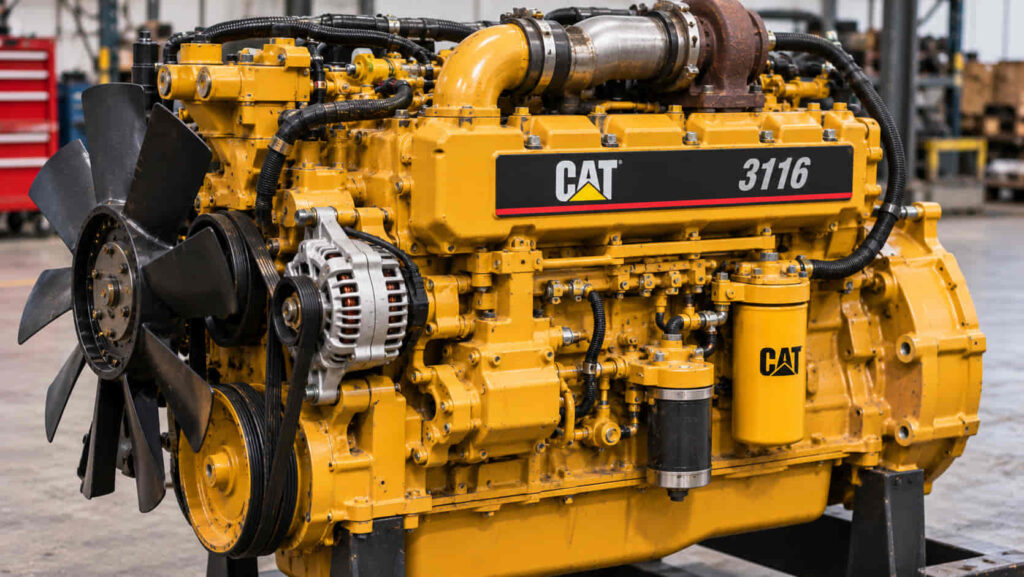
The Caterpillar 3116 is a 6.6-liter (approximately 402-cubic-inch), inline-six diesel engine with a 4.13-inch bore, 5.00-inch stroke, and firing order of 1-5-3-6-2-4. It was developed for medium-duty trucks, construction machinery, industrial equipment, generator applications, and marine propulsion.
The 3116 uses a four-stroke diesel combustion cycle, direct fuel injection, and two valves per cylinder. Many familiar configurations feature mechanically actuated, mechanically controlled unit injectors, commonly called the Mechanical Unit Injection or MUI system.
However, Caterpillar 3116 specifications differ significantly according to the engine’s intended application.
Caterpillar’s remanufactured on-highway engine documentation lists truck configurations producing approximately 170–275 horsepower. Its marine specifications identify propulsion ratings from 205 to 350 brake horsepower.
The higher marine ratings should not be confused with continuous-duty truck or industrial ratings because marine engines are calibrated for different operating requirements.
Engine torque also varies. Eaton’s heavy-duty clutch reference identifies several 3116 truck configurations developing approximately 420–750 lb-ft, depending on the exact horsepower rating.
A documented turbocharged-aftercooled marine configuration has a 16:1 compression ratio, an oil refill capacity of 25 liters, a cooling system capacity of 28 liters, and an approximate dry weight of 1,500 pounds.
However, those values do not automatically apply to all truck or industrial engines.
Another important consideration is lubrication. Caterpillar recommends specific single-grade engine oils for certain mechanically injected 3116 marine engines, making the correct oil selection particularly important.
For accurate 3116 Cat engine specs, the engine serial number, arrangement number, fuel injection configuration, and intended duty must always be verified.
This guide covers seven essential technical specifications, engine performance, maintenance requirements, common mechanical problems, and the differences between the Caterpillar 3116, 3126, and 3208.
What Is the Caterpillar 3116 Engine?
The Caterpillar 3116 is a medium-duty, six-cylinder diesel engine designed to balance compact dimensions, fuel efficiency, and useful torque for commercial and industrial equipment.
It belongs to Caterpillar’s 3100 engine family, which also includes the four-cylinder 3114 and the larger 3126.
The 3116 has six cylinders arranged in a straight line. It uses a liquid-cooled engine block, a single cylinder head, and a conventional pushrod valvetrain with two valves per cylinder.
Its relatively long piston stroke helps provide torque at the operating speeds used by medium-duty diesel equipment.
The engine became a familiar power source in trucks and machinery during the late 1980s and 1990s.
It was also widely adopted in marine propulsion applications.
Unlike larger Caterpillar engines designed for the heaviest commercial loads, the 3116 emphasizes a relatively compact installation package.
However, its smaller displacement does not mean it is mechanically simple in every respect.
The unit injector fuel system requires precise adjustment and specialized service knowledge.
The engine’s reliability and performance depend heavily on proper fuel system calibration, cooling, lubrication, and maintenance.
1. Caterpillar 3116 Displacement — 6.6 Liters
The Caterpillar 3116 has a displacement of 6.6 liters, commonly identified as approximately 402 cubic inches in Caterpillar’s marine specifications.
Some service publications list the rounded displacement as 403 cubic inches.
This small difference reflects rounding conventions rather than a separate engine family.
The total displacement is produced by six cylinders.
Each has a bore of 105 mm and a piston stroke of 127 mm.
Together, these dimensions produce approximately 6.6 liters of swept volume.
Displacement is an important engine specification because it influences the amount of air available for combustion.
However, it does not directly determine horsepower.
A 170-horsepower truck engine and a 350-horsepower marine engine can share the same displacement while using different fuel calibration, turbocharging, and operating requirements.
The engine’s 6.6-liter displacement should also not be confused with its oil capacity.
For example, the documented marine configuration requires approximately 25 liters of engine oil during a standard refill.
This is substantially greater than the engine’s displacement.
2. Caterpillar 3116 Bore and Stroke — 105 × 127 mm
The Caterpillar 3116 has a cylinder bore of 105 mm (4.13 inches) and a piston stroke of 127 mm (5.00 inches).
The bore is the nominal diameter of each cylinder.
The stroke is the distance the piston moves between top dead center and bottom dead center.
Because the stroke is longer than the bore, the 3116 is an undersquare engine.
This configuration is common in diesel engines developed for useful torque and moderate operating speeds.
However, the bore and stroke alone do not establish the engine’s maximum torque or durability.
Combustion pressure, fuel injection timing, connecting rod design, bearing clearances, and lubrication all affect performance.
These dimensions are also important during rebuilding.
A technician must inspect cylinder wear, piston condition, and related components.
The correct machining tolerances should come from the engine-specific Caterpillar service manual.
Rounded catalog dimensions are not sufficient for determining acceptable cylinder clearance.
3. Caterpillar 3116 Horsepower — Truck and Marine Ratings
Caterpillar 3116 horsepower varies by configuration, with documented on-highway remanufactured engines rated from approximately 170 to 275 horsepower and marine engines rated from 205 to 350 brake horsepower.
Caterpillar’s on-highway remanufactured-engine catalog identifies 3116 configurations rated at 170, 185, 200, 215, 250, and 275 horsepower.
Most of the listed truck arrangements have rated engine speeds around 2,450–2,600 RPM.
However, these are specific remanufactured engine arrangements rather than every rating ever offered.
The marine 3116 has a wider high-output range.
Caterpillar’s original marine propulsion literature includes ratings such as 205, 230, 255, 275, 280, 300, 310, and 350 brake horsepower, depending on the engine and duty classification.
The difference is significant.
A marine engine intended for intermittent high-speed operation may have a much higher horsepower rating than a truck or industrial engine designed for longer periods under load.
A 350-horsepower marine rating therefore should not be treated as an appropriate replacement calibration for a 170-horsepower truck engine.
The engine’s serial number and performance sheet must determine its actual factory output.
4. Caterpillar 3116 Torque — Approximately 420–750 lb-ft in Selected Truck Ratings
Caterpillar 3116 torque depends on factory horsepower and calibration, with documented truck configurations producing approximately 420–750 lb-ft.
Eaton’s commercial vehicle clutch reference provides several useful examples.
One 185-horsepower 3116 rating develops approximately 520 lb-ft at 1,560 RPM.
A 215-horsepower truck configuration is listed at approximately 605 lb-ft at the same engine speed.
A 250-horsepower version has a documented rating of approximately 660 lb-ft.
A 275-horsepower arrangement can reach approximately 750 lb-ft, depending on its specified configuration.
However, these values should not be combined into one universal torque figure.
The 3116 was calibrated for different transmissions, vehicle weights, and operating conditions.
Torque is especially important when selecting a clutch or transmission.
The transmission must be rated for the actual engine output rather than only its advertised horsepower.
A 3116 used in a medium-duty delivery truck may have different performance characteristics from a high-output marine version.
For accurate drivetrain engineering, the correct engine performance curve should be consulted.
5. Caterpillar 3116 Compression Ratio — 16:1 in Documented Marine Versions
Caterpillar identifies a compression ratio of 16:1 for the turbocharged-aftercooled 3116 marine configurations covered by its published propulsion specifications.
Compression ratio describes the relationship between the cylinder volume at bottom dead center and the remaining volume at top dead center.
Diesel engines depend on compression to raise the temperature of the intake air.
Fuel is then injected into the hot compressed air.
Combustion occurs without the spark plugs used by gasoline engines.
However, the compression ratio may differ according to piston design and engine arrangement.
The 16:1 figure should therefore be treated as the specification of the documented marine engines rather than a guaranteed value for every historical 3116.
This distinction becomes important during engine rebuilding.
Using an incorrect piston can alter the engine’s compression characteristics.
The combustion system, piston geometry, and injection equipment must be compatible.
Replacement parts should always match the original engine arrangement.
6. Caterpillar 3116 Firing Order — 1-5-3-6-2-4
The Caterpillar 3116 firing order is 1-5-3-6-2-4.
This sequence appears in Caterpillar’s official engine specifications for the 3116 and related 3126 engine family.
The firing order identifies the sequence in which the six cylinders produce power.
Cylinder number one is positioned at the front of the engine, opposite the flywheel end.
The remaining cylinders are numbered toward the rear.
This information is important during mechanical service.
Valve lash and injector adjustment procedures depend on the correct crankshaft position.
However, the firing order alone does not describe the complete adjustment sequence.
The engine must be positioned at the specified top-center locations.
The technician should then follow the applicable service chart.
The 3116 is a diesel engine and does not use a gasoline distributor or conventional ignition spark plugs.
Its firing order relates to diesel combustion and unit injector operation.
Incorrect cylinder identification can lead to valve or fuel injection adjustment errors.
7. Caterpillar 3116 Oil Capacity — 25 Liters for the Documented Marine Engine
The turbocharged-aftercooled Caterpillar 3116 marine engine has a published oil system refill capacity of 25 liters, approximately 6.6 US gallons or 26.4 US quarts.
This specification appears in Caterpillar’s official marine propulsion literature.
However, it must not automatically be used for every 3116 truck or industrial engine.
The engine family was manufactured with different oil sump configurations.
Some truck applications use a front sump.
Others use a rear sump.
The lubrication system can also include different oil filters and supporting equipment.
Consequently, the refill quantity may change.
The correct engine serial number and arrangement information should be checked before servicing.
A dipstick should also be calibrated for the installed oil pan.
This is especially important in marine installations where the engine may operate at a fixed installation angle.
After an oil change, the final level should be verified using the manufacturer’s procedure.
An excessive oil level can create operational problems.
Insufficient oil can compromise bearing and turbocharger lubrication.
The published 25-liter quantity is therefore an application-specific reference, not a universal fill instruction.
Read more: Can a Bad EGR Valve Cause a Misfire
Caterpillar 3116 Truck Engine Specs
The Caterpillar 3116 was offered in several medium-duty truck configurations, including ratings from 170 to 275 horsepower in Caterpillar’s remanufactured-engine documentation.
The engine was used in commercial vehicles requiring more power than small light-duty diesel engines.
Its inline-six design provided useful torque for transportation and vocational work.
The mechanical unit injection system was a defining feature of many 3116 truck engines.
However, exact equipment varied by serial-number group.
Caterpillar’s remanufactured-engine information identifies 2BK and 9GK engine prefixes among its documented truck configurations.
The listed engines also use different sump locations.
This matters when ordering replacement components.
An engine with a front-sump arrangement may not be a direct replacement for a rear-sump installation.
Fuel calibration, engine mounts, flywheel housing, and accessories also affect compatibility.
The correct truck engine should be selected using its complete arrangement number.
A used 3116 from another vehicle may require significant changes before it can be installed.
Caterpillar 3116 Marine Engine Specs
The Caterpillar 3116 marine engine was offered in turbocharged-aftercooled configurations producing approximately 205–350 brake horsepower, depending on duty rating.
The engine was used in recreational and commercial vessels.
Its relatively compact inline-six arrangement made it suitable for installations where space and weight were important.
Caterpillar’s published marine specifications identify rated speeds from approximately 2,400 to 2,800 RPM.
The 350-bhp engine is associated with a high-performance E rating.
This rating is intended for specific intermittent-duty applications.
Caterpillar defines the E rating as suitable for vessels that operate at rated load and rated speed for only a limited portion of their operating time.
The manufacturer’s remanufactured-engine brochure identifies up to 8% of operating time at rated load and speed, with a load factor of up to 30%.
This is important because a high-performance marine engine should not automatically be operated continuously at full output.
Commercial displacement vessels may require a lower horsepower rating with a different duty classification.
The correct engine and propeller combination must allow the engine to achieve its specified operating speed without excessive loading.
Caterpillar 3116 Naturally Aspirated vs. Turbocharged Versions
Caterpillar 3116 performance depends on the intake-air configuration, with turbocharged and turbocharged-aftercooled arrangements supporting higher output than naturally aspirated configurations.
A naturally aspirated engine relies on atmospheric pressure to supply combustion air.
It has fewer air-management components.
However, the amount of fuel that can be burned efficiently is limited by the available oxygen.
A turbocharged engine uses exhaust energy to compress intake air.
This supports greater power output.
An aftercooled engine also reduces the temperature of the compressed air.
That improves air density and supports the intended combustion conditions.
The documented high-output 3116 marine engines use turbocharging and aftercooling.
However, the installed turbocharger, fuel calibration, and cooling components must match the engine arrangement.
Increasing fuel delivery without considering airflow and cooling can raise exhaust temperature and mechanical stress.
A 3116 should therefore not be uprated simply because another engine in the family has a higher factory horsepower rating.
Caterpillar 3116 Fuel Injection System
The Caterpillar 3116 is particularly associated with a Mechanical Unit Injection system, in which fuel injection pressure is generated mechanically at the individual unit injectors.
In the MUI arrangement, the camshaft and valvetrain mechanism provide the force needed to operate the injectors.
A mechanical governor controls fuel delivery.
This differs from a conventional distributor-type injection pump with separate high-pressure lines to each injector.
It also differs from the electronically controlled HEUI technology associated with many later Caterpillar 3126 engines.
The 3116 fuel injection system requires precise mechanical adjustment.
Injector timing must be correct.
Injector rack positions must also be synchronized.
When these settings are incorrect, the engine may develop uneven power, smoke, rough operation, or poor fuel economy.
However, the exact symptoms depend on the fault.
An injector problem can also result from wear or fuel contamination.
A technician should identify the installed fuel system before ordering parts or beginning service.
The appropriate Caterpillar service literature must determine the adjustment procedure.
Caterpillar 3116 Injector Synchronization
Injector synchronization is one of the most important specialized service requirements on mechanically injected Caterpillar 3116 engines.
The purpose is to ensure that the individual injectors receive consistent fuel-control commands from the mechanical linkage.
Caterpillar’s tool instructions describe synchronizing injector racks relative to a reference injector.
The process requires specialized gauges and adjustment equipment.
The 223-2454 fuel system and governor tool group is associated with the relevant 3114, 3116, and 3126 mechanical unit injector service procedures.
However, injector synchronization is not equivalent to ordinary valve adjustment.
The correct procedure depends on the engine’s injector design and governor arrangement.
Incorrect adjustments can create uneven fueling.
The engine may develop abnormal exhaust smoke, rough idle, or reduced power.
Therefore, fuel system adjustment should be performed by a technician familiar with Caterpillar mechanical unit injectors.
Replacing one injector without completing the necessary synchronization can leave the engine operating incorrectly.
The service procedure should be followed whenever the manufacturer requires synchronization after injector removal or replacement.
Caterpillar 3116 vs. 3126 Fuel Injection
The 3116 and 3126 are related engines, but their fuel injection systems should not automatically be treated as identical.
The 3116 is best known for its mechanical unit injection arrangement.
Many 3126 truck engines use hydraulically actuated electronic unit injection, commonly known as HEUI.
The two systems generate injection pressure differently.
The MUI arrangement relies on mechanical actuation.
HEUI uses high-pressure engine oil to operate the injectors.
Its electronic controller regulates injection events.
This changes the required diagnostic equipment and service procedures.
A mechanical 3116 injector calibration problem requires a different approach from a HEUI oil-pressure control problem.
However, some documentation covers multiple engine versions in the same service publication.
The engine model and fuel system must therefore be identified before using that document.
This distinction is especially important when purchasing replacement injectors or researching no-start problems.
The correct parts must match the installed system.
Caterpillar 3116 Valve Lash Specifications
Caterpillar specifies an intake valve lash of 0.015 inch (0.38 mm) and an exhaust valve lash of 0.025 inch (0.64 mm) for the documented 3116 engine design.
The relevant service specification also identifies an inspection tolerance of approximately 0.003 inch for the applicable adjustment procedure.
Valve lash is the clearance between the valvetrain components when the valve is completely closed.
The correct clearance allows mechanical components to expand during operation.
Excessive lash may produce abnormal ticking and affect valve opening.
Insufficient lash can prevent a valve from seating properly.
This can lead to compression loss or excessive valve temperature.
Caterpillar requires the engine to be stopped during valve lash inspection.
The valves must also be fully closed.
The adjustment sequence depends on crankshaft position.
For the applicable procedure, some valves are adjusted with cylinder number one at top center on its compression stroke.
The remaining valves are adjusted after rotating the crankshaft to the specified second position.
The exact service chart should be followed.
Caterpillar 3116 Compression, Blow-By and Engine Condition
Compression and crankcase blow-by provide useful information about the mechanical condition of a Caterpillar 3116 engine, particularly when evaluating a used or high-hour unit.
Compression depends on the condition of the cylinders, pistons, rings, and valves.
If these components become excessively worn, the engine may become difficult to start.
It may also develop reduced power or excessive smoke.
Blow-by occurs when combustion gases pass the piston rings and enter the crankcase.
Some blow-by is normal.
However, excessive crankcase pressure can indicate internal wear.
A visual inspection alone may not establish whether the amount is acceptable.
The correct evaluation should use the manufacturer’s measurement procedures.
Turbocharger or crankcase ventilation problems can also affect the interpretation of oil consumption and smoke.
Therefore, an engine should not be condemned solely because vapor is visible at the breather.
Compression, blow-by, oil pressure, starting performance, and maintenance history should be considered together.
What Oil Does a Caterpillar 3116 Take?
The correct Caterpillar 3116 engine oil depends on application, and Caterpillar has specific single-grade oil recommendations for marine engines using mechanical unit injection.
This is one of the most important distinctions in the 3116 family.
Caterpillar’s commercial diesel engine fluid recommendations identify Cat Special Application Engine Oil, or SAEO, for certain 3116 and 3126 marine engines.
The manufacturer recommends SAE 30 and SAE 40 grades for the documented mechanically injected marine arrangements.
Caterpillar explains that some multigrade oils contain viscosity-index improvers that can contribute to deposits in the turbocharger compressor and aftercooler when crankcase blow-by passes through those components.
Therefore, the manufacturer does not generally recommend multigrade oil for the affected marine configuration unless the relevant crankcase ventilation arrangement changes that requirement.
However, this recommendation is specific to the documented marine engines.
It should not automatically be applied to every truck or industrial 3116.
For a truck application, the appropriate Caterpillar on-highway diesel lubrication instructions should be followed.
Historical oil classifications must also be interpreted carefully because some older API categories are obsolete.
The best approach is to confirm a suitable currently available lubricant with the appropriate Caterpillar dealer or service specialist.
Caterpillar 3116 Oil Change Interval
Caterpillar’s documented 3116 marine propulsion engine has a 250-hour oil change interval, while truck and industrial maintenance schedules depend on the installed configuration and operating conditions.
The marine specification is straightforward.
Caterpillar identifies a 250-hour oil and filter service interval for the published turbocharged-aftercooled engine.
However, this should not be used as a universal interval for every 3116.
Truck engines may have mileage-based maintenance schedules.
Industrial engines generally use operating-hour intervals.
The oil sump capacity can also influence service frequency.
Engines with smaller oil systems may require more frequent oil changes under certain maintenance strategies.
Fuel sulfur content and oil contamination are additional considerations.
Caterpillar’s historical on-highway service guidance accounts for lubricant quality, fuel conditions, and operating duty.
For marine engines, oil analysis can also help evaluate lubricant condition.
However, oil analysis should not be used to extend service intervals without an appropriate maintenance program.
The engine’s serial-number-specific operation and maintenance manual should determine the correct interval.
Caterpillar 3116 Normal Oil Pressure
Caterpillar 3116 oil pressure varies with engine speed, oil temperature, lubricant viscosity, and the installed lubrication system.
There is no single universal oil pressure reading that applies at every RPM.
When engine oil is cold, its viscosity is higher.
Pressure may therefore be higher during startup.
As the engine warms, pressure can decrease.
Oil pressure also changes with engine speed.
A warm idle reading should not automatically be compared with a rated-speed specification.
The oil pump must supply sufficient lubricant to the bearings, camshaft, and turbocharger.
If pressure falls below the engine’s required operating range, damage can occur.
However, a low gauge reading may also result from a sender or instrumentation problem.
The correct diagnostic procedure should verify actual pressure using suitable equipment.
Possible mechanical causes include low oil level, pump wear, internal leakage, and excessive bearing clearance.
The technician should compare the measured pressure with the exact engine service specification.
A serious lubrication warning should never be ignored.
Caterpillar 3116 Cooling System Capacity
The documented Caterpillar 3116 turbocharged-aftercooled marine engine has a cooling system capacity of approximately 28 liters, equivalent to 7.4 US gallons.
This figure applies to the specified marine engine package.
The system includes equipment necessary to control engine temperature.
However, truck and industrial installations can have substantially different cooling arrangements.
A medium-duty truck uses a radiator and associated hoses.
An industrial machine may use a specialized cooling package.
A marine engine can include a heat exchanger and seawater cooling components.
Therefore, total cooling capacity depends on the complete installation.
Correct coolant is essential.
A poorly maintained cooling system can cause overheating and corrosion.
The engine’s cooling passages, pump, thermostat, and heat exchanger or radiator must remain in good condition.
Marine installations also require attention to seawater flow.
Restricted cooling passages can raise operating temperature during heavy load.
The correct coolant formulation and service schedule should be confirmed for the installed engine.
Caterpillar 3116 Engine Weight
The turbocharged-aftercooled Caterpillar 3116 marine engine has a published approximate net dry weight of 681 kg, equivalent to 1,500 pounds.
This value comes from Caterpillar’s official marine propulsion specifications.
However, it should not be applied to every truck or industrial version.
The installed accessories affect engine mass.
A marine engine may include a water-cooled exhaust manifold, heat exchanger, seawater pump, and other equipment.
A truck engine uses a different cooling and exhaust arrangement.
The flywheel housing and mounting components can also vary.
The complete installation may weigh considerably more once a transmission, coolant, oil, and accessories are included.
Engine weight is important during replacement.
The lifting equipment must be suitable for the complete assembly.
The installation should also be evaluated for structural support.
A replacement engine of the same displacement may have different external components and mounting requirements.
The correct arrangement drawing should be used for engineering work.
Caterpillar 3116 Engine Dimensions
The documented Caterpillar 3116 marine engine measures approximately 65.5 inches long, 32.1 inches wide, and 33.8 inches high in the specified configuration.
These dimensions correspond to approximately 1,663 mm in length, 816 mm in width, and 860 mm in height.
However, Caterpillar explicitly notes that the published dimensions should not be used for final installation design.
The manufacturer directs installers to the appropriate detailed dimensional drawing.
This distinction is important because the engine was used in several applications.
A marine configuration may include equipment not found on a truck engine.
A truck installation may use different intake, exhaust, and accessory arrangements.
The transmission can also change the required overall length.
For a marine repower, shaft alignment and engine mounting height must be considered.
For an industrial replacement, the flywheel housing and power takeoff configuration matter.
An accurate installation plan requires the actual engine arrangement drawing, not simply a nominal length and width.
Caterpillar 3116 Fuel Consumption
Caterpillar 3116 fuel consumption depends on horsepower rating, engine speed, load, and intended duty cycle.
The manufacturer’s marine performance literature provides useful examples.
For its 300-bhp E-rated engine, the published propeller-demand data identifies approximately 15.8 US gallons per hour at 2,800 RPM and rated power.
The 350-bhp version uses approximately 19.2 US gallons per hour at 2,800 RPM under the documented propeller-demand conditions.
However, these figures belong to specific marine engines operating at high output.
They are not representative of every truck, industrial engine, or low-speed cruising condition.
Fuel consumption decreases when the engine produces less power.
Caterpillar’s marine performance sheets illustrate this relationship across different RPM values.
However, boat speed and fuel economy also depend on the vessel, hull, propeller, and operating conditions.
For trucks, road speed, vehicle weight, gearing, and terrain influence fuel economy.
The correct performance data should be used when calculating operating costs.
Caterpillar 3116 Engine Applications
The Caterpillar 3116 was used in medium-duty commercial vehicles, construction machinery, industrial equipment, and marine propulsion systems.
One familiar application is the Chevrolet Kodiak and GMC TopKick medium-duty truck family.
The engine was also installed in selected commercial buses and vocational vehicles.
Caterpillar construction equipment used the 3116 in particular machine configurations.
The engine’s relatively compact size made it suitable for equipment where installation space was limited.
Marine versions were used in recreational boats and workboats.
However, the engine configuration differs by application.
A truck engine may have a different fuel calibration and cooling system from a marine engine.
The marine engine may also use specialized exhaust equipment.
An engine removed from a truck is therefore not automatically a direct replacement for a marine propulsion unit.
The correct components and ratings must match the intended installation.
Does the Caterpillar 3116 Have Cylinder Liners?
The Caterpillar 3116 should not be assumed to have the same factory-replaceable wet cylinder liner system found in many larger heavy-duty diesel engines.
Its cylinder repair arrangements are different.
Caterpillar offers dry cylinder liner sleeves for certain 3114 and 3116 applications.
For example, Cat part number 589-8185 is identified as a cylinder liner sleeve for relevant engines.
However, the presence of a repair sleeve does not mean the engine uses a conventional wet-liner overhaul system.
A wet liner is directly exposed to coolant around part of its outer surface.
A dry repair sleeve has a different installation and sealing arrangement.
Consequently, rebuilding procedures are not interchangeable.
The technician must inspect cylinder wall condition and determine the approved repair method.
Block machining may be necessary.
The applicable replacement parts must also match the engine arrangement.
This distinction is important when comparing the 3116 with larger Caterpillar engines designed around wet cylinder liners.
Can You Rebuild a Caterpillar 3116 Engine?
A Caterpillar 3116 can be rebuilt when the engine block and critical components remain serviceable, but the repair requires appropriate machining, replacement parts, and specialized fuel system adjustment.
A proper overhaul begins with inspection.
The cylinders must be checked for wear.
The crankshaft and connecting rod bearings must also be evaluated.
The cylinder head requires inspection for cracks, valve sealing, and other damage.
Pistons and rings should be measured against Caterpillar’s service limits.
However, rebuilding the engine also involves the fuel injection system.
The unit injectors must be correctly timed and synchronized.
This requires tools and procedures that are not interchangeable with ordinary mechanical injection pump adjustments.
The lubrication and cooling systems should also be evaluated.
A rebuild that leaves a defective oil pump or damaged cooling component in place may not provide dependable operation.
Caterpillar has offered remanufactured 3116 engines and components for selected applications.
The best option depends on parts availability, repair cost, and the condition of the original engine.
Is the Caterpillar 3116 a Reliable Engine?
The Caterpillar 3116 can provide dependable service when maintained correctly, but its reliability is strongly influenced by the condition and adjustment of its fuel injection system.
Its inline-six architecture is suitable for medium-duty diesel work.
The engine also benefits from Caterpillar’s established service and replacement-parts ecosystem.
However, the mechanical unit injection system requires precise setup.
Incorrect injector synchronization can affect combustion quality.
Fuel contamination can also damage injection components.
Cooling system condition is another major factor.
An engine that operates under excessive load or insufficient cooling can experience premature wear.
Marine engines deserve particular attention because some high-output ratings are intended for intermittent use.
A 350-horsepower marine 3116 operated continuously at high load should not automatically be expected to have the same service characteristics as a lower-rated commercial engine.
Age also matters.
Many surviving 3116 engines have accumulated decades of operation.
A reliable ownership assessment should consider maintenance records, starting behavior, oil pressure, cooling performance, and engine load history.
Common Caterpillar 3116 Engine Problems
Common Caterpillar 3116 maintenance and troubleshooting concerns include injector synchronization problems, fuel contamination, hard starting, abnormal smoke, cooling system faults, oil leaks, and turbocharger wear.
Fuel injection is one of the most important diagnostic areas.
A poorly adjusted injector rack can contribute to uneven fueling.
The engine may develop rough idle, reduced performance, or excessive smoke.
However, the exact cause must be confirmed through testing.
A restricted fuel filter can also reduce performance.
Air entering the fuel system may cause starting difficulty.
Turbocharged engines have additional concerns.
A damaged turbocharger can affect boost pressure and oil consumption.
However, intake restrictions can create similar symptoms.
Cooling system problems are also important.
A blocked heat exchanger or radiator can lead to overheating.
Excessive oil consumption may indicate external leakage, internal wear, or turbocharger problems.
The appropriate repair should identify the underlying fault rather than replacing components based solely on symptoms.
How Long Does a Caterpillar 3116 Last?
Caterpillar 3116 engine lifespan depends on service hours, engine rating, operating load, maintenance quality, and the condition of internal components.
There is no single manufacturer-supported lifespan figure that applies to every 3116.
A medium-duty truck may be measured primarily by mileage.
A marine engine is usually evaluated using operating hours.
An industrial engine may also accumulate hours at a relatively constant speed.
These applications create different types of wear.
A lower-rated engine used within its intended operating range may have a different service life from a high-output engine that frequently operates near its maximum rating.
Oil maintenance is particularly important.
Fuel filtration also affects injector condition.
Correct cooling protects the cylinder head and other components.
A high-hour engine can remain serviceable after appropriate maintenance and repairs.
Conversely, a lower-hour engine may require major work following overheating or lubrication failure.
The most useful indicators include oil pressure, crankcase blow-by, compression-related symptoms, fuel system performance, and maintenance history.
Caterpillar 3116 vs. 3126 Engine
The Caterpillar 3116 and 3126 are related inline-six diesel engines, but the 3126 has greater displacement and important fuel-system differences.
The 3116 displaces 6.6 liters.
The 3126 displaces approximately 7.2 liters.
Both engines use a six-cylinder inline arrangement.
They also share the same general firing order.
However, their bore dimensions differ.
The 3116 uses a 105 mm bore.
The 3126 uses a larger nominal bore of approximately 110 mm.
Both use a 127 mm stroke.
The larger bore produces the 3126’s additional displacement.
Fuel injection also differs between common versions.
The 3116 is strongly associated with MUI.
Many later 3126 configurations use HEUI injection.
Consequently, their fuel-system diagnostics and replacement components may differ substantially.
The appropriate engine should be selected according to equipment requirements, maintenance support, and actual mechanical condition.
A 3126 is not automatically a direct replacement for a 3116 without considering mounting, electronics, and supporting systems.
Caterpillar 3116 vs. 3208 Engine
The Caterpillar 3116 and 3208 use different engine architectures, with the 3116 employing a 6.6-liter inline-six layout and the 3208 using a 10.4-liter V8 configuration.
The 3208 has substantially greater displacement.
However, it does not automatically produce more horsepower in every application.
Both engine families were offered in different output configurations.
The 3116 uses a relatively compact inline-six design.
The 3208 has eight cylinders arranged in two banks.
This changes the engine’s installation dimensions and mechanical layout.
Their fuel systems also differ.
The 3116 is closely associated with unit injection.
The 3208 uses a different mechanically controlled injection arrangement.
Rebuilding procedures and replacement parts are therefore not interchangeable.
The best engine depends on installation space, required horsepower, torque, service support, and duty cycle.
A high-output marine 3116 and a lower-output industrial 3208 should not be compared solely by displacement.
Caterpillar 3116 vs. 3306 Engine
The Caterpillar 3116 is smaller than the 3306, which has a nominal displacement of 10.5 liters and belongs to a heavier-duty engine family.
Both engines use six cylinders arranged in line.
However, their dimensions and mechanical construction differ.
The 3116 has a 6.6-liter displacement.
The 3306 has approximately 10.5 liters.
The larger engine is designed for more demanding heavy-duty applications.
It also uses a different fuel injection system.
The 3306 is associated with Caterpillar’s mechanical injection pump arrangements.
The 3116 uses unit injectors in its common configurations.
The two engines therefore require different diagnostic and repair techniques.
A 3116 can provide a more compact power package for medium-duty equipment.
A 3306 may be appropriate where greater engine displacement and heavy-duty construction are required.
However, swapping one for the other can involve significant modifications.
The engine mounts, flywheel housing, cooling system, and drivetrain must all be considered.
How to Identify a Caterpillar 3116 by Serial Number
The most reliable way to identify Caterpillar 3116 specifications is to use the engine serial number and arrangement number with the appropriate Caterpillar service documentation.
These identifiers establish the original factory configuration.
They are important because the 3116 was produced for several applications.
Caterpillar’s remanufactured truck-engine documentation identifies serial prefixes such as 2BK and 9GK.
Its marine maintenance documentation identifies additional prefixes, including 4KG, 1SK, 8NM, and 6SR.
However, a serial prefix alone does not determine every service requirement.
The complete serial number and arrangement information should be used.
This matters when selecting injectors, pistons, cooling components, oil pans, and replacement filters.
A remanufactured engine may also have different identification records from the original vehicle engine.
Therefore, the technician should identify the installed engine rather than relying only on the truck or boat model year.
A Caterpillar dealer can help confirm the correct engine configuration and service information.
What Should You Check Before Buying a Used Caterpillar 3116?
A used Caterpillar 3116 should be inspected for cold-start behavior, fuel injection performance, oil pressure, cooling system condition, excessive smoke, and evidence of previous overheating.
The engine identification should be verified first.
The buyer should determine the factory horsepower rating.
The engine’s intended duty should also be confirmed.
A marine engine requires additional attention to its operating history.
The buyer should investigate whether it was regularly operated within its rating.
A cold-start inspection can provide useful diagnostic information.
Hard starting may indicate fuel system, compression, or other problems.
Unusual exhaust smoke should also be evaluated.
The oil level and condition must be checked.
External leaks may indicate deteriorated seals.
Cooling system condition is equally important.
For marine installations, the heat exchanger and seawater cooling components require inspection.
Maintenance records can help establish whether injector synchronization and other specialized service work were completed correctly.
A professional Caterpillar diesel inspection is strongly recommended before purchasing an engine with an uncertain history.
Final Verdict: What Are the 3116 Cat Engine Specs?
The Caterpillar 3116 is a 6.6-liter inline-six diesel engine with a 105 mm bore, 127 mm stroke, two valves per cylinder, and firing order 1-5-3-6-2-4.
Its most important specifications depend on the intended application.
Caterpillar’s remanufactured truck-engine documentation identifies factory configurations from approximately 170 to 275 horsepower.
Selected truck ratings develop roughly 420–750 lb-ft of torque.
Marine configurations were offered from approximately 205 to 350 brake horsepower.
However, the highest marine power ratings are associated with specific operating-duty limitations.
The documented turbocharged-aftercooled marine engine has a compression ratio of 16:1.
Its oil refill capacity is approximately 25 liters, or 6.6 US gallons.
The published marine cooling capacity is 28 liters.
The same engine package has an approximate dry weight of 681 kg, or 1,500 pounds.
However, oil capacity, dimensions, and weight differ between truck, industrial, and marine installations.
The 3116’s valve lash specifications are 0.015 inch for the intake and 0.025 inch for the exhaust in the documented service configuration.
The mechanical unit injection system is another important feature.
It requires accurate injector timing and synchronization.
For certain marine engines, Caterpillar also specifies special single-grade SAE 30 or SAE 40 lubricant recommendations rather than ordinary multigrade diesel oil.
The engine can provide dependable service when maintained correctly.
However, its age, fuel injection condition, cooling system, and operating history are important considerations.
The most important rule when researching 3116 Cat engine specs is to verify the exact serial number, arrangement number, and application before using any horsepower, torque, oil capacity, compression ratio, or replacement-parts specification.
This helps prevent incorrect servicing and supports reliable long-term operation of the Caterpillar 3116 diesel engine.