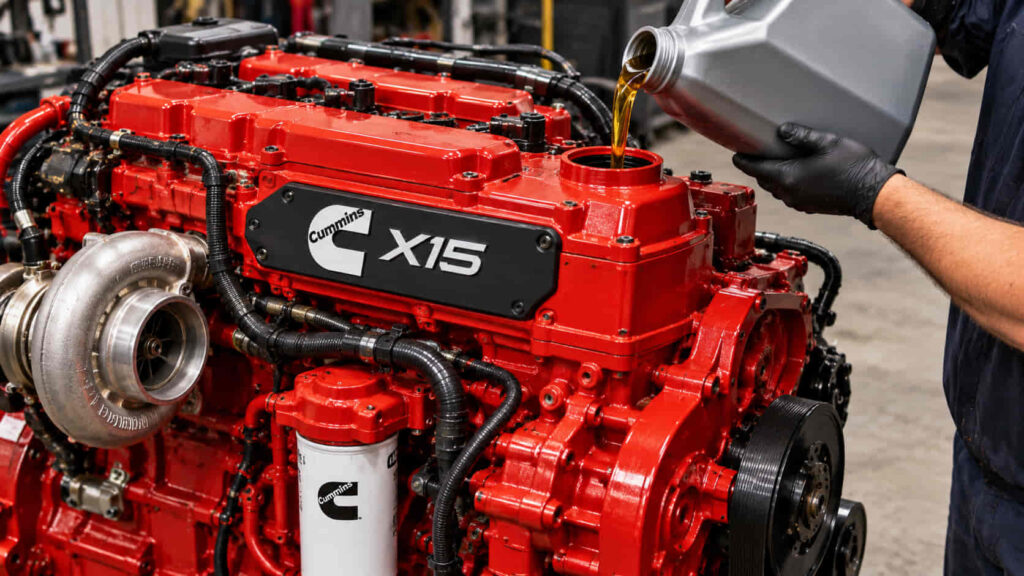
The Caterpillar C7 is a 7.2-liter, inline-six, four-stroke diesel engine with a 110 mm (4.33-inch) bore and 127 mm (5.0-inch) stroke. It features turbocharging, electronic engine management, and Caterpillar’s Hydraulic Electronic Unit Injector (HEUI) fuel injection system. Depending on the application, the engine produces substantially different horsepower and torque ratings.
Caterpillar’s industrial C7 specifications identify a power range of 225–300 horsepower at rated speeds of approximately 1,800–2,200 RPM. The C7 ACERT engine used in certain recreational vehicles was offered with ratings of 300–350 horsepower at 2,400 RPM, with a published peak torque figure of 860 lb-ft at 1,440 RPM.
Other applications use different calibrations. For example, Caterpillar offered a marine C7 ACERT rated at 454 brake horsepower, demonstrating that the engine’s maximum output cannot be represented by one universal horsepower figure.
Caterpillar C7 engine specifications also vary in compression ratio, oil capacity, weight, dimensions, and maintenance requirements. The industrial C7 has a published compression ratio of 16.2:1 in one Caterpillar specification, while an RV version uses 16.5:1.
The engine’s oil refill capacity also depends on the installed sump. Caterpillar lists 18 liters for one industrial C7 configuration and 21 liters for a standard C7 RV arrangement, with larger oil pans available in selected installations.
The C7 was introduced in 2003 as a successor to the Caterpillar 3126 engine family. It became widely used in medium-duty trucks, recreational vehicles, construction equipment, industrial machinery, and specialized applications.
Understanding the differences between the standard C7, C7 ACERT, and newer C7.1 is essential because these engines do not share identical specifications or maintenance requirements.
This guide covers Caterpillar C7 engine displacement, horsepower, torque, bore and stroke, compression ratio, firing order, valve clearance, fuel injection, oil capacity, dimensions, reliability, common problems, and service requirements.
What Is the Caterpillar C7 Engine?
The Caterpillar C7 is a medium-duty diesel engine developed for vehicles and equipment requiring substantial torque, compact packaging, and reliable operation under sustained mechanical loads.
The engine belongs to Caterpillar’s electronically controlled diesel engine family.
It was introduced in 2003 and is closely related to the earlier 3126 engine.
The C7 uses six cylinders arranged in a straight line.
This configuration provides inherent mechanical balance and a relatively straightforward cylinder head arrangement.
Its nominal displacement is 7.2 liters, or approximately 442 cubic inches.
The engine uses a cast-iron block and a single cylinder head.
Its pushrod valve train is driven by a camshaft located within the engine block.
Unlike many automotive four-valve diesel engines, the Caterpillar C7 uses three valves per cylinder.
Two intake valves allow air into each combustion chamber, while one exhaust valve releases combustion gases.
This gives the engine a total of 18 valves.
The C7 also uses a turbocharger to increase the amount of air entering the cylinders.
Many configurations include charge-air cooling to reduce intake temperature.
Electronic engine management controls fuel injection and operating speed.
However, the exact equipment depends on the engine’s application and production generation.
A C7 installed in a motorhome may have different turbocharger, cooling, or oil pan arrangements from a C7 used in an industrial machine.
Therefore, the correct specifications should always be matched to the actual engine serial number.
Caterpillar C7 Engine Displacement and Configuration
The Caterpillar C7 has a nominal displacement of 7.2 liters, commonly listed as approximately 441–442 cubic inches in official Caterpillar publications.
Its displacement is generated by six cylinders.
Each cylinder has a nominal bore of 110 mm and a stroke of 127 mm.
These measurements define the swept volume of the engine.
The C7 uses a four-stroke diesel combustion cycle.
Air enters the cylinder during the intake stroke.
The piston then compresses the air before fuel is injected.
Diesel combustion produces the force that drives the piston downward.
The exhaust stroke removes combustion gases.
The engine’s inline-six arrangement contributes to relatively smooth operation.
Compared with some V-type engine configurations, an inline-six has favorable inherent balance characteristics.
However, engine vibration still depends on mounting, combustion consistency, and operating condition.
The C7’s displacement positions it between smaller industrial diesels and Caterpillar’s larger heavy-duty engines.
This makes it suitable for equipment requiring more power than a small four-cylinder engine but not necessarily the size and weight of a much larger diesel.
The engine is commonly described as a 7.2L diesel.
However, the rounded cubic-inch figure can vary slightly between technical publications.
This does not necessarily indicate a different engine design.
Caterpillar C7 Bore and Stroke
The Caterpillar C7 has a bore of 110 mm (4.33 inches) and a stroke of 127 mm (5.0 inches).
These are among the most consistent specifications across the C7 engine family.
The bore represents the diameter of each cylinder.
The stroke describes the distance traveled by the piston between its upper and lower positions.
The C7 has a longer stroke than bore.
This is a common arrangement in diesel engines designed to deliver strong torque at relatively low engine speeds.
The relationship between bore and stroke influences piston speed, engine displacement, and combustion chamber geometry.
However, it does not independently determine horsepower or durability.
Fuel injection, boost pressure, compression ratio, airflow, and engine calibration also affect performance.
During an engine rebuild, bore measurements are especially important.
The cylinders should be checked for wear, taper, and out-of-round conditions.
The correct piston size must match the finished cylinder dimensions.
Likewise, crankshaft inspection should consider the original stroke and bearing specifications.
A mechanic should not assume that pistons or crankshaft components from another 7-liter diesel engine are interchangeable with those of the C7.
The correct replacement parts must match the engine’s serial number and component arrangement.
How Much Horsepower Does a Caterpillar C7 Have?
Caterpillar C7 horsepower depends on the application, with documented industrial versions producing 225–300 hp, certain RV engines producing 300–350 hp, and specialized marine engines offering higher ratings.
Caterpillar’s industrial C7 product specifications identify a minimum rating of 225 horsepower and a maximum rating of 300 horsepower.
The published rated speed range is approximately 1,800–2,200 RPM.
However, an industrial engine’s power rating is influenced by its intended duty cycle.
Some engines are designed for sustained operation.
Others may provide a higher output under intermittent conditions.
The C7 ACERT recreational vehicle engine has different ratings.
Caterpillar’s RV brochure identifies 300–350 horsepower at 2,400 RPM.
These configurations are intended for diesel motorhomes.
The higher output can support acceleration and performance in large recreational vehicles.
Caterpillar also produced specialized marine versions.
One official C7 ACERT marine publication identifies an output of 454 brake horsepower at 2,800 RPM.
However, marine engine ratings operate under specific duty-cycle conditions.
They should not be treated as ratings suitable for every truck or industrial installation.
The correct horsepower must therefore be identified from the engine’s rating plate or technical documentation.
A C7 engine cannot be accurately described as producing exactly 300 horsepower without identifying its application.
Caterpillar C7 Horsepower by Application
The Caterpillar C7 engine family was offered in multiple horsepower configurations because trucks, motorhomes, construction machinery, and marine equipment have different operating requirements.
In industrial applications, Caterpillar publishes 225-, 250-, 275-, and 300-horsepower configurations within certain C7 product families.
These ratings correspond to different duty categories and engine settings.
The engine’s governor limits operating speed according to the intended application.
A machine operating a hydraulic system may have different requirements from a highway vehicle.
For recreational vehicles, Caterpillar offered C7 ACERT configurations rated at 300, 330, and 350 horsepower.
These engines were designed for motorhomes requiring reliable highway performance.
Commercial truck versions also appeared with different factory outputs.
Independent heavy-duty engine parts supplier IPD identifies a historical C7 power range extending from approximately 190 to 360 horsepower across the broader engine family.
However, those figures should not be confused with the ratings for one particular C7 application.
The marine C7 ACERT has even higher published output in selected configurations.
This is possible because marine and road engines have different cooling arrangements, operating conditions, and duty ratings.
The important lesson is that horsepower depends on the exact engine configuration.
For a replacement engine or rebuild, the original rating information should be verified before selecting parts or programming the electronic control module.
How Much Torque Does a Caterpillar C7 Produce?
Caterpillar specifies a peak torque of 860 lb-ft at 1,440 RPM for the C7 ACERT RV engine covered by its 300–350 horsepower brochure.
This demonstrates the engine’s ability to deliver substantial torque at relatively low RPM.
Torque is particularly important for heavy vehicles.
A motorhome requires enough pulling force to accelerate, climb grades, and maintain appropriate road speed.
The C7’s relatively large displacement and turbocharged design support these operating characteristics.
However, the 860-lb-ft figure does not apply to every C7 engine.
An industrial engine rated at 225 horsepower may have a different torque curve.
Likewise, an engine designed for continuous operation can have a different calibration from an intermittent-duty version.
The exact torque curve should therefore be obtained from the applicable Caterpillar performance specification.
Another important consideration is peak torque versus rated horsepower.
An engine may produce maximum torque at a relatively low speed while reaching maximum horsepower at a higher RPM.
The C7 RV engine’s published peak torque occurs around 1,440 RPM.
Its rated horsepower is identified at 2,400 RPM.
These specifications reflect different points on the engine’s performance curve.
For practical operation, the correct driving or equipment speed depends on engine load, transmission configuration, and the manufacturer’s recommendations.
Caterpillar C7 Compression Ratio
Caterpillar C7 compression ratio varies by engine configuration, with official examples including 16.2:1 for an industrial version and 16.5:1 for a C7 ACERT RV engine.
The compression ratio describes the relationship between cylinder volume when the piston is at the bottom and top of its stroke.
Diesel engines use high compression to increase air temperature before fuel injection.
This allows the injected diesel fuel to ignite without the spark plugs used by gasoline engines.
However, the correct compression ratio is determined by the engine design.
Piston bowl geometry, cylinder head arrangement, and other components influence the final value.
Caterpillar’s industrial C7 specification lists a compression ratio of 16.2:1 for the referenced version.
The C7 ACERT RV brochure identifies 16.5:1.
A separate industrial ACERT specification identifies 17:1 for a particular 225-horsepower configuration.
These values show that the compression ratio should not be treated as one universal figure.
For engine rebuilding, matching the correct piston design is essential.
Using a piston intended for another compression ratio can change combustion characteristics.
The replacement parts should therefore be selected according to the engine serial number.
A mechanic should not assume that all C7 pistons are interchangeable simply because the bore and stroke are the same.
Caterpillar C7 Firing Order
The Caterpillar C7 firing order is 1-5-3-6-2-4 for the documented inline-six industrial engine configuration.
The firing order determines the sequence in which combustion events occur.
The C7 has six cylinders arranged in one row.
Cylinder number one is located at the front of the engine, opposite the flywheel end.
The specified sequence helps distribute combustion forces through the crankshaft.
It also contributes to smooth engine operation.
The C7 uses electronically controlled diesel fuel injection.
Therefore, ignition timing is not established through a distributor as it would be on an older gasoline engine.
The electronic control module commands fuel injection events.
However, the mechanical relationship between the crankshaft, camshaft, and cylinders remains essential.
Correct timing is particularly important during an engine rebuild.
The timing gear arrangement must be installed according to the proper service procedure.
Incorrect timing can affect combustion, valve operation, and engine performance.
The firing order is also useful during diagnostic testing.
A technician investigating a cylinder-specific fault must identify the correct cylinder position.
However, the firing order alone does not provide all the information required for adjusting valves or installing timing components.
The appropriate Caterpillar service manual should be followed.
Read more: Cummins X15 Oil Capacity
How Many Valves Does the Caterpillar C7 Have?
The Caterpillar C7 uses three valves per cylinder, giving the inline-six engine a total of 18 valves.
This is an important specification because the C7 is sometimes incorrectly described as a 24-valve engine.
The actual C7 cylinder head arrangement uses two intake valves and one exhaust valve per cylinder.
The intake valves allow air to enter the combustion chamber.
The exhaust valve releases gases after combustion.
The cylinder head uses a pushrod-operated valve train.
A camshaft located inside the engine block drives the lifters and pushrods.
Rocker arms transfer the movement to the valves.
The two intake valves are operated through the appropriate rocker and bridge arrangement.
The design is closely related to the earlier Caterpillar 3126 engine family.
However, cylinder head components and internal parts should not be assumed interchangeable without verification.
Valve condition is important for engine performance.
Damaged seats or incorrect valve clearance can affect compression and combustion.
During a rebuild, the cylinder head should be inspected for cracks, guide wear, and valve sealing problems.
The correct adjustment procedure also matters.
The engine’s valve train is designed to operate with specific clearances when cold.
Incorrect adjustment can contribute to noise, power loss, or mechanical damage.
Caterpillar C7 Valve Lash Specifications
The Caterpillar C7 industrial engine service information identifies a cold intake valve lash of 0.015 inch and a cold exhaust valve lash of 0.025 inch.
The corresponding metric values are approximately 0.38 mm for the intake valves and 0.64 mm for the exhaust valves.
The referenced service procedure also identifies an acceptable measurement tolerance of approximately 0.003 inch.
However, the correct procedure should be verified for the engine serial number.
Valve lash is the mechanical clearance within the valve train when the valve is closed.
As the engine operates, components expand with temperature.
The specified clearance allows the valve train to function correctly under normal conditions.
Excessive valve clearance can produce abnormal ticking and change valve timing.
Insufficient clearance can prevent valves from seating properly.
This may contribute to compression loss or valve damage.
The C7’s three-valve arrangement requires careful attention to the valve bridge and rocker arm positions.
Caterpillar’s service information provides a cylinder-specific adjustment sequence.
The engine is positioned at the appropriate top-center reference before selected valves are adjusted.
The crankshaft is then rotated according to the procedure to access the remaining valves.
Technicians should not use generic inline-six valve adjustment instructions without checking the correct Caterpillar documentation.
Precise adjustment helps preserve engine performance and valve train durability.
Caterpillar C7 HEUI Fuel Injection System
The Caterpillar C7 uses a Hydraulic Electronic Unit Injector system, commonly called HEUI, to control diesel fuel injection through electronically managed hydraulic pressure.
HEUI is one of the engine’s most important design features.
The system uses pressurized engine oil to operate the fuel injectors.
A hydraulic pump generates the oil pressure required for injection actuation.
The electronic control module regulates injection through the appropriate sensors and control valves.
The system can vary injection characteristics independently of a purely mechanical injection pump arrangement.
This provides greater control over combustion and engine operation.
However, the technology depends on several components working correctly.
The hydraulic pump must generate adequate pressure.
The injector actuation pressure control valve must regulate the system.
The relevant pressure sensor must provide reliable feedback.
The injectors must also respond correctly to electronic commands.
If the system develops a fault, the engine may become difficult to start or run unevenly.
A technician may need Caterpillar-compatible diagnostic equipment to evaluate the system.
HEUI problems should not automatically be diagnosed as failed injectors.
A pressure control issue, electrical fault, or contaminated oil can create similar symptoms.
The correct approach is to inspect the complete hydraulic and electronic injection system.
How Does the Caterpillar C7 HEUI System Work?
The C7 HEUI system uses high-pressure engine oil as the hydraulic force that activates fuel injection inside each electronically controlled unit injector.
The process begins with the engine’s lubrication system.
A dedicated hydraulic pump increases the oil pressure used for injection.
The engine control module manages this pressure through the injection actuation pressure control system.
Each injector receives electrical control signals.
When the appropriate conditions are met, the injector delivers fuel into the combustion chamber.
The hydraulic system allows precise control over the injection event.
However, engine oil quality becomes especially important.
The oil performs its ordinary lubrication function while also serving as the operating fluid for injector actuation.
Contaminated oil can interfere with precision hydraulic components.
Incorrect viscosity may also affect operation under certain conditions.
This is one reason the C7 requires careful oil maintenance.
The fuel system also depends on clean diesel fuel.
The engine uses fuel filtration to protect the injectors.
Caterpillar identifies a secondary two-micron fuel filter in certain industrial C7 specifications.
The exact filtration configuration depends on the application.
When diagnosing hard starting or rough operation, both oil-side and fuel-side conditions should be considered.
Replacing injectors without checking actuation pressure may lead to unnecessary expense.
Caterpillar C7 vs C7 ACERT Engine
C7 ACERT refers to Caterpillar engines incorporating its ACERT combustion and emissions-related technology, but the basic C7 name and the ACERT designation should not be treated as two completely unrelated engine families.
ACERT stands for Advanced Combustion Emissions Reduction Technology.
Caterpillar developed the system to improve combustion and manage emissions while maintaining useful engine performance.
Depending on the application, ACERT involved changes to fuel delivery, electronic control, air management, and other components.
The C7 ACERT retained the familiar inline-six architecture.
Its displacement remained approximately 7.2 liters.
The bore and stroke also remained 110 mm and 127 mm in the documented configurations.
However, individual engine specifications could differ.
Compression ratio, horsepower, torque, turbocharging equipment, and emissions components depend on the application.
The C7 ACERT RV engine was offered with ratings up to 350 horsepower in Caterpillar’s published brochure.
Industrial versions had different ratings.
The engine’s electronic control module and supporting systems should therefore be matched to the actual configuration.
A component listed for a C7 ACERT may not automatically fit every earlier C7.
The engine serial number and arrangement number are essential when ordering parts.
ACERT should be understood as a technology and engine-generation designation rather than a guarantee of identical components across all applications.
Caterpillar C7 Engine Weight
Caterpillar lists an approximate dry weight of 1,296 pounds (588 kg) for a basic industrial C7 engine without optional attachments.
The same approximate weight appears in the C7 ACERT RV specification, which identifies about 1,295 pounds including the flywheel.
However, engine weight can vary substantially by application.
A specialized oil-and-gas engine may include additional equipment.
Marine configurations can also require larger cooling and exhaust systems.
For example, Caterpillar’s C7 ACERT marine propulsion literature identifies a dry weight of approximately 1,761 pounds, or 799 kg, for its documented configuration.
This is considerably heavier than the basic industrial version.
The difference does not mean the basic engine block has a different displacement.
It reflects the installed equipment and complete engine package.
Weight is particularly important during engine replacement or rebuilding.
The lifting equipment must be rated for the engine and its attachments.
Engine mounts, chassis capacity, and supporting structures must also be suitable.
A replacement engine with different external components may not fit the same installation without modification.
The published dry weight also does not necessarily include all operating fluids.
Therefore, the complete lifting or transportation weight should be established before moving the engine.
Caterpillar C7 Engine Dimensions
The basic Caterpillar C7 industrial engine measures approximately 41.5 inches long, 29.8 inches wide, and 40.6 inches high according to the referenced manufacturer specification.
In metric units, these dimensions are approximately 1,053 mm long, 758 mm wide, and 1,032 mm high.
However, dimensions depend on the engine configuration.
The C7 ACERT RV brochure identifies a different approximate envelope.
Its published dimensions are approximately 42.4 inches long, 33.4 inches wide, and 38.4 inches high.
The differences reflect the packaging and accessories used in the documented arrangement.
Other configurations may include different turbocharger positions, air compressors, power take-off equipment, and cooling components.
For this reason, general engine dimensions should not be used as final installation measurements.
A vehicle manufacturer may require a particular flywheel housing, mounting bracket, or accessory location.
The correct engineering drawings should be used when planning an engine swap or replacement.
This is especially important in motorhomes.
Engine compartments may have limited clearance for the turbocharger, exhaust system, cooling connections, and service access.
A C7 engine from one application may require substantial modification before it can be installed in another.
Accurate measurements reduce the risk of purchasing an engine that cannot be installed correctly.
Caterpillar C7 Oil Capacity
Caterpillar C7 oil capacity varies by engine and oil pan configuration, with documented examples ranging from approximately 18 liters to larger capacities exceeding 28 liters in certain applications.
For one industrial C7 ACERT application, Caterpillar publishes an oil refill capacity of 18 liters.
That is approximately 4.8 US gallons or 19 US quarts.
The C7 ACERT RV brochure identifies a standard lubricant refill of 5.5 gallons, approximately 21 liters or 22 US quarts.
The same brochure also identifies an optional 7.5-gallon oil pan for certain chassis configurations.
That corresponds to 30 US quarts.
Caterpillar’s RV maintenance literature additionally distinguishes different shallow and deep oil pan arrangements.
These variations demonstrate why the oil capacity should never be determined from engine displacement alone.
A 7.2-liter engine does not necessarily require 7.2 liters of oil.
The lubrication system includes the oil pan, filter, galleries, and other components.
The oil capacity is determined by the design of that system.
The correct refill amount should be verified using the engine serial number and oil pan arrangement.
After an oil change, the final level must be checked using the dipstick.
The engine should not be overfilled simply because another C7 version has a larger sump.
Caterpillar C7 Motorhome Oil Capacity
A Caterpillar C7 motorhome engine may use approximately 19, 22, 28, or 30 US quarts of oil depending on the specific engine serial-number family and sump arrangement documented in different Caterpillar RV publications.
This is one of the most confusing aspects of C7 maintenance.
Owners sometimes encounter conflicting oil capacity figures.
However, the difference often comes from engine configuration rather than an incorrect technical reference.
Caterpillar’s C7 ACERT RV brochure lists a standard 5.5-gallon refill.
This equals 22 quarts.
It also identifies an optional 7.5-gallon pan.
That equals 30 quarts.
Caterpillar’s separate RV recommendations document describes 18-liter and 26-liter oil pan categories.
These correspond to approximately 19 and 28 US quarts.
The figures come from different documented configurations and maintenance references.
Therefore, a motorhome owner should not select an oil quantity based only on the vehicle’s model year or engine horsepower.
The engine serial number and physical oil pan must be checked.
The dipstick calibration is also important.
A coach may have an engine installed with an application-specific dipstick or sump.
Using the wrong refill quantity can create an overfilled crankcase.
For a motorhome, the safest approach is to confirm the exact capacity with Caterpillar before purchasing oil.
Caterpillar C7 Industrial Oil Capacity
An industrial Caterpillar C7 can have a different oil capacity from an RV engine because its sump, engine orientation, and intended equipment installation may differ.
For the documented C7 ACERT dry-manifold well-service engine, Caterpillar lists a lubricant refill quantity of 4.8 gallons.
This is approximately 18 liters.
Other industrial configurations may use larger oil pans.
For example, one Caterpillar industrial C7 ACERT specification identifies a refill quantity of approximately 28 liters.
The difference is substantial.
An industrial engine may be configured for continuous mechanical operation.
The equipment manufacturer may select a particular sump according to installation clearance and operating requirements.
A front-sump arrangement may differ from a rear-sump configuration.
However, neither should be assumed correct without identifying the actual engine.
The oil filter and service interval can also differ.
A C7 powering a construction machine may accumulate operating hours under severe dust and load conditions.
The maintenance requirements are therefore different from those of an RV used occasionally.
The applicable operation and maintenance manual should determine oil quantity and service frequency.
The final oil level must be confirmed with the dipstick.
The published refill specification is a reference, but it does not eliminate the need for checking the actual operating level.
What Type of Oil Does a Caterpillar C7 Use?
The Caterpillar C7 uses heavy-duty diesel engine oil meeting the appropriate Caterpillar specifications for its production generation, with SAE 15W-40 and SAE 10W-30 commonly identified in manufacturer literature.
The correct viscosity depends on operating temperature and engine configuration.
Caterpillar’s marine C7 ACERT specification explicitly identifies Caterpillar Diesel Engine Oil in SAE 10W-30 or SAE 15W-40.
The oil selected for a particular engine should also satisfy the required performance standard.
For certain 2007-era engines, Caterpillar’s maintenance literature identifies API CJ-4 and Cat ECF-3.
However, the correct oil specification depends on the emissions system and service documentation.
An engine equipped with a diesel particulate filter may have different lubricant requirements from an older engine without that equipment.
Modern heavy-duty diesel oils may meet newer API categories.
However, compatibility should be verified rather than assuming that every current formulation is suitable.
The HEUI system creates another reason to use the correct lubricant.
Engine oil serves both as a lubricant and as the hydraulic fluid used to actuate the injectors.
Poor oil maintenance can therefore affect engine wear and injection performance.
Oil viscosity should also be selected according to climate.
The engine’s operation and maintenance manual provides the correct temperature guidance.
The selected oil must meet the engine’s technical requirements, not simply carry a familiar diesel-engine brand name.
Caterpillar C7 Oil Change Interval
Caterpillar C7 oil change intervals vary according to oil pan capacity, vehicle application, operating hours, engine generation, and the maintenance program specified by Caterpillar.
For certain RV applications, Caterpillar’s 2005 maintenance guidance identifies approximately 11,000 miles or one year for a documented smaller oil pan category.
The same guidance identifies approximately 15,000 miles or one year for a larger pan category.
However, these intervals should not be treated as universal requirements for every C7.
Later engine generations and other applications may have different schedules.
A construction machine is generally serviced according to operating hours rather than road mileage.
A specialized marine C7 ACERT publication identifies a 200-hour oil change interval for its documented configuration.
This is substantially different from a motorhome’s mileage-based schedule.
The difference reflects operating conditions and engine duty ratings.
Oil condition is also influenced by fuel dilution, contamination, temperature, and engine wear.
Caterpillar’s Scheduled Oil Sampling program can help evaluate lubricant condition in appropriate applications.
However, oil analysis does not automatically authorize unlimited service intervals.
The correct oil and filter must be used.
The owner should follow the applicable operation and maintenance manual for the engine serial number.
Caterpillar C7 Oil Filter Specifications
The Caterpillar 1R-1807 is a commonly specified advanced-efficiency oil filter for certain C7 engine applications, but filter selection must be verified against the engine serial number.
Caterpillar lists this filter in its RV maintenance information.
The same part number appears in maintenance product recommendations for selected C7 engines.
The filter removes contaminants from the circulating engine oil.
This is particularly important because the C7’s HEUI system depends on clean oil.
However, a filter alone cannot compensate for neglected lubricant maintenance.
The correct filtration components should be installed at the appropriate interval.
The filter must also match the engine’s mounting and bypass requirements.
An aftermarket filter may appear physically similar while having different performance characteristics.
Therefore, filter compatibility should be verified.
The engine’s fuel system has its own filtration requirements.
Caterpillar identifies 1R-0751 as a secondary fuel filter for certain C7 applications.
However, the oil and fuel filters perform completely different functions.
They should never be confused.
When performing an oil change, the correct oil filter should be available before draining the engine.
After installation, the system should be checked for proper oil pressure and leakage.
The dipstick level should also be confirmed after the new oil has circulated.
Caterpillar C7 Cooling System Capacity
Caterpillar C7 cooling system capacity depends on whether the specification describes the engine alone or the complete vehicle cooling system.
The C7 ACERT RV brochure identifies an engine-only coolant capacity of approximately 3.5 US gallons, or 13.2 liters.
However, the total motorhome cooling system contains more components.
The radiator, coolant hoses, heater circuits, and other equipment can increase total capacity.
Therefore, the engine-only figure must not be used as the complete cooling system refill quantity.
Industrial and marine arrangements can differ even more.
A specialized marine engine may use a heat exchanger and seawater cooling equipment.
Its published coolant volume can be substantially larger than the RV engine-only figure.
The correct coolant formulation is also important.
Caterpillar offers Extended Life Coolant for relevant applications.
However, the coolant specification must match the actual engine and its maintenance requirements.
Cooling system condition affects engine durability.
Restricted flow, insufficient coolant, or a damaged radiator can cause overheating.
Repeated overheating can contribute to cylinder head gasket problems and other mechanical damage.
The coolant level and system condition should therefore be inspected regularly.
A cooling system problem should be repaired rather than managed through repeated coolant top-ups.
Caterpillar C7 Normal Operating Temperature
Caterpillar’s RV operating guidance identifies a normal coolant temperature range of approximately 180–215°F for the documented 3126/C7 applications.
This is equivalent to approximately 82–102°C.
However, the range should not automatically be treated as the normal specification for every industrial or marine C7.
The engine’s operating temperature depends on its cooling system and application.
A highway motorhome uses a vehicle radiator and cooling fan arrangement.
An industrial machine may have a different radiator, fan drive, and cooling package.
Marine applications can use heat exchangers.
Engine load also influences temperature.
During a long uphill climb, a motorhome engine may operate under sustained high load.
The cooling system must remove the additional heat.
However, the temperature should remain within the intended operating limits.
A coolant temperature warning should not be ignored.
The driver should reduce load and follow the manufacturer’s safety guidance.
Continuing to operate an overheating engine can cause severe mechanical damage.
The thermostat, water pump, radiator, hoses, and coolant condition should be inspected when abnormal temperatures occur.
A temperature reading should also be verified using accurate instrumentation.
Replacing cooling components without diagnosing the actual problem may not resolve overheating.
Caterpillar C7 Turbocharger Specifications
The Caterpillar C7 uses turbocharging to increase intake airflow and support its diesel power output, with turbocharger configurations varying by engine rating and application.
The turbocharger uses exhaust energy to drive a compressor.
The compressor increases the amount of air entering the engine.
This supports combustion and helps the engine produce useful torque.
Many C7 engines also use an aftercooler.
The aftercooler reduces the temperature of compressed intake air.
Cooler intake air can improve density and combustion efficiency.
However, the exact turbocharger design depends on the engine’s arrangement.
An industrial C7 may use different turbocharging equipment from a high-output RV or marine version.
The boost pressure also varies according to load, RPM, and calibration.
Caterpillar’s RV recommendations document identifies boost readings extending to approximately 28 psi in the relevant application.
However, this should not be interpreted as one universal maximum for every C7.
A technician should compare measured boost with the correct performance specification.
Low boost may result from a damaged turbocharger.
However, an intake leak, exhaust leak, sensor fault, or fuel delivery problem can produce similar symptoms.
The turbocharger should therefore be diagnosed as part of the complete engine system.
Caterpillar C7 Engine Applications
The Caterpillar C7 was used in medium-duty trucks, diesel motorhomes, construction equipment, and specialized industrial and marine applications.
The engine’s relatively compact inline-six design made it suitable for installations requiring substantial torque without using a much larger diesel engine.
Its commercial vehicle applications included medium-duty trucks.
Several diesel motorhome manufacturers also selected the C7 ACERT.
In these vehicles, the engine was commonly paired with an automatic transmission suited to the coach’s weight and operating conditions.
Construction equipment represented another major application.
Caterpillar’s performance literature identifies C7 ACERT use in machines such as certain wheel loaders, motor graders, and excavators.
However, engine configuration varies by machine.
An industrial engine may have different cooling arrangements and accessory drives.
Caterpillar also produced marine C7 ACERT engines.
These engines use marine-specific cooling and exhaust equipment.
The high-output marine configurations can have different horsepower ratings from industrial engines.
This range of applications demonstrates the versatility of the C7 architecture.
However, parts compatibility must always be checked.
A component designed for one C7 application may not be appropriate for another.
The engine serial number and arrangement number are essential when identifying the correct replacement parts.
Is the Caterpillar C7 a Reliable Engine?
The Caterpillar C7 can be a durable medium-duty diesel engine when properly maintained, but its reliability depends heavily on the HEUI injection system, cooling condition, lubrication, and previous operating history.
The engine uses a robust inline-six design.
Its cast-iron construction is suitable for demanding commercial applications.
Caterpillar’s engineering and parts support also provide advantages for maintenance.
However, the C7 is not free of common service concerns.
The HEUI system is a significant source of diagnostic complexity.
Oil contamination or faults involving the injector hydraulic system can cause starting and performance problems.
A defective injector can also produce rough operation.
The cooling system must remain effective.
Repeated overheating can damage cylinder head components and other internal parts.
Turbocharger condition is another factor.
Insufficient lubrication or abnormal operating conditions can cause turbocharger wear.
For older engines, age-related leaks and electrical problems become increasingly important.
However, a problem involving the fuel system does not automatically mean the engine block is worn out.
Many C7 issues can be repaired without a complete rebuild.
The best reliability assessment should consider actual compression, oil pressure, diagnostic information, maintenance records, and operating conditions.
A well-maintained C7 can provide substantial service life, but no fixed lifespan is guaranteed.
What Are Common Caterpillar C7 Engine Problems?
Common Caterpillar C7 troubleshooting concerns include HEUI system faults, hard starting, injector problems, oil or coolant leakage, low power, and abnormal turbocharger performance.
The HEUI system is one of the most important areas to inspect.
It uses high-pressure engine oil to operate the injectors.
If the hydraulic pump or pressure control system cannot maintain the required pressure, starting and injection performance may suffer.
However, the injectors themselves are not always responsible.
A faulty pressure sensor, wiring issue, or oil-related problem can create similar symptoms.
Fuel contamination can also interfere with injector operation.
The secondary fuel filter and water separation equipment should be maintained according to the applicable schedule.
Cooling problems represent another risk.
A restricted radiator, damaged water pump, leaking hose, or thermostat problem can cause overheating.
The engine may also develop external oil leaks as seals and gaskets age.
Low power should be diagnosed carefully.
The cause may involve fuel delivery, turbocharger boost, air intake restrictions, or an electronic control fault.
A diagnostic scan can help identify stored fault codes.
The correct approach is to test the affected system rather than assume every C7 problem is caused by an injector or turbocharger failure.
How Long Does a Caterpillar C7 Engine Last?
The Caterpillar C7 can provide a long service life under appropriate maintenance and operating conditions, but there is no universal mileage or operating-hour figure that guarantees its durability.
Engine lifespan depends on the application.
A highway vehicle may accumulate miles relatively quickly.
A construction machine may operate for thousands of hours without traveling far.
A marine engine may spend extended periods under sustained load.
These operating conditions are not directly comparable.
Therefore, mileage alone is not a reliable measure of C7 condition.
Maintenance history is especially important.
Oil changes affect both internal lubrication and HEUI system operation.
Fuel filtration also contributes to injector durability.
The cooling system must remain in good condition.
An engine repeatedly overheated or operated with low oil pressure may suffer premature wear.
The quality of previous repairs matters as well.
Incorrect injector installation, poor contamination control, or improperly adjusted valves can affect reliability.
Some C7 engines remain operational after extensive commercial service.
However, individual examples should not be treated as guaranteed averages.
A meaningful lifespan assessment requires evaluation of compression, oil consumption, crankcase pressure, oil pressure, engine hours, and maintenance history.
A properly maintained higher-hour engine may be in better condition than a lower-hour engine that has experienced neglect.
Caterpillar C7 vs 3126 Engine
The Caterpillar C7 is closely related to the earlier Caterpillar 3126 engine family, but the engines should not be assumed identical in every mechanical and electronic detail.
The 3126 was used in many medium-duty vehicles and industrial applications.
Its electronically controlled versions also used HEUI fuel injection.
The C7 followed the 3126 family and incorporated additional development.
The engines share several design concepts.
Both use inline-six arrangements and electronically controlled diesel injection.
They also have similar cylinder head and basic mechanical architecture.
However, component details changed over time.
The electronic control system, fuel injection components, emissions equipment, and certain internal parts can differ.
The C7 also has several distinct engine arrangements.
A parts catalog reference for a 3126 should not automatically be used to service a C7.
The engine serial number should determine the correct components.
For buyers evaluating older motorhomes, both engines can be attractive when maintained properly.
However, the C7 may offer newer electronic and emissions-related technology in certain applications.
The correct choice depends on the condition of the complete vehicle and the available service documentation.
A newer engine designation does not automatically mean that every individual C7 is more reliable than every 3126.
Caterpillar C7 vs C7.1 Engine
The Caterpillar C7 and C7.1 are different engine families with different displacement, bore and stroke, fuel injection arrangements, and emissions configurations.
This is one of the most important distinctions in C7 specification research.
The original C7 has a nominal displacement of 7.2 liters.
Its bore measures 110 mm, and its stroke measures 127 mm.
The Caterpillar C7.1 has a different displacement.
Caterpillar identifies approximately 7.01 liters for the C7.1.
Its bore measures 105 mm, while its stroke measures 135 mm.
Therefore, the C7.1 is not simply a slightly updated version with identical internal dimensions.
The engines also differ in available fuel injection technologies and emissions systems.
Certain C7.1 applications use common-rail fuel injection and advanced aftertreatment equipment.
The original C7 is strongly associated with HEUI injection.
Horsepower and torque also vary by application.
Caterpillar offers multiple C7.1 industrial ratings.
The newer engine can also have a different oil capacity and maintenance schedule.
Owners should therefore never use a C7.1 specification to service a C7 unless the manufacturer explicitly identifies the requirement as compatible.
The engine model and serial number must be verified first.
Caterpillar C7 vs C9 Engine
The Caterpillar C7 and C9 are separate inline-six diesel engines, with the C9 offering greater displacement and generally serving applications requiring higher power and torque.
The Caterpillar C7 has approximately 7.2 liters of displacement.
The C9 has approximately 8.8 liters in the relevant engine family.
Caterpillar’s performance literature identifies a nominal C9 bore of 112 mm and a stroke of 149 mm.
These dimensions are larger overall than those of the C7.
The additional displacement provides greater potential for power and torque.
However, the exact rating depends on engine calibration and application.
A high-output C7 may produce more horsepower than a lower-rated version of another engine family.
Therefore, displacement alone should not be used to compare performance.
The C9 is also physically larger and heavier in many configurations.
This can affect installation requirements.
The C7 may be more suitable for medium-duty vehicles where engine weight and packaging are important.
The C9 is often associated with heavier machinery and demanding industrial applications.
Fuel consumption, maintenance expenses, and parts prices also depend on the actual engine configuration.
Neither engine should be selected solely according to a generalized reliability reputation.
The correct choice depends on the equipment’s required output, operating cycle, and available installation space.
How to Identify Caterpillar C7 Engine Specifications by Serial Number
The most reliable way to identify the exact Caterpillar C7 specifications is to locate the engine serial number and arrangement number, then check the corresponding Caterpillar technical documentation.
The C7 name describes an engine family rather than one fixed specification.
Two engines may have the same 7.2-liter displacement while using different horsepower ratings, oil pans, or cooling equipment.
The engine serial number identifies the particular engine production configuration.
The arrangement number provides additional information about installed components.
Caterpillar’s parts and service systems use this information to identify the correct components.
For example, two C7 engines may require different oil refill quantities.
They may also use different external accessories.
The exact engine identification can help determine which information applies.
A technician should also verify whether the engine is an original installation.
Some vehicles may have received replacement engines during their service life.
The vehicle’s original specifications may therefore no longer match the installed powerplant.
The current engine identification should take precedence.
Caterpillar dealers and the official service information system can help verify the configuration.
This is especially important when ordering injectors, turbocharger components, pistons, oil filters, or overhaul kits.
Correct engine identification reduces the risk of expensive parts compatibility errors.
Final Verdict: What Are the Caterpillar C7 Engine Specs?
The Caterpillar C7 is a 7.2-liter inline-six diesel engine with a 110 mm bore, 127 mm stroke, three valves per cylinder, turbocharging, and electronically controlled HEUI fuel injection.
Its firing order is 1-5-3-6-2-4.
The industrial C7 uses a published compression ratio of 16.2:1 in one Caterpillar configuration.
The C7 ACERT RV engine uses 16.5:1.
Other configurations may differ.
Horsepower also depends on application.
Caterpillar lists approximately 225–300 horsepower for certain industrial C7 versions.
The C7 ACERT RV engine was offered at 300–350 horsepower with a published peak torque of 860 lb-ft at 1,440 RPM.
Specialized marine versions can have higher ratings.
The basic industrial C7 has an approximate dry weight of 1,296 pounds.
However, installed accessories and specialized cooling equipment can increase the complete engine’s weight.
Oil capacity is another variable specification.
A documented industrial configuration uses approximately 18 liters.
The standard C7 ACERT RV configuration in Caterpillar’s brochure uses approximately 21 liters, or 22 quarts.
Larger oil pans are available in some applications.
These figures must not be treated as interchangeable.
The correct engine oil and service interval also depend on production generation and operating conditions.
SAE 10W-30 and SAE 15W-40 are common Caterpillar diesel lubricant recommendations, provided the selected oil meets the appropriate performance specification.
The C7’s long-term reliability depends heavily on clean oil, appropriate fuel filtration, a healthy cooling system, and correct operation of the HEUI components.
Potential problems include injector actuation faults, oil leaks, overheating, and turbocharger issues.
However, these concerns do not automatically make the engine unsuitable for long-term service.
The most important rule when researching Caterpillar C7 engine specs is to verify the engine serial number and application before using horsepower, torque, compression ratio, oil capacity, or maintenance figures.
The C7, C7 ACERT, and C7.1 have meaningful technical differences.
Using the correct Caterpillar specifications helps prevent maintenance errors, improves repair accuracy, and supports dependable engine operation.