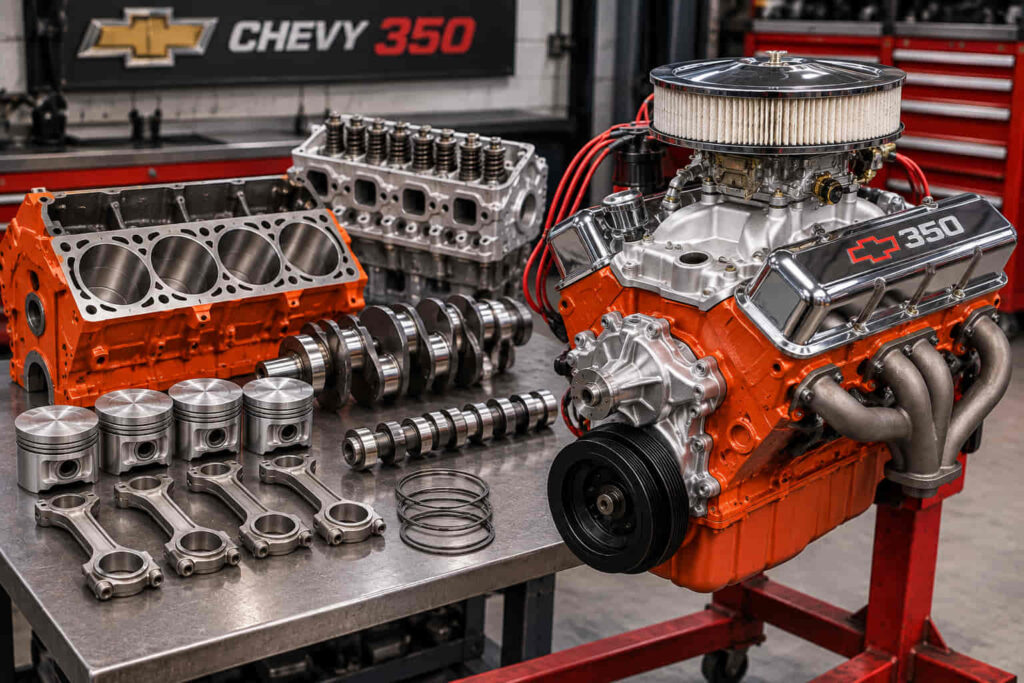
Chevy 350 Engine Rebuild: Complete Guide to Cost, Parts & Assembly
A Chevy 350 engine rebuild involves disassembling the 5.7-liter small-block V8, inspecting its internal components, restoring worn surfaces through precision machining, and reassembling the engine with suitable replacement parts. A properly rebuilt Chevrolet 350 can restore compression, improve oil pressure, reduce excessive oil consumption, and provide dependable performance for many additional years.
The Chevrolet 350 small-block engine is one of the most popular V8 engines ever produced by General Motors. Introduced for the 1967 model year, it became widely used in Chevrolet pickup trucks, Camaros, Corvettes, full-size cars, and numerous other applications. Its compact design, extensive aftermarket support, and straightforward mechanical construction make it particularly attractive for engine rebuilding.
However, the cost and complexity of a 350 rebuild depend on the engine’s condition and production generation. Earlier engines may use a two-piece rear main seal and flat-tappet camshaft, while later engines often use a one-piece rear main seal and may support a factory hydraulic roller camshaft. The 1996–2002 Vortec L31 also introduced important cylinder head and intake manifold differences.
A successful rebuild requires more than installing new piston rings and gaskets. Cylinder bore dimensions, crankshaft condition, bearing clearances, piston fitment, camshaft compatibility, and engine cleanliness must all be evaluated carefully.
Understanding the complete rebuilding process helps owners decide whether to rebuild their original engine, purchase a remanufactured replacement, or upgrade to a performance-oriented small-block configuration.
What Is a Chevy 350 Engine Rebuild?
A Chevy 350 engine rebuild is the process of restoring a worn or damaged Chevrolet 350 cubic-inch V8 engine to a reliable mechanical condition through inspection, machining, parts replacement, and precise reassembly.
The rebuilding process normally begins with removing the engine from the vehicle and disassembling its internal components.
The cylinder heads, intake manifold, oil pan, timing components, pistons, connecting rods, and crankshaft are removed so their condition can be evaluated.
Once disassembled, the engine block is cleaned and inspected for cracks, corrosion, damaged threads, and excessive cylinder wear.
The cylinder bores are measured for taper, out-of-round conditions, and scoring. If necessary, a machine shop enlarges and hones the cylinders to restore the correct dimensions and surface finish.
The crankshaft is inspected for journal damage and wear. Depending on its condition, it may be polished, reground, or replaced.
Connecting rods, pistons, and bearings also require inspection. Components outside their acceptable service limits must be restored or replaced.
The cylinder heads receive similar attention. Valve seats, guides, springs, valves, and sealing surfaces must be checked before the heads are reinstalled.
After machining and cleaning, the engine is assembled using appropriate bearings, piston rings, gaskets, seals, and other replacement components.
However, rebuilding does not necessarily mean replacing every internal part.
Some components may remain serviceable and can be reused after suitable inspection.
The objective is to restore the engine’s mechanical condition and operating performance, not simply to make its exterior look new.
Why Is the Chevy 350 a Popular Engine to Rebuild?
The Chevy 350 is popular for rebuilding because of its simple pushrod V8 architecture, widespread parts availability, extensive technical documentation, and long history of performance development.
The engine belongs to Chevrolet’s first-generation small-block family.
Its 350-cubic-inch displacement is approximately 5.7 liters, making it large enough to produce substantial torque while remaining relatively compact.
The original design uses a cast-iron engine block, two cylinder heads, and a single camshaft positioned inside the block.
Pushrods and rocker arms operate the valves.
This arrangement is mechanically straightforward compared with some modern engines that use multiple overhead camshafts and complex variable valve timing systems.
The Chevy 350 also has a large aftermarket parts industry.
Replacement pistons, bearings, camshafts, cylinder heads, intake manifolds, oil pumps, and gasket sets are readily available for many applications.
This makes it possible to build the engine for different purposes.
A stock restoration may focus on original compression, smooth operation, and reliability.
A mild performance rebuild may include an improved camshaft and cylinder heads.
More aggressive projects may use forged rotating assemblies, specialized cylinder heads, and upgraded valvetrain components.
Machine shops are also familiar with traditional small-block Chevrolet engine architecture.
However, not every 350 component is interchangeable across every production year.
Rear main seal design, camshaft compatibility, cylinder head configuration, and flywheel balancing are important differences.
The best results come from identifying the exact engine before choosing replacement parts.
What Are the Chevy 350 Engine Specifications?
The traditional Chevrolet 350 uses a 4.000-inch cylinder bore and a 3.480-inch crankshaft stroke, producing approximately 350 cubic inches of displacement.
It is a 90-degree V8 with two banks of four cylinders.
The engine uses a cast-iron block in most traditional production applications, although aftermarket and specialized versions may use different materials.
The standard small-block Chevrolet cylinder center spacing is approximately 4.400 inches.
The conventional block has a nominal deck height of approximately 9.025 inches.
Its camshaft is located within the block, and the cylinder heads generally use two valves per cylinder.
The traditional firing order is 1-8-4-3-6-5-7-2.
However, compression ratio and horsepower vary considerably by production period.
Some low-compression engines from the 1970s and 1980s produced relatively modest horsepower.
Other versions used higher compression, improved cylinder heads, and performance camshafts.
Chevrolet Performance continues offering modernized 350 crate engines based on the traditional small-block architecture.
For example, the company’s 350 HO crate engine has been offered with Vortec-style cylinder heads and a hydraulic flat-tappet camshaft.
Other Chevrolet Performance 350 configurations use hydraulic roller camshafts and aluminum cylinder heads.
This demonstrates that the 350 engine family contains several mechanical configurations.
A rebuilding project should begin by identifying the original engine’s casting numbers, production characteristics, crankshaft design, and cylinder heads.
Those details determine which parts are compatible and which machining specifications apply.
Which Chevy 350 Engine Do You Have?
Identifying the exact Chevy 350 engine is essential because different production generations use different rear main seals, camshafts, cylinder heads, and intake manifold configurations.
Earlier small-block Chevrolet engines generally used a two-piece rear main seal.
The seal was installed around the rear of the crankshaft using two separate sections.
The design changed for the 1986 production period, when Chevrolet introduced a one-piece rear main seal arrangement for the small-block V8.
This change affected the crankshaft and flywheel or flexplate configuration.
Chevrolet Performance’s technical documentation explains that the later engines use a different crankshaft flange bolt pattern.
The 1986-later engine also requires the correct externally counterweighted flywheel or flexplate for the corresponding crankshaft design.
Cylinder head changes occurred during the same general period.
Later small-block engines introduced center-bolt valve covers instead of the earlier perimeter-bolt arrangement.
Some later blocks were also designed to support factory hydraulic roller camshafts.
The 1996 Vortec L31 brought another important change.
Its Vortec cylinder heads use an eight-bolt intake manifold mounting pattern rather than the conventional 12-bolt pattern used by many earlier small-block heads.
The engine identification number and block casting number provide useful information about the original configuration.
However, an engine that has been rebuilt or modified previously may contain parts from several generations.
Physical component identification is therefore important.
A 350 block with aftermarket cylinder heads or a different crankshaft may require parts that differ from the original vehicle specifications.
When Does a Chevy 350 Need Rebuilding?
A Chevy 350 may need rebuilding when internal wear or mechanical damage causes low compression, excessive oil consumption, low oil pressure, abnormal engine noise, or persistent performance problems that cannot be corrected through ordinary repairs.
A worn engine may develop increased clearance between the piston rings and cylinder walls.
This can allow combustion gases to pass into the crankcase and increase oil consumption.
Worn main bearings or connecting rod bearings can also affect oil pressure.
However, low oil pressure does not automatically mean the entire engine requires rebuilding.
A worn oil pump, incorrect oil viscosity, or faulty pressure sender may produce similar symptoms.
Mechanical knocking can indicate bearing damage, but its source must be diagnosed accurately.
Valve train noise may originate from hydraulic lifters, rocker arms, pushrods, or other components.
Some of these problems can be repaired without removing the entire engine.
Overheating is another potential cause of internal damage.
Severe overheating may distort cylinder heads, compromise gasket sealing, or damage pistons and cylinder walls.
Repeated coolant loss may also indicate a cylinder head or gasket problem.
However, cooling system faults should be investigated before assuming internal engine failure.
Compression testing and cylinder leakage testing can help determine the condition of the combustion chambers.
Oil pressure testing provides information about the lubrication system.
An engine rebuild becomes more appropriate when several major internal components are worn or damaged.
The decision should be based on mechanical evidence rather than mileage alone.
How Do You Diagnose a Chevy 350 Before Rebuilding?
Before rebuilding a Chevy 350, the engine should be evaluated through compression testing, oil pressure measurement, cylinder leakage testing, cooling system inspection, and checks for abnormal mechanical wear.
A compression test measures how effectively each cylinder retains pressure during cranking.
Low compression can result from worn piston rings, damaged valves, head gasket problems, or other conditions.
However, compression readings alone do not identify the precise cause.
A cylinder leakage test can provide additional information.
Compressed air is introduced into a cylinder while the piston is positioned appropriately.
The location of escaping air can help identify whether the leak involves intake valves, exhaust valves, piston rings, or another sealing area.
Oil pressure should also be evaluated using a reliable gauge.
Low pressure may indicate bearing clearance problems, but other lubrication system faults must be considered.
A cooling system pressure test can help identify external or internal coolant leakage.
The engine oil should be inspected for signs of contamination.
Metal particles may indicate internal wear, while coolant contamination can suggest a sealing problem.
However, discoloration alone does not confirm a specific failure.
Spark plugs can also provide information about combustion conditions.
Unusual deposits, oil contamination, or differences between cylinders may help identify problems.
These diagnostic procedures determine whether the engine requires a complete rebuild or a smaller repair.
Correct diagnosis prevents unnecessary spending and helps ensure the original cause of failure is addressed.
What Tools Are Needed to Rebuild a Chevy 350?
A Chevy 350 engine rebuild requires equipment for engine removal, disassembly, precision measurement, component cleaning, and controlled reassembly.
An engine hoist is normally used to remove the engine from the vehicle.
A suitable engine stand supports the block during disassembly and rebuilding.
Hand tools are necessary for removing cylinder heads, accessories, timing components, and rotating assembly parts.
However, accurate rebuilding requires specialized measuring equipment.
A dial bore gauge is used to measure cylinder bore diameter, taper, and out-of-round conditions.
Outside micrometers are needed to measure crankshaft journals and piston dimensions.
A torque wrench ensures that fasteners are tightened to the correct specifications.
A torque-angle gauge may be required for certain specialized aftermarket components.
A ring compressor helps install pistons without damaging the rings.
A piston ring expander reduces the risk of twisting or breaking rings during assembly.
A feeler gauge is used to check piston ring end gaps and other mechanical clearances.
A dial indicator can assist with crankshaft endplay, camshaft measurements, and other inspections.
A valve spring compressor is useful when rebuilding cylinder heads.
An oil priming tool is important for preparing the lubrication system before the engine’s first startup.
However, not every part of a rebuild is suitable for ordinary home workshop equipment.
Cylinder boring, precision honing, crankshaft grinding, connecting rod resizing, and certain cylinder head operations require professional machinery.
A successful DIY rebuild often combines home disassembly and assembly with precision machine shop services.
How Do You Disassemble a Chevy 350 Engine?
A Chevy 350 engine should be disassembled systematically so the condition and original position of its components can be documented before cleaning and machining.
The engine is normally removed from the vehicle after disconnecting the required electrical, fuel, cooling, exhaust, and drivetrain connections.
All fluids must be drained and handled appropriately.
Once the engine is mounted securely on a stand, the external components can be removed.
The intake manifold, distributor, valve covers, exhaust manifolds, and accessory brackets are separated from the engine.
The cylinder heads are then removed.
Their condition should be documented, especially if there are signs of head gasket leakage or abnormal combustion.
The timing cover and timing chain are removed to provide access to the camshaft drive system.
The oil pan is removed so the lower engine components can be inspected.
The oil pump and pickup assembly can then be removed.
Connecting rod caps are loosened, and the piston and rod assemblies are carefully removed from their cylinders.
The crankshaft is removed after the main bearing caps have been released.
The camshaft and lifters are also removed using the procedure appropriate to the engine design.
Components should be organized and labeled.
Main bearing caps are machined to match the block and must not be mixed or installed in the wrong orientation.
Connecting rod caps are also matched to their corresponding rods.
Even when components will be replaced, careful documentation helps identify the original cause of failure.
How Do You Inspect the Chevy 350 Engine Block?
The Chevy 350 block must be inspected for cracks, cylinder wear, damaged threads, distorted sealing surfaces, and problems involving the main bearing supports before it is reused.
The block is the foundation of the entire engine.
Its cylinder bores must maintain the correct geometry for piston movement and ring sealing.
The crankshaft bearing supports must also remain aligned.
Before inspection, the block should be thoroughly cleaned.
Oil deposits and other contaminants can hide cracks or damaged surfaces.
The cylinder walls are measured for wear.
Bore taper occurs when the cylinder diameter differs between its upper and lower regions.
Out-of-round wear occurs when the cylinder is no longer circular.
Both conditions can reduce piston ring sealing.
The cylinder walls should also be inspected for scoring and damage.
The deck surfaces require attention.
Deep scratches, distortion, or corrosion can interfere with head gasket sealing.
The main bearing saddles and caps must be checked for damage.
Threaded holes should be inspected, particularly if the engine previously experienced improper fastener installation.
A machine shop may perform crack detection using methods suitable for cast-iron engine blocks.
Coolant passages should be inspected for corrosion or other defects.
If the block has severe structural damage, rebuilding may not be economical.
A replacement block or remanufactured engine may provide better value.
The decision should be made before purchasing expensive internal components.
Should You Bore a Chevy 350 Engine 0.030 Over?
Boring a Chevy 350 by 0.030 inch is a common rebuilding practice when cylinder wear requires machining, but it is not necessary or appropriate for every engine.
A standard Chevrolet 350 has a nominal bore diameter of 4.000 inches.
A 0.030-inch overbore increases the nominal cylinder diameter to 4.030 inches.
With the original 3.480-inch crankshaft stroke, this increases displacement to approximately 355 cubic inches.
The purpose of boring is primarily to restore correct cylinder geometry.
A worn cylinder may contain scoring, taper, or excessive diameter variation.
A machine shop can remove damaged material by enlarging the bore.
The cylinder is then honed to achieve the final dimensions and surface finish.
New oversize pistons and correctly matched rings are required.
However, boring removes material from the cylinder walls.
The amount of remaining wall thickness matters for strength and temperature control.
A block that has previously been bored may have limited remaining machining capacity.
Core shift and casting variation can also affect cylinder wall thickness.
For performance builds or blocks with uncertain history, a sonic thickness inspection may be appropriate.
If the existing bores remain within specification, a light hone may be sufficient.
Boring every rebuild automatically to 0.030 inch oversize is unnecessary.
The correct piston size should be selected after measuring the engine block and deciding how much machining is required.
What Is the Difference Between Honing and Boring a Chevy 350?
Boring enlarges the cylinder diameter to correct wear or damage, while honing establishes the final cylinder dimensions and surface finish required for piston ring operation.
Both processes are important, but they serve different purposes.
A worn cylinder may have taper, out-of-round dimensions, or scoring.
When the damage exceeds the amount that can be corrected through normal finishing, the cylinder must be bored.
The boring machine removes material to establish a new, larger diameter.
However, boring alone does not necessarily provide the final surface finish required for the piston rings.
Honing creates the specified cylinder finish.
The resulting surface texture helps establish proper contact between the piston rings and cylinder walls.
The finish must match the piston ring material and the intended application.
A cylinder that is excessively rough may accelerate ring wear.
A surface that is too smooth or otherwise unsuitable can interfere with normal ring seating.
Precision honing also helps establish the required final bore dimensions.
Some performance engine builders use a torque plate during honing.
The plate simulates some of the distortion created when a cylinder head is installed and its fasteners are tightened.
This can improve dimensional accuracy under assembled conditions.
However, the machining method should correspond to the intended build.
The cylinder bore must be measured after machining and before final assembly.
The selected pistons should then be checked against the finished cylinder dimensions.
Correct boring and honing are essential for compression, oil consumption control, and long-term engine durability.
Read more: K24 Valve Adjustment
How Do You Rebuild a Chevy 350 Crankshaft?
Rebuilding a Chevy 350 crankshaft involves inspecting its journals, checking alignment and surface condition, and restoring the bearing surfaces through polishing or grinding when appropriate.
The crankshaft converts piston movement into rotational power.
It operates under repeated loading and depends on an adequate lubricating oil film.
The main journals rotate inside the main bearings.
The connecting rod journals support the connecting rods.
These surfaces must have the correct dimensions, roundness, and finish.
A crankshaft removed from a worn engine may show scoring, surface damage, or excessive journal wear.
A machine shop should inspect it for cracks and other structural defects.
If the journals remain close to their original dimensions, polishing may be sufficient.
More extensive wear can require grinding the journals to an undersize dimension.
The engine then requires bearings manufactured for the new journal size.
However, grinding should not be performed automatically.
The correct procedure depends on the crankshaft material, damage, and available service limits.
The crankshaft must also be evaluated for straightness and other dimensional issues.
A severely damaged crankshaft may be more economical to replace.
The rear main seal design is another consideration.
Earlier Chevy 350 engines use a different crankshaft and sealing arrangement from later one-piece-seal engines.
The correct crankshaft must match the block and flywheel or flexplate configuration.
During assembly, crankshaft journal measurements are used to establish the appropriate bearing clearances.
The crankshaft should rotate smoothly after the main caps are tightened correctly.
What Are the Correct Chevy 350 Main Bearing Clearances?
Chevy 350 main bearing clearance must be established according to the exact crankshaft, bearing dimensions, and intended engine application rather than assuming one clearance is correct for every build.
Main bearings support the crankshaft within the engine block.
A thin film of pressurized engine oil separates the moving crankshaft journal from the bearing surface during normal operation.
If clearance is too small, the oil film may become inadequate under certain conditions.
Excessive clearance can contribute to oil pressure loss and abnormal bearing loading.
The correct specification depends on the engine configuration and components.
A stock replacement engine may use different target clearances from a high-RPM performance engine.
The crankshaft journal diameter must be measured accurately.
The installed bearing inside diameter must also be established.
The difference between those dimensions determines the oil clearance.
Some builders use precision micrometers and bore gauges.
Plastigage can also provide an approximate assembly check, but it does not replace comprehensive dimensional measurements.
The main bearing caps must be installed in the correct positions and orientations.
Fastener torque affects the assembled bearing housing geometry.
The correct bearing shells should match the crankshaft journal dimensions.
An undersize bearing is used when the crankshaft has been ground to the corresponding undersize.
The engine builder should also inspect thrust clearance.
Incorrect crankshaft endplay can affect crankshaft positioning and drivetrain operation.
Accurate bearing clearance measurement is one of the most important parts of a reliable Chevy 350 rebuild.
Should You Replace the Chevy 350 Pistons and Connecting Rods?
Pistons and connecting rods should be replaced when their condition or dimensions do not meet the requirements of the rebuild, but serviceable original components may be reused in suitable stock applications.
Pistons seal the combustion chambers through their rings while transferring force to the connecting rods.
The connecting rods transfer that force to the crankshaft.
Both components experience repeated mechanical and thermal loading.
Pistons should be inspected for damaged ring lands, skirt wear, cracking, and other defects.
Their dimensions must correspond to the finished cylinder bores.
If the block is bored oversize, the engine requires appropriately sized replacement pistons.
The original standard-diameter pistons cannot simply be reused in a larger bore.
Connecting rods require inspection for distortion, damaged bearing surfaces, and other structural concerns.
The big-end bore must remain within specification.
Some connecting rods can be resized when their condition permits.
However, damaged rods or unsuitable fasteners may require replacement.
For a basic stock rebuild, cast or hypereutectic replacement pistons may be appropriate.
A performance engine designed for higher cylinder pressures may benefit from forged pistons and stronger connecting rods.
However, the use of forged components does not eliminate the need for correct clearances.
Piston material influences thermal expansion and required cylinder fit.
The piston manufacturer’s instructions should determine the final dimensions.
A balanced rotating assembly is also important when replacement components differ in weight from the originals.
How Do You Set Chevy 350 Piston Ring End Gap?
Chevy 350 piston ring end gap is determined by the cylinder bore diameter, ring material, piston design, and intended operating conditions. Every compression ring should be checked in its corresponding finished cylinder before assembly.
Piston rings expand as their temperature increases.
The ends of each ring require sufficient clearance to prevent contact under operating conditions.
If the ends touch because the gap is too small, the ring may experience excessive stress.
This can damage the ring, piston, or cylinder wall.
Excessive ring gap can also affect combustion sealing and blow-by.
However, no single ring gap value is correct for every 350 build.
MAHLE’s published ring guidance provides a useful example.
For certain moderate-performance naturally aspirated ring configurations, its recommendation corresponds to a top ring gap of approximately 0.016 inch in a 4.000-inch bore.
Other ring materials, designs, and applications require different settings.
A turbocharged or supercharged engine may need greater thermal expansion allowance.
The second compression ring may also use a different gap from the top ring.
The correct procedure is to follow the supplied piston and ring manufacturer’s specifications.
Each ring is placed squarely into its corresponding cylinder bore.
A feeler gauge is used to measure the gap.
If a file-fit ring requires adjustment, material is removed carefully using an appropriate ring filing tool.
The ends should remain square and free from burrs.
After measurement, the rings are installed on the correct pistons using a suitable ring expander.
Ring orientation must also follow the manufacturer’s instructions.
Accurate ring fitting is essential for compression, oil control, and engine durability.
How Do You Rebuild Chevy 350 Cylinder Heads?
A Chevy 350 cylinder head rebuild involves inspecting the castings, valves, valve seats, guides, springs, and gasket surfaces before restoring or replacing worn components.
The cylinder heads control airflow into and out of the engine.
They also form the upper portion of the combustion chambers.
A worn cylinder head can reduce compression and cause oil consumption or valve sealing problems.
The rebuilding process begins with cleaning and inspection.
Cast-iron heads should be checked for cracks, particularly when the engine has experienced overheating.
The gasket surfaces must be evaluated for flatness and damage.
Valve guides should be inspected for wear.
Excessive guide clearance can affect valve movement and allow oil to enter the combustion chamber.
Valve seats must also provide proper contact with the valve faces.
A machine shop may restore the seating surfaces through precision machining.
Damaged valves may require replacement.
Valve springs should be checked for the correct load and installed height.
Weak springs can affect valve control, particularly at higher engine speeds.
However, selecting excessively strong springs for a stock camshaft can increase valvetrain wear unnecessarily.
Valve seals should be replaced when appropriate.
The intended camshaft determines some of the valvetrain requirements.
A performance camshaft with increased lift may require additional valve spring travel and piston-to-valve clearance.
Cylinder head rebuilding should therefore be coordinated with the complete engine configuration.
Are Vortec Heads Worth Using on a Chevy 350 Rebuild?
Vortec cylinder heads can be an effective upgrade for a traditional Chevy 350 because they offer improved combustion chamber and port characteristics compared with many older production heads.
Chevrolet introduced the well-known L31 Vortec cylinder heads for the 1996 truck engine applications.
These heads became popular among engine builders because they can provide useful airflow and combustion efficiency for street-oriented engines.
Chevrolet Performance’s 350 HO crate engine uses Vortec-style cast-iron cylinder heads.
Its technical documentation identifies 1.94-inch intake valves and 1.50-inch exhaust valves for that configuration.
However, Vortec heads are not direct replacements for every earlier cylinder head arrangement.
The intake manifold mounting pattern is an important difference.
Conventional older small-block Chevrolet heads commonly use a 12-bolt intake pattern.
The L31 Vortec heads use an eight-bolt pattern.
A compatible intake manifold is therefore required.
Valve lift clearance also matters.
Stock Vortec cylinder heads and valve spring hardware may have limitations that must be considered when installing a higher-lift camshaft.
An aggressive camshaft should not be installed without verifying retainer-to-guide clearance and spring compatibility.
Cooling system routing may also require attention.
Chevrolet Performance specifies an external coolant bypass arrangement for certain crate engines using Vortec heads.
The appropriate configuration should match the engine and vehicle installation.
For a mild performance rebuild, correctly prepared Vortec heads can be a practical option.
However, aftermarket aluminum heads may provide different advantages when greater airflow or weight reduction is required.
What Camshaft Should You Use in a Chevy 350 Rebuild?
The best camshaft for a Chevy 350 rebuild depends on the intended engine speed range, compression ratio, cylinder head airflow, transmission, axle gearing, and whether the engine is used for towing, street driving, or performance.
A camshaft determines when the intake and exhaust valves open and close.
Its lift, duration, and lobe separation characteristics influence airflow and engine behavior.
A stock-style camshaft generally emphasizes smooth idle, low-speed torque, and everyday drivability.
This can be suitable for pickup trucks and restoration projects.
A performance camshaft may increase airflow at higher engine speeds.
However, it may also reduce low-speed vacuum and change the torque curve.
An aggressive camshaft can produce a rough idle and may require additional modifications.
The engine’s compression ratio must also be considered.
A camshaft intended for a high-compression performance engine may perform poorly in a low-compression stock build.
The Chevy 350 has been produced with both flat-tappet and hydraulic roller camshaft configurations.
These designs have different lifter requirements and break-in procedures.
A flat-tappet camshaft requires particular attention to initial lubrication and break-in.
Hydraulic roller camshafts reduce sliding contact between the lifter and camshaft lobe.
However, retrofitting a roller system into an older block may require compatible lifters, retention components, and other parts.
The selected camshaft should match the actual cylinder heads, valve springs, and intended power range.
A balanced street engine generally benefits more from a properly matched camshaft than from the most aggressive profile available.
Flat-Tappet vs Roller Camshaft for a Chevy 350
A hydraulic roller camshaft generally offers advantages in friction and camshaft durability, while a flat-tappet camshaft can remain appropriate for an original-style rebuild when installed and broken in correctly.
The difference involves how the lifter contacts the camshaft lobe.
A flat-tappet lifter uses a sliding contact surface.
A roller lifter uses a rolling element that follows the camshaft lobe.
Because flat-tappet lifters operate under demanding contact conditions, they require careful lubrication.
During initial operation, a new flat-tappet camshaft and its lifters must establish the intended running surfaces.
Improper break-in can damage camshaft lobes or lifter faces.
The camshaft manufacturer’s installation instructions are therefore essential.
COMP Cams recommends an initial operating period at approximately 2,000–2,500 RPM for certain flat-tappet camshaft applications.
The company also emphasizes the use of appropriate assembly lubricant and break-in oil.
However, these procedures should not automatically be applied to every camshaft design.
A hydraulic roller system uses different contact mechanics and may not require the same camshaft break-in procedure.
However, piston rings and other newly installed components may still require appropriate initial operation.
Not every early Chevy 350 block is originally configured for factory hydraulic roller equipment.
A retrofit may be possible, but component compatibility must be confirmed.
The most appropriate camshaft depends on originality requirements, budget, available hardware, and intended engine performance.
What Is the Correct Chevy 350 Engine Rebuild Torque?
Chevy 350 engine torque specifications depend on the block, crankshaft, connecting rods, cylinder heads, and fasteners used in the particular build.
A useful example is Chevrolet Performance’s documented 350 HO crate engine specification.
For that engine, the cylinder head bolts are specified at 65 lb-ft.
The crankshaft main bearing cap fasteners use 70 lb-ft for the inner positions and 65 lb-ft for the outer positions.
The crankshaft balancer bolt is specified at 63 lb-ft.
The engine’s flywheel bolts use 65–70 lb-ft.
The water pump fasteners are specified at 30 lb-ft.
The oil pump mounting bolt is specified at 66 lb-ft.
However, these values are from a particular Chevrolet Performance engine and should not be treated as universal specifications for every historical Chevy 350.
Connecting rod fasteners are especially important.
For the documented 350 HO assembly, Chevrolet Performance identifies a preferred bolt stretch measurement of 0.006 inch.
It also provides a torque-angle procedure of 20 lb-ft followed by 55 degrees, with a specified alternative when an angle gauge is unavailable.
Different connecting rods may require different fastener procedures.
Aftermarket ARP bolts and studs should follow the instructions supplied with those components.
Cylinder head design can also affect the correct torque.
Vortec intake manifold fasteners require different attention from some earlier 12-bolt intake configurations.
The most reliable approach is to use the technical documentation corresponding to the actual engine and installed hardware.
Correct torque alone is not sufficient when bearing clearances, gasket surfaces, or component compatibility are incorrect.
How Do You Assemble the Chevy 350 Rotating Assembly?
The Chevy 350 rotating assembly should be installed only after the block, crankshaft, connecting rods, pistons, and bearings have been cleaned, inspected, and measured to the required specifications.
The crankshaft is installed with bearings selected for its measured journal dimensions.
The main bearing caps must be positioned correctly.
Fasteners are tightened in the appropriate sequence and to the specified values.
Crankshaft rotation should be checked as assembly progresses.
Any unexpected binding requires investigation.
Crankshaft endplay should also be measured.
Pistons and connecting rods are assembled according to their manufacturer’s requirements.
Piston rings are installed after confirming their dimensions and end gaps.
The ring orientation and piston direction must be correct.
A ring compressor is used to install each piston into its corresponding cylinder.
The connecting rod is guided onto its crankshaft journal without damaging the crankshaft surface.
The bearing and rod cap are installed using the correct orientation.
Connecting rod fasteners are then tightened or measured according to the specified procedure.
The crankshaft should rotate freely after each piston assembly is installed.
A sudden increase in resistance can indicate an incorrect bearing, damaged ring, improper rod orientation, or another assembly problem.
The rotating assembly must also be compatible with the engine’s balance requirements.
Incorrect piston weight or flywheel configuration can create vibration and component stress.
Precision measurement and careful assembly are essential for a successful rebuild.
How Do You Install the Chevy 350 Timing Chain?
The Chevy 350 timing chain must be installed with the crankshaft and camshaft sprockets correctly aligned so the valves operate at the intended points in the engine cycle.
The traditional small-block Chevrolet engine uses a timing chain to connect the crankshaft and camshaft.
The crankshaft rotates twice for every complete camshaft revolution.
The timing chain maintains the mechanical relationship between piston position and valve operation.
During rebuilding, the original timing components should be inspected.
A worn chain can introduce unwanted camshaft timing variation.
Damaged sprocket teeth or excessive chain looseness may justify replacement.
The new timing set must match the engine’s camshaft and crankshaft configuration.
Some aftermarket timing sets offer adjustable positions for changing camshaft timing.
However, changes should be made only when required by the engine build specification.
Incorrect timing can reduce performance and may create mechanical interference in certain modified engine combinations.
The alignment marks should be positioned according to the timing set and engine manufacturer’s instructions.
The installer should also verify camshaft movement and timing after assembly.
High-performance engine builders may use a degree wheel to measure the installed camshaft position.
This is especially relevant when aftermarket camshafts or adjustable timing components are used.
A properly installed timing chain supports consistent valve timing and dependable engine operation.
How Do You Adjust Chevy 350 Hydraulic Lifters?
Hydraulic lifter adjustment on a Chevy 350 establishes the correct lifter preload rather than setting a conventional fixed mechanical valve lash.
Many traditional small-block Chevrolet engines use hydraulic valve lifters.
These lifters use engine oil pressure and an internal mechanism to accommodate normal valvetrain clearance during operation.
However, the rocker arms must still be adjusted correctly during assembly.
An incorrectly adjusted rocker arm can create noise, poor valve operation, or excessive preload.
The correct procedure depends on the valvetrain configuration.
A conventional adjustable small-block Chevy rocker arm arrangement uses a nut to establish preload.
The engine is rotated so that the lifter is positioned on the camshaft’s base circle.
The rocker arm is then adjusted until the clearance between the components is eliminated.
The specified additional preload is applied according to the lifter manufacturer’s instructions.
However, the exact amount of preload differs between lifter designs.
A performance lifter may require a different setting from a standard replacement hydraulic lifter.
The same applies to certain short-travel or specialized lifter configurations.
Valve springs, pushrod length, rocker arm geometry, and cylinder head modifications also influence correct operation.
Pushrod length should be checked when major components have changed.
A rebuilt engine with incorrect valvetrain geometry may experience accelerated wear or reduced performance.
The correct hydraulic lifter adjustment should be based on the installed components rather than a universal number of turns.
How Do You Set the Chevy 350 Firing Order?
The traditional Chevy 350 firing order is 1-8-4-3-6-5-7-2, and the distributor and spark plug wires must be arranged correctly for normal combustion.
The firing order determines the sequence in which the cylinders receive ignition.
On a traditional Chevrolet small-block V8, the odd-numbered cylinders are located on the driver’s side of a conventional U.S. longitudinal installation.
These are cylinders one, three, five, and seven.
The even-numbered cylinders are located on the passenger side.
These are cylinders two, four, six, and eight.
Cylinder number one is at the front of the engine on the driver’s side.
The distributor rotates clockwise in a conventional small-block Chevrolet configuration.
The spark plug wires must be connected to the correct distributor terminals.
The number one cylinder is positioned at top dead center on the compression stroke when establishing initial distributor position.
However, top dead center also occurs during the transition between the exhaust and intake strokes.
The compression position must be confirmed to avoid incorrect distributor installation.
Once the distributor is positioned, the spark plug wires are routed according to the firing order.
Incorrect wire routing can produce misfires, backfiring, poor performance, or a no-start condition.
Ignition timing must also be set according to the specific engine and distributor.
An original emissions-controlled truck engine may require different timing procedures from a carbureted Chevrolet Performance crate engine.
The correct firing order is shared by the conventional Chevy 350 configurations, but ignition calibration must match the engine’s actual setup.
How Do You Prime a Rebuilt Chevy 350 Oil System?
A rebuilt Chevy 350 should have its lubrication system primed before initial startup so engine oil reaches the bearings and other critical components before the engine operates under combustion load.
The traditional small-block Chevy oil pump is mechanically driven through the distributor drive arrangement.
This makes it possible to prime the oil system using a suitable tool after the distributor has been removed.
The engine is filled with the specified break-in oil.
An oil priming tool is installed into the distributor opening so it engages the oil pump drive.
The tool is operated according to the engine manufacturer’s instructions.
Chevrolet Performance’s 350 HO installation guide describes using a priming tool and suitable drill to circulate oil before startup.
The guide also recommends rotating the crankshaft during priming so oil can reach the bearing surfaces appropriately.
However, actual priming procedures depend on the engine design and the tools used.
The oil pressure should be monitored during the process.
A properly functioning system should establish oil pressure and distribute lubricant through the engine.
The valvetrain should also receive lubrication where required.
An engine should not be started with known oil pressure problems.
Incorrect pickup tube installation, damaged oil pump components, restricted passages, or improper bearing clearances can prevent adequate lubrication.
Priming is especially important after an engine rebuild because many internal components have been cleaned and may contain little residual oil.
Assembly lubricant provides initial protection, but the oil system must establish normal flow during startup.
How Do You Break In a Rebuilt Chevy 350 Engine?
The correct Chevy 350 break-in procedure depends on the camshaft type, piston ring design, engine configuration, and instructions supplied by the engine builder or component manufacturer.
A newly rebuilt engine contains components that may need an initial operating period to establish normal contact patterns.
Piston rings must seat against the cylinder walls.
The crankshaft bearings must operate with appropriate oil pressure and clearances.
The camshaft may also require a specific break-in procedure.
For a new flat-tappet camshaft, the manufacturer’s instructions are especially important.
COMP Cams describes a procedure involving operation at approximately 2,000–2,500 RPM during the initial 30-minute break-in period for certain flat-tappet applications.
The purpose is to support lubrication of the camshaft and lifter contact surfaces.
The procedure also specifies suitable assembly lubricant and break-in oil.
However, a hydraulic roller engine does not necessarily require the same camshaft break-in process.
Chevrolet Performance provides separate instructions for its 350 HO crate engine.
Its guide includes oil priming, initial operating checks, controlled driving, and specified oil changes.
The guide recommends varying load and avoiding prolonged high-load operation during the initial break-in period.
It also specifies oil changes after particular operating intervals.
These instructions are applicable to that engine configuration and should not automatically replace the directions supplied with a different piston ring or camshaft package.
During break-in, oil pressure, coolant temperature, and fluid leaks should be monitored carefully.
Abnormal noise or pressure loss requires immediate attention.
Correct break-in supports the long-term reliability of the rebuilt engine.
What Engine Oil Should You Use for Chevy 350 Break-In?
The correct break-in oil for a rebuilt Chevy 350 depends on the camshaft design and the specifications of the engine builder and component manufacturers.
Flat-tappet camshaft engines require particular consideration.
Their camshaft lobes and lifter faces operate under substantial sliding contact stress.
The initial break-in process therefore requires suitable lubrication and appropriate antiwear additives.
Zinc and phosphorus-based additives, commonly associated with ZDDP, are often used in break-in lubricants developed for flat-tappet engines.
COMP Cams recommends a suitable high-lubricity break-in oil or approved additive for relevant camshaft installations.
However, using excessive additives or combining products without manufacturer approval is not necessarily beneficial.
The correct lubricant should be selected as part of the complete break-in procedure.
Chevrolet Performance’s 350 HO installation guide specifies 10W-30 nonsynthetic oil for the documented initial operating procedure.
The guide also provides oil change recommendations during early engine operation.
However, that requirement should not be interpreted as universal for every small-block Chevy rebuild.
Modern synthetic lubricants can be suitable for some engine designs and break-in programs when specifically approved.
The important factor is compatibility with the camshaft, lifters, piston rings, and engine builder’s requirements.
Oil filter selection is also important.
A quality filter helps capture contaminants generated or released during initial operation.
After break-in, the oil and filter should be changed according to the applicable instructions.
Correct oil selection and initial maintenance help protect the rebuilt engine during its most sensitive operating period.
How Much Does a Chevy 350 Engine Rebuild Cost?
A professional Chevy 350 engine rebuild commonly costs several thousand dollars, with the final price depending on machine shop work, replacement parts, labor, and the condition of the original engine.
Kelley Blue Book provides a general U.S. estimate of approximately $3,500–$6,000 for a professional engine rebuild.
However, this is a broad consumer estimate rather than a guaranteed price for a Chevrolet 350.
A basic rebuild may cost less when the original block, crankshaft, cylinder heads, and connecting rods remain serviceable.
The costs increase when extensive machining or major component replacement becomes necessary.
Cylinder boring and honing add machine shop expenses.
Crankshaft grinding or replacement creates additional cost.
Cylinder head rebuilding may require new valves, guides, springs, and machining.
A performance rebuild introduces further expenses.
Forged pistons, upgraded connecting rods, aluminum cylinder heads, and a hydraulic roller camshaft conversion can increase the total considerably.
The final price also depends on who performs the work.
A DIY owner may save some labor costs by handling disassembly and assembly.
However, professional machining and precision inspection remain necessary.
A repair shop performing complete engine removal, rebuilding, and reinstallation must account for additional labor.
The age and condition of the vehicle also matter.
Damaged accessories, cooling components, fuel system parts, or transmission components may require repairs at the same time.
The best estimate is obtained after the engine has been inspected and the required machining has been identified.
How Much Does a Chevy 350 Rebuild Kit Cost?
Chevy 350 rebuild kits vary in price and contents, with basic kits generally costing less than complete overhaul packages containing pistons, camshaft components, bearings, and other replacement parts.
An engine rebuild kit is not necessarily a complete engine restoration package.
Some kits contain gaskets, piston rings, and main and connecting rod bearings.
Other kits include pistons, camshaft bearings, timing components, and additional parts.
The term master rebuild kit may be used for more comprehensive packages.
However, the included components vary by supplier.
The correct kit depends on the engine’s dimensions.
If the block has been bored 0.030 inch oversize, the replacement pistons and rings must match the finished bore.
If the crankshaft journals have been ground undersize, the appropriate bearings must be selected.
Ordering a standard-size kit before the machine shop completes its inspection can create compatibility problems.
Camshaft selection is another consideration.
A flat-tappet camshaft may require new matched lifters.
A hydraulic roller engine requires compatible lifters and related components.
Gasket selection must also match the engine generation.
One-piece and two-piece rear main seal engines use different sealing components.
Vortec cylinder heads require compatible intake manifold gaskets.
A cheaper kit may not offer the best value if its components do not match the intended build.
The appropriate approach is to determine the machining requirements first and purchase parts according to the final engine specifications.
Is a Two-Bolt or Four-Bolt Main Chevy 350 Better for Rebuilding?
Both two-bolt and four-bolt main Chevy 350 blocks can be suitable for rebuilding, with the appropriate choice depending on the engine’s condition and intended horsepower level.
The term refers to the number of bolts securing the main bearing caps to the engine block.
Traditional two-bolt main blocks use two fasteners per main cap.
Four-bolt main blocks use additional bolts at the principal main bearing supports.
Four-bolt configurations are often associated with heavy-duty or performance applications.
However, the number of bolts does not independently determine the strength of the complete block.
Casting quality, main bearing web condition, fastener arrangement, machining, and crankshaft support all influence durability.
A sound two-bolt block can provide reliable service in a stock or moderately modified street engine.
A damaged four-bolt block may be less desirable despite having additional fasteners.
Some performance engine builders use aftermarket main studs or specialized caps.
However, replacing caps or significantly modifying the main bearing support system can require precision line boring or honing.
A proper rebuild begins by inspecting the existing block.
The main caps should be checked for damage and correct fitment.
The main bearing housing dimensions must also be measured.
For a normal street restoration, a healthy two-bolt block may be perfectly adequate.
For specialized high-output applications, an aftermarket block or more extensively reinforced configuration may provide additional advantages.
The intended use and measured block condition should guide the decision.
Can You Turn a Chevy 350 Rebuild Into a 383 Stroker?
A Chevy 350 can be converted into a 383 stroker by using a longer-stroke crankshaft and compatible rotating assembly components, but the conversion requires additional machining and careful clearance checks.
The standard Chevy 350 uses a 3.480-inch crankshaft stroke.
A conventional 383 stroker configuration increases the stroke to approximately 3.750 inches.
When combined with a 4.030-inch cylinder bore, the resulting displacement is approximately 383 cubic inches.
The additional displacement can increase torque potential, particularly when combined with suitable cylinder heads and camshaft characteristics.
However, the longer stroke changes the relationship between the crankshaft, connecting rods, pistons, and engine block.
The rotating assembly may require additional clearance around the lower cylinders and crankcase.
The camshaft and connecting rod geometry must also be considered.
Piston compression height must match the stroke and connecting rod combination.
The rotating assembly should be balanced according to the actual components.
A stroker conversion may also require changes to compression ratio, fuel delivery, and ignition timing.
Cylinder head airflow becomes more important as displacement increases.
A larger engine can demand greater airflow than the original 350 configuration.
The camshaft should also be selected to match the new displacement.
A 383 stroker is therefore a complete engine combination rather than simply a crankshaft replacement.
For an owner already rebuilding a worn Chevy 350, the conversion can be attractive when additional torque is desired.
However, its cost should be compared with a stock rebuild or complete 383 crate engine.
Is It Better to Rebuild a Chevy 350 or Buy a Crate Engine?
Rebuilding the original Chevy 350 is often attractive for classic vehicle restoration and customized performance projects, while purchasing a crate engine can provide a more predictable replacement package and reduce rebuilding complexity.
A rebuilt original engine allows the owner to retain the existing block and other serviceable components.
This may be important for collectible vehicles where original engine identification contributes to historical authenticity.
Rebuilding also provides control over component selection.
The owner can choose the pistons, camshaft, cylinder heads, compression ratio, and other characteristics.
However, a custom rebuild requires precise machining, component matching, and assembly.
Unexpected damage can increase the total cost.
A crate engine is supplied as a preassembled replacement.
Chevrolet Performance offers several 350-based crate engine configurations with different output ratings and component packages.
Some use traditional cast-iron heads and flat-tappet camshafts.
Others use aluminum cylinder heads and hydraulic roller valvetrains.
The buyer should verify whether the engine is supplied as a long block, base engine, or more complete turnkey package.
A crate engine may reduce the need to rebuild the original rotating assembly.
However, installation still requires suitable fuel, cooling, ignition, exhaust, and transmission components.
The engine must also comply with applicable emissions requirements for the intended vehicle.
A crate engine can be convenient when the original block is badly damaged or the owner does not want to manage a custom rebuild.
The more economical option depends on the complete installed cost and the vehicle’s intended use.
Rebuilt vs Remanufactured Chevy 350: Which Is Better?
A rebuilt Chevy 350 is generally restored according to the condition of the original engine, while a remanufactured Chevy 350 usually undergoes a standardized factory restoration process.
A custom rebuild begins with the owner’s engine.
The builder inspects its components and determines which repairs are necessary.
Serviceable parts may be reused after appropriate inspection.
The engine can also be modified to achieve specific performance goals.
Remanufacturing typically follows a documented process involving complete disassembly, cleaning, machining, component restoration, assembly, and quality-control testing.
Established remanufacturers may provide standardized replacement engines with written warranties.
However, the term remanufactured does not mean every component is new.
The engine may use restored original castings and selected reusable components.
Likewise, a professionally rebuilt engine is not automatically less reliable.
A skilled machine shop can restore a Chevy 350 to accurate mechanical specifications.
The main difference is often the manufacturing process and the amount of customization available.
A remanufactured replacement may be more convenient when the engine is needed quickly and a compatible assembly is available.
A custom rebuild may be preferable when retaining the original block or selecting specialized components is important.
Warranty coverage must also be compared.
The best choice depends on workmanship, replacement components, testing, total cost, and intended ownership period.
How Long Does a Rebuilt Chevy 350 Engine Last?
A properly rebuilt Chevy 350 can provide extensive additional service life, but longevity depends on machining quality, component selection, engine assembly, maintenance, and operating conditions.
The engine’s original reputation for durability does not guarantee a specific lifespan after rebuilding.
A rebuild that restores correct cylinder dimensions, bearing clearances, and valve sealing can provide dependable operation.
However, poor machine work or incorrect assembly can cause premature failure.
Lubrication is one of the most important factors.
The crankshaft and connecting rod bearings depend on a continuous oil film.
Low oil pressure, contaminated oil, or inadequate lubrication can damage those components.
Cooling system condition also matters.
Overheating can compromise head gasket sealing, distort cylinder heads, and damage pistons.
Fuel and ignition calibration influence combustion temperatures and mechanical loading.
An engine with excessive ignition advance or unsuitable compression for its fuel can experience detonation.
Performance modifications may also affect durability.
A mild street rebuild typically operates under different loads from a high-compression racing engine.
It is possible for a properly maintained rebuilt 350 to operate for many tens of thousands of miles and potentially much longer.
However, a universal mileage guarantee would be misleading.
Compression, oil pressure, oil consumption, cooling system performance, and maintenance history provide more useful information about engine condition.
The objective should be consistent mechanical reliability rather than achieving a particular odometer number.
What Are the Most Common Chevy 350 Rebuild Mistakes?
Common Chevy 350 rebuild mistakes include incorrect bearing clearance, inadequate engine cleaning, improper piston ring gaps, mismatched components, incorrect fastener torque, and failure to establish oil pressure before startup.
Engine cleanliness is especially important.
Metal particles and machining debris can remain in oil passages after machine work.
If these contaminants are not removed, they can enter new bearings during initial operation.
Incorrect bearing clearances create another risk.
A bearing that is too tight may fail because the required oil film cannot be maintained.
Excessive clearance may reduce oil pressure and increase mechanical loading.
Piston ring installation errors can affect compression and oil consumption.
A ring with insufficient end gap may expand excessively when hot.
A ring installed incorrectly may fail to seal or control oil properly.
Component compatibility is also essential.
One-piece and two-piece rear main seal engines require different components.
Vortec intake manifolds use a different mounting arrangement from many earlier heads.
Camshaft and distributor gear compatibility must also be considered.
Improper fastener torque can damage cylinder heads, distort components, or reduce clamping force.
Using aftermarket connecting rod bolts with generic factory torque values is particularly risky.
Flat-tappet camshaft break-in mistakes can also cause severe wear.
Finally, installing a rebuilt engine without correcting the original overheating, lubrication, or fuel system fault may result in another failure.
Successful rebuilding depends on careful diagnosis and documented measurements.
Is a Chevy 350 Engine Rebuild Worth It?
Rebuilding a Chevy 350 is often worthwhile when the engine block is structurally sound, the vehicle remains in good condition, and the total rebuild cost is reasonable compared with other replacement options.
The Chevy 350 benefits from broad parts availability and extensive technical support.
A stock rebuild can restore dependable operation to a classic Chevrolet pickup or passenger car.
For a collectible vehicle, preserving the original engine may also be desirable.
However, the economics depend on the engine’s condition.
A block with limited cylinder wear may require relatively modest machining.
A severely damaged block with a cracked cylinder or main bearing support may not be economical to restore.
The intended use also matters.
A daily-driven truck may benefit from a stock-style rebuild emphasizing torque and reliability.
A weekend muscle car may justify additional performance upgrades.
A racing engine may require more expensive internal components and specialized machine work.
The vehicle’s overall condition should also be considered.
A rebuilt engine does not repair a worn transmission, corroded frame, or failing suspension.
If the vehicle has several major mechanical problems, purchasing another vehicle may be more economical.
For an otherwise solid classic or work truck, rebuilding the 350 can be an effective way to extend its useful life.
The decision should compare the cost of rebuilding, remanufactured replacement, crate engine purchase, and complete vehicle replacement.
Final Verdict: How to Rebuild a Chevy 350 Engine Correctly
A successful Chevy 350 engine rebuild requires accurate diagnosis, complete inspection, professional machining where necessary, correct replacement parts, precision assembly, and an appropriate break-in procedure.
The traditional Chevrolet 350 is a durable and highly supported small-block V8.
Its 4.000-inch bore, 3.480-inch stroke, simple pushrod architecture, and extensive aftermarket make it a practical engine for restoration and performance projects.
However, rebuilding should begin with identifying the exact engine generation.
Older two-piece rear main seal engines differ from later one-piece-seal versions.
Camshaft and cylinder head designs also vary.
The 1996–2002 Vortec L31 uses a distinct intake manifold mounting pattern and other application-specific components.
Once the engine is identified, its mechanical condition must be evaluated.
The block should be inspected for cracks, cylinder wear, and damaged bearing supports.
The crankshaft requires dimensional inspection.
Pistons, connecting rods, cylinder heads, and valvetrain components must be evaluated for wear or damage.
Machining should be based on measurements rather than performed automatically.
A cylinder that remains within specification may not require boring.
An engine with worn or damaged bores may need oversize pistons and precision honing.
During reassembly, bearing clearance, piston ring gap, fastener torque, camshaft timing, and oil system preparation are particularly important.
The engine should be primed before startup.
A flat-tappet camshaft requires the appropriate break-in procedure, while roller-camshaft engines may use different instructions.
For a reliable street or truck engine, a carefully measured stock-style rebuild is often the most practical choice. For additional performance, a 383 stroker conversion, upgraded cylinder heads, or a properly matched camshaft can provide meaningful improvements when the supporting components are selected correctly.
Ultimately, the best Chevy 350 engine rebuild is one that restores accurate mechanical clearances and dependable operation while matching the owner’s budget, vehicle, and intended performance requirements.