The main difference between a locking differential and 4×4 is how each system delivers power to the wheels. A 4×4 drivetrain sends engine torque to both the front and rear axles, while a locking differential forces the left and right wheels on the same axle to rotate at the same speed. These systems perform different functions and can work together to improve vehicle traction on challenging terrain.
A 4×4 vehicle does not necessarily have locking differentials. Most conventional 4×4 systems use a transfer case to drive both axles, but open differentials can still allow one wheel on each axle to spin when traction is limited. A locking differential addresses this limitation by mechanically connecting both axle shafts, allowing the wheel with better grip to continue receiving driving torque.
The distinction becomes important when driving through deep mud, climbing rocky obstacles, or crossing uneven trails. A 4×4 system provides additional driven wheels, while a differential locker helps maintain traction when one wheel loses contact with the ground.
Understanding how these systems operate, their traction advantages, and their limitations helps determine whether standard 4×4 is sufficient or additional differential locking capability is necessary.
What Is the Difference Between a Locking Differential and 4×4?
The main difference between a locking differential and 4×4 is that a locking differential controls wheel rotation on the same axle, while 4×4 distributes engine torque to both the front and rear axles. A locking differential prevents the two wheels on an axle from rotating at different speeds, whereas a 4×4 drivetrain increases the number of wheels receiving driving torque.
A locking differential is an axle component, while 4×4 is a drivetrain configuration. In a conventional 4×4 vehicle, the transfer case connects the transmission to the front and rear driveshafts. However, the front and rear axle differentials may remain open, allowing the left and right wheels to rotate independently. A differential locker changes this behavior by mechanically coupling both axle shafts.
The differences between a locking differential and 4×4 are summarized below.
| Feature | Locking Differential | 4×4 Drivetrain |
|---|---|---|
| Primary function | Locks left and right wheel speeds on one axle | Delivers torque to front and rear axles |
| Main component | Differential locking mechanism | Transfer case and driveline |
| Wheel rotation | Both wheels on the locked axle rotate equally | Wheel speeds depend on differential configuration |
| Traction advantage | Maintains drive when one wheel loses grip | Provides traction through both driven axles |
| Vehicle compatibility | Available on 2WD and 4WD vehicles | Can operate with open or locking differentials |
| Best application | Cross-axle obstacles and severe traction loss | Loose surfaces and general off-road driving |
For example, a 4×4 truck with open differentials may struggle when one front wheel and one rear wheel lose traction. A truck equipped with a rear locking differential can maintain driving torque at both rear wheels, allowing the rear tire with sufficient grip to help move the vehicle forward.
Neither system directly replaces the other. 4×4 increases the number of driven axles, while a locking differential improves torque delivery between the wheels on a particular axle. Combining both systems provides greater traction capability in situations where standard open differentials limit vehicle movement.
How Does a Locking Differential Work?
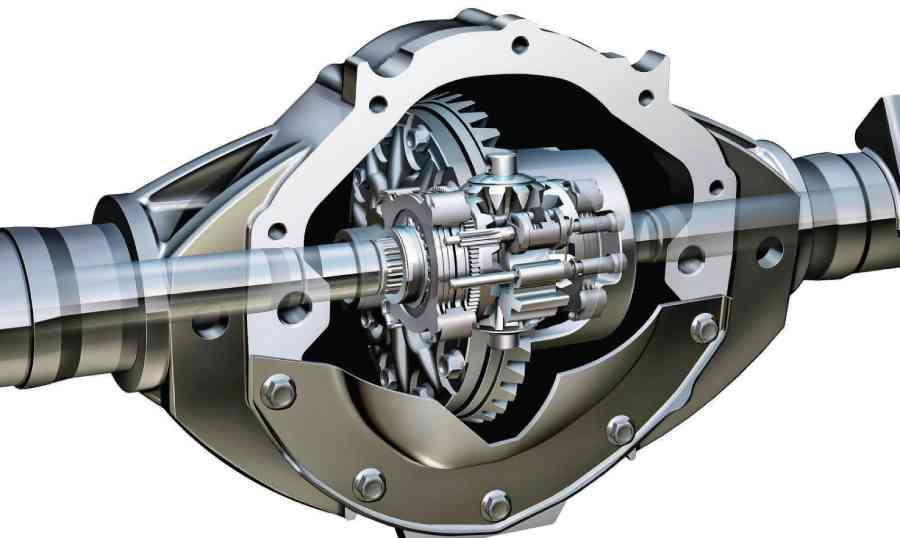
A locking differential works by mechanically connecting the left and right axle shafts, forcing both wheels on the same axle to rotate at identical speeds. This prevents the differential from allowing one wheel to spin faster than the other when traction is uneven.
Under normal conditions, an open differential allows the wheels to rotate at different speeds while turning. The outside wheel travels a longer distance than the inside wheel, so it must rotate faster. Differential gears accommodate this speed difference, reducing tire scrub and drivetrain stress during cornering.
However, an open differential has a traction limitation. Both axle shafts receive approximately equal torque, and the maximum usable torque is constrained by the wheel with the least resistance. When one wheel is suspended in the air or resting on slippery mud, it can spin while the opposite wheel receives insufficient torque to move the vehicle.
A locking differential eliminates this wheel-speed difference by engaging a mechanical locking mechanism. Depending on the design, the mechanism may use a sliding collar, locking pins, or another coupling system to connect the differential components. Once engaged, both axle shafts rotate together, allowing the wheel with better traction to transmit driving force even when the opposite wheel slips.
For example, when a truck climbs a rocky obstacle and its rear-left wheel lifts off the ground, an open rear differential may allow the suspended wheel to spin. Engaging a rear differential locker keeps the rear-right wheel rotating with the left wheel, allowing the grounded tire to propel the truck forward.
Locking differentials can be manually selectable or automatically activated, depending on their design. Selectable lockers allow drivers to engage the mechanism when additional traction is required and disengage it when normal differential operation is preferable. This is particularly important on high-traction surfaces, where locked wheels can cause tire scrub, increased steering resistance, and additional drivetrain stress.
How Does a 4×4 Drivetrain Work?
A 4×4 drivetrain works by transferring engine torque to both the front and rear axles, allowing all four wheels to contribute to vehicle propulsion. Unlike a two-wheel-drive system that powers only one axle, a conventional 4×4 system uses a transfer case, front and rear driveshafts, and axle differentials to deliver torque to both ends of the vehicle.
Engine torque passes through the transmission before reaching the transfer case, which distributes it between the front and rear drivetrains. Each driveshaft transfers torque to its corresponding axle differential, which distributes torque between the left and right wheels. In a conventional 4×4 equipped with open axle differentials, the wheels on each axle can rotate at different speeds during turns.
There are two main conventional 4×4 configurations: part-time 4WD and full-time 4WD. Part-time 4WD typically operates in two-wheel drive on paved roads and engages the front axle when additional traction is required. Its four-wheel-drive mode commonly couples the front and rear driveshafts without allowing a continuous speed difference between them. Full-time 4WD drives both axles continuously and generally uses a center differential or equivalent mechanism to accommodate different front and rear axle speeds during cornering.
Many off-road 4×4 vehicles also feature a two-speed transfer case with high-range (4H) and low-range (4L) gearing. High range supports driving on loose surfaces at moderate speeds, while low range multiplies torque at the wheels and provides greater control during steep climbs, rocky obstacles, and slow technical driving.
However, 4×4 does not automatically guarantee that all four wheels will maintain useful traction. A vehicle with open front and rear differentials can become immobilized when one wheel on each axle loses sufficient grip. Differential lockers and electronic traction-control systems address this limitation through different methods, allowing more driving force to reach wheels with available traction.
Which Provides Better Traction: a Locking Differential or 4×4?
Neither a locking differential nor 4×4 provides better traction in every situation because each system addresses a different limitation in torque delivery. A 4×4 drivetrain distributes driving torque across two axles, while a locking differential prevents wheel-speed differences across one axle. Their effectiveness depends on tire grip, terrain conditions, axle loading, and the vehicle’s differential configuration.
On loose surfaces where multiple tires maintain contact with the ground, 4×4 generally offers a traction advantage over conventional 2WD by distributing driving force between the front and rear axles. However, when one wheel loses traction completely, an open differential can limit the usable driving torque available at the opposite wheel. A locking differential addresses this specific limitation, making it particularly valuable on uneven off-road terrain.
How Does a Locking Differential Improve Traction on Uneven Terrain?
A locking differential improves traction on uneven terrain by allowing a wheel with sufficient grip to transmit driving force even when the opposite wheel on the same axle loses traction. This advantage is especially important during cross-axle articulation, when suspension movement causes one or more wheels to become lightly loaded or lift off the ground.
For example, consider a 4×4 truck climbing a rocky trail with its rear-left wheel suspended in the air. With an open rear differential, the suspended wheel may spin while the rear-right wheel receives insufficient torque to propel the vehicle. Engaging the rear differential locker forces both rear wheels to rotate at the same speed, allowing the grounded rear-right tire to generate forward movement.
This mechanical connection makes differential lockers effective during rock crawling, deep ruts, and obstacles that create substantial differences in wheel traction. However, a locker cannot create grip where none exists. If both wheels on the locked axle are on a surface with extremely low friction, wheelspin can still occur.
How Does 4×4 Improve Traction on Slippery Surfaces?
A 4×4 drivetrain improves traction on slippery surfaces by distributing driving torque between the front and rear axles, reducing the driving force demanded from each tire when sufficient grip is available. This helps a vehicle accelerate and maintain forward movement on loose gravel, mud, snow, and other low-traction surfaces.
For example, when a pickup truck accelerates on a muddy trail, its rear tires may struggle to generate enough traction to move the vehicle in two-wheel drive. Engaging 4×4 allows the front tires to contribute driving force, increasing the vehicle’s ability to move forward without relying entirely on the rear axle.
The advantage becomes less predictable when traction differs significantly between individual wheels. Conventional open differentials can allow excessive wheelspin at the least-loaded wheels, limiting the driving force available elsewhere. Modern brake-based traction-control systems can reduce this problem by applying braking force to spinning wheels, while mechanical differential lockers provide a direct connection between axle shafts.
The practical distinction is that 4×4 improves traction by using both driven axles, whereas a locking differential maintains drive across an axle when wheel traction becomes unequal. A 4×4 vehicle equipped with appropriate differential lockers can combine these advantages, although its actual capability remains dependent on tires, ground clearance, suspension articulation, and driving technique.
Can a 4×4 Vehicle Have a Locking Differential?
Yes, a 4×4 vehicle can have locking differentials on the rear axle, front axle, or both axles to improve traction when individual wheels lose grip. The 4×4 drivetrain distributes engine torque between the front and rear axles, while the locking differentials control wheel-speed differences within each axle. These systems operate together rather than replacing one another.
There are three common locking differential configurations for off-road 4×4 vehicles: rear-only lockers, front-only lockers, and dual lockers. A rear locking differential connects both rear axle shafts, allowing the rear wheels to rotate together when engaged. A front locking differential performs the same function on the front axle but can increase steering resistance during turns. Dual lockers independently lock the front and rear axle differentials, providing greater traction capability when wheels on both axles lose grip.
For example, the Jeep Wrangler Rubicon offers electronically selectable front and rear differential lockers on applicable models. When both lockers are engaged in a suitable four-wheel-drive mode, the left and right wheels on each axle rotate at the same speed. This helps maintain driving force when the vehicle crosses deep ruts or rocky obstacles that lift individual wheels off the ground.
However, locking both axle differentials does not mean all four wheels must rotate at identical speeds in every 4×4 configuration. Front-to-rear wheel-speed relationships also depend on the transfer case and center differential arrangement. A conventional part-time 4WD system engaged in 4H or 4L typically couples the front and rear driveshafts, while some full-time 4WD systems allow differences between axle speeds.
Using differential lockers also introduces mechanical limitations. Locked wheels cannot independently adjust their rotational speeds during cornering, increasing tire scrub, steering resistance, and drivetrain loads on high-traction surfaces. For this reason, selectable lockers are generally intended for low-speed off-road situations where additional traction is necessary.
A 4×4 vehicle with locking differentials provides more control over wheel-speed distribution than a conventional 4×4 with open differentials, making it particularly effective for technical off-road driving.
Can a 2WD Truck With a Locking Differential Outperform a 4×4?
Yes, a 2WD truck equipped with a rear locking differential can outperform a 4×4 vehicle with open differentials in specific off-road situations where wheel traction is highly uneven. However, a conventional 4×4 generally has a broader traction advantage because it can deliver driving torque through both the front and rear axles.
A rear-wheel-drive truck with a locking differential forces both rear wheels to rotate at the same speed. When one rear wheel loses contact with the ground, the opposite wheel can continue generating driving force if it maintains sufficient traction. In contrast, a conventional 4×4 with open front and rear differentials may struggle when one wheel on each axle loses grip, particularly without effective brake-based traction control.
For example, consider two trucks attempting to climb an uneven rocky obstacle. The first truck has rear-wheel drive and a locked rear differential, while the second has 4×4 with open differentials and no effective traction-control intervention. If the first truck maintains traction at one rear tire while the second truck loses traction at one wheel on each axle, the locked 2WD truck may continue climbing while the open-differential 4×4 becomes immobilized.
However, the outcome changes when both rear wheels of the 2WD truck encounter slippery mud or loose sand. Because the front wheels receive no driving torque, the vehicle relies entirely on the available traction at its rear tires. A 4×4 vehicle can use its front axle to generate additional driving force, increasing its ability to move across surfaces where rear-wheel traction alone is insufficient.
Vehicle weight distribution, tire design, ground clearance, suspension articulation, and electronic traction control also affect the comparison. A 4×4 with modern brake-based traction control may maintain forward movement in situations where an older open-differential 4×4 would become stuck.
The main advantage of a locked 2WD truck is maintaining drive across its powered axle, while the main advantage of 4×4 is distributing driving force across two axles. For consistent performance across varied off-road conditions, a 4×4 equipped with suitable differential lockers provides a more versatile traction configuration than either system alone.
When Should You Use a Locking Differential Instead of Standard 4×4?
You should engage a locking differential when standard 4×4 cannot maintain sufficient traction because one wheel on an axle is spinning or losing contact with the ground. Differential lockers are most effective on uneven terrain, deep ruts, rocky obstacles, and other conditions where traction differs significantly between the left and right wheels.
Standard 4×4 is generally sufficient when all four tires maintain reasonable ground contact and the vehicle can move without excessive wheelspin. On gravel roads, moderate muddy trails, and loose surfaces, distributing driving torque between the front and rear axles improves propulsion without necessarily requiring locked differentials. Engaging a locker becomes useful when an open differential limits driving torque to the wheel with better grip.
The appropriate traction system depends on the terrain and the type of wheel slip encountered.
| Driving Condition | Recommended Traction System | Reason |
|---|---|---|
| Deep mud | 4×4 with selective differential locking | Maintains driving force when individual wheels lose grip |
| Rock crawling | 4L with differential lockers when needed | Improves controlled movement over obstacles that unload individual wheels |
| Loose sand | 4×4 with appropriate tire pressure | Distributes driving force while reducing unnecessary wheelspin and tire scrub |
| Snow-covered roads | Appropriate winter tires and manufacturer-approved 4WD settings | Supports controlled acceleration without unnecessary axle locking |
| Uneven trails | 4×4 with a rear locker when required | Maintains propulsion when one rear wheel loses contact |
| Dry pavement | Normal road-driving mode with axle lockers disengaged | Allows wheel-speed differences during cornering and reduces drivetrain stress |
Rock crawling is one of the clearest situations where differential locking provides an advantage. When a vehicle climbs an obstacle diagonally, suspension articulation can reduce the load on one front wheel and the opposite rear wheel. Open differentials may allow these lightly loaded wheels to spin, preventing the tires with better grip from generating enough driving force. Engaging the appropriate axle locker helps maintain propulsion without requiring excessive throttle.
Snow and ice require a different approach because directional control is as important as forward traction. Locking an axle forces both wheels to rotate together, which can reduce the vehicle’s ability to accommodate different wheel speeds while turning. On slippery roads, unnecessary locker engagement can increase understeer, oversteer, or sideways sliding depending on the axle, vehicle configuration, and driving conditions.
Differential lockers should also be disengaged before returning to high-traction pavement unless the vehicle manufacturer specifically permits their use. Locked axle shafts cannot accommodate normal left-to-right wheel-speed differences during turns, increasing tire scrub and mechanical stress.
Use standard 4×4 for general off-road traction and engage differential lockers selectively when unequal wheel grip prevents forward movement. Always follow the vehicle manufacturer’s engagement procedures, speed restrictions, and terrain recommendations.
Do You Need a Locking Differential If Your Vehicle Already Has 4×4?
You do not need a locking differential for most everyday driving or moderate off-road conditions if your 4×4 vehicle already provides sufficient traction. A differential locker becomes valuable when you regularly encounter steep rocky trails, deep ruts, wheel lift, or obstacles where open differentials and electronic traction control cannot maintain forward movement.
For daily commuting, highway driving, and occasional travel on gravel roads, a conventional 4×4 system generally provides the necessary traction capability. Locking differentials offer little practical advantage on normal paved roads because the wheels need to rotate at different speeds during cornering. Appropriate tires, vehicle stability systems, and correct driving techniques are more relevant to safe everyday operation.
For recreational off-roading, the need for a locker depends on terrain difficulty and the vehicle’s existing equipment. A 4×4 with effective brake-based traction control can reduce wheelspin by applying braking force to a slipping wheel, helping the opposite wheel receive usable driving torque through an open differential. This allows many modern SUVs and pickup trucks to navigate moderate trails without mechanical differential lockers.
However, mechanical lockers provide a more direct traction solution during technical off-road driving. When a wheel becomes airborne during rock crawling, a locked differential keeps both wheels on that axle rotating together. Unlike brake-based traction control, the locking mechanism does not depend on braking the spinning wheel to create resistance within the differential.
A rear locking differential is a practical first choice for many off-road vehicles because it improves rear-axle traction without introducing the same steering limitations associated with a locked front axle. Front lockers and dual-locker configurations become more relevant for demanding obstacles where traction loss affects both axles.
The decision also depends on how frequently the vehicle encounters difficult terrain. Drivers who primarily use maintained roads and occasional unpaved trails generally gain limited benefit from adding a locker. Drivers who regularly tackle technical rock formations, deeply rutted tracks, or steep obstacles can benefit from the additional traction control.
A locking differential is an off-road capability upgrade rather than a requirement for every 4×4 vehicle. Choose one based on actual traction limitations, terrain difficulty, and the performance of the vehicle’s existing differential and traction-control systems.
What Is the Difference Between an Open Differential, a Limited-Slip Differential, and a Locking Differential?
The main difference between an open differential, a limited-slip differential (LSD), and a locking differential is how each system manages wheel-speed differences and transfers torque when traction varies between the wheels. An open differential allows unrestricted wheel-speed differences, a limited-slip differential restricts excessive speed differences or transfers additional torque through its internal mechanism, and a locking differential mechanically couples both axle shafts.
An open differential distributes approximately equal torque to both axle shafts while allowing the wheels to rotate at different speeds. This design supports smooth cornering and minimizes tire scrub on paved roads. However, when one wheel loses traction, the available driving torque at the opposite wheel becomes limited by the low-grip wheel. This makes open differentials less effective when crossing obstacles that unload individual tires.
A limited-slip differential improves traction by reducing the torque imbalance associated with an open differential. Clutch-type LSDs use friction plates to resist differences in wheel speed, while helical-gear LSDs use internal gear forces to create torque bias between the axle shafts. Their effectiveness depends on the design and the resistance available at each wheel. Some limited-slip differentials require additional braking intervention when one wheel has almost no traction.
A locking differential provides a more direct mechanical connection. When fully engaged, it forces both axle shafts to rotate at the same speed, allowing the wheel with greater traction to generate driving force even when the opposite wheel is airborne. This makes locking differentials particularly effective for low-speed technical off-roading.
| Feature | Open Differential | Limited-Slip Differential | Locking Differential |
|---|---|---|---|
| Wheel-speed difference | Freely permitted | Restricted according to design | Eliminated when locked |
| Torque distribution | Approximately equal axle-shaft torque | Torque bias depends on mechanism | Determined by resistance at each wheel |
| Cornering behavior | Smooth | Generally smooth, with design-dependent resistance | Increased tire scrub when locked |
| Traction with one wheel airborne | Limited without brake intervention | Depends on LSD design | Maintains drive at the grounded wheel |
| Typical application | Everyday road driving | Road performance and mixed terrain | Technical off-road driving |
Open differentials prioritize unrestricted wheel-speed differences, limited-slip differentials balance traction and cornering behavior, and locking differentials prioritize maintaining drive across an axle under severe traction loss. The appropriate design depends on vehicle use, road conditions, and required off-road capability.
Is a Front or Rear Locking Differential Better for Off-Road Driving?
A rear locking differential is generally the better first choice for most recreational off-road vehicles because it improves traction while preserving normal steering behavior at the front axle. A front locking differential provides additional traction during demanding obstacles but can increase steering resistance and reduce maneuverability when engaged.
A rear differential locker connects the left and right rear axle shafts, allowing both rear wheels to rotate together. This is particularly useful when climbing steep obstacles, crossing deep ruts, or navigating rocky terrain that causes one rear wheel to lose ground contact. Because the front wheels remain free to rotate at different speeds, the vehicle retains more predictable steering than it would with a locked front differential.
A front locking differential performs the same function on the front axle, but its location introduces additional handling considerations. During a turn, the inside and outside front wheels naturally travel different distances. Locking them together prevents the required wheel-speed difference, which can increase steering effort and cause the vehicle to resist turning. These effects become more noticeable on surfaces with substantial traction.
Front lockers are especially useful when the rear axle cannot provide sufficient driving force or when the front wheels must pull the vehicle over a difficult obstacle. For example, a 4×4 climbing a steep rock ledge may benefit from a front locker when one front wheel becomes unloaded and the rear tires cannot generate enough force to complete the climb.
Dual-locker configurations provide the greatest axle-level traction capability by allowing both front and rear differentials to be locked. However, engaging both lockers can reduce maneuverability and increase drivetrain loads, particularly during tight turns on high-grip terrain. Drivers should engage only the lockers required for the obstacle and follow manufacturer operating restrictions.
Choose a rear locker for general off-road traction improvements and consider a front locker for more demanding technical terrain. Vehicles that regularly encounter severe cross-axle traction loss can benefit from both, provided the lockers are used selectively and the drivetrain is designed to accommodate them.
Read more: Mercon LV vs Mercon V: Key Differences Explained
Can Using a Locking Differential Damage Your Drivetrain?
Yes, using a locking differential incorrectly can damage drivetrain components, particularly when the locker is engaged on high-traction surfaces or during sharp turns. Locking both axle shafts prevents the wheels from rotating at different speeds, increasing mechanical stress when the vehicle’s wheels need to travel different distances.
During normal cornering, the outside wheel follows a longer path than the inside wheel and must rotate faster. An open differential accommodates this difference through its internal gears. A locked differential prevents independent wheel rotation, forcing one or both tires to scrub against the road surface. On dry pavement, where tire grip is high, this resistance can place additional loads on axle shafts, differential gears, bearings, and other drivetrain components.
Drivetrain damage can also occur when a locked wheel suddenly regains traction after spinning. For example, a truck climbing a rocky obstacle may experience wheelspin when its tires lose contact with the ground. If a spinning tire abruptly lands on a high-grip surface, the sudden change in rotational speed can create a shock load through the axle shafts and differential assembly. Excessive throttle increases the severity of this impact.
Front differential lockers introduce additional mechanical demands because the front wheels must both steer and transmit driving torque. Engaging a front locker during tight turns can increase steering resistance and place additional stress on front axle joints, steering components, and tires. These effects depend on the vehicle’s axle design, steering geometry, and available traction.
The safest way to use a selectable locking differential is to engage it only when additional traction is necessary, maintain controlled wheel speed, and disengage it before returning to high-traction surfaces. Drivers should also follow manufacturer instructions regarding engagement speed, steering restrictions, and permitted driving conditions. Proper operation reduces unnecessary drivetrain stress while preserving the traction advantages of the locking mechanism.
Is AWD the Same as 4×4 With a Locking Differential?
No, all-wheel drive (AWD) is not the same as a 4×4 drivetrain equipped with a locking differential because AWD describes a drivetrain configuration, while a locking differential mechanically connects the wheels on an axle. Although both AWD and 4×4 can deliver driving torque to the front and rear axles, their mechanical arrangements, torque-control systems, and intended applications vary.
AWD systems commonly use electronically controlled clutches, center differentials, or other torque-distribution mechanisms to manage power delivery between the front and rear axles. Some AWD vehicles continuously drive both axles, while others engage a secondary axle when additional traction is required. These systems are generally designed to improve traction and stability across changing road conditions, including rain, snow, and loose gravel.
Conventional off-road 4×4 systems often use a transfer case with selectable high-range and low-range gearing. Low-range gearing increases torque multiplication and improves control during slow off-road driving. However, not every 4×4 vehicle includes low-range gearing, and some AWD systems incorporate advanced off-road features. The distinction therefore depends on the specific drivetrain design rather than the AWD or 4×4 label alone.
A mechanical locking differential performs a separate function by forcing both wheels on an axle to rotate together. This provides a traction advantage when one wheel loses ground contact or encounters extremely low resistance. AWD systems without mechanical axle lockers may instead rely on brake-based traction control to reduce wheelspin and redirect usable driving torque toward wheels with better grip.
For example, an AWD crossover with open differentials and electronic traction control can manage wheelspin on slippery roads by selectively braking individual wheels. A traditional 4×4 equipped with front and rear differential lockers can mechanically maintain drive across both axles during severe cross-axle traction loss, making it better suited to certain technical obstacles when other vehicle capabilities are comparable.
AWD primarily describes how driving torque reaches both axles, while a locking differential determines how the wheels on an individual axle are mechanically coupled. A vehicle’s actual off-road capability depends on its drivetrain configuration, differential design, traction-control system, tires, ground clearance, and suspension geometry rather than its drivetrain designation alone.