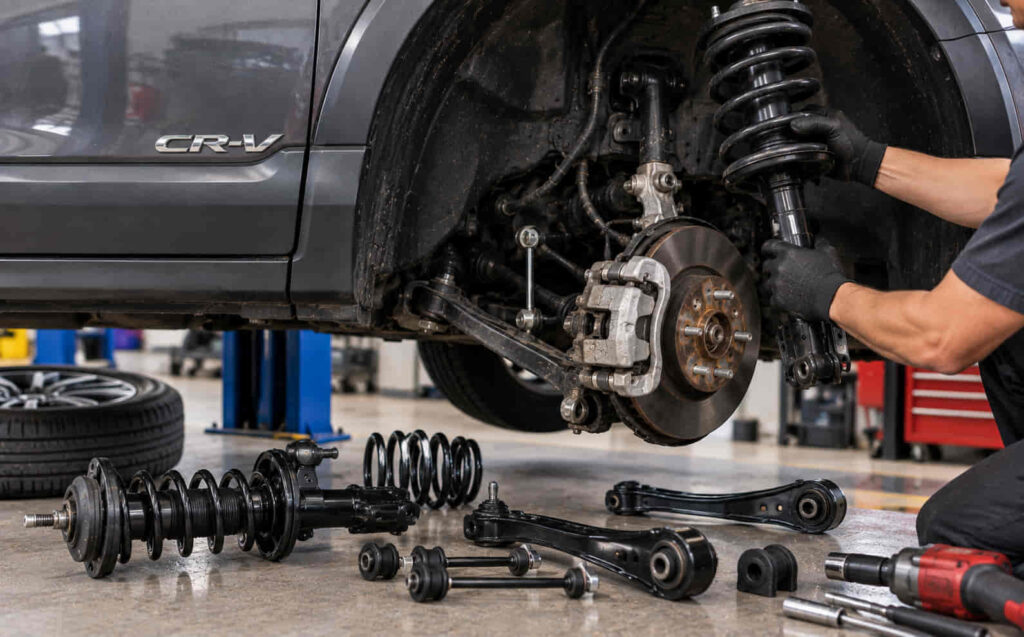
Honda CR-V suspension replacement involves replacing worn or damaged suspension components rather than replacing the entire suspension system at once. Depending on the diagnosis, the repair may involve struts, shock absorbers, control arms, bushings, ball joints, sway bar links, coil springs, or mounting components. Identifying the failed part first is essential because each component affects ride quality, handling, tire contact, and vehicle stability differently.
Common signs that a Honda CR-V needs a suspension inspection include clunking or knocking noises, excessive bouncing, uneven tire wear, poor handling, vehicle pulling, abnormal ride height, and visible fluid leakage from a strut or shock absorber. These symptoms do not always identify a single failed component, so the suspension should be inspected before replacement parts are selected.
Honda CR-V suspension replacement cost depends on the component being replaced, model year, front or rear suspension location, number of parts required, labor time, and whether OEM or aftermarket parts are used. Some repairs may also require a wheel alignment after the new components are installed. Understanding these factors helps determine what needs replacement, how the repair is performed, and what contributes to the final suspension repair cost.
What Does Honda CR-V Suspension Replacement Include?
Honda CR-V suspension replacement includes removing and replacing the worn or damaged components that prevent the suspension system from controlling wheel movement, absorbing road impacts, and maintaining vehicle stability. It does not automatically mean replacing every suspension component. The required repair depends on which parts have excessive wear, physical damage, leakage, looseness, or reduced ability to control suspension movement.
The main replaceable suspension components on a Honda CR-V include struts, shock absorbers, coil springs, control arms, bushings, ball joints, sway bar links, and strut mounts. These parts perform different functions within the suspension system. Struts and shock absorbers control excessive suspension movement, while coil springs support vehicle weight and allow the wheels to move vertically over road irregularities. Control arms and ball joints help maintain controlled wheel movement relative to the vehicle body, while bushings isolate vibration and permit movement between connected suspension components. Sway bar links connect the anti-roll system to the suspension and contribute to controlling body movement when the vehicle turns.
A suspension inspection determines which Honda CR-V parts require replacement. For example, fluid around a damaged strut can indicate loss of damping performance, while excessive movement in a worn ball joint or bushing can affect wheel control and suspension geometry. A clunking noise may originate from a sway bar link, mount, bushing, or another connection point, which means replacing a strut solely because the vehicle makes noise may not correct the actual problem. Diagnosis should therefore identify the failed component before parts are removed.
Replacing the entire Honda CR-V suspension system is generally unnecessary when the problem is isolated to one component or one group of related components. However, the condition of corresponding parts on the same axle also matters. Struts and shock absorbers influence damping from side to side, so differences in their condition can affect ride and handling characteristics. Other suspension parts can be assessed individually according to wear, damage, and manufacturer service requirements rather than being replaced automatically as a complete set.
The scope of Honda CR-V suspension replacement can therefore range from replacing a single worn component to servicing several connected parts during the same repair. A damaged control arm, for example, may involve a bushing or ball joint depending on the component design and replacement assembly used. Removing certain suspension components can also disturb wheel alignment settings, making an alignment inspection or adjustment part of the post-repair process. The correct replacement scope is determined by the failed component, the condition of related parts, and how the repair affects suspension geometry.
Read more: Honda CRV Tail Light Assembly
What Are the Signs That a Honda CR-V Suspension Needs Replacement?
The main signs that a Honda CR-V suspension may need replacement are clunking or knocking noises, excessive bouncing, uneven tire wear, reduced handling stability, vehicle pulling, nose-diving during braking, abnormal ride height, and visible leakage from a strut or shock absorber. These symptoms indicate that one or more suspension components may no longer control wheel movement or maintain the intended relationship between the wheels and vehicle body. A suspension inspection is necessary because the same symptom can originate from different components.
Clunking or knocking noises commonly indicate excessive movement at a suspension connection point. Worn sway bar links, control arm bushings, ball joints, or strut mounts can develop clearance that allows connected components to move or contact each other when the Honda CR-V travels over bumps, enters a driveway, or changes direction. The location and conditions under which the noise occurs help narrow the diagnosis, but noise alone does not identify the failed component. The suspension should be physically inspected for looseness, damaged rubber components, worn joints, and insecure mounting points before replacement.
Excessive bouncing indicates that the suspension is not controlling spring movement effectively. The coil springs compress and extend as the wheels encounter changes in the road surface, while the struts or shock absorbers damp that movement. When damping performance deteriorates, the body can continue moving after the initial road impact instead of returning to a controlled position. A Honda CR-V with this condition may feel unusually floaty over uneven pavement and less settled after crossing bumps.
Poor handling and excessive body movement can also indicate suspension deterioration. Worn components can reduce the suspension system’s ability to keep each tire consistently positioned against the road surface as the vehicle accelerates, brakes, or changes direction. The driver may notice reduced stability, additional body movement through corners, or steering behavior that feels less controlled than normal. Because tires, steering components, wheel alignment, and suspension components interact, these symptoms require diagnosis rather than automatic replacement of a specific part.
Uneven tire wear can develop when suspension wear affects wheel position or tire contact with the road. A damaged or excessively worn component may allow wheel geometry to move outside its intended range, causing sections of the tire tread to carry different loads. Alignment problems can produce similar wear patterns, and an alignment adjustment cannot correct excessive mechanical movement caused by a worn suspension joint or bushing. The mechanical problem must be repaired before the wheel alignment can be accurately evaluated and corrected.
Nose-diving during braking can indicate reduced control of front suspension movement, particularly when it becomes excessive compared with the vehicle’s normal behavior. Weight naturally transfers toward the front of a Honda CR-V during braking, but the suspension must control the resulting body movement. Deteriorated damping components can allow greater movement and make the vehicle feel less settled during deceleration. Brake condition must still be evaluated separately because braking behavior cannot be attributed to the suspension without inspection.
Visible fluid leakage provides a more direct indication of a possible strut or shock absorber problem. These components use internal fluid as part of the damping process, and significant leakage can accompany deterioration of the unit. However, visible moisture and substantial leakage are not necessarily equivalent conditions. Inspection should establish whether the component is actively leaking and whether its damping performance has deteriorated before determining that replacement is required.
Abnormal ride height can point to a spring or related structural suspension problem. A Honda CR-V that sits noticeably lower at one corner or displays an unexplained side-to-side height difference should be inspected for a damaged spring and associated suspension components. Ride height should be evaluated on a suitable level surface because tire pressure, vehicle load, and ground conditions can otherwise create a misleading visual difference.
These warning signs determine when a Honda CR-V suspension inspection is justified, but they do not establish that the entire suspension needs replacement. The important diagnostic relationship is symptom → affected area → component inspection → confirmed fault → replacement decision. Following this sequence prevents a general symptom such as clunking, pulling, or uneven tire wear from being incorrectly treated as proof that a particular suspension part has failed.
How Much Does Honda CR-V Suspension Replacement Cost?
Honda CR-V suspension replacement cost depends primarily on the component being replaced, the number of affected parts, labor time, model year, parts selection, and whether wheel alignment or additional repairs are required. There is no single accurate price for replacing a Honda CR-V suspension because “suspension replacement” can describe anything from replacing one sway bar link or bushing to replacing struts, control arms, and related components across an axle. The failed component must therefore be identified before the total repair cost can be estimated accurately.
Parts and labor form the two main components of a suspension replacement bill. Parts cost changes according to the type of component and whether the replacement uses Honda OEM, OEM-equivalent, or aftermarket parts. Labor cost is determined by the time required to access, remove, replace, and correctly reinstall the affected component. A relatively accessible suspension part can require less labor than a component whose removal involves several connected assemblies. Corroded or seized fasteners can further increase labor time because the technician must remove them without damaging surrounding components.
Strut replacement can represent a larger suspension repair because the strut assembly performs a major damping and structural function within the suspension design. Depending on the specific Honda CR-V configuration and parts selected, the repair may involve the strut itself or additional components associated with the assembly, such as the mount and related hardware. The condition of the corresponding strut should also be evaluated because a substantial difference in damping performance between the two sides of an axle can affect ride behavior.
Shock absorber replacement follows the same principle: the final price depends on the vehicle configuration, parts used, and labor required rather than on a universal Honda CR-V suspension price. A shock absorber that can be removed without disturbing as many surrounding components may have a different labor requirement from a strut assembly. This distinction is important when comparing suspension repair estimates because “shock replacement” and “strut replacement” do not describe identical procedures.
Control arms, bushings, ball joints, sway bar links, and mounts create additional cost variations. Some replacement components are supplied as complete assemblies, while other designs allow individual parts to be serviced. For example, replacing a complete control arm can involve a different combination of parts and labor from replacing an individual bushing. The correct comparison is therefore based on the exact component included in the estimate rather than the general description “Honda CR-V suspension repair.”
Model year and generation also influence suspension replacement cost because Honda CR-V suspension designs, component specifications, parts availability, and service procedures are not identical across every model year. An estimate for one CR-V generation should not automatically be applied to another. Front and rear suspension repairs can also have different parts and labor requirements because the components and suspension layouts perform different functions at each end of the vehicle.
OEM and aftermarket parts create another price difference. Genuine Honda components are designed around the vehicle manufacturer’s specifications, while aftermarket suspension parts are available across different price points and product specifications. A lower initial parts price does not by itself establish the total value of a repair. Fitment, component design, warranty coverage, intended vehicle use, and expected service life should be considered alongside purchase price when comparing replacement options.
Wheel alignment can add to the final Honda CR-V suspension replacement cost when the repair affects suspension geometry or wheel position. Replacing certain control arms, struts, joints, or related components can alter or require verification of alignment settings. Performing an alignment check after applicable suspension work helps establish whether the wheels are positioned within the required specifications. Alignment should therefore be treated as a related post-repair requirement when the replacement procedure affects wheel geometry, rather than being automatically included with every minor suspension repair.
Additional worn components discovered during inspection can also change the original estimate. Suspension parts operate as a connected system, so deterioration in one area may coexist with wear elsewhere. A technician may identify a damaged bushing, loose joint, deteriorated mount, or abnormal tire condition while diagnosing the initial complaint. These findings should be documented separately so the final repair scope distinguishes the confirmed problem from additional recommended work.
For this reason, an accurate Honda CR-V suspension replacement estimate should identify the specific failed component, replacement part, labor requirement, applicable alignment service, and any related repairs. Comparing estimates based only on the final price can be misleading when one estimate covers a single component and another includes paired components, additional hardware, or alignment. The repair scope provides the context needed to understand the actual suspension replacement cost.
How Is a Honda CR-V Suspension Replacement Performed?
Honda CR-V suspension replacement is performed by diagnosing the failed component, removing the affected suspension part, installing the correct replacement, checking connected components, verifying fastener installation, and testing the suspension after the repair. The exact procedure changes according to whether the vehicle needs a strut, shock absorber, control arm, ball joint, bushing, sway bar link, spring, or mount replaced. Diagnosis comes before disassembly because replacing a component based only on a noise or handling symptom can leave the actual suspension problem unresolved.
The process begins with a suspension inspection that connects the driver’s symptoms to a specific mechanical condition. A technician can examine the Honda CR-V for damaged or deteriorated bushings, excessive joint movement, leaking damping components, damaged springs, loose mounting points, and abnormal tire wear. The inspection can also include checking how the suspension responds to movement and evaluating the vehicle during a road test when appropriate. For example, a clunk heard over bumps can justify inspecting sway bar links, bushings, mounts, control arms, and other connection points rather than assuming that the struts need replacement.
Once the failed component has been identified, the vehicle is supported so the relevant suspension area can be accessed safely and the necessary parts can be removed. The disassembly sequence depends on the component and the Honda CR-V model year. Replacing a sway bar link involves a different scope of work from removing a strut assembly or control arm because each component has different mounting points and relationships with surrounding suspension parts. Connected brake, steering, wheel, and suspension components must remain correctly positioned and protected throughout the repair.
The removed component also provides additional diagnostic information. Physical deterioration such as torn rubber, excessive joint movement, structural damage, fluid leakage, or abnormal wear can help confirm the original diagnosis. At this stage, connected suspension parts should be checked because installing a new component beside another severely worn part can leave noise, movement, or handling problems unresolved. This inspection does not mean that every adjacent component should automatically be replaced; each additional replacement should have a documented mechanical reason.
The replacement component is then installed in the correct position and the suspension is reassembled. Correct fitment is important because suspension components control the position and movement of the wheels relative to the vehicle body. Fasteners and mounting points must be installed according to the applicable service requirements for the specific Honda CR-V configuration. Parts should not be treated as universally interchangeable across CR-V generations simply because they perform the same suspension function.
Wheel alignment is evaluated after suspension replacement when the work can affect wheel geometry. Components such as struts and control arms have a direct relationship with wheel position, while other minor repairs may not alter alignment in the same way. Alignment requirements therefore depend on the component replaced and the repair procedure. Checking alignment after applicable repairs helps identify incorrect toe, camber, or other adjustable geometry that could contribute to handling problems or abnormal tire wear.
The final stage is a post-repair inspection and functional check. The repaired area should be examined for correct installation, and the original symptom should be reassessed. A road test can confirm whether the previous clunking, excessive movement, instability, or other suspension behavior has been corrected. If the original symptom remains, further diagnosis is required rather than assuming that additional suspension parts should be replaced.
The complete Honda CR-V suspension replacement process therefore follows a clear sequence: diagnosis establishes the failed component, replacement corrects the mechanical fault, and post-repair verification confirms the result. Following this sequence limits unnecessary parts replacement and keeps the repair focused on the suspension components responsible for the vehicle’s symptoms.
How Long Does Honda CR-V Suspension Replacement Take?
Honda CR-V suspension replacement time depends on the component being replaced, the number of affected parts, the vehicle’s condition, and whether wheel alignment or additional suspension repairs are required. Replacing one accessible component requires a different amount of labor from replacing a pair of struts, control arms, or several interconnected suspension components. For this reason, repair time should be estimated from the confirmed scope of work rather than from the general term “suspension replacement.”
A single-component repair is generally less complex because the technician can focus on one diagnosed failure. A worn sway bar link, for example, has a different removal and installation process from a strut assembly because fewer suspension relationships may need to be disturbed. A larger repair can require removal of the wheel and multiple connected components before the failed part becomes accessible. Labor time increases further when both sides of an axle are being serviced during the same repair.
Strut replacement can require additional steps because a strut forms part of a larger suspension assembly. Depending on the Honda CR-V model year and replacement method, the technician may need to work with the spring, strut mount, and other connected components before the new unit can be installed. Control arm replacement has a different procedure but can also require additional labor because the arm connects the wheel assembly to the vehicle structure through mounting points, bushings, and related joints. The specific suspension design therefore determines the actual service time.
The physical condition of the Honda CR-V can extend the replacement process even when the required repair has already been identified. Corrosion, seized fasteners, damaged hardware, or previous repairs can make disassembly more difficult. For example, a fastener that cannot be removed normally may require additional work before the suspension component can be separated without damaging surrounding parts. These conditions cannot always be identified accurately until the vehicle has been inspected.
Additional suspension problems discovered during disassembly can also change the completion time. A technician replacing one diagnosed component may find excessive wear in a connected bushing, mount, joint, or other part once the suspension is accessible. The additional component should be evaluated independently before the repair scope is expanded. This distinction is important because extra service time should correspond to a confirmed condition rather than an assumption that all nearby suspension parts require replacement.
Wheel alignment adds another stage when the replacement affects suspension geometry. After applicable components have been installed, alignment measurements can determine whether wheel angles remain within the required specifications. Adjustment requires additional service time but serves a different purpose from the mechanical replacement itself: suspension replacement corrects the failed component, while alignment establishes the required wheel geometry after the repair.
An accurate Honda CR-V suspension replacement time estimate should therefore be based on the specific component, repair procedure, vehicle condition, additional diagnosed work, and post-repair requirements. A workshop can provide a more meaningful completion estimate after identifying these variables during inspection. Quoting one universal replacement time for every Honda CR-V suspension repair would ignore the substantial difference between a minor component replacement and a multi-component suspension service.
How Often Does Honda CR-V Suspension Need to Be Replaced?
Honda CR-V suspension components should be replaced according to their actual condition rather than by applying one replacement interval to the entire suspension system. Struts, shocks, bushings, ball joints, control arms, springs, mounts, and sway bar links experience different loads and forms of wear. As a result, one component can require replacement while the remaining suspension parts continue to function correctly.
Suspension wear develops through repeated movement and loading. Every time a Honda CR-V travels over a bump, pothole, uneven surface, or change in road elevation, suspension components absorb or control forces between the wheels and vehicle body. Over time, rubber bushings can deteriorate, joints can develop excessive movement, and damping components can lose performance. A severe road impact can accelerate this process by damaging a component before normal wear would otherwise require replacement.
Driving conditions influence how quickly suspension components deteriorate. Repeated travel on rough roads and frequent pothole impacts place different loads on the suspension from driving predominantly on smooth pavement. Vehicle loading also changes the forces handled by springs, dampers, bushings, and other components. These factors explain why two Honda CR-Vs of a similar age and mileage do not necessarily require the same suspension repairs at the same time.
Environmental exposure can contribute to suspension deterioration as well. Suspension components operate beneath the vehicle where they are exposed to water, road debris, dirt, and corrosive conditions. Corrosion can affect metal components and fasteners, while aging can reduce the flexibility and integrity of rubber bushings and mounts. The resulting condition depends on both the operating environment and the component involved.
Mileage alone therefore does not confirm that a Honda CR-V suspension needs replacement. A vehicle with higher mileage can still have individual suspension components that remain serviceable, while another vehicle can develop damage earlier because of road impacts, environmental exposure, or component-specific failure. Replacement should follow inspection findings such as excessive movement, physical damage, significant leakage, deterioration, or loss of the component’s intended function.
The practical replacement interval is therefore condition-based rather than system-wide. Suspension inspection becomes particularly relevant when the Honda CR-V develops abnormal noise, changes in ride behavior, handling problems, unusual tire wear, visible component damage, or other symptoms associated with suspension deterioration. This approach connects replacement timing to a measurable mechanical condition instead of replacing functional parts solely because the vehicle has reached a particular age or mileage.
Can You Drive a Honda CR-V With Bad Suspension?
A Honda CR-V can sometimes remain drivable with minor suspension wear, but driving with a confirmed damaged suspension component can affect handling, wheel control, tire wear, and vehicle stability. Whether the vehicle should continue to be driven depends on which component is affected and how severely it has deteriorated. A minor bushing deterioration does not create the same mechanical condition as a broken spring, severely loose ball joint, damaged control arm, or suspension component that can no longer control wheel movement.
The suspension keeps the tires positioned against the road while controlling movement between the wheels and vehicle body. When a component develops excessive play or loses its intended function, wheel movement can become less controlled. The driver may experience increased body movement, instability over uneven surfaces, changes in steering response, or unusual behavior during braking and cornering. These effects become more significant as component deterioration increases because the suspension has less ability to maintain predictable wheel and body movement.
Driving with worn struts or shock absorbers can produce a different set of effects from driving with a loose suspension joint. Struts and shocks control spring movement, so reduced damping can allow the Honda CR-V to bounce or continue moving after a road disturbance. A severely worn joint or damaged control arm can instead affect how a wheel is located relative to the vehicle. These conditions should not be treated as equivalent simply because both are classified as suspension problems.
Tire condition can also deteriorate when a suspension problem changes wheel control or geometry. Continued driving under these conditions can create uneven tread wear, meaning replacing the suspension component may not reverse damage that has already occurred to the tire. This relationship is one reason suspension diagnosis should include tire inspection and, where relevant, an evaluation of wheel alignment rather than treating each system as an unrelated problem.
A Honda CR-V should receive prompt inspection when suspension symptoms become severe or noticeably affect vehicle control. Significant instability, pronounced changes in steering behavior, an abnormal wheel position, a broken or displaced suspension component, substantial ride-height changes, or severe mechanical noises require greater attention than a minor noise with no detectable change in handling. The appropriate decision depends on inspection of the affected component rather than the presence of a generic “bad suspension” symptom.
Continuing to drive should not be used as a test to determine whether a suspected suspension problem will become worse. Mechanical wear does not provide a reliable self-diagnostic threshold, and increasing noise is not the only indication of deterioration. Inspection identifies whether the component remains mechanically secure and whether replacement is necessary before additional wear affects connected suspension parts, tires, or vehicle behavior.
Should You Replace Honda CR-V Suspension Parts in Pairs?
Honda CR-V suspension parts should be replaced in pairs when maintaining comparable performance across the same axle is important for the component being serviced, but paired replacement is not a universal requirement for every suspension part. The decision depends on the function of the component, the condition of its corresponding part on the opposite side, and the applicable repair procedure.
Struts and shock absorbers are the clearest examples because they control suspension damping. If one side has substantially different damping characteristics from the other, the suspension can respond differently to road inputs on each side of the vehicle. Evaluating both units on the same axle therefore provides useful context when one strut or shock absorber has deteriorated. The replacement decision should account for the condition of both components rather than assuming that every suspension part automatically needs replacement because its counterpart has failed.
Other components require a condition-based assessment. A damaged sway bar link, bushing, control arm, ball joint, or mount on one side does not by itself prove that the equivalent component on the opposite side has failed. The corresponding part should be inspected for excessive movement, deterioration, physical damage, or another measurable fault. A serviceable component does not become defective solely because a similar part on the other side requires replacement.
Age and operating history can still make inspection of paired components valuable. Components installed at the same time and exposed to similar mileage, road conditions, and environmental factors can develop related patterns of wear even when only one side initially produces symptoms. Inspection establishes whether this shared operating history has resulted in actual deterioration rather than using age alone as the reason for replacement.
The correct approach is therefore to distinguish paired performance considerations from automatic paired replacement. Struts and shocks warrant particular attention to side-to-side damping characteristics, while other Honda CR-V suspension components should be replaced according to confirmed condition and applicable service requirements. This keeps the repair scope connected to mechanical evidence instead of increasing the number of replacement parts without a diagnostic basis.
Should You Use OEM or Aftermarket Suspension Parts for a Honda CR-V?
OEM and aftermarket suspension parts can both be used for a Honda CR-V, but the correct choice depends on fitment, component specifications, ride characteristics, warranty, intended vehicle use, and total replacement cost. OEM parts prioritize compatibility with the original vehicle configuration, while aftermarket parts provide a wider range of manufacturers, specifications, and price points. The decision should therefore be based on the specific suspension component and replacement objective rather than assuming that one category is always superior.
OEM Honda suspension parts are designed for the corresponding vehicle application and provide a reference point for original fitment and suspension behavior. This can simplify component selection when the objective is to restore the Honda CR-V as closely as practical to its original configuration. Correct identification still matters because CR-V suspension components can differ by model year, generation, drivetrain configuration, trim, or other vehicle specifications. An OEM label does not eliminate the need to confirm that the part number matches the vehicle being repaired.
Aftermarket suspension parts expand the available choices beyond the original equipment supply channel. Replacement struts, shocks, control arms, bushings, sway bar links, and related components can be offered by multiple manufacturers at different price and specification levels. This variation means “aftermarket” describes a market category rather than one standard of construction or performance. Two aftermarket components designed for the same Honda CR-V application can differ in materials, damping characteristics, included hardware, warranty terms, and intended use.
Price is one reason Honda CR-V owners compare OEM and aftermarket parts, but purchase price should not be evaluated separately from the complete repair. A less expensive component that requires different accompanying hardware, has unsuitable fitment, or does not meet the intended repair objective can change the value of the replacement. Labor is also part of the total cost, so component selection should consider the complete parts-and-service requirement rather than comparing parts prices alone.
Ride characteristics are particularly relevant when selecting struts and shock absorbers because these components directly control suspension movement. A replacement designed to reproduce original damping behavior serves a different objective from a component designed around altered handling or another specialized application. Mixing components with substantially different characteristics on the same axle can also create inconsistent suspension behavior. Matching the replacement specification to the intended vehicle use is therefore more meaningful than choosing solely by brand category.
Warranty coverage and parts availability provide two additional comparison points. Warranty terms can differ between manufacturers and suppliers, while future availability can matter when corresponding components need service later. The exact coverage should be checked for the specific product because an OEM or aftermarket classification alone does not establish warranty duration or conditions.
The appropriate choice for a Honda CR-V suspension replacement is therefore the part that matches the vehicle application, provides the required suspension characteristics, meets the repair objective, and offers acceptable cost and warranty terms. OEM components provide an original-equipment-oriented option, while aftermarket components broaden the available choices. Accurate fitment and component specification remain necessary in either case.
How Can You Extend the Life of a Honda CR-V Suspension?
Honda CR-V suspension life can be extended by reducing unnecessary impact loads, maintaining the tires and wheel alignment, correcting suspension problems before they affect connected components, and inspecting the system when abnormal symptoms develop. Suspension wear cannot be eliminated because struts, shocks, bushings, joints, springs, and mounts continuously respond to road forces, but operating and maintenance conditions influence how those forces affect the system over time.
Road impacts place direct mechanical loads on suspension components. Repeatedly striking deep potholes or severe road irregularities forces the wheel to move rapidly through its suspension travel and transfers energy through the tire, wheel, joints, bushings, springs, and damping components. Avoiding severe impacts when road and traffic conditions allow reduces unnecessary loading. Inspection is appropriate after a substantial impact if the Honda CR-V develops new noise, pulling, vibration, abnormal steering behavior, or a visible change in wheel position.
Correct tire pressure also supports normal suspension operation because the tire is the first component to interact with the road surface. An incorrectly inflated tire changes how the tire deforms and responds to road inputs and can also produce abnormal tire wear that complicates suspension diagnosis. Tire pressure should therefore be maintained according to the specification applicable to the vehicle rather than adjusted as a substitute for correcting a suspension problem.
Wheel alignment should be addressed when measurements are outside the required specifications or after suspension work that affects wheel geometry. Incorrect alignment can accelerate tire wear and alter vehicle behavior, while a mechanically worn suspension component can prevent alignment from remaining within specification. The correct sequence is to repair excessive mechanical movement first and then perform the required alignment procedure. Repeatedly aligning a vehicle without correcting a worn joint, bushing, or related component does not resolve the underlying mechanical fault.
Early diagnosis can also prevent one suspension problem from creating additional consequences. A deteriorated component can change movement or loading within connected parts, while continued abnormal wheel geometry can damage tires. Addressing clunking, excessive bouncing, unusual tire wear, instability, or visible component damage when these symptoms appear allows the affected area to be inspected before the condition progresses further.
Vehicle loading should remain within the specifications applicable to the Honda CR-V because additional weight increases the forces supported and controlled by the suspension. Springs carry the vehicle load while dampers and connected suspension components control the resulting movement. Consistently subjecting the vehicle to loads beyond its intended operating limits increases mechanical stress and can affect suspension behavior as well as other vehicle systems.
Extending Honda CR-V suspension life therefore depends on controlling avoidable mechanical stress and responding to measurable signs of deterioration rather than replacing parts according to a preventive schedule without evidence of wear. Appropriate tire maintenance, alignment correction, impact avoidance, load management, and condition-based inspection support the suspension while preserving the same principle used throughout replacement: identify the mechanical condition first, then perform the service that condition requires.