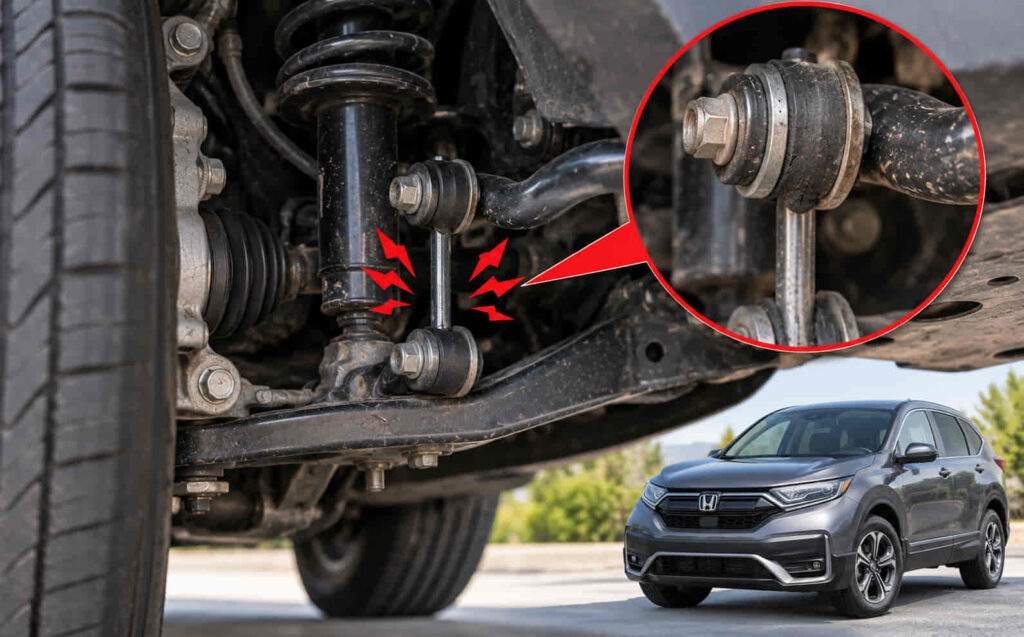
A bad Honda CR-V sway bar link commonly causes a clunking, knocking, or rattling noise from the front or rear suspension, especially when driving over bumps, potholes, uneven pavement, or driveway entrances. The noise develops when wear or looseness allows unwanted movement within the sway bar link joint or at its mounting points. As the suspension moves up and down, this clearance can cause the link and connected components to shift abruptly, producing a noticeable knock or clunk.
Sway bar link noise is not enough by itself to confirm a failed link. Sway bar bushings, ball joints, control arm bushings, struts, and strut mounts can produce similar suspension noises on a Honda CR-V. The location of the sound, the road conditions that trigger it, visible component damage, and mechanical play therefore need to be considered together before replacing a part.
This guide explains what a bad Honda CR-V sway bar link sounds like, when the noise is most noticeable, which symptoms accompany link wear, why the problem develops, and how to distinguish it from other suspension noises. It also explains when a worn link should be replaced and what the repair involves.
What Does a Bad Sway Bar Link Sound Like on a Honda CR-V?
A bad Honda CR-V sway bar link typically produces a clunking, knocking, or rattling sound as the suspension moves over uneven surfaces. The sound is usually short and repetitive rather than a continuous hum because it is generated by unwanted movement within the link joint or mounting connection. When clearance develops in these areas, suspension movement can shift the worn or loose components against each other and create an audible impact.
The noise is often easiest to notice when a Honda CR-V travels at low speed over small bumps, potholes, broken pavement, speed bumps, or driveway entrances. These surfaces make the left and right sides of the suspension move through different ranges, loading and unloading the sway bar and its end links. A worn joint can move through its excess clearance each time the suspension changes direction, which explains why several closely spaced bumps may produce repeated clunks or knocks.
Sway bar link noise can also become noticeable while turning because the stabilizer bar helps control body roll when weight transfers from one side of the vehicle to the other. The load placed on the link changes as the CR-V enters or exits a corner. If the link has excessive play, this change in load can expose the looseness and produce a knock. However, a noise that occurs while turning does not by itself identify the sway bar link as the failed component because ball joints, strut mounts, control arm bushings, and other suspension or steering components can produce noises under similar conditions.
The location and timing of the sound provide more diagnostic value when considered together. A clunk that repeatedly appears as one wheel passes over a bump is more consistent with suspension movement than a constant noise that rises with vehicle speed. The sound still needs to be matched with physical evidence, such as excessive joint play, loose mounting hardware, or visible sway bar link damage, before the link is identified as the source.
What Are the Symptoms of a Bad Honda CR-V Sway Bar Link?
The primary symptoms of a bad Honda CR-V sway bar link are suspension clunking or knocking, excessive play in the link joint, loose mounting points, and visible deterioration around the link or its protective boot. Noise is usually the symptom that prompts an inspection, while mechanical looseness or component damage provides stronger evidence that the sway bar link itself is worn.
Excessive play develops when a link joint can move beyond its intended range because its internal surfaces have worn. This movement matters because the sway bar link is designed to transfer force between the suspension and stabilizer bar without uncontrolled clearance at its connections. Once clearance increases, changes in suspension load can move the joint abruptly from one position to another. The resulting impact can create the characteristic clunking or knocking heard over uneven roads.
A damaged protective boot can provide another visible indication of deterioration. The boot protects the joint from water, road debris, and other contamination while helping retain lubrication around the moving surfaces. A torn or deteriorated boot does not prove that the joint has already failed, but it removes part of that protection and can accelerate wear. For this reason, boot condition should be evaluated together with joint movement and noise rather than treated as an independent diagnosis.
Loose or damaged mounting hardware can create symptoms similar to an internally worn link. Movement at a mounting point allows the connection to shift as suspension loads change, potentially producing a knock or rattle even when the joint itself is not the only problem. Inspection therefore needs to distinguish between internal joint play, mounting-point movement, and damage to surrounding suspension components.
Changes in vehicle handling require broader inspection rather than an automatic sway bar link diagnosis. The sway bar system contributes to controlling body movement during cornering, but noticeable instability or abnormal body motion can have several suspension causes. A Honda CR-V that combines suspension noise with a clear change in handling should therefore be inspected as a suspension system, with the sway bar link evaluated as one possible source rather than replacing it based on noise alone.
Read more: Honda CRV Trailing Arm Replacement
Why Does a Honda CR-V Sway Bar Link Make Noise?
A Honda CR-V sway bar link makes noise when wear, looseness, or physical deterioration creates unwanted movement at the link joint or mounting points. The sway bar link connects the suspension to the stabilizer bar, so its joints repeatedly change load as the wheels move and the vehicle corners. A healthy connection allows this movement without excessive clearance. Once clearance develops, the link can shift abruptly as suspension forces change, producing the clunking, knocking, or rattling sound associated with a worn sway bar link.
Joint wear is a primary mechanical cause of sway bar link noise. Repeated suspension movement places alternating loads on the link joints as the CR-V travels over bumps and uneven pavement. Wear inside a joint gradually increases the clearance between its moving surfaces. When the suspension compresses and rebounds, the worn joint moves through this clearance before transferring force to the stabilizer bar. That sudden movement creates an impact that can be heard as a clunk or knock.
A loose mounting connection can produce similar noise without exactly the same internal wear mechanism. The sway bar link must remain securely attached at its mounting points so suspension forces transfer through the connection rather than moving the hardware itself. If a mounting point becomes loose, the link can shift when the direction of the load changes. Repeated movement over small road irregularities can then produce a rattle or series of knocks.
Damage to a joint’s protective boot can accelerate the process that eventually creates noise. The boot helps protect the moving joint from water and road contamination while retaining lubrication around its working surfaces. When the boot tears or deteriorates, contamination can reach the joint and lubrication can be compromised. The resulting deterioration increases internal wear, which can eventually create enough clearance for the joint to produce noise. A damaged boot is therefore evidence of increased wear risk, but the boot alone does not prove that the sway bar link is already the source of a clunk.
Road conditions and component age can contribute to deterioration because sway bar links repeatedly absorb changes in suspension load. Potholes, rough pavement, and other sharp suspension movements increase the forces transmitted through the connection. Corrosion can also affect exposed hardware and mounting areas. These factors do not mean that every CR-V driven on rough roads will develop sway bar link noise, but they help explain why physical condition and joint play are more useful diagnostic evidence than vehicle age alone.
How Can You Check a Honda CR-V Sway Bar Link for Noise?
Check a Honda CR-V sway bar link by matching the driving conditions that produce the noise with a visual inspection and a physical check for abnormal movement or joint play. A clunk over bumps provides a reason to inspect the link, but confirmation requires evidence at the component itself because several suspension parts can create similar sounds.
Start by identifying when and where the noise occurs. A repeated clunk or knock associated with suspension movement over small bumps, potholes, uneven pavement, or driveway transitions supports inspection of the sway bar system. Determine whether the sound appears to come from the front or rear and whether one side is more noticeable. This narrows the inspection area without treating the sound itself as proof of a failed link.
A visual inspection can reveal deterioration that supports the diagnosis. Examine the sway bar link and its connections for a torn protective boot, physical damage, corrosion, displaced components, or mounting hardware that does not appear secure. The surrounding sway bar bushings and suspension components should also be inspected because damage near the link can create a similar noise or alter the forces acting on it. Visible deterioration becomes more diagnostically useful when it corresponds with the side and conditions under which the noise occurs.
Physical play provides stronger evidence of link wear. A sway bar link joint should not have uncontrolled looseness that allows it to knock between positions. Detectable abnormal movement at the joint or mounting connection can explain how suspension movement is producing the noise. The objective is not simply to determine whether the link moves, because suspension joints are designed to articulate, but to identify clearance or looseness that should not be present.
The diagnosis becomes stronger when several observations point to the same component. For example, a clunk from one corner over small bumps, a deteriorated link joint on that side, and confirmed excessive play form a more coherent diagnosis than noise alone. Conversely, a link with no abnormal play or visible damage should not automatically be replaced simply because the vehicle makes a clunking sound.
Any inspection that requires lifting the Honda CR-V must be performed with appropriate vehicle support and safe lifting procedures. A hydraulic jack alone should not be relied upon to support a vehicle while a person works underneath it. If the source of the noise cannot be isolated safely, a suspension inspection by a qualified technician can distinguish sway bar link play from faults in nearby components.
How Is Honda CR-V Sway Bar Link Noise Different From Other Suspension Noises?
Honda CR-V sway bar link noise is most strongly associated with a clunking, knocking, or rattling sound during suspension movement, but the sound alone cannot distinguish a bad sway bar link from other suspension problems. Sway bar bushings, ball joints, struts, strut mounts, and control arm bushings can produce overlapping noises. The more reliable distinction comes from combining when the noise occurs, where it originates, how the affected component moves, and what physical defects are found during inspection.
Sway bar bushing noise can be particularly difficult to separate from sway bar link noise because both components belong to the same stabilizer bar system and respond to many of the same suspension movements. A worn link creates unwanted movement at its joint or mounting connection, while a worn sway bar bushing allows abnormal movement where the stabilizer bar is supported by the vehicle. If the link has measurable joint play that corresponds with the location of the noise, the link becomes a stronger suspect. If the links remain tight but the stabilizer bar moves excessively within deteriorated bushings, the bushings require closer inspection instead.
Ball joint problems can also produce knocking or clunking, but the ball joint performs a different suspension function from the sway bar link. A sway bar link transfers forces between the suspension and stabilizer bar, whereas a suspension ball joint forms a load-bearing or locating connection that permits controlled steering and suspension movement, depending on the CR-V suspension design being inspected. Because both components contain articulating joints, wear can create unwanted clearance in either location. Identifying exactly where the play occurs is therefore more useful than trying to diagnose the vehicle from the character of the clunk alone.
Struts and strut mounts provide another possible source of noise over bumps. The strut controls suspension movement, while its mounting components connect the assembly to the vehicle structure. Wear, looseness, or damage within these areas can produce noises during compression, rebound, or steering movement. A noise that seems to come from the upper suspension area or accompanies other abnormal strut behavior should not automatically be attributed to the sway bar link. Inspection must trace the movement and sound to the component where the abnormal clearance or damage actually exists.
Control arm bushings can create similar diagnostic confusion because they help locate the suspension while isolating movement between connected components. Deteriorated rubber, separation, or excessive movement can allow the control arm to shift more than intended when suspension loads change. That movement may create a knock during braking, acceleration, road impacts, or other load transitions. In contrast, sway bar link noise is more directly associated with movement and loading of the stabilizer bar system. The conditions that trigger the sound can therefore help narrow the inspection, but physical evidence is still required.
The strongest Honda CR-V sway bar link diagnosis combines multiple matching findings rather than relying on one symptom. A repetitive clunk over uneven pavement, noise localized near a sway bar link, visible deterioration, and confirmed abnormal play at the same connection create a consistent mechanical explanation for the sound. If those findings are absent, other suspension components should remain part of the diagnosis. Replacing a sway bar link solely because a CR-V clunks over bumps risks replacing a functional component while leaving the actual source of the noise unresolved.
Is It Safe to Drive a Honda CR-V With a Bad Sway Bar Link?
A Honda CR-V with a worn sway bar link may remain drivable, but a confirmed bad link should be inspected and repaired rather than ignored. The sway bar link connects suspension movement to the stabilizer bar, which helps limit excessive body roll as the vehicle corners. Wear or looseness at this connection can reduce how effectively forces are transferred through the stabilizer bar system, while continued movement can allow the damaged connection to deteriorate further.
The severity of the problem depends on the condition of the link rather than the volume of the noise alone. A link with minor joint play and a link with a severely loose, damaged, or disconnected mounting point do not represent the same mechanical condition. For this reason, a quiet clunk does not prove that the problem is minor, and a loud clunk does not establish the severity without inspection. Physical condition, joint play, mounting security, and changes in vehicle behavior provide more useful information.
A change in handling deserves particular attention. The stabilizer bar system contributes to controlling body movement during cornering, so abnormal body roll or a noticeable change in stability should not be treated simply as an annoying suspension noise. Driving conditions that require abrupt steering or significant weight transfer can place additional demands on the suspension. The vehicle should be inspected promptly when sway bar link noise appears together with a noticeable handling change.
An unidentified suspension clunk also creates a separate safety concern because the sway bar link may not be the actual source. Ball joints, control arm components, struts, mounts, and other suspension parts can produce overlapping symptoms, while the consequences of failure differ between components. Confirming the source of the noise is therefore more important than deciding whether a CR-V is safe to drive based only on the assumption that the sway bar link is bad.
When Should You Replace a Honda CR-V Sway Bar Link?
Replace a Honda CR-V sway bar link when inspection confirms excessive joint play, physical damage, an insecure connection that cannot be corrected appropriately, or wear that identifies the link as the source of the suspension noise. Replacement should follow diagnosis rather than being based solely on mileage or the presence of a generic clunk.
Excessive joint play is a strong replacement indicator because it demonstrates that the connection can no longer maintain its intended controlled movement. When the joint repeatedly moves through unwanted clearance as the suspension loads and unloads, the underlying wear will not be corrected by lubrication of unrelated components or by replacing another suspension part. A link with confirmed internal wear requires replacement to remove that mechanical clearance.
Physical deterioration can also justify replacement when it compromises the link or joint. A torn protective boot deserves inspection because contamination and loss of joint protection can accelerate wear, but boot damage alone should not automatically be treated as proof that every link has failed. The decision becomes stronger when boot deterioration appears together with corrosion, abnormal movement, joint looseness, or noise that can be traced to the same connection.
Replacing both sway bar links at the same time is not an absolute requirement in every case. The link on the opposite side should be inspected for joint play, boot deterioration, corrosion, and other signs of wear. Because links on the same axle operate under similar mileage and road exposure, the second link may have comparable deterioration, but its condition should determine whether replacement is necessary. Replacing parts in pairs should not substitute for inspecting both sides.
A successful repair should address the diagnosed source rather than simply make the symptom temporarily disappear. If the Honda CR-V continues to clunk after a worn sway bar link is replaced, the remaining stabilizer bar bushings and nearby suspension components require further diagnosis. This approach prevents the common diagnostic error of treating every suspension clunk as evidence that another sway bar link is defective.
How Is a Honda CR-V Sway Bar Link Replaced?
A Honda CR-V sway bar link is replaced by safely accessing the affected suspension, removing the worn link from the stabilizer bar and suspension connection, installing the correct replacement link, and tightening the mounting hardware to the specification for that vehicle. Replacement removes the mechanical play created by a worn joint or damaged connection, but it should be performed only after diagnosis has identified the sway bar link as the source of the problem.
The repair begins with confirming which link is defective and inspecting the surrounding stabilizer bar system. This matters because replacing a link will not correct a clunk caused by a worn sway bar bushing, ball joint, control arm bushing, strut, or strut mount. The opposite sway bar link should also be inspected at this stage so that existing wear on both sides is identified before parts are installed.
The vehicle must then be lifted and supported using appropriate procedures before the sway bar link is removed. The mounting hardware connects the link between the stabilizer bar and the corresponding suspension mounting point. Corrosion can make removal more difficult because sway bar links and their fasteners are exposed to water, dirt, road debris, and other environmental contaminants. The exact removal method can also differ with the link design and the Honda CR-V model year being serviced.
The replacement link must match the application and be installed in the correct position. Mounting hardware should be tightened according to the applicable Honda service information or the specifications supplied for the replacement component. A single torque value should not be applied to every Honda CR-V because suspension specifications and hardware can differ by model year, drivetrain configuration, axle, and replacement part design.
The repair should finish with an inspection of the installed connection followed by verification that the original symptom has been corrected. If the same clunking or knocking remains under the road conditions that previously triggered it, further suspension diagnosis is necessary. Persistent noise indicates that the sway bar link may not have been the only source or that another nearby component requires attention.
How Can You Prevent Honda CR-V Sway Bar Links From Wearing Out Early?
Honda CR-V sway bar link wear cannot be eliminated, but avoiding severe suspension impacts and identifying damaged joints, boots, or mounting connections early can reduce unnecessary deterioration. Sway bar links are moving suspension components that repeatedly transfer loads between the suspension and stabilizer bar, so gradual mechanical wear remains possible even when the vehicle is properly maintained.
Reducing hard impacts from potholes, broken pavement, curbs, and similar road hazards limits sudden loads through the suspension. A sway bar link still experiences normal loading during everyday driving, but a sharp wheel movement can produce substantially different forces from smooth suspension travel. Avoiding a road hazard when it can be done safely therefore reduces unnecessary impact not only on the link but also on related suspension components.
Periodic suspension inspection can identify deterioration before excessive joint play develops. A damaged protective boot, corrosion around the connection, loose hardware, or early abnormal movement provides a reason for closer examination. Detecting these conditions does not guarantee that the link must immediately be replaced, but it allows the condition of the joint to be evaluated before looseness becomes severe enough to produce persistent noise.
Installation quality also affects the repaired connection. The correct link must be used for the specific Honda CR-V application, and its mounting hardware must be installed according to the applicable procedure and torque specification. Incorrect parts, improperly secured hardware, or installation that does not follow the component requirements can introduce movement or place unintended loads on the connection.
Related suspension problems should also be addressed when they are discovered. The sway bar link operates as part of a system rather than as an isolated component, so diagnosing surrounding bushings, joints, struts, and mounting points helps prevent repeated parts replacement without correcting the underlying noise. The objective is not simply to install a new sway bar link but to restore a secure connection and confirm that the Honda CR-V suspension operates without the abnormal movement that caused the original clunking, knocking, or rattling sound.