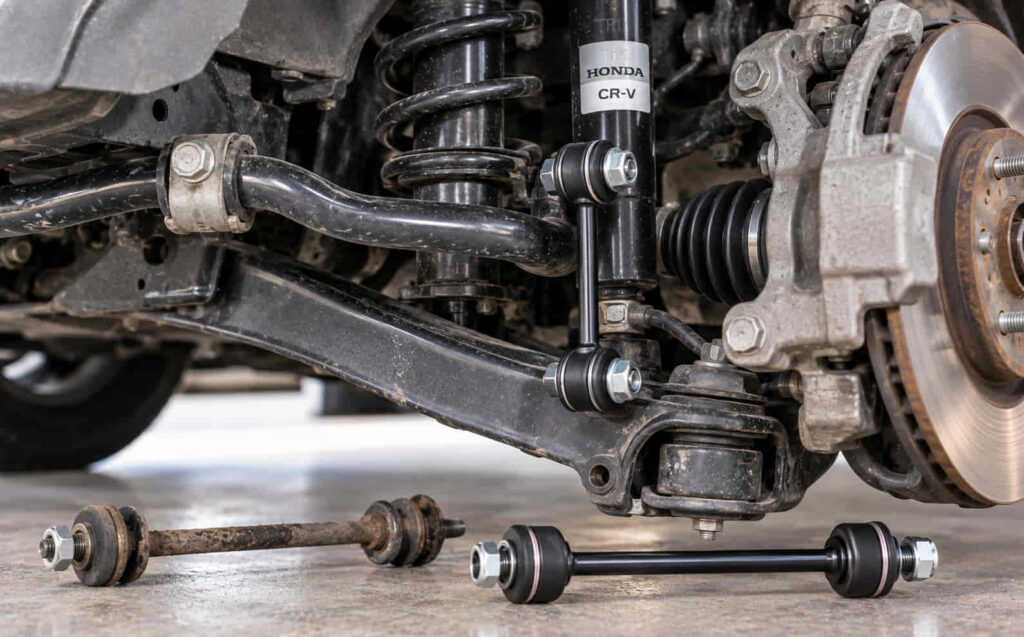
Honda CR-V sway bar links connect the stabilizer bar to the suspension and transfer force between these components as the wheels move. When a sway bar link develops excessive joint play or physical damage, one of the most noticeable symptoms is a clunking or rattling noise as the CR-V travels over bumps, uneven pavement, or other surfaces that make the suspension move. A worn link can also reduce how effectively the sway bar controls body roll because the connection is no longer operating as intended.
A clunking noise does not automatically mean a Honda CR-V has a bad sway bar link. Sway bar bushings, struts, control-arm components, and other suspension joints can produce similar noises, so the source should be confirmed through inspection before parts are replaced. Sway bar links also do not have one universal scheduled replacement mileage for every CR-V. Their replacement is primarily based on component condition rather than a fixed maintenance interval.
Correct diagnosis therefore requires identifying the symptoms, locating excessive movement or damage, and distinguishing a worn sway bar link from other suspension problems. This guide explains how Honda CR-V sway bar links work, the symptoms and mechanisms associated with link wear, how to diagnose a failed link, when replacement is appropriate, and what affects replacement cost and part selection.
What Do Sway Bar Links Do on a Honda CR-V?
Honda CR-V sway bar links connect the sway bar to the suspension so forces created by wheel movement can be transferred to the stabilizer bar. This connection allows the sway bar to resist differences in suspension movement between the left and right sides of the vehicle, which helps limit excessive body roll when the CR-V turns or experiences uneven suspension loading.
The sway bar, also called a stabilizer bar or anti-roll bar, works by twisting when the suspension on one side moves differently from the suspension on the opposite side. The sway bar link provides the mechanical connection required for this movement to reach the bar. When one wheel moves upward relative to the other, force passes through the suspension and link into the sway bar. The bar resists this difference in movement and transfers part of the load across the axle, reducing the amount the body leans relative to the suspension.
A sway bar link and a sway bar are therefore two different components. The sway bar is the larger torsion bar extending across the vehicle, while the links connect that bar to suspension components near the wheels. Depending on the Honda CR-V generation and suspension position, the exact mounting arrangement can differ, but the link’s fundamental role remains the same: it maintains a controlled mechanical connection between the stabilizer bar and suspension.
The joints at the ends of a sway bar link must move as the suspension changes position while remaining sufficiently tight to transfer force without excessive free play. Wear inside these joints changes that relationship. Instead of transmitting suspension movement immediately to the sway bar, a worn joint can move through its available clearance first. This mechanical play explains both the noise associated with failed links and the reduction in stabilizer-bar effectiveness that can occur as wear becomes more severe.
Sway bar links should also be distinguished from sway bar bushings. The links connect the sway bar to the moving suspension, whereas the bushings support and locate the sway bar where it mounts to the vehicle structure. Both components belong to the same stabilizer system, but failure of one does not establish failure of the other.
What Are the Symptoms of Bad Sway Bar Links on a Honda CR-V?
The main symptoms of bad Honda CR-V sway bar links are clunking or rattling over bumps, excessive movement at a link joint, visible joint or link damage, and changes in how effectively the stabilizer system controls body roll. Noise is often the symptom a driver notices first because joint wear creates clearance that allows parts of the link assembly to move when the suspension is loaded and unloaded.
Clunking commonly becomes noticeable when the CR-V travels over small bumps, broken pavement, driveway entrances, or other surfaces that cause one wheel to move differently from the other. These conditions repeatedly load and unload the stabilizer system. A worn sway bar link joint can move within its excessive clearance during each suspension movement, producing a knock or clunk as the direction of force changes. Repeated smaller movements can produce a rattling sound rather than one distinct impact.
Physical looseness provides stronger diagnostic evidence than noise alone. A worn link can develop measurable play at one or more joints, allowing movement that should not exist in a serviceable connection. Damage can also include deterioration around the joint, a compromised protective boot where one is used, corrosion, a bent link, or a connection that has become physically damaged. The significance of each condition depends on the link design and the extent of the damage, so visual evidence should be considered together with a mechanical inspection.
Handling changes can occur when link wear becomes sufficient to reduce the connection between the suspension and sway bar. Because the stabilizer bar relies on the link to transmit suspension forces, excessive play can delay or reduce that transfer. The CR-V can consequently have less effective body-roll control than it would with an intact stabilizer-bar connection. Noise may appear before a driver notices a major handling difference, so the absence of an obvious change in cornering behavior does not prove that a noisy link is in good condition.
A clunk or rattle is not sufficient by itself to diagnose a bad Honda CR-V sway bar link. Sway bar bushings, strut-related components, control-arm joints, and other suspension connections can generate noises under similar road conditions. The useful diagnostic relationship is therefore symptom plus confirmed component condition, not symptom alone. A clunk over bumps identifies the suspension as an area requiring inspection; excessive play or damage at the sway bar link provides the evidence needed to identify the link itself as the source.
For this reason, replacing sway bar links solely because a Honda CR-V develops a suspension noise can result in unnecessary parts replacement. The link should be inspected for play, damage, and abnormal movement before it is identified as the failed component. This distinction becomes particularly important when sway bar link and sway bar bushing problems produce similar noises from nearby areas of the suspension.
Read more: Honda CRV Transmission Fluid Interval.
Why Does a Bad Honda CR-V Sway Bar Link Make a Clunking Noise?
A bad Honda CR-V sway bar link makes a clunking noise when wear creates excessive clearance in the link joint, allowing components to move before the sway bar receives the suspension load. Each change in suspension direction can shift the worn joint through this clearance, creating an impact that the driver hears as a clunk, knock, or rattle.
A serviceable sway bar link needs enough articulation to follow suspension movement while keeping its joints tight. The suspension moves vertically as the wheel travels over changes in the road surface, and the link transfers part of that movement to the sway bar. Wear changes this mechanical relationship. Instead of transmitting force immediately, a loose joint can move through its free play before the load reaches the stabilizer bar. The resulting contact inside the worn connection creates noise.
Uneven surfaces make this symptom easier to detect because the stabilizer system becomes particularly active when the left and right wheels move by different amounts. Small potholes, rough pavement, driveway entrances, speed bumps, and uneven road edges can repeatedly load and unload the sway bar link. A worn joint can therefore produce several rapid knocks on a rough surface even when the same CR-V remains relatively quiet on a smooth, straight road.
The type of noise can also change with the amount of suspension movement. A larger change in wheel position can produce a more distinct clunk as the joint changes load direction, while a series of smaller road irregularities can create a lighter rattle. The sound itself does not establish how severely the link is worn because noise transmission through the suspension and vehicle body can make a small source sound more prominent inside the cabin.
Location also matters when interpreting the noise. A sound that appears to come from one front corner does not prove that the sway bar link at that corner has failed. Suspension components are mechanically connected, and vibration can travel through the subframe, stabilizer bar, strut, and surrounding structures. The source should therefore be identified through physical inspection rather than by sound location alone.
This mechanism explains why clunking over bumps is a symptom of a worn sway bar link but not a complete diagnosis. The noise establishes a reason to inspect the suspension. Confirming excessive play or damage at the link establishes a stronger connection between the symptom and the component responsible for it.
How Can You Tell If a Honda CR-V Sway Bar Link Is Bad?
A Honda CR-V sway bar link is identified as bad by confirming excessive joint play, physical damage, abnormal movement, or a failed connection during suspension inspection. Noise provides a starting point for diagnosis, but the condition of the link itself provides the evidence needed to determine whether replacement is appropriate.
The inspection begins with the complete link rather than only the area where the driver believes the noise originates. The mounting points and joints should remain mechanically secure while still allowing the articulation required by suspension movement. Excessive movement at a joint indicates that internal wear has created clearance beyond its intended condition. A link that moves independently at a worn connection can produce the same impact mechanism responsible for clunking on the road.
Visible damage can provide additional evidence. A bent link, damaged mounting point, significant corrosion, or deterioration around a joint can indicate that the component no longer maintains its intended connection. Where a joint uses a protective boot, damage to that protection can expose the joint to water and road contamination. A damaged boot alone should be interpreted according to the condition of the complete joint rather than automatically being treated as proof of identical mechanical wear in every case.
Diagnosis must also account for suspension loading. A stabilizer link can be loaded differently depending on wheel position and how the vehicle is supported during inspection. This can make joint movement easier or harder to detect under different conditions. A proper inspection therefore evaluates the component under conditions appropriate to the suspension design instead of assuming that an inability to move the link by hand proves that it has no wear.
The sway bar bushings should be examined when the link does not provide clear evidence of failure. A worn bushing can allow the stabilizer bar itself to move at its mounting point, producing knocking or rattling close to the location of the links. Strut-related components, control-arm joints, and other suspension connections can also produce noise as wheel position changes. Replacing the link without separating these possible sources turns the repair into a parts-based guess rather than a component diagnosis.
The most useful distinction is the location of abnormal movement. Excessive movement within the sway bar link joint supports a bad-link diagnosis, while movement of the stabilizer bar within its chassis mounting bushing points toward a sway bar bushing problem. This distinction matters because the components perform different functions even though both belong to the same stabilizer system and can produce similar symptoms.
A Honda CR-V sway bar link should therefore be diagnosed through the combination of the reported symptom and physical evidence. Clunking establishes the operating condition in which the problem appears; inspection establishes where the unwanted movement occurs. Confirmed play or damage at the link is a stronger basis for replacement than suspension noise by itself.
How Can You Tell a Bad Sway Bar Link From a Bad Sway Bar Bushing?
A bad Honda CR-V sway bar link is distinguished from a bad sway bar bushing by identifying where excessive movement occurs in the stabilizer system. A sway bar link connects the stabilizer bar to the suspension, while a sway bar bushing supports and locates the bar where it mounts to the vehicle structure. Both components can produce clunking or rattling noises, but they fail at different connection points.
A worn sway bar link develops unwanted movement at the link or its joints. As the suspension changes position, clearance within a worn joint allows the connection to move before force is transferred into the sway bar. This movement can create a distinct knock as the joint changes load direction. Physical inspection can reveal play at the link joint, damage to the link, deterioration around the joint, or another condition that prevents the connection from remaining mechanically secure.
A worn sway bar bushing affects the bar at a different location. The bushing surrounds and supports the stabilizer bar at its mounting point. When the bushing wears or deteriorates, the bar can move more than intended relative to its mount. The resulting movement can also produce knocking or rattling as suspension loads act on the stabilizer system. In this case, the unwanted movement occurs between the sway bar and its mounting bushing rather than within the sway bar link joint.
Noise alone does not reliably separate these two failures. Both components react to the same suspension movements, so either problem can become more noticeable when the Honda CR-V travels across potholes, uneven pavement, driveway entrances, or repeated small bumps. The stabilizer bar also connects the left and right sides of the suspension, which allows noise and vibration to travel through the assembly and makes the apparent location of a sound less reliable than physical inspection.
The diagnostic distinction therefore depends on where the free play is found. Movement at the link joint supports sway bar link failure, while excessive movement of the sway bar at its mounting bushing supports a bushing-related problem. If neither location shows abnormal movement, other suspension components should be inspected rather than replacing either component solely because the vehicle makes a clunk.
Correctly separating these failures prevents unnecessary replacement and preserves the relationship between symptom and cause. A Honda CR-V with a suspension knock does not need a sway bar link merely because links commonly produce that symptom. The component that demonstrates abnormal movement or physical failure should determine the repair.
When Should Honda CR-V Sway Bar Links Be Replaced?
Honda CR-V sway bar links should be replaced when inspection confirms excessive joint play, physical damage, a failed connection, or another condition that prevents the link from transferring stabilizer-bar forces as intended. Sway bar links are condition-based suspension components rather than routine maintenance items with one scheduled replacement mileage for every Honda CR-V.
This distinction means mileage alone is not sufficient to determine replacement timing. Two CR-Vs with the same odometer reading can have sway bar links in different conditions because suspension wear is influenced by the environment in which the vehicles operate. Repeated impacts from potholes and rough pavement increase suspension movement and loading, while exposure to water, road debris, and corrosive environments can affect joints, fasteners, protective surfaces, and other parts of the assembly.
Joint condition provides a more useful replacement criterion than age by itself. The link must articulate as the suspension moves, but the joint should not contain excessive free play that prevents immediate force transfer. Once wear creates unwanted clearance, the link can begin producing noise and can become less effective at maintaining the intended connection between the suspension and stabilizer bar. Replacement removes that worn connection and restores a mechanically secure link.
Physical damage can justify replacement even when the owner has not noticed persistent clunking. A bent link, severely damaged joint, compromised mounting connection, or other structural damage can prevent the component from operating as designed. Waiting for a louder noise adds no diagnostic value when inspection has already established that the link is physically defective.
A damaged protective joint boot requires more context. The boot helps isolate the joint from contamination where this design is used, so deterioration can increase exposure to water and road debris. However, the condition of the complete joint still matters. Inspection should determine whether contamination, corrosion, looseness, or mechanical wear has developed rather than treating every cosmetic boot defect as evidence of identical link failure.
There is consequently no universal Honda CR-V sway bar link replacement interval comparable to an engine-oil or transmission-fluid service schedule. A link can remain serviceable until its condition indicates replacement, while another can require attention sooner because of wear or damage. Claims that every Honda CR-V must replace sway bar links at a specific mileage should therefore be treated as estimates unless they are tied to a documented requirement for a particular vehicle.
Replacement should ultimately follow confirmed component condition. If a Honda CR-V produces suspension noise but its sway bar links remain mechanically secure and free of excessive play, replacing them does not address the diagnostic evidence. If inspection confirms link wear or damage, replacement is appropriate even if the vehicle has not reached an arbitrary mileage threshold. Condition, not a universal odometer number, determines when Honda CR-V sway bar links need replacement.
Should You Replace Both Honda CR-V Sway Bar Links at the Same Time?
Both Honda CR-V sway bar links do not automatically need replacement when only one link has failed, but the link on the opposite side should be inspected because both components operate on the same axle and experience similar mileage and road conditions. The replacement decision should follow the condition of each link rather than an absolute rule that every sway bar link must always be replaced in pairs.
The left and right links work as part of the same stabilizer system. Both transfer suspension movement to the sway bar, and both accumulate suspension cycles as the CR-V travels. They are also exposed to similar environmental conditions, including water, road debris, temperature changes, and corrosive material where road salt is used. When one high-mileage link develops joint wear, the opposite link can therefore have accumulated comparable age and environmental exposure even if it has not yet started making noise.
Similar exposure does not prove that both links have the same amount of wear. One side of the vehicle can encounter more potholes, curb impacts, road-edge damage, or contamination than the other. Manufacturing tolerances and previous repairs can also leave the two links at different stages of their service lives. Replacing a serviceable link solely because the opposite link failed is therefore a maintenance strategy rather than proof that both components are defective.
Replacing both links becomes more strongly supported when inspection identifies wear on both sides. Excessive joint play, physical deterioration, damaged connections, or other confirmed defects provide component-specific reasons for replacement. Pair replacement can also reduce the likelihood of performing another similar repair soon afterward when both original links show substantial age and one is already approaching the condition of the failed component.
Replacing only the failed link can be reasonable when the opposite link remains mechanically secure and shows no excessive play or relevant physical damage. The new and existing links still perform the same basic function independently at their respective suspension connections. A new link does not require the opposite link to be new simply to establish the stabilizer-bar connection.
The correct principle is therefore inspect both links and replace the components whose condition justifies replacement. Pair replacement can make practical sense when both links show comparable deterioration, but it should not be presented as a universal mechanical requirement for every Honda CR-V sway bar link repair.
How Long Do Honda CR-V Sway Bar Links Last?
Honda CR-V sway bar links do not have a universal service life or scheduled replacement mileage because their lifespan is determined primarily by component wear and operating conditions. Unlike maintenance items replaced at defined intervals, sway bar links remain in service until inspection identifies excessive wear, physical damage, or another condition requiring replacement.
Road surface is one factor that influences wear because sway bar links articulate as the suspension moves. A CR-V regularly driven over broken pavement, potholes, uneven roads, or similar surfaces subjects its suspension to more frequent and sometimes more abrupt movement than a vehicle primarily driven on smoother roads. Each movement creates another loading cycle through the link joints and stabilizer system. Greater accumulated loading can contribute to wear without establishing an exact mileage at which failure will occur.
Environmental exposure also affects service life. Sway bar links are positioned beneath the vehicle where water, dirt, road debris, and corrosive material can reach the assembly. Protective boots and joint sealing help isolate moving surfaces where those features are used, while corrosion protection helps preserve exposed metal. Damage to these protective features can increase exposure and contribute to deterioration over time.
Vehicle mileage still provides useful context because higher mileage generally represents more accumulated suspension movement, but mileage is not a direct measurement of sway bar link condition. A lower-mileage CR-V used extensively on poor roads can develop link wear while a higher-mileage vehicle operating under different conditions can retain serviceable links. This is why a single mileage estimate cannot reliably establish the replacement point for every Honda CR-V.
The absence of a scheduled interval also means sway bar links should not be replaced solely because the odometer reaches a predetermined number. Their condition becomes relevant when suspension symptoms appear or when an inspection reveals deterioration. Clunking over bumps can justify inspection, but excessive joint play, structural damage, or another confirmed defect provides the stronger reason for replacement.
Published lifespan estimates from repair shops or aftermarket parts sources should consequently be treated as general estimates rather than Honda CR-V replacement requirements. An estimate can describe when wear is sometimes encountered within a vehicle population, but it cannot determine the condition of an individual link without inspection.
The useful lifespan of a Honda CR-V sway bar link ends when wear or damage prevents the component from maintaining its intended stabilizer-bar connection. Evaluating the actual component provides a more reliable replacement decision than assuming every CR-V sway bar link reaches the end of its service life at the same mileage.
How Much Does It Cost to Replace Honda CR-V Sway Bar Links?
The cost to replace Honda CR-V sway bar links depends on the price of the replacement links, labor required for the repair, the number of links being replaced, and the specific CR-V configuration. A single universal replacement price is not accurate because parts prices and labor rates vary by model year, repair facility, location, and whether OEM or aftermarket components are installed.
Parts make up the first portion of the repair cost. A replacement link must match the applicable Honda CR-V suspension position and model configuration. Pricing can differ between an individual link and a pair, while Honda genuine parts and aftermarket alternatives can also occupy different price ranges. A lower parts price does not by itself establish a lower total repair cost because fitment, component quality, warranty, and installation requirements also affect the value of the repair.
Labor is the second major cost component. Replacing a sway bar link requires removal of the existing mounting connections and installation of the replacement component. A straightforward removal can keep labor requirements relatively limited compared with repairs involving major suspension assemblies. Corroded or seized hardware can increase the work required because the original fasteners may be more difficult to remove. Two Honda CR-Vs receiving the same replacement part can therefore require different amounts of labor because the condition of the existing hardware is different.
Replacing two links instead of one increases the parts requirement and adds installation work, but the total cost does not necessarily double. Some inspection and vehicle-access procedures overlap when both sides of the same axle are serviced during one repair visit. Whether replacing both links makes financial sense should still follow their condition rather than the assumption that pair replacement is mandatory.
The location of the repair also affects the final price. Dealer labor rates, independent repair-shop rates, taxes, parts markups, and regional labor costs are not uniform. An online estimate should therefore be interpreted within its market and date rather than treated as the guaranteed price for every Honda CR-V owner.
Cost should also be separated from diagnosis. Replacing inexpensive sway bar links does not produce a cost-effective repair when the actual clunk originates from a sway bar bushing, strut-related component, or another suspension joint. Confirming that the link is defective before calculating replacement cost prevents the price of an incorrect repair from being mistaken for the cost of solving the suspension problem.
Are OEM or Aftermarket Sway Bar Links Better for a Honda CR-V?
Both OEM and compatible aftermarket sway bar links can be replacement options for a Honda CR-V, but the correct choice depends on verified fitment, joint construction, sealing, corrosion protection, warranty, price, and the requirements of the repair. The OEM or aftermarket label alone does not establish whether a specific link is appropriate for a particular CR-V.
OEM Honda parts provide a direct route to a component specified for the applicable vehicle when the correct part number is selected. This can simplify fitment verification because the part can be matched through Honda’s vehicle-specific parts information. The primary consideration remains selecting the correct component rather than assuming that every sway bar link carrying a Honda application fits every CR-V generation.
Aftermarket sway bar links create a broader range of choices. Different manufacturers can use different joint designs, materials, protective boots, corrosion-resistant finishes, hardware, and warranty terms. These attributes should be evaluated individually. Treating every aftermarket link as equivalent ignores the differences between manufacturers and product lines, just as treating a higher price as automatic evidence of greater durability does not establish how the component will perform on the vehicle.
Fitment is particularly important because the Honda CR-V has been produced across multiple generations and suspension configurations. A product listing that states “Honda CR-V sway bar link” still needs to match the relevant model year and installation position. Front and rear stabilizer systems use their respective components, and catalog requirements can include additional vehicle information depending on the application. Visual similarity between two links is not sufficient evidence that they are interchangeable.
Joint protection deserves attention because sway bar links operate in an exposed suspension environment. Water, dirt, road debris, and corrosive material can reach the component throughout its service life. The design of the joint, its sealing system, protective boot where applicable, and corrosion-resistant surfaces therefore contribute to how the component handles its operating environment. These characteristics provide more useful comparison points than choosing a part solely from the OEM or aftermarket category.
Warranty and supplier support add another practical distinction. A replacement link can have appropriate dimensions but still differ in warranty coverage or availability of replacement support. These factors become more relevant when comparing similarly specified parts because they affect the ownership cost if a component develops a problem after installation.
The appropriate selection principle is therefore verify fitment first and compare component attributes second. An OEM Honda link can provide a straightforward vehicle-specific option, while a properly matched aftermarket link can provide an alternative with different pricing or design characteristics. Neither category should be declared universally superior without comparing the specific parts being considered for the specific Honda CR-V.
Can You Drive a Honda CR-V With a Bad Sway Bar Link?
A Honda CR-V with a worn sway bar link may remain drivable in some cases, but a confirmed bad link should be repaired because it can reduce the effectiveness of the stabilizer system and the severity of the failure cannot be determined from noise alone. A link with minor joint wear and a link that has become severely damaged or disconnected do not represent the same mechanical condition.
The effect of a worn link follows directly from its function. The sway bar relies on the link to transfer suspension movement into the stabilizer bar. When excessive joint clearance develops, some suspension movement can occur before the link transfers the load effectively. As wear progresses, the connection can become less effective at allowing the sway bar to perform its intended role in controlling body roll.
A Honda CR-V can therefore produce clunking or rattling before the driver notices a substantial handling change. Noise occurs because clearance allows unwanted movement within the worn connection, while the effect on vehicle behavior depends on how much function the link has lost. The presence of a noise should trigger inspection rather than be used by itself to classify the failure as either minor or severe.
A link that is physically damaged or disconnected represents a different condition from a joint that has only begun developing play. If the connection between the suspension and stabilizer bar is no longer maintained, the affected side cannot transfer stabilizer-bar forces through that link as designed. A noticeable change in body-roll control, abnormal suspension movement, or a visibly failed connection therefore provides a stronger reason to prioritize repair.
A bad sway bar link should also not be confused with failures involving components that locate or support the wheel. The link belongs to the stabilizer system, so claims that every failed sway bar link automatically causes immediate loss of wheel control exaggerate its mechanical role. At the same time, describing every failed link as harmless ignores the reduction in stabilizer-system function that can occur when the connection deteriorates.
The appropriate response is based on the confirmed condition of the component. A noisy but still connected link requires inspection and timely repair, while a severely damaged or disconnected link should receive greater repair priority because the stabilizer connection has been materially compromised. If the CR-V develops a significant handling change or abnormal suspension behavior, the vehicle should be evaluated rather than relying on the noise level to determine whether continued driving is appropriate.
How Do You Confirm the Correct Sway Bar Link for Your Honda CR-V?
The correct Honda CR-V sway bar link is confirmed by matching the replacement part to the vehicle’s model year, suspension position, and applicable fitment information before installation. The phrase “fits Honda CR-V” is not sufficient by itself because the CR-V has been produced across multiple generations with changes in suspension components and part applications.
Model year provides the first fitment constraint. A sway bar link designed for one CR-V generation should not be assumed to fit another simply because both vehicles carry the same model name. Parts catalogs divide applications by production years because mounting dimensions, joint configuration, hardware, and suspension design can change between generations.
Installation position provides the next constraint. A front sway bar link belongs to the front stabilizer system, while a rear link belongs to the rear system on configurations equipped with the applicable components. Parts that perform the same general function can have different dimensions and mounting arrangements according to their position. The replacement component must therefore match the location being repaired rather than being selected from the component name alone.
Vehicle-specific catalog information should then be used to narrow the application further. Depending on the model year and parts catalog, fitment information can account for drivetrain, trim, production details, or other configuration-specific attributes. An OEM part number or a verified aftermarket cross-reference provides stronger fitment evidence than visual similarity between the old and new links.
The existing component can provide additional confirmation, but visual comparison should support rather than replace catalog verification. Link length, mounting orientation, stud configuration, hardware, and joint arrangement can help identify an obvious mismatch. Two parts that look similar in a photograph can still differ in dimensions or application requirements that affect installation and suspension geometry.
Fitment verification should occur only after diagnosis has identified the sway bar link as the failed component. Buying the correct link for the vehicle does not solve a clunk caused by a sway bar bushing, strut component, control-arm joint, or another suspension connection. The repair process therefore has two separate requirements: confirm the failed component first and confirm the correct replacement part second.
The most reliable Honda CR-V sway bar link replacement starts with confirmed component failure and ends with vehicle-specific fitment verification. This sequence connects the original symptoms to physical evidence, the physical evidence to the repair decision, and the repair decision to the correct replacement component without relying on noise, mileage, or generic parts listings alone.