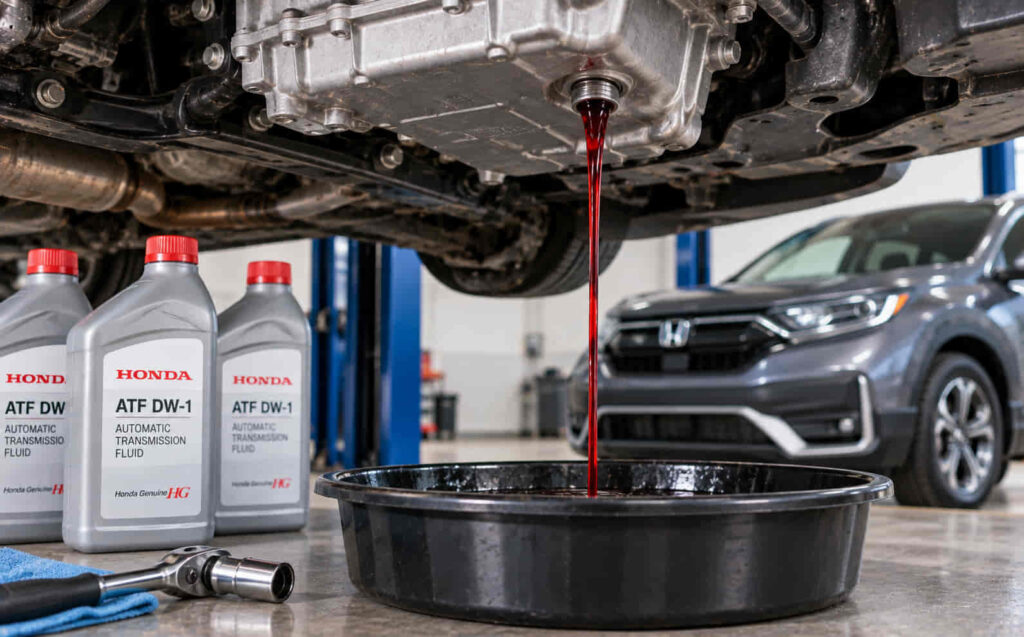
Honda does not use one fixed transmission fluid change interval for every Honda CR-V. For many modern CR-V models, the primary service indicator is Honda’s Maintenance Minder system, where sub-code 3 indicates that the transmission fluid needs to be replaced. The actual service timing depends on the model year, transmission type, operating conditions, and whether the vehicle is subject to severe driving conditions.
This distinction matters because generic recommendations such as changing transmission fluid every 30,000, 60,000, or 100,000 miles do not apply equally to every Honda CR-V. A gasoline CR-V with a continuously variable transmission (CVT), an older CR-V with a conventional automatic transmission, and a CR-V Hybrid can have different fluid specifications and maintenance requirements. Severe operating conditions can also shorten the service interval. For example, Honda specifies a 25,000-mile (40,000-km) transmission fluid replacement interval for certain CR-V models that are regularly driven at very low speeds in mountainous conditions.
The correct Honda CR-V transmission fluid interval should therefore be determined from the Maintenance Minder, the maintenance information for the specific model year, and the vehicle’s operating conditions. The sections below explain these factors, along with the correct fluid type, service method, and consequences of delaying transmission fluid maintenance.
How Often Should You Change the Transmission Fluid in a Honda CR-V?
You should change the transmission fluid in a Honda CR-V when the vehicle reaches the transmission-fluid service point specified by Honda for its model year and operating conditions. On many modern Honda CR-V models, this timing is determined by the Maintenance Minder rather than a single fixed mileage interval that applies to every vehicle. When sub-code 3 appears, Honda identifies the required maintenance item as replacement of the transmission fluid.
This means a universal recommendation such as changing Honda CR-V transmission fluid every 30,000, 60,000, or 100,000 miles is not sufficiently precise. The CR-V has been produced across multiple generations with different powertrains and transmission designs. Older models can use conventional automatic transmissions, while newer gasoline models commonly use continuously variable transmissions, or CVTs. Hybrid CR-V models have their own transmission configuration and fluid requirements. The correct interval must therefore match the specific model rather than being inferred from the Honda CR-V name alone.
Honda’s Maintenance Minder provides a more vehicle-specific approach to routine maintenance. The system monitors vehicle operating conditions and displays maintenance items when service becomes due. For transmission fluid, Maintenance Minder sub-code 3 means “replace transmission fluid.” This code is different from other numbered maintenance items. For example, rear differential fluid on applicable AWD CR-V models is a separate maintenance item and should not be confused with transmission fluid. Replacing one does not automatically mean the other has been serviced.
Driving conditions can also change when transmission fluid should be replaced. Honda specifies shorter intervals under particular severe operating conditions instead of relying solely on the normal Maintenance Minder schedule. For example, Honda documentation for the 2024 gasoline CR-V specifies transmission fluid replacement every 25,000 miles, or 40,000 km, when the vehicle is regularly driven at very low speeds in mountainous areas. Honda connects this requirement with increased transmission temperature under these operating conditions.
The 25,000-mile interval should not be interpreted as the standard transmission fluid interval for every Honda CR-V. It is a condition-specific requirement. A CR-V driven under normal conditions can follow different maintenance guidance, while another model year or powertrain can have a different severe-service requirement. The owner’s manual and maintenance information for the exact CR-V model year should take priority over generic mileage recommendations.
Does the Honda CR-V Transmission Fluid Interval Change by Model Year?
Yes, Honda CR-V transmission fluid maintenance requirements can change by model year, transmission design, powertrain, and operating conditions. A maintenance interval taken from one CR-V generation should therefore not automatically be applied to another. This distinction becomes especially important when comparing older automatic-transmission models, newer CVT-equipped gasoline models, and CR-V Hybrid models.
The transmission itself is one reason for this difference. Honda has used different transmission systems during the CR-V’s production history, and those systems do not necessarily use the same fluid. For example, Honda specifies HCF-2 transmission fluid for the CVT in applicable modern gasoline CR-V models. Applicable CR-V Hybrid models can instead require Honda HEVF-Type 1 transmission fluid. Because fluid specifications differ between these systems, treating all Honda CR-V transmission maintenance as one identical service can result in an incorrect fluid or maintenance procedure.
Severe-service requirements also demonstrate why model year matters. A 2024 gasoline CR-V operated regularly at very low speeds in mountainous conditions has a specified 25,000-mile (40,000-km) transmission fluid replacement interval. Honda documentation for the 2023 CR-V Hybrid provides a different severe-use transmission-fluid interval of 47,500 miles (76,000 km) or three years for specified low-speed mountainous operation. These figures apply to their stated models and operating conditions; they are not interchangeable universal CR-V intervals.
The practical rule is therefore straightforward: identify the model year and powertrain before determining the Honda CR-V transmission fluid interval. After identifying the vehicle, check its Honda maintenance information for Maintenance Minder sub-code 3 and any additional transmission-fluid instructions associated with severe operating conditions. This method provides a more accurate service point than choosing a mileage figure from a different CR-V generation.
For normal maintenance on CR-V models equipped with Maintenance Minder, the appearance of sub-code 3 is the primary transmission-fluid service signal specified by Honda. A fixed mileage becomes particularly important when the owner’s maintenance information establishes an additional interval for a defined operating condition. Keeping these two contexts separate prevents a severe-service figure from being incorrectly presented as Honda’s normal interval for every CR-V.
Read more: Chevy Silverado Jack Location
When Should You Change Honda CR-V Transmission Fluid Under Severe Driving Conditions?
Honda CR-V transmission fluid should be changed earlier when the vehicle operates under severe conditions specifically identified in the maintenance information for that model. Severe operation places greater thermal and mechanical demands on the transmission, so the fluid can require replacement sooner than it would under normal driving conditions. The applicable interval should come from the owner’s manual for the exact model year rather than from a universal severe-service schedule.
Low-speed mountain driving is one condition Honda specifically addresses. For example, Honda specifies a 25,000-mile (40,000-km) transmission fluid replacement interval for a 2024 gasoline CR-V that is regularly driven at very low speeds in mountainous areas. The reason is transmission temperature: sustained low-speed operation in demanding terrain can increase transmission temperature, creating a more severe operating environment for the fluid. This mileage is therefore a conditional maintenance interval rather than the standard interval for every 2024 CR-V.
The distinction between normal and severe operation is important because transmission fluid performs several functions inside the transmission. It provides lubrication while also supporting hydraulic operation and heat management. Higher operating temperatures place additional stress on the fluid and the transmission components it protects. Honda’s shorter severe-condition schedule addresses this operating environment before degraded fluid becomes a maintenance concern.
Towing can also affect the service schedule on CR-V models for which Honda explicitly includes trailer towing in its severe-use guidance. For example, Honda maintenance information for the 2020 CR-V specifies a 25,000-mile (40,000-km) transmission fluid interval when the vehicle is driven primarily in mountainous areas at very low speeds or used for trailer towing. This requirement should not automatically be transferred to model years whose manuals provide different instructions.
The correct approach is to match the interval to both the vehicle and the way it is driven. A CR-V used for ordinary commuting under normal conditions and a CR-V repeatedly subjected to severe low-speed mountain operation should not automatically receive identical transmission-fluid scheduling. Likewise, severe-use intervals from gasoline and hybrid CR-V models should not be combined because Honda can specify different requirements for their respective powertrains.
How Do You Know When a Honda CR-V Needs Transmission Fluid Service?
The primary indication that many modern Honda CR-V models need routine transmission fluid service is Maintenance Minder sub-code 3. When code 3 appears, Honda identifies transmission fluid replacement as a required maintenance item. This provides a clearer service signal than relying on a generic mileage recommendation that may have been written for another model year or transmission.
Maintenance Minder should be interpreted together with the maintenance instructions for the specific vehicle. Under normal operating conditions, the system provides the routine maintenance signal. Under a severe condition for which Honda establishes a separate interval, that condition-specific requirement also needs to be considered. A driver should therefore not assume that waiting indefinitely for a dashboard code overrides an explicit severe-service interval in the owner’s maintenance information.
Service history provides another important part of the decision. A used Honda CR-V with documented transmission-fluid maintenance gives the owner a known reference point for future service. If the maintenance history is unavailable, the mileage alone does not establish exactly when the fluid was last replaced. Checking the correct maintenance information and having the transmission service condition evaluated is more reliable than assuming that the previous owner followed the schedule.
Transmission behavior should not replace preventive maintenance as the trigger for fluid service. Changes such as abnormal transmission operation can indicate that inspection is necessary, but waiting for an operational symptom means the decision is no longer based solely on routine maintenance. Transmission fluid replacement is intended to maintain the system according to its service requirements rather than serve as a guaranteed repair for an existing transmission problem.
For this reason, use three pieces of information together: the Maintenance Minder, the model-specific Honda maintenance instructions, and the vehicle’s actual operating conditions. This approach keeps the Honda CR-V transmission fluid interval connected to the vehicle Honda designed the schedule for instead of applying a single mileage figure across every CR-V generation and powertrain.
What Happens If You Do Not Change Honda CR-V Transmission Fluid on Time?
Delaying Honda CR-V transmission fluid replacement beyond the applicable service point can reduce the fluid’s ability to support proper transmission operation and long-term durability. Transmission fluid operates under heat, pressure, and mechanical load. As its service life progresses, its condition changes, which is why transmission-fluid replacement forms part of Honda’s scheduled maintenance rather than being treated only as a repair after transmission problems appear.
Heat is particularly relevant to transmission fluid service life. Honda’s maintenance guidance establishes shorter replacement requirements for certain high-temperature operating conditions, including specified low-speed mountainous driving. This relationship helps explain why operating conditions matter when determining the service interval: a transmission subjected to greater thermal stress does not necessarily place the same demands on its fluid as the same vehicle used under less demanding conditions.
Transmission fluid also performs functions beyond basic lubrication. The fluid operates within a system that depends on appropriate fluid characteristics for normal transmission operation. For this reason, both delayed maintenance and the use of an incorrect fluid can work against the conditions the transmission was designed to operate under. Honda specifically warns for applicable CVT-equipped CR-V models that using transmission fluid other than the specified HCF-2 can adversely affect transmission operation and durability.
An overdue transmission-fluid service should not, however, be treated as proof that any existing transmission symptom was caused by old fluid. Abnormal operation can have multiple mechanical or control-related causes. Replacing fluid is preventive maintenance according to a service requirement; it is not a guaranteed repair for an existing transmission fault. A CR-V that already displays abnormal transmission behavior should be evaluated for the underlying cause instead of assuming a fluid change alone will correct it.
The practical objective is therefore to replace Honda CR-V transmission fluid at the appropriate service point rather than waiting for a transmission symptom to appear. Maintenance Minder, model-specific maintenance information, severe-use requirements, and documented service history provide more useful maintenance signals than waiting until transmission operation changes.
How Can You Find the Correct Transmission Fluid Interval for Your Honda CR-V?
The correct Honda CR-V transmission fluid interval is determined by matching the vehicle’s model year, powertrain, transmission, Maintenance Minder information, and operating conditions with Honda’s maintenance guidance for that specific vehicle. This approach is more precise than applying a universal 30,000-, 60,000-, or 100,000-mile recommendation to every CR-V.
Start with the model year because the Honda CR-V has used multiple transmission configurations throughout its production history. The powertrain should then be identified because a gasoline CR-V and a CR-V Hybrid from a similar period can use different transmission designs and fluids. A modern gasoline CR-V equipped with a CVT, for example, should not automatically be given the same fluid specification or maintenance assumptions as an older conventional automatic CR-V or a hybrid model.
For CR-V models equipped with Honda Maintenance Minder, sub-code 3 is the key transmission-fluid maintenance indicator. When this code appears, transmission fluid replacement is included in the required maintenance. The code should be interpreted alongside any additional notes in the owner’s maintenance information because Honda can specify separate replacement intervals for defined severe operating conditions.
Operating conditions provide the next piece of context. A fixed severe-service interval applies only when the vehicle meets the conditions attached to that interval. For example, the 25,000-mile (40,000-km) requirement specified for certain gasoline CR-V models under regular very-low-speed mountainous operation should not be presented as the normal transmission fluid interval for every CR-V. Other powertrains and model years can have different requirements.
The transmission fluid specification should be verified at the same time. Modern CR-V CVTs can specify Honda HCF-2, while applicable CR-V Hybrid transmissions can use Honda HEVF-Type 1. Older automatic-transmission models can have another specification. Confirming the fluid before service prevents an otherwise correctly timed transmission-fluid change from being performed with a fluid intended for a different transmission.
Service records add the final piece of information. The odometer shows how far the vehicle has traveled, but it does not show when its transmission fluid was last replaced. Documented maintenance history establishes whether a previous transmission-fluid service has already been completed and provides a reference point for subsequent maintenance.
For that reason, the owner’s manual and Honda maintenance information for the exact model should take precedence over generic Honda CR-V transmission fluid interval recommendations. Maintenance Minder code 3 identifies the routine service requirement on applicable models, while model-specific severe-use instructions determine whether the fluid needs replacement at an earlier fixed mileage. Together, these sources provide a more accurate maintenance decision than selecting one mileage interval for every Honda CR-V.