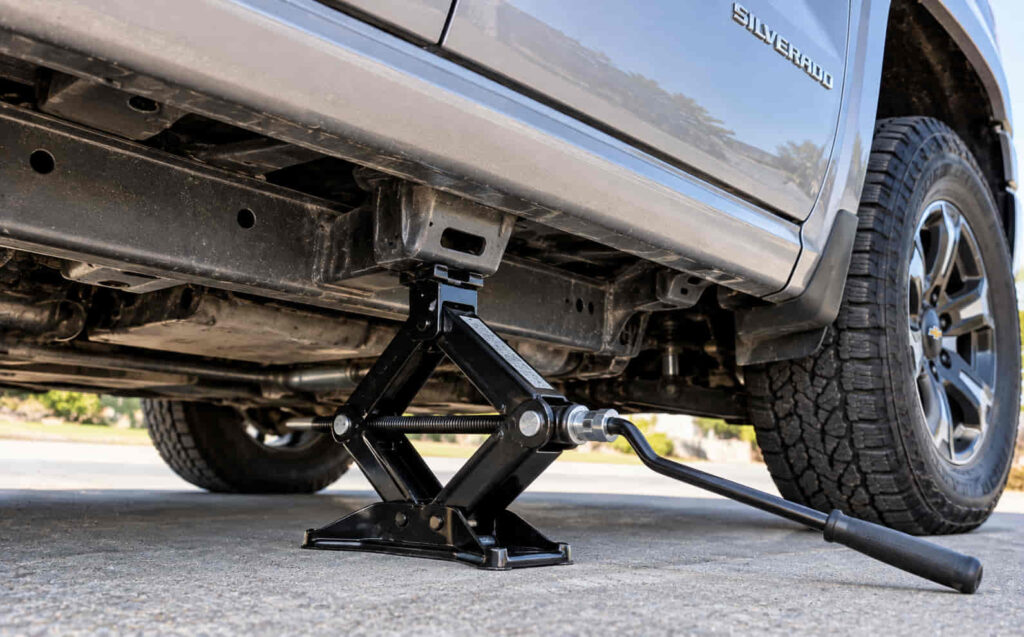
The Chevy Silverado jack location refers to two different places: where the factory jack and tire-changing tools are stored and where the jack should contact the truck when it is being lifted. These locations are not interchangeable. The storage location helps you find the factory equipment, while the jacking point is a structural location designed or specified for applying lifting force during tire service or other appropriate lifting procedures.
On a Chevy Silverado, the exact jack storage arrangement and approved lifting locations can vary by model year, Silverado series, cab configuration, and vehicle design. A jack location shown for one Silverado should therefore not be assumed to apply to every Silverado 1500 or HD truck. Identifying the specific vehicle configuration is especially important before positioning a jack under the frame, axle, suspension, or another structural component.
This guide explains where the Chevy Silverado factory jack and related tire tools are stored, how to identify the front and rear jack points, and where a floor jack should be positioned for an applicable lifting procedure. It also explains how to lift the truck safely, which areas should not be used as unverified jack points, when jack stands are required, and how jack locations can differ between Silverado configurations.
Where Is the Jack Located on a Chevy Silverado?
The factory jack on a Chevy Silverado is stored in a designated area inside the truck, but the exact storage location depends on the model year, cab configuration, and Silverado series. On applicable configurations, the jack and tire-changing equipment are secured in the cab rather than being left loose in the cargo bed or positioned permanently at a jacking point under the truck.
The storage system is designed to keep the jack restrained while the Silverado is being driven and accessible when roadside tire service is required. This distinction matters because searching underneath the truck for the factory jack confuses the storage location with the lifting location. The jack is removed from its storage position before it is placed at the appropriate structural jacking point.
Cab configuration can affect where the equipment is packaged. Silverado trucks have been produced with different interior layouts, including different rear-seat and storage arrangements, so a location that applies to one cab should not automatically be treated as universal. If the jack is not immediately visible, the designated storage area around or behind the applicable seating/storage section should be checked according to the vehicle-specific arrangement.
The jack should also be identified separately from the other tire-service equipment stored with or near it. The factory lifting device, jack handle components, wheel wrench, and spare-tire access tools perform different functions even when they occupy the same general storage area. Finding one tool therefore does not necessarily mean every required component has been located.
Model-specific information becomes important when the expected storage area is empty or the equipment arrangement differs from another Silverado. A previous owner may also have removed or relocated the factory jack, which means an empty storage position does not prove that the truck was originally supplied without one. The applicable owner’s information can be used to verify the intended storage arrangement for the specific vehicle.
The correct way to identify the Chevy Silverado jack location is therefore to match the model year, Silverado series, and cab configuration to the designated factory storage area. This provides a more reliable answer than assuming every Silverado stores its jack in exactly the same position.
Where Are the Jack Tools Stored on a Chevy Silverado?
Chevy Silverado jack tools are stored in the vehicle’s designated tire-service equipment area, typically associated with the factory jack storage arrangement on applicable configurations. These tools can include the components needed to operate the jack, loosen or tighten wheel fasteners, and access the spare tire, but their exact packaging and storage position can vary with the truck.
The jack handle is mechanically related to the lifting procedure because it allows the factory jack to be operated from a usable position. The wheel wrench serves a different function by providing the interface needed for wheel removal and installation. Spare-tire access equipment can also be part of the roadside tool arrangement when the spare tire is stored beneath the truck.
These components should be treated as a coordinated tire-service system rather than unrelated tools. A flat-tire procedure can require access to the spare tire before the damaged wheel is replaced, and the jack cannot perform the complete service by itself. Locating the jack while leaving the handle or wheel tool behind can therefore prevent the factory equipment from being used as intended.
The tools should remain secured in their designated storage arrangement when they are not in use. Loose metal tools inside the cab can move during driving, while incorrectly stored components can also be difficult to locate during roadside service. Returning each component to its retaining position helps preserve both accessibility and secure storage.
If the jack is present but one of the operating tools is missing, the equipment set should be treated as incomplete until the required function can be performed with suitable replacement equipment. A jack that cannot be operated correctly or a spare tire that cannot be accessed does not provide a complete tire-change solution simply because the main lifting device remains in the truck.
The practical relationship is jack storage → jack operating tools → wheel-removal tools → spare-tire access → roadside tire service. Keeping these entities together within the same service context explains why identifying the Chevy Silverado jack location should include the associated factory tools rather than only the lifting device itself.
Read more: Chevy Silverado Ball Joints
Where Are the Jack Points on a Chevy Silverado?
Chevy Silverado jack points are structural locations used to support the lifting force from a jack, and they are different from the location where the factory jack is stored. The correct contact point depends on the Silverado model, the end of the truck being lifted, and the lifting procedure being performed. A location that physically fits under a jack saddle is not automatically an approved jacking point.
The purpose of a jacking point is to transfer the truck’s weight through a structure capable of carrying the lifting load. When the jack is positioned correctly, force travels from the jack into the designated structural area as the wheel is raised. Positioning the jack against an unsuitable body panel, shield, bracket, or other non-load-bearing component can instead concentrate the vehicle’s weight where the component was not designed to support it.
This is why jack-point identification should occur before the truck is lifted. The underside of a Silverado contains the frame, suspension components, drivetrain parts, shields, brackets, lines, and other structures located close to one another. Their proximity does not mean they have the same load-bearing function. The correct point must be identified from the applicable lifting procedure rather than selected only because a component appears strong.
The required point can also change with the purpose of the lift. Using the factory jack to raise one wheel during roadside tire replacement is a different procedure from raising a larger portion of the truck with shop lifting equipment. The jack type, contact area, load distribution, and required support method can therefore differ even though both procedures involve lifting the same Silverado.
For this reason, the most accurate interpretation of a Chevy Silverado jack location is application-specific. The factory jack storage location identifies where the equipment is kept, while the front and rear jacking points identify where lifting force is applied. Keeping these two meanings separate prevents a common misunderstanding of the keyword and establishes the correct context for safe vehicle lifting.
Where Is the Front Jack Point on a Chevy Silverado?
The front jack point on a Chevy Silverado must be identified from the designated structural lifting location for the specific truck and lifting procedure rather than from a universal point assumed to fit every Silverado. Front suspension and chassis arrangements differ across Silverado generations and configurations, so the correct contact area should be verified for the vehicle being serviced.
The front of the truck contains several components that can look suitable for supporting a jack because they are made from substantial metal. However, visual strength alone does not establish that a component is intended to receive concentrated lifting force. Steering components, suspension parts, drivetrain components, protective structures, and the frame can occupy the same general area while serving different mechanical functions.
The lifting procedure also changes the load path. Raising one front wheel for tire service concentrates the procedure on that corner of the truck, while lifting the front of the vehicle with suitable shop equipment can involve a different contact and support strategy. These procedures should not be combined into a single instruction simply because both raise the front wheels from the ground.
Correct jack positioning requires the jack saddle or specified contact surface to engage the intended lifting area securely. Poor contact can allow the jack to shift as suspension geometry changes during lifting. The truck should therefore remain on a stable surface, and the lifting point should be positively identified before significant vehicle weight is transferred to the jack.
If a front lifting location cannot be confirmed for the exact Silverado configuration, the correct response is to verify the applicable vehicle lifting instructions rather than choose a nearby frame or suspension component by appearance. This is particularly important when comparing procedures across Silverado 1500 and HD applications or across different model generations.
Where Is the Rear Jack Point on a Chevy Silverado?
The rear jack point on a Chevy Silverado is the specified rear structural lifting location for the applicable truck and procedure, and it should be identified separately from the front jack point. The rear of the Silverado uses a different suspension and load path from the front, so front jacking instructions should not simply be transferred to the rear of the vehicle.
Rear lifting commonly places the jack within the structural context of the rear axle, frame, and suspension system, but the correct contact location still depends on the applicable procedure. The existence of a heavy axle or frame member does not make every surface on that assembly an equivalent jacking point. Brake components, lines, brackets, differential-related structures, and suspension hardware can be located close to areas that carry substantial vehicle loads.
Position also matters because the jack must remain stable while the vehicle rises. A contact point that is offset, curved, obstructed, or not intended for the jack saddle can produce unstable contact even when the surrounding component is structurally substantial. The objective is not simply to find the strongest-looking metal under the rear of the truck but to transfer lifting force through the intended location.
As with the front, lifting one rear wheel for roadside tire replacement and lifting the rear of the Silverado for workshop service are not automatically the same procedure. The factory jack is designed around its intended emergency-service use, while a floor jack and jack stands introduce different contact, capacity, and support requirements.
Front and rear jack locations should therefore be treated as separate vehicle-lifting entities. The correct rear jack point is determined by the Silverado configuration, the lifting equipment, and the intended procedure, not by copying the front lifting method or selecting an arbitrary location beneath the rear chassis.
Where Do You Put a Floor Jack on a Chevy Silverado?
A floor jack should be positioned under a verified structural lifting point that is appropriate for the specific Chevy Silverado and the portion of the truck being raised. The correct location depends on whether the front, rear, or one side of the vehicle is being lifted, as well as the Silverado model and suspension configuration. A floor jack should not be placed under a component simply because its saddle fits beneath it.
A floor jack and the factory Silverado jack perform the same basic function of raising the vehicle, but they are not identical lifting systems. The factory jack is packaged with the truck primarily for procedures such as roadside wheel and tire service. A hydraulic floor jack generally has a broader saddle, different lifting range, different load capacity, and a different approach to the vehicle. These differences affect how lifting force reaches the truck and how the jack remains positioned as the vehicle rises.
The floor jack saddle must contact an appropriate load-bearing area without transferring force into adjacent components that are not intended to support the vehicle. The underside of a Silverado contains structural members alongside brake lines, shields, brackets, suspension hardware, drivetrain components, and other equipment. Placing the saddle close to a structural member is not equivalent to placing it correctly on the intended lifting surface.
Jack movement during lifting also needs to be considered. As a floor jack raises the Silverado, the jack arm changes angle and the jack may need to roll slightly to maintain the relationship between the saddle and lifting point. A hard, level surface allows this movement to occur more predictably. Soft ground, significant slopes, or obstacles around the jack wheels can interfere with the lifting geometry and reduce stability.
The required lifting point can differ according to how much of the truck needs to rise. Raising one wheel for tire service does not necessarily use the same procedure as raising an entire end of the Silverado before installing jack stands. The latter procedure changes the amount of vehicle weight carried by the lifting equipment and requires suitable support points after the desired height is reached.
A floor jack should therefore be selected and positioned as part of a complete lifting system. Correct jack capacity, a verified Silverado lifting point, secure saddle contact, a stable surface, and appropriate support after lifting all work together. Using a larger floor jack does not make an incorrect contact point safe, just as identifying a correct structural point does not compensate for unsuitable lifting equipment.
How Do You Jack Up a Chevy Silverado Safely?
To jack up a Chevy Silverado safely, stabilize the truck first, identify the correct lifting point for the specific procedure, position suitable lifting equipment securely, raise the vehicle in a controlled manner, and support it properly before performing any work that places a person underneath it. Safe lifting depends on the complete sequence rather than the jack alone.
Vehicle stability begins before the jack carries any weight. The Silverado should be positioned on a firm, level surface where the lifting equipment can remain stable. The vehicle must be secured against unintended movement because raising one part of the truck changes how its weight is distributed through the wheels that remain on the ground. Appropriate wheel restraint and the vehicle’s parking procedure help prevent rolling while the lift is performed.
The correct jacking point should then be identified for the specific Silverado and the intended task. The contact area should be inspected so the jack can engage it without resting on nearby lines, brackets, shields, or other vulnerable components. This verification is especially important when a procedure found for another Silverado model year or configuration appears visually similar but has not been confirmed for the truck being lifted.
The jack should be raised gradually while its contact with the lifting point is observed. The objective is to keep the load centered and controlled as the suspension extends and the vehicle changes height. If the jack begins to lean, the saddle moves away from the intended contact area, or the vehicle shifts unexpectedly, continuing to raise the truck increases instability rather than correcting the problem.
Once sufficient height has been reached, the next step depends on the work being performed. A factory tire-change procedure and a repair that requires access beneath the Silverado have different support requirements. A jack provides lifting force, but lifting the vehicle and supporting it against unintended descent are separate functions. Work underneath the truck requires an appropriate support system positioned at verified support locations.
The truck’s stability should be confirmed before work begins. The lifting and support equipment must remain correctly positioned, and the vehicle should not depend on improvised objects or an unverified contact surface to carry its weight. The same principle applies when lowering the Silverado: the work area must be clear, the vehicle must be transferred back to the jack in a controlled manner when applicable, and the jack should be lowered gradually until the tires fully support the vehicle again.
The safe lifting sequence is therefore based on vehicle stability → correct lifting point → controlled lifting → appropriate support → stability verification → controlled lowering. Following this relationship is more important than treating the Chevy Silverado jack location as a single point under the truck, because safe jacking depends on both where the load is applied and how the vehicle is controlled throughout the procedure.
Where Should You Not Put a Jack on a Chevy Silverado?
You should not place a jack under an unverified Chevy Silverado body, suspension, drivetrain, or underbody component simply because it appears strong enough to support the truck. A safe jacking location must be capable of receiving concentrated lifting force through the applicable procedure. The appearance, thickness, or accessibility of a component does not establish that it is an approved lifting point.
This distinction matters because a jack concentrates a substantial portion of the vehicle’s weight into a relatively small contact area. A structural component designed to carry vehicle loads through its normal mounting points may still be unsuitable for concentrated force from a jack saddle at another location. Incorrect positioning can damage the contacted component, deform surrounding structures, or create an unstable interface between the jack and the truck.
Thin body panels and unverified sheet-metal surfaces are especially unsuitable when they are not designed as lifting locations. These structures can deform as vehicle weight is transferred onto the jack. Protective shields and covers present a similar problem because their purpose is to protect underlying components rather than carry the truck’s lifting load.
The presence of substantial suspension or drivetrain components can also create confusion. A control arm, differential-related component, bracket, steering part, or other heavy-looking structure may appear capable of supporting a jack, but its suitability depends on the specific Silverado design and approved lifting procedure. Nearby brake lines, wiring, hoses, and other vulnerable components also make approximate jack placement unsafe because the saddle can contact more than the intended structure as the vehicle rises.
A jack should not be positioned where the saddle cannot establish stable contact. Curved, angled, obstructed, or contaminated surfaces can allow the lifting interface to shift under load. The risk increases as suspension movement changes the relationship between the jack and truck during lifting. Correct load capacity cannot compensate for unstable contact.
The practical rule is verified structural lifting point first, jack placement second. Instead of selecting the strongest-looking component under a Chevy Silverado, identify the appropriate lifting location for the model and procedure before transferring vehicle weight to the jack. This prevents visual assumptions about the underbody from replacing application-specific lifting information.
Can You Work Under a Chevy Silverado Supported Only by a Jack?
You should not work underneath a Chevy Silverado when the vehicle is supported only by a jack. A jack is designed to raise and lower a load, while appropriate vehicle supports are used to hold the raised truck securely during work that places a person beneath it. These are separate mechanical functions even when the lifting equipment is rated for the vehicle’s weight.
A hydraulic or mechanical jack contains components that move as the truck is raised and lowered. The lifting system therefore depends on the continued stability and operation of the jack, its contact with the vehicle, and its contact with the ground. A change in any part of that system can allow the supported height to change. This makes the jack unsuitable as the only protection against vehicle descent when someone is underneath the Silverado.
Jack stands provide a different load path by supporting the raised vehicle at appropriate structural support locations after lifting. Their purpose is not to replace correct jack positioning during the lift but to provide stable support once the required working height has been reached. The support points must still be suitable for the specific Silverado because placing a stand under an unverified component creates another concentrated load even when the stand itself has sufficient capacity.
The ground beneath the support equipment is also part of the system. A stand positioned on a weak, uneven, or unstable surface cannot provide the same stability as one placed correctly on a firm and level working area. Vehicle weight must travel from the Silverado through the support point and stand into a surface capable of carrying that load without significant movement.
Support capacity must correspond to the load being carried, but capacity alone does not determine safety. Correct placement, stable contact, suitable ground conditions, and proper vehicle restraint remain necessary. A high-capacity stand placed at the wrong point does not correct an unsuitable support location, just as a high-capacity jack does not make an incorrect jacking point appropriate.
The essential distinction is a jack lifts the Silverado; the support system holds the Silverado while it is raised. When work requires access underneath the truck, the vehicle should be properly supported and its stability verified before a person enters the area below it. Treating the jack itself as the complete support system removes this separation between lifting and supporting functions.
Does Chevy Silverado Jack Location Change by Model Year?
Yes, the Chevy Silverado jack location and applicable jacking instructions can change by model year and vehicle configuration. Silverado trucks have been produced across multiple generations with changes to cab layouts, chassis designs, suspension systems, tire-service equipment, and storage arrangements. A jack location or lifting procedure from one model year should therefore not be treated as universal for every Silverado.
The difference can affect both meanings of “jack location.” The factory jack and tire tools may be packaged differently as interior storage arrangements change, while the specified lifting locations can also depend on the chassis and suspension configuration. This means finding the correct storage location does not establish where the jack should contact the truck, and identifying a lifting point on another Silverado does not confirm that the same procedure applies to a different model year.
Cab configuration adds another variable to factory equipment storage. Silverado interiors can provide different seating and storage arrangements, so the physical space available for securing a jack, wheel wrench, jack handle, and spare-tire tools can differ. Instructions showing equipment in a particular cab location are therefore most useful when the vehicle configuration matches the truck being serviced.
The same application-specific approach should be used underneath the vehicle. Silverado generations can differ in component layout and lifting instructions even when the trucks appear similar externally. A frame member, suspension component, or other structure visible in the same general area on two trucks should not be assumed to have identical jacking instructions based on appearance alone.
Model year is therefore a starting point rather than the only fitment attribute. The truck’s Silverado series and relevant configuration should also be identified before using model-specific lifting information. When a procedure conflicts with the physical arrangement of the vehicle, the applicable owner’s or service information should be verified instead of adapting instructions from another generation.
This creates a clear semantic relationship: model year → vehicle configuration → jack storage arrangement → specified lifting procedure. Treating those attributes together provides a more accurate answer to Chevy Silverado jack-location questions than assigning one storage position or one jacking point to every truck carrying the Silverado name.
Is the Jack Location Different on Silverado 1500 and Silverado HD?
The jack location and lifting procedure should not be assumed to be identical between a Silverado 1500 and Silverado HD. Although both belong to the Chevrolet Silverado truck family, they represent different vehicle applications, and differences in chassis, suspension, vehicle weight, equipment packaging, and service procedures can affect how the factory jack is stored and how the truck is lifted.
This distinction becomes especially important when searching for jack points. A Silverado 1500 lifting procedure found in a guide, video, or diagram does not automatically establish the correct contact point for a Silverado 2500HD or 3500HD. The underside may contain visually similar structural components, but the applicable lifting instructions need to correspond to the actual truck.
Vehicle weight also affects the lifting-equipment context. The jack and support equipment must be suitable for the load they are expected to carry. Because Silverado applications do not all have the same weight or configuration, equipment suitability should be established for the specific vehicle and lifting task rather than inferred from the fact that a jack works with another Silverado model.
Factory equipment provides another reason to distinguish the series. The jack supplied with a particular truck is part of that vehicle’s tire-service system, which includes its storage arrangement and operating procedure. Replacing missing factory equipment with a jack intended for another Silverado does not automatically establish equivalent capacity, fit, operating range, or compatibility with the required contact method.
The same principle applies to Silverado 1500, 2500HD, and 3500HD information found online. Model names should be treated as application identifiers rather than interchangeable labels. Before following a storage diagram or lifting procedure, the information should match the relevant model year and Silverado series closely enough to establish that it applies to the truck being serviced.
The correct sequence is therefore identify the Silverado → confirm model year and series → verify the storage or lifting procedure → use equipment appropriate for that application. This prevents a procedure that is valid for one Silverado configuration from being generalized to another truck solely because both vehicles share the Silverado name.
Where Is the Spare Tire on a Chevy Silverado?
The spare tire on many Chevy Silverado configurations is stored beneath the rear of the truck, where it is secured by a carrier system and accessed with the appropriate factory tire-service tools. The exact arrangement and removal procedure should still be verified for the specific model year and Silverado configuration because the spare-tire system is part of the vehicle-specific roadside equipment setup.
The spare tire is semantically connected to the Chevy Silverado jack location because both components are required during a typical roadside tire change. Finding the factory jack solves the lifting-equipment problem, but the replacement wheel still needs to be released from its storage position before the damaged tire can be replaced. This is why the jack handle, wheel wrench, and spare-tire access equipment are commonly discussed within the same service context.
On configurations that store the spare beneath the truck, the tire is not simply pulled from an open storage compartment. A retaining mechanism holds it against the underside of the vehicle during normal operation. The applicable tool system is used to operate that mechanism so the spare can be lowered to a position where it can be removed and used.
The spare-tire location should not be confused with a jacking point. Although both are found around the underside of the truck during tire service, the spare carrier and related hardware are storage components rather than locations intended to receive lifting force. The jack must still contact the appropriate structural lifting point for the procedure being performed.
Before beginning a roadside tire change, it is therefore useful to confirm the complete equipment relationship: the factory jack must be available and operational, the required tire tools must be present, and the spare tire must be accessible and suitable for use. Discovering that one of these components is missing only after the Silverado has been partially prepared for lifting can prevent the tire-change procedure from being completed.
The practical relationship is jack and tools → spare-tire access → correct jacking point → vehicle lifting → wheel replacement. The spare tire belongs in this article because it completes the tire-service context surrounding the factory Chevy Silverado jack without changing the article into a separate guide to spare-tire removal.
What Should You Do if the Factory Jack Is Missing?
If the factory jack is missing from your Chevy Silverado, first verify the designated storage location for the specific truck, then replace the missing equipment with a lifting solution that is suitable for the vehicle and the intended use. An empty area where another Silverado stores its jack is not sufficient evidence that the equipment is missing because storage arrangements can vary by model year, cab configuration, and series.
Previous ownership is another factor. A factory jack can be removed during earlier repairs, roadside service, interior modifications, or vehicle resale and never returned to its original position. The associated handle, wheel wrench, or spare-tire tools can also disappear independently, leaving an incomplete equipment set even when part of the original system remains in the truck.
Once the original storage arrangement has been verified and the jack is confirmed missing, replacement equipment should be evaluated by function rather than appearance alone. The replacement must be appropriate for the load it will lift, provide a usable lifting range, establish secure contact at the applicable lifting location, and remain suitable for the environment in which it will be used. A jack that physically fits in the Silverado does not automatically satisfy these requirements.
The intended use also affects the replacement decision. Equipment kept in the truck for emergency tire service has different packaging and portability requirements from a floor jack used primarily in a garage. A large shop jack may provide suitable lifting capability in its intended environment while being impractical as a direct replacement for the compact factory roadside equipment.
The rest of the tire-service system should be checked at the same time. Replacing the jack without confirming the presence of the operating handle, wheel-removal tool, and required spare-tire access equipment can leave the Silverado unable to complete a roadside wheel change. The objective is to restore the required service functions rather than replace only the most obvious missing component.
A missing factory jack therefore creates a vehicle identification → storage verification → equipment requirement → replacement suitability problem. Confirming these attributes before purchasing replacement equipment reduces the risk of selecting a jack that fits the storage space but does not match the Silverado’s actual lifting requirements.
Can You Use a Different Jack on a Chevy Silverado?
Yes, you can use a different jack on a Chevy Silverado when the replacement jack has suitable lifting capacity and range, can establish secure contact with the correct lifting point, and is appropriate for the intended lifting procedure. The replacement does not have to perform every task in exactly the same way as the factory jack, but it must be capable of lifting the required load safely within its designed operating conditions.
The factory jack is primarily part of the Silverado’s onboard tire-service system. Its size, storage arrangement, operating method, and lifting range are selected around its intended vehicle application and roadside use. A bottle jack or hydraulic floor jack can provide a different lifting method, but changing the lifting equipment does not change the requirement to use an appropriate structural lifting point.
Lifting capacity is one of the first specifications that must be matched to the actual task. The relevant load is not determined simply by the Silverado name because Silverado 1500 and HD trucks differ in weight and configuration. The jack must be suitable for the load it will actually carry during the selected lifting procedure rather than chosen from a generic assumption about pickup trucks.
Lifting range is equally important. A jack must be low enough to reach the intended contact area before lifting and capable of raising the truck sufficiently for the required service. This becomes especially relevant on trucks with different ride heights, tire sizes, suspension configurations, or modifications. A jack with adequate rated capacity can still be unsuitable when its minimum or maximum operating height does not match the vehicle.
Contact between the jack and truck also determines suitability. A floor jack uses a saddle that can differ substantially from the contact surface of a factory jack or bottle jack. The lifting point and jack interface must therefore work together without placing the load on adjacent brackets, lines, shields, or other components that are not intended to carry concentrated lifting force.
Stability should be evaluated according to the environment in which the jack will be used. A garage floor jack is designed around a different operating context from compact roadside equipment. Its wheels and lifting mechanism work best on an appropriate hard, level surface, while portability and onboard storage may make it less practical as emergency equipment carried in the Silverado.
A different jack also does not eliminate the need for separate vehicle support when work requires access underneath the truck. The jack raises the Silverado; appropriate support equipment holds the vehicle after lifting. Increasing jack capacity does not convert a lifting device into a complete support system.
The correct replacement decision therefore follows vehicle application → intended lifting task → required capacity → lifting range → jack-point compatibility → stability and support requirements. A bottle jack, floor jack, or replacement factory-style jack can be suitable for a Chevy Silverado when those requirements are satisfied, but jack type alone does not determine whether the lifting setup is appropriate.