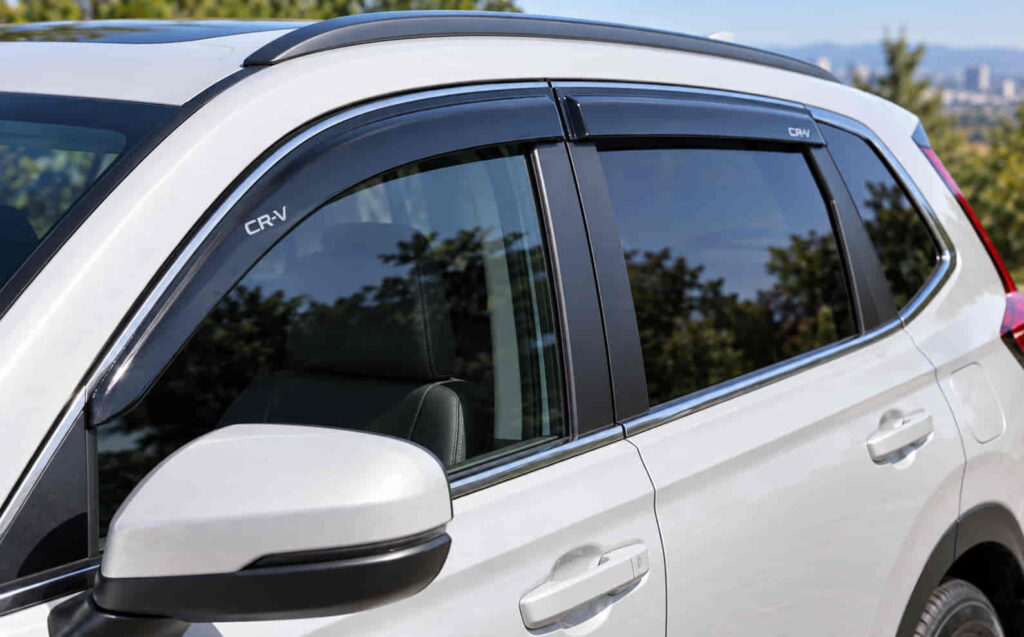
A Honda CR-V window deflector is an exterior accessory installed along the upper edge of a side window to redirect airflow and help limit the amount of rain entering when the window is partially open. Also called a rain guard, window visor, or vent visor, it allows additional cabin ventilation without exposing the window opening to rain and moving air as directly as an uncovered window.
Honda CR-V window deflectors are mainly available in two mounting designs: in-channel and tape-on. In-channel deflectors fit inside the window channel, where their position can interact with the glass and weatherstrip. Tape-on deflectors attach to the exterior door or window-frame area using automotive adhesive, so installation depends heavily on surface preparation, alignment, and secure bonding. These mounting methods affect fitment, installation, removal, and potential problems with window operation.
The correct deflector must also match the specific Honda CR-V application rather than simply carrying the CR-V name. Window and door geometry can differ between model years and generations, making verified fitment important before installation. This guide explains how Honda CR-V window deflectors work, their benefits and disadvantages, how in-channel and tape-on designs differ, how to choose and install the correct type, and how to address power-window, fitment, noise, maintenance, and removal issues.
What Is a Honda CR-V Window Deflector?
A Honda CR-V window deflector is an accessory mounted along the upper edge of a side window to alter the path of air and water around the window opening. The accessory extends outward from the normal window or door profile, creating a small barrier between outside airflow and the upper portion of the glass. This position allows the deflector to influence conditions around the opening when the window is lowered slightly.
Window deflectors are also commonly described as rain guards, window visors, or vent visors. These terms generally refer to the same accessory category when they describe a component installed above the side windows. The terminology can vary between manufacturers and sellers, so fitment and mounting design are more useful selection criteria than the product name alone.
The deflector should not be confused with other aerodynamic accessories installed elsewhere on the CR-V. A side-window deflector works specifically around the door glass and window opening, while accessories fitted to the hood, roof, or other areas interact with different airflow paths. The relevant Central Entity in this context is therefore the accessory positioned directly along the Honda CR-V side-window area.
The deflector itself does not open, close, or mechanically ventilate the cabin. Its function depends on the position of the window glass and the movement of outside air around the vehicle. When the window remains completely closed, the accessory primarily changes airflow around the exterior window area. When the glass is lowered slightly, the deflector covers part of the resulting opening and changes how moving air and rain reach it.
Mounting design determines how the accessory connects to the CR-V. An in-channel deflector occupies part of the window channel, while a tape-on deflector attaches to an exterior surface around the upper window area. This difference becomes important for installation, fitment, power-window operation, removal, and troubleshooting even though both products belong to the same window-deflector category.
What Does a Window Deflector Do on a Honda CR-V?
A window deflector redirects airflow around the upper portion of a Honda CR-V side window and provides a barrier that can reduce direct rain entry when the window is partially open. It works by changing the path that moving air and water would otherwise take across an exposed window opening.
Without a deflector, lowering the glass creates an opening directly between the cabin and outside airflow. Air moving along the side of the CR-V can interact with that opening, while rain traveling across the exterior of the vehicle can reach the exposed area more directly. Installing a deflector adds a projecting surface above the opening, altering this path before the air and water reach the cabin.
This mechanism allows the side window to remain slightly open while retaining more protection from light rain than an equivalent uncovered opening. The accessory does not create a waterproof seal over the open window. Water can still enter depending on the amount of window opening, rain intensity, wind direction, vehicle speed, and deflector geometry. Its function is to redirect exposure rather than make an open side window weatherproof.
The same airflow mechanism explains why a deflector can change the way air enters and leaves the cabin. With the glass lowered slightly, the opening provides a path for ventilation while the deflector modifies the direct airflow around it. The resulting airflow behavior depends on vehicle speed, window position, which windows are open, and the shape of the installed accessory.
A properly fitted deflector therefore functions through the relationship side-window opening → deflector surface → redirected airflow and water → altered cabin ventilation. This mechanism explains its main benefits more accurately than treating the accessory as a decorative cover above the window.
What Are the Benefits of Window Deflectors on a Honda CR-V?
The main benefits of Honda CR-V window deflectors are improved access to natural ventilation with partially open windows, reduced direct rain exposure around the opening, and controlled airflow around the upper side-window area. These benefits are closely related because they result from the same physical change to the airflow and water path around the door glass.
Ventilation is one of the primary reasons for installing window deflectors. A driver can lower the side window slightly to create an opening between the cabin and outside air while the deflector remains above part of that opening. This can provide passive airflow without requiring the window to be opened as far as it might be without the accessory under the same weather conditions.
Rain management is the second direct benefit. Because the deflector projects over the upper window area, it can redirect some water away from a partially open window. This is particularly relevant when ventilation is desired during light rain. The benefit should not be interpreted as complete rain protection because the effectiveness changes with window position, wind, rainfall, and vehicle movement.
Airflow control provides the mechanical link between ventilation and rain management. Instead of outside air meeting the upper window opening in exactly the same way as it would on an unmodified CR-V, the deflector changes the local airflow path. This can make partially open-window ventilation more practical in conditions where direct airflow or weather exposure would otherwise encourage the occupants to keep the glass fully closed.
Window deflectors can also change the exterior appearance of the CR-V by adding a continuous visor-like profile around the side windows. Appearance is a secondary attribute rather than the primary functional mechanism, and preferences vary between clear, tinted, low-profile, and more prominent designs. A visual preference should therefore be considered separately from verified vehicle fitment and mounting quality.
The practical value of the accessory is strongest when the owner regularly wants partially open-window ventilation combined with additional protection from direct rain and airflow. The deflector does not replace climate control, eliminate all wind effects, or make an open window waterproof; it modifies the conditions around the opening so that ventilation can remain usable in a broader range of situations.
Read more: Chevy Silverado Jack Location
What Are the Disadvantages of Honda CR-V Window Deflectors?
The main disadvantages of Honda CR-V window deflectors are potential changes in wind noise, installation or fitment problems, interference with window operation on some in-channel designs, and deterioration of adhesive attachment on tape-on designs. These issues are not inherent to every window deflector because their occurrence depends on product design, vehicle fitment, installation quality, and operating conditions.
Wind noise can change because a deflector modifies the exterior profile around the side window. Air that previously traveled across the original door and glass surfaces encounters an additional edge and projecting surface after installation. Depending on deflector shape, vehicle speed, window position, and fitment, this altered airflow can produce a different sound around the window area. A window deflector should therefore not be assumed to reduce wind noise in every driving condition.
Fitment problems can create more significant functional issues. A deflector designed for a different CR-V model year or window geometry may not follow the door frame correctly, resulting in gaps, excessive tension, poor alignment, or insecure mounting. These problems can affect appearance and attachment while also increasing the possibility of noise or movement at highway speeds.
In-channel deflectors introduce an additional consideration because they occupy space within the window channel. If the product is too thick, incorrectly seated, or incompatible with the specific application, the glass can encounter additional resistance as it closes. On applicable power-window systems, abnormal resistance can interfere with normal closing behavior and may contribute to the window stopping or reversing rather than reaching its fully closed position.
Tape-on deflectors avoid placing the accessory directly inside the glass channel, but their attachment depends on the bond between the adhesive and exterior mounting surface. Contamination, incorrect alignment, insufficient surface preparation, or deterioration of the attachment can allow an edge to lift or the deflector to become loose. Correct installation is therefore important even when the accessory does not interact directly with the window glass.
The disadvantages should be evaluated through deflector design → verified fitment → mounting method → installation quality → window and airflow behavior. A problem caused by poor installation should not automatically be attributed to all Honda CR-V window deflectors, just as a correctly fitted accessory should not be assumed to eliminate every possible noise or window-operation issue.
What Types of Window Deflectors Are Available for a Honda CR-V?
Honda CR-V window deflectors are primarily divided into in-channel and tape-on designs according to how they attach around the side windows. Both types create a visor-like surface above the window opening, but the mounting mechanism changes how the accessory fits the vehicle and interacts with surrounding components.
An in-channel window deflector is installed within the upper window channel. This gives the accessory a relatively integrated mounting position because a major part of its attachment is located inside the channel rather than across the visible exterior mounting surface. The design requires accurate fitment because the deflector shares space with the path used by the window glass and surrounding weatherstrip.
A tape-on window deflector, also described as an external-mount design, attaches to the exterior area above the side window using automotive adhesive. Instead of occupying the glass channel, it follows the exterior door or window-frame profile. Its installation therefore depends heavily on clean mounting surfaces, accurate initial alignment, and a secure adhesive bond.
Window deflectors can also differ in coverage and physical profile within these two mounting categories. A set may cover the front side windows or extend across both front and rear doors, depending on the product and CR-V application. Deflectors can also vary in projection, tint, material thickness, and exterior shape. These attributes affect appearance and airflow but do not replace mounting type and vehicle fitment as the primary selection criteria.
The most useful classification is therefore based first on where the deflector mounts. In-channel models use the window channel, while tape-on models use an exterior adhesive mounting surface. Understanding this distinction makes the later installation and troubleshooting procedures easier to interpret because the two designs do not rely on the same attachment mechanism.
What Is the Difference Between In-Channel and Tape-On CR-V Window Deflectors?
The main difference between in-channel and tape-on Honda CR-V window deflectors is their mounting location: in-channel deflectors fit inside the window channel, while tape-on deflectors adhere to the exterior surface above the window. This single design difference affects installation, appearance, interaction with the glass, attachment behavior, and removal.
In-channel deflectors use the existing window-channel area to retain the accessory. Their mounting method can create a more integrated appearance because a separate adhesive strip is not the primary visible attachment along the exterior surface. However, placing material inside the channel reduces available space around the path of the window glass, making correct product dimensions and seating particularly important.
Tape-on deflectors leave the window channel available for normal glass movement because the accessory is attached outside it. Their primary installation requirement is establishing a strong bond between the adhesive and the intended exterior mounting surface. Surface contamination, poor alignment, or incomplete adhesion can weaken that attachment even when the deflector itself has the correct physical shape.
The two types also fail in different ways when installation is incorrect. An improperly fitted in-channel unit can create unwanted resistance during window movement or fail to remain seated correctly. An improperly installed tape-on unit is more likely to develop attachment problems such as a lifting edge or loose section when the adhesive bond is inadequate.
Removal follows the same distinction. An in-channel deflector must be disengaged from the channel without damaging the weatherstrip or related window components, while a tape-on model requires the adhesive bond to be separated from the exterior mounting surface. Residual adhesive and surface condition become more relevant with the external-mount design.
Neither mounting type is universally better for every Honda CR-V. In-channel designs prioritize channel-based attachment, while tape-on designs separate the accessory from the glass channel and depend on exterior adhesion. The correct choice depends on verified CR-V fitment, preferred mounting method, installation requirements, and how the owner wants the accessory to interact with the window system.
Do Window Deflectors Fit Every Honda CR-V Model Year?
No, Honda CR-V window deflectors should not be treated as universal-fit accessories for every model year. The shape of the doors, upper window frames, glass channels, and surrounding trim can change between CR-V generations, so a deflector designed around one window geometry may not mount correctly on another.
Model year is important because the deflector must follow the physical profile of the window area. A tape-on unit needs its mounting surface and curvature to correspond with the exterior door or window-frame shape. An in-channel unit requires an even closer relationship with the window opening because part of the accessory sits inside the channel used by the glass.
A deflector can therefore appear visually similar to the correct part while still having a fitment problem. Small differences in length, curvature, mounting position, or channel dimensions can prevent the accessory from seating as intended. With a tape-on design, this can create gaps or poor adhesive contact. With an in-channel design, incorrect dimensions can affect retention or interfere with window movement.
CR-V generation is a useful application context because major vehicle redesigns can change the relevant door and window structures. However, generation alone should not replace verified product fitment. The actual product application should correspond to the specific CR-V model year and the doors it is designed to cover.
Front and rear deflectors also have different geometries within the same vehicle. A complete set is shaped around the individual window openings rather than using identical pieces at every door. This is why a product listing that specifies the correct CR-V application provides more useful compatibility information than a generic accessory described only as suitable for SUVs.
Mounting type adds another compatibility layer. A CR-V that can physically accept an external tape-on visor does not automatically establish compatibility with an in-channel version of similar shape. The latter must work with the window channel and glass movement, while the former depends primarily on the intended exterior mounting surface and adhesive interface.
Correct fitment therefore follows Honda CR-V model year → applicable vehicle design → specific window position → mounting type → verified product application. Matching these attributes before installation reduces the likelihood of gaps, loose attachment, channel interference, or other problems caused by using a deflector designed for a different CR-V.
How Do You Choose the Correct Window Deflector for a Honda CR-V?
Choose a Honda CR-V window deflector by confirming vehicle fitment first, then selecting the mounting type, window coverage, and physical design that match the intended use. Appearance and price can influence the final purchase, but they should come after compatibility because a deflector cannot perform correctly when its shape or mounting system does not match the vehicle.
The selection process begins with the CR-V model year and verified application. This establishes whether the deflector was designed around the relevant door and window geometry. When several products use similar descriptions, application information is more reliable than assuming that a part fits because its photographs resemble the window shape of the vehicle.
Mounting type is the next major decision. An in-channel deflector places part of the accessory inside the window channel and therefore requires accurate interaction with the glass, weatherstrip, and available channel space. A tape-on deflector keeps the primary mounting interface outside the channel but requires a suitable exterior surface for its adhesive attachment. The preferred type should reflect these mechanical differences rather than appearance alone.
Window coverage should also match the intended installation. Some owners want deflectors only around the front side windows, while others prefer a coordinated set across the front and rear doors. The selected pieces must correspond to their individual window positions because the shape of a front deflector does not establish fitment for a rear opening.
Material and profile influence durability, appearance, and airflow around the accessory. A more prominent visor changes the exterior profile differently from a low-profile design, while tint and finish affect visual integration with the CR-V. These characteristics can be compared after the required fitment and mounting method have been established.
OEM and aftermarket status can provide additional product context, but neither label eliminates the need to verify application. An OEM accessory is designed around specified Honda applications, while aftermarket products can offer different mounting styles, profiles, and coverage options. The relevant question is whether the specific product matches the CR-V and performs the required mounting function, not whether one category is automatically superior.
Installation requirements should be considered before purchase as well. A driver who chooses an in-channel model should account for its relationship with the window channel and power glass. A tape-on product requires careful exterior surface preparation and adhesive alignment. Selecting a product whose installation method is understood in advance reduces the likelihood that fitment problems are discovered only after the deflector has been partially installed.
The correct selection sequence is therefore verified CR-V application → mounting type → window coverage → installation requirements → material and profile preferences. This keeps vehicle compatibility as the primary decision criterion while allowing appearance, OEM or aftermarket origin, and other product attributes to refine the final choice.
How Do You Install In-Channel Window Deflectors on a Honda CR-V?
To install in-channel window deflectors on a Honda CR-V, the correctly fitted deflector is positioned inside the applicable upper window channel, seated according to its mounting design, and then checked to confirm that the glass can move through its normal path without excessive resistance. The exact installation method depends on the deflector design, so manufacturer-specific instructions take priority over a universal procedure.
Installation begins with confirming that each deflector matches its intended door and orientation. Front and rear pieces follow different window profiles, and an incorrectly positioned component can appear close to the correct shape while failing to seat properly. The window channel should also be inspected for dirt or other material that could prevent the accessory from fitting consistently against the intended surfaces.
The window glass must be lowered sufficiently to provide access to the channel before the deflector is positioned. The accessory is then introduced into the designated area according to its retention design. Because the deflector follows the shape of the window opening, forcing it into an incorrect position can create excessive stress in the accessory or place material where the glass needs clearance.
Once positioned, the deflector should sit consistently along the intended channel rather than remaining partially disengaged at one end. This seating is mechanically important because the accessory must remain stable while the window moves nearby. A section that is not fully positioned can increase resistance, shift during glass movement, or prevent the window from reaching its normal closed position.
Window operation becomes the primary functional check after installation. The glass should be raised carefully while its movement and contact with the channel are observed. If it encounters substantial resistance, stops unexpectedly, reverses on an applicable system, or pushes the deflector out of position, repeatedly forcing the window closed does not correct the underlying fitment or seating problem.
Some in-channel products use additional retention features or require a settling procedure after installation. These requirements should be followed for the specific product because retention systems are not identical across manufacturers. A procedure appropriate for one in-channel deflector should not automatically be transferred to another design solely because both accessories mount inside the channel.
A successful installation therefore follows the mechanical relationship verified fitment → correct channel positioning → secure seating → controlled window movement → final fitment verification. The objective is not merely to place the deflector inside the channel but to integrate it without preventing the Honda CR-V side window from operating as intended.
How Do You Install Tape-On Window Deflectors on a Honda CR-V?
To install tape-on window deflectors on a Honda CR-V, the exterior mounting surface must be properly prepared, the deflector must be aligned with the correct window position, and the automotive adhesive must establish uniform contact with the intended surface. Unlike an in-channel design, a tape-on deflector relies primarily on the quality of the exterior adhesive bond for retention.
Surface preparation directly affects that bond. Dirt, wax, oil, moisture, or other contamination between the adhesive and mounting area reduces the quality of contact. Cleaning the intended attachment surface according to the deflector manufacturer’s requirements allows the adhesive to contact the actual exterior surface instead of bonding partly to removable contamination.
Alignment should be established before the adhesive is fully committed to the surface. The deflector must follow the correct upper-window profile and maintain the intended relationship with adjacent pieces, door edges, and window openings. Poor initial positioning can produce inconsistent gaps or place the accessory where it interferes with another component.
The adhesive backing is then handled according to the product’s installation method while the deflector is maintained in its intended position. Uniform pressure along the attachment area helps establish contact between the adhesive and mounting surface. Pressing only isolated sections can leave areas with weaker contact, particularly where the deflector follows changes in the door or window-frame curvature.
The adhesive also requires the conditions specified by its manufacturer to develop the intended bond. Temperature, surface condition, moisture exposure, and time after installation can affect adhesive performance. Because bonding requirements differ between products, one universal waiting period should not be assigned to every Honda CR-V tape-on window deflector.
The installation should be inspected after the deflector has been attached. Its edges should remain aligned with the intended mounting surface without obvious lifting or sections that failed to make appropriate contact. A loose edge should be addressed as an attachment problem rather than assuming normal driving pressure will permanently force the adhesive back into place.
Tape-on installation therefore follows verified fitment → surface preparation → accurate alignment → adhesive contact → bonding → attachment inspection. This differs fundamentally from in-channel installation because the tape-on accessory depends on the exterior bond rather than occupying the window-glass channel.
Can In-Channel Deflectors Affect Honda CR-V Power Windows?
Yes, an in-channel window deflector can affect Honda CR-V power-window operation if the accessory reduces clearance or creates excessive resistance in the path used by the window glass. This interaction is specific to the mounting design because an in-channel deflector occupies part of the same upper channel into which the glass travels when the window closes.
Under normal operation, the window glass moves through a defined path until it reaches the closed position. Installing an in-channel deflector adds material within part of that path. A correctly fitted product is designed to accommodate this relationship, but incorrect fitment, incomplete seating, excessive material thickness, or improper positioning can increase the resistance encountered by the moving glass.
The resulting symptom can appear near the top of window travel because this is where the glass begins interacting most closely with the modified channel. The window may slow, stop before fully closing, require abnormal effort to reach the upper position, or reverse on an applicable power-window system. These symptoms indicate that the relationship between the glass, channel, weatherstrip, and installed deflector should be checked.
A window-operation problem that begins immediately after deflector installation should therefore be evaluated in the context of the new accessory before assuming that the window regulator or motor has independently failed. Timing provides useful diagnostic context, but it does not prove the deflector is responsible. The actual point of resistance and the seating of the accessory still need to be inspected.
Forcing the window repeatedly against excessive resistance is not an effective installation correction. If the deflector is incorrectly positioned, repeated closing attempts can continue applying force without resolving the fitment problem. The appropriate response is to verify that the correct deflector has been installed on the correct door and that it is seated according to its intended retention design.
The diagnostic relationship is in-channel deflector → available channel space → glass movement → resistance → power-window behavior. This is why power-window compatibility should be considered during product selection and verified immediately after installation rather than treated as an unrelated issue after the accessory is fitted.
Why Does the Window Reverse After Installing a CR-V Deflector?
A Honda CR-V power window can reverse after an in-channel deflector is installed when the glass encounters enough additional resistance near the top of its travel to trigger the applicable window-control response. The deflector does not need to block the glass completely; increased resistance within the closing path can be sufficient to prevent normal operation on a system designed to respond to an obstruction or abnormal load.
The mechanism begins with reduced clearance in the upper window channel. If the deflector is not fully seated, has shifted from its intended position, or does not fit the specific CR-V application correctly, the glass can encounter additional pressure as it approaches the closed position. Instead of continuing smoothly into the channel, the window system may respond to that resistance by stopping or reversing.
This behavior should be distinguished from a general power-window failure. A failed regulator, motor, switch, electrical connection, or another window-system problem can also produce abnormal operation, but those faults do not share the same direct installation relationship. When reversal begins immediately after an in-channel deflector is fitted, checking the accessory’s position and the point where resistance occurs provides a more direct diagnostic path.
The deflector should also be checked for correct door position and orientation. Front and rear pieces have different profiles, and a component that appears close to the required shape can still place pressure in the wrong part of the channel. Correct model-year fitment does not compensate for installing a piece on the wrong window or seating it incorrectly.
If the accessory is correctly identified but the glass still encounters abnormal resistance, the product-specific installation requirements should be reviewed before additional force is applied. Some designs use particular retention features or installation procedures that determine how the deflector settles within the channel. These requirements should not be replaced with a generic method intended for another product.
Window reversal after installation therefore follows a diagnosable sequence: deflector position or fitment → altered channel clearance → increased glass resistance → applicable window-control response. Confirming each part of that sequence helps separate an installation-related problem from an unrelated Honda CR-V window-system fault.
How Do You Fix a Loose Honda CR-V Window Deflector?
A loose Honda CR-V window deflector should be corrected by identifying whether it uses an in-channel or tape-on mounting system and then addressing the specific attachment problem responsible for the movement. A loose tape-on deflector usually involves the adhesive interface, while movement in an in-channel deflector is more closely related to fitment, seating, or its retention design.
For an in-channel deflector, the first issue to examine is whether the accessory remains correctly positioned inside the window channel. A section that has moved away from its intended position can lose retention and may also interfere with the path of the window glass. The deflector should match the correct door, follow the intended window profile, and remain seated according to its specific mounting design.
Incorrect fitment can produce repeated looseness even when the accessory is repositioned. A deflector designed for another CR-V model year, generation, or window position may not maintain the required relationship with the channel. In this situation, forcing the accessory into place addresses the visible movement without correcting the dimensional mismatch responsible for it.
A loose tape-on deflector requires a different diagnostic approach because its retention depends on the adhesive bond. An edge can begin lifting when the mounting surface was contaminated during installation, the deflector was misaligned, adhesive contact was incomplete, or the attachment has deteriorated. Pressing a failing section back against the door does not necessarily restore the original bond when the adhesive or mounting surface can no longer provide reliable contact.
The condition of the mounting surface and deflector should therefore be evaluated before attempting to restore an adhesive-mounted unit. Any corrective method must remain compatible with the accessory material and the CR-V exterior surface. Product-specific attachment requirements are preferable to applying an arbitrary adhesive because different materials and mounting systems are not designed around the same bonding properties.
Movement should also be investigated when it appears only at higher vehicle speeds. Airflow places force on the projecting deflector surface, so an attachment problem that is difficult to detect while the vehicle is stationary can become more apparent during driving. Visible movement, a lifting edge, or new noise can therefore indicate that attachment or fitment should be inspected before continued use.
The correct troubleshooting path is identify mounting type → locate the movement → inspect fitment or adhesion → correct the underlying attachment problem → verify secure installation. This approach fixes the mechanism causing the loose Honda CR-V window deflector instead of treating every loose accessory as the same adhesive problem.
Do Honda CR-V Window Deflectors Reduce Wind Noise?
Honda CR-V window deflectors change airflow around the side windows, but they should not be expected to reduce wind noise under every driving condition. The acoustic result depends on the deflector’s shape and fitment, vehicle speed, window position, and the way airflow interacts with the modified exterior profile.
With a side window partially open, a deflector changes how outside air reaches the opening. This can alter the direct airflow experienced by occupants and change the sound produced around the upper window area. The effect can be perceived differently depending on how far the window is open and whether other windows are also open.
With the glass closed, the deflector remains an additional exterior surface exposed to moving air. Its leading edges, profile, and relationship with the door frame can create airflow patterns that did not exist before installation. A properly fitted product can behave differently from one that protrudes incorrectly or has an edge that is no longer securely attached.
New wind noise after installation should therefore trigger a fitment inspection rather than an immediate assumption that window deflectors inherently make a CR-V noisy. A gap, loose section, incorrect alignment, or poorly seated in-channel component can alter airflow locally and generate sound. Identifying where the noise begins provides more diagnostic value than evaluating the accessory category as a whole.
Wind noise also needs to be distinguished from mechanical movement. A loose deflector can vibrate or shift under airflow, producing a sound that may initially be interpreted as ordinary wind noise. If the sound changes with vehicle speed and is accompanied by visible accessory movement, attachment condition becomes a relevant part of the diagnosis.
The relationship is therefore deflector profile and fitment → altered airflow → acoustic response around the window. Window deflectors can change the character of wind noise, but whether that change is perceived as lower, higher, or simply different depends on the specific Honda CR-V, accessory design, installation quality, and operating conditions.
Can You Go Through a Car Wash With Honda CR-V Window Deflectors?
A Honda CR-V with correctly installed and securely attached window deflectors can generally be washed, but the condition of the deflectors and the requirements of the specific product should be checked before using an automatic car wash. A newly installed or loose deflector presents a different situation from an accessory that has completed its required installation process and remains firmly attached.
Tape-on window deflectors depend on an adhesive bond between the accessory and the exterior mounting surface. Immediately after installation, that bond may not yet have developed according to the adhesive manufacturer’s requirements. Exposing the deflector to water, cleaning chemicals, brushes, or other mechanical forces before the specified bonding period is complete can place additional stress on the attachment.
In-channel deflectors use a different retention mechanism because they are positioned within the window channel rather than relying primarily on an exterior adhesive strip. Their attachment should still be inspected before a car wash. A deflector that is partially unseated or already moving can experience additional force from water or wash equipment, which can worsen an existing fitment problem.
Automatic car washes also differ in how they contact the vehicle. Touchless systems primarily expose exterior accessories to pressurized water and cleaning products, while contact-style systems can introduce physical interaction from brushes or other washing equipment. The presence of a window deflector adds a projecting exterior surface, making secure installation important regardless of the wash method.
A loose edge, visible movement, damaged accessory, or deteriorated attachment should therefore be corrected before the CR-V enters an automatic wash. The relevant question is not simply whether window deflectors are compatible with car washes, but whether the specific accessory is securely installed and whether its manufacturer places restrictions on washing after installation.
The practical relationship is installation method → attachment condition → required bonding or seating → wash exposure. Once the deflector is installed according to its product requirements and remains secure, normal vehicle cleaning becomes an ownership consideration rather than a separate mounting procedure.
Do Window Deflectors Affect Window Tint on a Honda CR-V?
Honda CR-V window deflectors do not automatically damage window tint, but the potential for interaction depends on the deflector mounting method, the location of the tint film, and how the window glass moves after installation. In-channel designs deserve particular attention because they occupy space near the path of the moving glass.
Automotive window tint film is typically applied to the interior surface of the glass, while the deflector is installed around the upper window area. A tape-on deflector mounts outside the glass channel, so its adhesive attachment does not normally require the accessory itself to contact the tint film. Its installation and removal should still be performed without treating the glass or surrounding surfaces carelessly.
An in-channel deflector creates a different mechanical relationship. Because part of the accessory sits inside the upper channel, incorrect seating or incompatible fitment can increase pressure around the glass as the window closes. If the glass experiences abnormal contact or resistance, the condition should be corrected rather than repeatedly cycling the window and assuming the accessory will automatically settle into a safe position.
The presence of tint should therefore be considered together with window operation. A window that moves smoothly through its complete path after the correctly fitted deflector is installed presents a different condition from one that slows, binds, reverses, or encounters visible interference. Abnormal glass movement indicates a fitment or installation issue that should be diagnosed regardless of whether the window is tinted.
Tint condition and installation timing can also create separate considerations that are not caused by the deflector itself. A newly installed tint film has its own handling requirements, while a window deflector has separate mounting and bonding requirements. These procedures should follow the instructions applicable to each product rather than using one universal waiting period for both.
The relevant relationship is deflector mounting method → window-channel interaction → glass movement → potential contact with the window system. Correct Honda CR-V fitment and normal glass operation are therefore more useful indicators than assuming that either in-channel or tape-on deflectors will inherently damage window tint.
How Do You Clean and Maintain Honda CR-V Window Deflectors?
Honda CR-V window deflectors should be cleaned with methods that protect both the accessory surface and its mounting system, while routine inspection should focus on attachment condition, physical damage, debris, and normal window operation. Maintenance is not limited to keeping the visor clean because a deflector must also remain securely positioned around the side window to function correctly.
Dirt and road residue accumulate on the exposed surfaces because the deflector sits directly in the airflow around the vehicle. Removing this contamination prevents buildup along the edges and makes cracks, loose sections, or attachment problems easier to identify. Cleaning products and methods should remain compatible with the deflector material because aggressive chemicals or abrasive treatment can damage the surface or finish.
The mounting area deserves separate attention. Tape-on deflectors should be inspected along the adhesive interface for lifting edges, gaps, or sections that move when they should remain secured. Water and contamination around an already compromised attachment can make the problem more noticeable, but cleaning alone does not restore an adhesive bond that has lost reliable contact with the mounting surface.
In-channel deflectors should be checked for consistent seating and their relationship with the window glass. Debris in the channel or movement of the accessory can change the clearance available to the glass. If the window begins closing differently, slowing near the top, reversing, or contacting the deflector after previously operating normally, the mounting condition should be inspected rather than treating the change as normal accessory wear.
Physical condition also affects continued use. Cracks, deformation, or damage around a mounting area can change how airflow loads the deflector at road speed. A damaged accessory that no longer retains its intended shape or attachment should be evaluated for replacement instead of relying on its remaining attachment points to keep it in position.
Effective maintenance therefore follows surface cleaning → attachment inspection → channel or adhesive evaluation → window-operation check → damage assessment. This condition-based approach keeps the Honda CR-V window deflector functional while allowing mounting problems to be identified before they develop into loose attachment or window interference.
How Do You Remove Honda CR-V Window Deflectors?
Honda CR-V window deflectors should be removed according to their mounting design because in-channel and tape-on deflectors use different retention mechanisms. In-channel removal requires the accessory to be disengaged from the window channel without damaging surrounding components, while tape-on removal requires the adhesive bond to be separated from the exterior mounting surface.
An in-channel deflector should first be approached as part of the window-channel system rather than pulled outward like an externally attached visor. The glass needs to remain clear of the area where the accessory is being disengaged, and the deflector should be released according to its retention design. Excessive bending or uncontrolled pulling can damage the accessory or place unnecessary force on the weatherstrip and channel.
Any additional retention features used by the specific in-channel product must also be accounted for during removal. Because manufacturers use different designs, a universal pulling direction or removal technique should not be applied to every deflector. Understanding how the installed product is retained reduces the likelihood of damaging the window area while trying to remove it.
Tape-on deflectors require a different process because the attachment exists between adhesive and the exterior surface. The bond should be separated in a controlled manner rather than removing the visor abruptly. Excessive force can place unnecessary stress on the mounting surface, while uncontrolled removal can leave substantial adhesive residue behind.
Residual adhesive should be handled with methods compatible with the CR-V exterior surface and the adhesive system involved. The objective is to restore the mounting area without damaging the underlying finish or surrounding trim. If another tape-on deflector will be installed afterward, remaining adhesive and contamination can also prevent the replacement from establishing proper contact.
The mounting area should be inspected after either type is removed. In-channel removal provides an opportunity to check the window channel and weatherstrip, while tape-on removal exposes the exterior attachment surface for inspection and cleaning. Normal window operation should also be verified after an in-channel accessory has been removed if the vehicle previously experienced resistance or reversal.
The removal process therefore follows the same distinction that governs the entire accessory lifecycle: in-channel deflectors interact with the window channel, while tape-on deflectors depend on an exterior adhesive bond. Identifying that mounting mechanism before removal protects the relevant CR-V components and completes the sequence from product selection and installation through maintenance and eventual replacement.