A Toyota Highlander oil leak can come from engine seals, gaskets, the oil pan, the oil filter, or components disturbed during an oil change. The exact source depends on where fresh oil appears, how quickly the engine oil level drops, the Highlander’s model year and engine configuration, and whether the leak started after maintenance. A small amount of oil around a sealing surface may indicate seepage, while an active leak that rapidly lowers the oil level requires more immediate attention.
Common signs of an oil leak include dark oil spots under the vehicle, a declining dipstick level, an oily or burning smell, and smoke when leaking oil reaches a hot engine or exhaust surface. The location of the oil stain alone does not always identify the failed component because oil can travel down the engine and across the underbody before dripping onto the ground.
Diagnosing the source is therefore the first step before replacing parts. This guide explains the possible causes and symptoms of a Toyota Highlander oil leak, where to inspect for leaking oil, when continued driving becomes risky, the repairs used for different leak sources, and the factors that determine repair cost.
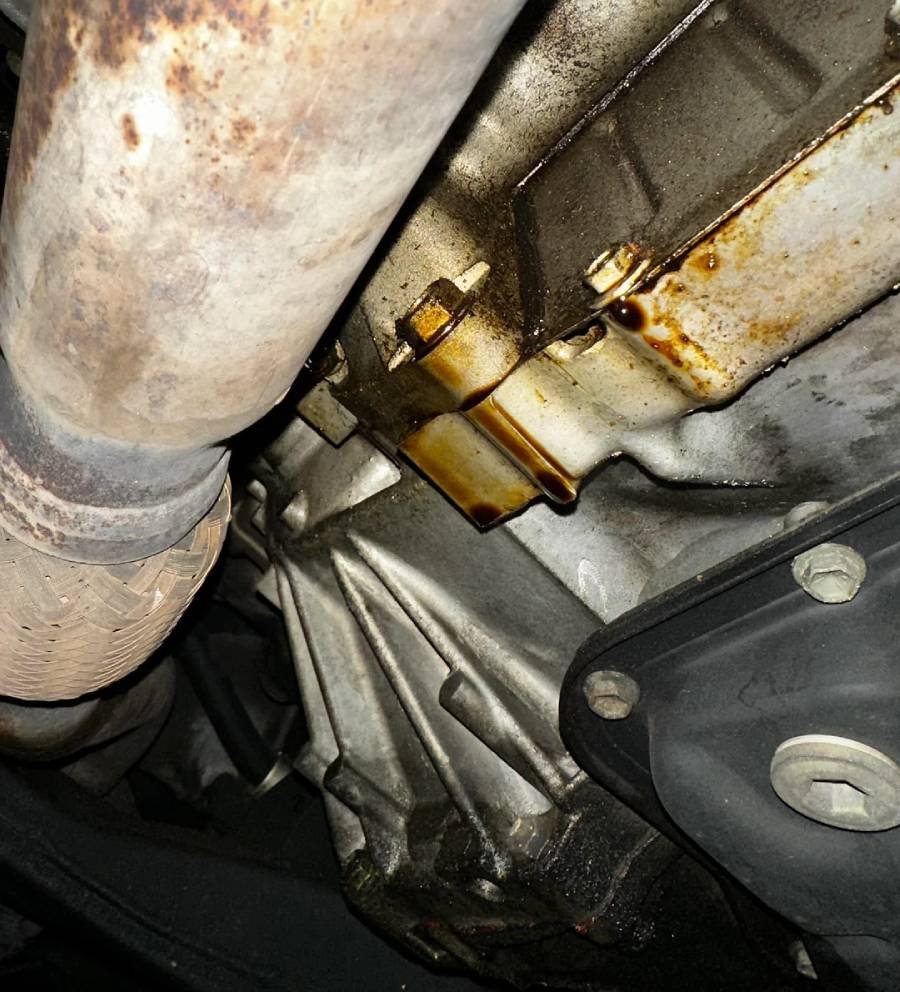
What Are the Most Common Causes of a Toyota Highlander Oil Leak?
A Toyota Highlander can leak engine oil from the valve cover gasket, timing cover, oil pan sealing area, drain plug, oil filter, crankshaft seal, or camshaft seal. The exact failure point varies by engine configuration, model year, mileage, maintenance history, and the location where fresh oil first appears. A wet component should not automatically be treated as the source because engine oil flows downward and can spread across adjacent surfaces while driving.
A valve cover gasket leak occurs when the seal between the valve cover and cylinder head no longer prevents engine oil from escaping. Heat cycles and aging can degrade sealing materials over time. Because the valve cover is located toward the top of the engine, escaping oil can travel down the engine before reaching the ground. This can make a valve cover leak appear to originate from a lower component. Oil residue around the valve cover perimeter is therefore more useful diagnostically than the location of a puddle under the vehicle.
A timing cover leak develops when oil escapes through a sealing surface around the timing cover. Oil from this area can spread along the front or side of the engine and continue downward, making the leak difficult to locate without cleaning the affected surfaces first. Timing cover repairs can also involve more labor than easily accessible external seals because technicians may need to remove multiple components to reach and reseal the cover.
The oil pan and its sealing surface are possible leak points at the bottom of the engine. Oil around the oil pan perimeter can indicate a sealing problem, while physical damage to the pan can create a separate leak. Because the oil pan is already at a low point on the engine, fresh oil concentrated around its sealing surface provides a stronger diagnostic clue than oil that has simply collected on the bottom of the engine after leaking from above.
The oil filter and drain plug should receive particular attention when a leak begins immediately after an oil change. An incorrectly installed filter, sealing problem, loose drain plug, damaged sealing washer, or damaged drain-plug threads can allow oil to escape after service. The timing of the symptom provides useful diagnostic context: a leak that appears directly after maintenance should prompt inspection of recently serviced components before unrelated seals are replaced.
The crankshaft and camshaft seals are additional possible sources of engine oil leakage. These seals prevent oil from escaping where rotating shafts pass through sealed areas of the engine. Seal deterioration or damage can allow oil to migrate onto nearby components. Locating these leaks accurately matters because replacing an internal or difficult-to-access seal can require substantially more disassembly than correcting an oil-filter or drain-plug leak.
What Are the Symptoms of an Oil Leak in a Toyota Highlander?
The main signs of a Toyota Highlander oil leak are oil spots under the vehicle, a falling engine oil level, visible oily residue, a burning-oil smell, and smoke when oil reaches a hot surface. These symptoms provide different information about the leak, so diagnosis should consider them together rather than relying on a single oil stain.
Dark or brown spots beneath the Highlander are one of the easiest signs to notice. However, the point where oil reaches the ground does not necessarily identify the leaking component. Oil can move down the engine, collect on covers or the splash shield, and travel rearward as air moves underneath the vehicle. For example, a leak beginning higher on the engine can eventually form a puddle below the oil pan area.
A declining oil level on the dipstick provides stronger evidence that engine oil is being lost, but it does not prove that an external leak is responsible. Engine oil can also be consumed internally without creating a visible puddle. A Highlander that repeatedly requires oil between scheduled services therefore needs diagnosis to distinguish external leakage from oil consumption rather than assuming both conditions have the same cause.
A burning-oil smell can develop when leaking oil reaches a hot engine or exhaust surface. The heat causes the oil to produce a noticeable odor and, when enough oil reaches the hot surface, visible smoke may appear from the engine compartment. This symptom requires more attention than a dry stain from an old leak because it indicates that oil is reaching an area hot enough to burn or vaporize it.
The combination of symptoms also helps indicate severity. A minor wet area around a gasket with a stable dipstick reading is different from an active leak that produces fresh puddles and a measurable decline in oil level. The second condition represents continuing oil loss and increases the risk that the engine will eventually operate with insufficient lubrication if the oil level is not monitored and the source is not repaired.
Where Should You Check for an Oil Leak on a Toyota Highlander?
To find a Toyota Highlander oil leak, inspect the engine from the highest visible oil residue downward, then check the lower engine, recently serviced components, and underbody. Oil follows gravity when the vehicle is stationary and can spread across engine surfaces or move rearward underneath the vehicle while driving. For this reason, the lowest wet component is not necessarily the component that is leaking.
Start at the top of the engine and work downward. Look for fresh oil, wet sealing surfaces, or accumulated oily residue around the valve cover area and other upper-engine sealing points. Oil originating high on the engine can run down the cylinder head and engine block before collecting around lower components. Finding fresh oil above an apparently leaking oil pan, for example, indicates that the lower wet area may be receiving oil from another source.
Next, inspect the lower engine and oil pan area. Look around the oil pan perimeter, drain plug, and nearby surfaces for fresh oil. The pattern matters: oil concentrated around a specific sealing edge provides more diagnostic value than a generally oily underbody. The engine splash shield can complicate this inspection because it can catch leaking oil and allow it to accumulate or spread before reaching the ground.
The oil filter and drain plug deserve an early inspection when the leak started after an oil change. Check for fresh oil around the filter sealing area and drain plug rather than immediately assuming an older engine gasket has failed. A strong time relationship between maintenance and the first appearance of a leak narrows the diagnostic process because these components were recently removed, replaced, or disturbed.
How Can You Tell Where the Oil Leak Is Coming From?
You can identify the source of an oil leak by cleaning existing oil residue, monitoring for fresh oil, and tracing the new oil toward its highest visible point. Old residue makes diagnosis unreliable because it does not show whether a component is still actively leaking. Cleaning the affected area creates a clearer starting point for determining where fresh oil first emerges.
Inspect the cleaned engine again after the vehicle has operated long enough for the leak to reappear. Follow fresh oil upward rather than following it toward the point where it drips onto the ground. For example, fresh oil beginning around an upper sealing surface and continuing down toward the oil pan indicates a different source from oil that first appears directly along the oil pan sealing area.
Leak rate also provides diagnostic information. A slow seep may create an oily film without producing a puddle, whereas an active leak can produce fresh drops and a measurable reduction in the dipstick reading. When the source remains unclear after visual inspection, professional diagnosis is preferable to replacing components based only on where oil happens to collect.
Is It Safe to Drive a Toyota Highlander With an Oil Leak?
Driving a Toyota Highlander with an oil leak depends on the leak rate, remaining engine oil level, warning indicators, and whether leaking oil is reaching hot components. A minor seep with a stable oil level presents a different situation from an active leak that rapidly removes oil from the engine. The amount of oil on the driveway alone is therefore not enough to determine whether continued driving is safe.
Engine oil maintains a lubricating film between moving engine components. Continued oil loss reduces the available oil supply, and an excessively low level can compromise lubrication. Increased friction then generates additional heat and accelerates wear on internal components. This creates a direct progression from oil loss → insufficient lubrication → increased friction and heat → accelerated wear → potential engine damage.
Oil reaching a hot engine or exhaust component creates another reason for concern. A burning-oil smell or visible smoke indicates that escaped oil is contacting a surface hot enough to vaporize or burn it. The problem is no longer limited to oil loss in this situation, so the leak source should be identified rather than simply topping up the engine oil and continuing to drive normally.
When Should You Stop Driving a Toyota Highlander With an Oil Leak?
Stop driving a Toyota Highlander when the leak causes rapid oil loss, the oil level becomes dangerously low, an oil-pressure warning appears, or substantial smoke develops from leaking oil contacting hot components. These signs indicate a higher-risk condition than minor surface seepage and should not be treated as a routine cosmetic leak.
An oil-pressure warning requires particular attention because oil level and oil pressure are not the same measurement. Adding oil should not be treated as proof that an oil-pressure problem has been resolved. Continuing to operate an engine without adequate lubrication can turn a repairable leak or lubrication problem into extensive internal engine damage.
Rapid leakage is another reason to stop driving. If fresh oil quickly reappears after being cleaned, a puddle forms in a short period, or the dipstick level drops noticeably over a limited driving distance, continued operation increases the chance that the engine will lose more oil than expected. The appropriate response is to identify and repair the source rather than relying on repeated top-offs.
A small seep should still be monitored even when immediate driving is possible. Seals and gaskets do not need to produce a large puddle before they warrant inspection. Recording the oil level and checking whether the wet area expands helps distinguish a stable seep from a leak that is progressively losing more oil.
How Do You Fix a Toyota Highlander Oil Leak?
To fix a Toyota Highlander oil leak, identify the exact leak source first and then repair or replace the failed seal, gasket, filter, plug, or other affected component. The correct repair depends on where fresh oil originates. Replacing a lower gasket because oil has collected at the bottom of the engine can fail to solve the problem when the oil is actually leaking from a higher sealing surface.
A leaking valve cover gasket is repaired by removing the valve cover, replacing the failed sealing material, cleaning the mating surfaces, and reinstalling the cover correctly. The surrounding area should then be cleaned and inspected again after the engine has operated. This final inspection matters because residual oil left on the engine can create the appearance that the replacement gasket is still leaking.
A timing cover leak generally requires resealing the affected cover rather than simply cleaning the external oil residue. Access can require removal of components positioned in front of or around the cover, which increases labor compared with an easily accessible external seal. The sealing surfaces must also be prepared correctly before the cover is reinstalled because the repair depends on restoring an oil-tight joint between mating surfaces.
An oil pan leak requires repair of the actual sealing point or damaged component. A leak originating along the oil pan sealing surface can require resealing, while a physically damaged pan may require replacement. Before performing either repair, oil running down from higher on the engine should be ruled out. Otherwise, a wet oil pan can be incorrectly diagnosed as the source when it is only collecting oil from another leak.
Oil leaks that begin immediately after an oil change should be traced to the recently serviced areas first. The oil filter, its sealing surface, the drain plug, and the drain-plug sealing hardware should be inspected for fresh oil. A loose or incorrectly sealed service component requires a different repair from an aged engine gasket, making the timing of the leak an important part of diagnosis.
A crankshaft or camshaft seal leak requires replacement of the failed seal after the leak location has been confirmed. Access requirements vary with engine configuration and seal location, so the amount of disassembly can be substantially greater than for an oil filter or drain-plug correction. This is one reason an accurate diagnosis has financial value: replacing the wrong component adds labor and parts costs without stopping the oil loss.
Oil additives marketed as stop-leak products should not replace diagnosis of the failed component. An oil leak is a symptom of a sealing, installation, or component problem. Identifying that problem establishes whether the repair requires a new gasket, a new seal, correction of a recently serviced component, or replacement of a damaged part.
How Much Does It Cost to Fix a Toyota Highlander Oil Leak?
The cost to fix a Toyota Highlander oil leak depends primarily on the leaking component, required parts, labor time, engine configuration, model year, and local labor rate. There is no single accurate repair price for every Highlander oil leak because correcting an accessible drain-plug problem requires substantially different work from removing components to reseal a timing cover.
The failed component is the first cost variable. A service-related leak involving a drain plug, sealing washer, or oil filter can require relatively limited parts and labor when no additional damage exists. Gasket and seal repairs become more expensive as the amount of disassembly required to reach the leaking area increases. For this reason, the price of the replacement seal itself does not necessarily indicate the final repair bill.
Labor access can account for a large portion of the repair cost. Two leaks may involve inexpensive sealing materials but require very different amounts of technician time. An externally accessible sealing point can be reached with limited disassembly, while a timing cover or difficult-to-access engine seal can require removal and reinstallation of multiple surrounding components. The repair estimate therefore needs to consider labor procedure as well as parts price.
The severity of the leak can also change the final bill when additional problems are discovered. A simple sealing failure is different from a leak involving damaged threads, a damaged oil pan, contaminated surrounding components, or another mechanical fault. Diagnosis should establish these conditions before a repair estimate is treated as final.
Exact dollar ranges should be matched to the specific Toyota Highlander model year, engine, leak source, and current labor market rather than presented as one universal price. A component-specific estimate is more useful than stating that a “Toyota Highlander oil leak costs X dollars to fix” without identifying the failed component.
Why Does Toyota Highlander Oil Leak Repair Cost Vary by Model Year?
Toyota Highlander oil leak repair costs vary by model year because different generations and powertrains can use different engine layouts, components, sealing designs, and repair procedures. These differences affect both the parts required and the amount of labor needed to reach the leaking component.
Component accessibility is particularly important. A repair that requires limited disassembly on one engine configuration can involve additional removal steps on another. Labor time changes accordingly even when the general diagnosis—such as a leaking engine seal or cover—is similar.
Model year should therefore be established before comparing repair estimates. The most useful estimate identifies the vehicle year, engine or powertrain configuration, confirmed leak source, required parts, and expected labor procedure. Comparing prices without these variables can create misleading expectations because two Toyota Highlanders with an “oil leak” may require entirely different repairs.
How Can You Tell Engine Oil From Other Fluids Leaking From a Toyota Highlander?
You can distinguish engine oil from other fluids leaking from a Toyota Highlander by checking the fluid’s appearance, consistency, smell, location, and whether the engine oil level is decreasing. Fluid color alone is not enough for a reliable diagnosis because engine oil changes appearance with use, and other automotive fluids can also become darker as they age or collect contaminants.
Engine oil generally has an oily, slippery consistency and can range from relatively light amber when fresh to dark brown or black after extended use. Finding a dark fluid beneath the engine therefore supports an engine-oil diagnosis, but the observation should be confirmed by checking the dipstick and inspecting the engine for fresh oil residue. A falling dipstick level combined with fresh external oil provides stronger evidence than the color of a driveway stain alone.
Coolant differs from engine oil in both function and consistency. Coolant circulates through the engine cooling system rather than the lubrication system and generally has a thinner, more watery consistency than engine oil. A suspected coolant leak should be traced toward cooling-system components rather than automatically classified as an oil leak because the two problems require different diagnostic procedures and repairs.
Transmission fluid should also be distinguished from engine oil before engine components are replaced. The location of the wet area, fluid characteristics, vehicle configuration, and affected fluid level help narrow the source. Fluid found beneath the vehicle can travel along covers and underbody surfaces, so the puddle location should be treated as a diagnostic clue rather than definitive proof of which system is leaking.
The most reliable approach is to combine several observations. Check the engine oil level, identify the highest point where fresh fluid appears, inspect the surrounding components, and determine whether the fluid returns after the area is cleaned. This process reduces the risk of diagnosing an engine oil leak based solely on a stain beneath the Toyota Highlander.
Read more: 10 Signs Your Toyota Highlander Needs Immediate Service
How Can You Prevent Oil Leaks in a Toyota Highlander?
You can reduce the risk and severity of Toyota Highlander oil leaks through regular oil-system inspections, correct oil-change procedures, routine oil-level checks, and early repair of developing seepage. Preventive maintenance cannot guarantee that every gasket or seal will remain leak-free because sealing materials and components can deteriorate with age, heat cycles, mileage, and operating conditions.
Inspecting for leakage during routine oil changes creates an opportunity to identify a developing problem before substantial oil loss occurs. The engine and lower underbody can be checked for fresh wet areas, accumulated oil residue, and changes from the previous service. A small new wet area has greater diagnostic value when previous inspections established that the same component was dry.
Correct installation of the oil filter and drain plug is particularly important because both components are handled during an oil change. Their sealing surfaces and related hardware need to create an oil-tight connection after service. When a leak first appears immediately after an oil change, these recently serviced components should be inspected before assuming an unrelated gasket failed at the same time.
Checking the dipstick regularly helps identify oil loss that may not produce a visible puddle. A splash shield can retain leaking oil, a slow leak can spread across engine surfaces, and some oil loss may occur without leaving an obvious driveway stain. Tracking the level over time provides evidence of whether the engine is losing a measurable quantity of oil between services.
Early diagnosis also limits the period during which escaped oil can spread across other components. Oil residue that accumulates over time makes the original source harder to identify because several surfaces can become wet. Cleaning and repairing a confirmed leak therefore improves both oil retention and the ability to detect a separate leak if one develops later.
Preventive maintenance should not be presented as a guarantee against all oil leaks. Aging seals, gaskets, sealing surfaces, and mechanical components can still develop faults even when the vehicle receives regular maintenance. The practical goal is to detect leakage early, maintain the correct oil level, and correct the underlying failure before oil loss threatens engine lubrication.
Does a Toyota Highlander Oil Leak Depend on the Model Year or Engine?
The possible source and repair procedure for a Toyota Highlander oil leak can depend on the model year, generation, engine, and powertrain configuration. Toyota Highlanders produced across different generations do not all use an identical engine layout, so a leak pattern or repair procedure identified for one configuration should not automatically be applied to every Highlander.
Engine configuration affects where components are located and how technicians access them. Valve covers, timing-related components, oil pans, seals, and surrounding parts can have different layouts depending on the powertrain. These differences influence both diagnosis and repair because oil may follow a different path down the engine and technicians may need different levels of disassembly to reach the same general type of sealing component.
Model year also matters when researching a suspected recurring problem. A report about an oil leak on one Highlander generation does not establish that the same component is a common failure across all model years. Claims such as “the most common Toyota Highlander oil leak” should therefore be supported by generation- or engine-specific evidence rather than inferred from isolated cases.
The same principle applies to repair costs. A useful Toyota Highlander oil leak estimate should identify the model year, powertrain, confirmed leaking component, parts required, and expected labor procedure. This explains why two Highlander owners can receive different repair estimates even when both initially describe the problem simply as an engine oil leak.
For owners diagnosing a leak, the practical sequence is to identify the model year and powertrain first, confirm that the leaking fluid is engine oil, locate the highest point of fresh oil, and then match the repair to that specific configuration. This approach is more reliable than applying a generic leak diagnosis to every Toyota Highlander.