A blinking Service Engine Soon light indicates an active engine or emissions-related fault that requires prompt diagnosis. On many vehicles, a flashing engine warning light is associated with a severe engine misfire. A misfire occurs when one or more cylinders fail to complete combustion correctly, which can allow unburned fuel to enter the exhaust system and raise the catalytic converter temperature.
Do not treat a blinking Service Engine Soon light the same as a routine maintenance reminder or automatically assume it has the same urgency as a solid warning light. The exact meaning depends on the vehicle manufacturer and model, but continued blinking—especially when accompanied by engine shaking, loss of power, overheating, smoke, or a strong fuel smell—requires immediate attention. Continuing to drive under severe conditions can increase the risk of catalytic converter or other vehicle damage.
This guide explains what a blinking Service Engine Soon light means, the main faults that can trigger it, when you should stop driving, and how the problem is diagnosed with symptoms, OBD-II trouble codes, and component testing. It also explains the repairs required for common causes such as engine misfires, worn spark plugs, failed ignition coils, fuel-delivery faults, and vacuum leaks.
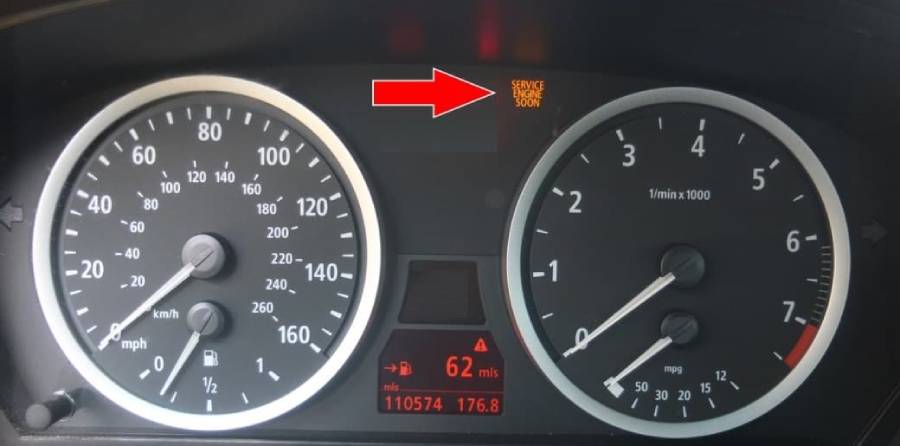
What Does a Blinking Service Engine Soon Light Mean?
A blinking Service Engine Soon light means the vehicle has detected an active fault that may require immediate attention. On vehicles that use the Service Engine Soon indicator as the Malfunction Indicator Lamp (MIL), repeated flashing is commonly associated with an engine or emissions-related problem severe enough to require prompt diagnosis. The exact warning strategy varies by manufacturer, model, and model year, so the vehicle owner’s manual remains important for interpreting the indicator correctly.
An engine misfire is one of the most important faults associated with a flashing engine warning light. A misfire occurs when combustion fails to occur correctly in one or more cylinders. The underlying problem can involve ignition, fuel delivery, air intake, engine timing, wiring, or another system that affects combustion. When the fault is severe enough, the vehicle’s onboard diagnostic system can detect abnormal combustion events and illuminate or flash the warning light.
The risk is not limited to poor engine performance. A severe misfire can allow unburned fuel to pass from the combustion chamber into the exhaust system. This fuel can burn inside the catalytic converter, increasing its operating temperature and potentially damaging the catalyst. For this reason, a continuously blinking engine warning light deserves more urgent attention than a warning that appears briefly and does not return.
The term “Service Engine Soon” can also create confusion because dashboard terminology differs among manufacturers. Some vehicles use Service Engine Soon for the engine malfunction indicator, while other dashboards have separate maintenance reminders. A maintenance reminder generally indicates scheduled service based on mileage or time, whereas a flashing malfunction indicator signals a detected operating fault. Identify which warning system your vehicle uses before assuming the light only means that routine maintenance is due.
How Serious Is a Blinking Service Engine Soon Light?
A blinking Service Engine Soon light can indicate a serious problem, particularly when the engine is misfiring, shaking, losing power, or producing other abnormal symptoms. The urgency depends on both the fault detected by the vehicle and how the engine is behaving when the warning appears. A flashing light accompanied by severe symptoms requires a different response from an intermittent warning when the vehicle otherwise operates normally.
Engine shaking is one of the clearest signs that the fault requires prompt attention. Each cylinder normally contributes power in a controlled sequence. When one or more cylinders misfire repeatedly, power delivery becomes uneven and the driver may feel vibration through the steering wheel, seat, or vehicle body. The same fault may also produce rough idling, hesitation, poor acceleration, or a noticeable reduction in engine power.
Several additional symptoms increase the urgency of a blinking warning light. Stop driving as soon as it is safe to do so when the vehicle develops severe shaking, substantial power loss, overheating, smoke, abnormal engine noises, or a strong fuel smell. An overheating warning or oil-pressure warning appearing at the same time requires particular attention because continued engine operation may increase the potential for mechanical damage.
A blinking light should still be diagnosed when it stops flashing or when no severe drivability symptoms are present. Intermittent faults can occur only at a specific engine speed, temperature, load, or operating condition. For example, an ignition component may perform normally at idle but fail when acceleration increases cylinder pressure and places greater demand on the ignition system. The warning disappearing therefore does not establish that the underlying fault has been repaired.
The practical distinction is between warning severity and diagnosis urgency. Severe symptoms can justify stopping the vehicle immediately and arranging roadside assistance or towing. A vehicle without severe symptoms still requires timely diagnosis because repeated operation with an active misfire or another combustion fault can turn a repairable problem into more expensive exhaust-system damage.
What Causes the Service Engine Soon Light to Blink?
There are 7 main fault categories that can cause or contribute to a blinking Service Engine Soon light: engine misfires, worn spark plugs, failed ignition coils, faulty fuel injectors, low fuel pressure, intake or vacuum leaks, and engine-management faults. These problems can disrupt combustion in one or more cylinders. When the resulting fault is severe enough to trigger the vehicle’s warning strategy, the Service Engine Soon light may flash instead of remaining steadily illuminated.
1. Engine misfire
An engine misfire is one of the most important conditions to investigate when the Service Engine Soon light starts blinking. A misfire means one or more cylinders are not completing combustion correctly. The engine control module monitors engine operation and can identify irregularities associated with individual or multiple cylinders.
A severe or repeated misfire can affect both engine performance and the exhaust system. Fuel delivered to a misfiring cylinder may not burn completely inside the combustion chamber. Unburned fuel can then enter the exhaust, where it can increase catalytic converter temperature. This relationship explains why a blinking engine warning light associated with an active misfire requires prompt diagnosis rather than simply clearing the warning code.
Common signs of a misfire include rough idle, engine shaking, hesitation, reduced acceleration, and loss of power. The symptoms may remain constant or appear only under specific conditions, such as acceleration, high engine load, or certain engine speeds.
2. Worn or fouled spark plugs
Worn or fouled spark plugs can cause the Service Engine Soon light to blink by preventing reliable ignition of the air-fuel mixture. A spark plug must produce a spark capable of initiating combustion at the correct point in the engine cycle. Excessive electrode wear, deposits, incorrect gap, or contamination can reduce that capability.
Spark-plug problems may become more noticeable as engine load increases. A plug that still fires adequately during light-load operation may misfire during harder acceleration when combustion conditions place greater demand on the ignition system. The driver may therefore notice a blinking warning light together with hesitation or shaking when accelerating while the engine appears smoother at idle.
Spark plugs should be inspected rather than automatically replaced solely because a misfire code is present. A cylinder-specific misfire can also originate from an ignition coil, injector, compression problem, wiring fault, or another condition affecting the same cylinder.
3. Failed ignition coil
A weak or failed ignition coil can produce an intermittent or continuous misfire because the affected cylinder does not receive sufficient ignition voltage. Coil-on-plug systems typically use an individual ignition coil for each cylinder, allowing a single failed coil to cause a cylinder-specific drivability problem while the remaining cylinders continue operating.
The resulting symptoms can include rough running, shaking, hesitation, reduced power, and a blinking engine warning light. A weak coil may also fail primarily under load, making the problem more obvious during acceleration or climbing a hill than during idle.
Diagnosis should confirm the coil fault before replacement. A technician can compare misfire data, inspect electrical connections, test the ignition system, and use appropriate component-testing procedures to determine whether the coil itself or another part of the cylinder’s ignition circuit is responsible.
4. Faulty fuel injector
A faulty fuel injector can cause a misfire by delivering too little fuel, too much fuel, or an inconsistent amount of fuel to a cylinder. A restricted injector can create a lean combustion condition, while a leaking injector can deliver excessive fuel. Either condition can interfere with normal combustion.
Injector-related faults may produce rough idle, hesitation, poor acceleration, increased fuel consumption, fuel odor, or cylinder-specific misfires. However, these symptoms overlap with ignition and air-intake problems. An OBD-II code identifying a misfiring cylinder therefore does not prove that its injector has failed.
Injector diagnosis can include electrical circuit checks, injector operation tests, fuel-system evaluation, and comparison with other cylinders. This process separates an actual injector problem from faults such as a damaged connector, ignition failure, or inadequate fuel pressure.
5. Low or unstable fuel pressure
Insufficient fuel pressure can prevent the engine from receiving the fuel volume required for stable combustion. The problem may involve the fuel pump, pressure-control components, restrictions in the fuel-delivery system, electrical supply, or another component that affects fuel pressure.
A fuel-pressure problem can become particularly noticeable when the engine requires more fuel. The vehicle may idle acceptably but hesitate, lose power, or misfire during acceleration because fuel demand has increased. A blinking Service Engine Soon light under load can therefore justify testing fuel delivery rather than assuming the problem is limited to spark plugs or ignition coils.
Fuel pressure should be measured and compared with the specifications for the specific vehicle. Replacing a fuel pump based only on a lean condition or misfire code can lead to an unnecessary repair when the actual problem lies elsewhere in the fuel or air-management system.
6. Intake or vacuum leak
An intake or vacuum leak can allow unmetered air to enter the engine. This additional air changes the air-fuel mixture and can create a lean condition, particularly at operating points where the leak represents a significant portion of the total airflow.
A substantial leak may result in rough idle, unstable engine speed, hesitation, lean-condition codes, or misfires. The effect can differ with engine speed and load, which means the warning light may not behave consistently under every driving condition.
Diagnosis involves locating the source of the unwanted airflow rather than simply replacing a sensor associated with a lean code. Intake hoses, vacuum lines, gaskets, and related connections are examples of areas that may require inspection, depending on the engine design.
7. Sensor, wiring, or engine-management fault
Sensor signals, electrical circuits, and engine-management components can contribute to a blinking warning light when they disrupt ignition, fuel delivery, timing, or the calculation of the air-fuel mixture. Relevant faults can involve airflow measurement, crankshaft or camshaft position signals, electrical connectors, damaged wiring, or other inputs required for correct engine operation.
These faults require diagnosis based on the specific trouble codes and operating data. A code associated with a sensor does not necessarily mean the sensor itself has failed. Damaged wiring, poor electrical connections, air leaks, mechanical problems, or another component can produce data outside the expected range and cause the ECM to detect a fault.
The correct diagnostic approach is therefore to identify the affected system first and test the suspected cause second. Do not replace components solely because their names appear in an OBD-II code description. The code provides diagnostic direction; component testing determines the repair.
Why Is the Service Engine Soon Light Blinking and the Car Shaking?
A blinking Service Engine Soon light combined with car shaking strongly indicates that the engine is running unevenly, with an active misfire being an important cause to investigate. Each cylinder should contribute power in a controlled sequence. When one or more cylinders fail to combust correctly, their power contribution becomes uneven and the resulting vibration can be felt through the vehicle.
The severity of the shaking can depend on how many cylinders are affected and how frequently the misfire occurs. A single intermittent misfire may create occasional hesitation or vibration, while a persistent cylinder misfire can produce continuous rough running. Multiple-cylinder misfires can cause more substantial shaking, poor acceleration, and noticeable power loss.
Shaking at idle can occur because uneven cylinder operation becomes easy to feel when engine speed is low. Shaking during acceleration can become more pronounced because the engine is under greater load and requires reliable ignition and fuel delivery from every cylinder. A weak ignition coil, worn spark plug, fuel-delivery problem, or another combustion fault may therefore become more apparent when the accelerator is pressed.
Do not continue driving normally when the blinking light is accompanied by severe shaking. Reduce engine load and move to a safe location because persistent misfiring can allow unburned fuel to reach the catalytic converter. Diagnosis should identify the affected cylinder or system and then determine whether the root cause involves ignition, fuel, air, electrical, or mechanical operation.
Why Does the Service Engine Soon Light Blink When Accelerating?
The Service Engine Soon light can blink during acceleration because higher engine load exposes combustion faults that may not be severe enough to appear at idle or during light cruising. Acceleration increases the engine’s demand for fuel, airflow, and reliable ignition. A marginal component can function adequately under low load but fail when those demands rise.
Ignition faults are one possible example. A worn spark plug or weak ignition coil may provide enough ignition performance for light-load operation but begin misfiring when the driver accelerates. The result can be hesitation, shaking, reduced power, and a warning light that flashes during the period of active misfire.
Fuel-delivery problems can produce a similar pattern. The engine requires more fuel as load increases. Insufficient fuel pressure, restricted delivery, or an injector problem can prevent a cylinder or multiple cylinders from maintaining the required mixture. Combustion then becomes unstable and the onboard diagnostic system may detect the resulting misfire.
A light that blinks only during acceleration should not be dismissed because it turns off when the accelerator is released. A load-dependent warning identifies an operating condition under which the fault occurs; it does not show that the fault has disappeared. Recording when the warning occurs and scanning the vehicle for stored diagnostic trouble codes can provide useful information for the next diagnostic step.
Can You Drive With a Blinking Service Engine Soon Light?
Driving with a blinking Service Engine Soon light is generally not recommended until the cause and severity of the fault are identified. A flashing engine warning can indicate an active malfunction, and continued driving may increase the risk of catalytic converter damage when a severe misfire is present. How quickly you need to stop depends on the vehicle’s behavior, the other warning lights displayed, and the symptoms occurring at the same time.
A vehicle that still runs smoothly without overheating, substantial power loss, smoke, unusual noises, or a strong fuel smell may allow enough time to move to a safe location. This does not mean the warning should be ignored. Reduce engine load, avoid unnecessary acceleration, and arrange diagnosis as soon as possible because an intermittent fault can become more severe as operating conditions change.
Stop driving as soon as it is safe when the blinking light occurs with severe engine shaking, substantial loss of power, overheating, smoke, abnormal mechanical noises, or a strong fuel smell. These symptoms indicate that continuing normal operation could increase the risk of damage or leave the vehicle unable to maintain safe performance. An oil-pressure or overheating warning appearing at the same time also requires immediate attention rather than continued driving to a distant repair facility.
Distance alone should not determine whether you continue driving. A repair shop may be only a few miles away, but operating an engine with a severe active misfire for those miles can continue sending unburned fuel into the exhaust. The safer decision is based on fault severity and vehicle behavior rather than whether the destination appears close enough to reach.
What Should You Do If the Service Engine Soon Light Starts Blinking While Driving?
Reduce engine load and move toward a safe stopping location when the Service Engine Soon light begins blinking while driving. Avoid hard acceleration and high engine speeds because additional load can make a combustion or ignition fault more pronounced. Maintain control of the vehicle and do not make an abrupt stop in an unsafe traffic position solely because the warning begins flashing.
There are 6 immediate actions to take when the warning appears:
- Reduce engine load. Ease off the accelerator and avoid demanding additional power from the engine.
- Avoid high RPM and hard acceleration. Aggressive acceleration can intensify a load-dependent misfire.
- Check the other warning indicators. Pay particular attention to engine temperature, oil pressure, and any additional critical warnings.
- Move to a safe location. Leave active traffic when it is safe to do so and evaluate how the vehicle is running.
- Shut the engine off when severe symptoms occur. Severe shaking, overheating, smoke, major power loss, abnormal noises, or a strong fuel smell are reasons not to continue normal operation.
- Arrange diagnosis or towing when necessary. Tow the vehicle when continued operation could increase damage or when the vehicle cannot be driven safely.
Do not attempt to solve the problem simply by restarting the engine. A restart may cause the warning to disappear temporarily when the underlying fault is intermittent, but it does not confirm that the ignition, fuel, air, electrical, or mechanical problem has been corrected. The diagnostic trouble code may also remain stored even when the dashboard light is no longer flashing.
The same principle applies to clearing codes with an OBD-II scanner. Erasing a trouble code can turn the warning light off without correcting the condition that generated it. Diagnosis should establish the root cause before the code is cleared and the vehicle is returned to normal use.
What Damage Can Happen If You Keep Driving With the Light Blinking?
Continued driving with a blinking Service Engine Soon light can damage the catalytic converter when the warning is caused by a severe engine misfire. The critical mechanism is incomplete combustion. Fuel that fails to burn correctly inside a misfiring cylinder can enter the exhaust system and expose the catalytic converter to an abnormal thermal load.
The process follows a direct sequence: misfire → incomplete combustion → unburned fuel enters the exhaust → fuel reacts or burns in the catalytic converter → converter temperature rises → catalyst damage can occur. The catalytic converter is designed to process exhaust pollutants, not to handle a continuous supply of unburned fuel from a severe combustion fault. Persistent overheating can damage the converter’s internal catalyst structure and reduce its ability to control emissions.
Catalytic converter damage can create additional vehicle problems. A damaged or restricted converter can affect exhaust flow, contribute to reduced engine performance, and trigger additional diagnostic trouble codes. The original ignition or fuel-system fault may therefore develop into a more extensive repair when the vehicle continues to operate with a severe misfire.
Continued misfiring also affects drivability before permanent exhaust damage occurs. Uneven cylinder output can produce shaking, hesitation, poor acceleration, and reduced power. These effects become particularly relevant in situations that require predictable engine response, such as merging into traffic or climbing a grade.
Not every blinking Service Engine Soon light proves that catalytic converter damage has already occurred. The blinking warning identifies a fault condition that requires diagnosis; the underlying cause, duration, severity, and vehicle-specific warning strategy determine the actual damage risk. Prompt diagnosis is therefore more reliable than either ignoring the warning or assuming that an expensive component has already failed.
How Do You Diagnose a Blinking Service Engine Soon Light?
Diagnose a blinking Service Engine Soon light by identifying the symptoms, scanning the vehicle for diagnostic trouble codes, reviewing the conditions under which the fault occurred, and testing the affected system before replacing parts. An OBD-II scanner provides a starting point, but the code alone does not establish which component has failed.
The diagnostic process should follow 5 main steps: identify the symptoms, retrieve diagnostic trouble codes, review available freeze-frame or live data, inspect the affected system, and test suspected components. This sequence helps distinguish an ignition problem from a fuel, air-intake, electrical, sensor, or mechanical fault.
Start by documenting how the vehicle behaves when the warning light flashes. Relevant details include whether the engine shakes, loses power, idles roughly, hesitates during acceleration, or develops the problem only at a specific engine speed or temperature. The operating condition matters because an intermittent misfire may appear under load while remaining difficult to reproduce at idle.
Next, connect an OBD-II scanner and retrieve stored, pending, and active diagnostic trouble codes when the scan tool supports those functions. These codes identify the systems or operating conditions in which the engine control module detected a problem. Freeze-frame data can provide additional context by recording vehicle conditions associated with a fault, such as engine speed, load, temperature, and other available parameters.
Use the code to narrow the diagnostic path rather than treating it as a replacement instruction. For example, a cylinder-specific misfire code identifies the cylinder in which the control system detected a misfire, but the root cause could involve a spark plug, ignition coil, injector, wiring, air leak, fuel delivery, or mechanical condition. Replacing the first component associated with a code can leave the actual fault unresolved.
Component testing comes after the affected system has been identified. An ignition-related diagnosis can require inspection of spark plugs, ignition coils, connectors, and wiring. A suspected fuel problem can require injector and fuel-pressure testing. Lean-operation symptoms can justify checking for intake or vacuum leaks. The exact procedure depends on the codes, symptoms, engine design, and manufacturer diagnostic information.
The final step is to confirm the repair. Clear codes only after the underlying fault has been corrected, then operate or test the vehicle under the conditions that previously triggered the problem. A successful repair should address both the warning and the drivability symptom rather than merely switching off the dashboard light.
Which OBD-II Codes Are Common With a Blinking Engine Warning Light?
P0300 and the P0301–P0308 range are important OBD-II codes to check when a blinking engine warning light is associated with a misfire. P0300 indicates a random or multiple-cylinder misfire, while codes in the P0301–P0308 range identify detected misfires associated with specific cylinders on engines that have those cylinder numbers.
For example, P0301 identifies a detected misfire associated with cylinder 1, while P0302 points to cylinder 2. The same numbering pattern continues through P0308 for cylinder 8. These codes help narrow the diagnostic area, but they do not state why combustion failed in the affected cylinder.
A P0301 code, for example, does not automatically mean cylinder 1 needs a new spark plug or ignition coil. The same code can require investigation of ignition, fuel delivery, wiring, air intake, or mechanical operation. The code describes the detected condition; testing identifies its cause.
P0300 requires a broader diagnostic approach because misfires are occurring randomly or across multiple cylinders rather than being isolated to one identified cylinder. Conditions affecting the entire engine, such as fuel-delivery problems, intake leaks, or other shared systems, may therefore need to be evaluated alongside cylinder-specific ignition and fuel components.
Other diagnostic trouble codes may appear with a blinking Service Engine Soon light depending on the underlying fault and the vehicle. Fuel-system, air-metering, sensor, ignition-circuit, or emissions-related codes can provide additional diagnostic context. Their relevance should be evaluated together with misfire data, symptoms, and operating conditions rather than interpreted independently.
An OBD-II scanner is therefore useful for answering where the diagnostic process should begin, not automatically which part should be replaced. Basic code readers may retrieve DTCs, while more capable scan tools can provide freeze-frame information, live data, misfire information, and manufacturer-specific functions when supported by the vehicle and tool. These additional data points can make it easier to reproduce the fault and isolate its root cause.
How Do You Fix a Blinking Service Engine Soon Light?
Fix a blinking Service Engine Soon light by repairing the fault that caused the warning, not by resetting the light or replacing parts based only on an OBD-II code. The correct repair depends on whether diagnosis identifies an ignition, fuel-delivery, air-intake, electrical, sensor, or mechanical problem.
For a worn or fouled spark plug, inspect the affected plug and related ignition components before replacing parts as required. Spark plugs deteriorate through electrode wear, deposits, contamination, or other conditions that interfere with reliable ignition. When worn plugs are confirmed as the cause of a misfire, replacement restores the spark required for consistent combustion. The remaining plugs should also be evaluated according to the vehicle’s service requirements rather than assuming that only the cylinder identified by a misfire code needs attention.
For a failed ignition coil, confirm that the coil cannot reliably provide ignition before replacing it. A cylinder-specific misfire may point toward an ignition problem, but the same cylinder can misfire because of a spark plug, injector, wiring, compression, or other fault. Testing the ignition circuit prevents a P0301, P0302, or similar code from becoming an automatic instruction to purchase a new coil.
For a faulty fuel injector, determine whether the problem involves fuel delivery through the injector itself or its electrical circuit. A restricted injector may deliver insufficient fuel, while a leaking injector can provide excessive fuel. Injector testing, circuit checks, and comparison with other cylinders help determine whether cleaning, electrical repair, or injector replacement is appropriate.
For low fuel pressure, diagnose the fuel-delivery system before replacing the fuel pump. Insufficient pressure can originate from several points in the system, depending on vehicle design. Pressure testing under the operating conditions that produce the fault can show whether fuel supply becomes inadequate as engine demand increases.
For an intake or vacuum leak, locate and seal the source of unmetered air. Hoses, connections, intake components, and gaskets are examples of areas that may require inspection. Repairing the leak restores control over the air entering the engine and can correct a lean condition or misfire when unwanted airflow is the root cause.
For a sensor, wiring, or electrical fault, test the relevant circuit and signal before installing a replacement component. A sensor-related trouble code can be produced by a damaged connector, wiring problem, abnormal input from another system, or operating condition outside the expected range. Replacing a sensor without confirming its failure can leave both the warning light and the original drivability problem unchanged.
Mechanical engine faults require a different diagnostic path. A cylinder can misfire even when its spark and fuel delivery are functioning correctly if it cannot produce the mechanical conditions required for combustion. When ignition, fuel, air, and electrical checks do not explain a persistent misfire, further mechanical testing may be required rather than repeatedly replacing external components.
The repair sequence should remain consistent: identify the fault → verify the root cause → repair or replace the failed component → clear the applicable codes → reproduce the original operating conditions → confirm that the fault does not return. This process fixes the condition responsible for the blinking warning instead of merely removing its visible dashboard symptom.
Will a Blinking Service Engine Soon Light Reset After the Problem Is Fixed?
A Service Engine Soon light may turn off after the underlying fault is corrected and the vehicle’s onboard diagnostic system confirms that the malfunction is no longer occurring. The exact behavior depends on the vehicle, the type of fault, and how its diagnostic monitor is designed. Repairing the problem therefore does not guarantee that every stored code disappears immediately.
The distinction between an active fault and a stored diagnostic trouble code is important. An active fault represents a condition that is currently being detected, while information about a previous malfunction can remain stored after the condition stops occurring. This allows a technician to retrieve diagnostic evidence even when the warning is no longer visible when the vehicle arrives for service.
Some diagnostic monitors need the vehicle to operate under specific conditions before determining whether a fault has been resolved. These conditions can include particular temperatures, speeds, loads, or other operating parameters. The warning may therefore change after the relevant monitor runs successfully rather than immediately after a component is repaired.
A scan tool can also be used to clear diagnostic trouble codes after the repair, but clearing a code is not the same as fixing the fault. If the underlying problem remains, the onboard diagnostic system can detect it again and the warning light can return. Clearing codes before diagnosis can also remove useful fault information that could have helped identify when and how the malfunction occurred.
Disconnecting the battery should not be treated as a repair method for a blinking Service Engine Soon light. Removing stored information or temporarily extinguishing a warning does not correct a failed ignition coil, worn spark plug, injector problem, vacuum leak, fuel-delivery fault, or another condition responsible for the malfunction.
The repair is complete when the root cause has been corrected and verification shows that the original problem no longer occurs. This means checking more than the dashboard indicator. The engine should operate normally under the conditions that previously produced shaking, hesitation, power loss, or blinking, and the diagnostic system should not continue identifying the same active fault.
What Is the Difference Between a Blinking and Solid Service Engine Soon Light?
A blinking Service Engine Soon light generally indicates a more urgent fault than a solid Service Engine Soon light when the indicator functions as the vehicle’s Malfunction Indicator Lamp. A solid light commonly means the onboard diagnostic system has detected an engine or emissions-related fault that requires diagnosis, while flashing can indicate a malfunction severe enough to require more immediate attention. The exact warning behavior depends on the manufacturer, model, and model year.
The practical difference is the urgency of the driver’s response. A solid light with normal engine operation usually allows the driver to arrange diagnosis without treating the warning as an immediate roadside emergency. The fault should still be investigated because problems involving emissions controls, sensors, fuel delivery, or engine operation can remain active even when drivability appears normal.
A blinking light requires greater caution because an active misfire can threaten the catalytic converter. The risk increases when flashing occurs together with engine shaking, hesitation, substantial power loss, or other abnormal behavior. Reduce engine load and move to a safe stopping location when these symptoms occur rather than continuing to drive normally.
Do not use light behavior alone to determine which component has failed. Solid versus blinking primarily communicates fault status or urgency; it does not diagnose the root cause. Retrieve the diagnostic trouble codes and test the affected system before deciding which repair is required.
Is the Service Engine Soon Light the Same as the Check Engine Light?
The Service Engine Soon light can serve the same function as the Check Engine light on vehicles that use “Service Engine Soon” as the label for the Malfunction Indicator Lamp (MIL). Dashboard terminology differs among manufacturers, so the wording printed beside an engine-related warning is not identical across all vehicles.
The MIL is part of the vehicle’s onboard diagnostic system and alerts the driver when a monitored engine or emissions-related malfunction is detected. Depending on the vehicle, the dashboard may identify this indicator with wording such as “Check Engine” or “Service Engine Soon,” or use an engine-shaped symbol. This is why two vehicles can display different labels for warnings that perform a similar diagnostic function.
A Service Engine Soon indicator should not automatically be confused with a scheduled maintenance reminder. Maintenance reminders are associated with service intervals or maintenance requirements rather than necessarily indicating an active engine malfunction. Depending on the vehicle, reminders can use labels such as maintenance required, service due, or manufacturer-specific messages.
Check the owner’s manual when the function of a particular dashboard indicator is unclear. The manual identifies what the manufacturer intended the warning to communicate and helps distinguish the MIL from oil-change reminders and other service indicators.
Can a Service Engine Soon Light Blink and Then Stop?
A Service Engine Soon light can blink and then stop when the fault is intermittent or occurs only under specific operating conditions. The warning disappearing does not prove that the underlying problem has repaired itself. The vehicle may simply no longer be operating under the conditions that caused the control system to detect the fault.
A load-dependent misfire provides a common diagnostic pattern. A weak ignition component may operate adequately while the engine is idling or cruising under light load but begin misfiring during hard acceleration. The warning can blink while the misfire is active and stop flashing after engine load decreases.
Temperature and engine speed can also influence intermittent faults. An electrical connection, fuel-delivery problem, air-intake fault, or other malfunction may become detectable only within a particular operating range. Recording whether the warning occurs during cold starts, acceleration, highway driving, or another repeatable condition can provide useful diagnostic context.
Diagnostic information may remain available even after the light stops blinking. Stored or pending trouble codes and available freeze-frame data can help identify what the control system detected. Treat a warning that stops flashing as an intermittent fault to investigate, not as confirmation that no fault remains.
Read more: i-ACTIVSENSE System Malfunction: Meaning, Causes, and Fixes
Should You Reset a Blinking Service Engine Soon Light Yourself?
Do not reset a blinking Service Engine Soon light as a substitute for diagnosing and repairing the underlying fault. Clearing diagnostic trouble codes can remove the visible warning temporarily, but it cannot repair an engine misfire, failed ignition component, fuel-delivery problem, vacuum leak, wiring fault, or mechanical problem.
Clearing codes before diagnosis can also remove useful diagnostic information. Stored trouble codes and freeze-frame data can show which fault was detected and the operating conditions present when it occurred. Removing this information before recording it can make an intermittent problem more difficult to reproduce and diagnose.
Resetting the diagnostic system can also affect readiness monitors. These monitors evaluate specific emissions-related systems under defined operating conditions. After codes are cleared or diagnostic information is reset, some monitors may need additional vehicle operation before they complete their checks again.
A better sequence is scan → record codes and available data → diagnose → repair → clear codes when appropriate → verify the repair. If the same fault returns after the codes are cleared, additional diagnosis is required because the condition responsible for the warning remains present.
Resetting the light is reasonable after the underlying problem has been identified and corrected, provided the procedure is appropriate for the specific vehicle. The goal is not simply to make the dashboard warning disappear. The goal is to restore normal engine operation and confirm that the fault responsible for the blinking Service Engine Soon light no longer occurs.