Tire alignment is the adjustment of a vehicle’s wheel angles to match manufacturer specifications so the wheels are positioned correctly relative to the road and each other. Also called wheel alignment, this service does not adjust the tires themselves. Instead, it corrects the angles of the wheels through the vehicle’s steering and suspension system.
The 3 primary alignment angles are camber, caster, and toe. Camber describes the inward or outward tilt of a wheel when viewed from the front. Caster refers to the angle of the steering axis when viewed from the side. Toe describes whether the wheels point slightly inward or outward when viewed from above. Vehicle manufacturers specify acceptable values for these angles because each one influences how the tires contact the road and how the vehicle responds to steering input.
Proper tire alignment is important because incorrect wheel angles can contribute to uneven tread wear, reduced tire life, vehicle pulling, an off-center steering wheel, and less predictable handling. This article explains how tire alignment works, why camber, caster, and toe matter, which signs indicate bad alignment, what causes alignment problems, and when an alignment inspection is appropriate.
What Is Tire Alignment?
Tire alignment is the process of measuring and adjusting the angles of a vehicle’s wheels so they meet the specifications established by the vehicle manufacturer. Although the term “tire alignment” is commonly used, wheel alignment is technically more precise because the adjustments are made through steering and suspension components that control wheel position rather than by modifying the tires themselves.
Proper alignment determines how each wheel sits relative to the road surface, the vehicle, and the other wheels. A technician measures specific wheel angles and compares the measurements with the manufacturer’s acceptable specifications. When an adjustable angle falls outside its specified range, the technician makes corrections through components in the steering or suspension system. The objective is to restore the intended wheel geometry rather than simply make the wheels appear straight.
Wheel alignment also affects how the tires interact with the road. A tire is designed to maintain an appropriate contact area with the road as the vehicle travels and responds to steering inputs. Incorrect wheel angles can change how forces are distributed across the tread. For example, excessive tilt can place more load on one side of a tire, while incorrect toe can cause the tire to scrub across the road instead of rolling in its intended direction.
Alignment specifications are not identical for every vehicle. Manufacturers establish specifications according to factors such as suspension design, steering geometry, vehicle configuration, and intended handling characteristics. For this reason, proper tire alignment means bringing the measurable and adjustable wheel angles within the specifications for the specific vehicle rather than applying one universal alignment setting.
What Are Camber, Caster, and Toe in Tire Alignment?
The 3 primary alignment angles are camber, caster, and toe. Each angle describes a different part of wheel or steering geometry and affects vehicle behavior in a different way. Camber primarily describes wheel tilt, caster describes the steering-axis angle, and toe describes the direction the wheels point relative to each other.
What Is Camber in Wheel Alignment?
Camber is the inward or outward tilt of a wheel when the vehicle is viewed from the front. A wheel has negative camber when its top tilts inward toward the vehicle and positive camber when its top tilts outward. The correct camber specification depends on the suspension design and manufacturer requirements.
Camber influences how the tire tread contacts the road. Excessive positive or negative camber can concentrate load toward one side of the tread rather than distributing it as intended. When this condition persists, the inner or outer portion of the tire can wear faster than the rest of the tread. Abnormal wear on one edge can therefore be associated with a camber problem, although tire wear alone is not enough to diagnose alignment.
Camber can also be affected by the condition of suspension components. Wear, damage, or changes in suspension geometry can move the wheel away from its specified angle. An alignment inspection measures the actual camber angle and determines whether it remains within the range specified for that vehicle.
What Is Caster in Wheel Alignment?
Caster is the forward or backward angle of the steering axis when the vehicle is viewed from the side. Unlike camber, caster does not primarily describe the visible tilt of the wheel. It describes the geometry of the axis around which the wheel turns during steering.
Caster contributes to directional stability and steering behavior. The appropriate caster geometry helps a vehicle track predictably in a straight line and contributes to the steering system’s tendency to return toward its centered position after a turn. A caster difference between the left and right sides can also influence how the vehicle tracks.
The required caster value depends on the vehicle’s suspension and steering design. Technicians therefore evaluate caster against vehicle-specific specifications instead of treating one angle as correct for every car. Caster may also have different adjustment possibilities depending on the suspension design.
What Is Toe in Wheel Alignment?
Toe is the angle that describes whether a pair of wheels points inward or outward relative to the vehicle’s centerline when viewed from above. Toe-in occurs when the fronts of the wheels point slightly toward each other. Toe-out occurs when they point away from each other.
Incorrect toe can have a direct effect on tire wear because the wheels may no longer roll in the intended parallel direction. Instead, the tires can experience lateral scrubbing as the vehicle moves forward. Continued scrubbing increases tread wear and can produce characteristic wear patterns across the tire surface.
Toe also influences directional behavior and steering response. The manufacturer specifies the intended toe setting according to the vehicle’s steering and suspension geometry. During an alignment, the measured toe is compared with that specification and adjusted when necessary. Together with camber and caster, toe provides the core geometric measurements used to determine whether the vehicle’s wheel alignment is within specification.
Why Is Tire Alignment Important?
Proper tire alignment is important because it helps maintain even tire wear, predictable steering, straight-line tracking, and the handling characteristics intended for the vehicle. Correct alignment keeps camber, caster, and toe within manufacturer specifications so each wheel operates at its intended angle relative to the road and the vehicle.
One major reason alignment matters is tire wear. Incorrect wheel angles change how forces act across the tire tread. Excessive camber can place more load on the inner or outer portion of a tire, while incorrect toe can make the tread scrub laterally against the road as the vehicle moves forward. Both conditions can cause sections of the tread to wear faster than intended. Maintaining correct alignment therefore helps the tread wear more evenly and prevents alignment-related wear from shortening usable tire life.
Alignment also affects how a vehicle tracks in a straight line. The wheels need to operate at coordinated angles for the vehicle to follow its intended direction without unnecessary steering correction. When alignment is outside specification, the driver may need to apply continuous steering input to maintain a straight path. A vehicle may also pull toward one side or feel less consistent during normal driving.
Steering behavior is another reason proper alignment matters. Caster, toe, and other aspects of suspension geometry influence how the vehicle responds when the driver turns the steering wheel and how it behaves as the steering returns toward center. Correct alignment supports predictable steering response because the wheel geometry remains within the range designed for the vehicle.
Tire alignment should therefore be viewed as part of both tire and suspension maintenance. Correct alignment does not eliminate every cause of tire wear or handling problems, but it removes incorrect wheel geometry as a source of abnormal tread loading and undesirable steering behavior.
What Are the Signs of Bad Tire Alignment?
There are 5 common signs of bad tire alignment: the vehicle pulls to one side, the steering wheel remains off-center, the tires wear unevenly, the steering feels inconsistent, or the vehicle has difficulty tracking straight. These symptoms can indicate that one or more wheel angles are outside specification, but an alignment measurement is required to confirm the condition.
Vehicle pulling to the left or right is one noticeable sign. A misaligned vehicle may drift toward one side while traveling on a relatively level, straight road, requiring the driver to make repeated steering corrections. Alignment is not the only possible cause of pulling, however. Tire pressure differences, tire condition, road slope, and suspension or steering problems can produce similar behavior.
An off-center steering wheel can also indicate an alignment problem. When driving straight, the steering wheel should normally sit close to its intended centered position. If the vehicle travels straight while the steering wheel remains noticeably rotated to one side, the relationship between steering position and wheel direction may require inspection. Alignment measurements can determine whether wheel geometry is contributing to the condition.
Uneven tire wear is another important sign because incorrect alignment changes how the tread contacts and moves across the road. Excessive camber can contribute to greater wear on one edge of a tire, while incorrect toe can produce abnormal wear as the tread repeatedly scrubs against the pavement. Inspecting wear across the full width of each tire can reveal patterns that justify a closer alignment and suspension check.
Inconsistent or unstable steering behavior can occur when wheel geometry no longer matches the vehicle’s specifications. The driver may notice that steering corrections are required more frequently or that the vehicle does not respond as predictably as expected. Because worn steering and suspension components can create similar symptoms, these components should be considered during diagnosis rather than assuming alignment is the only cause.
Difficulty tracking straight is the fifth common sign. A properly aligned vehicle should maintain a predictable direction under normal conditions without constant correction from the driver. When the vehicle repeatedly wanders away from its intended path, wheel alignment is one factor that should be checked alongside tire condition, tire pressure, steering components, and suspension components.
These signs should be treated as reasons to inspect alignment rather than definitive proof that the wheels are misaligned. For example, uneven tread wear can result from incorrect tire pressure as well as alignment, and vehicle pulling can be influenced by the road surface. Measuring camber, caster, and toe against manufacturer specifications provides a more reliable diagnosis than relying on symptoms alone.
What Causes Tire Alignment to Go Bad?
Tire alignment can go bad when an impact, worn steering or suspension component, or mechanical repair changes the position of a wheel relative to its specified alignment angles. Common triggers include hitting potholes, striking curbs, driving over severe road hazards, component wear, and replacing certain steering or suspension parts. The underlying issue is a change in wheel or suspension geometry that moves camber, caster, or toe outside the vehicle manufacturer’s specifications.
Potholes can contribute to alignment problems because a wheel and suspension assembly absorb a substantial force when the tire enters or strikes the edge of a pothole. A sufficiently strong impact can affect the position of steering or suspension components and alter wheel geometry. The vehicle may then develop symptoms such as pulling, an off-center steering wheel, or abnormal tire wear. A minor pothole impact does not automatically cause misalignment, so alignment should be measured when symptoms appear or the impact was severe enough to raise concern.
Hitting a curb can affect alignment through a similar mechanism. A direct impact places force on the wheel, tire, steering linkage, and suspension components. The risk depends on factors such as impact direction, speed, and the condition of the affected components. Visible wheel or tire damage after a curb strike also requires attention because alignment adjustment alone cannot correct a bent wheel, damaged tire, or failed suspension component.
Worn steering and suspension parts can create alignment problems even without a single major impact. Components such as tie rods, ball joints, control arms, and suspension bushings help control wheel position as the vehicle moves. Wear can introduce unwanted movement into the assembly, preventing the wheel from consistently maintaining its intended geometry. In this situation, performing an alignment without addressing the worn component may not provide a lasting correction.
Certain steering and suspension repairs can also require an alignment check. Replacing a component that influences wheel position can change the geometry that existed before the repair. The appropriate procedure depends on the vehicle and the component replaced, but measuring alignment after relevant repairs confirms whether the wheels remain within specification.
Normal vehicle use does not mean that alignment must become incorrect at a fixed mileage. Road conditions, impacts, component condition, suspension design, and repair history all affect alignment. For this reason, symptoms and vehicle-specific maintenance requirements provide a stronger basis for deciding when to inspect alignment than assuming every vehicle needs the same alignment interval.
What Happens If You Drive With Bad Tire Alignment?
Driving with bad tire alignment can accelerate uneven tire wear and make the vehicle require more steering correction because the wheels are no longer operating at their intended angles. The severity of these effects depends on which alignment measurement is incorrect and how far it has moved outside specification.
Abnormal tire wear is one of the clearest long-term consequences. A tire is intended to roll across the road with its tread loaded according to the vehicle’s suspension geometry. Excessive camber can concentrate loading toward one side of the tread, while incorrect toe can make the tire scrub laterally as it rolls. Repeated over thousands of wheel rotations, these conditions can remove tread unevenly and reduce the useful life of the affected tire.
Uneven wear also creates a practical maintenance problem because correcting the alignment does not restore tread that has already been removed. An alignment can correct the wheel geometry responsible for future abnormal wear, but an extensively worn tire may still require replacement. Identifying alignment problems before severe tread wear develops can therefore prevent usable tread from being lost prematurely.
Bad alignment can also affect straight-line tracking. When wheel angles do not correspond with their intended specifications, the vehicle may tend to move away from its desired path. The driver then compensates through repeated steering inputs. The result can be a vehicle that feels less predictable even though the driver can still keep it traveling in the intended direction.
The effect should not be overstated as proof of every steering or tire problem. Pulling, wandering, vibration, and abnormal tire wear can also result from tire-pressure differences, damaged tires, wheel imbalance, or worn steering and suspension components. Bad alignment is one possible cause within this diagnostic context. Measuring the wheel angles and inspecting related components separates an actual alignment problem from conditions that produce similar symptoms.
Continuing to drive without investigating clear alignment symptoms allows the underlying condition to persist. An alignment inspection can determine whether camber, caster, or toe is outside specification and whether adjustment alone is appropriate or a damaged or worn component needs attention first.
How Is Tire Alignment Checked and Corrected?
Tire alignment is checked by measuring the vehicle’s wheel angles, comparing the measurements with manufacturer specifications, and adjusting applicable steering or suspension settings when an angle is outside its specified range. A typical alignment process follows 5 stages: vehicle inspection, alignment measurement, specification comparison, adjustment, and final verification.
The process should begin with an inspection because an alignment adjustment cannot correct every mechanical problem that affects wheel position. Tires, wheels, and relevant steering and suspension components need to be in suitable condition before accurate adjustments are made. For example, excessive movement in a worn tie rod, ball joint, or suspension bushing can prevent a wheel from maintaining a consistent position. A damaged component may therefore need repair before the alignment can be corrected properly.
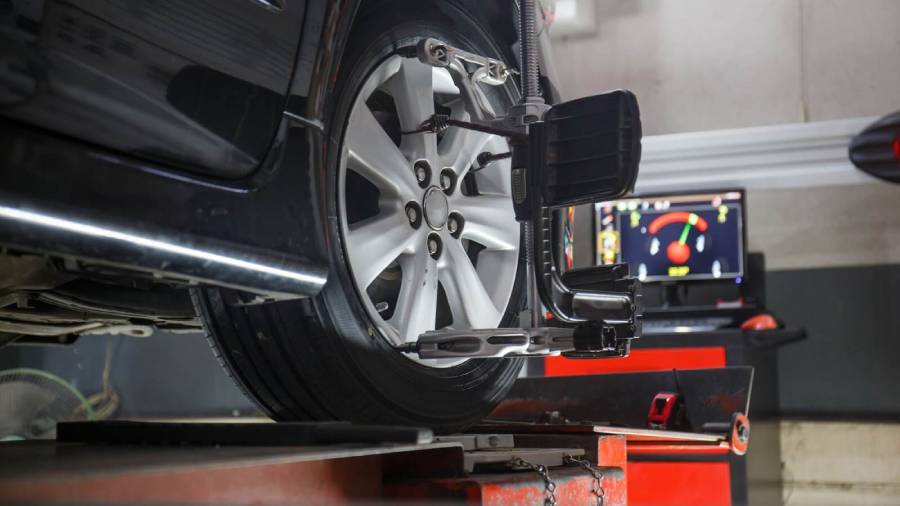
Alignment equipment then measures wheel geometry. Sensors or targets associated with the wheels allow the alignment system to determine measurements such as camber, caster, and toe. These measurements are compared with specifications for the vehicle. This comparison is important because there is no single camber, caster, or toe setting that applies to every car. Correct values depend on the vehicle’s suspension and steering design.
When an adjustable measurement falls outside specification, the technician makes the appropriate correction through the vehicle’s steering or suspension system. Toe, for example, can be adjusted on many vehicles through the steering linkage. The available adjustments for camber and caster depend on the suspension design. Some vehicles provide direct adjustment, while other configurations may require a different repair procedure when a measurement is outside specification.
The final step is verification. Wheel angles are measured again after the adjustments to confirm that applicable measurements are within the required specifications. This step distinguishes an actual alignment procedure from simply inspecting the tires or visually checking whether the wheels appear straight.
What Happens During a Tire Alignment Service?
During a tire alignment service, a technician measures wheel geometry and corrects adjustable angles that do not meet the vehicle’s specifications. The service does not physically align the tire tread or change the shape of a tire. Instead, it works through the steering and suspension geometry that determines wheel position.
A vehicle may also require additional attention before an alignment can be completed successfully. A bent component, damaged wheel, or excessively worn steering or suspension part cannot necessarily be corrected by changing alignment settings. Identifying these conditions first prevents an adjustment from being used as a substitute for a necessary mechanical repair.
The completed service should leave applicable wheel angles within the specified range and establish the intended relationship among the wheels, suspension, steering system, and road. However, alignment does not repair tire wear that has already occurred. If a tire has developed substantial abnormal tread wear before the alignment is corrected, the remaining tire condition must be evaluated separately.
When Should You Get a Tire Alignment?
You should get a tire alignment checked when the vehicle develops alignment-related symptoms, experiences a significant road impact, shows abnormal tire wear, or undergoes steering or suspension work that can affect wheel geometry. A fixed mileage interval should not be treated as a universal rule because alignment requirements differ according to vehicle design, manufacturer guidance, road conditions, component condition, and driving history.
An alignment inspection is appropriate when the vehicle consistently pulls to one side, does not track straight, or has a steering wheel that remains noticeably off-center during straight-line driving. These symptoms do not prove that alignment is incorrect, but they provide a reason to measure the wheel angles and inspect other potential causes.
Abnormal tire wear is another trigger. Uneven wear concentrated on an inner or outer tread area or other unusual wear patterns can justify checking alignment. Tire pressure and tire condition should also be examined because alignment is not the only cause of irregular tread wear. Measuring wheel geometry establishes whether camber, caster, or toe is actually outside specification.
A significant pothole or curb impact can also justify an inspection, particularly when the vehicle behaves differently afterward. The impact itself does not confirm misalignment. The relevant question is whether the force changed wheel geometry or damaged a component that controls wheel position.
Alignment should also be considered after steering or suspension repairs that affect wheel geometry. Components such as tie rods, control arms, ball joints, and related suspension parts influence wheel position. The exact requirement depends on the repair and vehicle, so vehicle-specific service information should determine whether an alignment check is required.
The most reliable approach is therefore to base alignment checks on vehicle symptoms, tire-wear patterns, significant impacts, relevant repairs, and manufacturer guidance rather than assuming that every vehicle requires alignment after the same number of miles. An alignment measurement can then determine whether adjustment is actually necessary.
What Is the Difference Between Tire Alignment and Tire Balancing?
Tire alignment adjusts wheel angles, while tire balancing corrects uneven weight distribution in a wheel-and-tire assembly. The 2 services address different mechanical conditions and should not be treated as interchangeable solutions. Alignment focuses on wheel geometry, including camber, caster, and toe, whereas balancing focuses on how mass is distributed as the wheel and tire rotate.
A wheel alignment is needed when measurable wheel angles fall outside the vehicle manufacturer’s specifications. Incorrect alignment can contribute to symptoms such as uneven tread wear, vehicle pulling, an off-center steering wheel, and poor straight-line tracking. The correction involves adjusting applicable steering or suspension settings to restore the intended wheel geometry.
Tire balancing addresses a different mechanism. A wheel-and-tire assembly can have small differences in mass around its circumference. As the assembly rotates, an imbalance can produce vibration that becomes noticeable through the steering wheel, seat, or vehicle body at certain speeds. Balancing identifies these weight differences and uses balancing weights to compensate for them.
The symptoms can overlap enough to cause confusion, but the distinction is important for diagnosis. Pulling and alignment-related tread wear point more directly toward wheel geometry, while speed-related vibration can indicate a wheel-and-tire balance problem. Neither symptom should be used as a diagnosis by itself because tire damage, wheel damage, and steering or suspension problems can produce similar effects.
A vehicle can also require both services at the same time. Correctly balancing a wheel does not change camber, caster, or toe, and performing an alignment does not correct an uneven distribution of mass around a wheel-and-tire assembly. Each condition must therefore be measured and corrected according to its own cause.
Does Tire Pressure Affect Wheel Alignment?
Tire pressure does not directly change the wheel alignment angles measured as camber, caster, and toe, but incorrect pressure can affect tire wear and vehicle behavior in ways that resemble an alignment problem. Tire pressure and wheel alignment are separate maintenance factors even though both influence how tires perform on the road.
Incorrect inflation changes how a tire supports the vehicle and how its tread contacts the road. Underinflation or overinflation can produce abnormal tread wear over time. Because uneven wear is also associated with incorrect alignment, looking only at the tread without considering tire pressure can lead to an incomplete diagnosis.
Pressure differences between tires can also affect how a vehicle feels while driving. If one tire is significantly different from the appropriate pressure, vehicle behavior may change enough for the driver to suspect an alignment issue. Tire pressures should therefore be checked when investigating pulling, unusual tire wear, or changes in handling rather than assuming wheel geometry is responsible.
Correcting tire pressure does not adjust alignment angles. If camber, caster, or toe is outside specification, those measurements still require an alignment assessment and, where applicable, adjustment. Conversely, performing an alignment does not correct an improperly inflated tire. Checking both conditions helps distinguish tire-related symptoms from actual wheel-geometry problems.
Does Tire Rotation Fix Bad Alignment?
No. Tire rotation does not fix bad alignment because moving tires between positions does not correct camber, caster, or toe. Tire rotation and wheel alignment perform different maintenance functions: rotation changes where individual tires operate on the vehicle, while alignment corrects the geometry that determines wheel position.
Tire rotation is used to manage differences in tread wear among tire positions. Front and rear tires can experience different loads and forces depending on vehicle configuration, steering, braking, and drivetrain layout. Moving tires according to an appropriate rotation pattern can help distribute this wear across the tire set.
An alignment problem remains present after the tires are rotated if the underlying wheel angles remain outside specification. For example, moving a tire that has developed abnormal wear does not correct excessive camber or incorrect toe at the wheel position responsible for that wear. A tire placed in that position later can be exposed to the same geometry-related wear mechanism.
Rotation also cannot reverse tread wear that has already occurred. If misalignment has worn one section of a tire excessively, correcting the alignment can address the geometry responsible for future wear, but it cannot restore lost tread depth. The existing tire condition must still be evaluated independently.
Tire rotation and alignment can therefore complement each other within a tire-maintenance strategy, but one does not replace the other. Rotation manages tire position and wear distribution; alignment manages wheel geometry. Keeping this distinction clear helps identify the appropriate service when abnormal tire wear or vehicle-handling symptoms appear.