When you pull into a gas station, one simple question can make a significant difference in your vehicle’s performance and operating costs: what type of gas should you put in your Toyota Camry?
With multiple fuel grades available at the pump, many drivers wonder whether regular gasoline is enough or if premium fuel offers better performance. The confusion becomes even greater for owners of newer Camry models, hybrid variants, or drivers purchasing a used Camry from a different model year. Choosing the wrong fuel can lead to unnecessary expenses, while using a higher-octane fuel than required often provides little to no real benefit.
The Toyota Camry has long been recognized as one of the most reliable and fuel-efficient midsize sedans on the market. Part of its popularity comes from its ability to deliver excellent performance while keeping ownership costs relatively low. Understanding the correct fuel requirements is an important step toward maximizing fuel economy, protecting your engine, and avoiding wasted money at the gas station.
In this complete fuel guide, you’ll learn exactly what type of gas a Toyota Camry uses, whether premium gasoline is necessary, fuel recommendations by model year, and practical tips to help improve fuel efficiency. By the end of this article, you’ll know precisely which fuel is best for your Camry and why.
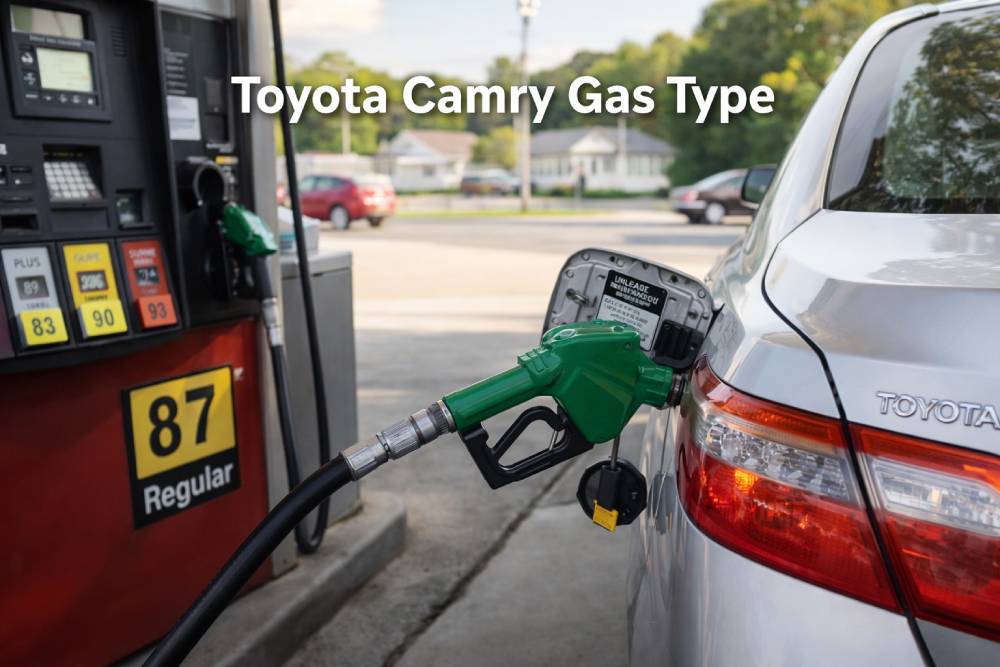
Quick Answer: What Type of Gas Does a Toyota Camry Use?
If you’re looking for a quick answer, most Toyota Camry models are designed to run on regular unleaded gasoline with an octane rating of 87. This recommendation applies to the vast majority of Camry vehicles produced over the past two decades, including many of the latest models and hybrid versions.
Toyota engineers carefully design Camry engines to deliver optimal performance, efficiency, and reliability using regular unleaded fuel. As a result, drivers typically do not need to spend extra money on premium gasoline. Unless your owner’s manual specifically recommends a higher octane fuel, regular 87 octane gasoline is the most cost-effective choice.
For most drivers, using premium gasoline will not significantly improve horsepower, fuel economy, or engine longevity. In many cases, the additional cost simply increases fuel expenses without providing measurable benefits.
Key Fuel Recommendation for Most Toyota Camry Models:
• Fuel Type: Regular Unleaded Gasoline
• Minimum Octane Rating: 87
• Premium Fuel Required: No
• Hybrid Models: Regular Unleaded Gasoline
• Best Practice: Always consult your owner’s manual for confirmation
By following Toyota’s fuel recommendations, you can keep your Camry running efficiently while avoiding unnecessary fuel costs.
Understanding Toyota Camry Fuel Requirements
To understand why Toyota recommends regular gasoline for most Camry models, it helps to understand how fuel octane ratings work.
An octane rating measures a fuel’s ability to resist premature combustion inside the engine. When fuel ignites too early, it can create a condition known as engine knocking or pinging. Over time, severe knocking can reduce engine efficiency and potentially cause damage.
Many drivers assume that premium gasoline is always better because it has a higher octane rating. In reality, octane is not a measure of fuel quality or energy content. It simply indicates how resistant the fuel is to knocking under high compression conditions.
Most Toyota Camry engines are engineered with compression ratios that operate perfectly on regular 87-octane gasoline. Since the engine does not require higher knock resistance, using premium fuel typically offers little advantage.
In the United States, gasoline is generally available in three common grades:
Regular gasoline typically carries an 87-octane rating and is the fuel recommended for most Toyota Camry models.
Mid-grade gasoline usually has an octane rating of 89 and is occasionally chosen by drivers seeking a middle-ground option, although it is rarely necessary for Camry engines.
Premium gasoline generally ranges from 91 to 93 octane and is intended for high-performance or luxury vehicles that specifically require it.
Because the Camry focuses on efficiency, reliability, and affordability, Toyota recommends regular unleaded fuel for most drivers.
Toyota Camry Gas Type by Model Year
One reason the Toyota Camry remains popular is its consistency. Across multiple generations, Toyota has maintained straightforward fuel requirements that help owners save money while enjoying dependable performance.
Camry models produced between 2000 and 2011 typically use naturally aspirated four-cylinder and V6 engines designed to run on regular 87-octane gasoline. These vehicles were engineered for daily commuting and long-term reliability, making regular fuel the ideal choice.
Models manufactured from 2012 through 2017 introduced improvements in engine efficiency and fuel economy. Despite these upgrades, Toyota continued recommending regular unleaded gasoline for most trim levels. Owners of these vehicles can confidently fill up with 87-octane fuel without worrying about reduced performance.
The eighth-generation Camry, introduced for the 2018 model year, brought significant advancements through Toyota’s Dynamic Force engine technology. These modern powertrains offer improved fuel efficiency, stronger performance, and lower emissions. Even with these technological improvements, Toyota still recommends regular unleaded gasoline for most configurations.
Hybrid versions of the Toyota Camry follow the same principle. Whether you own an older hybrid or the latest model, regular 87-octane gasoline remains the recommended fuel type. The hybrid system is designed to maximize efficiency without requiring premium fuel.
The following table provides a simple overview:
2000–2011 Toyota Camry: Regular Unleaded Gasoline (87 Octane)
2012–2017 Toyota Camry: Regular Unleaded Gasoline (87 Octane)
2018–2026 Toyota Camry: Regular Unleaded Gasoline (87 Octane)
Toyota Camry Hybrid Models: Regular Unleaded Gasoline (87 Octane)
For the majority of Camry owners, fuel selection is refreshingly simple. Filling up with regular unleaded gasoline allows the vehicle to perform exactly as Toyota intended while helping drivers minimize operating costs.
Can You Put Premium Gas in a Toyota Camry?
One of the most common questions among Toyota Camry owners is whether premium gasoline can be used instead of regular fuel. The simple answer is yes. Premium gasoline will not harm your Camry’s engine. In fact, modern engine management systems can easily accommodate higher-octane fuel.
However, the more important question is whether premium gasoline provides any meaningful benefit. For most Toyota Camry models, the answer is no.
Premium gasoline contains a higher octane rating, typically between 91 and 93. This higher rating is designed for engines with greater compression ratios or turbocharged systems that require additional resistance to engine knocking. Since most Camry engines are specifically engineered to operate on 87-octane fuel, they do not need the extra knock protection offered by premium gasoline.
Some drivers report slightly smoother engine operation after switching to premium fuel. Others believe their vehicles accelerate more responsively. In reality, these differences are often difficult to measure in everyday driving conditions. Independent testing has consistently shown that vehicles designed for regular fuel rarely experience noticeable performance gains from premium gasoline.
The biggest downside is cost. Premium fuel often costs significantly more per gallon. Over the course of a year, the extra expense can add up quickly without delivering meaningful improvements in fuel economy or engine performance.
For example, if a driver consumes 600 gallons of fuel annually and premium gasoline costs $0.60 more per gallon than regular fuel, the additional annual expense would exceed $350. For many Camry owners, that money could be better spent on maintenance, tire replacements, or other vehicle-related expenses.
Unless Toyota specifically recommends premium fuel for your particular model or engine configuration, regular unleaded gasoline remains the smartest financial choice.
What Happens If You Use the Wrong Fuel?
Using the wrong fuel occasionally is not always a disaster, but understanding the potential consequences can help prevent costly mistakes.
If you accidentally fill your Toyota Camry with premium gasoline instead of regular fuel, there is generally no reason to worry. The vehicle will continue operating normally, and the engine management system will adjust accordingly. The primary consequence is simply spending more money than necessary.
The situation becomes more serious when lower-octane fuel is used in a vehicle that requires a higher octane rating. While this is uncommon for most Camry models, some engines may experience knocking, reduced performance, or decreased fuel efficiency if the recommended fuel requirements are ignored for extended periods.
Fortunately, most modern Camrys are equipped with sophisticated sensors that monitor combustion conditions. These systems can often adjust ignition timing to minimize the risk of engine damage. However, consistently using fuel below the manufacturer’s recommendation is never advisable.
A much more serious mistake occurs when diesel fuel is accidentally pumped into a gasoline-powered Toyota Camry. Gasoline and diesel engines operate differently and require entirely different fuel systems. Starting the vehicle after adding diesel fuel can lead to significant repairs involving the fuel injectors, fuel pump, and related components.
If diesel fuel is mistakenly added to a Camry, do not start the engine. Instead, arrange for the vehicle to be towed to a qualified repair facility where the fuel system can be properly drained and inspected.
Paying close attention at the fuel pump can prevent unnecessary repairs and ensure your Camry continues operating reliably.
Toyota Camry Hybrid Fuel Type
As hybrid vehicles become increasingly popular, many prospective buyers wonder whether the Toyota Camry Hybrid requires special fuel. The good news is that fuel selection remains simple.
Toyota Camry Hybrid models are designed to run on regular unleaded gasoline with an 87-octane rating. Despite their advanced hybrid technology, these vehicles do not require premium gasoline.
The Camry Hybrid combines a gasoline engine with an electric motor to maximize efficiency and reduce fuel consumption. Toyota carefully engineered the hybrid powertrain to achieve excellent fuel economy while maintaining low operating costs. Requiring premium fuel would increase ownership expenses and undermine one of the hybrid’s key advantages.
Because the electric motor assists the gasoline engine during acceleration and low-speed driving, the engine often operates under lighter loads than in a conventional vehicle. This efficient design further reduces the need for higher-octane fuel.
Many Camry Hybrid owners enjoy exceptional fuel economy ratings that can significantly reduce annual fuel expenses. Depending on driving habits and model year, hybrid versions often achieve substantially better fuel efficiency than their gasoline-only counterparts.
For drivers focused on minimizing fuel costs, the combination of regular unleaded gasoline and hybrid efficiency creates an attractive ownership experience. There is no need to pay extra for premium fuel when Toyota’s engineering has already optimized the system for regular gasoline.
Whether you own a traditional Camry or a Camry Hybrid, filling up with 87-octane regular unleaded gasoline remains the recommended and most economical choice.
Tips to Improve Toyota Camry Fuel Economy
Choosing the correct fuel is only one part of maximizing efficiency. Even though the Toyota Camry is known for its excellent fuel economy, driving habits and maintenance practices can significantly affect how many miles you get from every gallon.
One of the simplest ways to improve fuel efficiency is maintaining proper tire pressure. Underinflated tires create additional rolling resistance, forcing the engine to work harder. Checking tire pressure regularly can improve fuel economy while also extending tire life and enhancing safety.
Driving style also plays a major role in fuel consumption. Rapid acceleration, aggressive braking, and high-speed driving can dramatically reduce fuel efficiency. Smooth acceleration and maintaining a consistent speed allow the engine to operate more efficiently and consume less fuel.
Routine maintenance should never be overlooked. Replacing air filters when necessary, following recommended oil change intervals, and keeping the engine properly tuned can help maintain optimal performance. A well-maintained Camry is more likely to deliver the fuel economy figures Toyota intended.
Using fuel from reputable gas stations is another smart practice. High-quality gasoline often contains detergents and additives that help keep fuel injectors and engine components cleaner over time. Cleaner fuel systems contribute to more efficient combustion and smoother operation.
Reducing unnecessary weight can also improve efficiency. Carrying heavy items in the trunk or transporting cargo that is not needed increases the vehicle’s workload. Removing excess weight can provide modest but measurable fuel savings.
Planning routes effectively can further reduce fuel consumption. Avoiding heavy traffic, minimizing idle time, and combining multiple errands into a single trip can help maximize fuel economy throughout the year.
While no single strategy will dramatically transform fuel consumption, combining these habits can result in noticeable savings over the life of the vehicle.
Frequently Asked Questions
No. Most Toyota Camry models are designed to run on regular unleaded gasoline with an octane rating of 87. Premium gasoline is generally not required unless specifically stated in the owner’s manual.
For most Camry models, premium gasoline provides little to no measurable improvement in performance, fuel economy, or engine longevity. Since the engine is optimized for regular fuel, the benefits of premium gasoline are usually minimal.
What type of gas does a Toyota Camry Hybrid use?
Toyota Camry Hybrid models use regular unleaded gasoline with an octane rating of 87. Premium fuel is not necessary.
Is 89-octane fuel acceptable for a Toyota Camry?
Yes. Using 89-octane fuel will not damage the vehicle. However, because most Camry engines are designed for 87-octane gasoline, drivers typically will not notice any meaningful advantages from using mid-grade fuel.
Nothing harmful will occur. The vehicle will continue operating normally. The only real drawback is paying more for fuel without receiving significant benefits.
Some premium fuels contain additional detergent additives, but many regular fuels from major brands also meet strict detergent standards. The difference in engine cleanliness is generally small for vehicles maintained properly.
How can I confirm the correct fuel for my specific Camry?
The best source of information is your owner’s manual. You can also check the fuel recommendation label located inside the fuel door on many models.
Conclusion
The answer to the question “What type of gas does a Toyota Camry use?” is surprisingly simple. Most Toyota Camry models, including hybrid versions, are designed to run efficiently on regular unleaded gasoline with an octane rating of 87.
Toyota engineers developed the Camry to provide an ideal balance of reliability, fuel economy, and affordability. Because of this design philosophy, premium gasoline is typically unnecessary and often results in higher fuel expenses without delivering meaningful performance improvements.
Whether you drive an older Camry from the early 2000s, a modern eighth-generation model, or one of the latest hybrid variants, regular unleaded fuel remains the recommended choice for the vast majority of vehicles. Following Toyota’s fuel recommendations helps ensure optimal engine performance while keeping ownership costs under control.
Beyond selecting the right fuel, maintaining proper tire pressure, practicing efficient driving habits, and keeping up with routine maintenance can further improve fuel economy and extend the life of your vehicle.
The next time you pull up to the pump, you can do so with confidence. By choosing the correct Toyota Camry gas type and following a few simple efficiency tips, you’ll enjoy reliable performance, lower operating costs, and the long-term dependability that has made the Toyota Camry one of the world’s most trusted sedans.