The “Service DEF System See Dealer” message means your vehicle has detected a fault in the Diesel Exhaust Fluid (DEF) or Selective Catalytic Reduction (SCR) system that requires diagnosis. It does not automatically mean the DEF tank is empty. The warning can appear because of incorrect or contaminated DEF, a faulty DEF sensor, pump or injector, a NOx sensor problem, damaged wiring, or another fault affecting the SCR emissions system.
You should not ignore a Service DEF System warning. Depending on the vehicle and the fault detected, the warning may be followed by a Check Engine Light, reduced engine power, a speed restriction, or other manufacturer-specific operating restrictions. Simply adding more DEF or clearing a diagnostic trouble code will not fix the problem when a component or electrical fault is responsible.
Diagnosing the warning starts with checking the DEF level and condition, reviewing other dashboard messages, and scanning the vehicle for diagnostic trouble codes. This guide explains what the Service DEF System See Dealer message means, what causes it, whether you can keep driving, how the system is diagnosed and repaired, and why the warning may remain after adding DEF.
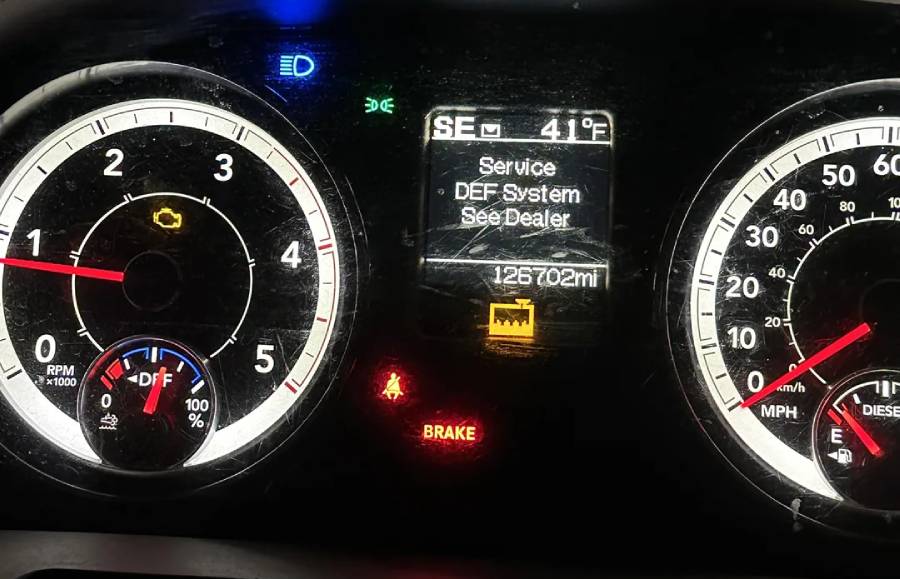
The “Service DEF System See Dealer” message means the vehicle has detected a problem affecting the Diesel Exhaust Fluid or SCR emissions-control system. The warning indicates a system fault that needs diagnosis rather than simply confirming that the DEF tank needs more fluid.
DEF is a urea-based fluid used by diesel vehicles equipped with Selective Catalytic Reduction. The vehicle injects DEF into the exhaust stream, where the SCR process helps convert nitrogen oxides (NOx) into less harmful emissions. The system depends on several components working together, including the DEF tank, sensors, pump, injector or doser, NOx sensors, SCR catalyst, wiring, and engine or emissions control modules. A fault affecting the operation or monitoring of these components can trigger a DEF system warning.
A Service DEF System message is different from a basic low-DEF warning. A low-level warning primarily tells the driver that the DEF supply needs to be replenished. A service warning indicates that the vehicle has detected an abnormal condition within the system. For example, the tank may contain enough DEF while a failed sensor reports incorrect information, the pump cannot deliver the required fluid, or the dosing system cannot operate as expected.
The words “See Dealer” also do not necessarily prove that a dealership is the only place capable of repairing the problem. They indicate that the vehicle requires service. A qualified diesel repair shop with the correct diagnostic equipment may also be able to identify and repair the fault, depending on the vehicle and the system involved.
How Serious Is the “Service DEF System See Dealer” Warning?
The Service DEF System See Dealer warning should be treated as a service-required condition because an unresolved DEF or SCR fault can lead to additional emissions warnings and vehicle operating restrictions. The immediate severity depends on the specific fault and the strategy programmed by the vehicle manufacturer.
A vehicle may initially display only the DEF system warning while continuing to drive normally. This does not mean the problem has resolved itself or is harmless. The control system continuously monitors parameters such as DEF delivery, sensor signals, NOx levels, and SCR performance. If the expected operating conditions are not met during subsequent monitoring, the vehicle can record diagnostic trouble codes and display additional warnings.
More serious conditions can be accompanied by the Check Engine Light, reduced engine power, or a manufacturer-specific speed limitation. Certain diesel vehicles also use escalating warning or inducement strategies when an emissions-system problem remains unresolved. The exact sequence, mileage countdown, speed restriction, and restart conditions vary by make, model, model year, and fault type, so a single restriction should not be assumed to apply to every diesel vehicle.
The severity also depends on the underlying cause. A fluid-level or minor electrical issue may require a relatively straightforward correction, while a failed DEF pump, NOx sensor, dosing component, or SCR-related fault can require additional diagnostic testing and component repair. Reading the stored diagnostic trouble codes is therefore more useful than judging the problem from the dashboard message alone.
Can You Drive With the “Service DEF System See Dealer” Warning?
You can often drive a vehicle temporarily when the Service DEF System See Dealer message first appears and the vehicle has no reduced-power or stop-driving symptoms, but the fault should be diagnosed promptly. Continuing to drive indefinitely can allow the warning condition to progress into an operating restriction on vehicles that use emissions-system inducement strategies.
Start by checking all dashboard messages rather than looking at the DEF warning in isolation. A Service DEF System message with otherwise normal vehicle operation presents a different situation from the same warning accompanied by reduced engine power, a speed-limit message, a starting restriction, or another serious warning. These additional messages indicate that the control system has detected a condition requiring more immediate attention.
Do not assume that filling the DEF tank makes continued driving safe simply because the warning mentions the DEF system. Adding the correct fluid addresses a low fluid level, but it does not repair a failed pump, defective sensor, clogged injector, damaged wiring, NOx sensor fault, or SCR performance problem. If the service message remains after the fluid level has been verified, the system needs further diagnosis.
Check the owner’s manual for the exact make, model, and model year when the dashboard displays a countdown, speed restriction, or restart-related warning. Manufacturer-specific DEF strategies differ, and the manual explains what the displayed warning means for that vehicle. Seek professional diagnosis promptly when the vehicle loses power, develops additional emissions warnings, enters a restricted operating mode, or displays a message indicating that further operation or restarting will be limited.
There are 7 common fault categories that can trigger the “Service DEF System See Dealer” warning: low or incorrect DEF, DEF sensor failure, DEF pump failure, DEF injector problems, NOx sensor faults, wiring or electrical problems, and SCR system faults. Although each problem affects a different part of the emissions system, they can produce the same dashboard message because the vehicle monitors the DEF and SCR system as an interconnected emissions-control process.
Identifying the exact cause requires more than reading the dashboard message. The engine or emissions control module monitors sensor signals, DEF delivery, dosing operation, NOx readings, and SCR performance. When one of these parameters falls outside the expected range, the module can store a diagnostic trouble code and activate the service warning. Reading those codes and testing the affected system is therefore more reliable than replacing a component based on the warning message alone.
Can Low or Incorrect DEF Trigger the Warning?
Low, incorrect, or contaminated DEF can contribute to a DEF system warning when the vehicle detects an abnormal fluid level, quality, or dosing condition. However, a Service DEF System warning should not automatically be interpreted as a low-fluid warning because the two messages can represent different conditions.
Low DEF reduces the amount of fluid available for the SCR system. Vehicles normally monitor the supply and provide a dedicated low-level warning before the tank is depleted. Refilling the tank with the manufacturer-specified DEF can resolve a warning caused solely by insufficient fluid, although the vehicle may require time or a manufacturer-specific recognition procedure before the displayed level updates.
Incorrect or contaminated fluid creates a different problem. The SCR system is designed to operate with DEF that meets the required specification. Adding another liquid, introducing contaminants into the DEF tank, or using degraded fluid can interfere with dosing and emissions performance. In this situation, simply adding more DEF does not remove the underlying contamination and further inspection may be required.
Can a Faulty DEF Sensor Cause the Warning?
A faulty DEF sensor can trigger the Service DEF System warning by sending incorrect or implausible information to the vehicle’s control module. Depending on the vehicle design, the DEF tank assembly can monitor parameters such as fluid level, temperature, and quality.
The control module relies on these measurements to determine whether enough usable DEF is available and whether the system can operate under current conditions. A sensor or related circuit that reports a value outside its expected range can therefore make the system appear defective even when DEF is physically present in the tank.
For example, a failed level-sensing circuit may continue to indicate insufficient fluid after the tank has been filled. A temperature-related fault can interfere with system monitoring or operation, particularly because DEF performance must be managed across different ambient temperatures. Diagnosis should confirm the sensor signal and its electrical circuit before the sensor or tank assembly is replaced.
Can a Bad DEF Pump Cause the Warning?
A bad DEF pump can trigger the warning when the system cannot deliver DEF at the pressure or rate required for proper dosing. The pump moves fluid from the DEF tank toward the dosing system, making it a critical link between stored DEF and the SCR process.
Pump problems can be mechanical or electrical. A pump may fail to operate, operate inconsistently, or fail to produce the expected pressure. The fault can also originate outside the pump itself, such as from a damaged connector, wiring problem, power-supply issue, or another part of the delivery circuit.
A pump-related diagnostic trouble code does not by itself prove that the pump must be replaced. The correct diagnostic process verifies electrical supply, wiring, pressure or delivery performance, and related system conditions. This distinction prevents unnecessary replacement of an expensive component when the actual problem is located elsewhere in the circuit.
Can a Clogged or Faulty DEF Injector Cause the Warning?
A clogged or faulty DEF injector can trigger the warning because the SCR system cannot receive the required amount of DEF when dosing is restricted or uncontrolled. The injector, also called a DEF doser, introduces a controlled quantity of fluid into the exhaust stream.
Deposits or crystallized DEF around the dosing area can interfere with proper flow. An injector can also develop an electrical fault or fail mechanically. When actual dosing no longer matches the system’s commanded operation, downstream emissions monitoring can identify inadequate SCR performance and store related fault codes.
Visible deposits near the injector can provide a diagnostic clue, but they do not establish the complete cause by themselves. The injector, delivery system, electrical circuit, and related SCR data should be evaluated together. Cleaning may be appropriate for certain deposits, while an electrically or mechanically failed injector may require replacement.
Can a Bad NOx Sensor Cause a DEF System Warning?
A bad NOx sensor can cause a DEF system warning because NOx measurements are used to monitor the effectiveness of the SCR emissions-control process. Depending on the system design, sensors positioned around the SCR system measure nitrogen oxide levels and provide feedback to the vehicle’s control module.
These measurements help the control system determine whether emissions are being reduced as expected. An inaccurate, implausible, or missing NOx sensor signal can therefore make SCR performance appear abnormal even when the DEF tank contains the correct fluid.
This relationship explains why adding DEF does not fix every DEF-related dashboard warning. The fluid itself may be acceptable while the monitoring system cannot verify proper emissions performance. NOx sensor codes should consequently be diagnosed alongside wiring, connectors, sensor data, dosing operation, and SCR performance rather than treated automatically as proof of a fluid problem.
Can Wiring or Electrical Problems Trigger the Warning?
Damaged wiring, corroded connectors, poor electrical connections, and power or ground faults can trigger a Service DEF System warning by interrupting communication with DEF and SCR components. The emissions-control system depends on electrical circuits connecting sensors, pumps, dosing components, control modules, and other monitored devices.
Electrical faults can imitate component failure. For example, a sensor may stop reporting valid data because its connector is damaged rather than because the sensor itself has failed. Similarly, a DEF pump may not operate when its power supply or wiring circuit is interrupted.
Diagnosis should therefore include inspection and circuit testing when the stored trouble codes indicate an electrical problem. Replacing a sensor, pump, or injector without checking its circuit can leave the original fault unchanged and cause the warning to return.
Can an SCR System Fault Cause the Warning?
An SCR system fault can trigger the Service DEF System warning when the vehicle determines that the exhaust aftertreatment system is not reducing NOx emissions as expected. DEF is only one part of this process; successful operation also depends on correct dosing, sensor feedback, exhaust conditions, and SCR catalyst performance.
The control module evaluates information from multiple components to determine whether the system is operating effectively. A problem with DEF delivery can reduce SCR performance, but inadequate performance can also result from a sensor, dosing, electrical, catalyst, or other related aftertreatment fault.
For this reason, an SCR-related diagnostic code requires systematic diagnosis rather than immediate replacement of the most obvious component. The technician must determine whether the poor performance originates from DEF supply and dosing, inaccurate sensor information, an electrical fault, or another part of the aftertreatment system before selecting the repair.
A DEF system fault can appear with 6 main signs: the Service DEF System message, a Check Engine Light, additional DEF warnings, reduced engine power, speed restrictions, and restart-related warnings on vehicles that use these operating restrictions. The exact symptoms depend on the failed component, diagnostic trouble code, vehicle manufacturer, and severity of the emissions-system fault.
The dashboard warning is often the first indication of a problem because many DEF and SCR faults do not immediately change how the engine feels while driving. The vehicle’s control module can detect an abnormal sensor signal, insufficient DEF delivery, or SCR performance problem before the driver notices a mechanical symptom. This is why a vehicle may appear to run normally while displaying a Service DEF System message.
A Check Engine Light can appear when the DEF problem generates an emissions-related diagnostic trouble code. Additional messages may also identify a low DEF level, emissions-system problem, reduced-power condition, or another manufacturer-specific restriction. These accompanying warnings provide important diagnostic context because they help distinguish a basic fluid-level problem from a broader system malfunction.
Reduced engine power or a speed restriction represents a more serious stage than a warning message alone. Some diesel vehicles use an inducement strategy when qualifying emissions faults remain unresolved. The vehicle may progressively restrict operation to encourage repair of the emissions-control system. The exact strategy differs between manufacturers, so the displayed dashboard instructions and the owner’s manual should be used to determine what applies to a specific vehicle.
Changes in DEF consumption can also provide diagnostic information in some situations. A vehicle that appears to use little or no DEF over an extended period may have a dosing or monitoring problem, while unusually high apparent consumption can justify checking for leaks or another delivery-system issue. Consumption alone cannot identify the failed component, but it can be evaluated alongside diagnostic trouble codes and live system data.
How Do You Diagnose a “Service DEF System See Dealer” Warning?
Diagnosing a Service DEF System See Dealer warning requires checking the DEF supply and dashboard messages first, scanning for diagnostic trouble codes, and then testing the system indicated by those codes. This sequence is more reliable than immediately replacing the DEF pump, sensor, injector, or NOx sensor.
Diagnosis should move from basic observations to component-specific testing. The warning itself identifies the affected system but does not identify the exact failed part. A technician therefore combines the driver’s symptoms, fluid condition, stored trouble codes, live sensor data, electrical tests, and system-performance tests to isolate the cause.
What Should You Check Before Using an OBD-II Scanner?
Check the dashboard messages, DEF level, DEF condition, recent service history, visible leaks, and accessible electrical connections before moving to scan-tool diagnosis. These basic checks can reveal straightforward problems and provide useful context for interpreting diagnostic trouble codes.
Start with the dashboard. Record the exact wording of every message rather than relying only on “Service DEF System.” Look for a Check Engine Light, low-DEF warning, mileage countdown, reduced-power message, speed restriction, or restart-related warning. Taking a photo of the instrument cluster can preserve the exact information for later diagnosis.
Next, verify that the DEF tank contains sufficient fluid. Use DEF that meets the specification required by the vehicle manufacturer and avoid assuming that any liquid sold for diesel vehicles is appropriate. If the warning appeared shortly after a refill, consider what fluid was added, whether the container was clean, and whether contamination could have occurred during filling.
Inspect accessible areas for obvious physical problems. DEF residue or crystallized deposits around a connection, line, tank area, or dosing component can indicate leakage or fluid exposure. Damaged wiring, disconnected plugs, loose connectors, or corrosion can also produce faults that resemble a failed sensor or actuator. Do not disconnect or dismantle emissions components solely to perform a visual check when the manufacturer’s service procedure requires specific precautions.
Review what happened immediately before the warning appeared. A recent DEF refill, battery or electrical repair, emissions-system service, component replacement, or previous intermittent warning can narrow the diagnostic direction. This history does not prove the cause, but it helps connect the current fault with recent changes to the vehicle.
Which Trouble Codes Can Point to a DEF System Fault?
Diagnostic trouble codes can identify the circuit or operating condition associated with a DEF system fault, but a code does not automatically identify the component that must be replaced. Codes should be treated as diagnostic directions that require confirmation through testing.
DEF-related codes can fall into several categories, including reductant-system performance, DEF pressure or delivery, heater circuits, level or quality sensing, dosing, NOx sensing, and SCR efficiency. A vehicle can also store more than one code because a single failure can affect several monitored parameters. For example, a delivery problem can influence dosing performance and eventually produce an SCR-efficiency-related fault.
Record all stored, pending, and relevant manufacturer-specific codes before clearing anything. Freeze-frame information and live data can provide additional context by showing operating conditions when a fault was detected. Clearing codes before recording this information can remove evidence that would otherwise help identify an intermittent or operating-condition-specific problem.
Interpret codes as part of the complete system rather than in isolation. A code associated with a DEF pump circuit, for example, can result from the pump itself, wiring, a connector, power supply, ground, or another electrical condition. Testing the circuit before replacing the pump separates an actual component failure from a problem elsewhere in the electrical path.
The same principle applies to NOx and SCR codes. An abnormal downstream NOx reading does not automatically mean the SCR catalyst has failed, just as an SCR performance code does not automatically mean the DEF fluid is bad. Sensor accuracy, DEF dosing, exhaust conditions, electrical integrity, and other relevant system parameters may need to be verified before the failed part can be identified.
When Does the DEF System Need Professional Diagnosis?
Professional diagnosis is appropriate when the warning persists after basic DEF checks, the vehicle has reduced-power or operating restrictions, or the fault requires pressure, dosing, electrical, sensor-data, or SCR-efficiency testing. These procedures often require equipment and service information beyond a basic code reader.
An advanced scan tool can provide information that a simple OBD-II reader may not display. Depending on the vehicle, a technician may need manufacturer-specific trouble codes, live DEF sensor readings, NOx data, commanded dosing information, system tests, or service functions. These values allow the technician to compare what the control module commands with what the system actually does.
Physical testing may also be necessary. A suspected pump problem can require pressure or delivery verification, while an injector problem can require dosing inspection or testing. Electrical faults may require voltage, ground, resistance, continuity, or connector checks. SCR performance problems can require analysis of multiple sensors and operating conditions rather than replacement of a single component.
Professional diagnosis becomes more urgent when the dashboard displays a countdown, speed restriction, reduced engine power, restart warning, or another escalating emissions message. Continuing to clear codes without repairing the underlying problem does not restore system operation and can leave the vehicle approaching a manufacturer-programmed restriction.
Fix the “Service DEF System See Dealer” warning by identifying and repairing the underlying DEF or SCR system fault rather than clearing the message alone. The correct repair depends on whether the problem involves the DEF fluid, a sensor, the pump, injector, NOx sensor, wiring, or another part of the SCR emissions system.
The repair process should follow the diagnostic evidence. Verify basic conditions such as DEF level and fluid condition first, then retrieve diagnostic trouble codes and test the system identified by those codes. This approach prevents unnecessary component replacement because the same dashboard warning can result from several different faults.
There are 6 main repair categories for a DEF system warning: correcting a DEF fluid problem, repairing or replacing a failed sensor, repairing the DEF pump system, cleaning or replacing the DEF injector, correcting NOx or SCR faults, and repairing damaged wiring or connectors. The warning should be cleared or reset only after the underlying problem has been corrected.
Can Refilling or Replacing the DEF Fix the Warning?
Refilling the DEF tank can fix the warning when insufficient DEF is the actual cause, while incorrect or contaminated DEF may require the affected fluid to be removed and replaced according to the vehicle manufacturer’s service procedure. Adding DEF will not repair a failed sensor, pump, injector, electrical circuit, or SCR component.
Start by confirming the DEF level and checking whether the vehicle displays a separate low-fluid message. If the tank is low, add DEF that meets the specification required for the vehicle. Avoid transferring DEF through dirty containers or equipment because contamination can introduce substances that interfere with the fluid or system.
A warning that remains after a proper refill requires further investigation. The vehicle may not be receiving accurate level information, the dosing system may not be delivering DEF correctly, or an unrelated emissions fault may be responsible for the message. Some vehicles also require specific operating conditions before an updated fluid level or repaired condition is recognized.
Incorrect fluid requires a different response from low fluid. Do not assume that adding correct DEF on top of contaminated or incorrect fluid will restore normal operation. The appropriate service procedure can involve removing the affected fluid and inspecting the system for contamination before refilling it with the correct DEF.
How Is a Faulty DEF Sensor Fixed?
A faulty DEF sensor is fixed by confirming that the sensor or its circuit is producing incorrect data and then repairing the circuit or replacing the failed sensor or applicable tank module. Sensor replacement should follow diagnosis rather than being based solely on the dashboard warning.
The diagnostic process compares sensor information with actual operating conditions. For example, a level-related fault should be investigated when the system reports an implausible DEF level or continues to indicate insufficient fluid despite a verified refill. Electrical testing can determine whether the problem originates from the sensor, connector, wiring, power supply, ground, or another part of the circuit.
Component design affects the final repair. On some vehicles, an affected sensor may be serviced separately, while other designs integrate multiple sensing functions into a larger DEF tank or header assembly. The required replacement therefore depends on the specific make, model, model year, and system configuration.
After repair, verify that the control module receives plausible sensor information and that the relevant diagnostic trouble code does not return. Replacing the component without confirming normal data can leave an electrical or system-level problem undetected.
How Is a Bad DEF Pump Fixed?
A bad DEF pump is fixed by confirming that the pump cannot produce the required DEF delivery or pressure and then repairing the related circuit or replacing the failed pump or module. A pump-related code alone is not sufficient evidence that the pump itself has mechanically failed.
Diagnosis should verify that the pump receives the required electrical supply and command before replacement. Damaged wiring, poor connections, power or ground problems, and other circuit faults can prevent a functional pump from operating. Testing these conditions separates an electrical failure from a pump failure.
The delivery side of the system also matters. A pump that operates electrically but cannot provide the expected fluid delivery can still prevent correct DEF dosing. Depending on the vehicle, diagnosis may involve monitoring commanded operation, system pressure, or other manufacturer-specific parameters with appropriate equipment.
Replace the pump or applicable assembly when testing confirms an internal failure. After the repair, verify system operation rather than assuming that installation alone has corrected the problem. The relevant pressure, delivery, diagnostic data, and warning status should return to their expected conditions.
How Is a Clogged DEF Injector Fixed?
A clogged DEF injector is fixed by inspecting the dosing system, removing appropriate deposits when serviceable, or replacing the injector when it has an electrical or mechanical failure. The repair must restore controlled DEF delivery into the exhaust system.
DEF deposits or crystallization can form around areas where the fluid is exposed and can interfere with dosing when buildup becomes significant. Visible deposits provide useful evidence, but their presence should be evaluated together with diagnostic codes and dosing-system performance before a repair decision is made.
Cleaning can be appropriate when removable deposits are responsible for restricted operation and the component remains functional. A damaged, electrically failed, or mechanically defective injector may instead require replacement. The exact cleaning and replacement procedure should follow the service information for the vehicle.
After servicing the injector, confirm that the dosing system operates correctly and check for leaks or recurring deposits. A repeated buildup can indicate that the visible deposit was a symptom of another problem rather than the complete cause.
How Are NOx Sensor and SCR Faults Fixed?
NOx sensor and SCR faults are fixed by determining whether inaccurate sensor data, incorrect DEF dosing, an electrical problem, or an actual aftertreatment-system fault is causing the abnormal emissions readings. Replacing a NOx sensor or SCR component without confirming the cause can result in an expensive repair that does not eliminate the warning.
NOx sensors provide information used to evaluate emissions and SCR operation. A sensor that produces implausible or incorrect data can cause the control module to identify a performance problem even when other parts of the system are operating correctly. Diagnosis should therefore evaluate the sensor signal and electrical circuit before replacement.
An SCR performance fault requires broader testing because several upstream problems can reduce apparent catalyst efficiency. Incorrect DEF dosing, DEF delivery problems, sensor errors, electrical faults, and other exhaust aftertreatment conditions can affect the measurements used to evaluate SCR performance.
Replace a NOx sensor when testing confirms that the sensor has failed. More extensive SCR repairs should be considered only after related fluid, dosing, sensor, and electrical causes have been evaluated. This diagnostic order reduces the risk of replacing a high-cost component unnecessarily.
How Are Wiring and Connector Faults Repaired?
Wiring and connector faults are repaired by locating the open circuit, short, damaged wire, poor terminal connection, corrosion, or power and ground problem and restoring the circuit to its specified electrical condition. Electrical testing is important because a circuit failure can produce symptoms that closely resemble a defective DEF component.
Begin with the circuit associated with the diagnostic trouble code rather than inspecting unrelated wiring throughout the vehicle. Check accessible connectors for physical damage, loose terminals, contamination, corrosion, or evidence that the harness has rubbed against surrounding components. Visual inspection should then be supported by the electrical tests required for that circuit.
Repair damaged wiring or terminals using an appropriate automotive electrical repair method. Simply reconnecting a loose connector may solve a connection problem, but corrosion, damaged terminals, broken conductors, or recurring harness contact require correction of the underlying defect.
After completing the electrical repair, reconnect the system correctly, verify component communication or operation, and check whether the diagnostic trouble code returns. A successful repair restores both the circuit and the operation of the DEF or SCR component that depends on it.
Reset the “Service DEF System See Dealer” message only after the underlying DEF or SCR system fault has been corrected. Clearing the warning without repairing its cause does not fix the system, and the message or diagnostic trouble code can return when the vehicle detects the fault again.
The reset process depends on the vehicle and the problem that triggered the warning. Some DEF-related messages can disappear after the control module confirms that normal operating conditions have returned. For example, after correcting a fluid-level problem, the vehicle may update the DEF level after completing the manufacturer-defined monitoring conditions. A separate manual reset is not always required.
Other faults require diagnostic equipment after the repair. A scan tool may be needed to clear stored diagnostic trouble codes, perform a manufacturer-specific service procedure, command a system test, or verify that the repaired component operates correctly. These procedures vary by make, model, model year, and emissions-system configuration.
Do not use disconnecting the battery or repeatedly clearing codes as a substitute for diagnosis. Removing a warning from the dashboard does not restore DEF pressure, repair a sensor circuit, unclog an injector, correct NOx sensor data, or restore SCR performance. The warning can return as soon as the control module reruns the affected monitor and detects the same condition.
A warning that returns after being cleared indicates that the fault is still active, the repair did not address the complete cause, or the system has not yet met the conditions required to confirm a successful repair. Recheck the diagnostic trouble codes and system data instead of repeatedly resetting the message.
Why Does the DEF Warning Stay On After Adding DEF?
The DEF warning can stay on after adding DEF because the problem may involve something other than a low fluid level or because the vehicle has not yet recognized that the condition has been corrected. A refill solves an insufficient-fluid problem, but it cannot repair a failed sensor, pump, injector, NOx sensor, wiring circuit, or SCR system fault.
One common explanation is that the dashboard message is a system-service warning rather than a simple low-DEF warning. The presence of “Service DEF System” indicates that diagnosis may be required. Filling the tank changes the quantity of DEF available but does not correct another fault already detected by the control module.
A level-sensing problem can also leave the warning active after a refill. The tank may physically contain enough DEF while the control module continues receiving an incorrect or implausible level signal. Testing the sensor data and its electrical circuit can determine whether the vehicle is accurately detecting the amount of fluid in the tank.
Incorrect or contaminated DEF is another possible reason. Adding more correct DEF does not necessarily correct fluid that has already been contaminated or mixed with an inappropriate substance. The affected fluid may need to be removed and the system serviced according to the manufacturer’s procedure when contamination is confirmed.
A delivery-system fault can produce the same result. The tank can be full while a failed pump, restricted injector, or related problem prevents the system from dosing the required amount of DEF into the exhaust. In this case, the quantity in the tank is not the limiting factor; the problem is moving and dosing the fluid correctly.
An active NOx sensor, electrical, or SCR-related fault can also keep the warning illuminated regardless of DEF level. The vehicle evaluates emissions-system performance using more than the amount of fluid in the tank. Sensor information, dosing performance, electrical integrity, and SCR operation can all influence whether the control module considers the system functional.
Finally, the vehicle may need to complete specific recognition or monitoring conditions after a legitimate repair or refill. These conditions are manufacturer-specific. Check the owner’s manual or service information for the exact vehicle rather than following a universal drive-cycle or reset procedure.
How Much Does It Cost to Fix a DEF System Fault?
The cost to fix a DEF system fault depends primarily on the failed component, vehicle design, parts price, diagnostic time, and labor required to access the system. A fluid-level or minor wiring problem can require substantially less work than replacing a DEF pump assembly, NOx sensor, or SCR catalyst.
The warning message alone cannot provide an accurate repair price because it does not identify the failed part. Two vehicles displaying the same Service DEF System message can require completely different repairs. One may need the correct DEF or a connector repair, while another may require diagnosis and replacement of a major emissions-system component.
| Fault or repair | Typical repair complexity | Main cost driver |
|---|---|---|
| DEF refill or fluid correction | Low | DEF quantity and fluid service |
| Wiring or connector repair | Low to medium | Fault location and labor time |
| DEF sensor repair or replacement | Medium | Sensor or integrated module design |
| DEF injector replacement | Medium | Injector price and accessibility |
| NOx sensor replacement | Medium to high | Sensor price and diagnostic time |
| DEF pump or module replacement | High | Assembly price and labor |
| SCR catalyst-related repair | High | Component price and diagnostic complexity |
DEF sensor repairs illustrate why vehicle design affects cost. A vehicle with a separately serviceable sensor may require fewer replacement parts than a design that integrates the affected sensing components into a larger tank or module assembly. The part configuration should therefore be confirmed before estimating the repair.
Labor cost also changes according to the location of the failed component and the tests required to confirm it. An accessible connector fault can be relatively straightforward to repair, while intermittent wiring problems or SCR performance faults can require substantially more diagnostic time. Paying for correct diagnosis can prevent the greater expense of replacing functional components.
Get a vehicle-specific estimate after the diagnostic trouble codes and failed system have been identified. The estimate should distinguish diagnostic labor, replacement parts, repair labor, and any manufacturer-specific procedures required after installation. A component-level diagnosis provides a more useful cost estimate than pricing repairs from the dashboard warning alone.
You can reduce the risk of DEF system problems by using the correct DEF, preventing contamination, storing DEF properly, responding to warnings promptly, and following the vehicle manufacturer’s maintenance requirements. These practices protect the fluid supply and reduce avoidable problems involving DEF delivery, dosing, and system monitoring.
Use only DEF that meets the specification required by the vehicle manufacturer. The SCR system depends on fluid with the correct composition, so substituting another liquid or using unsuitable fluid can interfere with emissions-system operation. Check the owner’s manual when the required specification is unclear, particularly before using DEF from an unfamiliar container or source.
Prevent contamination whenever DEF is transferred or added to the vehicle. Keep dirt, fuel, engine oil, coolant, water, and other substances out of the DEF tank, and use clean equipment intended for DEF handling. Contamination can change fluid quality and introduce material into components responsible for storing, pumping, and dosing the fluid.
Store unused DEF according to the product and vehicle manufacturer’s recommendations. Temperature, storage duration, and container condition can affect whether stored fluid remains suitable for use. Keep the container properly sealed and avoid using DEF when its condition or storage history is uncertain.
Respond to DEF and emissions warnings when they first appear instead of waiting for the vehicle to develop an operating restriction. A low-fluid warning provides an opportunity to refill the tank before the supply becomes critically low, while a Service DEF System warning indicates that the system may need diagnosis. Early investigation can also preserve useful diagnostic information before additional faults complicate the original problem.
Follow the maintenance and service information specified for the exact vehicle. DEF and SCR systems differ between manufacturers, engines, and model years, so a maintenance procedure that applies to one diesel vehicle should not automatically be applied to another. Vehicle-specific guidance is especially important for fluid requirements, warning sequences, diagnostic procedures, and post-repair system checks.
When Should You Take the Vehicle to a Dealer or Repair Shop?
Take the vehicle to a qualified dealer or diesel repair shop when the Service DEF System warning persists after basic checks, additional emissions warnings appear, engine power becomes restricted, or diagnosis requires specialized DEF and SCR testing. Professional diagnosis is particularly important when the vehicle is approaching a manufacturer-programmed operating restriction.
Seek service when the DEF level has been verified but the warning remains active. A full tank combined with a persistent service message indicates that adding fluid alone has not resolved the condition. The problem may involve sensing, delivery, dosing, electrical operation, NOx monitoring, or another part of the SCR system.
Arrange diagnosis promptly when the Check Engine Light or additional DEF messages appear with the original warning. Multiple warnings can indicate that the control module has stored additional information about the emissions-system fault. Retrieving the diagnostic trouble codes and relevant system data helps identify which circuit or operating condition requires testing.
Treat reduced engine power, speed restrictions, countdown messages, and restart-related warnings as higher-priority conditions. These messages indicate that the problem has progressed beyond a basic dashboard notification on vehicles that use emissions-system inducement strategies. Follow the instructions displayed by the vehicle and consult the owner’s manual for the exact make, model, and model year.
Professional service is also appropriate when diagnosis requires DEF pressure testing, dosing tests, advanced electrical measurements, live NOx sensor analysis, SCR performance evaluation, or manufacturer-specific scan-tool functions. These tests provide evidence about the actual failure and reduce the likelihood of replacing expensive components unnecessarily.
A dealership is not automatically required simply because the dashboard says “See Dealer.” A qualified independent diesel repair facility can be an appropriate option when it has the diagnostic equipment, technical information, and experience required for the vehicle’s emissions system. A dealership may be preferable when the repair requires manufacturer-specific programming, software procedures, warranty work, recalls, service campaigns, or specialized equipment unavailable elsewhere.
The repair is complete when the underlying fault has been corrected and the system verifies normal operation, not merely when the dashboard message disappears. Confirm that relevant diagnostic trouble codes do not return, DEF and SCR data are plausible, and any required system monitor or manufacturer-specific verification procedure completes successfully.