The Ram App and Uconnect are related parts of RAM’s connected vehicle ecosystem, but they serve different purposes. The Ram App primarily gives owners access to supported vehicle functions and information from a smartphone, while Uconnect is the in-vehicle system used for infotainment, connectivity, navigation, and other integrated features. They are therefore not two competing versions of the same product.
The distinction mainly comes down to where and how each system is used. The Ram App extends supported connected vehicle functions to your phone, which can include remote controls, vehicle status information, and location-related features depending on the vehicle and connected services. Uconnect operates primarily through the vehicle’s built-in interface and handles functions such as audio, Bluetooth connectivity, navigation on compatible systems, and smartphone integration through Apple CarPlay or Android Auto.
The two can still be connected through the broader RAM connected-services ecosystem, which is why their names and features are sometimes confused. This Ram App vs Uconnect comparison explains their differences, what each system does, how they work together, and when a RAM owner would use one instead of the other.
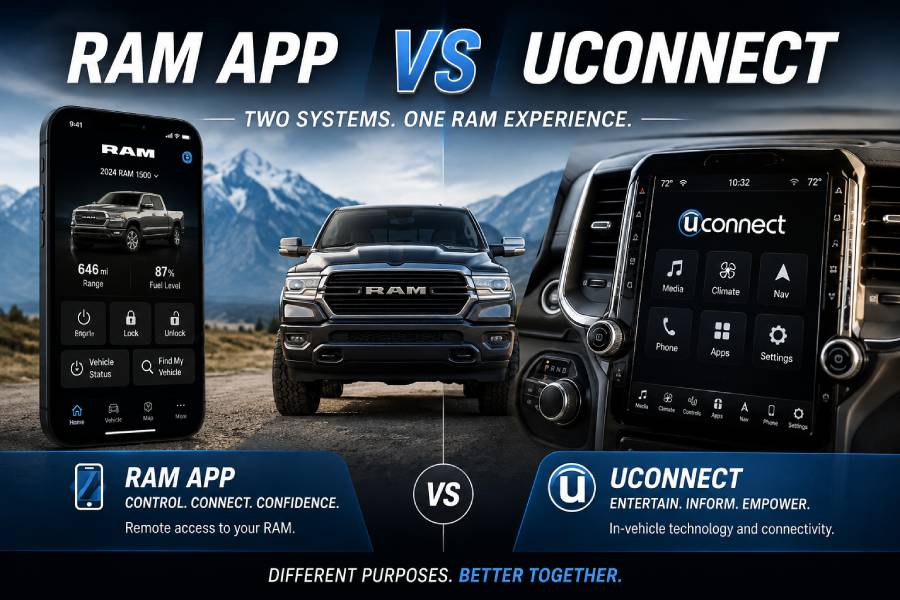
What Is the Difference Between the Ram App and Uconnect?
The main difference between the Ram App and Uconnect is how and where they provide access to vehicle functions. The Ram App is a smartphone application that gives RAM owners remote access to supported vehicle information and connected features. Uconnect is an infotainment and connectivity system built into compatible RAM vehicles and primarily operates through the vehicle’s touchscreen and controls.
The Ram App is designed around interactions that can take place away from the vehicle. Depending on the RAM model, model year, equipment, and connected services, an owner may use the app to perform supported remote actions or check vehicle information without sitting inside the truck. This makes the smartphone the primary interface between the owner and supported remote vehicle services.
Uconnect serves a different role because its primary interface is inside the vehicle. The system combines supported infotainment and connectivity functions in one interface, including audio controls, Bluetooth connectivity, navigation on equipped vehicles, and smartphone integration. Compatible Uconnect systems can also work with Apple CarPlay and Android Auto, allowing drivers to access supported smartphone functions through the vehicle’s display.
| Feature | Ram App | Uconnect |
|---|---|---|
| Primary interface | Smartphone | In-vehicle touchscreen and controls |
| Primary purpose | Remote vehicle access and information | Infotainment and connectivity |
| Main use location | Inside or away from the vehicle | Primarily inside the vehicle |
| Remote vehicle functions | Available when supported | Not its primary interface purpose |
| Audio and infotainment | Not its primary function | Yes |
| Navigation | Not its primary function | Available on compatible systems |
| Apple CarPlay and Android Auto | No | Available on compatible systems |
| Vehicle information | Available for supported vehicles and services | Vehicle-dependent information and settings |
The comparison therefore does not identify one system as a replacement for the other. The Ram App extends supported connected functions to a smartphone, while Uconnect provides the vehicle-integrated interface for infotainment and connectivity. A RAM owner can use both because each system addresses a different part of the connected vehicle experience.
Is the Ram App the Same as Uconnect?
No, the Ram App is not the same as Uconnect. The Ram App is a mobile application, while Uconnect is the vehicle-integrated infotainment and connectivity system. The two are related through the broader connected vehicle ecosystem, but they represent different interfaces and functions.
The distinction becomes clearer by looking at where each interaction starts. A driver who uses a smartphone to access a supported remote vehicle function is interacting through the Ram App. A driver who uses the vehicle touchscreen to manage audio, connect a phone through Bluetooth, use compatible navigation, or access supported smartphone integration is interacting with Uconnect.
The confusion comes from the overlap between RAM vehicles, Uconnect, and connected services. Some functions available through a mobile app depend on the vehicle’s hardware, configuration, and eligibility for connected services. As a result, the Ram App can interact with features associated with the same connected vehicle ecosystem in which Uconnect operates without becoming the Uconnect system itself.
A useful way to distinguish them is by their primary roles: the Ram App extends supported vehicle access to a phone, whereas Uconnect provides supported infotainment and connectivity functions through the vehicle. This distinction also explains why having access to one does not mean that every feature associated with the other is automatically available. Feature availability depends on the specific RAM vehicle, its equipment, model year, and applicable connected services.
What Does the Ram App Do?
The Ram App gives RAM owners smartphone access to supported remote vehicle functions, vehicle information, and connected services. Instead of requiring the driver to be inside the vehicle, the app acts as a mobile interface for compatible functions. The exact features available depend on the RAM model, model year, vehicle equipment, account configuration, and active connected services.
This remote-access role is the main reason the Ram App differs from Uconnect. Uconnect concentrates many driver-facing functions inside the vehicle, while the Ram App extends supported interactions beyond the dashboard. For example, an owner with an eligible vehicle can use supported remote functions from a phone rather than returning to the truck to perform the same action manually.
The app should therefore be viewed as part of the broader RAM ownership and connected-services experience rather than as a replacement for the infotainment system. Features associated with entertainment, in-vehicle audio controls, and the main dashboard interface remain within Uconnect or other vehicle systems.
Which Remote Vehicle Features Can You Use With the Ram App?
The Ram App can provide remote vehicle controls such as remote start, remote stop, door locking, door unlocking, and vehicle-location functions when those features are supported by the vehicle and its connected-service configuration. Availability is not identical across every RAM truck because the required hardware and service eligibility vary by model and model year.
Remote start illustrates the purpose of the app. Instead of entering the vehicle and starting the engine directly, an eligible owner can send a remote-start request from the smartphone. Remote lock and unlock follow the same principle by allowing supported vehicle access functions to be initiated when the owner is away from the truck.
Location-related functionality addresses another ownership use case. A supported vehicle-location feature can help an owner locate the truck without relying solely on memory of where it was parked. These remote capabilities distinguish the Ram App from in-vehicle infotainment functions because the interaction starts on the owner’s smartphone rather than the vehicle touchscreen.
What Vehicle Information Can You Check in the Ram App?
The Ram App can display supported vehicle status and ownership information without requiring the owner to check the vehicle directly. The specific information shown depends on the connected vehicle and services associated with the owner’s account.
Vehicle information adds a monitoring function to the app’s remote-control role. An owner may be able to review supported status information from a smartphone before reaching the vehicle. This creates a direct connection between the RAM vehicle and the owner’s mobile device and makes relevant vehicle information accessible outside the cabin.
The important distinction is that the app does not independently generate this vehicle data. It provides an interface through which information supported by the connected vehicle ecosystem can be presented to the owner. A feature that appears for one RAM vehicle may therefore be unavailable for another vehicle with a different model year, equipment package, or connected-service configuration.
What Does Uconnect Do in a RAM Vehicle?
Uconnect provides the primary in-vehicle interface for supported infotainment, connectivity, navigation, communication, and smartphone-integration functions in compatible RAM vehicles. Drivers interact with these functions through the vehicle’s display, controls, and connected technologies rather than relying primarily on the Ram App.
The system brings multiple functions into one vehicle-integrated environment. Instead of using separate controls for every source of digital information or entertainment, the driver can access supported features through the Uconnect interface. The available functions depend on the Uconnect version and the equipment installed in the specific RAM vehicle.
This makes Uconnect fundamentally different from the Ram App in terms of location and purpose. The Ram App focuses on supported smartphone-based access to the vehicle, while Uconnect focuses on the digital experience available when the driver or passengers are using the vehicle.
What Infotainment Features Does Uconnect Provide?
Uconnect manages supported in-vehicle infotainment functions such as audio, media, Bluetooth connectivity, and compatible smartphone integration. These functions are accessed through the vehicle’s built-in interface and form a central part of the driver’s interaction with the infotainment system.
Audio and media controls allow occupants to manage supported entertainment sources from the vehicle. Bluetooth provides a wireless connection between compatible mobile devices and the infotainment system, allowing supported communication and audio functions to operate without a physical connection.
The Uconnect touchscreen also acts as a central interface for available digital features. The exact screen size, menu structure, functionality, and supported services differ between Uconnect versions and RAM configurations. For this reason, the presence of Uconnect does not mean every RAM vehicle has an identical set of infotainment features.
Uconnect can provide integrated navigation and connected functions on RAM vehicles equipped with compatible systems and services. Navigation availability depends on the specific Uconnect configuration, so it should not be assumed that every Uconnect-equipped RAM includes the same native navigation capability.
An integrated navigation system differs from a basic smartphone map displayed independently on a phone because navigation is incorporated into the vehicle’s infotainment environment. Drivers can access supported navigation functions through the Uconnect interface when their vehicle is equipped for them.
Connectivity also allows Uconnect to interact with compatible phones and supported services. Bluetooth is one connection method, while Apple CarPlay and Android Auto provide another route for bringing supported smartphone applications and functions onto the vehicle display. These connections expand what the infotainment system can access without turning the smartphone itself into the Uconnect system.
Does Uconnect Support Apple CarPlay and Android Auto?
Compatible Uconnect systems support Apple CarPlay and Android Auto, allowing supported smartphone functions and apps to appear through the vehicle’s infotainment interface. Compatibility depends on the Uconnect system, RAM model, model year, and vehicle equipment.
Apple CarPlay connects a compatible iPhone with the infotainment system, while Android Auto provides comparable integration for compatible Android devices. These platforms can give drivers access to supported functions such as navigation, communication, audio, and other compatible apps through the in-vehicle interface.
Apple CarPlay and Android Auto should not be confused with the Ram App. The Ram App primarily connects the owner with supported RAM vehicle functions and information. Apple CarPlay and Android Auto connect compatible smartphone experiences with the vehicle’s infotainment interface. Uconnect is the in-vehicle system through which this integration is available on compatible RAM vehicles.
The relationship can therefore be separated into three functions: the Ram App supports remote interaction with the RAM vehicle, Uconnect manages the compatible in-vehicle infotainment environment, and Apple CarPlay or Android Auto integrates supported smartphone functions into that environment. Each serves a distinct role even though all three can involve the same phone and vehicle.
How Do the Ram App and Uconnect Work Together?
The Ram App and Uconnect work as different access points within the broader RAM connected vehicle ecosystem: the Ram App provides supported remote access from a smartphone, while Uconnect provides supported infotainment and connectivity functions inside the vehicle. Their functions can relate to the same RAM vehicle, but the driver interacts with each through a different interface.
The relationship starts with the vehicle rather than with one system controlling the other. When an owner uses a supported remote feature through the Ram App, the interaction begins on the smartphone and reaches the eligible vehicle through connected services. When the driver manages audio, navigation, Bluetooth, or another supported infotainment function through Uconnect, the interaction takes place primarily through the vehicle’s built-in interface.
A practical example is remote start. On an eligible RAM vehicle with the required connected services, the owner can initiate a supported remote-start command through the Ram App before reaching the truck. After entering the vehicle, the driver can use Uconnect for supported in-vehicle functions such as audio, navigation, phone connectivity, or smartphone integration. The two interactions involve the same vehicle but serve different stages of the ownership and driving experience.
This relationship also explains why some features appear connected even though the Ram App and Uconnect are not the same product. Both exist within a connected vehicle environment where functionality depends on the vehicle’s hardware, software, equipment, and eligible services. A feature accessible remotely through a phone should not automatically be classified as a Uconnect infotainment feature simply because both systems are associated with the same RAM vehicle.
The simplest model is Ram App → connected services → RAM vehicle for supported remote interactions and driver → Uconnect → in-vehicle infotainment and connectivity for supported functions inside the truck. This separation makes it possible for a RAM owner to use both systems without treating them as competing platforms.
Do You Need Uconnect to Use the Ram App?
Using the Ram App does not mean that every Uconnect feature is required, but the app’s connected vehicle functions depend on the specific RAM vehicle, its equipment, and its eligibility for supported connected services. The requirement should therefore be evaluated by individual feature and vehicle configuration rather than by assuming that installing the Ram App automatically enables remote functions.
Three components determine what an owner can access: the Ram App provides the smartphone interface, the RAM vehicle provides the compatible hardware and vehicle functions, and the applicable connected services provide the connection required for supported remote interactions. If the vehicle does not support a particular connected function, installing the app does not add that capability to the truck.
Uconnect has a different role. A compatible Uconnect system provides the vehicle’s supported infotainment and connectivity environment, but the availability of Ram App functions is not determined simply by whether the dashboard carries the Uconnect name. Model year, equipment, connected-service eligibility, and account configuration can change which functions are available.
For example, two RAM trucks can both have Uconnect while offering different connected capabilities because they use different system versions, equipment configurations, or service arrangements. The corresponding Ram App experience can therefore differ between those vehicles. One owner may have access to supported remote functions that another owner does not have.
For this reason, RAM owners should verify compatibility for their specific vehicle rather than using a general Uconnect feature list as proof that a Ram App function will work. Uconnect compatibility, Ram App availability, and connected-service eligibility are related factors, but they are not interchangeable terms.
Do the Ram App and Uconnect Require a Subscription?
The Ram App and Uconnect do not have one universal subscription requirement because access depends on the specific feature, connected service, vehicle equipment, and model year. Owners should distinguish between using the Ram App itself, using the Uconnect hardware installed in the vehicle, and accessing connected services that may require an active service plan.
The Uconnect system installed in a RAM vehicle remains the interface for compatible built-in functions such as audio controls, Bluetooth, vehicle settings, and other equipment-specific features. These functions are tied primarily to the vehicle’s hardware and software rather than to a single subscription covering everything Uconnect can do. Connected or premium services associated with the system can have separate requirements.
The Ram App follows a similar distinction. Installing or accessing an application is not the same as having every remote vehicle function available. Features such as supported remote start, remote door locking or unlocking, and other connected commands depend on the vehicle and applicable connected services. An owner can therefore have the app on a smartphone without having access to every function displayed or associated with the broader connected ecosystem.
Subscription requirements can also change according to the service attached to a particular vehicle. A RAM owner evaluating costs should identify the exact feature needed first and then check whether that feature is included with the vehicle, provided through an active trial, or associated with a paid connected-service plan. This approach is more accurate than treating “Uconnect subscription” as a single product that unlocks every Ram App and Uconnect feature.
The practical distinction is built-in vehicle functionality versus subscription-dependent connected functionality. Owners should verify current service availability and plan requirements for their specific VIN and account because connected-service packages and eligibility can differ across RAM models and model years.
Which RAM Vehicles Work With the Ram App and Uconnect?
Ram App and Uconnect compatibility depends on the specific RAM model, model year, installed equipment, Uconnect system, and connected-service eligibility. The presence of the RAM badge alone does not guarantee that every app, remote, infotainment, or connectivity feature is available.
Uconnect has appeared in different generations and configurations across RAM vehicles. A newer vehicle equipped with a more recent Uconnect system can support a different set of infotainment, connectivity, and smartphone-integration functions than an older RAM with an earlier system. Even vehicles from the same model line can have different capabilities when their trim levels or optional equipment differ.
The Ram App introduces another compatibility layer because remote functions require more than a compatible smartphone. The vehicle must contain the hardware and connected capabilities needed to receive and execute the requested function. The corresponding service must also be available for that vehicle and properly associated with the owner’s account when the feature requires connected-service access.
For example, the availability of remote start should not be inferred solely from the existence of a remote-start button in an app or from the vehicle having a Uconnect touchscreen. The truck needs the applicable remote-start capability and connected-service support for an app-based remote-start request to work. The same principle applies to other supported remote controls and vehicle-information features.
Owners should therefore check five compatibility factors: RAM model, model year, installed Uconnect system, vehicle equipment, and connected-service eligibility. Checking the specific VIN or vehicle account provides a more reliable answer than using a general RAM model name because two trucks from the same model family can have different configurations.
This distinction is particularly important when comparing used RAM vehicles. A feature advertised for a current RAM model does not establish that an older model year supports the same Ram App or Uconnect functionality. Compatibility should always be established for the individual vehicle before assuming that a specific connected or infotainment feature is available.
Should You Use the Ram App or Uconnect?
Use the Ram App for supported remote vehicle interactions from your smartphone and Uconnect for supported infotainment, navigation, connectivity, and smartphone-integration functions inside your RAM vehicle. For many RAM owners, the practical answer is to use both because the two systems serve different purposes rather than replace each other.
Choose the Ram App when the interaction starts away from the vehicle. Supported remote start, remote door locking or unlocking, vehicle-location functions, and vehicle information are examples of tasks that can make a mobile interface useful. Availability depends on the RAM model, model year, equipment, and connected-service eligibility, so the exact set of functions differs between vehicles.
Choose Uconnect when the interaction primarily takes place inside the vehicle. Audio and media controls, Bluetooth connectivity, compatible built-in navigation, vehicle-integrated controls, and supported Apple CarPlay or Android Auto integration belong to the in-vehicle infotainment experience. Uconnect provides the interface for these functions through the vehicle’s display and controls.
The difference becomes clearer when both systems are used during the same trip. An owner of an eligible RAM truck could use the Ram App to initiate a supported remote start before reaching the vehicle. After entering the truck, the driver could use Uconnect to select an audio source, connect a phone, access compatible navigation, or use Apple CarPlay or Android Auto. The Ram App handles the supported remote interaction, while Uconnect handles the supported in-vehicle digital experience.
There is therefore no universal winner in a Ram App vs Uconnect comparison. The Ram App is the better interface for supported remote access, while Uconnect is the appropriate interface for supported in-vehicle infotainment and connectivity. One does not become unnecessary simply because the other is available.
For owners deciding which features they can actually use, the vehicle configuration is more important than the product name alone. Check the RAM model, model year, installed Uconnect system, equipment, and connected-service eligibility before expecting a specific feature. This is especially important for used RAM trucks, where two vehicles from the same model family can have different hardware and connected capabilities.
The simplest distinction is based on where the driver needs the function: use the Ram App when you need supported access from your phone and use Uconnect when you need supported functions through the vehicle. Together, they cover different parts of the connected RAM ownership experience.