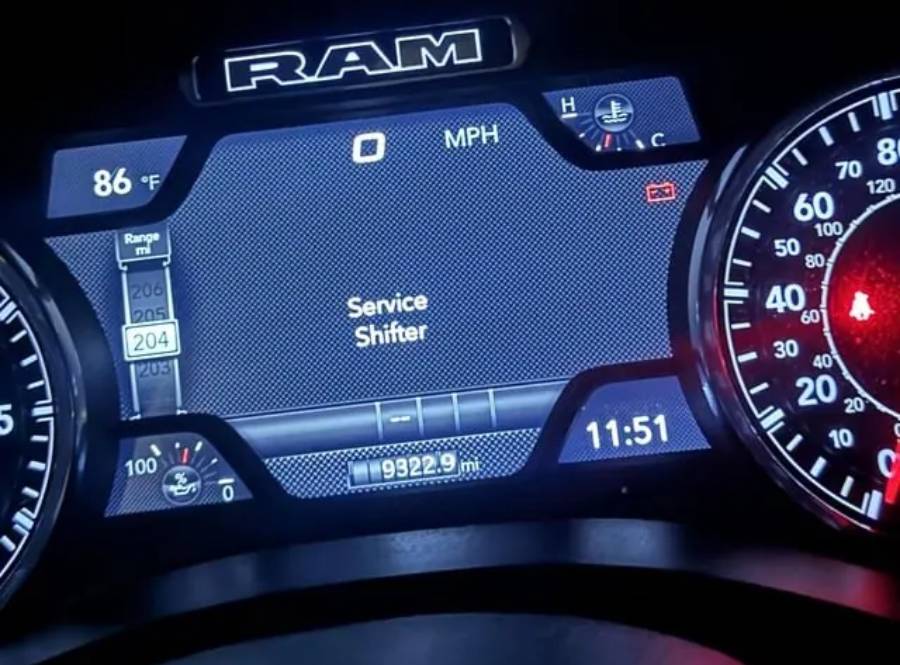
The Service Shifter warning on a RAM 1500 indicates that the truck has detected a fault involving the electronic gear-shifting system or a system it relies on. The message does not automatically mean the transmission has failed. The fault may involve the shifter assembly, wiring or electrical connectors, battery voltage, a control module, module communication, or another component that affects gear-selection signals.
The severity of a Service Shifter warning depends on how the RAM 1500 behaves when the message appears. A truck that still selects each gear correctly and drives normally presents a different situation from one that cannot shift into the requested gear, displays an incorrect gear position, or shifts unexpectedly. A warning that disappears after restarting the truck also does not prove that the underlying fault has been repaired, especially when the message returns intermittently.
Diagnosing the problem therefore requires identifying the symptoms, scanning for relevant diagnostic trouble codes, checking the electrical system, and testing the affected shifter components before replacing parts. This guide explains what the RAM 1500 Service Shifter warning means, the main causes and symptoms, whether the truck is safe to drive, how the fault is diagnosed, and which repairs can resolve it.
What Does the Service Shifter Warning Mean on a RAM 1500?
The Service Shifter warning on a RAM 1500 means the vehicle has detected a problem affecting the electronic gear-shifting system or its ability to communicate with another vehicle system. The warning tells the driver that the shifter system requires diagnosis; it does not identify the failed component by itself. Depending on the fault, the problem may involve the gear selector, electrical wiring, a control module, power supply, or communication between electronic modules.
The RAM 1500 uses electronic signals to communicate the driver’s selected gear to the systems responsible for managing gear selection and transmission operation. When the truck detects a signal, voltage, communication, or component condition outside its expected parameters, it can display the Service Shifter message on the instrument cluster. This explains why an electrical fault can produce a shifter warning even when the transmission itself has not suffered an internal mechanical failure.
A Service Shifter message can also appear while the truck continues to select Park, Reverse, Neutral, and Drive normally. In this situation, the system has detected a fault, but that fault has not necessarily progressed to the point where the driver notices a change in shifting behavior. Intermittent wiring connections, voltage problems, or electronic faults can produce warnings that appear and disappear.
For this reason, a Service Shifter warning does not automatically mean the RAM 1500 needs a new transmission. The warning identifies a problem associated with gear-selection operation or the systems supporting it. Diagnostic trouble codes, electrical testing, symptoms, and component inspection are needed to determine whether the actual cause is the shifter, wiring, electrical supply, electronic controls, or transmission-related hardware.
What Causes the Service Shifter Warning on a RAM 1500?
There are 6 main categories of problems that can cause a Service Shifter warning on a RAM 1500: a faulty shifter assembly, damaged wiring or connectors, low or unstable electrical voltage, control-module faults, software or module communication problems, and transmission-related faults. These causes can produce the same dashboard message because each can interfere with the truck’s ability to identify, communicate, or execute a requested gear selection.
The warning message alone cannot determine which of these 6 causes is responsible. Diagnosis should establish the fault before parts are replaced because an electrical connection problem and a defective shifter assembly, for example, can produce similar symptoms while requiring completely different repairs.
Can a Faulty Shifter Assembly Trigger the Service Shifter Warning?
A faulty shifter assembly can trigger the Service Shifter warning when the RAM 1500 cannot reliably determine or communicate the driver’s selected gear. The gear selector is an input device within the electronic shifting system, so an internal electrical or electronic fault can prevent the expected gear-selection information from reaching the systems that need it.
A failing shifter does not always stop working completely. The fault may initially be intermittent, allowing the selector to operate normally during one drive and trigger a warning during another. As the problem develops, the driver may notice additional symptoms involving gear selection, gear-position indication, or inconsistent shifter response.
The shifter assembly should not be replaced solely because the dashboard displays Service Shifter. A diagnostic scan and appropriate electrical or component tests should first establish whether the shifter itself is generating the fault or whether another part of the circuit is interfering with its operation.
Can Damaged Wiring or Loose Connectors Cause the Warning?
Damaged wiring, poor electrical connections, or loose connectors can cause a RAM 1500 Service Shifter warning by interrupting the signals used by the electronic shifting system. The shifter and related control systems depend on electrical circuits to transmit gear-selection information, power components, and exchange data.
A connector with poor contact can create an intermittent problem rather than a permanent failure. Vibration, movement, contamination, corrosion, damaged terminals, or wiring damage can interrupt a circuit under certain conditions and restore it later. The truck may therefore display Service Shifter during one trip while appearing normal after the engine is restarted.
Electrical inspection is important before replacing expensive electronic components. Finding damaged wiring or a poor connection changes the repair from component replacement to repairing the affected circuit or connector.
Can Low Battery Voltage Cause a RAM 1500 Service Shifter Warning?
Low or unstable system voltage can contribute to a Service Shifter warning because the RAM 1500’s electronic shifter and control modules require a stable electrical supply. When voltage falls outside the operating range required by electronic components, modules may behave incorrectly or communication between them may be disrupted.
This relationship is especially relevant when the Service Shifter message appears alongside other electrical symptoms. A weak battery, charging-system problem, poor power connection, or voltage interruption can affect more than one electronic system at the same time. The diagnostic process should therefore evaluate the truck’s electrical condition rather than assuming the shifter assembly has failed.
Low battery voltage, however, should be treated as a diagnostic possibility rather than a universal explanation for the warning. If voltage and power-supply tests are normal, diagnosis needs to continue toward wiring, communication, shifter, module, or transmission-related faults.
Can a Faulty Control Module Cause the Service Shifter Message?
A control-module fault can cause the Service Shifter message when the module cannot correctly process or communicate information required for gear selection. The RAM 1500 relies on multiple electronic systems rather than a purely mechanical connection between the driver’s gear-selection input and vehicle operation.
A module-related problem can involve the module itself, its power or ground supply, its connections, or its communication with other modules. These possibilities matter because a communication fault does not automatically prove that the module receiving or reporting the fault is defective.
Module replacement should therefore come after diagnostic testing identifies the affected circuit or controller. Replacing a control module without checking its power supply, wiring, connectors, and stored diagnostic trouble codes risks replacing a functional component while leaving the actual cause unresolved.
Can Software or Module Communication Problems Trigger the Warning?
Software or communication problems can trigger a Service Shifter warning when the RAM 1500’s electronic modules cannot exchange or interpret the information required for normal shifter operation. Modern vehicle systems exchange electronic data, so a communication problem can affect the shifter even when its physical selector mechanism remains operational.
Diagnostic trouble codes are important in this situation because they help identify which system detected the abnormal condition and whether the fault involves communication, voltage, a circuit, or a specific component. The diagnostic process can then move from the stored evidence toward the affected system instead of relying on the dashboard message alone.
A software update should not be treated as a universal Service Shifter fix. Software-related repair is appropriate when diagnosis and applicable service information establish that software or programming is responsible for the condition. Otherwise, clearing codes or updating software may leave an electrical or hardware fault unresolved.
Can a Transmission Problem Cause the Service Shifter Warning?
A transmission-related problem can cause a Service Shifter warning, but the warning by itself does not prove that the RAM 1500 has an internal transmission failure. The shifter and transmission operate within the same gear-selection process, which means faults associated with transmission operation can influence the information monitored by the electronic shifting system.
Additional symptoms make this distinction important. A RAM 1500 that displays Service Shifter but selects every gear correctly requires a different diagnostic approach from a truck that also shifts unexpectedly, cannot engage a requested gear, or displays other transmission-related warnings. The combination of symptoms and diagnostic trouble codes provides more useful evidence than the Service Shifter message alone.
The correct diagnostic sequence is therefore to identify the stored faults and symptoms before deciding whether the problem originates in the electronic shifter system or the transmission. Service Shifter should be treated as a diagnostic starting point, not as a diagnosis of transmission failure.
What Symptoms Can Appear With a RAM 1500 Service Shifter Warning?
A RAM 1500 with a Service Shifter warning can show 6 main symptom groups: a dashboard warning message, abnormal gear selection, an unresponsive shifter, incorrect gear-position indication, unexpected shifting behavior, and additional warning lights. The exact symptoms depend on whether the fault originates in the shifter assembly, an electrical circuit, a control or communication system, or another component involved in gear selection.
The Service Shifter message itself may be the only symptom. In an intermittent fault, the warning can appear while the truck continues to start, select gears, and drive normally. The message may also disappear after the vehicle is switched off and restarted. This behavior indicates that the fault is not continuously active, but it does not establish that the underlying problem has been repaired.
Gear-selection problems are more significant because they indicate that the fault is affecting vehicle operation rather than only generating a stored warning. The driver may select Drive, Reverse, Neutral, or Park and notice that the truck does not respond as expected. A shifter that responds inconsistently requires prompt diagnosis because reliable gear selection is essential for controlling vehicle movement.
An incorrect or unexpected gear indication provides another diagnostic clue. The displayed gear position should correspond with the driver’s selection. A mismatch between the selected position, instrument-cluster indication, and actual vehicle response can indicate a problem in the gear-selection signal path. The fault may involve the selector itself, its wiring, electrical connections, or the electronic systems interpreting the signal.
Unexpected shifting behavior increases the urgency of the problem. Hesitation when selecting a gear, failure to engage the requested gear, or other abnormal transmission behavior means the Service Shifter message is accompanied by a drivability symptom. These conditions require a broader diagnosis because the problem may extend beyond the physical shifter control.
Additional dashboard warnings can also help identify the affected system. A Service Shifter message that appears with the Check Engine Light or other powertrain or electrical warnings provides more diagnostic information than the Service Shifter message alone. A scan tool can retrieve stored diagnostic trouble codes and help determine whether multiple warnings originate from the same underlying fault.
Can You Drive a RAM 1500 With the Service Shifter Warning?
You should drive a RAM 1500 with a Service Shifter warning only when the truck can reliably select and maintain the intended gear and no serious drivability symptoms are present. Stop driving when gear selection becomes unreliable, the truck shifts unexpectedly, the displayed gear does not correspond with vehicle operation, or another symptom makes vehicle control uncertain.
The warning itself does not establish the severity of the fault. A RAM 1500 that displays Service Shifter while operating normally presents less immediate risk than a truck that cannot reliably engage Drive, Reverse, or Park. The driver’s decision should therefore be based on the warning plus the truck’s actual behavior rather than on the dashboard message in isolation.
Continuing to drive should also not be interpreted as permission to ignore the warning. An intermittent electrical or electronic fault can exist before a noticeable drivability problem develops. If the truck currently operates normally, diagnostic scanning and inspection can identify the problem before it progresses or returns under different driving conditions.
When Should You Stop Driving the RAM 1500?
Stop driving the RAM 1500 when the Service Shifter warning is accompanied by unreliable gear selection, unexpected vehicle movement, an incorrect gear indication, failure to engage the requested gear, or severe transmission-related symptoms. These conditions indicate that the problem may interfere with the driver’s ability to control how the truck moves.
An inability to select or confirm Park is particularly important because the driver needs to know that the truck is securely placed in the intended gear before exiting it. Likewise, a truck that does not consistently respond when Drive or Reverse is selected should not be treated as having only a dashboard-warning problem. The malfunction is affecting a vehicle-control function.
Unexpected shifting or a mismatch between the displayed gear and actual vehicle response also warrants stopping in a safe location. The driver should not continue normal operation when the gear-selection system behaves unpredictably because the next requested shift may not produce the expected result.
Other serious warning indicators should be considered together with the Service Shifter message. If the truck develops major drivability problems or additional critical warnings, professional diagnosis or towing is safer than attempting to continue driving solely because the engine still runs.
When Can You Drive the Truck for Diagnosis?
A RAM 1500 can generally be driven a short distance for diagnosis when the Service Shifter message is present but the truck starts normally, selects every requested gear correctly, maintains the selected gear, and shows no abnormal driving behavior. This situation indicates that the warning has been detected without an obvious loss of gear-selection function at that moment.
Before driving, confirm that Park, Reverse, Neutral, and Drive respond as expected while the vehicle is stationary and controlled. Pay attention to the instrument-cluster gear indication and any additional warning lights. If the shifter response or vehicle behavior changes during this check, the safer option is to stop using the truck and arrange professional assistance.
A warning that disappears after restarting the RAM 1500 still deserves diagnosis when it returns. Restarting can remove an active dashboard message when an intermittent condition is no longer present, but it does not repair damaged wiring, a poor connector, unstable voltage, or a failing electronic component.
The practical distinction is therefore between a warning with normal gear control and a warning with abnormal gear control. The first condition may allow a careful trip for diagnosis, while the second can make continued driving unsafe. In both cases, identifying the stored fault codes and underlying cause is more reliable than judging the problem solely by whether the Service Shifter message remains visible.
How Do You Diagnose a RAM 1500 Service Shifter Warning?
Diagnose a RAM 1500 Service Shifter warning by checking the symptoms first, scanning the vehicle for diagnostic trouble codes, testing the battery and electrical supply, inspecting shifter wiring and connectors, and then testing the components identified by those results. This sequence helps separate electrical and communication faults from a defective shifter assembly, control-module problem, or transmission-related fault.
Diagnosis should begin before any parts are replaced. The Service Shifter message identifies the system requiring attention but does not identify one specific failed component. Replacing the shifter assembly based only on the dashboard warning can leave the problem unresolved when damaged wiring, poor electrical connections, low voltage, or another electronic fault is responsible.
The diagnostic process should also consider when the warning occurs. A message that appears immediately after starting the truck provides a different clue from one that occurs while selecting a particular gear or appears intermittently during driving. Recording the warning conditions, other dashboard messages, and changes in shifting behavior gives the technician more information to compare with stored fault codes.
What Should You Check Before Using a Scan Tool?
Check the warning behavior, gear-selector operation, additional dashboard lights, battery condition, and accessible electrical connections before scanning the RAM 1500. These initial observations establish whether the problem is limited to a warning message or is already affecting gear-selection operation.
Start by observing whether the Service Shifter message remains active or disappears after restarting the truck. Next, with the vehicle secured, verify whether the selector responds consistently and whether the displayed gear corresponds with the intended selection. An inconsistent response or incorrect gear indication increases the likelihood that the fault is affecting gear-selection operation rather than producing only an intermittent dashboard message.
Check for additional warning lights at the same time. A Check Engine Light or another electrical or powertrain warning may indicate that other vehicle systems have also detected a fault. These warnings should be considered together because one electrical, communication, or power-supply problem can affect multiple electronic systems.
Battery condition and recent electrical events also provide useful context. If the warning began after a weak or discharged battery, battery replacement, electrical repair, or another event involving vehicle power, that information should be included in the diagnosis. It does not prove that voltage caused the Service Shifter warning, but it identifies a relevant system that should be tested.
How Do You Scan a RAM 1500 for Shifter Fault Codes?
Scan the RAM 1500 with a diagnostic tool capable of accessing the modules involved in the shifter and powertrain systems, then record the stored diagnostic trouble codes before clearing anything. The codes provide a more specific diagnostic direction than the Service Shifter dashboard message alone.
A basic code reader may retrieve engine-related OBD-II codes but may not provide access to every module involved in an electronic shifter fault. A capable scan tool can provide broader module information and help determine whether the fault involves a circuit, communication network, power supply, gear-position signal, controller, or another monitored condition.
Stored and active codes should be documented before they are cleared. Clearing codes too early removes information that can help establish where and when the malfunction occurred. When multiple codes are present, their relationship also matters. Several communication or low-voltage codes across different modules, for example, point the diagnostic process in a different direction from a specific code associated with one shifter circuit.
A diagnostic trouble code should also not be interpreted automatically as an instruction to replace the component named in its description. A circuit-related code can originate from wiring, connectors, power, ground, or the component itself. The code identifies the area that requires testing; electrical and component checks determine the actual repair.
How Do You Test the Battery and Electrical System?
Test battery voltage, charging-system performance, power connections, and relevant grounds before concluding that an electronic shifter component has failed. Stable electrical power is required for the RAM 1500’s shifter and control modules to operate and communicate correctly.
Begin with the battery because weak or unstable voltage can affect several electronic systems simultaneously. A battery that cannot maintain appropriate voltage under load may create electronic symptoms even when the truck still starts. Charging-system performance should also be evaluated because replacing or charging a battery will not permanently correct a problem caused by inadequate charging.
Battery terminals and major electrical connections should be inspected for looseness, contamination, corrosion, or physical damage. A battery can test adequately while a poor connection still causes voltage loss between the power source and an electronic component. Grounds require similar attention because an unreliable ground path can interfere with module operation and signal integrity.
Electrical test results should determine the next step. If battery, charging, power, and ground conditions are correct, diagnosis can move toward the shifter circuits and related modules. If a voltage or connection problem is identified, that problem should be corrected and the system retested before expensive electronic components are condemned.
How Do You Inspect the Shifter Wiring and Connectors?
Inspect the shifter wiring and connectors for loose connections, damaged terminals, corrosion, contamination, chafed wiring, broken conductors, and other conditions that can interrupt electrical signals. Wiring faults can imitate component failures because the shifter depends on its circuits to receive power and communicate gear-selection information.
Visual inspection is the first stage, but a wire that looks intact externally is not automatically electrically sound. Intermittent faults can result from a conductor damaged inside its insulation, a terminal with inadequate contact pressure, or a connection that loses contact when the vehicle vibrates. This explains why some Service Shifter warnings disappear after restarting the truck and return later.
The inspection should concentrate on circuits identified by scan results and applicable diagnostic information rather than disturbing every connector in the vehicle. When a specific circuit is suspected, electrical testing can establish whether power, ground, continuity, resistance, or signal behavior is outside the expected specification.
Finding a wiring or connector fault before replacing the shifter assembly is significant because repairing the circuit can restore normal system operation without replacing a functional selector or control module. After the repair, the system should be retested to confirm that the warning and associated fault codes do not return.
When Does the Shifter Assembly or Control Module Need Testing?
Test the shifter assembly or related control module after preliminary checks show that power supply, grounds, wiring, and connectors are functioning correctly or when diagnostic results specifically identify those components or their circuits. Component testing should confirm the failure rather than serve as the first diagnostic step.
For the shifter assembly, the objective is to determine whether the selector consistently produces the signals expected for each requested gear. A shifter that sends incorrect or inconsistent information can cause a warning even though its external controls appear physically normal. Scan-tool data and electrical tests can help distinguish an internal selector fault from a problem elsewhere in the circuit.
Control-module diagnosis requires the same evidence-based approach. A module communication code does not automatically mean the module itself has failed because loss of power, poor ground, damaged communication wiring, or another network problem can prevent a functional module from communicating. These supporting circuits should be verified before module replacement is considered.
The diagnostic sequence therefore moves from symptoms → fault codes → power and voltage → wiring and connectors → component testing. Following this order reduces unnecessary parts replacement and provides a clearer connection between the Service Shifter warning, the confirmed fault, and the repair required to correct it.
How Do You Fix the Service Shifter Warning on a RAM 1500?
Fix the Service Shifter warning on a RAM 1500 by repairing the specific electrical, shifter, control-module, software, or transmission-related fault identified during diagnosis. There is no single repair that resolves every Service Shifter warning because the dashboard message can result from faults in several parts of the electronic gear-selection system.
The repair should follow the diagnostic evidence rather than begin with replacement of the shifter assembly. For example, damaged wiring requires circuit repair, unstable electrical power requires correction of the battery or charging-system problem, and a confirmed internal shifter fault may require shifter assembly replacement. Treating every Service Shifter warning as the same failure increases the risk of replacing functional parts without eliminating the original fault.
After completing the repair, the system should be tested again. Relevant diagnostic trouble codes can be cleared after they have been recorded and the confirmed fault has been corrected. The truck should then be checked for normal gear selection, correct gear-position indication, and recurrence of the Service Shifter message.
Can Restarting the RAM 1500 Clear the Service Shifter Warning?
Restarting a RAM 1500 can make an intermittent Service Shifter warning disappear, but restarting the truck does not repair the underlying fault. Cycling the ignition can cause a warning to disappear when the electronic system no longer detects the abnormal condition during the next operating cycle.
This distinction matters because intermittent electrical faults do not need to remain active continuously. A poor connector, unstable voltage, damaged circuit, or electronic communication problem may occur under one set of conditions and disappear under another. The dashboard can therefore return to normal even though the condition that originally triggered the warning still exists.
Use a restart as an observation rather than a confirmed repair. If the Service Shifter warning returns, record when it occurs and whether other symptoms appear with it. Repeated warnings justify diagnostic scanning even when the truck continues to shift normally.
Can Repairing Wiring or Connectors Fix the Warning?
Repairing damaged wiring or faulty electrical connectors can fix the Service Shifter warning when diagnosis confirms that the affected circuit is interrupting power, ground, or signal communication. Electronic gear-selection components depend on intact circuits, so restoring the electrical connection can return the system to normal without replacing the shifter itself.
The required repair depends on the type and location of the electrical damage. Examples include repairing a damaged conductor, correcting a loose terminal, restoring a poor connection, or addressing corrosion or contamination that interferes with electrical contact. The objective is to restore the circuit to its required electrical condition rather than merely make the dashboard warning disappear temporarily.
The repaired circuit should be tested before the job is considered complete. Normal electrical operation, reliable gear selection, absence of returning fault codes, and no recurrence of the Service Shifter message provide stronger evidence of a successful repair than clearing the warning alone.
Can Battery or Charging-System Repairs Clear the Warning?
Battery or charging-system repairs can resolve a Service Shifter warning when testing confirms that insufficient or unstable electrical power is disrupting the shifter system or its control modules. Correcting the power-supply problem allows the electronic systems to operate within their intended voltage range.
The correct repair depends on the diagnosed electrical fault. A battery that fails appropriate testing may require replacement, while a charging-system fault requires correction of the component or connection responsible for inadequate charging. Loose or poor battery connections can also require repair even when the battery itself remains serviceable.
A battery should not be replaced solely because the Service Shifter warning is present. The relationship needs to be established through electrical testing or supporting diagnostic evidence. If the battery and charging system operate correctly, replacing the battery is unlikely to resolve a fault originating in the shifter, wiring, communication network, or another component.
After an electrical repair, retest the truck under the conditions that previously produced the warning. Confirming stable electrical operation and checking whether relevant fault codes return helps determine whether the power-supply problem was the root cause or whether additional diagnosis is required.
When Does the Shifter Assembly Need Replacement?
The shifter assembly needs replacement when diagnostic testing confirms that the assembly itself cannot reliably provide or communicate the correct gear-selection input. Replacement should follow evidence of an internal shifter fault rather than the Service Shifter message alone.
A defective assembly may produce inconsistent gear-selection information, abnormal selector response, or repeated faults associated with its operation. However, damaged wiring or poor connections can produce similar symptoms because they interfere with the same electrical signals. Testing the associated circuits before replacement separates an internal shifter failure from an external electrical problem.
When replacement is confirmed, the correct component and repair procedure depend on the RAM 1500’s configuration and model year. The repaired system should then be checked to verify that the selector consistently identifies the requested gear and that the Service Shifter warning does not return.
When Does a Control Module Need Repair or Replacement?
A control module should be repaired or replaced only when diagnosis confirms that the module itself has failed after its power supply, grounds, wiring, connectors, and communication circuits have been verified. A module that cannot communicate is not automatically a defective module because an external electrical fault can produce the same result.
For example, loss of module power can make a functioning controller appear offline to a diagnostic scanner. Damage to a communication circuit can produce a similar effect by preventing information from reaching other vehicle systems. Confirming these supporting circuits prevents a wiring fault from being misdiagnosed as an expensive electronic-module failure.
Module replacement can also involve procedures beyond physically installing the component. Depending on the affected system and vehicle configuration, programming, configuration, initialization, or another manufacturer-specified procedure may be required before the replacement module operates correctly with the truck.
The repair should therefore follow applicable diagnostic and service information for the specific RAM 1500 rather than a universal module-replacement procedure. After the work is completed, communication between the affected systems and normal shifter operation should be verified.
Can a Software Update Fix a RAM 1500 Service Shifter Warning?
A software update can fix a RAM 1500 Service Shifter warning when applicable service information identifies software or module programming as the cause of the specific fault. A software update is not a universal reset or repair for every Service Shifter message.
Electronic modules use programmed logic to interpret signals and communicate with other vehicle systems. A software-related problem can therefore produce abnormal system behavior even when the shifter hardware, wiring, and electrical supply remain functional. When a documented software correction applies to the vehicle and its symptoms, updating or reprogramming the affected module can address that condition.
Software should not be used to bypass physical diagnosis. Updating a module will not repair a broken wire, loose connector, unstable power supply, or internally failed shifter assembly. The applicable fault codes, symptoms, vehicle configuration, and service information should support the decision to perform an update.
The repair is complete only when the underlying fault has been addressed and the RAM 1500 operates normally afterward. Clearing the Service Shifter message is an outcome of a successful repair, not the repair itself.
How Much Does It Cost to Fix a RAM 1500 Service Shifter Warning?
The cost to fix a RAM 1500 Service Shifter warning depends on whether diagnosis identifies a wiring or connector problem, battery or charging fault, defective shifter assembly, control-module problem, software issue, or transmission-related failure. There is no reliable single repair price because the Service Shifter message describes a system fault rather than one specific failed part.
Diagnosis is the first cost to consider when the cause is unknown. A professional diagnostic process may include scanning multiple vehicle modules, checking stored trouble codes, testing battery and charging voltage, inspecting wiring and connectors, and testing the shifter or related control circuits. Paying for accurate diagnosis can reduce the total repair cost when it prevents replacement of a functional shifter or electronic module.
Wiring and connector repairs depend heavily on the location and extent of the damage. Correcting a loose or accessible connection requires less labor than locating an intermittent fault inside a wiring harness. The same principle applies to battery and charging-system problems: the final cost depends on which component or connection fails testing rather than on the Service Shifter warning itself.
Shifter assembly and control-module repairs can involve both parts and labor. Electronic-module replacement may add programming, configuration, or initialization procedures where required for the specific RAM 1500. Transmission-related repairs represent a separate cost category because an internal transmission problem can require substantially different work from repairing the electronic gear selector.
For this reason, the most useful repair estimate is one based on the confirmed fault and the RAM 1500’s model year, configuration, local labor rate, and required parts. A price estimate based only on the words “Service Shifter” can be misleading because two trucks displaying the same warning may require completely different repairs.
Why Does the Service Shifter Warning Keep Coming Back?
A Service Shifter warning that keeps returning indicates that the RAM 1500 is detecting the fault again or that the original cause has not been permanently corrected. Recurrent warnings are particularly consistent with intermittent electrical connections, wiring faults, unstable voltage, communication problems, or components that fail only under certain operating conditions.
An intermittent connector illustrates how the warning can disappear and return. The connection may function normally while the truck is stationary but lose electrical contact because of vibration, temperature changes, or movement. Once communication is restored, the warning may disappear during a later ignition cycle even though the defective connection remains.
Clearing diagnostic trouble codes can create a similar pattern when no repair has been performed. Clearing a code removes stored diagnostic information or turns off a warning under applicable conditions; it does not repair the circuit or component that originally caused the fault. The warning returns when the vehicle detects the same abnormal condition again.
Repeated warnings should therefore be diagnosed based on the conditions under which they occur. Record whether the message appears during startup, after selecting a particular gear, after a battery-related event, or while driving. Combining this information with stored and active diagnostic trouble codes can help isolate an intermittent problem that is not present continuously during inspection.
Why Does My RAM 1500 Say Service Shifter but Still Drive Normally?
A RAM 1500 can display Service Shifter and still drive normally because the electronic system can detect an abnormal signal or operating condition before the fault causes an obvious loss of gear-selection function. The absence of noticeable driving symptoms does not prove that every part of the shifter system is functioning correctly.
Electronic monitoring allows the truck to identify conditions that the driver cannot directly feel. An intermittent circuit problem, communication fault, voltage irregularity, or developing component failure may generate a warning while Park, Reverse, Neutral, and Drive continue to operate as expected. The fault may also occur briefly and stop before it noticeably affects vehicle behavior.
This situation differs from a Service Shifter warning accompanied by incorrect gear indication or unreliable shifting. When the truck still operates normally, the immediate safety concern is lower because the driver retains normal gear control. The underlying warning still deserves diagnosis, particularly when it returns after being cleared or after the vehicle is restarted.
Scanning the vehicle while diagnostic information remains available is more useful than waiting for the truck to stop shifting correctly. Stored trouble codes can preserve evidence about an intermittent condition even when the dashboard warning is no longer active. This information can direct testing toward the affected circuit or system before the fault becomes more severe.
Does the Service Shifter Warning Mean the RAM 1500 Transmission Is Failing?
No, a Service Shifter warning does not by itself mean that the RAM 1500 transmission is failing. The message can result from a fault in the electronic shifter, wiring, electrical supply, control or communication system, or another component involved in gear selection, while the mechanical transmission remains functional.
The distinction exists because the gear-selection system includes more than the transmission itself. The driver’s selection must be detected, converted into electronic information, communicated through the appropriate vehicle systems, and acted upon correctly. A fault at an earlier stage of this process can trigger Service Shifter without an internal mechanical transmission failure.
Transmission involvement becomes more relevant when the warning occurs with additional symptoms. Failure to engage a requested gear, abnormal shifting behavior, significant drivability problems, or transmission-related diagnostic trouble codes provide evidence that diagnosis needs to extend beyond the selector and its electrical circuits.
The warning should therefore be interpreted as evidence of a gear-selection system problem rather than proof of transmission failure. Diagnostic testing determines whether the fault ends at the shifter or electrical system or extends to transmission-related components. This distinction prevents an electronic warning from being treated prematurely as evidence that the entire transmission requires replacement.
When Should a RAM 1500 With a Service Shifter Warning Go to a Mechanic?
A RAM 1500 with a Service Shifter warning should receive professional diagnosis when the warning repeatedly returns, the cause cannot be identified through basic checks, or the truck develops abnormal gear-selection or driving behavior. Immediate assistance is more appropriate when the malfunction affects the driver’s ability to select and maintain the intended gear safely.
Do not continue normal driving when the truck cannot reliably engage Park, Reverse, Neutral, or Drive, when the actual vehicle response does not match the selected gear, or when unexpected shifting makes vehicle movement unpredictable. These symptoms indicate that the problem has progressed beyond a dashboard message and is affecting a function required for safe vehicle control.
Professional diagnosis is also appropriate when the Service Shifter warning continues to return despite normal driving behavior. A technician with a diagnostic tool capable of communicating with the relevant RAM 1500 modules can retrieve fault information that a basic engine-code reader may not provide. Electrical testing can then determine whether the fault involves power, ground, wiring, connectors, communication, the shifter assembly, or another component.
Owners should also seek professional service when diagnosis points toward control-module programming, module replacement, complex network communication faults, or internal transmission problems. These repairs can require vehicle-specific diagnostic equipment, procedures, or programming rather than basic component replacement.
The decision should ultimately depend on whether gear control remains reliable and whether the underlying fault has been identified. A Service Shifter warning with normal operation may allow the truck to be driven carefully for diagnosis, while unreliable gear selection or unexpected vehicle behavior warrants stopping the vehicle and arranging appropriate professional assistance.