The Mazda RX8 Rotary Engine Specs continue to attract car enthusiasts, collectors, and performance drivers who appreciate one of the most unconventional engines ever installed in a production sports car. While most manufacturers rely on piston engines, Mazda chose a different path by developing the naturally aspirated Renesis 13B MSP rotary engine. Its compact design, smooth power delivery, and exceptionally high revving character helped the RX8 stand out from virtually every competitor in its class.
At first glance, the official 1.3 liter displacement may seem surprisingly small for a sports coupe capable of producing more than 230 horsepower. This often leads to confusion among new enthusiasts who expect engine size to directly reflect performance. Unlike a conventional four cylinder or six cylinder engine, the Renesis uses two triangular rotors instead of reciprocating pistons, making its displacement and power characteristics fundamentally different.
Understanding the Mazda RX8 rotary engine requires looking beyond horsepower figures alone. Engine architecture, combustion design, compression, lubrication, and cooling all contribute to the unique driving experience that has made the RX8 a favorite among rotary enthusiasts for more than two decades. At the same time, these engineering differences also explain why proper maintenance plays a much larger role in long term reliability than it does for many conventional sports cars.
This comprehensive guide explores the complete Mazda RX8 Rotary Engine Specs, including the Renesis 13B MSP engine design, horsepower, torque, displacement, compression ratio, redline, fuel system, ignition system, and performance characteristics. It also examines reliability, common engine problems, maintenance requirements, and ownership costs, giving both prospective buyers and existing owners the technical knowledge needed to better understand one of Mazda’s most iconic rotary engines.
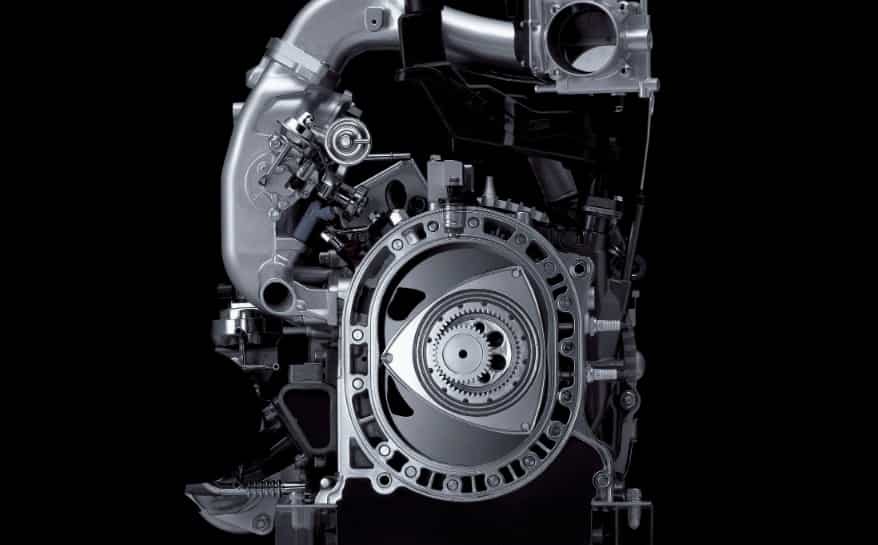
Mazda RX8 Rotary Engine Specs at a Glance
Before exploring the engineering details, it is helpful to understand the key specifications of the Mazda RX8 Renesis engine. The table below provides a quick overview of the most important technical data. Keep in mind that some figures may vary slightly depending on the model year, transmission, and regional market.
| Specification | Details |
|---|---|
| Engine Name | Renesis |
| Engine Code | 13B MSP |
| Engine Type | Naturally Aspirated Twin Rotor Wankel Rotary Engine |
| Displacement | 1,308 cc |
| Number of Rotors | 2 |
| Valvetrain | Not Applicable |
| Aspiration | Naturally Aspirated |
| Fuel System | Electronic Multi Point Fuel Injection |
| Compression Ratio | 10.0:1 |
| Maximum Horsepower | Up to 238 hp |
| Maximum Torque | Up to 159 lb ft (216 Nm) |
| Maximum Engine Speed | Up to 9,000 rpm |
| Transmission Options | 5 Speed Automatic, 5 Speed Manual, 6 Speed Manual |
| Drivetrain | Rear Wheel Drive |
| Fuel Type | Premium Unleaded Gasoline |
| Oil Capacity | Approximately 3.7 L to 4.0 L |
| Cooling System | Liquid Cooled |
| Production Years | 2003 to 2012 |
Although the Renesis engine is officially rated at only 1.3 liters, its performance characteristics are unlike those of a conventional piston engine with the same displacement. The rotary design allows the engine to rev significantly higher while maintaining remarkably smooth operation throughout the rev range. This unique approach enables the RX8 to deliver sports car performance from an engine that occupies far less physical space than most comparable powerplants.
Another distinctive feature of the Renesis is its side exhaust port configuration. Unlike earlier Mazda rotary engines, this design improves combustion efficiency, reduces emissions, and increases usable power without requiring turbocharging. As a result, the RX8 became the first mass produced naturally aspirated rotary powered sports car to combine high specific output with modern emissions compliance.
These specifications provide a solid foundation for understanding how the Mazda RX8 performs on the road. In the following sections, we will examine the Renesis 13B MSP in greater detail, explaining how its engineering differs from traditional piston engines and why it remains one of the most fascinating production engines ever built by Mazda.
What Is the Mazda RX8 Renesis 13B MSP Engine?
The Renesis 13B MSP is the engine that defines the Mazda RX8. It is also one of the most distinctive powerplants ever developed by Mazda. Unlike a conventional piston engine, it uses two triangular rotors that rotate inside specially shaped housings. As a result, the engine delivers smooth power and a unique driving experience.
The name Renesis combines the words Rotary Engine and Genesis. It reflects Mazda’s goal of creating a new generation of rotary technology. The engine debuted with the RX8 in 2003. Since then, it has become a favorite among automotive enthusiasts around the world.
One of the biggest improvements was the Multi Side Port, or MSP, exhaust design. Previous rotary engines used peripheral exhaust ports. However, Mazda moved the exhaust ports to the side housing on the Renesis. This change reduced exhaust overlap and improved combustion efficiency. In addition, it helped the engine meet stricter emissions standards while maintaining strong high RPM performance.
The Renesis is also remarkably compact and lightweight. Therefore, Mazda positioned the engine farther behind the front axle. This layout contributed to nearly perfect weight distribution and sharper handling. Although the engine produces modest low speed torque, it performs best at higher engine speeds. Manual transmission models can rev to approximately 9,000 rpm, giving the RX8 its signature driving character.
Today, the Renesis 13B MSP remains an important milestone in Mazda’s engineering history. Its innovative rotary design, compact dimensions, and engaging performance continue to attract drivers who value originality and a truly unique sports car experience.
Mazda RX8 Engine Specifications
The Mazda RX8 was designed around the Renesis 13B MSP, an engine that combines compact dimensions with impressive high RPM performance. Although its official displacement is only 1,308 cc, the rotary design produces power very differently from a conventional piston engine. As a result, the RX8 delivers a driving experience that continues to stand out among modern sports cars.
The Renesis features a naturally aspirated twin rotor layout with electronic multi point fuel injection. In addition, it uses a 10.0:1 compression ratio and is available with both manual and automatic transmissions. Depending on the model year and market, power ranges from approximately 189 horsepower to 238 horsepower. Likewise, torque varies between 159 lb ft and 162 lb ft, while manual transmission models can rev to as much as 9,000 rpm.
Unlike a traditional four cylinder engine, the Renesis does not rely on pistons, connecting rods, or camshafts. Instead, each rotor spins around an eccentric shaft inside a specially shaped housing. Consequently, the engine runs with very little vibration and delivers exceptionally smooth power throughout the rev range. At the same time, its compact size allows Mazda to position the engine farther behind the front axle, improving both weight distribution and handling balance.
The ignition system is equally distinctive. Each rotor housing uses leading and trailing spark plugs to achieve more efficient combustion. Furthermore, the electronic oil metering system injects a small amount of oil into the combustion chambers to lubricate the apex seals. Therefore, checking the engine oil regularly is an essential part of RX8 ownership.
For a quick reference, the table below highlights the most important Mazda RX8 engine specifications.
| Specification | Value |
|---|---|
| Engine Code | 13B MSP Renesis |
| Engine Type | Naturally Aspirated Twin Rotor Wankel Rotary |
| Displacement | 1,308 cc |
| Number of Rotors | 2 |
| Aspiration | Naturally Aspirated |
| Fuel System | Electronic Multi Point Fuel Injection |
| Compression Ratio | 10.0:1 |
| Maximum Horsepower | 189 hp to 238 hp |
| Maximum Torque | 159 lb ft to 162 lb ft |
| Maximum Engine Speed | Up to 9,000 rpm |
| Fuel Requirement | Premium Unleaded Gasoline |
| Cooling System | Liquid Cooled |
| Lubrication | Electronic Oil Metering System |
Overall, these specifications explain why the Renesis remains one of the most distinctive production rotary engines ever built. While it produces less low speed torque than many modern turbocharged engines, it rewards drivers with responsive throttle input, smooth high RPM performance, and a driving character that is difficult to replicate.
Series 1 vs Series 2 Mazda RX8 Engine Specs
Although the Mazda RX8 kept the same Renesis 13B MSP rotary engine throughout its production, Mazda introduced several updates over the years. Therefore, the differences between Series 1 and Series 2 are worth understanding before buying or restoring an RX8. Both generations deliver the signature rotary driving experience, but each offers unique advantages.
Series 1 models were produced from 2003 to 2008. During this period, Mazda offered both manual and automatic transmissions in most markets. Manual models produced up to 238 horsepower and featured a higher redline, making them the preferred choice for performance enthusiasts. In contrast, automatic versions produced less power because of revised engine tuning and a lower engine speed limit. Nevertheless, both models maintained excellent chassis balance and responsive handling.
In 2009, Mazda launched the updated Series 2. While the core engine remained unchanged, several supporting systems received important revisions. For example, Mazda upgraded the ignition components, refined the engine management software, and improved the cooling system. In addition, suspension tuning and chassis reinforcement enhanced overall driving stability. As a result, many owners consider the later models more refined and dependable for daily use.
The table below highlights the main differences between the two generations.
| Specification | Series 1 | Series 2 |
|---|---|---|
| Production Years | 2003 to 2008 | 2009 to 2012 |
| Maximum Horsepower | Up to 238 hp | Up to 232 hp |
| Maximum Torque | Up to 159 lb ft | Up to 155 lb ft |
| Maximum Engine Speed | Up to 9,000 rpm | Up to 9,000 rpm |
| Engine Management | Original ECU | Updated ECU |
| Ignition System | Standard | Improved |
| Cooling System | Standard | Enhanced |
Overall, both generations remain excellent choices for rotary enthusiasts. However, Series 1 appeals to drivers seeking maximum factory performance. Meanwhile, Series 2 is better suited to buyers who prioritize improved reliability and everyday usability. Ultimately, a well maintained RX8 will usually provide a better ownership experience than a neglected example, regardless of its production year.uction year alone.
Mazda RX8 Fuel Economy and Oil Consumption
The Mazda RX8 delivers an engaging driving experience, but fuel economy is not one of its strongest qualities. Although the Renesis 13B MSP has an official displacement of just 1.3 liters, it typically consumes more fuel than many larger four cylinder engines. This is because a rotary engine uses a different combustion process and operates most efficiently at higher engine speeds. As a result, owners should expect fuel consumption that reflects its performance rather than its engine size.
In everyday driving, fuel economy varies depending on road conditions, transmission type, and driving habits. Manual transmission models generally consume slightly more fuel when driven aggressively, while automatic versions may offer more consistent efficiency in city traffic. However, frequent high RPM driving will increase fuel consumption regardless of the transmission. Therefore, smooth acceleration and regular maintenance can help improve overall efficiency without reducing the enjoyable character of the RX8.
Oil consumption is another characteristic that surprises many first time owners. Unlike a conventional piston engine, the Renesis is designed to inject a small amount of engine oil into the combustion chambers. This process lubricates the apex seals and helps protect critical internal components. Consequently, a gradual drop in the oil level is considered normal and should not be mistaken for an engine fault.
Overall, checking the oil level regularly is one of the most important maintenance tasks for every RX8 owner. In addition, using the recommended oil grade and replacing it at the proper service interval will help maintain engine performance and reliability. By following these simple habits, owners can enjoy the unique character of the rotary engine while reducing the risk of premature wear and costly repairs.
Mazda RX8 Reliability
The Mazda RX8 has earned a reputation for being both rewarding and demanding to own. Although the Renesis 13B MSP is an innovative rotary engine, its long term reliability depends heavily on proper maintenance. Unlike many conventional engines, it requires consistent attention to oil levels, ignition components, and the cooling system. Therefore, owners who follow the recommended service schedule often experience far fewer mechanical problems than those who neglect routine maintenance.
One of the most common concerns is compression loss. As the engine accumulates mileage, worn apex seals can reduce compression and make the engine difficult to start, especially when it is warm. In addition, weak ignition coils or worn spark plugs may cause incomplete combustion, reducing both performance and fuel efficiency. If these issues are ignored, they can eventually damage the catalytic converter and increase repair costs.
Overheating is another problem that should never be overlooked. Because the rotary engine generates significant heat, the cooling system must remain in excellent condition. For example, a failing radiator, leaking coolant hose, or faulty thermostat can quickly lead to serious engine damage. As a result, regular inspections are essential for preventing expensive repairs and extending engine life.
Overall, a well maintained RX8 can provide many years of enjoyable driving. However, buyers should always verify the engine’s compression before purchasing a used vehicle. Likewise, reviewing the maintenance history can reveal whether the car has received proper care throughout its life. By choosing a well serviced example and following preventive maintenance, owners can enjoy the unique performance of the Renesis engine with greater confidence and reliability.
Mazda RX8 Engine Rebuild and Ownership Cost
Owning a Mazda RX8 can be highly rewarding, but understanding potential rebuild costs is essential. Although many Renesis engines remain reliable for years, every rotary engine will eventually experience internal wear. Therefore, knowing when a rebuild is necessary can help owners avoid severe engine damage and unexpected expenses.
A rebuild is usually recommended when the engine develops low compression, poor hot starting, or noticeable power loss. In some cases, excessive oil consumption or unusual engine noise may also indicate internal wear. However, these symptoms should always be confirmed with a rotary compression test before major repairs begin. This test provides a much more accurate assessment than a standard compression test designed for piston engines.
The rebuild process typically involves complete engine disassembly, inspection of the rotors and housings, and replacement of worn seals, bearings, gaskets, and other critical components. In addition, experienced rotary specialists will measure internal clearances to determine whether key parts can be reused or should be replaced. As a result, the final cost depends on the engine’s condition and the quality of replacement parts.
Ownership costs extend beyond engine repairs. Routine oil changes, ignition components, cooling system maintenance, and premium fuel should all be included in the long term budget. Nevertheless, preventive maintenance is usually far less expensive than repairing a neglected engine. Overall, buyers should focus on maintenance records and compression results instead of mileage alone. By purchasing a well maintained RX8 and following a consistent service schedule, owners can reduce long term expenses while preserving the performance and reliability of the Renesis engine.
Advantages and Disadvantages of the RX8 Rotary Engine
The Mazda RX8 stands out because of its unconventional rotary engine. Although it requires more attention than a typical piston engine, it offers a driving experience that few sports cars can match. Therefore, understanding both its strengths and weaknesses is essential before deciding whether the RX8 is the right car for you.
One of the biggest advantages is the engine’s compact and lightweight design. As a result, Mazda positioned the Renesis farther behind the front axle, creating nearly perfect weight distribution and responsive handling. In addition, the rotary engine operates with exceptional smoothness and can reach very high engine speeds without the vibration commonly associated with piston engines. Consequently, the RX8 feels agile and rewarding on winding roads.
However, the Renesis also has several limitations. It produces less low end torque than most modern naturally aspirated or turbocharged engines. Furthermore, fuel economy is relatively poor despite the engine’s small displacement. The engine also consumes oil by design, so owners must check the oil level regularly. If routine maintenance is ignored, problems such as low compression, ignition failure, or overheating can develop and lead to expensive repairs.
The table below summarizes the main advantages and disadvantages of the RX8 rotary engine.
| Advantages | Disadvantages |
|---|---|
| Compact and lightweight engine | Lower low RPM torque |
| Smooth high RPM performance | Higher fuel consumption |
| Excellent weight distribution | Normal engine oil consumption |
| Unique rotary driving experience | Requires specialized maintenance |
| Distinctive engine sound | Rebuild costs can be expensive |
Overall, the RX8 is best suited for enthusiasts who appreciate innovative engineering and are willing to follow a proper maintenance routine. On the other hand, drivers seeking low running costs and minimal maintenance may find a conventional sports car more practical. Ultimately, the Renesis engine rewards informed owners with a driving experience that remains unique more than a decade after production ended.
Mazda RX8 Rotary Engine Compared With Other Engines
The Renesis 13B MSP is often compared with both earlier Mazda rotary engines and modern piston engines. Although all three engine types deliver power in different ways, each has its own strengths and compromises. Therefore, understanding these differences helps explain why the RX8 continues to attract enthusiasts despite its unique maintenance requirements.
The most common comparison is between the RX8 Renesis and the turbocharged 13B REW found in the Mazda RX7. The RX7 engine produces significantly more torque and responds well to performance modifications. However, the naturally aspirated Renesis was designed with cleaner emissions and improved efficiency in mind. As a result, it offers smoother power delivery and a simpler engine layout, although it cannot match the acceleration of the twin turbo RX7.
The Renesis is also very different from a conventional inline four engine. While a piston engine delivers stronger low RPM torque and better fuel economy, it is generally larger and heavier. In contrast, the rotary engine is remarkably compact and produces very little vibration. Consequently, the RX8 benefits from excellent weight distribution and precise handling, especially on winding roads.
Modern turbocharged engines provide another interesting comparison. They generate impressive torque at low engine speeds and often achieve better fuel efficiency. Nevertheless, many drivers prefer the immediate throttle response and high revving nature of the Renesis. Likewise, the distinctive rotary sound and smooth power delivery create a driving experience that is difficult to replicate with forced induction.
Overall, the Renesis 13B MSP is not the most powerful or economical engine in its class. Instead, it appeals to drivers who value engineering innovation and balanced performance over outright speed. For that reason, the Mazda RX8 remains one of the most distinctive sports cars ever produced, even when compared with newer performance models.
Frequently Asked Questions
What engine does the Mazda RX8 use?
The Mazda RX8 is powered by the Renesis 13B MSP, a naturally aspirated twin rotor Wankel rotary engine. Unlike a conventional piston engine, it uses rotating triangular rotors instead of pistons. As a result, it delivers smooth power, a compact design, and an exceptionally high revving character.
Is the Mazda RX8 really a 1.3 liter engine?
Yes. The official displacement is 1,308 cc, or 1.3 liters. However, rotary engines calculate displacement differently from piston engines. Therefore, comparing the RX8 directly with a 1.3 liter four cylinder engine can be misleading because both engine designs produce power in different ways.
How much horsepower does a Mazda RX8 produce?
Horsepower depends on the model year, transmission, and market. Manual transmission models produce up to 238 horsepower, while automatic versions generally deliver between 189 and 212 horsepower. Consequently, manual models provide stronger high RPM performance.
Why does the Mazda RX8 burn oil?
The Renesis engine is designed to inject small amounts of oil into the combustion chambers to lubricate the apex seals. Therefore, gradual oil consumption is a normal operating characteristic rather than a mechanical fault. Nevertheless, owners should check the oil level regularly to protect the engine.
How long does a Mazda RX8 rotary engine last?
Engine lifespan varies according to maintenance, driving habits, and operating conditions. Although some engines require rebuilding earlier, well maintained examples can provide many years of reliable service. Regular oil checks, a healthy ignition system, and proper cooling all contribute to longer engine life.
Is the Mazda RX8 reliable?
The RX8 can be reliable when it receives proper maintenance. However, neglected engines are more likely to experience compression loss, ignition problems, or overheating. As a result, buyers should always inspect the vehicle carefully and perform a rotary compression test before making a purchase.
What fuel should the Mazda RX8 use?
Mazda recommends premium unleaded gasoline for the Renesis engine. Higher octane fuel supports efficient combustion and helps the engine achieve its intended performance. In addition, using the recommended fuel can reduce the risk of engine knock under demanding driving conditions.
Can the Renesis engine be turbocharged?
Yes, the Renesis can be turbocharged with aftermarket components. However, forced induction requires extensive modifications to the fuel, ignition, cooling, and engine management systems. Therefore, most owners should only consider a turbo conversion after consulting an experienced rotary specialist.
Conclusion
The Mazda RX8 Rotary Engine Specs demonstrate why the Renesis 13B MSP remains one of the most distinctive production engines ever developed. Although its official displacement is only 1.3 liters, the rotary design delivers smooth high RPM performance, compact packaging, and balanced vehicle dynamics that continue to impress driving enthusiasts. As a result, the RX8 offers a character that is difficult to duplicate with a conventional piston engine.
Throughout this guide, we explored the engine’s specifications, performance, fuel economy, reliability, maintenance requirements, and ownership costs. In addition, we compared the Renesis with other engine types to highlight its unique engineering philosophy. While the RX8 demands more attention than many sports cars, consistent maintenance can significantly improve reliability and extend engine life.
Overall, the Mazda RX8 is an excellent choice for enthusiasts who appreciate innovative engineering and an engaging driving experience. However, purchasing a well maintained example is far more important than choosing a specific model year. Therefore, always review the service history, verify engine compression, and inspect the cooling and ignition systems before making a decision.
If you already own a Mazda RX8 or are planning to buy one, share your experience or questions in the comments below. Your insights may help other enthusiasts better understand the strengths, challenges, and long term ownership experience of this iconic rotary powered sports car.