The 2026 Hyundai Palisade gets up to 25 MPG on the highway with its gasoline engine. Fuel economy varies by drivetrain and configuration. Hyundai rates the front wheel drive model at 19 MPG city, 25 MPG highway, and 21 MPG combined. The HTRAC all wheel drive model gets 18 MPG city, 24 MPG highway, and 20 MPG combined. The XRT configuration returns 16 MPG city, 22 MPG highway, and 19 MPG combined.
Hyundai Palisade gas mileage also varies by model year. For example, the 2025 front wheel drive model gets 22 MPG combined, while the comparable 2026 model gets 21 MPG combined. Engine design, drivetrain, vehicle weight, wheels, and driving conditions all influence fuel consumption. Driving habits also affect how closely real world mileage matches EPA estimates.
This guide compares Hyundai Palisade MPG by model year and drivetrain. It also explains the Palisade driving range on a full tank and the main factors that reduce fuel economy. You will also see estimated fuel costs and how the Palisade compares with other three row SUVs.
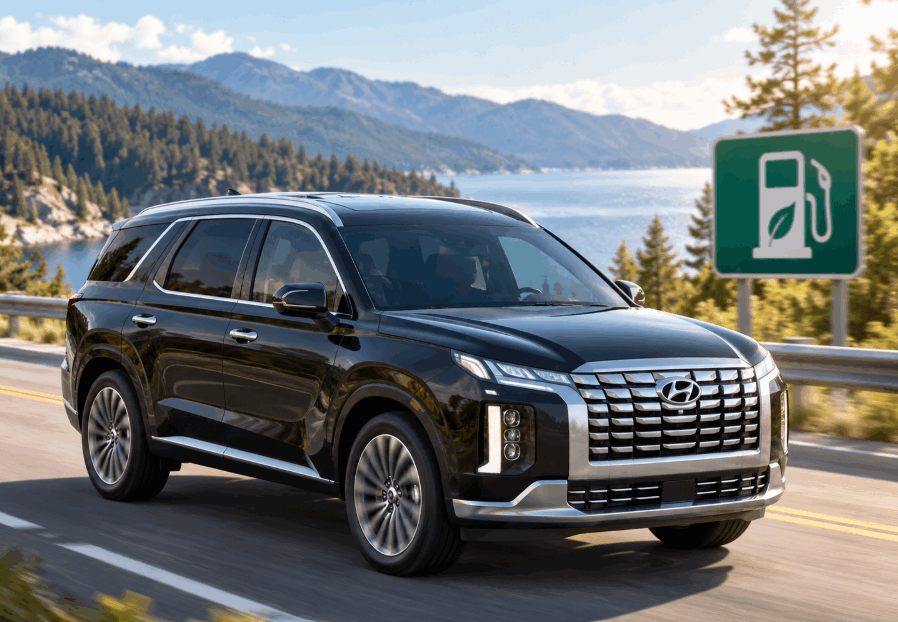
What Is the Hyundai Palisade Gas Mileage?
The 2026 Hyundai Palisade gets between 19 and 21 MPG combined with its gasoline engine. The exact rating depends on drivetrain and configuration. Specifically, the standard front wheel drive model gets 19 MPG city, 25 MPG highway, and 21 MPG combined. In contrast, the HTRAC all wheel drive model gets 18 MPG city, 24 MPG highway, and 20 MPG combined.
The 2026 XRT uses HTRAC all wheel drive and returns lower fuel economy. It gets 16 MPG city, 22 MPG highway, and 19 MPG combined. Therefore, configuration can change fuel economy within the same model year. In addition, Hyundai notes that driving conditions, driving habits, vehicle options, and vehicle condition affect actual mileage.
| 2026 Configuration | City MPG | Highway MPG | Combined MPG |
|---|---|---|---|
| Front wheel drive | 19 | 25 | 21 |
| HTRAC all wheel drive | 18 | 24 | 20 |
| XRT HTRAC all wheel drive | 16 | 22 | 19 |
City MPG estimates fuel use during lower speed driving with frequent stops. Meanwhile, highway MPG reflects steady driving at higher speeds. Combined MPG blends city and highway use into one figure. Therefore, combined MPG gives buyers a useful number for comparing overall fuel economy.
EPA figures work best as comparison values rather than guaranteed results. For example, a driver in congested traffic may see lower mileage. In contrast, a driver who takes longer highway trips may get closer to the highway rating. Moreover, tire pressure, cargo weight, temperature, and acceleration habits can affect real world fuel consumption.
What Is the Hyundai Palisade MPG by Model Year?
Hyundai Palisade gas mileage has stayed close to 21 or 22 MPG combined for most gasoline models since 2020. However, highway MPG and drivetrain differences have changed across model years. For example, the 2023 front wheel drive model reached 27 MPG highway. As a result, it has the highest highway rating in this group.
| Model Year | Drivetrain | City MPG | Highway MPG | Combined MPG |
|---|---|---|---|---|
| 2020 | Front wheel drive | 19 | 26 | 22 |
| 2020 | All wheel drive | 19 | 24 | 21 |
| 2021 | Front wheel drive | 19 | 26 | 22 |
| 2021 | All wheel drive | 19 | 24 | 21 |
| 2022 | Front wheel drive | 19 | 26 | 22 |
| 2022 | All wheel drive | 19 | 24 | 21 |
| 2023 | Front wheel drive | 19 | 27 | 22 |
| 2023 | All wheel drive | 19 | 25 | 21 |
| 2024 | Front wheel drive | 19 | 26 | 22 |
| 2024 | All wheel drive | 19 | 24 | 21 |
| 2025 | Front wheel drive | 19 | 26 | 22 |
| 2025 | HTRAC all wheel drive | 19 | 24 | 21 |
| 2026 | Front wheel drive | 19 | 25 | 21 |
| 2026 | HTRAC all wheel drive | 18 | 24 | 20 |
The 2020, 2021, and 2022 Palisade models share the same fuel economy pattern. Specifically, front wheel drive versions get 19 MPG city, 26 MPG highway, and 22 MPG combined. Meanwhile, all wheel drive versions get 19 MPG city, 24 MPG highway, and 21 MPG combined. Therefore, front wheel drive holds a one MPG advantage in combined fuel economy.
The 2023 Palisade improved highway mileage without increasing combined MPG. For example, front wheel drive reached 27 MPG highway, while all wheel drive reached 25 MPG. However, combined ratings remained at 22 MPG and 21 MPG, respectively. Therefore, the 2023 model stands out more for highway efficiency than overall efficiency.
For 2024 and 2025, front wheel drive returned to 26 MPG highway. Meanwhile, all wheel drive returned to 24 MPG highway. Combined mileage stayed at 22 MPG for front wheel drive and 21 MPG for all wheel drive. Overall, these two model years deliver nearly identical fuel economy.
Which Hyundai Palisade Model Year Gets the Best Gas Mileage?
The 2023 front wheel drive Hyundai Palisade gets the best highway gas mileage at 27 MPG. However, it does not hold a unique advantage in combined MPG. Instead, front wheel drive models from 2020 through 2025 all reach 22 MPG combined.
The redesigned 2026 gasoline Palisade changes this pattern. Specifically, front wheel drive drops to 21 MPG combined. HTRAC all wheel drive drops to 20 MPG combined. In addition, the XRT returns 19 MPG combined. Therefore, the 2026 model uses more fuel than several earlier front wheel drive versions.
As a result, buyers should compare both model year and drivetrain before choosing a Palisade based on fuel economy. A one MPG difference may appear small. However, that difference can increase fuel use over thousands of miles. The effect becomes more important for drivers who cover long annual distances.
Does a Hyundai Palisade Get Better Gas Mileage With FWD or AWD?
The front wheel drive Hyundai Palisade gets better gas mileage than the HTRAC all wheel drive model. For 2026, front wheel drive gets 21 MPG combined. In comparison, HTRAC all wheel drive gets 20 MPG combined. Therefore, choosing front wheel drive saves about one MPG in typical mixed driving.
The difference also appears in city and highway ratings. Specifically, the 2026 front wheel drive Palisade gets 19 MPG city and 25 MPG highway. Meanwhile, the HTRAC all wheel drive version gets 18 MPG city and 24 MPG highway. As a result, front wheel drive holds a one MPG advantage in both driving conditions.
The same pattern appears in earlier model years. For example, the 2025 front wheel drive Palisade gets 22 MPG combined. In contrast, the HTRAC all wheel drive version gets 21 MPG combined. Therefore, buyers who prioritize fuel economy usually gain a small advantage with front wheel drive.
All wheel drive uses more fuel because the system sends power to additional wheels. As a result, the drivetrain includes more components and creates additional mechanical resistance. Moreover, all wheel drive hardware adds weight to the vehicle. The engine must move that extra mass during acceleration.
However, the fuel economy penalty remains relatively small in standard Palisade configurations. A difference of one MPG may not matter much for low mileage drivers. In contrast, the cost becomes more noticeable over long distances.
For example, consider a driver who travels 15,000 miles per year. At 21 MPG, the vehicle uses about 714 gallons of fuel. At 20 MPG, it uses about 750 gallons. Therefore, the one MPG difference adds about 36 gallons of fuel per year.
Front wheel drive offers the better MPG choice. However, all wheel drive provides traction benefits that some drivers may value more than fuel savings. Therefore, the best drivetrain depends on both driving conditions and ownership priorities.
Why Does Hyundai Palisade Gas Mileage Change Between Model Years?
Hyundai Palisade gas mileage changes because engine design, vehicle weight, drivetrain, aerodynamics, wheels, and configuration affect fuel consumption. Model updates can change one or several of these factors. Therefore, MPG can increase or decrease even when the vehicle keeps the same name.
Engine specifications play a major role. For example, the 2025 Palisade uses a 3.8 liter V6 engine. The redesigned 2026 gasoline model uses a 3.5 liter V6 engine. However, a smaller engine does not automatically guarantee better MPG. Vehicle weight, transmission tuning, and overall design also influence efficiency.
Vehicle weight affects how much energy the engine needs for acceleration. Specifically, a heavier vehicle requires more energy to reach the same speed. Therefore, additional equipment can increase fuel consumption. Passenger load and cargo weight can create a similar effect during daily driving.
Drivetrain also changes MPG. Front wheel drive sends power to two wheels. In contrast, HTRAC all wheel drive can distribute power across four wheels. Therefore, the all wheel drive system adds mechanical complexity and weight. This helps explain why AWD versions often return lower combined MPG.
Aerodynamics become more important at highway speeds. Air resistance increases as speed rises. As a result, body shape and exterior components affect highway fuel economy. Roof accessories can also create more drag and increase fuel use.
Wheels and tires influence efficiency through weight and rolling resistance. Larger wheels can add rotational mass. Meanwhile, wider or more aggressive tires can increase resistance against the road. Therefore, different trim configurations may produce different EPA ratings.
Finally, vehicle configuration can combine several MPG factors at once. The 2026 XRT, for example, gets 19 MPG combined. The standard HTRAC all wheel drive version gets 20 MPG combined. Therefore, buyers should compare the exact trim and drivetrain instead of relying on one Palisade MPG figure.
Overall, model year alone does not determine fuel economy. Engine design, weight, drivetrain, aerodynamics, wheels, and configuration work together. As a result, the most accurate comparison uses the EPA rating for the exact Palisade version being considered.
How Far Can a Hyundai Palisade Go on a Full Tank?
A 2026 Hyundai Palisade can travel up to about 475 miles on a full tank based on its highway EPA rating. Hyundai lists a 19 gallon fuel tank for the gasoline Palisade. Therefore, actual range depends mainly on drivetrain and driving conditions.
The front wheel drive model gets 19 MPG city, 25 MPG highway, and 21 MPG combined. As a result, a full 19 gallon tank provides about 361 miles of city range. Highway range reaches about 475 miles. Meanwhile, estimated combined range reaches about 399 miles.
The HTRAC all wheel drive version gets 18 MPG city, 24 MPG highway, and 20 MPG combined. Therefore, its estimated city range reaches about 342 miles. Highway range reaches about 456 miles. Combined range comes to about 380 miles.
The XRT configuration uses more fuel. Specifically, its ratings reach 16 MPG city, 22 MPG highway, and 19 MPG combined. Therefore, estimated range falls to about 304 miles in city driving. Highway range reaches about 418 miles, while combined range reaches about 361 miles.
These calculations show the theoretical distance from a completely full tank. However, drivers rarely use every gallon before refueling. Traffic, weather, speed, cargo, and driving habits can also reduce actual range. Therefore, the distance shown on a vehicle trip computer may differ from these estimates.
Overall, front wheel drive provides the longest gasoline Palisade range because it uses less fuel. The difference becomes most noticeable on highway trips. For example, the theoretical highway difference between front wheel drive and the XRT reaches about 57 miles per tank.
What Factors Reduce Hyundai Palisade Gas Mileage?
Ten main factors can reduce Hyundai Palisade gas mileage, including aggressive driving, high speeds, traffic, low tire pressure, extra weight, roof cargo, weather, air conditioning, idling, and towing. These factors increase engine load, mechanical resistance, or energy demand. Therefore, real world MPG can fall below the EPA estimate.
Aggressive acceleration and hard braking have one of the largest effects. For example, the U.S. Department of Energy reports that aggressive driving can reduce fuel economy by 15 to 30 percent at highway speeds. In stop and go traffic, the reduction can reach 10 to 40 percent. Therefore, smoother acceleration and earlier braking help conserve fuel.
High speed also increases fuel use because aerodynamic resistance rises as the vehicle moves faster. Specifically, Department of Energy research found about 27 percent lower fuel economy at 80 mph than at 60 mph across tested light duty vehicles. In addition, frequent traffic stops force the engine to accelerate the Palisade repeatedly. As a result, congested city driving usually consumes more fuel than steady highway travel.
Tire pressure, cargo, and exterior equipment also matter. Low tire pressure increases rolling resistance. Meanwhile, unnecessary cargo adds weight that the engine must move. The Department of Energy estimates that an extra 100 pounds can reduce fuel economy by about one percent. Moreover, roof cargo increases aerodynamic drag and can further reduce efficiency.
Weather and climate control create additional energy demands. Cold conditions can reduce fuel economy, while air conditioning requires energy from the engine. In addition, excessive idling burns fuel without adding any driving distance. The Department of Energy states that idling can consume about one quarter to one half gallon per hour.
Finally, towing can create a much larger load than normal passenger or cargo weight. A trailer adds mass and aerodynamic resistance. Therefore, the engine needs more fuel to maintain speed. Department of Energy testing found that a large trailer at maximum towing capacity doubled fuel consumption for a tested SUV above 65 mph. However, the exact effect on a Palisade depends on trailer weight, speed, terrain, and weather.
How Much Does It Cost to Fuel a Hyundai Palisade?
A 2026 Hyundai Palisade can cost about $2,000 to $2,100 in fuel per year at 12,000 miles of driving. This estimate assumes gasoline costs $3.50 per gallon. The exact cost depends on drivetrain, annual mileage, gas prices, and real world MPG.
You can estimate annual fuel cost with a simple formula. Divide annual mileage by combined MPG. Next, multiply the required gallons by the price of gasoline.
For example, the 2026 front wheel drive Palisade gets 21 MPG combined. Driving 10,000 miles per year uses about 476 gallons of gasoline. Therefore, annual fuel cost reaches about $1,667 at $3.50 per gallon. With 12,000 miles of annual driving, the cost rises to about $2,000. A 15,000 mile year increases the estimate to about $2,500.
The HTRAC all wheel drive model gets 20 MPG combined. As a result, it uses 500 gallons over 10,000 miles. That equals about $1,750 in annual fuel cost. Driving 12,000 miles raises the estimate to $2,100. Meanwhile, 15,000 miles increases the cost to about $2,625.
| Annual Mileage | FWD at 21 MPG | AWD at 20 MPG |
|---|---|---|
| 10,000 miles | $1,667 | $1,750 |
| 12,000 miles | $2,000 | $2,100 |
| 15,000 miles | $2,500 | $2,625 |
The one MPG difference between FWD and AWD creates a measurable annual cost. For 12,000 miles of driving, AWD uses about 29 more gallons than FWD. At $3.50 per gallon, that difference costs about $100 per year. Increasing annual mileage to 15,000 miles raises the gap to about $125.
However, fuel price changes can have a larger effect than the drivetrain difference. For example, raising gas prices from $3.50 to $4.00 per gallon increases annual spending even when MPG stays unchanged. Because of this, buyers should use their local fuel price when estimating ownership costs.
Driving conditions also change the final figure. Heavy traffic can reduce real world MPG below the EPA combined rating. In contrast, steady highway driving may produce mileage closer to the highway estimate. As a result, EPA ratings provide a useful baseline, but actual annual fuel spending will vary.
Is the Hyundai Palisade Good on Gas for a Three Row SUV?
The 2026 Hyundai Palisade delivers average to slightly below average gas mileage among comparable gasoline three row SUVs. Its front wheel drive version gets 21 MPG combined. Meanwhile, several direct competitors reach 22 MPG or more.
For example, the 2026 Honda Pilot with two wheel drive gets 19 MPG city, 27 MPG highway, and 22 MPG combined. This gives the Pilot a one MPG advantage in combined fuel economy. Its highway rating also exceeds the Palisade by two MPG. Honda lists most Pilot AWD configurations at 21 MPG combined.
The 2026 Toyota Grand Highlander provides a larger efficiency advantage. Its front wheel drive LE and XLE configurations get 21 MPG city, 28 MPG highway, and 24 MPG combined. In this case, these versions beat the Palisade FWD by three MPG combined. Toyota also lists certain AWD versions at 23 MPG combined.
The 2026 Kia Telluride sits closer to the Palisade. Front wheel drive versions return about 20 MPG city and 26 MPG highway. Meanwhile, AWD versions drop to about 18 MPG city and 23 MPG highway. As a result, the Telluride and Palisade occupy a similar efficiency range, although exact ratings depend on configuration.
Overall, the gasoline Palisade does not lead the segment for fuel economy. However, its ratings remain close to other large gasoline SUVs with three rows of seating. The 21 MPG combined FWD rating is only one MPG below the Honda Pilot. In contrast, the Toyota Grand Highlander creates a wider efficiency gap.
Buyers who place fuel economy above other factors have more efficient gasoline options. However, drivers comparing similar V6 three row SUVs may find the Palisade MPG competitive enough for its class. Small MPG differences become more important for high mileage owners because they accumulate over thousands of miles.
Does the Hyundai Palisade Hybrid Get Better Gas Mileage Than the Gas Model?
The 2026 Hyundai Palisade Hybrid gets significantly better gas mileage than the gasoline Palisade. Certain front wheel drive hybrid configurations reach 34 MPG combined. In comparison, the gasoline front wheel drive Palisade gets 21 MPG combined. Therefore, the hybrid improves combined fuel economy by 13 MPG.
The difference becomes even larger in city driving. The efficient hybrid configurations get 33 MPG city and 35 MPG highway. Meanwhile, the gasoline front wheel drive model gets 19 MPG city and 25 MPG highway. As a result, the hybrid has a 14 MPG advantage in city driving. It also gains 10 MPG on the highway.
| 2026 Palisade | City MPG | Highway MPG | Combined MPG |
|---|---|---|---|
| Gas FWD | 19 | 25 | 21 |
| Hybrid FWD | 33 | 35 | 34 |
| Gas AWD | 18 | 24 | 20 |
| Hybrid AWD | 29 | 30 | 29 |
All wheel drive hybrid models also use less gasoline. Specifically, the hybrid AWD version gets 29 MPG combined. The gasoline HTRAC AWD model gets 20 MPG combined. Therefore, the hybrid holds a nine MPG advantage with all wheel drive.
Higher MPG can also reduce annual fuel use. For example, driving 12,000 miles at 21 MPG requires about 571 gallons. At 34 MPG, the same distance requires about 353 gallons. Consequently, the hybrid can use about 218 fewer gallons in this example.
Using the earlier example price of $3.50 per gallon, that difference equals about $763 per year. However, actual savings depend on fuel prices and real world mileage. Purchase price and ownership plans also affect the total financial benefit.
Overall, the Palisade Hybrid provides the stronger choice when fuel economy is the main priority. The advantage becomes especially useful for drivers who travel long annual distances. City drivers can also benefit because hybrid systems use electric assistance effectively at lower speeds.
How Can You Improve Hyundai Palisade Gas Mileage?
You can improve Hyundai Palisade gas mileage by driving smoothly, controlling speed, maintaining tire pressure, reducing weight, limiting idling, and keeping the vehicle properly maintained. These actions reduce engine load and unnecessary fuel use. Therefore, they can help real world MPG stay closer to EPA estimates.
First, accelerate smoothly and avoid hard braking. Aggressive driving can reduce fuel economy by 15 to 30 percent at highway speeds. In stop and go traffic, the loss can reach 10 to 40 percent. Therefore, gradual acceleration and earlier braking can produce meaningful fuel savings.
Next, control highway speed whenever conditions allow. Fuel economy generally falls as speeds rise above 50 mph. This happens because aerodynamic resistance increases with speed. As a result, maintaining a steady legal speed can reduce fuel consumption. Cruise control can also help maintain a consistent speed on suitable highways.
Proper tire pressure also supports better MPG. Underinflated tires create more rolling resistance against the road. According to the Department of Energy, correct tire pressure can improve fuel economy by about 0.6 percent on average. In some cases, the improvement can reach 3 percent.
In addition, remove unnecessary cargo when possible. Extra weight increases the energy needed for acceleration. Roof cargo creates another problem because it increases aerodynamic drag. For this reason, removing an unused roof box can improve highway efficiency.
Avoid unnecessary idling as well. An idling engine consumes fuel while adding zero driving miles. The Department of Energy states that idling can use about one quarter to one half gallon per hour. Therefore, reducing long idle periods directly lowers wasted gasoline.
Finally, follow the recommended maintenance schedule. Engine problems can reduce efficiency and increase fuel consumption. Proper maintenance helps the engine operate as designed. Together, efficient driving and regular maintenance give Palisade owners the best chance of improving real world gas mileage.