The 2026 Hyundai Palisade gets up to 19 MPG city, 25 MPG highway, and 21 MPG combined with its gasoline engine. Fuel economy changes based on the powertrain, drivetrain, and trim. Gasoline HTRAC all wheel drive models get 18 MPG city, 24 MPG highway, and 20 MPG combined. The XRT AWD returns 16 MPG city, 22 MPG highway, and 19 MPG combined.
The Hyundai Palisade Hybrid delivers much better fuel economy. Hyundai lists 33 MPG city, 35 MPG highway, and 34 MPG combined for its most efficient front wheel drive hybrid models. Other hybrid configurations have slightly lower ratings. All wheel drive hybrid models get 29 MPG city, 30 MPG highway, and 29 MPG combined.
These figures show why buyers should not rely on a single Hyundai Palisade MPG number. Powertrain and drivetrain choices directly affect fuel consumption. Trim configuration can also influence the final EPA rating.
This guide compares city, highway, and combined MPG across Hyundai Palisade configurations. It also covers MPG by model year, driving range, real world fuel economy, and annual fuel costs. These comparisons help buyers understand how EPA ratings affect everyday ownership.
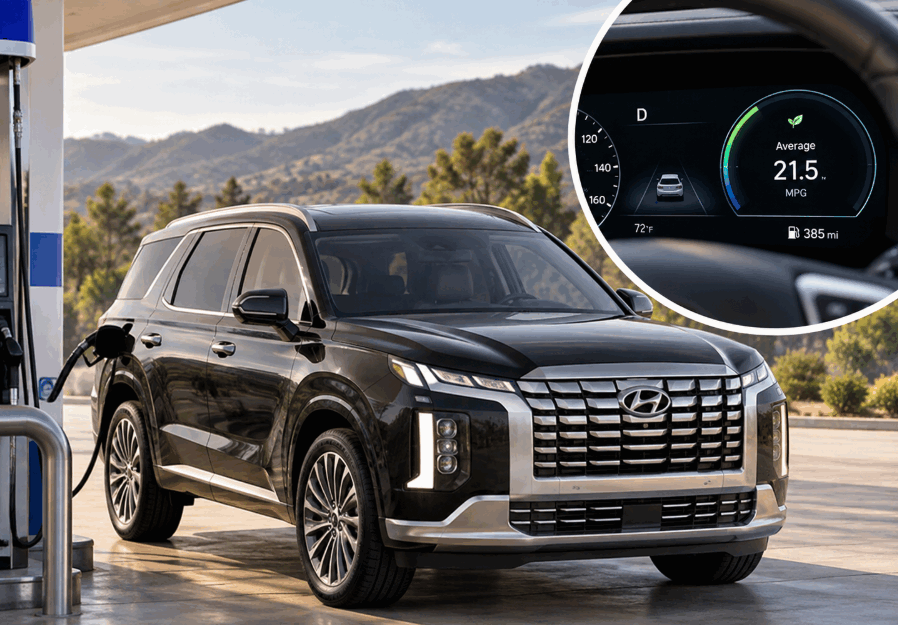
What Is the Hyundai Palisade MPG?
The 2026 Hyundai Palisade gets up to 19 MPG city, 25 MPG highway, and 21 MPG combined with its gasoline engine. These figures apply to front wheel drive configurations. Adding HTRAC all wheel drive reduces the rating to 18 MPG city, 24 MPG highway, and 20 MPG combined.
The XRT AWD has the lowest fuel economy among current gasoline configurations. It gets 16 MPG city, 22 MPG highway, and 19 MPG combined. Its configuration focuses more on capability than maximum fuel efficiency.
The Hyundai Palisade Hybrid delivers much higher MPG. The most efficient front wheel drive hybrid models get 33 MPG city and 35 MPG highway. Their combined rating reaches 34 MPG. Hybrid AWD models get 29 MPG city, 30 MPG highway, and 29 MPG combined.
| 2026 Palisade Configuration | City MPG | Highway MPG | Combined MPG |
|---|---|---|---|
| Gasoline FWD | 19 | 25 | 21 |
| Gasoline AWD | 18 | 24 | 20 |
| XRT AWD | 16 | 22 | 19 |
| Hybrid FWD, most efficient configuration | 33 | 35 | 34 |
| Hybrid AWD | 29 | 30 | 29 |
City MPG estimates fuel use during lower speed driving with frequent stops. Highway MPG reflects more consistent driving at higher speeds. Combined MPG represents a mix of city and highway conditions.
Combined MPG provides the clearest single number for comparing Palisade configurations. A gasoline FWD model returns 21 MPG combined. The most efficient hybrid FWD configuration reaches 34 MPG combined. That creates a difference of 13 MPG between these two configurations.
The figures also show why Hyundai Palisade MPG cannot be represented by one number. Powertrain and drivetrain create meaningful differences in fuel consumption. Buyers should compare the exact configuration they plan to purchase.
How Does Hyundai Palisade MPG Differ Between FWD and AWD?
Front wheel drive Hyundai Palisade models get better fuel economy than comparable all wheel drive models. The difference appears in city, highway, and combined EPA ratings.
The 2026 gasoline Palisade with front wheel drive gets 19 MPG city and 25 MPG highway. Its combined rating is 21 MPG. A gasoline AWD model gets 18 MPG city and 24 MPG highway. Its combined rating falls to 20 MPG.
This creates a difference of 1 MPG in each category. The percentage difference appears small, but it affects fuel use across thousands of miles. A driver covering 15,000 miles at 21 MPG would use about 714 gallons. The same distance at 20 MPG requires about 750 gallons. That represents roughly 36 additional gallons for the lower MPG configuration.
All wheel drive uses more fuel because the drivetrain sends power to more wheels when needed. AWD hardware also adds weight and mechanical resistance. The engine must move these additional components along with the vehicle. This increases the amount of energy required for a given distance.
The same relationship appears in the Palisade Hybrid lineup. The most efficient hybrid FWD configuration reaches 34 MPG combined. Hybrid AWD models get 29 MPG combined. The 5 MPG gap is larger than the difference between standard gasoline FWD and AWD models.
Fuel economy is not the only reason to choose a drivetrain. HTRAC all wheel drive can provide additional traction in rain, snow, loose surfaces, and other low grip conditions. Front wheel drive places greater emphasis on fuel efficiency and mechanical simplicity.
Buyers should therefore match drivetrain choice to their driving environment. FWD provides the stronger MPG result when fuel economy has priority. AWD accepts higher fuel consumption in exchange for additional traction capability.
How Does Hyundai Palisade Hybrid MPG Compare With Gas MPG?
The 2026 Hyundai Palisade Hybrid gets up to 34 MPG combined, compared with 21 MPG for the gasoline FWD model. This creates a 13 MPG difference between the most efficient configurations. In addition, the hybrid provides a clear advantage in both city and highway driving.
The gasoline FWD Palisade gets 19 MPG city and 25 MPG highway. Its combined rating reaches 21 MPG. In comparison, the most efficient hybrid FWD configuration gets 33 MPG city and 35 MPG highway. It also achieves 34 MPG combined. As a result, the hybrid gains 14 MPG in city driving and 10 MPG on the highway.
The hybrid system improves efficiency by combining a gasoline engine with an electric motor. At lower speeds, the electric motor can reduce gasoline use. In addition, regenerative braking captures energy when the vehicle slows down. The hybrid battery then stores that energy for later use.
City driving shows one of the clearest hybrid advantages. Stop and go traffic creates repeated opportunities for regenerative braking. Moreover, the electric motor can assist the gasoline engine during acceleration. Therefore, the engine does not need to provide all the power by itself.
AWD reduces fuel economy for both powertrains. The gasoline AWD Palisade gets 20 MPG combined. Meanwhile, the hybrid AWD version gets 29 MPG combined. Therefore, the hybrid maintains a 9 MPG advantage when both vehicles use AWD.
Fuel consumption makes this difference easier to understand. For example, a vehicle rated at 21 MPG uses about 714 gallons over 15,000 miles. A vehicle rated at 34 MPG uses about 441 gallons over the same distance. As a result, the higher MPG configuration uses about 273 fewer gallons.
However, actual fuel consumption depends on driving conditions and vehicle use. Traffic, speed, weather, cargo, and driving style can change real world results. Even so, the EPA figures show a clear efficiency advantage for the hybrid.
Therefore, the hybrid provides the strongest fuel economy in the 2026 Palisade lineup. This advantage becomes more important for drivers with high annual mileage. It also matters for drivers who spend significant time in city traffic.
Which Hyundai Palisade Trim Gets the Best MPG?
The most efficient 2026 Hyundai Palisade configurations achieve 33 MPG city, 35 MPG highway, and 34 MPG combined. These FWD hybrid configurations provide the highest fuel economy in the current Palisade lineup.
By comparison, Hybrid Limited and Hybrid Calligraphy FWD models get lower ratings. They achieve 31 MPG city, 32 MPG highway, and 31 MPG combined. Therefore, their combined fuel economy is 3 MPG lower than the most efficient hybrid configuration.
The difference does not come from the trim name alone. Instead, the complete vehicle configuration affects fuel economy. Wheel size, equipment, drivetrain, and vehicle weight can change the amount of energy required for movement.
AWD hybrid trims also use more fuel than their FWD counterparts. They get 29 MPG city, 30 MPG highway, and 29 MPG combined. In this case, AWD hardware adds weight and mechanical demand. As a result, the vehicle needs more energy to travel the same distance.
Gasoline trims follow a similar pattern. Standard FWD configurations get 19 MPG city, 25 MPG highway, and 21 MPG combined. In comparison, standard HTRAC AWD configurations get 18 MPG city, 24 MPG highway, and 20 MPG combined.
The XRT has the lowest MPG among the listed gasoline configurations. It gets 16 MPG city, 22 MPG highway, and 19 MPG combined. However, the XRT focuses more on traction and capability. For example, it includes all terrain tires and increased ground clearance.
Therefore, trim level alone does not determine Hyundai Palisade MPG. Powertrain and drivetrain have a greater effect on fuel consumption. In addition, equipment differences can create smaller changes between configurations.
For maximum fuel economy, an efficient FWD hybrid configuration provides the strongest choice. By contrast, a standard gasoline FWD model provides the best MPG among gasoline configurations. The XRT sacrifices some efficiency for equipment focused on traction and capability.
How Has Hyundai Palisade MPG Changed by Model Year?
Hyundai Palisade MPG stayed fairly consistent from 2020 through 2025 before changing more significantly for 2026. Earlier models used a 3.8 liter V6 engine. For 2026, Hyundai introduced a new 3.5 liter V6 and added a hybrid powertrain.
From 2020 through 2022, FWD models achieved 19 MPG city, 26 MPG highway, and 22 MPG combined. During the same period, AWD models returned 19 MPG city, 24 MPG highway, and 21 MPG combined. Therefore, choosing AWD reduced highway and combined efficiency.
The 2023 Palisade improved its highway ratings. FWD models achieved 19 MPG city, 27 MPG highway, and 22 MPG combined. Meanwhile, AWD models reached 19 MPG city, 25 MPG highway, and 21 MPG combined. However, the combined ratings stayed unchanged.
For 2024, the FWD rating returned to 19 MPG city and 26 MPG highway. Combined fuel economy remained at 22 MPG. AWD models returned 19 MPG city, 24 MPG highway, and 21 MPG combined. The 2025 Palisade used the same EPA ratings.
The 2026 model year introduced a larger change. Gasoline FWD models get 19 MPG city, 25 MPG highway, and 21 MPG combined. Gasoline AWD models get 18 MPG city, 24 MPG highway, and 20 MPG combined. Therefore, the new gasoline Palisade uses slightly more fuel than the most efficient earlier gasoline models.
However, 2026 also introduced the Palisade Hybrid. The most efficient hybrid FWD configurations get 33 MPG city, 35 MPG highway, and 34 MPG combined. Hybrid AWD models get 29 MPG city, 30 MPG highway, and 29 MPG combined. As a result, the hybrid creates the largest MPG improvement in Palisade history.
The model year comparison also reveals an important pattern. Gasoline fuel economy changed only slightly across the first six model years. In contrast, adding hybrid technology produced a much larger efficiency gain.
Therefore, buyers should compare both model year and powertrain. A 2025 gasoline Palisade can deliver better gasoline MPG than a comparable 2026 gasoline model. However, the 2026 Hybrid offers the best overall fuel economy.
How Far Can a Hyundai Palisade Travel on a Full Tank?
A 2026 Hyundai Palisade can theoretically travel about 361 to 475 highway miles on gasoline, depending on the configuration. Hybrid models can travel farther because they use less fuel per mile. However, actual range depends on traffic, speed, weather, cargo, and driving habits.
The 2026 gasoline Palisade has a 19 gallon fuel tank. Therefore, a FWD model rated at 19 MPG city could cover about 361 city miles. Its 25 MPG highway rating produces an estimated 475 highway miles. Using its 21 MPG combined rating gives an estimated 399 miles.
The gasoline AWD model has the same 19 gallon tank. However, its lower MPG reduces estimated range. At 18 MPG city, it could cover about 342 miles. At 24 MPG highway, the estimate reaches about 456 miles. Its 20 MPG combined rating equals about 380 miles.
The XRT AWD uses more fuel than other gasoline configurations. Its 16 MPG city rating produces about 304 miles from 19 gallons. Meanwhile, its 22 MPG highway rating produces about 418 miles. Its 19 MPG combined rating equals about 361 miles.
The Palisade Hybrid uses an 18.2 gallon fuel tank. Despite the smaller tank, its higher MPG creates a much longer estimated range. For example, 33 MPG city produces about 601 miles. A 35 MPG highway rating produces about 637 miles. At 34 MPG combined, the estimate reaches about 619 miles.
Hybrid AWD models also provide strong range. Their 29 MPG combined rating equals about 528 miles from 18.2 gallons. Therefore, the hybrid can travel farther while carrying less fuel than the gasoline model.
These calculations use a simple formula. Multiply fuel tank capacity by the EPA MPG rating. For example, 19 gallons multiplied by 25 MPG equals 475 miles.
However, drivers should treat these figures as estimates. A vehicle may not use every gallon before the driver refuels. In addition, EPA ratings represent standardized test conditions. Real world conditions can increase or reduce the distance between fuel stops.
For that reason, MPG and fuel tank capacity should be evaluated together. A larger tank does not always produce a longer range. Higher fuel efficiency can have a greater effect, as the Palisade Hybrid demonstrates.
Why Is Your Hyundai Palisade MPG Lower Than the EPA Rating?
Your Hyundai Palisade MPG can fall below the EPA rating because real driving conditions differ from standardized testing. Seven major factors affect the result. These include speed, traffic, driving style, weather, tires, vehicle load, and towing.
EPA fuel economy ratings provide a consistent way to compare vehicles. However, they do not guarantee the exact MPG every driver will achieve. The EPA considers city driving, highway driving, cold weather, air conditioning, fast acceleration, and high speeds. Even so, individual conditions can produce different results.
For example, two Palisade drivers can own the same configuration and record different MPG. One driver may travel mostly on open highways. Another may make short trips through heavy traffic. Therefore, their fuel consumption can differ even with the same EPA rating.
How Do Driving Speed and Traffic Affect Hyundai Palisade MPG?
High speeds, heavy traffic, and aggressive driving can reduce Hyundai Palisade MPG. Each condition increases the amount of fuel needed to cover a given distance.
Higher speeds increase aerodynamic resistance. As speed rises, the engine must produce more power to push the SUV through the air. Therefore, highway MPG can fall when drivers travel faster than the conditions represented by fuel economy testing.
Stop and go traffic creates another efficiency penalty. The vehicle repeatedly accelerates from low speeds and then loses energy during braking. In addition, long periods of idling consume fuel without adding miles. This lowers the calculated MPG.
Driving style also changes fuel consumption. Rapid acceleration demands more power from the engine. Hard braking then wastes much of the vehicle’s momentum. In contrast, smoother acceleration and more consistent speeds reduce unnecessary energy use.
The Palisade Hybrid can recover some energy through regenerative braking. However, driving behavior still matters. Frequent hard acceleration can increase energy demand faster than the hybrid system can offset it.
How Do Weather, Tires and Vehicle Load Affect Hyundai Palisade MPG?
Cold weather, incorrect tire pressure, extra weight, and towing can lower Hyundai Palisade fuel economy. These conditions increase energy demand or make the vehicle harder to move.
Cold temperatures affect several parts of vehicle operation. The engine takes longer to reach an efficient operating temperature. Drivers may also use heating and other accessories more often. As a result, short winter trips can produce lower MPG.
Tire condition matters because tires create rolling resistance. Low tire pressure increases that resistance. Therefore, the engine needs more energy to keep the vehicle moving. Proper inflation also supports predictable handling and tire wear.
Additional weight creates a similar effect. Passengers, luggage, and cargo increase the mass that the powertrain must move. Consequently, frequent acceleration requires more energy when the Palisade carries a heavy load.
Towing places even greater demand on the vehicle. A trailer adds weight and can increase aerodynamic resistance. Therefore, drivers should not expect normal EPA fuel economy while towing.
Several factors can also work together. For example, cold weather, low tire pressure, roof cargo, and heavy traffic may occur during the same trip. The combined effect can create a noticeable MPG difference.
For this reason, drivers should use EPA ratings as comparison figures rather than guaranteed results. The ratings help buyers compare Palisade configurations under a common standard. Real world MPG reflects how and where each owner drives.
How Much Does It Cost to Fuel a Hyundai Palisade?
A Hyundai Palisade can cost about $1,544 to $2,625 per 15,000 miles under a fuel price assumption of $3.50 per gallon. The exact amount depends on powertrain, drivetrain, actual MPG, and local fuel prices.
The calculation uses a simple formula. Divide annual mileage by combined MPG to estimate annual fuel use. Then multiply the gallons by the price of fuel. For consistency, the examples below assume 15,000 miles per year and gasoline at $3.50 per gallon.
A gasoline FWD Palisade rated at 21 MPG uses about 714 gallons over 15,000 miles. Therefore, annual fuel spending would reach about $2,500 at the assumed price.
A gasoline AWD model gets 20 MPG combined. It would use about 750 gallons over the same distance. As a result, annual fuel spending increases to about $2,625. The 1 MPG difference adds about $125 under these assumptions.
The efficiency advantage becomes larger with the hybrid. A hybrid FWD model rated at 34 MPG uses about 441 gallons over 15,000 miles. Therefore, annual fuel spending falls to about $1,544.
A hybrid AWD model rated at 29 MPG uses about 517 gallons over the same distance. At $3.50 per gallon, that equals about $1,810 per year.
The difference between gasoline FWD and hybrid FWD reaches about $956 per 15,000 miles. However, this calculation measures fuel spending only. It does not include purchase price, insurance, maintenance, financing, or resale value.
Annual mileage also changes the financial effect. A driver who covers 7,500 miles will use roughly half as much fuel. In contrast, someone driving 20,000 miles will benefit more from each additional MPG.
Fuel prices create another variable. For example, the gasoline FWD calculation reaches $2,500 at $3.50 per gallon. The same 714 gallons would cost about $2,856 at $4.00 per gallon.
Therefore, MPG becomes more financially important as mileage and fuel prices rise. Buyers can estimate their own cost by replacing the example values with local fuel prices and expected annual mileage.
Is Hyundai Palisade MPG Good for a Three Row SUV?
The Hyundai Palisade MPG is competitive for a three row midsize SUV, especially when compared with similar gasoline models. The gasoline version focuses on balancing performance, passenger space, and efficiency. Meanwhile, the hybrid version creates a much stronger fuel economy advantage.
A gasoline FWD Palisade achieves 21 MPG combined. This figure fits the expectations of a large SUV with three rows of seating, a spacious cabin, and strong passenger capacity. However, buyers who prioritize fuel savings will find more value in the hybrid configuration.
The Palisade Hybrid changes the efficiency discussion. Its most efficient FWD configuration reaches 34 MPG combined. Therefore, it provides fuel economy closer to smaller vehicles while maintaining the size and utility expected from a three row SUV.
Fuel economy is only one part of the Palisade ownership experience. Buyers also consider interior space, comfort, technology, safety features, towing ability, and long distance usability. As a result, the ideal configuration depends on each driver’s priorities.
For example, a family that frequently drives in urban areas may benefit from the hybrid system. The hybrid can use less fuel during repeated acceleration and braking. In contrast, a driver who needs additional traction may prefer an AWD model despite the lower MPG rating.
The Palisade competes in a segment that includes vehicles such as the Kia Telluride, Honda Pilot, and Toyota Grand Highlander. These SUVs also balance passenger capacity with fuel economy. Therefore, MPG comparisons should consider both efficiency and the vehicle’s overall purpose.
The best Hyundai Palisade MPG choice depends on the buyer’s driving pattern. The FWD hybrid provides the highest fuel efficiency. The gasoline FWD model provides strong efficiency without hybrid technology. AWD models provide additional traction with a small fuel economy trade off.
Overall, Hyundai Palisade MPG ratings show that buyers have several options. The gasoline models provide practical fuel economy for a large SUV. The hybrid models provide a significant improvement for drivers who want lower fuel consumption.