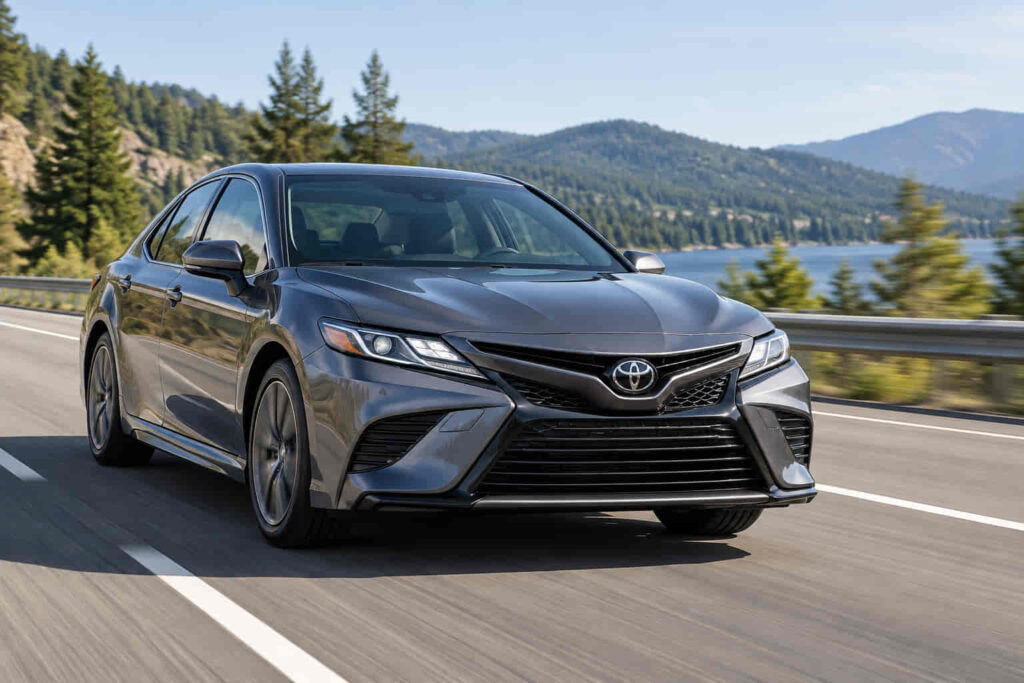
A Toyota Camry can last around 200,000 to 300,000 miles when it receives consistent maintenance and major mechanical problems are repaired before they cause additional damage. For a driver covering about 12,000 to 15,000 miles per year, that mileage can represent roughly 13 to 25 years of use. Reaching the upper end of that range is not guaranteed, however, because a Camry’s actual lifespan depends on its maintenance history, driving conditions, climate, and the condition of major components such as the engine and transmission.
The 200,000-mile mark is therefore more useful as a high-mileage reference point than as a fixed expiration date. A well-maintained Camry can remain usable beyond this point, while a neglected vehicle can develop expensive engine, transmission, cooling-system, suspension, or corrosion problems much earlier. Mileage alone does not determine whether a Camry has reached the end of its useful life.
This article explains how long Toyota Camrys last in both miles and years, whether a Camry can reach 200,000 or 300,000 miles, and which factors have the greatest effect on longevity. It also covers engine and transmission lifespan, maintenance, high-mileage used Camrys, and the point at which continued repairs may no longer make economic sense.
How Long Do Toyota Camrys Last?
Toyota Camrys can typically last around 200,000 to 300,000 miles with consistent maintenance, although reaching the upper end of that range requires favorable mechanical and operating conditions. At 12,000 miles of driving per year, 200,000 miles represents about 17 years of use, while 300,000 miles represents 25 years. At 15,000 miles per year, the same mileage range represents roughly 13 to 20 years. This makes mileage more useful than vehicle age alone when estimating how long a Camry can remain on the road.
A Camry does not automatically become unreliable when its odometer reaches a specific number. Vehicle lifespan depends on the accumulated condition of the engine, transmission, cooling system, suspension, electrical system, and body rather than mileage alone. For example, a Camry with 180,000 miles and documented oil changes, cooling-system maintenance, and timely repairs can be mechanically healthier than a 100,000-mile Camry that has experienced repeated overheating or neglected fluid service. Mileage shows how far the vehicle has traveled, while maintenance history helps explain the wear accumulated during those miles.
The difference between a typical lifespan and a maximum possible lifespan is also important. Reaching 200,000 miles is a more realistic longevity target for a maintained Camry than assuming every vehicle will reach 300,000 miles. As mileage increases, wear components such as engine mounts, wheel bearings, suspension parts, hoses, seals, and other aging components require replacement even when the engine and transmission remain functional. A high-mileage Camry can therefore continue running while requiring progressively more maintenance to remain dependable.
Age creates a separate form of deterioration that mileage cannot measure. Rubber seals, hoses, electrical connections, paint, interior materials, and suspension bushings deteriorate with time, while moisture and road salt can accelerate corrosion. A 20-year-old Camry with relatively low mileage may consequently require age-related repairs that a newer Camry with greater mileage does not. The practical lifespan of a Toyota Camry should therefore be evaluated through mileage, chronological age, maintenance history, and mechanical condition together rather than through the odometer reading alone.
Can a Toyota Camry Last 200,000 Miles?
A Toyota Camry can reach 200,000 miles when its engine, transmission, cooling system, and other major components receive appropriate maintenance throughout the vehicle’s life. The 200,000-mile point should not be treated as an automatic end-of-life threshold. Instead, it represents a stage at which maintenance history and current mechanical condition become increasingly important because the vehicle has accumulated enough use for both routine wear and age-related problems to affect reliability.
Engine maintenance has a direct effect on whether a Camry reaches this mileage. Engine oil lubricates moving components and helps control friction and heat, while the cooling system prevents excessive operating temperatures. Repeatedly delaying oil changes, allowing the engine to operate with insufficient oil, or continuing to drive with an overheating problem increases internal wear and can turn a repairable issue into major engine damage. A Camry that receives appropriate fluid service and has leaks or cooling problems corrected early has a stronger mechanical foundation for reaching 200,000 miles.
The transmission is another major factor because a vehicle with a functioning engine can still become uneconomical to keep if the transmission develops a costly failure. Transmission longevity is influenced by operating temperature, driving conditions, fluid condition, previous service, and the specific powertrain fitted to the vehicle. Warning signs such as delayed engagement, abnormal shifting, slipping, unusual noises, or fluid leaks deserve attention before they develop into more extensive problems. Keeping a Camry on the road for 200,000 miles therefore depends on maintaining the complete powertrain rather than focusing exclusively on engine life.
Reaching 200,000 miles also requires replacing components that are designed to wear during normal operation. Brakes, tires, batteries, suspension components, belts, hoses, bearings, and other service items do not need to last for the entire life of the car for the car itself to reach high mileage. Their replacement is part of normal long-term ownership. For example, replacing worn suspension components at high mileage does not mean the Camry has reached the end of its life; it restores systems that have deteriorated while allowing the engine, transmission, chassis, and other serviceable systems to remain in use.
The more useful question at 200,000 miles is therefore not simply whether the Toyota Camry still runs, but whether it remains safe, dependable, and economical to maintain. A vehicle with a sound powertrain, manageable repair requirements, limited structural corrosion, and a strong maintenance history can retain useful life beyond this mileage. In contrast, simultaneous engine, transmission, structural, and electrical problems can make continued ownership uneconomical even when the vehicle is technically still drivable.
Read more: Toyota P0505
Can a Toyota Camry Last 300,000 Miles?
A Toyota Camry can last 300,000 miles, but this should be considered a high-mileage outcome rather than the expected lifespan of every Camry. Reaching this mileage requires more than routine oil changes. The vehicle must remain mechanically sound across its engine, transmission, cooling system, suspension, electrical components, and body while receiving repairs as individual parts wear out. A Camry that reaches 300,000 miles has usually gone through multiple cycles of preventive maintenance and component replacement during its life.
The difference between 200,000 and 300,000 miles is significant because another 100,000 miles exposes the vehicle to additional mechanical wear and age-related deterioration. At an annual driving distance of 12,000 miles, traveling from 200,000 to 300,000 miles requires approximately 8.3 additional years. At 15,000 miles per year, it requires about 6.7 years. During that period, seals can leak, suspension components can wear, bearings can deteriorate, electrical components can fail, and corrosion can progress even when the original engine remains operational.
Long highway trips can also produce a different wear pattern from repeated short-distance or stop-and-go driving. Highway driving generally involves fewer acceleration, braking, and transmission-shifting cycles per mile once the vehicle reaches operating temperature. A Camry that accumulated much of its mileage under steady operating conditions can therefore have a different mechanical condition from another Camry showing the same odometer reading after years of short trips and congested urban driving. The odometer measures distance, but it does not describe how that distance was accumulated.
A 300,000-mile Camry should consequently be evaluated as a collection of systems rather than by asking whether its original engine can physically run that long. An engine may remain serviceable while the transmission, air-conditioning system, suspension, steering components, or body requires substantial work. Conversely, replacing individual components does not reset the vehicle’s mileage or mean it has failed to achieve a long lifespan. Long-term vehicle ownership depends on keeping enough major systems functional that continued repairs remain practical.
The economic limit can arrive before the mechanical limit. For example, a Camry may still start and drive at very high mileage but require several expensive repairs within a short period. When the combined cost and frequency of those repairs exceed the value the owner receives from keeping the vehicle, its useful ownership life may effectively be ending even though the car remains technically repairable. This distinction explains why 300,000 miles is possible without being an appropriate lifespan expectation for every Toyota Camry.
What Factors Determine How Long a Toyota Camry Lasts?
Six major factors determine how long a Toyota Camry lasts: maintenance history, driving habits, operating environment, engine condition, transmission condition, and rust or corrosion. These factors interact throughout the vehicle’s life, which is why two Camrys from the same model year can reach substantially different mechanical conditions at the same mileage. Mileage records accumulated distance; these six factors help explain the amount and type of wear produced while accumulating it.
Maintenance history has one of the strongest connections to long-term mechanical condition because preventive service controls wear before it develops into larger failures. Engine oil protects internal moving surfaces, coolant regulates engine temperature, and other fluids support the systems for which they are designed. Maintenance also includes responding to problems rather than merely following scheduled service intervals. An oil leak that is identified and repaired is fundamentally different from the same leak being ignored until the engine repeatedly operates with insufficient lubrication.
Driving habits influence how frequently components experience load, heat, acceleration, braking, and shifting. Repeated hard acceleration increases powertrain load, while aggressive braking accelerates brake wear. Frequent short trips can also create different operating conditions because the engine repeatedly starts from cold and may spend a greater proportion of each trip below normal operating temperature. A driver who reacts promptly to warning lights, unusual sounds, fluid loss, overheating, or changes in shifting behavior can also prevent an initial defect from damaging related components.
Operating environment affects both mechanical wear and vehicle aging. Extreme heat places additional demands on the cooling system and battery, while cold conditions affect starting and fluid behavior. Moisture and road salt can accelerate corrosion on exposed metal. This matters because a Camry’s lifespan is not determined exclusively by its powertrain. Severe structural corrosion can reduce the practical life of a vehicle even when its engine remains functional.
Engine condition becomes increasingly important as mileage rises because accumulated wear, lubrication problems, overheating, leaks, and unresolved faults can affect the engine’s ability to remain reliable. Oil consumption or a minor leak does not automatically mean an engine has reached the end of its life, but the cause, severity, and progression of the problem matter. Persistent overheating is particularly important because excessive temperature can damage multiple engine components rather than producing wear in only one serviceable part.
Transmission condition creates a similar constraint on vehicle longevity. A Camry with a healthy engine can still face a major ownership decision when its transmission develops severe slipping, delayed engagement, abnormal shifting, or another costly failure. Transmission condition depends on factors such as previous service, heat exposure, driving behavior, fluid condition, mileage, and the particular powertrain. Engine and transmission health should therefore be evaluated separately instead of treating “the powertrain” as a single component with one lifespan.
Rust and corrosion can ultimately place a physical limit on an otherwise functional high-mileage Camry. Cosmetic surface rust and structural corrosion are not equivalent. Corrosion affecting load-bearing areas, mounting points, brake or fuel lines, and other safety-related components has greater consequences than superficial body deterioration. This is why climate and geographic history become increasingly relevant when evaluating an older Camry: a mechanically healthy vehicle with limited corrosion can present a very different longevity outlook from a similar-mileage vehicle with significant structural deterioration.
These six factors explain why there is no universal mileage at which every Toyota Camry should be considered worn out. A Camry’s remaining lifespan is determined by its current condition and accumulated maintenance history, not by the odometer in isolation. Mileage becomes most useful when it is interpreted together with service records, operating history, mechanical inspection, and evidence of age-related deterioration.
How Long Does a Toyota Camry Engine Last?
A Toyota Camry engine can remain serviceable for 200,000 miles or more when it receives consistent lubrication, effective cooling, and timely repairs, but there is no single mileage at which every Camry engine fails. Engine lifespan varies by model year, engine design, maintenance history, operating conditions, and previous mechanical problems. For this reason, an engine with 150,000 miles and a history of overheating can be in worse condition than an engine with substantially higher mileage that has received consistent maintenance.
Lubrication is one of the primary mechanisms affecting engine longevity because engine oil reduces friction between moving components while helping manage heat and contaminants. Running an engine with insufficient oil, repeatedly extending oil-change intervals beyond appropriate service requirements, or ignoring significant oil leaks can increase internal wear. The effect is cumulative: inadequate lubrication does not need to cause an immediate breakdown to shorten an engine’s useful life. Repeated operation under poor lubrication conditions can gradually increase wear until oil consumption, loss of compression, abnormal noise, or other mechanical problems become significant.
Cooling-system condition is equally important because an engine must remain within its intended operating-temperature range. Coolant loss, a failing water pump, radiator problems, thermostat faults, damaged hoses, or other cooling-system defects can lead to overheating. Severe or repeated overheating can damage components that would otherwise remain serviceable for much longer. Correcting the cause of an overheating event promptly therefore protects more than the cooling system itself; it can prevent a localized problem from shortening the life of the engine.
Engine age should also be separated from engine failure. High-mileage engines can develop leaks, worn seals, sensors, ignition-system faults, or other repairable problems without requiring complete engine replacement. The relevant distinction is whether the problem involves a replaceable peripheral component or substantial internal engine damage. A leaking gasket and catastrophic internal damage are both engine-related problems, but they have very different implications for the remaining life and repair economics of the vehicle.
Maintenance records provide stronger evidence of engine condition than mileage alone, but records still cannot replace an inspection of the vehicle’s current state. An older Camry should be evaluated for abnormal noises, fluid leaks, overheating history, warning lights, exhaust abnormalities, and other signs of mechanical deterioration. The best estimate of Toyota Camry engine lifespan therefore combines mileage with service history and current engine condition rather than treating 200,000 or 300,000 miles as a guaranteed limit.
How Long Does a Toyota Camry Transmission Last?
A Toyota Camry transmission can also remain functional into high mileage, but its lifespan depends on transmission type, model year, maintenance history, heat exposure, driving conditions, and existing wear. A universal replacement mileage would be misleading because Camrys produced across different generations do not use one identical transmission, and two transmissions of the same type can experience different operating histories.
Heat and lubrication are central to transmission longevity. Transmission fluid performs functions such as lubrication and heat management while supporting transmission operation. Fluid condition, leaks, operating temperature, and appropriate servicing therefore affect long-term wear. A transmission that repeatedly operates under unfavorable conditions can deteriorate even when the engine remains healthy, making transmission condition an independent factor in the overall lifespan of a high-mileage Camry.
Changes in transmission behavior become increasingly relevant as a vehicle ages. Slipping, delayed engagement, abnormal shifting, unusual noises, fluid leakage, or a noticeable change from previous operation can indicate a problem that requires diagnosis. Continuing to drive without identifying the cause can allow a smaller fault to develop into a more expensive repair in some cases. Early diagnosis is especially important on a high-mileage vehicle because the economic impact of a major transmission repair must be considered alongside the condition and value of the rest of the car.
A transmission failure does not necessarily define the absolute lifespan of the Camry because a transmission can be repaired or replaced. It can, however, define the economic lifespan of an individual vehicle. Spending heavily on a transmission can make sense when the engine, body, suspension, electrical system, and other major components remain in good condition. The same repair becomes less attractive when several expensive systems require work simultaneously. Transmission longevity should therefore be evaluated within the condition of the complete vehicle.
What Maintenance Helps a Toyota Camry Last Longer?
The maintenance that helps a Toyota Camry last longer is maintenance that prevents lubrication failure, overheating, progressive powertrain damage, unsafe wear, and neglected faults from becoming major repairs. The exact service requirements depend on the Camry’s model year, engine, powertrain, mileage, and operating conditions, so the maintenance schedule for the specific vehicle should determine service intervals rather than a single generic interval applied to every Camry.
Engine oil and filter service directly supports engine longevity by maintaining appropriate lubrication and controlling contaminants. The correct oil specification and service interval should follow the requirements for the specific Camry. Owners should also monitor oil level between services, particularly as the vehicle accumulates mileage, because completing an oil change on schedule does not protect an engine that subsequently operates with an insufficient oil level due to consumption or leakage.
Cooling-system maintenance protects the engine from excessive temperature. Coolant condition, hoses, the radiator, water pump, thermostat, and related components must collectively maintain effective heat transfer and coolant circulation. A visible leak, rising temperature gauge, recurring coolant loss, or overheating event deserves diagnosis rather than simply adding more coolant and continuing to drive. Preventing repeated overheating can preserve engine components that would be considerably more expensive to repair than the original cooling-system fault.
Transmission maintenance should follow the requirements applicable to the specific model and transmission rather than a universal fluid-change rule. Fluid leakage and changes in shifting behavior should also be investigated when they appear. This is particularly relevant for longevity because engine maintenance alone cannot keep a Camry operational if transmission deterioration eventually makes the vehicle unreliable or uneconomical to repair.
Brakes, tires, steering, and suspension do not normally determine engine lifespan, but they determine whether an aging Camry remains safe and practical to operate. Worn tires affect traction, deteriorated suspension components affect vehicle control and tire wear, and neglected brake problems can compromise stopping performance. Replacing these wear components should be considered part of keeping a vehicle serviceable at high mileage rather than evidence that the entire vehicle has reached the end of its life.
Leaks, warning lights, abnormal sounds, unusual vibrations, and changes in vehicle behavior should be treated as diagnostic information. Preventive maintenance is most effective when scheduled service is combined with early fault detection. For example, identifying a coolant leak before an overheating event can protect the engine, while diagnosing abnormal tire wear can reveal an alignment or suspension problem before additional components deteriorate.
Rust prevention and inspection also become increasingly important as chronological age increases, especially where vehicles are exposed to moisture or road salt. Mechanical maintenance can keep an engine and transmission operational, but it cannot reverse advanced structural corrosion. Cleaning corrosive material from the vehicle, addressing damaged protective coatings where appropriate, and inspecting corrosion-prone areas can therefore contribute to the usable lifespan of an older Camry.
Long Toyota Camry lifespan is the cumulative result of maintaining multiple systems rather than performing one specific service. Oil and cooling-system maintenance protect the engine, appropriate transmission care supports drivetrain longevity, chassis maintenance preserves safe operation, and early diagnosis prevents smaller faults from progressing unnoticed. A maintenance history that consistently addresses these areas provides a stronger foundation for high mileage than relying on Toyota Camry’s reputation for reliability alone.
What Is Considered High Mileage for a Toyota Camry?
A Toyota Camry with more than 100,000 miles can reasonably be considered a high-mileage vehicle, but 100,000 miles does not mean the car is near the end of its useful life. The significance of that mileage depends on vehicle age, maintenance history, driving conditions, and the current condition of major systems. For a Camry capable of remaining serviceable beyond 200,000 miles under appropriate conditions, crossing 100,000 miles is better viewed as a point at which maintenance history becomes increasingly important rather than as an automatic replacement threshold.
Mileage also needs to be interpreted relative to vehicle age. A Camry that reaches 120,000 miles over 12 years has averaged 10,000 miles per year, while one reaching the same mileage in six years has averaged 20,000 miles per year. These vehicles have identical odometer readings but different combinations of chronological aging and road use. The older vehicle has had more time for rubber components, seals, corrosion, and other age-related deterioration to develop, while the newer vehicle has accumulated its mechanical use over a shorter period.
The type of driving behind the mileage matters as well. A vehicle that accumulated substantial mileage through long, steady trips has experienced a different number of cold starts, braking events, acceleration cycles, and transmission shifts than a vehicle driven the same distance primarily through short urban trips. This does not make highway mileage automatically harmless or city mileage automatically damaging, but it demonstrates why an odometer cannot describe the complete operating history of a vehicle.
The meaning of high mileage also changes as the odometer continues to rise. At 100,000 miles, an owner may primarily be evaluating maintenance history and normal wear. At 200,000 miles, the accumulated condition of the engine, transmission, suspension, cooling system, electrical components, and body becomes more consequential. Near 300,000 miles, continued ownership increasingly depends on how successfully individual components have been maintained, repaired, or replaced throughout the vehicle’s life.
For this reason, high mileage describes accumulated use rather than remaining lifespan. A 150,000-mile Camry with documented maintenance and sound mechanical condition can have more useful life remaining than a lower-mileage example with evidence of overheating, neglected service, severe corrosion, or transmission problems. Mileage should narrow the questions a buyer asks; it should not answer those questions by itself.
Is a Toyota Camry With Over 100,000 Miles Worth Buying?
A Toyota Camry with more than 100,000 miles can be worth buying when its maintenance history, mechanical condition, structural condition, and purchase price support continued reliable ownership. The odometer should be treated as one evaluation factor rather than a pass-or-fail test. A high-mileage Camry becomes a poor purchase when its lower acquisition price is offset by unresolved mechanical problems, substantial corrosion, neglected maintenance, or multiple expensive repairs likely to occur soon after purchase.
Maintenance records provide useful evidence because they show how the vehicle was treated before it reached its current mileage. Records for routine service and documented repairs can reveal whether previous owners responded to maintenance requirements and mechanical faults. Missing records do not prove that a vehicle was neglected, but they reduce the amount of verifiable information available to the buyer. This uncertainty becomes more important at high mileage because the consequences of years of deferred maintenance may not be visible from the odometer or exterior condition.
Engine condition should be assessed independently from Toyota Camry’s general reputation for durability. A prospective buyer should pay attention to abnormal engine noises, warning lights, visible fluid leakage, unusual exhaust behavior, overheating evidence, and signs of unresolved oil or cooling-system problems. A clean exterior cannot compensate for serious internal engine deterioration, and a vehicle’s reputation for longevity does not guarantee that an individual example received the maintenance required to achieve it.
Transmission behavior deserves the same level of attention. Delayed engagement, slipping, abnormal shifting, unusual noises, or fluid leakage can indicate problems that require further diagnosis. A high-mileage Camry may still represent good value when its transmission operates correctly and the rest of the vehicle is sound, but a major transmission problem can substantially change the economics of the purchase. This is especially true when transmission work would be added to other immediate repairs.
The suspension, steering, brakes, tires, cooling system, electrical equipment, and body should also be evaluated because buying a high-mileage car means buying the condition of the entire vehicle rather than only its engine and transmission. Worn suspension components or tires may represent manageable maintenance expenses, whereas severe structural corrosion or several major system failures can fundamentally change the purchase decision. The relevant question is how much work the car requires now and how that cost compares with its purchase price and expected remaining service life.
A pre-purchase inspection can reduce uncertainty by allowing the vehicle’s present condition to be assessed before money changes hands. This is particularly valuable when service records are incomplete or the buyer cannot independently evaluate the powertrain, underbody, leaks, suspension, and evidence of previous damage. The objective is not to find a used Camry with zero wear; a vehicle beyond 100,000 miles will have accumulated wear. The objective is to distinguish normal, manageable deterioration from problems that indicate substantial repair exposure.
A well-maintained 100,000-mile Camry should therefore not be rejected solely because it has crossed a six-digit odometer reading. Purchase quality depends on the relationship between condition, service history, price, and expected future repair requirements. A documented and mechanically sound high-mileage Camry can be a more rational purchase than a lower-mileage example whose previous maintenance and operating history have left it in poorer condition.
What Are the Signs That a Toyota Camry Is Near the End of Its Life?
A Toyota Camry may be approaching the end of its useful life when multiple major systems develop serious problems at the same time and restoring dependable operation requires increasingly frequent or expensive repairs. One isolated failure does not establish that the entire vehicle is worn out. A failed alternator, worn suspension component, leaking hose, or other replaceable part can occur on an otherwise serviceable high-mileage Camry. The condition becomes more significant when engine, transmission, structural, electrical, or other major problems begin accumulating faster than they can be economically resolved.
Persistent engine problems are among the strongest warning signs when they involve more than routine maintenance or an isolated replaceable component. Repeated overheating, substantial fluid loss, abnormal internal noises, persistent warning lights, severe oil consumption, or recurring problems after previous repairs justify further diagnosis. The mechanism matters because a leaking external component can have a very different effect on remaining lifespan from extensive internal engine wear. A diagnosis should therefore identify the underlying fault before mileage or symptoms are used to declare the engine—or the vehicle—finished.
Serious transmission deterioration can create a similar turning point. Persistent slipping, delayed engagement, abnormal shifting, unusual noises, or a diagnosed internal failure can make a high-mileage Camry substantially more expensive to keep. A transmission problem alone does not necessarily end the vehicle’s life because transmissions can be repaired or replaced. The decision changes when a major transmission expense appears alongside an aging engine, deteriorated suspension, electrical faults, corrosion, or other significant repair requirements.
Repeated overheating deserves particular attention because it can connect a cooling-system fault to more extensive engine damage. A Camry that loses coolant because of a repairable hose or cooling-system component does not automatically have a short remaining lifespan. Continuing to operate the vehicle while it repeatedly overheats can create a more serious problem. This illustrates why early fault diagnosis affects longevity: the initial defect and the secondary damage caused by ignoring it can have very different repair costs and consequences.
Structural corrosion is another warning sign because its effect cannot be evaluated in the same way as cosmetic wear. Surface deterioration on a body panel does not have the same significance as severe corrosion affecting structural areas or safety-related components. An older Camry can have a functional engine and transmission while corrosion makes continued operation difficult or unsafe to justify. In climates where vehicles encounter moisture and road salt, underbody condition therefore becomes an important part of evaluating remaining vehicle life.
Increasing repair frequency provides a broader signal than any single component failure. An aging Camry may require normal replacement of brakes, tires, batteries, suspension parts, seals, or other wear items and still provide dependable transportation. The situation changes when the owner repeatedly repairs one system only for another expensive problem to emerge soon afterward. At that point, the relevant measure is no longer whether each individual fault is technically repairable but whether the complete vehicle can still provide reliable service at a reasonable total cost.
The end of a Toyota Camry’s useful life is therefore better identified by cumulative mechanical and structural condition than by a fixed odometer number. A 250,000-mile Camry with a healthy powertrain and manageable maintenance requirements may have useful life remaining, while a lower-mileage vehicle with severe corrosion and multiple major failures may not. The combination of problems—and the cost of correcting them—provides more information than mileage alone.
When Should You Repair or Replace a High-Mileage Toyota Camry?
Repairing a high-mileage Toyota Camry makes sense when the repair restores dependable use at a reasonable cost and the vehicle’s other major systems remain in good condition; replacement becomes more rational when expensive problems accumulate across multiple systems and future repair exposure is high. The decision should compare more than the price of one repair with the market value of the car. Current condition, expected remaining life, upcoming maintenance, replacement-vehicle cost, and the probability of additional major repairs all affect the economic outcome.
A single expensive repair does not automatically make replacement the better choice. For example, spending money on a major repair can still be economically reasonable when the Camry has a sound engine, healthy transmission, limited corrosion, maintained suspension, and no pattern of recurring failures. Replacing the car would require purchasing another vehicle whose acquisition cost and mechanical history must also be considered. The relevant comparison is therefore the cost of obtaining reliable transportation through the repair versus the total cost and uncertainty involved in replacing the vehicle.
The calculation changes when several major repairs converge. A Camry that simultaneously needs substantial engine work, transmission repair, suspension restoration, and corrosion-related work presents a different ownership case from one that only needs a single component replaced. Repairing the first problem does not eliminate the financial exposure created by the remaining problems. This cumulative repair burden is one reason the economic lifespan of a vehicle can end before its mechanical lifespan: nearly every component may be technically replaceable, but replacing enough of them may no longer be financially efficient.
Repair frequency should also be considered alongside repair cost. Several smaller failures occurring within a short period can create reliability problems even when no individual invoice is large enough to justify replacing the vehicle. Repeated breakdowns can add towing costs, diagnostic expenses, lost time, and uncertainty to ownership. A high-mileage Camry that requires predictable maintenance is fundamentally different from one that repeatedly develops unexpected faults.
Safety-related condition carries greater weight than cosmetic deterioration. Faded paint, worn upholstery, and minor exterior damage can reduce vehicle value without necessarily preventing continued use. Serious structural corrosion, unresolved braking or steering problems, and other defects that affect safe operation require a different evaluation. Repair decisions should first determine whether the vehicle can be restored to safe and dependable condition before considering whether cosmetic improvements are financially worthwhile.
An owner should also distinguish sunk costs from future costs. Money already spent maintaining a Camry does not make the next repair economically justified by itself. The decision should focus on what the vehicle is likely to require from the present point forward. A long history of maintenance can be valuable evidence about vehicle condition, but previous repair spending should not be the sole reason to continue investing in a car whose major systems are now deteriorating simultaneously.
The practical replacement point is reached when the expected cost, reliability risk, and condition of the complete Camry make continued ownership less attractive than obtaining another vehicle. This point may occur before or after 200,000 miles because mileage is not the economic threshold. A well-maintained high-mileage Camry can remain worth repairing, while a neglected vehicle can reach its economic end of life considerably earlier.
Does a Toyota Camry Last Longer Than Similar Sedans?
A Toyota Camry can achieve a lifespan comparable to other long-lasting sedans, including the Honda Accord and Toyota Corolla, but no model automatically lasts longer based on its nameplate alone. The useful lifespan of an individual vehicle depends on its powertrain, model year, maintenance history, driving conditions, corrosion exposure, and accumulated mechanical wear. For a buyer comparing used sedans, these vehicle-specific factors provide more useful information than assuming every Camry will outlast every competing model.
The Honda Accord is a relevant comparison because both the Accord and Camry have been sold across numerous generations and powertrain configurations. Longevity therefore needs to be evaluated at the model-year and vehicle-condition level rather than through a universal Camry-versus-Accord mileage claim. A well-maintained Accord can remain serviceable at high mileage, just as a neglected Camry can develop expensive problems before reaching the mileage commonly associated with long vehicle life. Comparing maintenance records, engine and transmission condition, corrosion, and existing repair requirements produces a more meaningful result than comparing odometer readings alone.
The Toyota Corolla also provides useful context, although it belongs to a different vehicle class from the Camry. Both vehicles can accumulate high mileage when properly maintained, but their individual repair histories remain more important than their shared Toyota badge. For example, a lower-mileage Camry with a history of overheating or transmission problems may present greater ownership risk than a higher-mileage Corolla with documented maintenance and no major mechanical symptoms. Brand reputation can help identify vehicles worth investigating, but it cannot establish the condition of a specific used car.
The same principle applies to other midsize sedans. Vehicle longevity is produced by the interaction between engineering, maintenance, operating conditions, age, and repairs performed throughout the vehicle’s life. Differences between generations also prevent a single lifespan figure from accurately representing every vehicle produced under one model name. Comparing specific model years and powertrains becomes more useful when a purchase decision requires greater precision.
Toyota Camry longevity should therefore be judged primarily by the condition and history of the individual vehicle rather than by whether the Camry nameplate is expected to outlast a competing sedan. A maintained Camry can remain useful beyond 200,000 miles and may continue substantially farther when its major systems remain healthy. Reaching that mileage, however, is not the result of reputation alone. Long service life depends on maintaining the engine, transmission, cooling system, chassis, and other critical systems while addressing faults before they create larger mechanical or economic problems.