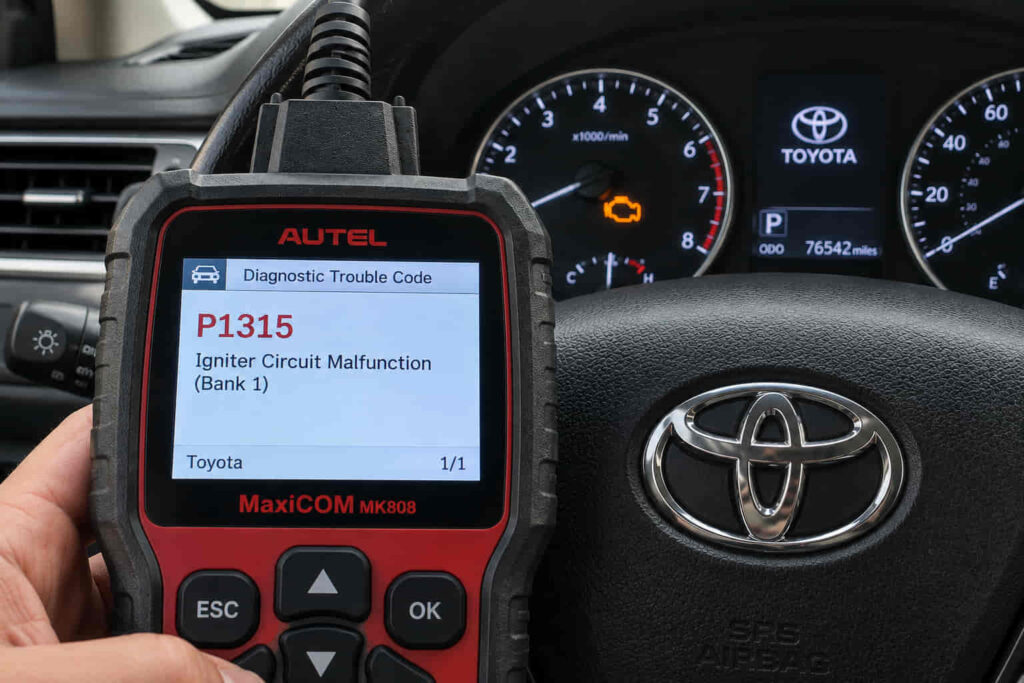
Toyota P1315 is a manufacturer-specific diagnostic trouble code for an Igniter Circuit Malfunction (No. 4) on applicable Toyota ignition systems. The code indicates that the engine control module (ECM) has detected a problem associated with the ignition confirmation circuit for the No. 4 ignition coil with igniter. On Toyota Direct Ignition System applications that use this code definition, the ECM controls ignition timing through an IGT ignition trigger signal and monitors ignition operation through an IGF confirmation signal returned from the igniter.
P1315 does not automatically prove that the No. 4 ignition coil has failed. Toyota diagnostic information also identifies the ignition system, an open or short in the relevant IGT or IGF circuit, the ignition coil with integrated igniter, and the ECM as potential trouble areas. Correct diagnosis therefore requires identifying the applicable Toyota model and engine, reading stored and accompanying trouble codes, inspecting the circuit, and testing the suspected ignition component before replacing parts.
This guide explains what Toyota P1315 means, how the IGT and IGF signals relate to the fault, which symptoms and causes are associated with the code, and how the problem should be diagnosed and repaired. It also explains whether the vehicle should be driven, how serious P1315 is, and why the code can return after being cleared.
What Does Toyota Code P1315 Mean?
Toyota code P1315 means Igniter Circuit Malfunction (No. 4) on applicable Toyota engines equipped with the ignition system associated with this DTC. The code directs diagnosis toward the No. 4 ignition circuit rather than confirming that one specific component has already failed. This distinction matters because the ignition coil with igniter, electrical wiring, connectors, IGT or IGF circuits, and ECM can participate in the circuit used to control and confirm ignition.
Toyota’s ignition control strategy uses communication between the ECM and the ignition coil with igniter. The ECM sends an IGT signal to command ignition at the required timing. After the ignition event is generated, the igniter returns an IGF signal that allows the ECM to confirm ignition operation. The diagnostic relationship is therefore based on both commanding ignition and receiving the expected confirmation rather than simply detecting whether electrical power reaches a spark plug.
P1315 is stored when the ECM detects the fault condition defined for the No. 4 igniter circuit on the applicable system. An interruption in the expected ignition-control or confirmation process can direct diagnosis toward several points in the same electrical path. For example, a defective ignition coil with integrated igniter can affect the expected signal, but an open or short in the associated circuit can produce a diagnostic condition without the coil itself being the root cause. This is why reading “No. 4” in the code definition should not immediately lead to replacing the No. 4 ignition coil.
The cylinder reference also needs to be interpreted according to the specific Toyota engine being diagnosed. Toyota has used different engines, ignition configurations, and control strategies across its vehicle range and model years. A diagnostic procedure for one Toyota application should not automatically be applied to another vehicle simply because both display P1315. Identifying the model, model year, engine, and applicable wiring information establishes the correct diagnostic context before electrical measurements or component replacement begins.
P1315 should therefore be treated as a circuit diagnostic direction, not a parts-replacement instruction. The code identifies where the ECM detected an ignition-related abnormality, while testing determines whether the actual fault is in the ignition coil with igniter, its circuit, an electrical connection, the ignition system, or the ECM. This distinction prevents unnecessary parts replacement and establishes the correct sequence for diagnosing the code.
What Are the Symptoms of Toyota Code P1315?
The primary confirmed indication of Toyota P1315 is a stored diagnostic trouble code and an illuminated malfunction indicator lamp, while noticeable engine symptoms depend on whether the underlying ignition fault disrupts combustion. A circuit fault that interferes with ignition on the affected cylinder can produce drivability symptoms, but the severity of those symptoms depends on whether the fault is active, intermittent, or limited to the monitored electrical circuit.
An active ignition failure can cause the affected cylinder to contribute less power or stop contributing normally to engine operation. When this occurs, the driver can experience rough engine operation, vibration, hesitation, reduced power, or other behavior associated with incomplete combustion. The mechanism is straightforward: the cylinder requires correctly timed ignition of the air-fuel mixture to contribute normal torque. When the ignition process fails, engine operation becomes less balanced because the affected cylinder is no longer producing its expected contribution.
The severity can change when the circuit problem is intermittent. A loose connection, damaged wiring, or another electrical fault can interrupt the relevant signal only under certain conditions, allowing the engine to operate normally at one moment and exhibit symptoms at another. This creates an important diagnostic distinction because a Toyota can arrive for inspection with P1315 stored even when the engine appears to run normally during the initial check. The absence of a constant rough-running symptom does not by itself prove that the stored fault is irrelevant.
Other diagnostic trouble codes can provide additional context when they are stored with P1315. A technician should therefore read the complete DTC record instead of diagnosing the vehicle from P1315 in isolation. Codes associated with ignition or misfire behavior can help establish whether the circuit fault has also affected combustion, while freeze-frame or related scan data can preserve information about operating conditions when a fault was detected where the applicable vehicle supports that information.
Symptoms alone cannot identify which part of the P1315 circuit has failed. A defective ignition component and an electrical circuit problem can produce similar engine behavior because both can interrupt the same ignition process. The symptoms establish the effect of the fault, while circuit and component testing establish its cause. This is why a rough-running engine combined with P1315 supports further ignition-system diagnosis but does not, by itself, confirm that the No. 4 ignition coil should be replaced.
Read more: How Long Do Toyota Camrys Last
What Causes the P1315 Code on a Toyota?
Toyota P1315 is caused when the ECM detects the specified malfunction in the No. 4 igniter circuit on an applicable Toyota ignition system. The root cause can be within the ignition system itself, the No. 4 ignition coil with igniter, the IGT or IGF circuit and its electrical connections, or the ECM. These causes belong to the same diagnostic path because each can interfere with the ECM’s ability to command or confirm the expected ignition event.
A faulty ignition coil with integrated igniter is one possible cause because the igniter participates directly in the ignition-control and confirmation process. The ECM sends the ignition timing command through the IGT circuit, while the igniter provides ignition confirmation through the IGF circuit. A failure inside the coil or integrated igniter can prevent this process from operating as expected and create the condition monitored by the ECM. The component should still be tested rather than replaced solely because P1315 is present.
An open or short in the IGT circuit can produce the same diagnostic direction without requiring an internal failure of the ignition coil. The IGT circuit carries the ignition command from the ECM toward the igniter. Damaged wiring, poor terminal contact, or another circuit defect can interrupt that command or alter the electrical condition expected by the control system. In this case, installing a new coil without repairing the circuit leaves the root cause in place and can result in P1315 returning.
The IGF side of the circuit is also important because ignition confirmation is part of Toyota’s monitoring strategy on these applications. The IGF signal allows the ECM to determine whether the expected ignition operation has been confirmed. An open, short, poor connection, or other fault affecting this signal path can therefore create an ignition-feedback problem even when the initial ignition command is being generated. This explains why diagnosis must examine both control and feedback rather than focusing exclusively on whether the engine appears to have spark.
Electrical connectors can create intermittent versions of these faults. A terminal that is loose, damaged, contaminated, or making inconsistent contact can allow the circuit to operate under one condition and fail under another. Vibration, temperature changes, and movement of the wiring harness can make an intermittent electrical problem particularly difficult to reproduce during a stationary inspection. A stored P1315 accompanied by inconsistent symptoms therefore requires attention to connector and harness condition rather than assuming the absence of a current symptom means the circuit is healthy.
The ECM remains within the diagnostic path, but an ECM fault should not be the first conclusion when P1315 appears. The ignition component, wiring, connectors, power and ground conditions where applicable, and relevant IGT/IGF circuits need to be evaluated according to the procedure for the specific Toyota application. Suspecting the ECM before these areas are verified can lead to an expensive replacement without correcting a simpler circuit fault.
The causes of P1315 should consequently be understood through their common mechanism. Each valid cause interferes with the ignition-control or confirmation process monitored by the ECM for the applicable No. 4 igniter circuit. This causal relationship is more useful for diagnosis than treating P1315 as a generic ignition-coil replacement code.
How Do You Diagnose Toyota Code P1315?
Diagnosing Toyota P1315 requires confirming the code, identifying the exact Toyota application, inspecting the No. 4 ignition circuit, testing the relevant ignition component and IGT/IGF circuit, and isolating the fault before replacing parts. The diagnostic sequence matters because P1315 identifies a monitored circuit condition but does not independently establish which component within that circuit caused the condition.
Diagnosis begins by confirming the stored DTC with a scan tool and checking the complete code record. P1315 should not be viewed in isolation when other ignition or combustion-related codes are present because accompanying DTCs can provide additional evidence about the fault. Available freeze-frame and operating data should also be reviewed when supported by the vehicle because they can indicate the conditions under which the ECM detected the malfunction.
The vehicle application must then be identified before applying electrical specifications or a wiring diagram. Toyota has used multiple engines and ignition-system configurations, so the model, model year, engine, and applicable service information determine the correct connector terminals, circuit routing, test conditions, and specifications. Using a diagram or measurement from a different Toyota engine simply because it also supports P1315 can produce an incorrect diagnosis.
A visual and electrical inspection should establish whether the circuit has an obvious physical problem before expensive components are condemned. The relevant wiring harness and connectors should be checked for damaged wires, poor terminal fit, corrosion, disconnected connectors, or other conditions capable of producing an open, short, or intermittent connection. This inspection has direct diagnostic value because a new ignition component cannot correct a broken wire or unreliable electrical connection elsewhere in the circuit.
The No. 4 ignition coil with igniter should then be evaluated according to the diagnostic procedure applicable to the engine. Where the engine design and manufacturer procedure permit component substitution between cylinders as a diagnostic method, observing whether the fault follows the suspected component can help separate a component failure from a circuit fault. The result must be interpreted together with the stored codes and vehicle-specific procedure rather than treating a component swap as a universal test for every Toyota application.
The IGT and IGF circuits require attention when component condition alone does not explain the fault. The objective is to determine whether the ECM’s ignition command can reach the relevant igniter and whether the expected ignition confirmation can return through the monitored circuit. Electrical testing must use the correct Toyota wiring information and specifications for the vehicle being diagnosed. Guessing voltage, resistance, waveform, or terminal values is inappropriate because these details can vary by application.
The ECM becomes a reasonable diagnostic suspect only after the external circuit and applicable ignition components have been verified. This order prevents a control module from being replaced because of a fault actually caused by wiring, a connector, or an ignition component. Any ECM-related diagnosis should follow the manufacturer procedure for the exact vehicle because module replacement can also involve vehicle-specific installation or programming requirements.
The final diagnostic step is confirmation rather than parts replacement. After the identified fault is repaired, the stored DTC can be cleared using an appropriate diagnostic method and the vehicle can be operated under suitable conditions to determine whether P1315 returns. Engine operation and related DTCs should also be rechecked. A successful Toyota P1315 diagnosis ends when the root cause has been repaired and the fault no longer recurs, not when a suspected part has merely been replaced.
How Do You Fix Toyota Code P1315?
To fix Toyota P1315, repair the ignition component, wiring, connector, IGT/IGF circuit, or ECM-related fault that diagnosis confirms is causing the No. 4 igniter circuit malfunction. P1315 does not have one universal repair because several faults within the monitored ignition circuit can produce the code. Replacing the No. 4 ignition coil without testing the circuit may solve the problem when the coil or integrated igniter has failed, but it will not correct damaged wiring, a poor electrical connection, or another circuit fault.
A confirmed failure of the No. 4 ignition coil with integrated igniter requires repair or replacement of that component according to the procedure for the specific Toyota model and engine. The important diagnostic requirement is confirmation before replacement. If testing shows that the fault follows the suspected ignition component while the associated circuit remains functional, the component becomes a stronger root-cause candidate. Installing a replacement part without this isolation step can create unnecessary repair cost while leaving the original fault unresolved.
Damaged wiring requires a circuit repair rather than ignition-component replacement. An open or short in an IGT or IGF circuit can interrupt the communication required between the ECM and igniter, producing the monitored fault even when the ignition coil itself remains functional. Repair must restore circuit continuity and electrical integrity according to the applicable Toyota wiring information. The repaired harness should also be inspected for the condition that caused the damage, particularly when abrasion, heat exposure, previous repairs, or connector movement contributed to the failure.
A poor connector or terminal connection requires the electrical connection to be restored reliably. Loose terminals, damaged connector bodies, corrosion, or inconsistent contact can create intermittent faults that disappear while the vehicle is being inspected and return during normal operation. Simply disconnecting and reconnecting a connector can temporarily change the symptom without correcting a damaged terminal. A successful repair addresses the physical reason the connection was unreliable and then verifies that the circuit remains stable.
An ECM-related repair should only follow testing that has eliminated the more direct circuit and ignition-component causes specified for the applicable vehicle. Replacing the ECM prematurely can be both expensive and ineffective when an external wiring or ignition fault remains present. If testing actually confirms an ECM problem, the repair or replacement procedure must follow the requirements of the specific Toyota because control-module installation requirements are not identical across every model and model year.
The repair is not complete immediately after the suspected fault has been corrected. The stored P1315 code should be cleared with an appropriate diagnostic method, and the ignition system should then be verified under suitable operating conditions. The technician should confirm that P1315 does not return and that any related engine-performance symptoms or accompanying DTCs have also been resolved. If the code returns, diagnosis should continue rather than repeatedly replacing the same component.
The correct P1315 repair is therefore the repair that restores the ignition-control and confirmation circuit and prevents the fault from recurring. This can mean replacing a failed ignition component, repairing wiring, correcting a connector fault, or addressing an ECM-related problem after proper diagnosis. The code itself determines the diagnostic area; testing determines the repair.
Can You Drive a Toyota With a P1315 Code?
Driving with Toyota P1315 should be limited until the underlying ignition fault is diagnosed, especially when the engine is misfiring, running roughly, losing power, or showing another significant drivability problem. Whether the vehicle can continue operating for a short period depends on the actual fault and symptoms rather than the P1315 number alone. An intermittent stored circuit fault with normal engine operation presents a different situation from an active ignition failure that prevents a cylinder from combusting normally.
An active ignition problem can reduce the affected cylinder’s contribution to engine output. The driver may notice rough operation, vibration, hesitation, or reduced performance when combustion is disrupted. Continuing to drive while the engine is operating abnormally can expose other systems to consequences from the unresolved fault. For this reason, noticeable misfire or substantial loss of engine performance should be treated as a reason to stop normal driving and have the vehicle diagnosed rather than attempting to complete an arbitrary number of miles.
A flashing malfunction indicator lamp requires greater urgency than a normally illuminated warning lamp because it can indicate a condition requiring immediate attention. When an ignition failure produces severe misfire, unburned fuel can enter the exhaust system and increase thermal stress on the catalytic converter. Continued operation under that condition can turn an ignition-system fault into a more expensive emissions-system problem. Reducing secondary damage is therefore one reason P1315 should not be ignored when it is accompanied by active misfire symptoms.
An intermittent P1315 with apparently normal engine operation still requires diagnosis. Electrical faults can change with vibration, temperature, harness movement, or connector contact, so normal operation during one trip does not establish that the circuit has repaired itself. The stored code indicates that the ECM detected the applicable abnormal condition at some point, and clearing the code without finding its cause can remove diagnostic information while leaving the fault capable of returning.
The safest response depends on vehicle behavior. A Toyota that is shaking severely, repeatedly stalling, losing substantial power, or exhibiting another condition that makes normal operation unsafe should not be driven merely because it can still move. A vehicle that runs normally with a stored P1315 may be in a less immediate situation, but the code should still be diagnosed promptly because the underlying ignition-circuit condition has not been established.
P1315 should therefore be treated according to the severity of the underlying ignition fault rather than by assigning the code a universal safe-driving distance. Diagnose the vehicle promptly, minimize continued driving when active engine symptoms are present, and correct the root cause before relying on the Toyota for normal operation.
How Serious Is Toyota Code P1315?
Toyota P1315 should be treated as a potentially serious ignition-system fault because the code can represent a failure in the circuit the ECM uses to control or confirm ignition operation. The actual severity depends on whether the fault is intermittent, whether ignition on the affected cylinder is disrupted, and whether the engine is experiencing an active misfire. A stored P1315 on an otherwise normally running engine does not have the same immediate consequences as a fault accompanied by severe rough running, loss of power, or repeated misfire.
The first level of severity is a stored or intermittent circuit fault without an obvious drivability problem. In this situation, the ECM has detected the condition required to store P1315, but the circuit may be functioning normally when the vehicle is inspected. This can occur when wiring or connector contact changes with vibration, temperature, or harness movement. The absence of current symptoms reduces the immediate drivability concern, but it does not establish that the underlying electrical problem has disappeared.
The fault becomes more serious when it interferes with ignition and combustion on the affected cylinder. An engine cylinder produces useful torque only when the air-fuel mixture is burned at the appropriate point in the combustion cycle. If the ignition process is interrupted, the cylinder can lose part or all of its normal contribution. The resulting imbalance can produce rough operation, vibration, hesitation, and reduced engine performance. At this stage, P1315 is no longer simply a stored electrical diagnostic issue because the underlying fault is affecting how the engine runs.
Severity increases further when the ignition problem produces an active misfire that allows unburned fuel to enter the exhaust. Fuel that is not burned normally inside the cylinder can react in the exhaust system and increase catalytic-converter temperature. This creates the possibility of secondary damage that can cost substantially more to repair than the original ignition or circuit problem. A flashing malfunction indicator lamp or severe engine misfire therefore requires more urgent attention than a stored P1315 with no noticeable drivability symptoms.
P1315 can also become a reliability concern even when the initial symptoms are inconsistent. An intermittent connection can progress from an occasional signal interruption to a more persistent failure if the underlying wiring, connector, or terminal condition deteriorates. A vehicle that runs normally today can consequently develop a more noticeable ignition problem later without the root cause changing. Diagnosing the stored fault before it progresses reduces both breakdown risk and the possibility of secondary problems.
The seriousness of Toyota P1315 is therefore determined by the condition causing the code and its effect on ignition, not by the DTC number alone. A stored intermittent fault warrants prompt diagnosis, while active misfire, severe rough running, substantial power loss, or a flashing warning lamp requires greater urgency and should not be treated as a condition for continued normal driving.
How Much Does It Cost to Fix Toyota Code P1315?
The cost to fix Toyota P1315 depends on the diagnosed root cause because P1315 can require anything from an electrical connection repair to ignition-component, wiring, or ECM-related work. There is no single accurate repair price for the code itself. The final cost consists of diagnosis plus the labor and parts required to correct the specific failure found in the No. 4 igniter circuit.
Diagnostic labor is the first part of the cost when the cause is not already established. Reading P1315 with a scan tool takes relatively little time, but retrieving the code is not the same as diagnosing it. Proper troubleshooting can require inspection of the ignition coil and connectors, examination of the wiring harness, circuit testing, review of applicable wiring diagrams, and verification of IGT and IGF operation according to vehicle-specific service information. An intermittent electrical problem can require more diagnostic time because the fault may not be present continuously while testing is performed.
A failed ignition coil with integrated igniter generally creates a different repair cost from a wiring fault. If diagnosis confirms that the No. 4 ignition component is defective, the total expense is determined by the price of the correct component and the labor required for the specific engine. Parts prices vary according to Toyota model, engine, model year, component manufacturer, and whether an original-equipment or aftermarket replacement is used. For this reason, a universal coil-replacement price attached to every P1315 diagnosis would be misleading.
Wiring and connector repairs are even less suitable for a fixed price. Correcting a loose or damaged terminal can involve relatively limited parts cost, while locating and repairing an open or short deeper inside a wiring harness can require substantially more labor. Accessibility also matters because two circuit faults with similar electrical symptoms can require very different amounts of disassembly and diagnostic time. The visible size of an electrical defect therefore does not necessarily predict the total repair bill.
An ECM-related fault can represent a more expensive repair path, but the ECM should not be replaced simply because cheaper repairs have failed to clear P1315. It should become the repair target only after the applicable diagnostic procedure supports that conclusion and the external ignition circuit has been verified. Depending on the Toyota application, control-module replacement can involve additional vehicle-specific procedures beyond physically installing the module, which can further affect the total cost.
An accurate estimate should therefore be calculated after the vehicle’s model, year, engine, labor rate, parts choice, and confirmed root cause are known. P1315 has a diagnostic range rather than one fixed repair price: the code identifies the circuit that requires investigation, while the failed component or circuit determines what the owner actually pays. A diagnosis-based estimate is more useful than a broad price range that assumes every Toyota displaying P1315 needs the same repair.
How Do You Clear Toyota Code P1315?
Toyota P1315 should be cleared after the underlying ignition-circuit fault has been diagnosed and repaired, not used as a substitute for repairing the problem. An appropriate scan tool can erase the stored diagnostic trouble code from the ECM after the repair is completed. Clearing the code removes the stored diagnostic information, but it does not repair a failed ignition coil with igniter, damaged wiring, a poor connector, or another fault responsible for the original P1315 condition.
The distinction between clearing and fixing P1315 matters because the ECM continues monitoring the ignition system after the code has been erased. If the condition that triggered P1315 is still present and the applicable detection criteria are met again, the ECM can store the code again. For example, clearing P1315 after discovering a damaged connector does not solve the problem if terminal contact remains intermittent. The warning lamp may disappear temporarily, but the same electrical interruption can cause the DTC to return.
Clearing diagnostic information before inspecting it can also remove useful evidence. Stored DTCs, accompanying codes, and available operating information can help establish what was occurring when the fault was detected. This information is particularly valuable when P1315 results from an intermittent circuit problem that is not active during inspection. The diagnostic record should therefore be reviewed before codes are erased.
After the root cause has been repaired and P1315 has been cleared, the vehicle needs a verification check. The engine should be operated under appropriate conditions while engine behavior and diagnostic information are monitored. If the code remains absent and the original symptoms no longer occur, the repair has stronger evidence of success. If P1315 returns, the diagnostic process is not complete and the circuit needs further investigation.
Clearing P1315 is therefore the final reset step in the repair process, while verification establishes whether the repair actually corrected the fault. The correct sequence is to retrieve diagnostic information, identify the root cause, perform the repair, clear the stored code, and confirm that the fault does not return.
Why Does Toyota Code P1315 Keep Coming Back?
Toyota P1315 keeps coming back when the ECM detects the qualifying No. 4 igniter-circuit fault again after the code has been cleared. A recurring code indicates that the root cause remains present, occurs intermittently, or was not correctly identified during the previous diagnosis. Repeatedly erasing P1315 without isolating the fault only resets the diagnostic record and does not prevent another detection event.
An unresolved electrical problem is an important explanation for a recurring P1315. Wiring can appear intact during a visual inspection while still containing a damaged conductor, poor terminal connection, or intermittent short. Connector contact can also change with engine vibration, temperature, or harness movement. This explains why a Toyota can operate normally during a workshop inspection but store P1315 again after returning to normal driving conditions.
An incorrect initial diagnosis can also cause the code to return. Replacing the No. 4 ignition coil because the code references the No. 4 igniter circuit does not repair an open or short elsewhere in the associated IGT or IGF circuit. If the original component was functional, the replacement changes one part of the system while the actual electrical fault remains. The ECM can then detect the same abnormal condition and store P1315 again.
A replaced component does not automatically eliminate the need for circuit verification. If a new ignition component has been installed and P1315 returns, diagnosis should reassess the circuit rather than assuming another identical component has immediately failed. Connector fit, wiring integrity, circuit continuity, applicable power and ground conditions, and ECM-side operation should be checked according to the service information for the specific Toyota. The purpose is to determine which part of the diagnostic assumption was not confirmed during the first repair.
Intermittent faults require particular attention because the circuit can test normally while the failure is absent. A successful diagnosis may require reproducing the operating conditions associated with the fault and checking whether harness movement or connector disturbance changes circuit behavior. The exact test method should follow the applicable Toyota diagnostic procedure rather than relying on a generic electrical specification across different engines.
A recurring P1315 is evidence that diagnosis or repair is not yet complete. The solution is not to clear the code repeatedly but to return to the ignition-control and feedback circuit, identify the unresolved failure, repair it, and verify the vehicle again under conditions capable of revealing the original fault.
What Other Trouble Codes Can Appear With Toyota P1315?
Toyota P1315 can appear with other ignition- or misfire-related diagnostic trouble codes when the underlying fault affects more than the monitored No. 4 igniter circuit. Accompanying codes can provide diagnostic context, but they must be interpreted according to the specific Toyota model, engine, and control system. Their presence does not automatically mean that every stored code represents a separate failed component.
On Toyota applications using the same family of igniter-circuit diagnostics, cylinder- or igniter-specific codes can point toward comparable faults associated with other ignition circuits. Their diagnostic value comes from the pattern they create. A fault isolated to one circuit can direct testing differently from several ignition-related circuit codes appearing together. The second pattern can justify examining shared wiring, electrical conditions, or control-system relationships in addition to individual ignition components.
Misfire-related DTCs can provide another layer of evidence when an ignition-circuit malfunction actually disrupts combustion. If the affected cylinder does not ignite its air-fuel mixture correctly, the ECM may detect abnormal combustion behavior in addition to the electrical condition represented by P1315. In that situation, the igniter-circuit code describes one part of the diagnostic problem while a misfire code can describe the resulting combustion effect. The codes should be analyzed together rather than treated as unrelated faults.
The order and combination of codes are more useful than simply producing a long list of possible DTC numbers. P1315 accompanied by evidence concentrated on one cylinder creates a different diagnostic picture from P1315 appearing with several electrical or ignition faults. Technicians should use the complete DTC record, vehicle-specific wiring information, current symptoms, and circuit-test results to determine whether the codes share one root cause or represent separate problems.
Related codes should therefore be used to narrow the Toyota P1315 diagnosis rather than expand the parts-replacement list. The complete diagnostic pattern helps determine whether the fault is isolated to the No. 4 ignition circuit or forms part of a broader ignition, wiring, or engine-performance problem. Once the root cause has been repaired, the codes can be cleared and the vehicle verified to confirm that the original fault pattern does not return.