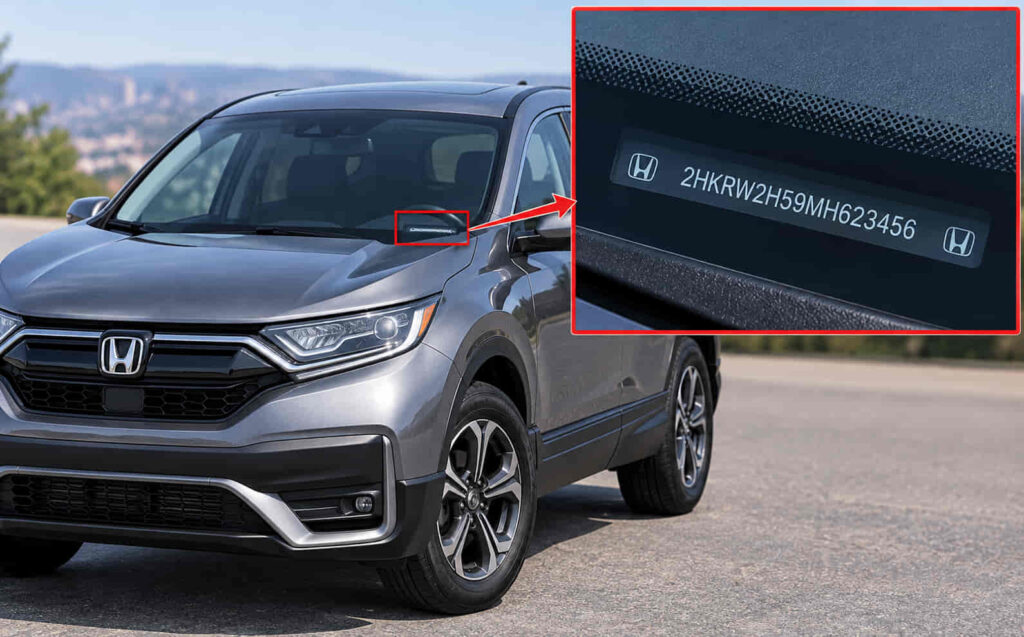
A Honda CR-V VIN decoder is a tool that interprets the Vehicle Identification Number assigned to a specific CR-V and returns vehicle-identification information associated with that VIN. Modern Honda CR-V models use a standardized 17-character VIN that contains structured identifiers rather than a random sequence of letters and numbers. Decoding those characters can help identify information such as the manufacturer, vehicle attributes, model year, assembly information, and the individual vehicle identifier, depending on the VIN and the data source used by the decoder.
The VIN can be found on the vehicle itself and in associated vehicle documents. Once the correct number is located, decoding starts with entering the complete VIN accurately and comparing the returned information with the CR-V being inspected. This is especially useful when confirming vehicle identity, checking model information, or researching a used Honda CR-V.
A Honda CR-V VIN decoder should not be confused with a vehicle history report. VIN decoding focuses on information encoded in or associated with the vehicle identifier, while a vehicle history service may retrieve external records such as title, ownership, or accident-related information when those records are available. This guide explains where to find a Honda CR-V VIN, how its 17-character structure works, what information can be decoded, how to interpret key VIN elements, and why a VIN may sometimes fail to decode.
What Is a Honda CR-V VIN Decoder?
A Honda CR-V VIN decoder is a tool that interprets a CR-V’s Vehicle Identification Number to identify vehicle information represented by or associated with that VIN. The decoder uses the VIN as its input, interprets the standardized identifier, and returns available vehicle attributes according to the decoding system and data source being used.
The VIN itself is the central identifier in this process. For a modern Honda CR-V, it consists of 17 characters arranged in a standardized structure. Different sections of the VIN serve different identification purposes, including identifying the manufacturer and describing or distinguishing the vehicle. A decoder converts this structured identifier into information that is easier for the vehicle owner, buyer, technician, or researcher to interpret.
A VIN decoder is therefore different from simply checking whether a string contains 17 characters. Length is one part of validating a modern VIN, but a valid-looking sequence still needs to follow the applicable VIN structure. Accurate decoding also depends on entering every character correctly because changing a single character changes the identifier being evaluated.
The information returned can vary between decoders. One source may provide manufacturer, model-year, plant, and vehicle-related attributes, while another may display a different level of detail based on its underlying data. A missing field does not automatically mean that the Honda CR-V lacks that characteristic; it can mean that the particular decoder does not provide or resolve that information.
This creates the primary semantic relationship for the decoding process: Honda CR-V → Vehicle Identification Number → structured identifier → VIN decoder → interpreted vehicle information. Understanding that relationship is important before interpreting individual characters or treating decoder output as a complete record of the vehicle.
Where Can You Find the VIN on a Honda CR-V?
A Honda CR-V VIN can be found on the vehicle and in its associated identification documents, with the dashboard area visible through the windshield and the driver-side door or door-jamb area serving as key places to inspect on the vehicle. The purpose of checking these locations is to obtain the complete identifier accurately before using a Honda CR-V VIN decoder.
The windshield-area VIN is useful because it can be inspected without decoding any other vehicle information first. The identifier is displayed at the base of the windshield on the driver’s side where it can be read from outside the vehicle. Because a VIN contains 17 characters on modern CR-Vs, each character should be transcribed carefully rather than relying on a partial number.
Vehicle identification information can also appear on the certification label in the driver-side door or door-jamb area. This location provides another reference when confirming that the identifier being entered into a decoder corresponds to the vehicle being inspected. The exact label presentation can vary, so the VIN should be identified by its complete vehicle-identification sequence rather than by assuming every number printed on the label serves the same purpose.
The VIN can additionally appear on vehicle documentation such as registration or title records, depending on the jurisdiction and document involved. Comparing the identifier on the physical vehicle with the identifier shown in relevant documentation is more informative than decoding a number copied from an unverified source. This is particularly relevant when researching a used Honda CR-V because the decoder’s result is only useful for the vehicle being inspected if the correct VIN was entered.
VIN location therefore forms the first operational step in decoding: locate the identifier → read all characters accurately → verify the VIN where appropriate → enter the same identifier into the decoder. A transcription error at this stage can produce an invalid result or information associated with a different identifier.
How Many Characters Are in a Honda CR-V VIN?
A modern Honda CR-V VIN contains 17 characters, following the standardized VIN format used for road vehicles manufactured under the modern VIN system. These 17 positions combine letters and numbers into a structured identifier that distinguishes the vehicle and supports the decoding of specific vehicle information.
The characters are not simply a serial number running from the first position to the seventeenth. The VIN is organized into sections that serve different identification functions. The first part identifies the manufacturer context, the middle portion contains vehicle-description information, and the final portion helps identify the individual vehicle and related attributes defined by the applicable VIN structure.
Modern VINs also avoid the letters I, O, and Q because they can be visually confused with the numbers 1 and 0. This distinction is useful when copying a Honda CR-V VIN from the dashboard or another physical location. A character that appears to be an “O,” for example, should not simply be entered as that letter in a standardized 17-character VIN.
Character count alone, however, does not establish that a VIN is correct. A 17-character sequence can still contain a transcription error or fail other structural checks. This is why the complete VIN should be copied from a reliable vehicle or document location before attempting to interpret model year, manufacturer information, or other attributes.
For Honda CR-V decoding, the 17-character format provides the framework for the next level of interpretation. Instead of treating all positions as unrelated codes, the VIN can be understood through its major structural sections: World Manufacturer Identifier (WMI) → Vehicle Descriptor Section (VDS) → Vehicle Identifier Section (VIS).
Read more: Honda CRV Window Deflector
How Is a Honda CR-V VIN Structured?
A Honda CR-V VIN is structured as a 17-character vehicle identifier divided into three main sections: the World Manufacturer Identifier (WMI), Vehicle Descriptor Section (VDS), and Vehicle Identifier Section (VIS). These sections organize the VIN so that different positions contribute to manufacturer identification, vehicle description, validation, model-year information, plant information, and identification of the individual vehicle.
The WMI occupies the first three positions and establishes the manufacturer context for the vehicle. The VDS occupies positions four through nine and contains vehicle-description information defined within the applicable VIN system. The VIS occupies positions 10 through 17 and includes information used to identify the vehicle further, including model-year and plant-related identifiers as well as the sequence that distinguishes the individual vehicle.
This structure explains why a Honda CR-V VIN should not be interpreted as 17 unrelated characters. A character has meaning because of both its position and the decoding rules associated with that position. Moving a character to another position or entering the wrong character changes the structure being interpreted and can therefore change or invalidate the decoding result.
The ninth position has a specific validation role in VINs subject to the applicable check-digit requirements, while the tenth position is commonly used for the model-year code. These positions illustrate why VIN interpretation requires more than identifying the manufacturer from the beginning of the sequence. Different parts of the identifier perform different functions within the complete VIN.
For practical Honda CR-V decoding, the useful hierarchy is 17-character VIN → WMI + VDS + VIS → position-specific information → decoded vehicle attributes. This structure provides the foundation for interpreting individual fields without assuming that every character directly represents a consumer-facing specification such as trim level or optional equipment.
What Does the WMI Section of a Honda CR-V VIN Mean?
The World Manufacturer Identifier is the first three characters of a Honda CR-V VIN and identifies the manufacturer within the geographic and manufacturing context represented by that WMI. It establishes who manufactured the vehicle before the remaining VIN positions describe and identify the vehicle in greater detail.
The WMI is important for the Honda CR-V because the model has been produced for different markets and at different manufacturing locations. For that reason, users should not assume that every Honda CR-V begins with one universal three-character sequence. The WMI must be interpreted from the VIN of the specific vehicle being decoded.
The first three positions work as a unit rather than as a model name written in coded form. They provide manufacturer-identification context, while later positions perform the vehicle-description and vehicle-identification functions. A Honda manufacturer identifier at the beginning of the VIN therefore does not by itself establish the complete CR-V configuration.
This distinction becomes useful when comparing two Honda CR-V VINs. Two vehicles can both be CR-Vs while beginning with different WMI sequences because their manufacturing context differs. Conversely, identifying Honda from the WMI does not prove that the vehicle is a CR-V; the rest of the VIN must also be interpreted.
The WMI therefore creates the first decoding layer: VIN positions 1–3 → manufacturer context → Honda identification → remaining vehicle description and identification. A complete Honda CR-V VIN decoder continues beyond this section to interpret the information represented elsewhere in the 17-character sequence.
What Information Does a Honda CR-V VIN Decoder Show?
A Honda CR-V VIN decoder can show vehicle-identification and specification-related information such as the manufacturer, vehicle or model attributes, model year, assembly information, and individual vehicle identifier, depending on the VIN and the decoder’s data source. The exact output is not identical across every decoder because different services can use different decoding logic and supporting databases.
Manufacturer information is derived from the identification structure at the beginning of the VIN, while other positions contribute to vehicle-description information. A decoder translates these codes into readable fields so the user does not need to interpret each applicable VIN position manually. This makes the VIN useful for confirming whether decoded information corresponds with the Honda CR-V being inspected.
Model-year information is another important output because the standardized VIN structure contains a designated model-year position. Plant-related information and the identifying sequence in the VIS can further distinguish the vehicle. Together, these attributes move the result from general manufacturer identification toward the identity of a specific CR-V.
A decoder may also return vehicle attributes such as body, restraint, engine, drivetrain, or other specification-related information when those attributes can be resolved from the VIN and the source supporting the decoder. However, the presence and precision of these fields depend on the vehicle and data source. A decoder that leaves a field blank does not establish that the vehicle lacks that feature.
The same limitation applies to trim and optional equipment. A VIN can identify substantial information about a Honda CR-V without necessarily encoding every retail package, accessory, or option in a form that every public decoder can resolve. Decoder output should therefore be interpreted according to the fields actually supported rather than extending the result beyond the information provided.
VIN-decoded information must also be separated from external historical records. Accident events, ownership changes, title events, service records, and similar history are not simply contained as a chronological record inside the 17-character VIN. Services that provide such information use the VIN as an identifier to search external records associated with that vehicle.
The information flow is therefore Honda CR-V VIN → encoded identification structure → decoding logic and supporting data → readable vehicle attributes. When external historical databases are added, the VIN becomes a lookup key for another type of information, but that process is different from decoding the VIN itself.
How Can You Find the Model Year From a Honda CR-V VIN?
The model year of a modern Honda CR-V can be identified from the 10th character of its standardized 17-character VIN by interpreting that position with the applicable model-year code. The tenth position belongs to the Vehicle Identifier Section and provides a standardized way to represent model year within the VIN.
The character does not work as a simple numerical representation of the year. Instead, VIN model-year codes use letters and numbers in a repeating sequence. This means the character must be interpreted within the context of the vehicle and the applicable year range rather than converted directly into a calendar year without additional context.
This repeating structure matters because the same model-year character can represent years in different VIN cycles. A Honda CR-V VIN decoder resolves the code using the rest of the vehicle information and its underlying decoding data. Looking at the tenth character alone without considering the vehicle context can therefore create ambiguity.
Model year should also be distinguished from the exact date on which the vehicle was manufactured. A CR-V assigned to a particular model year may have been assembled during a different calendar year. Production or certification information associated with the vehicle can provide additional date context, while the tenth VIN position identifies the model-year designation rather than an exact assembly date.
The same distinction applies to registration dates. The date a Honda CR-V was first registered does not redefine the model-year code encoded in its VIN. A vehicle can be manufactured, assigned to a model year, sold, and registered at different points in time, so those dates should not be treated as interchangeable.
The correct interpretation is therefore 10th VIN position → model-year code → applicable VIN cycle and vehicle context → Honda CR-V model year. A decoder performs this interpretation automatically, while manual decoding requires the correct model-year code reference and sufficient context to resolve the repeating sequence.
What Does the Check Digit in a Honda CR-V VIN Mean?
The check digit is the ninth character of a Honda CR-V VIN subject to the applicable VIN validation system, and its purpose is to help verify the mathematical consistency of the complete VIN rather than describe a vehicle feature. It functions as a validation element within the 17-character identifier.
The check process uses information from the other VIN positions. Characters are assigned values, those values are processed with position-specific weighting, and the resulting calculation determines the expected check digit. The character in the ninth position can then be compared with that expected result to evaluate whether the VIN is structurally consistent under the validation formula.
This mechanism makes the check digit useful for detecting certain transcription errors. If a character has been entered incorrectly, the resulting VIN may fail the calculation because the expected ninth-position value no longer matches. This is one reason a VIN decoder or validation system may reject a 17-character sequence even when its length appears correct.
The check digit does not identify the CR-V’s trim, engine, drivetrain, model year, or production plant. Those attributes are associated with other VIN positions or supporting decoding data. Treating the ninth character as another specification code ignores its distinct validation function.
Passing a check-digit calculation also should not be interpreted as a complete verification of the physical vehicle or its history. The calculation evaluates the identifier’s structural relationship; it does not independently confirm ownership, accident history, title status, current equipment, or whether the VIN being entered was copied from the correct vehicle.
The semantic role of this position is therefore complete VIN → character values and position weights → validation calculation → check digit → structural consistency check. It supports VIN validation before or during decoding without replacing vehicle identification or historical verification.
How Do You Decode a Honda CR-V VIN?
To decode a Honda CR-V VIN, first obtain the complete 17-character identifier from a reliable vehicle or document location, enter it accurately into an appropriate VIN decoder, and then compare the decoded attributes with the CR-V being researched. Successful decoding depends on both the accuracy of the input and the information supported by the decoder.
The process begins with the VIN itself rather than with assumptions about model year, trim, or manufacturing location. The identifier can be read from the vehicle, such as the dashboard VIN area visible through the windshield, and compared with another relevant vehicle or document location when verification is necessary. All 17 characters should be transcribed in their original order.
Character accuracy is critical because every VIN position has a defined role within the complete structure. Substituting one number or letter can alter manufacturer information, vehicle-description data, model-year interpretation, the identifying sequence, or the validity of the VIN. Standardized VINs also exclude the letters I, O, and Q, which helps reduce confusion with visually similar numbers.
Once the VIN is entered, the decoder interprets the identifier according to its available decoding rules and supporting data. The resulting fields can then be reviewed for manufacturer, model-related information, model year, plant information, vehicle attributes, and other available identifiers. Not every decoder will return every field for every Honda CR-V.
The decoded result should then be compared with the actual vehicle and relevant documentation when the objective is verification. If a VIN decodes to information that conflicts with the CR-V being inspected, the discrepancy should be investigated rather than changing characters until the decoder produces an expected result. The first checks should include whether the VIN was copied correctly and whether the correct identifier was used.
A VIN decoder also has a defined information boundary. It interprets vehicle-identification information and may supplement that interpretation with database information, but the 17-character VIN does not contain a complete chronological record of accidents, owners, repairs, title events, or maintenance. Those records require separate data sources that use the VIN as a vehicle-specific lookup key.
Honda CR-V VIN decoding therefore follows the relationship locate the VIN → verify accurate transcription → decode the identifier → interpret returned attributes → compare them with the vehicle → investigate discrepancies when necessary. This sequence preserves the VIN’s role as a vehicle identifier while preventing decoder output from being treated as information it was not designed to provide.
Why Is My Honda CR-V VIN Not Decoding?
A Honda CR-V VIN may fail to decode because the identifier was entered incorrectly, does not match the expected VIN format, is not fully supported by the decoder, or cannot be resolved with the data available to that service. A failed lookup therefore does not have one universal cause, and it should not automatically be interpreted as evidence that the VIN itself is fraudulent or that the vehicle has an identification problem.
Transcription errors are one of the first issues to check because a modern Honda CR-V VIN contains 17 position-sensitive characters. Omitting a character, reversing two positions, or substituting a visually similar number or letter changes the identifier being processed. Standardized VINs do not use the letters I, O, and Q, so a sequence containing one of those letters should prompt another inspection of the original VIN.
The decoder can also reject a VIN when structural validation fails. The number may contain 17 characters while still being inconsistent with applicable VIN rules, including the relationship evaluated through the check-digit system. Character count and structural validity are therefore separate conditions: a VIN can have the expected length without successfully passing every validation step.
A correctly entered VIN can still produce incomplete or unsuccessful results when the decoding service lacks sufficient data for that vehicle. VIN decoders do not all use identical databases, and coverage can differ by market, model year, vehicle attribute, and data source. One service failing to return a field does not prove that the information cannot be resolved elsewhere.
Vehicle age and VIN format are another contextual factor for VIN decoding in general. Modern Honda CR-V vehicles use the standardized 17-character system discussed in this guide, but VIN-decoding services may also process vehicles from other periods and markets with different levels of coverage. The decoder must support the identifier and relevant vehicle data rather than merely accept text in an input field.
When a Honda CR-V VIN does not decode, the useful diagnostic relationship is VIN source → transcription accuracy → character format → structural validation → decoder coverage → returned result. Checking these layers in sequence is more reliable than repeatedly modifying the VIN until a lookup service returns the expected vehicle.
Can a Honda CR-V VIN Tell You the Exact Trim?
A Honda CR-V VIN can provide vehicle attributes that help identify its configuration, but the VIN alone should not be assumed to reveal the exact retail trim, package, and installed options through every decoder. The level of detail depends on what is represented by the VIN and how the decoding service maps those identifiers to Honda vehicle data.
Trim identification is more complex than reading the model-year character because retail trim names are not simply stored as a complete text label in one universal VIN position. Vehicle-description positions can encode characteristics used to distinguish configurations, while a decoder’s supporting database translates available codes into consumer-readable information. The precision of that translation determines what the user sees.
This explains why two VIN decoders can display different levels of detail for the same Honda CR-V. One may identify the model and several vehicle attributes without presenting a specific trim name, while another may associate the VIN with additional configuration information. The difference can result from database coverage rather than a change in the VIN itself.
Optional equipment should be treated separately from trim identification. Accessories, dealer-installed equipment, later modifications, and certain option combinations should not automatically be inferred from a basic VIN decoding result. The physical vehicle can also change during its service life even though its original VIN remains the same.
When exact configuration matters, the decoded VIN can therefore serve as one identification layer rather than the only source of evidence. Information associated with the vehicle, appropriate Honda documentation, equipment present on the CR-V, and other reliable vehicle-specific records can provide additional confirmation when a general VIN decoder does not resolve the required detail.
The correct semantic relationship is VIN → vehicle-description identifiers → decoder data → available configuration attributes → possible trim identification. This is more precise than assuming VIN → guaranteed complete trim and option list, which exceeds what every decoder can reliably provide.
Can You Identify a Honda CR-V Engine From the VIN?
A Honda CR-V VIN decoder can provide engine-related information when the applicable VIN structure and the decoder’s supporting data identify that attribute, but the returned result should be understood as vehicle-identification information rather than physical confirmation of the engine currently installed. Decoder coverage determines how specifically the engine information is presented.
Engine-related identification belongs within the broader Vehicle Descriptor Section and its interpretation. A decoder can use the relevant VIN positions together with manufacturer-specific data to translate the identifier into available vehicle attributes. Depending on the CR-V and the decoding source, the result may provide information associated with the engine configuration assigned to that vehicle.
The VIN should not, however, be treated as a direct inspection of the engine. A vehicle can undergo repairs or component replacement during its service life without receiving a new VIN simply because an engine-related component changed. The VIN continues to identify the vehicle, while the current mechanical configuration must be confirmed from the vehicle itself when that distinction matters.
This difference is especially important when researching a used Honda CR-V. If a decoder identifies an engine-related specification but the physical vehicle appears inconsistent with that information, the discrepancy requires further verification. The appropriate response is not to assume that the decoder or the vehicle must automatically be fraudulent; VIN transcription, decoder data, vehicle repairs, and physical identification all provide relevant diagnostic context.
A missing engine field also does not establish that the VIN contains no useful vehicle-description information. It can reflect the limitations of the particular decoder or its database. Another authoritative vehicle-information source may provide more detail for the same identifier.
Engine identification through a Honda CR-V VIN therefore follows VIN → vehicle-description data → decoder interpretation → engine-related attribute, while confirmation of the engine currently installed follows physical vehicle → component identification → mechanical verification. Keeping these two processes separate prevents a VIN lookup from being treated as a substitute for inspecting the actual vehicle.
Is a Honda CR-V VIN Decoder the Same as a Vehicle History Report?
No, a Honda CR-V VIN decoder is not the same as a vehicle history report because the two tools answer different questions about the vehicle. A VIN decoder interprets identification and specification-related information represented by or associated with the 17-character VIN, while a vehicle history service uses that VIN as an identifier to search available external records connected with the specific vehicle.
The distinction begins with the source of the information. A VIN contains a standardized identification structure that can be decoded to determine attributes such as manufacturer context, model year, plant-related information, and other vehicle characteristics supported by the decoding source. These attributes describe the identity or original classification of the vehicle rather than providing a chronological account of events that occurred during its life.
A vehicle history report works differently. The VIN acts as a lookup key that connects the specific Honda CR-V with records collected by the service from external data sources. Depending on the provider, jurisdiction, and available records, those results may relate to title events, reported damage, ownership or registration activity, odometer information, or other historical events. Those events are not stored as a running history inside the 17 VIN characters.
This distinction explains why decoding a Honda CR-V VIN cannot establish that the vehicle has never been involved in an accident. The VIN may correctly identify the vehicle while containing no encoded chronology of collisions. Determining whether an accident record exists requires access to relevant historical data, and the absence of a record from one database does not necessarily establish that no event occurred.
The same principle applies to ownership and service history. A VIN identifies the vehicle consistently as it changes owners or receives repairs, but the VIN characters themselves do not change to record each transaction or maintenance event. External systems can associate new records with the same identifier over time, creating the historical information that a vehicle history service may retrieve.
A Honda CR-V VIN decoder and a vehicle history source can therefore complement each other without being interchangeable. The decoder addresses “What vehicle does this VIN identify?”, while a history lookup addresses “What available records are associated with this vehicle?” Keeping those questions separate prevents decoded specifications from being mistaken for evidence about the CR-V’s past.
How Can You Use a VIN When Checking a Used Honda CR-V?
When checking a used Honda CR-V, the VIN can be used as a common vehicle identifier for comparing the physical vehicle, decoded information, relevant documents, and available external records. Its value comes from connecting these information sources to the same vehicle rather than relying on a single decoder result as a complete used-car assessment.
The process begins by obtaining the VIN from the CR-V itself. The identifier visible in the dashboard area can be compared with another applicable identification location and with relevant vehicle documentation. Matching identifiers establish a consistent reference for the next stage of research, while an unexplained difference should be investigated before information from one source is assumed to describe the vehicle being inspected.
Decoding the VIN then provides an identity check. Manufacturer, model-year information, vehicle attributes, and other available decoded fields can be compared with the CR-V presented for sale. If the VIN identifies characteristics that conflict with the physical vehicle or seller-provided information, the discrepancy creates a reason for additional verification rather than a reason to alter the VIN until the expected result appears.
The same VIN can subsequently be used with appropriate external record sources when historical information is required. This changes the information mechanism from decoding to record lookup. The identifier remains the same, but the question changes from interpreting the VIN’s vehicle information to finding available records associated with that particular Honda CR-V.
Physical inspection remains a separate evidence layer. A correctly decoded VIN cannot determine the present mechanical condition of the engine, transmission, suspension, brakes, body, or other systems. It also cannot establish that every component currently installed matches the vehicle’s original configuration. Vehicle identity and current vehicle condition are related during a used-car evaluation, but they are not the same information.
The strongest verification relationship is therefore physical VIN → decoded vehicle identity → vehicle documents → available external records → physical vehicle condition. Each layer answers a different question while the VIN connects them to the same Honda CR-V. This makes VIN decoding useful during used-vehicle research without extending it beyond its actual role as a vehicle-identification tool.
What Should You Do if the VIN Does Not Match on a Honda CR-V?
If the VIN does not match across a Honda CR-V, its relevant vehicle identification locations, or associated documents, the discrepancy should be verified before the VIN is used to identify, register, research, or evaluate the vehicle. A mismatch means that two sources expected to refer to the same vehicle are displaying different identifiers, but the difference alone does not establish its cause.
The first step in understanding the discrepancy is confirming that the complete VIN was read accurately. A modern Honda CR-V VIN contains 17 position-sensitive characters, so one incorrectly copied character creates a different identifier. The VIN visible in the dashboard area can be compared with another applicable identification location on the vehicle and with the relevant documentation available for that CR-V.
The location of the mismatch provides useful context. If the physical identification locations agree with each other but a document contains a different character, the discrepancy requires verification of the document and vehicle records. If identifiers displayed on the physical vehicle do not agree, the issue concerns vehicle identification more directly and should not be resolved merely by choosing whichever VIN produces the expected decoder result.
Decoded information can provide another comparison layer but should not replace inspection of the identifiers themselves. If one VIN decodes to a Honda CR-V with attributes consistent with the vehicle while another produces conflicting information, that difference helps define the discrepancy. It does not independently explain why the identifiers differ.
A VIN mismatch should also not automatically be labeled as evidence of theft, fraud, or VIN tampering without supporting evidence. Transcription mistakes, documentation errors, and other identification issues can produce discrepancies that require different forms of verification. When the mismatch affects ownership, registration, title, or the legal identity of the vehicle, the appropriate official vehicle or registration authority for the jurisdiction should be used to establish the correct record.
The diagnostic relationship is therefore physical VIN locations → document VIN → accurate transcription → decoded identity → discrepancy verification. The purpose is to establish which identifier legitimately belongs to the Honda CR-V rather than forcing inconsistent information into a single expected result.
Can Older Honda CR-V Models Have a Different VIN Format?
Honda CR-V models are generally associated with the standardized 17-character VIN era, so a substantially shorter or nonstandard identifier presented as a CR-V VIN should not automatically be treated as a normal consequence of the vehicle being an older model. The CR-V entered production after the modern 17-character VIN system had already become established in major automotive markets.
The broader automotive context is important because vehicles manufactured before modern VIN standardization can have identifiers that differ in length and structure. This explains why general VIN-decoding resources sometimes discuss shorter or manufacturer-specific VIN formats. That historical limitation applies to older vehicles broadly, but it should not be transferred automatically to the Honda CR-V simply because an individual CR-V is from an early model year.
Market context can still affect decoder coverage. Honda CR-Vs have been produced and sold in multiple regions, and a decoder designed around one market may provide less information for a vehicle originating from another. In this situation, a 17-character VIN can be structurally appropriate while a particular decoder returns incomplete information because its supporting database does not fully cover that application.
This distinction is important when troubleshooting an early Honda CR-V that fails to decode. The sequence should first be checked for accurate transcription and correct character count, followed by the VIN’s structural validity and the decoder’s coverage. Assuming that an unsuccessful lookup is caused by an “old VIN format” can direct the investigation away from the actual problem.
The same principle applies when an identifier found elsewhere on the vehicle contains fewer than 17 characters. Vehicles contain multiple numbers and codes for components, manufacturing information, and other identification purposes. A shorter number should not be treated as the VIN merely because it appears on the Honda CR-V.
The final semantic relationship is therefore Honda CR-V → standardized vehicle identification → 17-character VIN → decoder compatibility → vehicle-specific information. Historical nonstandard VIN formats remain relevant to VIN decoding as a general automotive concept, but they do not change the primary 17-character framework used to identify and decode Honda CR-V vehicles.