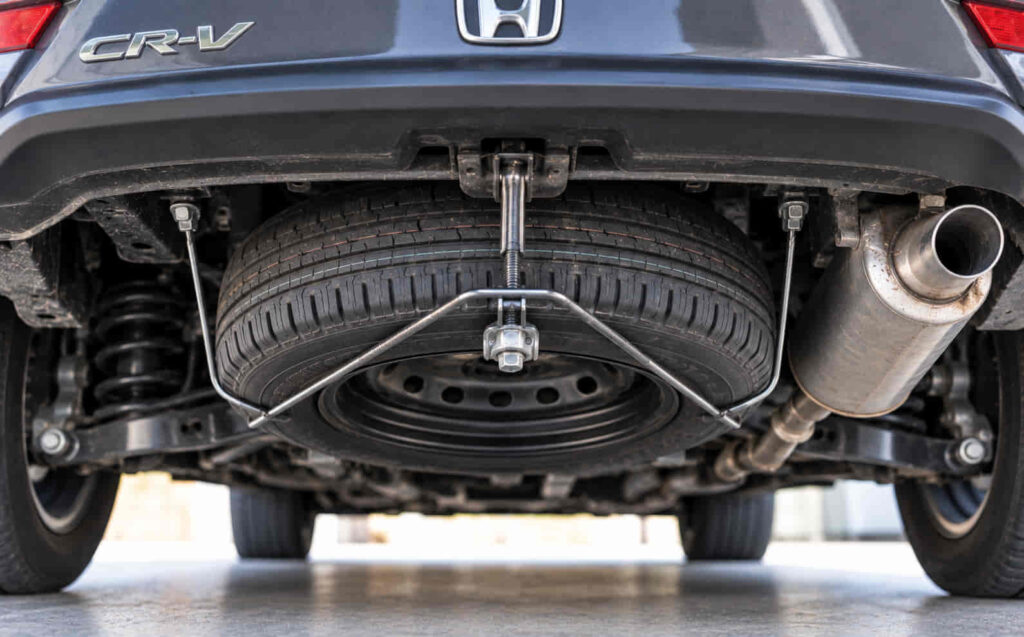
A Honda CR-V spare tire mount is the mounting system that secures the spare wheel and tire to the vehicle, but its location and design are not the same across every CR-V model year. Depending on the generation and vehicle configuration, the spare tire can use a different storage location, retaining system, carrier, or mounting hardware. For this reason, identifying a replacement mount by the “Honda CR-V” model name alone is not enough to confirm compatibility.
The correct spare tire mount must match both the vehicle and the spare tire setup. Model year, mounting location, available attachment points, wheel and tire dimensions, and the specific mounting hardware can all affect fitment. This distinction becomes especially important when replacing a damaged or missing factory component, adding a spare tire to a CR-V that uses a different original configuration, or considering an aftermarket carrier for a full-size spare.
Before purchasing or replacing any component, the existing spare tire system should therefore be identified first. This guide explains where Honda CR-V spare tires are mounted, how mounting designs can differ by model year, how to confirm the correct spare tire mount, when replacement is necessary, and what to verify when choosing OEM or aftermarket parts.
What Is a Honda CR-V Spare Tire Mount?
A Honda CR-V spare tire mount is the mounting system that holds and secures the spare wheel and tire in its designated position on the vehicle. Depending on the CR-V generation and spare tire configuration, this system can involve a carrier or mounting point together with retaining hardware that prevents the spare from moving while the vehicle is being driven.
The spare tire mount should be distinguished from the spare tire itself. The tire and wheel form the spare wheel assembly used after a tire problem, while the mount is responsible for retaining that assembly when it is stored. This distinction matters when diagnosing a missing or damaged spare tire setup because replacing the tire does not replace missing mounting hardware, and installing new mounting hardware does not establish that the spare wheel itself is the correct size for the vehicle.
The mount also needs to secure the spare against movement created by braking, acceleration, cornering, and road vibration. A correctly retained spare should remain in its intended storage position rather than moving freely within or around the vehicle. The mounting system therefore performs a storage and retention function even though it does not participate in normal suspension or drivetrain operation.
“Spare tire mount” can refer to more than one physical component depending on the vehicle design. On one configuration, the relevant part may be a retaining mechanism associated with an internal spare-wheel storage area. On another, the term may refer to a carrier or bracket used to hold the wheel externally. For this reason, searching for a Honda CR-V spare tire mount without identifying the model year and existing mounting arrangement can produce parts that perform the same general function but are not interchangeable.
The correct component is therefore defined by its relationship to the specific vehicle. A Honda CR-V spare tire mount must secure the applicable spare wheel at the mounting location designed or properly configured for that CR-V. Identifying that location is the next step before replacement parts or mounting hardware can be selected.
Where Is the Spare Tire Mounted on a Honda CR-V?
The spare tire location on a Honda CR-V depends on the model year, generation, and original spare tire configuration, so there is no single mounting location that should be assumed for every CR-V. The correct location must be identified from the specific vehicle before a replacement mount, carrier, or retaining component is selected.
Honda CR-V designs have changed substantially across generations, including changes to the rear body structure and cargo area. These changes affect how spare-wheel storage is incorporated into the vehicle. A spare can be associated with an internal cargo-area storage arrangement on applicable configurations, while older vehicle designs can use a different mounting approach. The existence of these different layouts is why a mounting component identified only as a “CR-V spare tire mount” still requires model-year verification.
The location also determines what type of mounting system is required. An internally stored spare needs a retaining arrangement compatible with the vehicle’s spare-wheel storage area and surrounding cargo-floor structure. An externally carried spare requires a carrier and attachment arrangement designed for that mounting position. These systems cannot be treated as equivalent simply because both secure a spare tire.
A vehicle that does not have an obvious spare tire in the expected cargo area should not automatically be assumed to have a missing mount. The original configuration first needs to be established. Depending on the specific CR-V, the vehicle’s equipment and spare-tire provision can differ, which changes whether the task is replacing a missing component, restoring an original spare-tire system, or adding a system that was not present in the same form originally.
This distinction is particularly important when purchasing used parts or aftermarket carriers. A component can be advertised for a Honda CR-V while being intended for only a specific generation, mounting position, or conversion. Matching the general vehicle model does not establish that the vehicle contains the required mounting points or that the spare wheel will fit the available storage space.
The reliable way to locate and identify a Honda CR-V spare tire mount is to start with the exact model year and existing spare-tire configuration. Once the original mounting location is established, the carrier, retaining hardware, and replacement parts can be evaluated within the correct vehicle context rather than assuming one spare-tire arrangement applies across the entire CR-V model line.
Does the Honda CR-V Spare Tire Mount Change by Model Year?
The Honda CR-V spare tire mount can change by model year and generation because changes to the vehicle body, cargo area, spare-tire location, and factory equipment can require a different mounting system. A mount that fits one CR-V generation should therefore not be assumed to fit another generation simply because both vehicles use the Honda CR-V name.
Model year matters because a spare tire mount is connected to the physical structure and packaging of the vehicle. When the rear body or cargo-area layout changes, the available space for a spare wheel can also change. The location of mounting points, the space surrounding the tire, the retaining method, and the hardware required to secure the assembly can consequently differ. These physical relationships make the mount a vehicle-specific component rather than a universal CR-V accessory.
Generation changes create an especially important fitment boundary. A major redesign can alter the dimensions and arrangement of the rear cargo area as well as the way a spare tire is stored or carried. Even when two generations both provide a location for a spare, this does not establish that their retaining hardware, brackets, carriers, or mounting dimensions are identical. Functional similarity and physical interchangeability are separate attributes.
Differences can also exist within a generation. Vehicle equipment and parts applications can depend on the specific configuration, market, or production information used by the relevant parts catalog. This is why model year should be treated as the beginning of fitment verification rather than the only information required. When a catalog requests additional vehicle details, those details should be confirmed before the part is selected.
This distinction becomes more important when the purpose is to add a spare tire rather than replace an existing mount. A replacement starts with a known mounting system already associated with the vehicle. A retrofit must first establish whether the CR-V has the required space, attachment points, and compatible components for the proposed system. A part advertised for a CR-V does not by itself prove that every CR-V from a broad year range contains the same factory provisions for installation.
The correct fitment sequence therefore starts with the exact Honda CR-V model year, identifies its generation and original spare-tire configuration, and then verifies the applicable mount or carrier. This prevents a broad model-name match from being mistaken for confirmed physical compatibility.
What Parts Make Up a Honda CR-V Spare Tire Mounting System?
A Honda CR-V spare tire mounting system consists of the components that locate, support, and retain the spare wheel, but the exact parts depend on the mounting design used by the specific vehicle. The system should therefore be identified as an assembly of related components rather than assuming every CR-V uses one universal spare tire bracket.
The primary mounting component provides the physical connection between the spare wheel and its storage or carrying position. Depending on the design, this function can be performed through a carrier, holder, retaining mechanism, or another vehicle-specific mounting arrangement. Its purpose is to keep the spare positioned correctly and provide a secure point through which the wheel can be retained.
Retaining hardware completes that connection. A spare wheel must remain secured against movement rather than merely resting in the correct area. The applicable hardware can include fasteners or retention components designed for the mounting system. The exact hardware should be determined from the vehicle application because thread dimensions, attachment methods, component lengths, and surrounding clearances cannot be assumed to be identical across different CR-V designs.
The vehicle-side mounting point is another part of the system even when it is not purchased with the replacement mount. A carrier or retainer needs a structurally appropriate location to attach to the vehicle. If that attachment point is damaged, missing, or not present on the configuration being modified, purchasing the carrier alone does not create a complete installation. This is one reason replacement and retrofit projects require different fitment checks.
The spare wheel itself also affects the mounting system even though it is not the mount. Wheel and tire dimensions determine how much physical space the assembly occupies and whether the intended retaining component can secure it correctly. A mounting system designed around a compact spare should not automatically be assumed to accommodate a full-size wheel and tire merely because both can serve as replacement wheels for the vehicle under different circumstances.
Identifying the individual components prevents several different problems from being grouped under the same phrase. A Honda CR-V can have a suitable spare wheel but missing retaining hardware, an intact mounting point but a damaged carrier, or a replacement carrier that does not correspond to the vehicle-side attachment. Each condition requires a different part even though a search for any of them might begin with “Honda CRV spare tire mount.”
The mounting system should therefore be evaluated from the vehicle outward: the vehicle mounting point must support the applicable carrier or retaining mechanism, the hardware must secure that mechanism correctly, and the completed system must retain the intended spare wheel. Establishing these relationships makes it possible to identify the actual missing or damaged component before selecting a replacement.
Read more: Honda CRV Sway Bar Links
Does the Honda CR-V Spare Tire Mount Change by Model Year?
The Honda CR-V spare tire mount can change by model year and generation because changes to the vehicle body, cargo area, spare-tire location, and factory equipment can require a different mounting system. A mount that fits one CR-V generation should therefore not be assumed to fit another generation simply because both vehicles use the Honda CR-V name.
Model year matters because a spare tire mount is connected to the physical structure and packaging of the vehicle. When the rear body or cargo-area layout changes, the available space for a spare wheel can also change. The location of mounting points, the space surrounding the tire, the retaining method, and the hardware required to secure the assembly can consequently differ. These physical relationships make the mount a vehicle-specific component rather than a universal CR-V accessory.
Generation changes create an especially important fitment boundary. A major redesign can alter the dimensions and arrangement of the rear cargo area as well as the way a spare tire is stored or carried. Even when two generations both provide a location for a spare, this does not establish that their retaining hardware, brackets, carriers, or mounting dimensions are identical. Functional similarity and physical interchangeability are separate attributes.
Differences can also exist within a generation. Vehicle equipment and parts applications can depend on the specific configuration, market, or production information used by the relevant parts catalog. This is why model year should be treated as the beginning of fitment verification rather than the only information required. When a catalog requests additional vehicle details, those details should be confirmed before the part is selected.
This distinction becomes more important when the purpose is to add a spare tire rather than replace an existing mount. A replacement starts with a known mounting system already associated with the vehicle. A retrofit must first establish whether the CR-V has the required space, attachment points, and compatible components for the proposed system. A part advertised for a CR-V does not by itself prove that every CR-V from a broad year range contains the same factory provisions for installation.
The correct fitment sequence therefore starts with the exact Honda CR-V model year, identifies its generation and original spare-tire configuration, and then verifies the applicable mount or carrier. This prevents a broad model-name match from being mistaken for confirmed physical compatibility.
What Parts Make Up a Honda CR-V Spare Tire Mounting System?
A Honda CR-V spare tire mounting system consists of the components that locate, support, and retain the spare wheel, but the exact parts depend on the mounting design used by the specific vehicle. The system should therefore be identified as an assembly of related components rather than assuming every CR-V uses one universal spare tire bracket.
The primary mounting component provides the physical connection between the spare wheel and its storage or carrying position. Depending on the design, this function can be performed through a carrier, holder, retaining mechanism, or another vehicle-specific mounting arrangement. Its purpose is to keep the spare positioned correctly and provide a secure point through which the wheel can be retained.
Retaining hardware completes that connection. A spare wheel must remain secured against movement rather than merely resting in the correct area. The applicable hardware can include fasteners or retention components designed for the mounting system. The exact hardware should be determined from the vehicle application because thread dimensions, attachment methods, component lengths, and surrounding clearances cannot be assumed to be identical across different CR-V designs.
The vehicle-side mounting point is another part of the system even when it is not purchased with the replacement mount. A carrier or retainer needs a structurally appropriate location to attach to the vehicle. If that attachment point is damaged, missing, or not present on the configuration being modified, purchasing the carrier alone does not create a complete installation. This is one reason replacement and retrofit projects require different fitment checks.
The spare wheel itself also affects the mounting system even though it is not the mount. Wheel and tire dimensions determine how much physical space the assembly occupies and whether the intended retaining component can secure it correctly. A mounting system designed around a compact spare should not automatically be assumed to accommodate a full-size wheel and tire merely because both can serve as replacement wheels for the vehicle under different circumstances.
Identifying the individual components prevents several different problems from being grouped under the same phrase. A Honda CR-V can have a suitable spare wheel but missing retaining hardware, an intact mounting point but a damaged carrier, or a replacement carrier that does not correspond to the vehicle-side attachment. Each condition requires a different part even though a search for any of them might begin with “Honda CRV spare tire mount.”
The mounting system should therefore be evaluated from the vehicle outward: the vehicle mounting point must support the applicable carrier or retaining mechanism, the hardware must secure that mechanism correctly, and the completed system must retain the intended spare wheel. Establishing these relationships makes it possible to identify the actual missing or damaged component before selecting a replacement.
How Do You Confirm the Correct Spare Tire Mount for a Honda CR-V?
The correct Honda CR-V spare tire mount is confirmed by matching the part to the exact model year, generation, mounting location, original spare-tire configuration, and applicable vehicle-specific fitment information. A product description that states only “fits Honda CR-V” is not enough to establish compatibility across every CR-V generation.
Model year is the first identifier because it places the vehicle within a specific design period. The CR-V has changed across generations, and those changes can affect rear-body packaging, cargo-area dimensions, spare-wheel storage, and mounting points. Once the model year is known, the applicable generation and original mounting arrangement can be identified before individual replacement parts are compared.
The existing spare-tire system provides the next source of fitment information. If the CR-V already has a factory mounting arrangement and only one component is damaged or missing, the replacement should correspond to that system. The mounting location, attachment method, existing hardware, and relationship between the mount and spare wheel provide useful evidence about the required component. This is more reliable than selecting a mount from appearance alone.
An OEM part number provides another strong fitment reference when an original Honda component is being replaced. The number can be checked against vehicle-specific parts information to determine whether the component applies to the relevant CR-V. An aftermarket replacement should likewise provide a verified application for the vehicle rather than relying only on a generic description or visual resemblance to the original component.
Additional vehicle information should be used whenever the parts catalog requires it. A catalog may separate applications using production details, market specification, drivetrain, trim, or other vehicle attributes. These requirements should not be ignored simply because the replacement parts look similar. If the catalog distinguishes two applications, the relevant vehicle information needs to be confirmed before one is selected.
Spare wheel dimensions must also correspond to the mounting system. The mount is responsible for securing a physical wheel-and-tire assembly, so available clearance and retention geometry matter. A component can attach correctly to the vehicle but still be unsuitable for a different spare-wheel configuration if the tire cannot fit within the intended storage or carrying space.
Visual comparison is useful as a final verification rather than a substitute for application data. Mounting orientation, attachment points, hardware dimensions, carrier shape, and the way the spare is retained can reveal an obvious mismatch. However, two components that look similar can still have different dimensions or mounting requirements.
The reliable fitment process is to identify the vehicle first, identify its mounting system second, and verify the replacement part against both before purchasing it. This sequence prevents model-name compatibility from being confused with confirmed Honda CR-V spare tire mount fitment.
When Should a Honda CR-V Spare Tire Mount Be Replaced?
A Honda CR-V spare tire mount should be replaced when damage, excessive corrosion, failed hardware, deformation, or another physical condition prevents the mounting system from securing the spare wheel correctly. It is a condition-based component, so there is no universal mileage interval at which every spare tire mount needs replacement.
The primary replacement criterion is retention. The mount must hold the spare in its intended position while the vehicle is moving. A component that has become bent, cracked, structurally weakened, or unable to maintain a secure connection can no longer perform this function as designed. Replacement becomes appropriate when the defect affects the mount’s ability to locate or retain the spare rather than merely changing its appearance.
Corrosion requires the same condition-based evaluation. Surface corrosion and structural deterioration are not automatically equivalent. Minor surface oxidation does not establish that a mount has lost its ability to secure the spare, while severe corrosion can weaken a bracket, carrier, fastener, or attachment area. The relevant question is whether corrosion has materially affected the strength, movement, threads, attachment, or retention function of the component.
Mounting hardware can fail independently of the main carrier or holder. Damaged threads, missing fasteners, seized hardware, or a retaining component that no longer tightens correctly can prevent the spare from being secured even when the larger mounting component remains intact. Identifying the failed part first can determine whether the repair requires replacement of the complete mount or only the applicable hardware.
The vehicle-side attachment point should also be inspected before a new mount is installed. Replacing a damaged carrier does not solve a problem caused by deformation or deterioration at the location where the carrier attaches to the vehicle. The mount and its attachment point operate as one retention system, so both sides of the connection need to support the replacement component correctly.
A missing mount creates a different diagnostic situation. Before purchasing a replacement, it should be established whether the specific Honda CR-V originally used that mounting system. If a component is missing from an original factory arrangement, the task is a replacement or restoration. If the vehicle was not configured with the proposed mounting arrangement, the project becomes a retrofit and requires additional compatibility checks.
There is therefore no useful scheduled replacement mileage for a Honda CR-V spare tire mount. Unlike engine oil, filters, or other routine service items, the mount does not need replacement merely because the vehicle reaches a predetermined odometer reading. Replacement is justified when inspection confirms that the existing mounting system is missing, damaged, or no longer capable of securely retaining the applicable spare wheel.
How Do You Replace a Honda CR-V Spare Tire Mount?
Replacing a Honda CR-V spare tire mount requires confirming the failed component, identifying the correct vehicle-specific replacement, removing the damaged mounting component or hardware, installing the replacement at the intended attachment point, and verifying that the spare wheel is securely retained. The exact removal and installation procedure depends on the CR-V model year and mounting design, so one procedure should not be treated as universal across every generation.
The repair should begin with the existing mounting system rather than the replacement part. Inspection needs to establish whether the carrier, retaining component, mounting hardware, or vehicle-side attachment point is actually damaged. This prevents a complete mount from being replaced when the problem is limited to a missing or failed fastener, and it also prevents a new carrier from being installed onto a damaged attachment point.
The replacement component should then be verified against the specific CR-V. Model year, mounting location, original configuration, and applicable part information establish whether the new component corresponds to the system being removed. When an OEM component is used, the applicable part number provides an important fitment reference. An aftermarket component should have vehicle-specific application information that matches the CR-V being repaired.
Removal depends on how the mount is attached. An internal spare-wheel retaining system and an external carrier do not use the same mounting arrangement, and corrosion or damaged hardware can further change the work required. Existing attachment points should be inspected after removal because stripped threads, deformation, or structural corrosion can prevent the replacement component from being secured correctly.
Installation restores the mechanical relationship between the vehicle, mount, retaining hardware, and spare wheel. The replacement component needs to sit in its intended position and use the appropriate attachment method for that design. Required fastener specifications and installation procedures should follow the applicable vehicle or component service information rather than a generic torque value applied to every Honda CR-V spare tire mount.
The repair is not complete simply because the replacement component attaches to the vehicle. The spare wheel must also fit the intended location and remain securely retained after installation. The completed system should prevent unwanted wheel movement and should not interfere with surrounding cargo-area components, body panels, or other vehicle equipment.
A correct Honda CR-V spare tire mount replacement therefore restores the complete retention system rather than merely installing a bracket that physically fits. The vehicle attachment, mount, hardware, and spare wheel must function together as the intended system.
Can You Install a Spare Tire Mount on a Honda CR-V That Did Not Come With One?
A spare tire mount can be added to some Honda CR-V configurations when a compatible mounting solution and suitable attachment points are available, but installation should not be assumed possible on every CR-V that lacks the desired factory spare-tire setup. Adding a mounting system is a retrofit, and a retrofit requires more compatibility checks than replacing an existing factory component.
The distinction begins with the vehicle’s original configuration. A replacement restores a known mounting system using an existing location and attachment arrangement. A retrofit introduces a spare wheel and mounting system into a vehicle that may not have been packaged around that combination. The first question is therefore not which carrier to purchase, but whether the specific CR-V provides the space and structurally appropriate mounting arrangement required by the proposed system.
Physical space is one constraint. A spare wheel occupies a defined volume determined by its wheel diameter, tire diameter, and width. The proposed storage or carrying location must accommodate that assembly without interfering with surrounding components. A mount can be mechanically attachable while the intended spare tire remains too large for the available space, which means mount fitment and spare-wheel fitment need to be confirmed separately.
Attachment points create another constraint. A carrier requires an appropriate connection to the vehicle structure. The presence of a hole, panel, or visually convenient location does not establish that it was designed to support the loads created by a mounted spare wheel. A retrofit system should use attachment provisions specified for its application rather than relying on an improvised mounting location.
Aftermarket systems can provide solutions for configurations where owners want a different spare-tire arrangement, but an aftermarket product still requires application-specific verification. The product should identify the compatible model years or configurations and specify the mounting method and hardware required. A generic statement that a carrier is suitable for SUVs does not establish Honda CR-V fitment.
The spare wheel itself must also be evaluated as part of the retrofit. Wheel and tire compatibility with the vehicle does not automatically establish compatibility with the carrier. The mounting system must accommodate the physical dimensions and retention requirements of the intended spare while maintaining adequate clearance around the installation.
This is why a retrofit should not be treated as the reverse of removing a factory mount. A successful Honda CR-V spare tire mount retrofit requires three compatible relationships: the mount must fit the vehicle, the spare must fit the mount, and the complete assembly must fit the available mounting location. If one of these relationships cannot be verified, the fact that an individual component is marketed as a spare tire carrier does not establish a complete compatible system.
Can a Honda CR-V Spare Tire Mount Hold a Full-Size Spare?
A Honda CR-V spare tire mount can hold a full-size spare only when the mount, available storage or carrier space, mounting hardware, and vehicle configuration are compatible with the dimensions and weight of the full-size wheel-and-tire assembly. A mount designed around a compact spare should not automatically be assumed to accommodate a full-size spare simply because the larger wheel can be used with the vehicle.
Physical dimensions create the first compatibility requirement. A full-size spare generally occupies more space than a compact temporary spare, so the available mounting location needs sufficient diameter, width, and surrounding clearance. An internally stored spare can be limited by the dimensions of the cargo-floor compartment and nearby trim, while an external carrier has its own clearance and positioning requirements. A wheel that is compatible with the CR-V at the hub can therefore still be incompatible with the vehicle’s spare-storage location.
The mounting system creates a separate requirement. The carrier or retaining mechanism must physically accommodate the intended wheel and hold it securely in the correct position. Retaining hardware designed for one wheel configuration should not be assumed to work correctly with another if differences in wheel dimensions prevent proper engagement or secure retention. The spare must be compatible with both the vehicle and the mounting system.
Weight also becomes relevant because a full-size wheel-and-tire assembly can impose a different load on a carrier than the spare configuration for which that carrier was designed. This matters particularly when an aftermarket system relocates the spare to an external mounting position. The applicable carrier should be designed for the wheel-and-tire combination being installed rather than selected only because its mounting pattern appears compatible.
A full-size spare retrofit can also affect usable space. An internal installation may change cargo-floor fit or reduce storage volume if the larger tire extends beyond the space originally allocated to the spare. An external installation can introduce different clearance considerations around the rear of the vehicle. These packaging effects need to be evaluated as part of fitment rather than discovered after the mount has been installed.
Wheel compatibility and mount compatibility are therefore two separate questions. The first determines whether the spare wheel and tire are appropriate for the intended vehicle use. The second determines whether that assembly can be safely stored and retained by the selected mounting system. Passing one fitment check does not automatically satisfy the other.
A full-size spare should therefore be added to a Honda CR-V mount only after the wheel-and-tire dimensions, available clearance, carrier application, mounting method, and retention system have all been verified together. This prevents vehicle fitment from being incorrectly treated as proof of spare tire mount fitment.
Is an OEM or Aftermarket Spare Tire Mount Better for a Honda CR-V?
Neither an OEM nor an aftermarket Honda CR-V spare tire mount is universally better; the appropriate choice depends on verified vehicle fitment, mounting design, material and corrosion protection, included hardware, installation requirements, warranty, and the intended spare-tire configuration. These attributes provide a more useful comparison than choosing a mount solely from its OEM or aftermarket classification.
An OEM Honda component has an important advantage when restoring an original mounting system because it can be identified through the applicable vehicle-specific part information. When the correct part number corresponds to the CR-V and original spare-tire configuration, the buyer has a direct reference for the component’s intended application. This is particularly useful when replacing a missing or damaged factory carrier, holder, or retaining component.
OEM identification does not eliminate the need to verify the vehicle. A genuine Honda component from another CR-V generation is not automatically compatible with a different model year. The relevant part number still needs to correspond to the vehicle and mounting location being repaired. “OEM Honda CR-V” describes the source of the component, not universal interchangeability across the entire CR-V model line.
Aftermarket mounts provide additional options, especially when the intended installation differs from the original factory configuration. A manufacturer can design a carrier for a particular CR-V application or provide a system intended to accommodate a different spare-wheel arrangement. This can make aftermarket products relevant to retrofit projects where the objective is not simply to reproduce the original mounting system.
Aftermarket products should be evaluated at the individual-product level. Mounting points, material construction, corrosion protection, hardware, supported wheel-and-tire dimensions, installation requirements, and warranty can differ between products. Two carriers sold for the same general vehicle category can therefore represent substantially different mounting solutions.
Included hardware is another practical comparison point. A mount supplied with application-specific hardware can reduce uncertainty about the components required for installation, while a product that requires additional brackets or fasteners changes the complete parts requirement. The buyer should determine what is included rather than assuming the carrier itself represents the entire installation system.
The intended use ultimately determines which category is more relevant. Restoring an original Honda CR-V spare tire mounting arrangement creates a different parts-selection problem from adding an external carrier or accommodating a full-size spare. OEM components can align directly with a documented original configuration, while a verified aftermarket system can address a different mounting objective when it is specifically designed for that application.
The correct choice is therefore the mount that has verified compatibility with the specific Honda CR-V and the intended spare-wheel configuration. OEM or aftermarket status should be evaluated after fitment has been established, not used as a substitute for fitment verification.
How Much Does a Honda CR-V Spare Tire Mount Replacement Cost?
The cost to replace a Honda CR-V spare tire mount depends on the mounting component required, whether the repair uses OEM or aftermarket parts, the condition of the existing hardware, and the amount of labor needed for installation. A replacement of one damaged retaining component and a complete spare tire carrier installation are different repairs, so they should not be assigned one universal price.
The required part creates the first cost difference. A mounting system can involve a carrier or holder, retaining hardware, brackets, fasteners, and vehicle-specific attachment components. If only one retaining component is missing or damaged, the parts requirement can be substantially different from a repair involving the complete mounting assembly. The failed component should therefore be identified before the replacement cost is estimated.
OEM and aftermarket selection also affects parts cost. An applicable OEM Honda component is associated with a specific original parts application, while aftermarket manufacturers can offer alternative designs at different price points. Price alone does not determine which option produces the correct repair. A less expensive component that does not match the mounting location or spare-wheel configuration has no fitment value, while a more expensive part should not be assumed to fit solely because of its price or brand.
Labor depends on the mounting design and condition of the existing installation. Replacing accessible retaining hardware can require less work than removing a damaged carrier or dealing with corroded mounting points. Seized fasteners, damaged threads, deformation, or corrosion around the attachment area can increase the work required before a replacement component can be installed securely.
Replacement and retrofit costs should also be separated. A replacement restores an existing mounting arrangement and can reuse vehicle-side provisions that remain serviceable. A retrofit may require a carrier, additional brackets, hardware, or other application-specific components that were not part of the existing configuration. A full-size spare conversion can add another requirement because the carrier and available mounting space must accommodate the intended wheel-and-tire assembly.
For these reasons, a price quoted for one Honda CR-V model year or one type of carrier should not be treated as the replacement cost for every CR-V. Parts pricing, labor rates, and product availability also change by market and over time. A useful estimate needs to identify the specific vehicle and repair scope before applying current parts and labor pricing.
The total Honda CR-V spare tire mount replacement cost is therefore the combined cost of the correct mounting components, required hardware, and installation work for the specific vehicle. Confirming the failed component and fitment before pricing the repair prevents an estimate for one mounting system from being applied to a different replacement or retrofit.
What Should You Check Before Buying a Honda CR-V Spare Tire Mount?
Before buying a Honda CR-V spare tire mount, confirm the exact vehicle application, existing mounting system, intended spare-wheel configuration, replacement-part fitment, and hardware requirements. These checks establish whether the mount will work as a complete retention system rather than merely whether the product description contains the words “Honda CR-V.”
The exact model year should be established first because it identifies the relevant CR-V generation and narrows the applicable mounting designs. A broad year range in a product listing should still be checked against vehicle-specific fitment information. If the catalog requires additional configuration or production details, those attributes need to match the vehicle before compatibility is considered confirmed.
The existing mounting location should then be identified. A buyer replacing an internal retaining component needs a part for that system, while an external carrier or retrofit serves a different mounting arrangement. This distinction prevents a component designed to hold a spare tire in one location from being selected for another location simply because both products are described as spare tire mounts.
The purpose of the installation also needs to be clear. Replacing a damaged original component, restoring missing factory hardware, adding a spare tire to a different original configuration, and installing a full-size spare carrier represent different use cases. Each creates its own requirements for mounting points, hardware, available space, and spare-wheel dimensions.
The intended spare wheel must be checked separately from the mount. Wheel and tire diameter, width, and overall package dimensions affect whether the spare physically fits the available storage or carrier location. A wheel that is appropriate for the vehicle is not automatically compatible with every spare tire carrier available for that vehicle.
The complete parts package should also be verified before installation begins. A carrier may be sold separately from brackets, retaining hardware, or other attachment components. Determining what the product includes and what the vehicle already has prevents missing hardware from being discovered only after the original mounting system has been disassembled.
OEM part numbers and verified aftermarket application data provide stronger evidence than product photographs or general descriptions. Visual comparison can help identify obvious differences, but appearance does not establish dimensions, attachment specifications, or application. The final purchase decision should be based on vehicle-specific fitment information.
The correct buying sequence is to confirm the Honda CR-V, confirm its mounting location, confirm the intended spare wheel, and then confirm the mount and hardware as one compatible system. Following this order connects vehicle identification, spare-tire configuration, fitment, and replacement into a single verification process and reduces the risk of purchasing a carrier or retaining component that cannot be installed correctly.