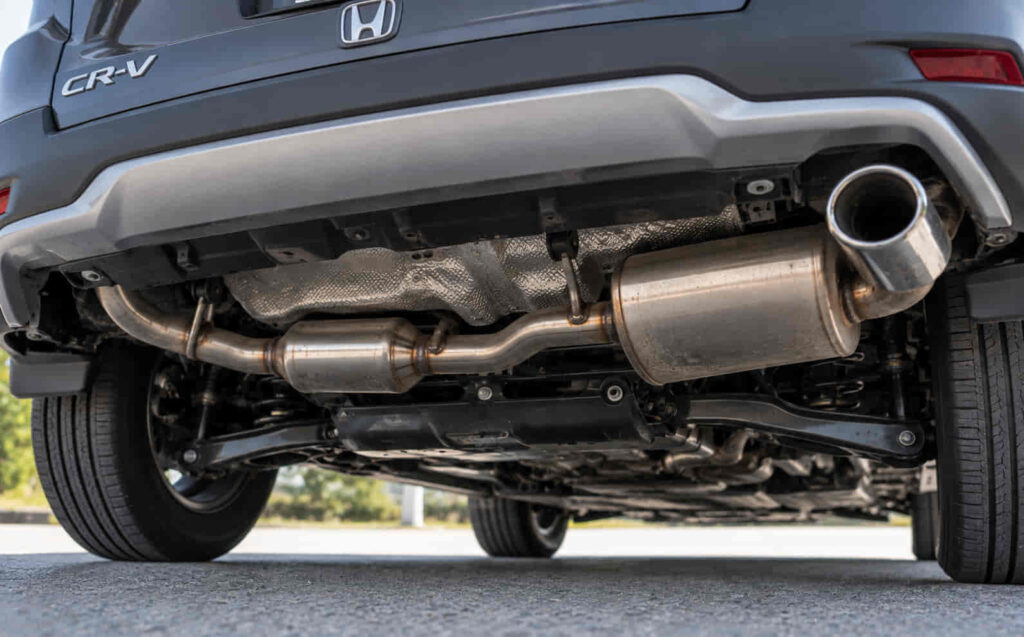
The Honda CR-V exhaust system carries exhaust gases away from the engine, helps control harmful emissions, reduces exhaust noise, and directs the remaining gases out through the rear of the vehicle. It is not a single component. The system consists of connected parts that can include the exhaust manifold, catalytic converter, oxygen sensors, exhaust pipes, resonator, muffler, tailpipe, gaskets, hangers, and heat shields, depending on the model year and exhaust configuration.
A problem in one of these components can change how the entire exhaust system operates. An exhaust leak can increase engine or exhaust noise and allow exhaust gases to escape before reaching the tailpipe. A loose heat shield or damaged hanger can create rattling, while corrosion can weaken pipes, connections, or the muffler. Catalytic converter and oxygen-sensor-related faults can also affect emissions control and may trigger a check engine light. These conditions require diagnosis because similar symptoms can originate from different parts of the system.
This guide explains the main Honda CR-V exhaust system parts, how the system works, common failure symptoms, exhaust leaks and noises, diagnostic methods, repair and replacement decisions, and ways to extend exhaust component life. Understanding these relationships makes it easier to identify the source of an exhaust problem and determine which component actually requires repair.
What Is the Honda CR-V Exhaust System?
The Honda CR-V exhaust system is a connected group of components that carries exhaust gases from the engine, supports emissions control, reduces exhaust noise, and releases the treated gases through the rear of the vehicle. The system begins where combustion gases leave the engine and continues through the exhaust path to the tailpipe. Its exact component arrangement varies by CR-V model year, engine, and exhaust configuration.
The exhaust system performs more than one function because engine exhaust must be transported, treated, and discharged. Exhaust gases produced during combustion need a controlled path away from the engine and passenger compartment. Emissions-control components within that path help reduce specific pollutants before the gases leave the vehicle, while sound-control components reduce the pressure pulses and noise produced by engine operation.
The system also depends on mechanical support and sealed connections. Gaskets and flanges help maintain sealed joints between exhaust components, while hangers support sections of the exhaust underneath the vehicle. Heat shields protect nearby areas from the high temperatures generated by exhaust components. A failure in one of these supporting parts can create symptoms such as rattling or leakage even when the main exhaust pipe or muffler remains structurally intact.
The Honda CR-V exhaust system should therefore be understood as one connected system rather than as a muffler or tailpipe alone. A problem at one location can change exhaust flow, noise, emissions behavior, or the physical stability of another section. Identifying the affected component is the first step toward determining whether the problem requires a localized repair or component replacement.
What Parts Are Included in a Honda CR-V Exhaust System?
A Honda CR-V exhaust system can include the exhaust manifold, catalytic converter, oxygen sensors, exhaust pipes, resonator, muffler, tailpipe, gaskets, flanges, hangers, and heat shields, depending on the vehicle configuration. These components are positioned along or around the exhaust path, and each performs a different function as exhaust gases move away from the engine.
The exhaust manifold is located near the beginning of the exhaust path and collects gases leaving the engine. From this area, the gases move into downstream exhaust components. Sealed connections are important at this stage because a damaged gasket, connection, or nearby exhaust component can allow gases to escape before they travel through the complete system.
The catalytic converter is part of the emissions-control section of the exhaust system. Exhaust gases pass through the converter, where chemical reactions reduce specific harmful pollutants before the gases continue downstream. Oxygen sensors positioned in relation to the exhaust stream provide information used by the vehicle’s engine and emissions-control systems. A catalytic converter problem and an oxygen sensor problem are therefore related to the same exhaust context but are not the same failure.
Exhaust pipes connect the major components and provide the physical route for gases beneath the vehicle. Depending on the Honda CR-V configuration, the exhaust path can also include a resonator that modifies particular sound frequencies before the gases reach the muffler. The muffler further reduces exhaust noise, while the tailpipe provides the final path through which gases leave the vehicle.
Gaskets, flanges, hangers, and heat shields support the operation of these larger components. Gaskets and flanges maintain connections between exhaust sections, while hangers hold the system in its intended position and allow controlled movement as the vehicle operates. Heat shields limit heat exposure to surrounding areas. Damage to these smaller components can produce exhaust leaks, vibration, or rattling without requiring replacement of the entire Honda CR-V exhaust system.
How Does the Honda CR-V Exhaust System Work?
The Honda CR-V exhaust system works by directing combustion gases from the engine through emissions-control and sound-control components before releasing them through the tailpipe. Each stage has a defined role, so normal exhaust operation depends on both unrestricted gas movement and sealed connections between components.
The process begins when exhaust gases leave the engine and enter the exhaust path. The manifold collects these gases and directs them toward downstream components. Because exhaust gases leave the engine at high temperature and in repeated pressure pulses, the system must withstand thermal cycling while maintaining a controlled route underneath the vehicle.
As the gases travel through the emissions-control section, the catalytic converter reduces specific pollutants through chemical reactions. Oxygen sensors monitor conditions in the exhaust stream and provide information that the vehicle uses for engine and emissions management. These functions explain why some exhaust-related failures can produce a check engine light even when the driver does not initially hear an abnormal exhaust sound.
The gases then continue through the exhaust pipes and applicable sound-control components. A resonator can reduce or modify specific exhaust frequencies, while the muffler reduces the overall sound produced by exhaust pulses. The treated and quieter gases eventually travel through the tailpipe and exit behind the vehicle.
Normal operation therefore depends on the complete exhaust path remaining appropriately sealed, supported, and free from damaging restrictions. A leak allows gases and sound to escape before the intended outlet, a loose mounting component can create movement and rattling, and a restricted exhaust component can interfere with normal gas flow. This relationship between components and functions is why Honda CR-V exhaust problems should be diagnosed according to the location and type of failure rather than treated as a single generic exhaust fault.
Read more: Honda CRV AC Compressor Replacement Cost Standard
What Are the Signs of a Honda CR-V Exhaust System Problem?
The main signs of a Honda CR-V exhaust system problem include abnormal exhaust noise, rattling, exhaust odor, visible corrosion or damage, vibration, reduced engine performance, and an illuminated check engine light when an emissions-related fault is present. These symptoms do not all indicate the same failure. Their location, timing, and operating conditions help determine which part of the exhaust system requires inspection.
A louder-than-normal exhaust is commonly associated with a leak or damaged exhaust component because gases and pressure pulses can escape before reaching the intended outlet. The sound can change according to the location and size of the opening. A leak near the front of the exhaust path can sound different from damage farther downstream around a pipe or muffler, so increased noise identifies a reason for inspection rather than a specific failed component by itself.
Rattling or metallic vibration points toward a different group of possible faults. A loose heat shield, deteriorated hanger, damaged mounting point, or internal damage within an exhaust component can allow metal parts to move or vibrate as the engine runs and the vehicle travels over the road. The noise may change with engine speed, vehicle movement, or exhaust temperature because the system expands as it becomes hot.
Exhaust odor can indicate that gases are escaping somewhere other than the intended tailpipe outlet. The location of the leak matters because gases escaping toward the front or underside of the vehicle create a different condition from a defect at the rear of the exhaust system. Exhaust odor around or inside the passenger area warrants prompt inspection rather than relying on noise alone to judge the severity of the problem.
Visible rust, corrosion, cracks, damaged connections, or a hanging exhaust section provide physical evidence that the system has deteriorated. Surface discoloration does not automatically mean a component requires replacement, but corrosion that weakens the material or creates an opening can lead to leakage and structural failure. A damaged hanger can also allow an otherwise functional exhaust section to move excessively and contact surrounding components.
Reduced engine performance and a check engine light require a different diagnostic approach because they can involve exhaust flow or emissions-control operation rather than a simple hole in a muffler. A restricted exhaust component can interfere with normal gas flow, while catalytic-converter or oxygen-sensor-related faults can affect emissions monitoring. These symptoms need diagnostic confirmation because numerous non-exhaust faults can also produce performance changes or illuminate the check engine light.
Honda CR-V exhaust symptoms should therefore be interpreted as evidence that identifies where diagnosis should begin, not as proof that a particular component needs replacement. Combining the type of symptom with its location, operating conditions, visual evidence, and diagnostic results provides a more accurate basis for determining the actual exhaust problem.
What Are the Most Common Honda CR-V Exhaust System Problems?
Honda CR-V exhaust system problems can develop from leaks, corrosion, damaged pipes or connections, failed gaskets, loose heat shields or hangers, muffler deterioration, and faults involving emissions-related components. The exact failure pattern depends on vehicle age, operating environment, physical damage, thermal cycling, and the condition of individual exhaust components.
Exhaust leaks develop when a pipe, connection, gasket, weld area, or other section can no longer maintain a sealed path for exhaust gases. The resulting symptom depends heavily on leak location. A small opening can initially produce ticking or increased exhaust sound, while more extensive damage can create a clearly louder exhaust and allow greater quantities of gas to escape before reaching the tailpipe.
Corrosion is a major mechanism of exhaust deterioration because much of the system operates underneath the vehicle while repeatedly heating and cooling. Moisture and environmental exposure can attack metal surfaces, while road contaminants can accelerate deterioration in conditions where they are present. Over time, weakened material can develop holes, cracks, or failed connections that turn structural deterioration into an exhaust leak.
Physical damage can affect pipes, mounting points, heat shields, and other components underneath the Honda CR-V. Road debris or contact with an obstacle can deform an exhaust section or disturb its mounting position. Even when the damaged area does not immediately leak, altered alignment can create vibration, contact with surrounding components, or additional stress at exhaust connections.
Gaskets, flanges, and connections can fail independently of the main pipes and muffler. A connection that no longer seals correctly allows gases to escape even when the larger components remain usable. This distinction matters for repair decisions because a localized connection or gasket failure does not automatically justify replacing an entire exhaust section.
Heat shields and exhaust hangers create another common category of problems. A loose heat shield can produce a metallic rattle while the exhaust itself remains sealed. A deteriorated or damaged hanger can allow excessive exhaust movement, changing component alignment and permitting contact with the vehicle body or nearby parts. Diagnosing these supporting components prevents a noise problem from being incorrectly attributed to the muffler or catalytic converter.
Muffler deterioration can produce increased exhaust noise when corrosion or physical damage compromises the component. Internal deterioration can also change the sound produced by the exhaust system even when external damage is not immediately obvious. The muffler should therefore be evaluated as part of the complete exhaust path rather than replaced automatically whenever the vehicle becomes louder.
Catalytic converter and oxygen-sensor-related faults belong to the exhaust system but require different evidence from a basic pipe or muffler failure. A catalytic converter can develop efficiency, restriction, physical, or internal problems, while an oxygen sensor can produce incorrect or abnormal feedback when the sensor or its related circuit has a fault. Diagnostic trouble codes and system testing are needed to distinguish these conditions because a check engine light alone does not identify which exhaust or emissions component has failed.
The central repair principle is that Honda CR-V exhaust problems should be isolated to the failed component and failure mechanism before replacement begins. A leaking gasket, loose heat shield, corroded pipe, damaged muffler, and emissions-related fault represent different repair scopes even though all belong to the same exhaust system. Correct failure identification prevents a localized problem from becoming an unnecessary full-system replacement.
How Can You Tell If a Honda CR-V Has an Exhaust Leak?
A Honda CR-V may have an exhaust leak when it develops increased exhaust noise, ticking or hissing sounds, exhaust odor, visible damage, or escaping gases around a pipe, gasket, flange, or other exhaust connection. These signs identify a possible loss of sealing within the exhaust path, but the leak location must be confirmed before deciding which component requires repair.
The sound produced by an exhaust leak depends on where gases escape. A leak closer to the engine can create a sharper ticking or tapping sound that changes with engine speed because individual exhaust pulses escape through the opening. A larger opening or damage farther along the exhaust path can produce a deeper and noticeably louder exhaust sound. Noise characteristics can help narrow the inspection area, but sound alone does not establish the exact failed component.
Exhaust odor provides another important indication because a sealed system is designed to carry exhaust gases through the intended path and release them from the tailpipe. A damaged gasket, cracked section, failed connection, or corroded pipe can allow gases to escape before reaching that outlet. An exhaust smell around or inside the Honda CR-V requires prompt attention because the problem involves the containment and routing of combustion gases, not simply vehicle noise.
Visual evidence can make the source easier to identify. Corrosion that has created a hole, a separated connection, damaged pipework, or deterioration around a flange can provide a direct explanation for leakage. However, an exhaust system can also leak at a gasket or connection without a large opening being obvious from a basic visual inspection. This is why the absence of a clearly visible hole does not eliminate the possibility of an exhaust leak.
Leak location also determines repair scope. A failed gasket or connection can require a localized repair, while a severely corroded exhaust section may require replacement of the affected component. If corrosion extends across several connected areas, repairing one opening may not provide a durable solution because adjacent metal can already be structurally weakened.
An exhaust leak should therefore be diagnosed according to location, cause, severity, and condition of the surrounding components. Confirming these four factors distinguishes a repairable connection problem from a deteriorated exhaust section that requires replacement and prevents the entire Honda CR-V exhaust system from being replaced because of one isolated leak.
Why Is a Honda CR-V Exhaust Making a Rattling or Loud Noise?
A Honda CR-V exhaust can make a rattling or loud noise because of an exhaust leak, loose heat shield, damaged hanger, deteriorated muffler, damaged pipe or connection, or internal damage within an exhaust component. Rattling and increased exhaust volume are different sound patterns, so identifying when and where the noise occurs helps narrow the possible source.
A metallic rattle commonly develops when a component that should remain secured begins to vibrate. Heat shields are positioned around high-temperature exhaust areas, and a loose mounting point can allow a shield to vibrate against itself or another surface. Exhaust hangers can create a similar symptom when deterioration allows the exhaust assembly to move farther than intended and contact surrounding parts.
Rattling can also originate inside an exhaust component. Internal deterioration can leave material or structures able to move as exhaust flow, engine vibration, and road movement act on the system. This type of noise needs to be distinguished from an external heat shield because replacing a major exhaust component will not correct a rattle caused only by loose external hardware.
A Honda CR-V that suddenly becomes louder presents a different diagnostic pattern. An opening in a pipe, failed gasket, separated connection, damaged muffler, or another exhaust leak allows pressure pulses and sound to escape before the gases pass through the complete sound-control path. The resulting noise can become more noticeable during acceleration because exhaust flow increases as engine load rises.
The location of the sound provides useful diagnostic context. Noise near the front of the vehicle directs inspection toward components and connections in the forward exhaust path, while noise farther underneath or toward the rear directs attention to pipes, mounting points, the muffler, and related connections. Sound can travel through metal, however, so the loudest point heard from inside the cabin does not always identify the exact failure location.
Noise should also be interpreted together with other symptoms. A loud exhaust combined with exhaust odor supports investigation for leakage, while a metallic rattle without increased exhaust volume can point more strongly toward a heat shield, hanger, or loose component. A check engine light or reduced performance introduces additional diagnostic possibilities that cannot be resolved from exhaust sound alone.
The correct approach is therefore to use noise type + noise location + operating condition + associated symptoms to identify the source. A rattling Honda CR-V exhaust does not automatically require a catalytic converter or muffler, and a loud exhaust does not automatically require complete exhaust replacement. Locating the actual failure determines whether the repair involves a mounting component, sealed connection, pipe, muffler, or another part of the exhaust system.
How Is a Honda CR-V Exhaust System Problem Diagnosed?
A Honda CR-V exhaust system problem is diagnosed by confirming the reported symptom, inspecting the exhaust path, locating leaks or abnormal noises, checking damaged connections and components, and evaluating emissions-related faults when the symptoms require it. Diagnosis should identify both the failed component and the failure mechanism before a repair or replacement decision is made.
The process begins with the symptom that caused the vehicle to be inspected. A loud exhaust, metallic rattle, exhaust odor, reduced performance, or check engine light provides a different starting point for diagnosis. Reproducing the symptom under the conditions in which it occurs helps narrow the inspection because an exhaust noise that appears during acceleration can require a different investigation from a rattle that occurs primarily at idle or over road movement.
A visual inspection can identify physical problems along accessible sections of the exhaust system. Corroded pipes, damaged connections, separated joints, deteriorated mounting points, loose heat shields, and impact damage can provide direct evidence of a fault. The surrounding area also matters because a visibly damaged component may be only one part of a larger corrosion problem.
Leak diagnosis focuses on finding where the exhaust path has lost its seal. The technician evaluates pipes, gaskets, flanges, connections, and other potential leak points rather than assuming that increased exhaust noise originates from the muffler. Leak location determines the repair because a failed connection can require a different solution from a pipe or muffler that has deteriorated through corrosion.
Noise diagnosis requires the source of vibration or sound to be isolated. A loose heat shield can produce a metallic rattle without creating an exhaust leak, while a damaged hanger can allow the exhaust assembly to contact surrounding parts. Internal component deterioration can create another type of rattle. Distinguishing these conditions prevents a supporting component problem from being misdiagnosed as failure of a larger and more expensive exhaust part.
A check engine light introduces an electronic diagnostic layer. Diagnostic trouble codes can identify which system or operating condition requires further testing, but a code should not automatically be treated as proof that a named component needs replacement. Oxygen-sensor-related information, catalytic converter performance, exhaust leakage, engine operation, and the applicable electrical circuits may need to be evaluated together to establish the actual cause.
The completed diagnosis should establish where the problem is located, what has failed, why the symptom occurs, and how much of the exhaust system is affected. These findings determine whether the Honda CR-V requires a localized repair, replacement of one exhaust component, or a broader repair when deterioration extends across multiple sections.
Can a Damaged Honda CR-V Exhaust System Affect Engine Performance?
A damaged Honda CR-V exhaust system can affect engine performance when the failure interferes with exhaust flow or with information used for engine and emissions management, but not every exhaust problem reduces engine performance. A loose heat shield, damaged hanger, or rear exhaust leak can create noise without producing the same operating effects as an exhaust restriction or certain emissions-related faults.
Exhaust gases must leave the engine through the designed exhaust path. When a component becomes severely restricted, normal exhaust flow can be disrupted. This creates a different mechanical condition from a simple opening in a downstream pipe because a restriction interferes with the movement of gases rather than allowing them to escape early.
A restricted catalytic converter is one condition that can affect exhaust flow. If restriction becomes significant, the engine can have greater difficulty moving exhaust gases through the system, and the driver may notice reduced response or performance under operating conditions that require greater exhaust flow. These symptoms still require diagnosis because reduced engine performance can originate from systems unrelated to the exhaust.
Oxygen sensors create another relationship between the exhaust system and engine operation. These sensors monitor conditions in the exhaust stream and provide information used by the vehicle’s control system. A sensor fault, wiring problem, exhaust leak that affects relevant readings, or another related condition can therefore influence diagnostic information and engine-management behavior. These faults must be separated rather than treating every oxygen-sensor-related code as proof of a failed catalytic converter.
An exhaust leak does not produce the same effect in every location. A downstream leak can primarily change exhaust noise and gas routing, while a leak in a location that affects relevant sensor information can create additional diagnostic consequences. Leak location is therefore necessary for understanding both the symptom and its potential effect on vehicle operation.
Mechanical support problems generally create a different set of consequences. A loose heat shield or deteriorated hanger can produce rattling and vibration while exhaust flow remains normal. These failures still require repair when they allow excessive movement or component contact, but their presence alone does not establish that engine performance has been reduced.
The relationship between the Honda CR-V exhaust system and engine performance should therefore be evaluated according to the type and location of the failure. Restrictions and certain emissions-related conditions can affect engine operation, while other exhaust faults primarily affect noise, gas containment, or component stability. Confirming that distinction prevents an exhaust symptom from being incorrectly used to explain every change in vehicle performance.
How Is a Honda CR-V Exhaust System Repaired?
A Honda CR-V exhaust system is repaired by correcting the specific leak, damaged connection, mounting problem, deteriorated pipe, muffler fault, or emissions-related component failure identified during diagnosis. Exhaust repair is therefore component-specific rather than a single procedure applied to the entire system. The correct repair depends on the location of the problem, severity of the damage, condition of surrounding components, and whether the affected section can be restored reliably.
A failed gasket or exhaust connection can require a localized repair when the surrounding components remain structurally sound. The damaged sealing component is corrected so exhaust gases remain inside the intended path. Flanges and adjoining surfaces also need to be evaluated because installing a new gasket cannot create a durable seal if corrosion or physical damage prevents the connection from sealing correctly.
A damaged exhaust pipe requires a different decision. Localized damage may allow an appropriate repair when the remaining metal is structurally sound, while extensive corrosion can make replacement of the affected pipe section more appropriate. Repairing one opening in heavily deteriorated material can leave adjacent areas vulnerable to another leak because the visible hole may represent only one point within a larger weakened section.
Heat shield and hanger problems are generally addressed according to the damaged mounting component rather than by replacing unrelated exhaust parts. A loose heat shield needs to be secured or corrected according to its condition, while a failed hanger requires restoration of proper exhaust support. Correct mounting matters because excessive movement can allow pipes, the muffler, or other exhaust components to contact surrounding parts and create additional vibration or damage.
Muffler repair decisions depend on the type and extent of deterioration. A failed connection around the muffler creates a different repair condition from extensive corrosion or internal muffler damage. When the muffler structure itself has deteriorated enough to cause leakage or loss of sound control, replacing that component can provide a more complete repair than repeatedly addressing individual weak areas.
Catalytic converter and oxygen-sensor-related repairs require diagnostic confirmation because these components participate in emissions management. A diagnostic trouble code associated with an oxygen sensor or catalytic converter does not by itself establish that the named component must be replaced. Exhaust leaks, wiring faults, sensor operation, engine conditions, and converter performance may need to be evaluated before the repair target is established.
Honda CR-V exhaust repair should therefore follow the relationship confirmed failure → affected component → surrounding condition → appropriate repair scope. This approach preserves serviceable parts of the exhaust system while ensuring that a localized repair is not used where corrosion, structural deterioration, or internal component damage makes replacement necessary.
When Does a Honda CR-V Exhaust System Need Replacement?
A Honda CR-V exhaust system needs replacement at the component or section level when corrosion, physical damage, leakage, internal failure, or structural deterioration makes a reliable localized repair impractical. Complete exhaust system replacement is not automatically required when one component fails because the exhaust system consists of separate sections with different functions and deterioration patterns.
Component replacement is appropriate when the failure is isolated and the surrounding exhaust system remains serviceable. A deteriorated muffler, damaged pipe section, failed catalytic converter, or another confirmed component fault can often be addressed at the affected section. This preserves functional exhaust components instead of treating the system as one indivisible assembly.
The extent of corrosion is one of the main factors separating repair from replacement. A small damaged area surrounded by structurally sound metal presents a different condition from a pipe or muffler with widespread deterioration. When corrosion has weakened a substantial section, repairing one visible opening can leave nearby material unable to provide a durable seal or adequate structural support.
Physical deformation can also require component replacement when the damage changes exhaust alignment, restricts the gas path, compromises connections, or prevents the component from performing its intended function. The decision depends on what the impact damaged rather than on the presence of a dent alone. A damaged pipe that still maintains appropriate flow and sealing represents a different condition from one that has collapsed or separated.
Internal component failure can require replacement even when the exterior appears intact. A muffler can develop internal deterioration that changes exhaust noise, while a catalytic converter can develop an internal fault that cannot be evaluated solely from its external housing. Diagnostic evidence is therefore necessary when symptoms indicate an internal problem without obvious external damage.
Replacement of multiple exhaust sections becomes more reasonable when deterioration extends across several connected components. On an older system with widespread corrosion, repairing one section can expose another weakened connection shortly afterward. In that situation, the condition of adjacent pipes, flanges, muffler sections, hangers, and connections should be considered together when defining the repair scope.
The key distinction is that Honda CR-V exhaust component replacement and complete exhaust system replacement are not the same repair. Replacement should extend only as far as the confirmed damage and surrounding deterioration justify. Evaluating each affected section individually provides a more accurate repair decision than assuming that one exhaust leak, noise, or failed component requires replacement of everything from the engine to the tailpipe.
Can You Drive a Honda CR-V With an Exhaust System Problem?
Whether a Honda CR-V can continue to be driven with an exhaust system problem depends on the location, severity, and type of failure. A loose heat shield that produces a minor rattle represents a different condition from an exhaust leak that allows gases to enter the passenger area, a detached exhaust section, or a restriction that interferes with engine operation. The symptom must therefore be connected to the actual failure before the effect on continued driving can be evaluated.
An exhaust leak requires particular attention because the system is designed to contain combustion gases and release them through the intended outlet. When a pipe, gasket, flange, or connection leaks, gases can escape underneath or around the vehicle before reaching the tailpipe. A noticeable exhaust odor inside the cabin should not be treated as a simple noise problem because it indicates that exhaust gases may be reaching an area where they should not be present.
Physical instability creates another concern. A damaged hanger, separated connection, or severely corroded section can allow part of the exhaust system to move beyond its intended position. A component that hangs unusually low, contacts surrounding parts, or appears partially detached can deteriorate further as the vehicle moves. In this condition, the problem involves structural support as well as exhaust-system performance.
A restriction produces a different operating condition because exhaust gases cannot move through the system normally. If a restricted component is severe enough to affect exhaust flow, the Honda CR-V can develop reduced performance or other drivability symptoms. Continuing to operate the vehicle without diagnosing the restriction does not correct the underlying cause and can allow the operating problem to persist.
Minor rattling without leakage, structural instability, or performance symptoms can represent a less extensive failure, such as a loose heat shield. However, the sound still needs to be identified because a similar rattle can originate from another exhaust component. Noise severity alone is not a reliable measurement of repair urgency without knowing what is producing it.
The decision to continue driving should therefore be based on the confirmed exhaust failure rather than the presence of an exhaust symptom alone. Exhaust odor in the cabin, severe leakage, a loose or hanging component, significant performance changes, or evidence of major physical damage requires more immediate inspection than an isolated minor noise from a securely mounted component.
Should You Repair or Replace a Honda CR-V Exhaust Component?
A Honda CR-V exhaust component should be repaired when the damage is localized and the remaining component can provide a durable, sealed, and structurally sound result; replacement is more appropriate when corrosion, physical damage, or internal failure extends beyond a reliable localized repair. The decision should be made for the affected component rather than automatically applied to the complete exhaust system.
Localized connection problems can favor repair when the adjoining exhaust sections remain in good condition. A failed gasket, loose connection, or mounting problem can often be corrected without replacing a functional pipe, muffler, or other major component. The repair remains appropriate only when the surrounding material can support the restored connection and maintain the exhaust seal.
Corrosion changes the decision because the visible failure may represent only part of the deterioration. Repairing a small opening in otherwise strong metal is different from repairing a hole surrounded by thin, heavily corroded material. When the surrounding section has lost structural integrity, replacement can provide a more durable solution than repeatedly repairing individual weak points.
Physical damage should be evaluated according to its effect on the component. A minor deformation does not automatically require replacement, but damage that creates a leak, restricts exhaust flow, prevents proper alignment, or compromises mounting can make replacement necessary. The functional consequence of the damage is more important than its appearance alone.
Internal failure also favors replacement when the affected component cannot be restored through an external repair. A muffler with deteriorated internal structures or a catalytic converter with a confirmed internal failure presents a different condition from a loose heat shield or leaking connection. Diagnosis must establish the internal fault before the component is replaced because external symptoms can overlap with less expensive problems.
Repair durability should be considered together with immediate cost. A localized repair that restores a structurally sound component can avoid unnecessary replacement, while repeated repairs on a severely deteriorated section can create additional labor without providing a lasting solution. The surrounding exhaust condition therefore affects the economic value of both options.
The repair-versus-replacement decision should ultimately follow damage location + failure type + corrosion extent + structural condition + expected repair durability. This keeps the Honda CR-V exhaust repair proportional to the diagnosed problem: serviceable components remain in place, while components that can no longer perform their function reliably are replaced.
How Can You Extend the Life of a Honda CR-V Exhaust System?
You can extend the life of a Honda CR-V exhaust system by identifying leaks and abnormal noises early, inspecting corrosion and physical damage, maintaining exhaust mounting components, and repairing developing problems before they damage surrounding sections. Exhaust components operate under repeated heat cycles and are exposed beneath the vehicle, so preventing every form of deterioration is not realistic. The practical objective is to detect conditions that accelerate damage before they expand into larger repairs.
Periodic inspection helps identify deterioration before an exhaust component loses its structural integrity. Pipes, connections, muffler sections, hangers, and visible heat shields can be checked for corrosion, physical damage, abnormal movement, and failed mounting points. Early corrosion does not automatically require component replacement, but deterioration that begins weakening a connection or creating leakage should be evaluated before the affected area becomes more extensive.
Changes in exhaust sound provide another early warning. A new ticking, hissing, rattling, or unusually loud exhaust indicates that the system is operating differently from its previous condition. Investigating the sound early can reveal a loose heat shield, deteriorated hanger, leaking gasket, damaged connection, or developing hole before movement, heat, and continued exhaust flow contribute to further deterioration.
Exhaust leaks should also be corrected according to their cause rather than treated only as a noise problem. Escaping gases indicate that the intended exhaust path is no longer sealed. A small leak around a serviceable connection can develop into a larger problem if the underlying gasket, flange, pipe, or surrounding corrosion continues to deteriorate. Repairing the confirmed source protects the integrity of the connected exhaust sections.
Maintaining proper exhaust support can reduce unnecessary mechanical stress. Hangers allow the system to remain positioned beneath the vehicle while accommodating normal movement and thermal expansion. When a hanger deteriorates, additional movement can place stress on connections or allow exhaust components to contact surrounding surfaces. Correcting the mounting problem can therefore protect more than the hanger itself.
Physical damage underneath the vehicle should be inspected even when it does not immediately produce a loud exhaust. Contact with road debris or an obstacle can deform a pipe, disturb a heat shield, damage a mounting point, or change exhaust alignment. Identifying the effect of the impact early makes it possible to correct localized damage before vibration or altered positioning creates additional problems.
Emissions-related warning signs should not be ignored simply because the exhaust remains quiet. A check engine light associated with an emissions or exhaust-related condition requires diagnosis to determine whether the cause involves an oxygen sensor, catalytic converter, exhaust leak, electrical circuit, engine condition, or another system. Early diagnosis prevents assumptions about expensive components while ensuring that a confirmed fault is not left unresolved.
Extending Honda CR-V exhaust system life therefore depends on early fault detection, maintaining sealed connections, controlling corrosion-related deterioration, preserving proper exhaust support, and repairing confirmed damage before it spreads to adjacent components. These practices cannot eliminate normal aging, but they can reduce the likelihood that a localized exhaust problem develops into a larger repair involving multiple sections of the system.