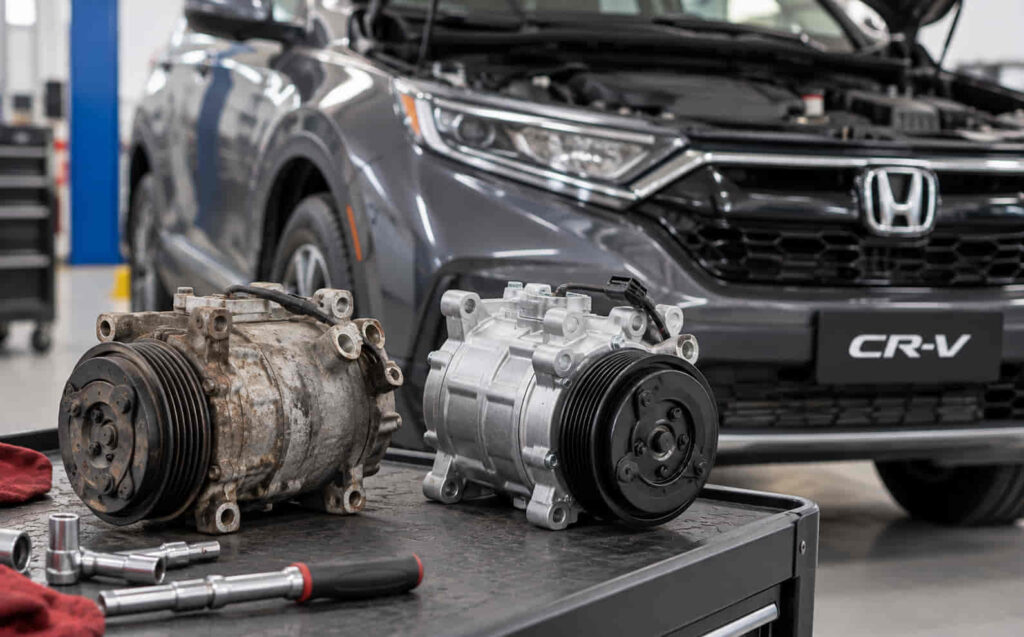
Honda CR-V AC compressor replacement cost depends on more than the price of the compressor itself. The final repair bill can include the replacement component, labor, refrigerant recovery and recharge, compressor oil, seals, system testing, and additional repairs when another air-conditioning component has been damaged. The exact cost therefore depends on the Honda CR-V model year, compressor specification, parts choice, labor rate, and condition of the AC system.
A compressor should also be diagnosed before replacement because an air-conditioning system that does not blow cold air does not automatically have a failed compressor. Refrigerant leaks, electrical faults, compressor clutch problems, restricted components, or other AC system failures can produce similar symptoms. Replacing the compressor without identifying the actual fault can increase repair costs without correcting the underlying problem.
This guide explains how Honda CR-V AC compressor replacement cost is calculated, what parts and labor contribute to the total, which conditions can increase the repair scope, and how technicians determine whether replacement is necessary. It also explains the replacement process, repair time, OEM versus aftermarket compressor considerations, and the factors that help distinguish a necessary compressor replacement from an unnecessary expense.
How Much Does Honda CR-V AC Compressor Replacement Cost?
Honda CR-V AC compressor replacement cost is determined by the compressor, labor, refrigerant service, and any additional AC repairs required during the replacement. A compressor replacement quote can therefore differ substantially between Honda CR-V vehicles even when the repair is described using the same service name. Model year, compressor configuration, parts selection, shop labor rate, refrigerant type, and the condition of the rest of the air-conditioning system all contribute to the final amount.
The compressor itself is one of the largest parts of the replacement cost. The required compressor must match the Honda CR-V model year and AC system configuration because compressors are not universally interchangeable across every generation. The replacement unit may be a genuine Honda component, an OEM-equivalent aftermarket compressor, or a remanufactured unit. These choices have different purchase prices and can also differ in warranty coverage and included components.
Labor represents the second major part of the repair cost. Replacing an AC compressor requires more than simply removing one component and installing another. The refrigerant must be properly recovered before the system is opened, the failed compressor must be removed, the replacement must be installed, and the system must then be evacuated and recharged according to the applicable service requirements. Labor cost therefore reflects both the shop’s hourly rate and the time required to complete the specific Honda CR-V repair.
Refrigerant service can also contribute to the total replacement bill. Opening the air-conditioning system requires appropriate refrigerant recovery, and the system must be evacuated before it is recharged after the replacement. The type and required quantity of refrigerant depend on the specific Honda CR-V configuration. Refrigerant service should therefore be treated as part of the complete replacement procedure rather than assuming that the compressor’s purchase price represents the entire repair.
Additional parts can increase the cost when the failed compressor has caused contamination or when related components are found to be defective. Depending on the failure, the repair may involve seals, O-rings, compressor oil, a receiver/drier or accumulator, an expansion device, or another AC component. A compressor that has suffered internal mechanical failure can create a different repair scope from a compressor that has an isolated clutch or control problem. The technician must determine the condition of the system before establishing which additional parts are actually required.
Diagnosis is another important cost consideration because an AC system that does not produce cold air does not automatically require a new compressor. Low refrigerant caused by a leak, an electrical problem, a failed compressor clutch, a restriction, or another component failure can produce poor cooling without requiring compressor replacement. Confirming the failure before purchasing the compressor prevents the replacement cost from being incurred when the compressor is not the actual source of the problem.
The most accurate Honda CR-V AC compressor replacement estimate should therefore separate the compressor price, labor charge, refrigerant service, required seals or oil, additional components, and applicable testing. A quote that includes only the compressor may appear inexpensive while excluding services that are necessary to complete the repair correctly. Conversely, a higher estimate may include additional components or procedures that are justified by the diagnosed condition.
There is consequently no single Honda CR-V AC compressor replacement cost that functions as a universal standard for every vehicle. The meaningful cost standard is a complete repair estimate tied to the specific Honda CR-V, confirmed compressor failure, required replacement parts, labor procedure, and condition of the AC system. Comparing quotes using these same cost categories provides a more accurate basis for evaluating the actual repair expense than comparing one total number without knowing what the estimate includes.
What Is Included in Honda CR-V AC Compressor Replacement Cost?
Honda CR-V AC compressor replacement cost can include the replacement compressor, labor, refrigerant recovery and recharge, compressor oil, replacement seals, system evacuation, and post-repair testing. The exact combination depends on the condition of the air-conditioning system and the compressor failure being repaired. A quote for the compressor itself therefore does not necessarily represent the complete cost of returning the Honda CR-V AC system to normal operation.
The replacement compressor is the primary component in the repair. Its price depends on the specific Honda CR-V application and the type of replacement unit selected. Genuine Honda, aftermarket, and remanufactured compressors can have different prices and warranty terms. The correct component must match the vehicle’s AC system because compressor specifications are not identical across every Honda CR-V model year or configuration.
Labor covers the work required to remove the failed compressor and install the replacement. Before the system can be opened, existing refrigerant must be recovered using appropriate service equipment. The technician then accesses the compressor, disconnects the required connections, removes the failed unit, installs the replacement, and restores the associated connections. The amount of labor depends on the vehicle configuration and accessibility of the compressor.
Refrigerant service forms another part of the replacement procedure. When the AC system is opened, refrigerant recovery is required before component removal, followed by system evacuation and recharge after the replacement. Evacuation removes air and moisture from the opened system before refrigerant is introduced again. The required refrigerant type and quantity depend on the specific Honda CR-V, so these details should be confirmed against the vehicle’s applicable service specifications.
Compressor oil and sealing components can also be part of the repair. The AC system depends on appropriate lubrication for compressor operation, while seals and O-rings maintain the integrity of connections between components. When a connection is opened during compressor replacement, the applicable sealing components should be evaluated and replaced when required rather than assuming that an existing seal can always be reused.
Post-repair testing establishes whether the air-conditioning system is operating correctly after the new compressor has been installed. The system can be checked for appropriate pressure and cooling performance while also being inspected for refrigerant leakage. A successful installation therefore involves more than confirming that the compressor physically fits; the complete AC system must operate correctly after it has been evacuated and recharged.
Additional components may become part of the repair when compressor failure has affected the rest of the system. A compressor with internal mechanical damage can introduce contamination into the refrigerant circuit, potentially expanding the repair scope beyond the compressor itself. The receiver/drier or accumulator, expansion device, condenser, seals, or other components may require evaluation depending on the failure and system design. These parts should not automatically be included in every compressor replacement estimate because their necessity depends on the diagnosed condition.
The distinction between compressor cost and complete replacement cost is therefore essential when comparing Honda CR-V AC repair estimates. One quote may include only the replacement unit and basic labor, while another may include refrigerant service, seals, oil, testing, and additional components required by the condition of the system. Comparing the scope of each quote provides a more meaningful cost comparison than comparing the headline price alone.
Read more: Honda CRV Fuel Economy Comparison
How Much Do Parts and Labor Affect Honda CR-V AC Compressor Cost?
Parts and labor are the two primary cost categories in a Honda CR-V AC compressor replacement, but their share of the final bill changes according to the compressor selected and the work required on the specific vehicle. A higher-priced compressor can make parts the dominant expense, while a repair involving difficult access, additional AC service, or related component replacement can increase the labor portion. The total cost should therefore be evaluated as the combination of the component and the complete installation procedure.
Compressor selection directly affects parts cost because replacement units are available from different supply categories. A genuine Honda compressor, an aftermarket replacement, and a remanufactured compressor do not necessarily have the same purchase price, warranty, included hardware, or specification. Even within the aftermarket category, products from different manufacturers can vary substantially. The correct comparison is therefore between compressors that fit the same Honda CR-V application and satisfy the same repair requirement rather than between the lowest and highest prices found under the general “AC compressor” label.
Model year also affects parts pricing because Honda CR-V AC systems have changed across generations. A compressor designed for one vehicle application cannot be assumed to fit another simply because both vehicles carry the CR-V name. Refrigerant requirements and related AC components can also differ by application. Correct vehicle identification is therefore part of cost control because ordering an incompatible compressor can create additional parts delays and labor without completing the repair.
Labor cost is calculated from both the time required for the repair and the labor rate charged by the service facility. Compressor replacement requires access to the component, refrigerant recovery before opening the system, removal of the old compressor, installation of the replacement, restoration of the refrigerant circuit, evacuation, recharge, and operational testing. A repair that requires additional component removal or correction of related AC problems requires more work than an uncomplicated compressor replacement.
The hourly labor rate creates another source of variation between estimates. Two repair facilities can perform the same number of labor hours but produce different labor charges because their rates differ. Geographic market, facility type, equipment, and business operating costs can influence those rates. This means a labor-price difference does not by itself show that one estimate includes more repair work; the labor hours and the hourly rate need to be understood separately.
Parts and labor also interact when the repair scope expands. If diagnosis identifies contamination, a damaged related component, or another condition that must be corrected while the refrigerant circuit is open, the estimate can increase in both categories simultaneously. Additional components increase parts cost, while removing, installing, flushing where applicable, evacuating, recharging, and testing the expanded system increases labor. This relationship explains why compressor replacement cannot always be priced accurately from the compressor price alone.
A useful Honda CR-V AC compressor estimate therefore identifies which compressor is being installed and which procedures are included in the labor charge. Separating these two categories makes it possible to determine whether a price difference comes from component selection, labor rate, repair time, or an expanded repair scope.
What Factors Change Honda CR-V AC Compressor Replacement Cost?
Honda CR-V AC compressor replacement cost changes primarily with model year, replacement-part selection, labor rate, compressor accessibility, refrigerant requirements, failure type, and damage to related AC components. These variables affect different parts of the repair, which is why two Honda CR-V compressor replacements can have different total costs even when both vehicles require a new compressor.
Model year influences cost through component compatibility and AC system specification. Different CR-V generations can require different compressor assemblies, refrigerant specifications, mounting arrangements, or associated components. The model year therefore affects more than the number printed on a parts catalog; it determines which repair components and service requirements apply to the vehicle.
The type of compressor failure can create an even larger difference in repair scope. An isolated fault that does not contaminate the refrigerant circuit presents a different repair condition from internal mechanical compressor damage. If internal damage releases debris into the system, replacing only the compressor can leave contamination elsewhere in the refrigerant circuit. The technician must then determine which related components and procedures are necessary to prevent the remaining contamination from affecting the replacement compressor.
Refrigerant requirements also contribute to the final cost because compressor replacement requires the sealed AC system to be opened. Refrigerant must be recovered before the repair and the system must be evacuated and recharged afterward. The applicable refrigerant type, required quantity, service equipment, and amount of refrigerant remaining in the system can affect the service portion of the estimate. A separate refrigerant leak can also require diagnosis and repair before the system can be returned to normal operation.
Component accessibility affects labor because the technician must reach the compressor and its connections without damaging surrounding systems. If other components must be moved or removed to create working access, the procedure requires additional labor compared with a more direct installation. Corroded, seized, or damaged fasteners and connections can further increase repair time because the removal process no longer follows the expected condition.
Related AC faults can increase cost when they are discovered during diagnosis rather than caused directly by the compressor replacement. A leaking seal, damaged hose, electrical fault, condenser problem, or another defective component can coexist with compressor failure. These conditions should be separated diagnostically because replacing the compressor does not automatically correct every fault in the air-conditioning system.
The final Honda CR-V AC compressor replacement cost is therefore produced by vehicle specification + confirmed failure + parts selection + labor requirement + refrigerant service + necessary related repairs. Understanding these relationships is more useful than searching for one universal “standard” price because it shows exactly why the repair estimate changes and which cost categories should be verified before the work is authorized.
How Do You Know If a Honda CR-V AC Compressor Needs Replacement?
A Honda CR-V AC compressor needs replacement when diagnosis confirms that the compressor has a mechanical or internal failure that cannot be corrected through a separate repair. Poor cooling alone is not enough to confirm compressor failure because low refrigerant, refrigerant leaks, electrical faults, control problems, restrictions, and other AC component failures can produce similar symptoms. The replacement decision should therefore be based on the condition of the compressor rather than on cabin temperature alone.
Loss of cooling is one symptom that can lead to compressor diagnosis. The compressor is responsible for circulating refrigerant and creating the pressure conditions required for the air-conditioning cycle to operate. If the compressor cannot perform this function correctly, the system may lose cooling capacity. However, insufficient refrigerant caused by a leak can also prevent normal AC operation, so poor cooling must be evaluated together with refrigerant condition, system pressures, compressor operation, and other diagnostic evidence.
Abnormal noise can indicate a mechanical compressor problem when the sound is traced specifically to the compressor. Internal wear or damage can create grinding, rattling, or other abnormal mechanical noise during operation. Noise location matters because the serpentine-belt drive and nearby rotating components can produce sounds that may initially appear to come from the compressor area. Confirming the source prevents a neighboring component problem from being treated as compressor failure.
A compressor that does not operate also requires further diagnosis before replacement. The cause can be mechanical, but compressor operation also depends on the vehicle’s electrical and AC control conditions. A power-supply problem, control fault, pressure-related condition, or clutch-related fault on an applicable system can prevent compressor operation without proving that the compressor itself has suffered internal failure. Electrical and system conditions therefore need to be checked before the complete compressor is condemned.
A seized compressor represents a more serious mechanical condition because it can affect more than cabin cooling. If the compressor’s rotating assembly cannot move normally, the fault can place abnormal load on the accessory-drive system where applicable. The repair scope then depends on the exact compressor design and the condition of the related drive components. This type of failure should be distinguished from an AC system that simply produces insufficient cooling while the compressor remains mechanically operable.
Internal compressor damage can also change the replacement decision because it may affect the refrigerant circuit beyond the failed component. Mechanical deterioration can introduce debris or contamination into the system, requiring the technician to evaluate connected components before installing a replacement compressor. In that situation, the question is no longer only whether the compressor needs replacement, but whether the failure has expanded the repair scope.
The most reliable indication that a Honda CR-V AC compressor requires replacement is therefore diagnostic evidence that identifies the compressor as the failed component and establishes the type of failure involved. Symptoms identify where testing should begin; they do not determine the replacement by themselves. This distinction prevents an expensive compressor from being replaced when the actual problem is a leak, electrical condition, or another AC system fault.
How Is a Bad Honda CR-V AC Compressor Diagnosed?
A bad Honda CR-V AC compressor is diagnosed by evaluating the reported symptoms, inspecting the AC system, confirming refrigerant and system conditions, checking compressor operation, and separating compressor failure from electrical, leakage, and related-component faults. The exact diagnostic procedure depends on the model year and AC system design, but the objective remains the same: identify the component responsible for the malfunction before determining the repair scope.
Diagnosis begins by confirming the condition reported by the driver. If the complaint is insufficient cooling, intermittent cooling, abnormal noise, or failure of the AC system to operate, the technician needs to reproduce or verify that condition when possible. This creates a defined symptom that can be connected to measurable system behavior instead of beginning with the assumption that the compressor is defective.
The refrigerant system must then be considered because compressor performance depends on the conditions within the AC circuit. An incorrect refrigerant charge or refrigerant loss caused by leakage can change system operation and cooling performance. Pressure and temperature behavior, refrigerant condition, and visible evidence of leakage can provide information about whether the fault is related to compressor performance, refrigerant quantity, a restriction, or another part of the system.
Compressor operation is evaluated in the context of the specific Honda CR-V system. A technician can determine whether the compressor is being commanded or allowed to operate and whether its behavior is consistent with the conditions present in the refrigerant circuit. If the compressor is not operating, the diagnostic process must determine whether the cause originates inside the compressor or from the electrical, control, pressure, or related systems that influence its operation.
Mechanical condition provides another diagnostic layer. Abnormal noise, binding, seizure, or evidence of internal deterioration can support a compressor-failure diagnosis when those conditions are traced to the compressor itself. If internal failure is suspected, the condition of the refrigerant circuit also becomes important because contamination can affect the components that will remain after the compressor is removed.
Electrical diagnosis prevents control-related faults from being misidentified as mechanical compressor failure. The applicable circuit, connectors, commands, and related controls need to be evaluated according to the vehicle’s system design when the compressor does not operate as expected. Replacing the compressor without resolving an external electrical fault can leave the original AC problem unchanged after the new component is installed.
The diagnosis should ultimately establish what failed, why the observed symptom occurs, and whether the compressor itself requires replacement. That information directly affects the Honda CR-V AC compressor replacement cost. An isolated compressor failure can produce one repair scope, while refrigerant leakage, contamination, electrical faults, or damage to connected AC components can produce a different scope and a different final estimate. Accurate diagnosis is therefore part of cost control, not a separate issue from the replacement price.
Can Other AC Parts Increase Honda CR-V Compressor Replacement Cost?
Other AC components can increase Honda CR-V compressor replacement cost when diagnosis shows that they are damaged, contaminated, leaking, restricted, or otherwise necessary to complete the repair correctly. Replacing the compressor does not automatically require replacing every component in the air-conditioning system. The additional repair scope should be determined by the compressor failure mode and the condition of the connected refrigerant circuit.
Internal compressor damage is one condition that can expand the repair substantially. The compressor contains moving components that operate within the refrigerant and lubricant circuit. If those internal components deteriorate mechanically, debris can enter the refrigerant path and travel beyond the compressor. Installing a new compressor without addressing contamination that remains elsewhere in the system can expose the replacement unit to material left by the original failure.
The condenser can become relevant when contamination is present because refrigerant passes through it as part of the AC cycle. Whether the condenser requires replacement depends on system design, contamination severity, and the applicable repair procedure. It should not be added automatically to every Honda CR-V compressor estimate, but its condition needs to be considered when internal compressor damage has distributed debris through the system.
The receiver/drier or accumulator, depending on the applicable AC system design, also performs a specific role in refrigerant management and moisture control. Opening the refrigerant circuit or repairing a contaminated system can affect whether this component becomes part of the repair scope. The correct decision depends on the Honda CR-V model year, AC system configuration, component condition, and applicable service procedure rather than a universal rule for every compressor replacement.
An expansion device can add cost when diagnosis identifies a restriction, contamination, or another condition affecting refrigerant flow. A restricted refrigerant path can interfere with system pressures and cooling performance, while contamination associated with compressor damage can affect components elsewhere in the circuit. Replacing a compressor without correcting a confirmed restriction can leave the AC system unable to operate as intended.
Seals, O-rings, hoses, and refrigerant connections can create a different type of additional expense. These components do not need to fail because the compressor failed, but an existing refrigerant leak can coexist with compressor damage. Connections opened during the repair also need appropriate sealing when they are reassembled. Correcting leakage is necessary because recharging a system that cannot retain its refrigerant does not complete the repair.
The serpentine belt and related drive components may also require inspection where the compressor is mechanically connected to the accessory drive. A seized or mechanically damaged compressor can create abnormal loading at the drive system. This does not mean the belt or every related component must always be replaced, but their condition should be established when the compressor failure could have affected them.
Additional AC parts should therefore increase Honda CR-V compressor replacement cost only when their condition, system design, or the compressor failure creates a justified repair requirement. An estimate that includes additional components should identify why they are necessary. This allows the owner to distinguish an expanded repair caused by contamination or related damage from unnecessary replacement of components that remain serviceable.
How Is a Honda CR-V AC Compressor Replaced?
Honda CR-V AC compressor replacement involves recovering the refrigerant, accessing and removing the failed compressor, installing the correct replacement component, restoring the refrigerant circuit, evacuating and recharging the system, and verifying AC operation. These procedures explain why the labor charge covers more than the physical removal and installation of the compressor.
Before the refrigerant circuit is opened, the existing refrigerant must be handled with appropriate AC service equipment. The system is not treated like an unpressurized mechanical assembly because refrigerant must be recovered rather than intentionally released during service. The condition and quantity recovered can also provide information relevant to the repair, particularly when refrigerant loss or contamination is part of the diagnosis.
The technician then gains access to the compressor and disconnects the components required for removal. The exact access procedure depends on the Honda CR-V model year and configuration. Refrigerant connections, electrical connections, mounting hardware, and the applicable drive arrangement must be separated without introducing unnecessary contamination or damaging components that will remain in service.
The removed compressor and the surrounding system can provide additional evidence about the failure. If the compressor has internal mechanical damage, the repair cannot be treated solely as a component exchange without considering whether contamination has entered the refrigerant circuit. Findings at this stage can confirm whether the original estimate remains appropriate or whether additional system work is required.
The replacement compressor must match the applicable vehicle specification and be installed with the lubrication and sealing requirements appropriate to the system. Compressor oil quantity and distribution matter because the compressor depends on lubrication during operation, while the refrigerant circuit must remain sealed. Connections opened during replacement therefore need to be restored correctly before the system is recharged.
After installation, the opened AC system is evacuated before refrigerant is introduced. Evacuation helps remove air and moisture and provides an opportunity to evaluate whether the system can maintain the required vacuum conditions before charging. The system is then recharged with the refrigerant type and quantity specified for the applicable Honda CR-V rather than filled according to a generic amount.
The final stage is operational verification. The technician checks whether the compressor and AC system operate as intended after the repair and whether the system provides appropriate cooling without evidence of leakage or another unresolved fault. If the original problem remains, further diagnosis is required rather than assuming that installation of a new compressor automatically confirms a successful repair.
Honda CR-V AC compressor replacement is therefore a refrigerant-system service as well as a mechanical component replacement. Refrigerant handling, component access, installation, lubrication, sealing, evacuation, recharge, and testing all contribute to labor and total repair cost. Understanding this process explains why comparing only the retail price of a compressor with a complete shop estimate does not represent the same repair scope.
How Long Does Honda CR-V AC Compressor Replacement Take?
Honda CR-V AC compressor replacement time depends on the model year, compressor accessibility, failure condition, refrigerant service, and whether additional AC components require repair or replacement. The physical installation of the compressor is only one part of the complete service. Diagnosis, refrigerant recovery, system evacuation, recharge, and post-repair testing can all affect how long the vehicle remains at the repair facility.
Compressor accessibility directly influences labor time because the technician must reach the component and its refrigerant, electrical, mounting, and drive connections. The arrangement of surrounding components can differ between Honda CR-V model years and powertrain configurations. A repair that provides relatively direct compressor access requires a different amount of work from one in which additional components must be moved or removed before the compressor can be serviced.
The condition of the existing hardware can also change the time required. Corroded fasteners, damaged connections, or components that do not separate normally can slow removal even when the standard repair procedure remains unchanged. These conditions are difficult to predict from the service name alone because they depend on the individual vehicle’s age, environment, and previous repair history.
Internal compressor failure can extend repair time further when contamination is found in the refrigerant circuit. The technician must determine whether connected components require additional service or replacement before the new compressor is installed. A compressor-only repair and a contaminated-system repair therefore should not be assigned the same expected completion time because their repair scopes are different.
Refrigerant recovery, evacuation, recharge, and testing also contribute to total service time. After the compressor is installed and the refrigerant circuit is closed, the system must be prepared and charged according to the applicable specification before cooling performance can be verified. This means installation time and complete AC service time are not interchangeable measurements.
The vehicle may remain at the shop longer than the actual labor time billed on the repair order. Diagnosis, parts availability, service-equipment scheduling, additional authorization, and post-repair verification can extend the elapsed time between vehicle drop-off and completion without representing continuous technician labor. For cost comparison, labor hours and total shop turnaround time should therefore be treated as separate values.
An accurate Honda CR-V AC compressor replacement time estimate should be based on the specific vehicle and confirmed repair scope. Once the compressor failure, related AC condition, required parts, and service procedures are established, the repair facility can provide a more meaningful time estimate than a universal duration applied to every CR-V compressor replacement.
Can You Drive a Honda CR-V With a Bad AC Compressor?
Whether a Honda CR-V can continue to be driven with a bad AC compressor depends on the type of compressor failure and whether that failure affects systems beyond cabin cooling. An AC system that has simply lost cooling presents a different mechanical condition from a compressor that is seized, creating abnormal noise, or affecting an accessory-drive component. The failure mode must therefore be identified before continued driving is evaluated.
When the fault is limited to air-conditioning performance and does not interfere with the accessory drive or another vehicle system, the immediate symptom may primarily be loss of cabin cooling. The compressor problem still requires diagnosis because continued AC operation with an unresolved mechanical fault can change the condition of the system. The absence of cold air alone, however, does not prove that the vehicle has a mechanically seized compressor.
A seized compressor requires greater attention because the compressor may be mechanically connected to the engine’s accessory-drive system, depending on the specific Honda CR-V configuration. If a compressor or related pulley cannot rotate normally, abnormal loading can affect the belt or connected drive components. In that situation, continuing to operate the vehicle can involve consequences beyond losing air conditioning.
Abnormal grinding, severe mechanical noise, belt problems, smoke, or evidence that a rotating component is binding should therefore not be treated as ordinary loss of AC performance. These symptoms indicate that the mechanical condition needs prompt inspection. Continuing to drive simply to determine whether the symptom becomes worse does not provide a controlled diagnostic test and can allow a mechanical problem to progress.
A refrigerant-related problem creates a different consideration. If cooling performance has declined because the system has lost refrigerant, the source of the leak still needs to be identified rather than repeatedly adding refrigerant without correcting the fault. Low cooling performance caused by a leak and mechanical compressor seizure can produce different repair decisions even though both may initially be described by the driver as an AC problem.
The practical distinction is between an AC fault that affects comfort and a mechanical failure that can interact with other vehicle components. A Honda CR-V with poor AC cooling may remain mechanically drivable under some failure conditions, while a seized or severely damaged compressor can require more immediate attention. Diagnosis determines which condition applies to the specific vehicle.
For that reason, continued driving should not be based solely on whether the cabin can tolerate the loss of air conditioning. The compressor’s mechanical condition, accessory-drive behavior, abnormal noise, and related symptoms need to be considered together. This approach keeps the decision connected to the actual failure mode rather than treating every Honda CR-V AC compressor problem as either automatically safe to drive or automatically immobilizing.
Should You Choose an OEM or Aftermarket AC Compressor for a Honda CR-V?
Choosing between an OEM and aftermarket AC compressor for a Honda CR-V should be based on correct fitment, compressor specification, warranty coverage, expected service life, and total installed cost rather than purchase price alone. The compressor is a central mechanical component of the air-conditioning system, so a lower component price does not create savings if the replacement unit is incompatible, performs incorrectly, or requires another replacement prematurely.
An OEM compressor is designed to meet the specifications established for the applicable Honda CR-V AC system. This provides a defined reference for fitment and system compatibility when the correct part is selected by vehicle application. OEM components can carry a higher purchase price than alternative replacement units, but the comparison should include what is supplied with the compressor, applicable warranty terms, and whether additional parts must be purchased separately.
Aftermarket compressors provide another replacement option and can reduce the initial parts expense in some repairs. However, aftermarket is a broad category rather than a single quality level. Different manufacturers can use different production standards, component designs, warranties, and included hardware. An aftermarket compressor should therefore be evaluated by its suitability for the specific Honda CR-V rather than selected simply because it has the lowest advertised price.
Remanufactured compressors create a third consideration because they reuse an existing compressor assembly that has undergone a rebuilding process. Their value depends heavily on the remanufacturing process, replaced internal components, testing standards, supplier, and warranty. A remanufactured unit with an attractive purchase price does not automatically provide the lowest long-term repair cost if another compressor replacement later requires the refrigerant system to be opened and serviced again.
Warranty coverage also needs to be evaluated together with labor. A compressor warranty may cover the replacement component under specified conditions without necessarily covering every expense associated with removing the failed unit, installing another compressor, evacuating the system, or recharging the refrigerant. The practical value of a warranty therefore depends on both its component coverage and the costs that remain the vehicle owner’s responsibility.
The condition of the existing AC system matters regardless of which compressor is selected. A high-quality replacement compressor cannot correct contamination, an unresolved refrigerant leak, an electrical fault, or another defective component elsewhere in the system. Correct diagnosis and preparation of the refrigerant circuit protect the replacement decision because compressor quality and system condition influence the repair together.
The appropriate choice is therefore the compressor that provides correct Honda CR-V compatibility, suitable quality, clear warranty protection, and an acceptable total installed cost. OEM can provide a direct specification-based replacement, while a properly selected aftermarket or remanufactured compressor can provide an alternative when its fitment and quality are established. The decision should compare complete repair value rather than component price in isolation.
How Can You Avoid Unnecessary Honda CR-V AC Compressor Replacement Costs?
The most effective way to avoid unnecessary Honda CR-V AC compressor replacement costs is to confirm compressor failure before authorizing replacement and to define exactly what the repair estimate includes. AC systems contain multiple components that can cause similar cooling symptoms, so replacing the compressor based only on an observation such as “the AC is not cold” can result in an expensive repair that does not address the actual fault.
Diagnosis should establish whether the compressor itself has failed or whether another condition is preventing normal AC operation. Refrigerant leakage, incorrect refrigerant charge, electrical faults, control problems, restrictions, and related component failures can affect cooling performance. Identifying the actual cause separates a necessary compressor replacement from a repair that should target another part of the system.
The estimate should also separate the compressor from the services and components surrounding the replacement. The vehicle owner needs to understand whether the quoted amount includes refrigerant recovery and recharge, compressor oil, seals, evacuation, testing, and any additional AC components. This prevents two estimates with different repair scopes from being treated as equivalent simply because both are labeled “AC compressor replacement.”
Additional parts should have a diagnostic or procedural reason for being included. If the estimate contains a condenser, receiver/drier or accumulator, expansion device, hose, or another AC component, the repair facility should be able to connect that component to contamination, leakage, restriction, damage, system design, or an applicable replacement requirement. This distinction controls cost without excluding parts that are genuinely necessary to protect the repair.
Correct compressor identification prevents another avoidable expense. The replacement unit must match the Honda CR-V model year and applicable AC system configuration. Comparing OEM, aftermarket, and remanufactured options is useful only after compatibility has been established. Selecting an incorrect unit based primarily on a low advertised price can create fitment problems, delays, or additional labor.
Existing refrigerant leaks should also be addressed as part of the repair decision. Installing a compressor and recharging the system without correcting a confirmed leak can result in another loss of refrigerant and continued poor AC performance. The compressor replacement and the leak repair are separate diagnostic issues even when both must be corrected during the same service visit.
A second diagnostic opinion can provide additional information when the proposed repair is expensive or when the reason for compressor replacement is unclear. The useful comparison is not simply whether another shop quotes a lower total. It is whether both diagnoses identify the same failed component, the same related system conditions, and substantially the same required repair scope.
Avoiding unnecessary Honda CR-V AC compressor replacement cost therefore depends on confirmed diagnosis, correct compressor fitment, transparent parts and labor scope, justified related repairs, and verification of the complete AC system condition. These factors address the central cost question more accurately than searching for the cheapest compressor or treating one advertised replacement price as a universal standard.