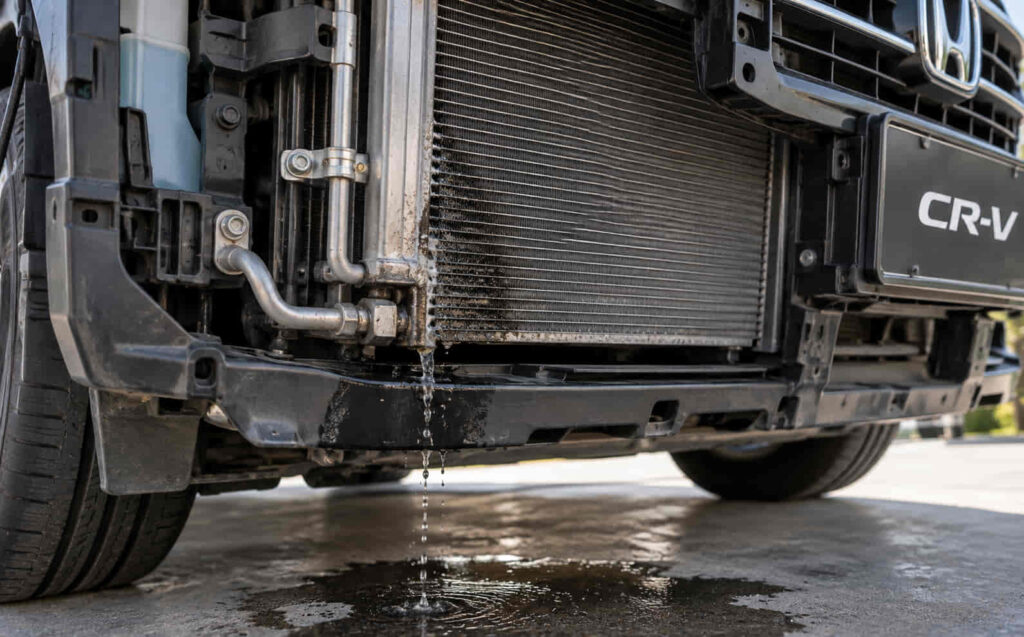
A Honda CR-V AC condenser leak allows refrigerant to escape from the air-conditioning system, which can reduce cooling performance and eventually prevent the system from producing properly cold air. The condenser is part of the refrigerant circuit, so a leak in this component reduces the amount of refrigerant available to complete the cooling cycle. As refrigerant continues to escape, the air coming from the vents can become progressively warmer.
A leaking condenser does not always produce an obvious symptom immediately. A small leak can cause gradually declining A/C performance, while a larger leak can lead to a more noticeable loss of cooling. In some cases, an oily residue or other evidence around the condenser can help identify the leak, but warm air alone does not prove that the condenser is the source. Refrigerant can also escape from other components, including lines, connections, seals, the evaporator, or other parts of the A/C system.
This guide explains the symptoms and causes of a Honda CR-V AC condenser leak, how the leak can be confirmed, and how to distinguish a condenser leak from other refrigerant leaks. It also explains when a leaking condenser needs replacement, what happens when the leak is left unrepaired, and how the repair process restores the A/C system.
What Is an AC Condenser Leak on a Honda CR-V?
A Honda CR-V AC condenser leak is a loss of refrigerant from the condenser or a sealing connection associated with the condenser. The condenser is part of the vehicle’s air-conditioning refrigerant circuit, so a leak allows refrigerant to escape instead of remaining within the closed system. As the refrigerant charge decreases, the A/C system has less refrigerant available to complete its normal cooling cycle, which can reduce the temperature of the air coming from the vents.
The condenser has an important position within the A/C system because it handles refrigerant after it leaves the compressor. Refrigerant enters the condenser at high pressure and releases heat before continuing through the rest of the system. A leak therefore affects both refrigerant quantity and the system’s ability to maintain the pressure and flow conditions required for normal operation. The size of the leak determines how quickly refrigerant is lost; a small leak can cause cooling performance to decline gradually, while a larger leak can cause a much more rapid loss of A/C performance.
A condenser leak does not necessarily mean that the condenser itself has a hole. Refrigerant can also escape around connections, seals, or other points associated with the condenser assembly. This distinction matters during diagnosis because replacing the entire condenser is not automatically the correct repair for every refrigerant leak found near the condenser. The exact leak location must be established before deciding which component or seal requires repair.
A Honda CR-V that is no longer producing cold air also does not automatically have a condenser leak. Low refrigerant can result from leaks elsewhere in the A/C system, including refrigerant lines, connections, the evaporator, or other components. The presence of reduced cooling confirms an A/C performance problem, but it does not by itself identify the condenser as the source of the refrigerant loss. A condenser diagnosis therefore requires evidence that connects the refrigerant leak specifically to the condenser or its associated connections.
What Are the Symptoms of a Honda CR-V AC Condenser Leak?
The main symptom of a Honda CR-V AC condenser leak is declining A/C cooling performance as refrigerant escapes from the system. The vents may initially produce air that is less cold than expected, followed by increasingly weak cooling as refrigerant loss continues. If the system is recharged but cooling performance later declines again, an unresolved refrigerant leak becomes a stronger diagnostic possibility.
Cooling performance decreases because an automotive A/C system requires an appropriate refrigerant charge to transfer heat effectively. When a condenser leak reduces that charge, the system can no longer operate under its intended refrigerant conditions. The severity and progression of the symptom depend partly on the leak rate. A slow leak may produce a gradual reduction in cooling over an extended period, whereas a larger opening can allow refrigerant to escape faster and make the loss of cooling more noticeable.
Evidence around the condenser can provide a more direct clue than vent temperature alone. Refrigerant circulates with lubricant in the A/C system, so a leak can sometimes leave an oily residue near the damaged area or connection. Physical damage to the condenser, such as a visibly damaged section near the front of the vehicle, can further strengthen suspicion when it corresponds with the area where leakage is detected. Dirt alone, however, should not be treated as proof of a refrigerant leak.
Repeated refrigerant loss is another important symptom because the A/C refrigerant circuit is intended to remain sealed. Adding refrigerant may temporarily restore cooling when the charge is low, but it does not close the point where refrigerant is escaping. If cooling returns after a recharge and then deteriorates again, the system should be checked for a leak rather than repeatedly treating low refrigerant as the underlying problem.
Warm air from the vents is not sufficient to diagnose a Honda CR-V AC condenser leak. Compressor problems, electrical faults, refrigerant leaks at other locations, and additional A/C system failures can produce similar cooling symptoms. A condenser leak becomes a confirmed diagnosis only when the refrigerant loss is traced to the condenser or a connection associated with it.
What Causes an AC Condenser to Leak on a Honda CR-V?
A Honda CR-V AC condenser can leak when physical damage, corrosion, or deterioration at a refrigerant connection creates an opening in the sealed A/C circuit. These failure mechanisms affect the condenser differently, but each produces the same fundamental result: refrigerant can escape from a system that is designed to retain it.
Physical damage is an important cause because the condenser is positioned toward the front of the vehicle, where airflow can pass through it and remove heat from the refrigerant. That location also exposes the condenser area to road debris and damage associated with front-end impacts. If an impact punctures or deforms a refrigerant-carrying section of the condenser, the resulting opening can become a direct leak path.
Corrosion can create a leak through a different mechanism. Environmental exposure can gradually deteriorate metal surfaces, and sufficiently severe deterioration can weaken a refrigerant passage until it no longer remains sealed. This type of failure can be less visually obvious than impact damage because the leak may develop progressively rather than appearing immediately after a specific event.
Connections and sealing points near the condenser must also be considered during diagnosis. A deteriorated seal or compromised connection can release refrigerant in the condenser area even when the condenser core itself remains intact. Locating the leak precisely is therefore important: refrigerant detected near the condenser does not automatically prove that the entire condenser assembly has failed.
The cause of the leak should also be separated from the cause of the A/C symptom. Low refrigerant is a consequence of a leak, not the physical cause of the condenser failure. Likewise, an A/C system that blows warm air identifies a cooling problem but does not explain why the condenser would be leaking. Diagnosis needs to move from the symptom to the leak location and then to the physical failure responsible for that leak.
Read more: Honda CRV Rear Wiper Size
How Do You Confirm an AC Condenser Leak on a Honda CR-V?
A Honda CR-V AC condenser leak is confirmed by locating refrigerant leakage at the condenser or one of its associated connections, rather than diagnosing the problem from weak cooling alone. A/C performance establishes that a problem exists, while leak detection establishes where refrigerant is escaping. This distinction prevents the condenser from being replaced simply because the system has lost cooling capacity.
Diagnosis starts by examining the condenser and its connection points for physical damage and evidence associated with leakage. Because the condenser is positioned toward the front of the vehicle, visible impact damage, deformation, corrosion, or residue concentrated around a specific area can narrow the suspected leak location. Visual evidence is useful for directing further inspection, but the appearance of the condenser alone does not confirm that refrigerant is currently escaping from it.
Leak-detection methods provide stronger evidence when the source is not visually obvious. Depending on the diagnostic procedure and the condition of the A/C system, a technician can use methods such as an electronic refrigerant leak detector or approved fluorescent dye to identify where leakage is occurring. The objective is not simply to establish that the system has lost refrigerant; it is to connect that loss to a specific point in the refrigerant circuit.
The location of the detected leak also determines the repair decision. A leak through the condenser core indicates a different failure from leakage at a connection or sealing point near the condenser. In the first case, the condenser itself is the failed component. In the second, the repair must address the specific connection or seal responsible for the loss rather than assuming the entire condenser is defective.
The condenser should therefore be treated as the cause only after the leak has been localized to it. Recharging an undercharged system and observing that the A/C becomes cold again confirms that refrigerant quantity affects cooling performance, but it does not identify where the original refrigerant escaped.
How Can You Tell a Condenser Leak From Other Honda CR-V AC Leaks?
A condenser leak is distinguished from other Honda CR-V A/C leaks by identifying the physical location where refrigerant escapes. Refrigerant loss produces overlapping symptoms regardless of whether the leak occurs at the condenser, evaporator, refrigerant lines, hoses, seals, or connection points. Vent temperature and declining cooling performance therefore cannot reliably separate one leak location from another.
A condenser leak produces evidence at the front-mounted condenser or its associated connections. This location can make condenser damage more accessible to visual inspection than a leak originating from a component positioned deeper within the vehicle. Visible condenser damage combined with leak-detection evidence at the same location provides a substantially stronger diagnostic connection than warm vent air alone.
A refrigerant-line or connection leak follows the same basic failure mechanism but occurs at a different point in the circuit. Oil residue or detected refrigerant around a line fitting should direct diagnosis toward that fitting rather than toward the condenser simply because both components belong to the same A/C system. Precise localization matters because replacing a component that is not leaking will not stop refrigerant loss.
An evaporator leak requires the same diagnostic principle. The evaporator is located in a different part of the HVAC system, so its leak cannot be confirmed by inspecting the condenser. When refrigerant is disappearing but no leak is found at the condenser or accessible lines and connections, diagnosis has to continue rather than treating the condenser as the default failure point.
The most useful distinction is therefore location, not symptom. Weak cooling indicates an A/C performance problem, and repeated refrigerant loss indicates that leakage should be investigated, but neither identifies the failed component by itself. A Honda CR-V AC condenser leak is specifically a condenser-related diagnosis only when testing localizes the leak to the condenser or its associated connection.
Does a Leaking Honda CR-V AC Condenser Need to Be Replaced?
A leaking Honda CR-V AC condenser generally needs to be replaced when the leak originates from damage or failure within the condenser itself. A puncture, crack, corrosion-related opening, or damaged refrigerant passage creates a physical leak path that allows refrigerant to escape. Adding refrigerant cannot close that opening, so restoring the refrigerant charge without correcting the failed component does not provide a complete repair.
The exact leak location determines whether condenser replacement is necessary. If diagnostic testing identifies leakage through the condenser core, the condenser is the failed component and the repair must address that component. If refrigerant is instead escaping from a serviceable connection or sealing point associated with the condenser, the required repair can differ because the condenser core itself may not be the source. This is why leak localization should occur before parts are replaced.
Repeatedly recharging an A/C system with a confirmed leak does not solve the underlying failure. A recharge changes the amount of refrigerant in the system, while the leak is a physical pathway through which that refrigerant escapes. Cooling can improve temporarily after the refrigerant charge is restored, but the same performance problem can return as the system loses refrigerant again. Recharge and leak repair therefore perform two different functions: one restores refrigerant quantity, while the other corrects the reason that quantity was lost.
Replacement decisions should also be based on confirmed failure rather than symptoms alone. A Honda CR-V that blows warm air does not automatically need an AC condenser because compressor faults, electrical problems, incorrect refrigerant charge, and leaks elsewhere in the system can affect cooling. Condenser replacement becomes relevant after diagnosis establishes that the condenser itself is responsible for the refrigerant loss.
How Is a Honda CR-V AC Condenser Leak Repaired?
A Honda CR-V AC condenser leak is repaired by correcting the confirmed leak source and then restoring the A/C system to the proper operating condition. When the condenser itself is leaking because of physical or corrosion-related damage, this normally means removing the failed condenser and installing a compatible replacement. When the leak is localized to a connection or seal rather than the condenser core, the repair should address that specific failure instead.
Condenser replacement involves more than exchanging one visible component for another because the condenser is part of a sealed refrigerant circuit. The refrigerant must be handled with appropriate A/C service equipment, the failed component must be disconnected from the circuit, and the replacement must be installed with the required sealing connections intact. The system then needs to be serviced according to the applicable vehicle and A/C system specifications before normal operation is evaluated.
The sealing points deserve attention during the repair because a replacement condenser cannot solve a leak caused by an incorrectly sealed connection. Connections disturbed during component replacement must provide a sealed refrigerant path when the system returns to operation. This also explains why finding the exact leak source before repair is important: a condenser replacement addresses condenser failure, while a connection leak requires correction at the connection.
After the physical leak source has been corrected, the A/C system must be checked to determine whether it can retain its refrigerant charge and operate correctly. Cooling performance alone is not sufficient evidence of a successful leak repair immediately after service. The repair objective is both to restore cold-air performance and to prevent refrigerant from continuing to escape through the original failure point.
A complete Honda CR-V AC condenser leak repair therefore has two outcomes: the refrigerant leak is eliminated and normal A/C operation is restored. If refrigerant continues to disappear after condenser-related repairs, further diagnosis is required because another leak or A/C system fault may also be present.
Can You Drive a Honda CR-V With an AC Condenser Leak?
A Honda CR-V can generally remain mechanically drivable with an AC condenser leak when the problem is limited to the air-conditioning system, but the A/C should not be treated as operating normally while refrigerant is being lost. The condenser belongs to the climate-control refrigerant circuit rather than the system that directly propels the vehicle. A loss of A/C cooling therefore differs from an engine, transmission, brake, or steering failure that directly affects basic vehicle operation.
Drivability and continued A/C operation are two separate issues. A vehicle may still start, accelerate, steer, and brake normally while its air conditioner produces little or no cold air. However, continuing to operate a malfunctioning A/C system does not repair the refrigerant leak. As refrigerant escapes, the system moves farther away from the operating conditions for which it was designed.
Repeatedly adding refrigerant is also not a substitute for fixing the condenser. A recharge can restore the refrigerant quantity temporarily, but the new refrigerant can escape through the same opening if the leak remains. The appropriate repair path is to locate the leak, correct the failed condenser or connection, and then service the system to the applicable specification.
Loss of air conditioning can also have practical consequences beyond passenger comfort. The climate-control system contributes to windshield defogging and dehumidification under relevant conditions, so reduced A/C performance can affect the vehicle’s ability to manage interior moisture efficiently. A confirmed condenser leak should therefore be repaired rather than treated only as an inconvenience caused by warmer vent temperatures.
What Happens If You Do Not Fix a Honda CR-V AC Condenser Leak?
If a Honda CR-V AC condenser leak is not repaired, refrigerant can continue escaping until cooling performance becomes weak or the air-conditioning system can no longer cool the cabin as intended. The progression follows the physical leak: the opening remains present, refrigerant charge decreases, and A/C performance deteriorates as operating conditions move outside the intended range.
A small leak can make this progression difficult to recognize at first. The system may still cool after refrigerant has begun escaping, particularly when enough charge remains for noticeable cooling. Performance can then decline over time. This pattern explains why a vehicle may receive a recharge, produce cold air again, and later develop the same symptom when the underlying leak was never repaired.
Leaving the leak unresolved also creates a cycle of treating refrigerant loss instead of treating its cause. Each recharge addresses the amount of refrigerant present at that moment but leaves the physical escape path unchanged. Once a condenser leak has been confirmed, repairing the leak is the step that interrupts this cycle.
An unresolved leak can also complicate later diagnosis if the system becomes severely undercharged. The original symptom may progress from reduced cooling to little or no effective cooling, while additional A/C operating symptoms may appear. Repairing a confirmed leak and then evaluating system performance provides a clearer diagnostic sequence than continuing to operate or recharge a system known to be losing refrigerant.
How Can You Reduce the Risk of Future Honda CR-V AC Condenser Damage?
The risk of future Honda CR-V AC condenser damage can be reduced by identifying front-end damage early and investigating significant changes in A/C performance before refrigerant loss becomes an ongoing problem. Preventive inspection cannot eliminate every condenser leak because the component remains exposed to environmental conditions and potential impact, but it can help identify physical damage before the problem is repeatedly treated as low refrigerant.
The condenser area deserves inspection after front-end impacts or other events that may damage components behind the grille or bumper area. Even when exterior cosmetic damage appears limited, the condition of A/C components can be relevant if cooling performance changes afterward. A direct relationship between an impact and subsequent refrigerant loss provides useful diagnostic context when the system is inspected.
Changes in cooling performance should also be treated as diagnostic information rather than automatically as a request for more refrigerant. If the Honda CR-V repeatedly loses cooling after the refrigerant charge has been restored, locating the leak provides more value than continuing the recharge cycle. Early leak localization can distinguish condenser damage from leaks at lines, seals, connections, or other A/C components.
Condenser leak prevention ultimately depends on protecting the component where practical and responding to evidence of damage or refrigerant loss. A refrigerant recharge restores charge; it does not prevent a damaged condenser from leaking again. Correct diagnosis and repair of the physical failure are what restore the sealed refrigerant circuit.