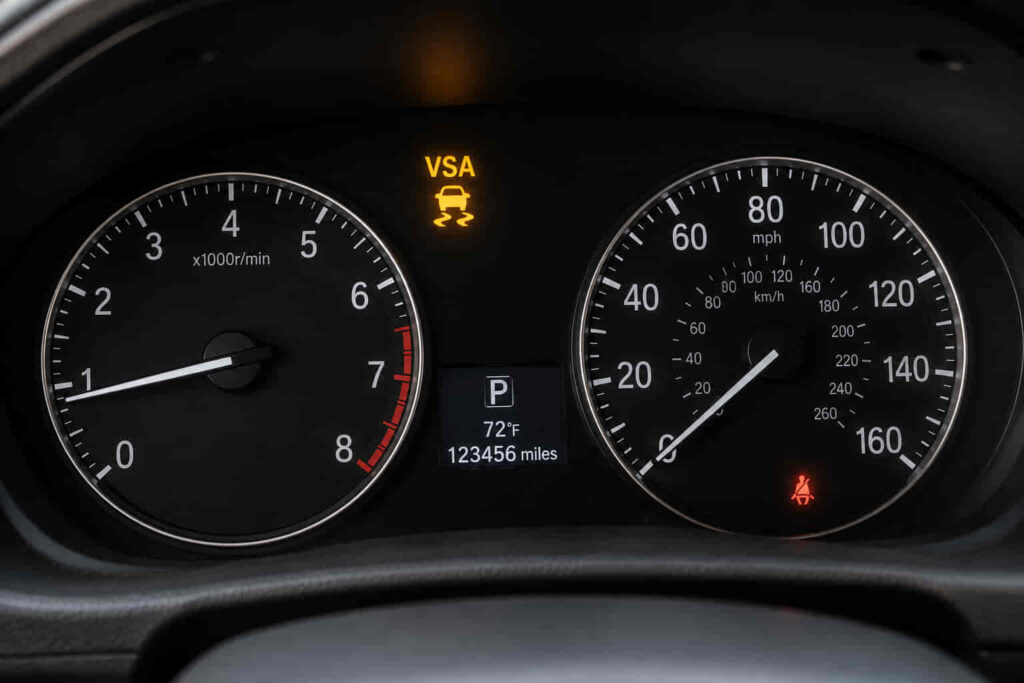
Seeing the VSA light illuminate on your Honda Accord’s dashboard can be concerning, especially if it appears unexpectedly while driving. Many drivers immediately wonder whether the vehicle is still safe to operate, what caused the warning, and whether the problem requires an expensive repair. Although the VSA light does not always indicate a serious mechanical failure, it should never be ignored because it signals that the Vehicle Stability Assist system is no longer operating as intended.
Honda’s Vehicle Stability Assist (VSA) system is designed to improve vehicle stability by helping maintain traction during acceleration, cornering, and slippery road conditions. Working together with the anti-lock braking system (ABS), traction control, wheel speed sensors, steering angle sensors, and other electronic components, the system automatically applies braking force or reduces engine power when it detects a potential loss of control. If any part of this network malfunctions or receives abnormal data, the VSA warning light may turn on to alert the driver.
The challenge is that the VSA light can be triggered by many different issues. A failing wheel speed sensor, low battery voltage, steering angle sensor calibration problems, ABS module faults, brake system issues, or even an illuminated check engine light may all cause the warning to appear. Because multiple systems share information with the VSA module, identifying the root cause requires understanding how these components interact rather than assuming the warning points to a single defective part.
This guide explains everything you need to know about the Honda Accord VSA light. You’ll learn what the warning means, the most common reasons it turns on, whether it’s safe to continue driving, how to diagnose and reset the system, estimated repair costs, and practical steps to prevent future VSA-related problems. By the end of this article, you’ll be able to determine when the issue requires immediate professional attention and when it may have a relatively simple solution.
What Does the VSA Light Mean on a Honda Accord?
The VSA light on a Honda Accord indicates that the Vehicle Stability Assist system has detected a fault or has been temporarily disabled, reducing its ability to help maintain traction and vehicle stability. While the warning does not necessarily mean the vehicle is unsafe to drive, it does mean one of Honda’s primary electronic stability systems may no longer function correctly during emergency maneuvers or on slippery road surfaces. Understanding what the warning represents is the first step toward identifying the underlying problem and determining whether immediate repairs are necessary.
Vehicle Stability Assist is Honda’s electronic stability control system, designed to improve directional control whenever the vehicle begins to lose traction. The system continuously monitors information from multiple sensors, including wheel speed sensors, the steering angle sensor, the yaw rate sensor, lateral acceleration sensors, and the brake pressure system. Using this real-time data, the VSA control module determines whether the vehicle is following the driver’s intended path. If excessive understeer, oversteer, or wheel slip is detected, the system automatically reduces engine torque or applies braking force to individual wheels to help restore stability.
Because the VSA system depends on information from several interconnected vehicle systems, the warning light does not always point to a failure within the VSA module itself. A malfunctioning ABS wheel speed sensor, low battery voltage, damaged steering angle sensor, faulty brake pressure sensor, defective ABS control module, or communication problem within the vehicle’s electronic network may all prevent the VSA system from operating correctly. In many cases, the warning simply informs the driver that one or more supporting components have stopped providing reliable data, causing the stability control system to deactivate as a protective measure.
The behavior of the warning light also provides useful diagnostic information. If the VSA light flashes briefly while driving on wet pavement, snow, gravel, or during aggressive acceleration, the system is actively working to maintain traction. This flashing is considered normal because it indicates that the stability control system is intervening to prevent wheel slip. However, if the VSA light remains illuminated continuously after the engine starts or stays on throughout normal driving, the system has detected a fault that requires diagnosis.
Many Honda Accord owners notice that the VSA light appears together with other dashboard warnings. One of the most common combinations is the VSA light and the ABS warning light appearing simultaneously. Since both systems share wheel speed sensors, hydraulic components, and electronic control modules, a single failure within the ABS system can disable both functions at the same time. Likewise, certain engine or transmission faults that illuminate the Check Engine Light may also trigger the VSA warning because the engine control module and VSA control module continuously exchange operating data.
The VSA OFF indicator should not be confused with the standard VSA warning light. When the driver manually presses the VSA OFF button, the vehicle intentionally disables traction control functions under specific driving conditions, such as attempting to free the vehicle from deep snow or mud. In this situation, the VSA OFF indicator simply confirms that the driver has temporarily turned the system off. By contrast, the standard VSA warning light indicates that the system has detected an abnormal condition regardless of whether the driver attempted to disable it.
Environmental conditions can occasionally influence VSA operation as well. Driving through deep water, heavy snow, or icy conditions may temporarily affect wheel speed sensor readings or reduce available traction enough to activate the system repeatedly. Although these situations often resolve once normal driving conditions return, a warning light that remains illuminated afterward usually indicates an underlying mechanical or electrical issue rather than a temporary loss of traction.
The VSA system should also be viewed as an assistance feature rather than a substitute for safe driving. Even when operating normally, Vehicle Stability Assist cannot overcome excessive speed, unsafe cornering, worn tires, or poor road conditions. Its purpose is to improve vehicle stability by assisting the driver during loss-of-traction events, not to eliminate the physical limits of tire grip. Therefore, when the VSA warning light remains on, drivers should recognize that one important layer of electronic safety assistance may no longer be available.
Understanding what the Honda Accord VSA light represents allows owners to respond appropriately instead of assuming the warning automatically indicates a catastrophic failure. In many cases, the underlying cause is a relatively common sensor or electrical problem that can be accurately diagnosed using an OBD-II scan tool capable of reading ABS and VSA fault codes. Identifying the specific diagnostic code is far more reliable than replacing components based solely on the dashboard warning, making proper diagnosis the most effective first step toward restoring full stability control functionality.
Read more: Subaru Extended Warranty Cost
What Are the Most Common Reasons the VSA Light Comes On?
The Honda Accord VSA light can illuminate for many reasons, but most cases are caused by sensor failures, electrical problems, brake system faults, or communication errors between the VSA module and other vehicle control systems. Because Vehicle Stability Assist relies on data from multiple electronic components, a problem affecting even one sensor can disable the entire stability control system. Identifying the underlying cause requires understanding how these systems interact rather than assuming the VSA module itself has failed.
A faulty wheel speed sensor is one of the most common causes of a VSA warning light. Each wheel is equipped with a sensor that continuously measures rotational speed and sends this information to both the ABS and VSA control modules. If one sensor produces inaccurate readings or stops communicating entirely, the system can no longer determine whether a wheel is slipping. To prevent incorrect stability interventions, the VSA system automatically disables itself and stores a diagnostic trouble code. Wheel speed sensors may fail because of corrosion, road debris, damaged wiring, excessive wheel bearing play, or contamination from metal particles.
Problems within the ABS system frequently trigger the VSA warning as well. Honda’s Vehicle Stability Assist depends on the Anti-lock Braking System to selectively apply braking force to individual wheels during stability correction. If the ABS hydraulic control unit, ABS pump, or ABS control module develops a fault, the VSA system loses one of its primary operating functions. This is why the ABS warning light and VSA light often appear together on the dashboard, indicating that both systems require diagnosis.
A malfunctioning steering angle sensor is another common source of VSA faults. This sensor measures the position of the steering wheel and tells the VSA module the direction the driver intends to travel. The system continuously compares steering input with the vehicle’s actual movement. If the steering angle sensor becomes miscalibrated after a wheel alignment, battery replacement, steering repair, or collision, the VSA module may detect conflicting information and illuminate the warning light. In many situations, recalibration using a professional diagnostic scan tool restores normal operation without replacing the sensor.
The yaw rate sensor also plays a critical role in stability control. Located near the center of the vehicle, this sensor measures how quickly the vehicle rotates around its vertical axis during cornering. Combined with lateral acceleration data, it allows the VSA module to determine whether the vehicle is following the driver’s intended path. If the sensor produces unrealistic readings because of internal failure or communication problems, the stability control system may shut down to prevent incorrect braking intervention.
Low battery voltage is another surprisingly common trigger. Modern Honda Accord models rely on stable electrical voltage to operate dozens of electronic control modules simultaneously. A weak battery, deteriorating alternator, loose battery terminals, or charging system problem can reduce system voltage below acceptable operating limits. When voltage becomes unstable, sensitive control modules—including the VSA system—may generate communication errors or temporarily disable certain safety features until normal voltage is restored.
An illuminated Check Engine Light can also activate the VSA warning, even when no problem exists within the stability control system itself. Honda integrates the engine control module and VSA control module through the vehicle’s communication network. If the engine computer detects a significant malfunction affecting engine performance, throttle control, ignition timing, or emissions, it may instruct the VSA system to deactivate certain functions. This explains why repairing the engine-related fault often causes the VSA warning to disappear after the diagnostic codes are cleared.
Brake system components can also contribute to VSA faults. A defective brake pedal switch, brake pressure sensor, hydraulic pressure irregularity, or abnormal brake fluid condition may interfere with the VSA system’s ability to apply braking force accurately during stability correction. Since controlled braking is one of the system’s primary methods of maintaining vehicle stability, even relatively minor brake-related electrical faults may trigger the warning light.
Electrical wiring and connector problems become more common as vehicles age. Moisture intrusion, corrosion, rodent damage, loose electrical connectors, broken wiring harnesses, or poor grounding points can interrupt communication between sensors and control modules. These intermittent faults are often more difficult to diagnose because the warning light may appear and disappear depending on road vibration, temperature changes, or humidity. Professional diagnostic equipment capable of monitoring live sensor data is often necessary to identify these issues accurately.
In less common situations, the VSA control module itself may develop an internal fault. Although electronic control modules are generally reliable, prolonged exposure to heat, vibration, water intrusion, or electrical surges can eventually cause hardware failures. Before replacing the module, technicians typically verify sensor operation, wiring integrity, battery voltage, and communication networks because module replacement is significantly more expensive than correcting many of the underlying issues that produce similar warning symptoms.
Finally, recent vehicle repairs should always be considered during diagnosis. Wheel alignments, suspension work, brake repairs, wheel bearing replacement, steering component installation, battery replacement, or collision repairs may unintentionally affect sensor calibration or electrical connections. A VSA warning that appears immediately after maintenance often indicates that a sensor requires recalibration, a connector was left unsecured, or a related component was disturbed during the repair process rather than indicating a completely new mechanical failure.
Although these are the most common reasons the Honda Accord VSA light turns on, the warning itself does not identify the exact problem. The most reliable diagnostic approach is to scan the vehicle for manufacturer-specific ABS and VSA diagnostic trouble codes using a professional scan tool. These codes provide the information needed to identify the failed component, avoid unnecessary parts replacement, and restore the Vehicle Stability Assist system to normal operation as efficiently as possible.
Can You Drive With the VSA Light On?
Yes, you can usually drive a Honda Accord with the VSA light on, but only if no other critical warning lights are illuminated and the vehicle is operating normally. A steady VSA warning light generally indicates that the Vehicle Stability Assist system has been disabled due to a detected fault, meaning the vehicle has lost an important electronic safety feature rather than suffering an immediate mechanical failure. However, the level of risk depends on the underlying cause of the warning, the driving conditions, and whether additional dashboard warning lights are present.
When only the VSA light remains illuminated, the vehicle’s engine, transmission, steering, and conventional braking system often continue to function normally. The primary difference is that the electronic stability control system can no longer intervene if the vehicle begins to skid or lose traction. Under normal driving conditions on dry pavement, many drivers may notice little or no difference in vehicle behavior. During heavy rain, snow, ice, loose gravel, or emergency avoidance maneuvers, however, the absence of VSA assistance increases the likelihood of wheel slip and reduces the vehicle’s ability to automatically correct oversteer or understeer.
Driving becomes significantly more concerning when the VSA light appears together with the ABS warning light. Because the Anti-lock Braking System and Vehicle Stability Assist share wheel speed sensors, hydraulic controls, and electronic modules, simultaneous warnings often indicate that both systems have been affected. In this situation, the vehicle can still stop using conventional hydraulic brakes, but anti-lock braking and electronic stability control may no longer operate during hard braking or slippery conditions. Drivers should reduce speed, increase following distance, and schedule diagnostic testing as soon as possible.
The situation becomes even more serious if the Check Engine Light appears together with the VSA warning. On many Honda Accord models, engine management problems automatically disable certain VSA functions because the stability control system relies on accurate engine torque management during corrective interventions. Although some engine faults involve relatively minor issues such as ignition coil or sensor failures, others may affect engine performance, throttle response, or emissions systems. Diagnosing the engine-related fault should take priority because resolving it often restores normal VSA operation as well.
A flashing VSA light should not automatically be interpreted as a malfunction. During acceleration on slippery roads or while cornering on low-traction surfaces, the flashing indicator simply confirms that the system is actively reducing wheel slip and helping stabilize the vehicle. This behavior is completely normal and demonstrates that the Vehicle Stability Assist system is functioning correctly. Concern arises only when the light remains illuminated continuously after the vehicle has started or stays on during normal driving without any traction loss.
Certain driving symptoms indicate that the vehicle should not be operated until repairs are completed. If the VSA warning is accompanied by severe brake problems, difficulty steering, loss of engine power, unusual noises, transmission slipping, or multiple critical warning lights, the underlying fault may extend beyond the stability control system. Continuing to drive under these conditions increases the risk of further mechanical damage or reduced vehicle control. The safest response is to stop driving as soon as conditions permit and arrange for professional diagnosis.
Road conditions should also influence your decision. On dry highways with predictable traffic conditions, driving a short distance to a repair facility may present relatively low risk if the vehicle behaves normally. On wet roads, icy surfaces, steep mountain routes, or during severe weather, the loss of electronic stability assistance becomes much more significant. Because VSA is specifically designed to improve traction under these challenging conditions, postponing repairs increases the possibility of losing control if an emergency maneuver becomes necessary.
Before assuming a major repair is required, drivers should perform several basic checks. Verify that the battery terminals are secure, ensure tire sizes match Honda’s specifications, confirm tire pressures are properly adjusted, and inspect whether the VSA OFF button has been pressed accidentally. Low battery voltage, mismatched tires, or simple operating errors occasionally trigger stability system warnings without indicating a major component failure. If the warning persists after these inspections, professional diagnostic scanning should be the next step.
A professional diagnostic scan is especially important because the VSA warning itself does not identify the failed component. The underlying issue may involve a wheel speed sensor, steering angle sensor calibration, brake switch, ABS module, electrical connector, charging system problem, or communication fault between electronic control modules. Retrieving manufacturer-specific ABS and VSA diagnostic codes allows technicians to isolate the actual cause instead of replacing parts through trial and error, reducing both repair time and unnecessary expense.
In most situations, a continuously illuminated Honda Accord VSA light should be treated as an early warning rather than an immediate emergency. The vehicle will often remain drivable, but one of its most important active safety systems is no longer available to assist during loss-of-traction events. Addressing the warning promptly not only restores full stability control but also prevents relatively minor electrical or sensor-related problems from developing into more expensive repairs later.
How Do You Reset the Honda Accord VSA Light?
You can reset the Honda Accord VSA light only after the underlying problem has been corrected. Although some temporary electrical issues may allow the warning light to disappear after restarting the vehicle or clearing diagnostic trouble codes, a permanent fault within the VSA system will cause the light to return almost immediately. Resetting the warning without repairing the actual problem does not restore Vehicle Stability Assist functionality because the control module continuously monitors the entire system every time the vehicle is driven.
The first step is determining whether the VSA light was triggered by a temporary operating condition or an active system fault. If the warning appeared briefly after driving through heavy rain, deep snow, or loose gravel and disappears after restarting the engine, the system may have experienced a temporary interruption rather than a mechanical failure. In these situations, the VSA module successfully completes its self-diagnostic check during the next ignition cycle and resumes normal operation without further action.
A simple ignition restart is often the easiest initial test. After parking the vehicle safely, switch off the engine, wait several minutes, and restart the car. During startup, the Honda Accord performs a self-check of the ABS, VSA, engine management, and other electronic control systems. If the warning was caused by a temporary communication interruption or low-voltage event that has already been resolved, the VSA light may remain off after the self-test is complete. If the light immediately returns, additional diagnosis is required.
Checking the battery and charging system should be the next step because unstable system voltage frequently causes electronic control modules to generate fault codes. A weak battery, loose battery terminals, poor ground connections, or a failing alternator can interrupt communication between the ABS module, engine control module, and VSA control unit. Ensuring the battery is fully charged and the charging system operates within Honda’s specifications may resolve voltage-related warnings without replacing any VSA components.
The VSA OFF button should also be inspected before assuming a mechanical failure. Many Honda Accord models include a dashboard button that temporarily disables portions of the stability control system. If the button has been pressed accidentally, the vehicle may display the VSA OFF indicator instead of reporting an actual system malfunction. Pressing the button again usually restores normal operation once the system completes its startup checks. Understanding the difference between the VSA OFF indicator and the standard VSA warning light helps prevent unnecessary repairs.
If the warning remains illuminated, the most reliable diagnostic step is scanning the vehicle with an OBD-II scan tool capable of reading Honda ABS and VSA diagnostic trouble codes. Basic code readers designed only for engine diagnostics often cannot access the ABS or stability control modules. Professional diagnostic equipment retrieves manufacturer-specific fault codes that identify whether the problem involves a wheel speed sensor, steering angle sensor, yaw rate sensor, brake pressure sensor, ABS control module, communication network, or another supporting component. These codes eliminate guesswork and allow repairs to focus on the actual cause.
Certain repairs require additional electronic calibration before the VSA light can be reset successfully. Replacing a steering angle sensor, performing a wheel alignment, installing suspension components, replacing wheel bearings, or disconnecting the battery for an extended period may require the steering angle sensor or yaw rate sensor to be recalibrated using professional diagnostic equipment. Without completing these calibration procedures, the VSA control module may continue detecting implausible sensor data even though the new components are functioning correctly.
After repairs are completed, technicians typically clear the stored diagnostic trouble codes using a professional scan tool. Once the codes are erased, the VSA module performs another series of self-tests during the next drive cycle. If every sensor reports valid information and no additional faults are detected, the warning light remains off and full Vehicle Stability Assist functionality is restored. If the light returns immediately or after several miles of driving, it usually indicates that the original problem was not fully corrected or that another related fault remains within the system.
Drivers should avoid disconnecting the battery solely to erase the VSA warning. Although removing battery power may temporarily clear certain stored fault codes on some Honda Accord models, the control modules will detect the same malfunction again during the next self-diagnostic cycle if the underlying issue still exists. In addition, disconnecting the battery may erase learned settings or require other vehicle systems to complete recalibration procedures, making this an unreliable long-term solution.
Internet videos and online forums sometimes suggest manual reset sequences involving brake pedal presses, ignition cycling, or combinations of dashboard buttons. While these procedures may apply to certain Honda model years under very specific conditions, they do not repair failed sensors, damaged wiring, faulty ABS modules, or other genuine system malfunctions. Following unofficial reset procedures without confirming the actual diagnostic trouble codes often delays proper repairs and may create unnecessary confusion.
The most effective way to reset the Honda Accord VSA light is to treat the warning as the final step of the repair process rather than the first. Once the underlying fault has been accurately diagnosed and corrected, the VSA control module can successfully complete its self-tests, clear the warning, and restore full stability control performance. Focusing on diagnosis before attempting a reset not only resolves the warning permanently but also ensures the vehicle’s active safety systems continue operating exactly as Honda intended.
How Much Does It Cost to Fix a Honda Accord VSA Light?
The cost to fix a Honda Accord VSA light can range from less than $100 to more than $2,000, depending on the underlying cause of the warning. The VSA light itself is not the problem—it simply indicates that the Vehicle Stability Assist system has detected a fault. Repair costs vary because the warning may be triggered by a simple battery issue, a failed wheel speed sensor, a steering angle sensor calibration, or a defective ABS control module. Accurate diagnosis is therefore the most important step before replacing any components.
One of the least expensive repairs involves correcting a battery or charging system problem. If low system voltage causes communication errors between the VSA module and other electronic control units, replacing an aging battery or repairing the charging system may eliminate the warning entirely. Battery replacement is generally one of the more affordable VSA-related repairs, while alternator replacement costs more because it involves additional parts and labor. Since unstable voltage can trigger multiple dashboard warnings simultaneously, technicians often verify battery health before investigating more complex failures.
A faulty wheel speed sensor is among the most common reasons the VSA light appears, and it is usually one of the more economical repairs. Each wheel contains a sensor that measures rotational speed for both the ABS and VSA systems. Dirt, corrosion, damaged wiring, or internal sensor failure can interrupt the signal and disable stability control. Replacing a wheel speed sensor typically requires relatively little labor compared with major brake or suspension repairs, making it one of the first components technicians inspect when diagnosing VSA faults.
Repair costs increase when the problem involves the steering angle sensor or yaw rate sensor. In some situations, these sensors simply require recalibration after a wheel alignment, suspension repair, or battery replacement. Calibration can often restore proper operation without replacing any hardware. If the sensor itself has failed internally, however, replacement becomes necessary, increasing both parts and labor costs. Fortunately, calibration-related issues are more common than complete sensor failures.
ABS-related repairs vary considerably depending on the failed component. A damaged ABS wiring harness, corroded connector, or brake pressure sensor may require relatively straightforward repairs. By contrast, replacing the ABS hydraulic control unit or ABS control module is significantly more expensive because these components are highly integrated with the braking and stability control systems. In addition to replacement costs, module installation often requires specialized programming and system bleeding procedures before the vehicle can safely return to service.
Electrical wiring faults can create unpredictable repair costs because diagnosing intermittent communication problems often requires more labor than replacing a failed sensor. Broken wires, corroded connectors, damaged grounding points, or moisture intrusion may cause the VSA light to appear only under certain driving conditions. Technicians frequently perform voltage drop tests, continuity testing, and live data monitoring before locating the exact point of failure. Although the replacement parts themselves may be inexpensive, diagnostic labor can represent a significant portion of the repair bill.
Engine-related problems should also be considered because the Check Engine Light and VSA light frequently appear together on Honda Accord models. In these situations, repairing the engine fault—such as replacing a failed ignition coil, oxygen sensor, throttle body component, or mass airflow sensor—may automatically restore normal VSA operation after the diagnostic codes are cleared. This illustrates why replacing VSA components before diagnosing engine-related trouble codes can result in unnecessary repair expenses.
In rare cases, the VSA control module itself may require replacement. Although module failures are relatively uncommon compared with sensor or wiring issues, replacement costs are substantially higher because the module must usually be programmed to communicate correctly with the vehicle’s other electronic control systems. Before authorizing module replacement, experienced technicians typically verify sensor outputs, electrical circuits, battery voltage, and communication networks to eliminate less expensive causes that produce similar warning symptoms.
Diagnostic testing should always be included in the total repair budget. A professional scan using equipment capable of accessing Honda-specific ABS and VSA modules is often the fastest and least expensive way to identify the root cause. Spending money on proper diagnosis can actually reduce overall repair costs because it prevents replacing functional components based on assumptions. Many unnecessary repairs occur when owners replace wheel speed sensors, batteries, or ABS components without first confirming the stored diagnostic trouble codes.
Vehicle model year and parts availability can also influence repair expenses. Older Honda Accord models may use less expensive aftermarket replacement parts, while newer vehicles equipped with Honda Sensing technology and additional electronic safety features often require more sophisticated components and calibration procedures. Labor rates also vary by region and whether repairs are performed at an authorized Honda dealership or an independent repair facility with the necessary diagnostic equipment.
Ultimately, the cost of repairing a Honda Accord VSA light depends far more on the failed component than on the warning itself. Many VSA-related issues originate from relatively affordable sensors or electrical faults, while only a small percentage involve expensive control modules or hydraulic assemblies. Investing in an accurate diagnosis before purchasing replacement parts remains the most effective strategy for minimizing repair costs and restoring the Vehicle Stability Assist system as quickly and efficiently as possible.
Can a Bad Battery Cause the VSA Light to Turn On?
Yes, a weak or failing battery is one of the most overlooked causes of a Honda Accord VSA light. The Vehicle Stability Assist system depends on stable electrical voltage to communicate with the ABS module, engine control module, steering angle sensor, and numerous other electronic components. When battery voltage drops below the required operating range or fluctuates unexpectedly, communication between these modules may become unstable, causing the VSA system to disable itself as a protective measure.
A deteriorating battery often produces warning signs beyond the illuminated VSA light. Drivers may notice slow engine cranking, dim headlights, intermittent dashboard warnings, or difficulty starting the vehicle after it has been parked overnight. Because modern Honda Accord models contain dozens of interconnected control modules, even a temporary voltage drop during engine startup can generate multiple warning lights simultaneously, including the VSA, ABS, and Check Engine indicators.
The charging system should also be evaluated rather than focusing exclusively on the battery itself. A failing alternator, loose battery terminals, damaged ground connections, or corroded battery cables can produce the same electrical instability as a worn-out battery. Testing both battery condition and charging voltage allows technicians to identify whether the problem originates from energy storage or charging performance before replacing electrical components unnecessarily.
Fortunately, voltage-related VSA warnings are often among the easiest and least expensive problems to resolve. Once battery voltage and charging performance return to normal, the vehicle can complete its electronic self-diagnostics successfully, allowing the VSA warning to disappear after fault codes are cleared. For this reason, battery testing should always be included during the initial diagnosis of any unexplained VSA warning.
Can the Check Engine Light Trigger the VSA Light?
Yes, the Check Engine Light can directly trigger the Honda Accord VSA light because the engine management system and Vehicle Stability Assist system continuously share operating information. Honda designed these systems to work together, allowing the VSA module to reduce engine torque during wheel slip and maintain vehicle stability. If the engine control module detects a fault that affects engine performance, it may automatically limit or disable certain VSA functions.
This relationship often surprises Honda owners because the original problem may have nothing to do with the stability control system itself. A malfunctioning ignition coil, throttle body, crankshaft position sensor, oxygen sensor, or emissions-related component can activate the Check Engine Light. Once the engine computer enters a protective operating mode, the VSA module may illuminate its own warning because it can no longer rely on accurate engine torque management.
One of the most common diagnostic mistakes is attempting to repair the VSA system before resolving engine-related trouble codes. In many situations, repairing the engine fault automatically restores normal communication between control modules, allowing the VSA warning to disappear after diagnostic codes are cleared. This is why technicians typically investigate Check Engine Light codes first whenever both warnings appear together.
The most efficient approach is to perform a complete diagnostic scan covering the engine, ABS, and VSA systems simultaneously. Reading only engine fault codes or only ABS codes provides an incomplete picture of the vehicle’s electronic network. Evaluating every related control module helps identify the root cause more quickly and prevents replacing functioning VSA components when the actual problem originates elsewhere.
How Can You Prevent Future VSA System Problems?
Preventing future Honda Accord VSA problems depends on maintaining the vehicle’s braking, steering, suspension, electrical, and electronic systems according to Honda’s recommended service schedule. Since the VSA system relies on accurate information from multiple sensors and control modules, preventative maintenance significantly reduces the likelihood of unexpected warning lights and stability control failures.
Maintaining proper battery health is one of the simplest preventive measures. Replacing an aging battery before it begins producing unstable voltage, cleaning battery terminals, and periodically testing charging system performance help ensure consistent electrical communication between vehicle control modules. Stable voltage reduces the risk of intermittent electronic faults that may otherwise trigger unnecessary dashboard warnings.
Routine brake system inspections also contribute to reliable VSA operation. Because Vehicle Stability Assist uses the ABS hydraulic system to control individual wheel braking, maintaining brake fluid quality, replacing worn brake components, and addressing ABS warnings promptly help preserve stability control performance. Ignoring minor brake issues may eventually affect systems that depend on accurate hydraulic pressure and wheel speed information.
Wheel alignments, suspension repairs, and steering component replacement should always be followed by proper calibration procedures whenever required by Honda. Steering angle sensors and related electronic systems depend on precise calibration to calculate vehicle direction accurately. Performing these calibrations after repairs helps prevent false VSA warnings caused by incorrect sensor reference values.
Drivers should also avoid ignoring dashboard warning lights. Addressing a Check Engine Light, ABS warning, battery warning, or brake system warning early often prevents additional electronic systems from becoming affected. Since Honda’s control modules continuously exchange operating information, correcting one developing fault may prevent multiple warning lights from appearing later.
Finally, using quality replacement parts and following Honda’s maintenance recommendations provides the best long-term protection for the VSA system. Genuine or high-quality replacement sensors, proper tire sizes, regular brake service, healthy electrical components, and periodic diagnostic inspections all contribute to reliable Vehicle Stability Assist performance throughout the vehicle’s service life.
Frequently Asked Questions About the Honda Accord VSA Light
What does the VSA light mean on a Honda Accord?
The VSA light indicates that the Vehicle Stability Assist system has detected a fault or has been disabled, reducing its ability to improve traction and stability during challenging driving conditions.
Can I drive with the VSA light on?
In most cases, yes. If the vehicle drives normally and no critical warning lights are present, you can usually drive carefully to a repair facility. However, stability control assistance may not be available on slippery roads.
Can a bad battery cause the VSA light to come on?
Yes. Low battery voltage or charging system problems can interrupt communication between electronic control modules, causing the VSA warning light to illuminate.
Why are my VSA and Check Engine lights on together?
Honda’s engine management system and VSA system communicate continuously. An engine-related fault can automatically disable certain VSA functions, causing both warning lights to appear simultaneously.
How do I reset the Honda Accord VSA light?
The warning light should only be reset after the underlying fault has been repaired. Clearing diagnostic codes without fixing the problem usually results in the VSA light returning during the next self-test.
How much does it cost to fix a Honda Accord VSA light?
Repair costs vary widely depending on the failed component. Simple electrical or sensor-related issues are generally much less expensive than replacing an ABS module or VSA control unit. A professional diagnostic scan is the best way to determine the actual repair required.