Seeing a “Service StabiliTrak” message on your GMC Yukon dashboard can be alarming, especially if it appears alongside the Check Engine Light, ABS warning, or Reduced Engine Power notification. While many drivers immediately assume there is a major problem with the vehicle’s stability control system, the warning often points to an issue with one of several interconnected components rather than the StabiliTrak system itself.
StabiliTrak is General Motors’ electronic stability control system, designed to help keep your GMC Yukon stable during sudden turns, slippery road conditions, or emergency maneuvers. It works by constantly monitoring data from multiple sensors, including wheel speed sensors, the steering angle sensor, and the yaw rate sensor. If the system detects inaccurate data or a component failure, it disables stability control and displays the Service StabiliTrak message to alert the driver.
The good news is that this warning does not always indicate an expensive repair. In many cases, the issue can be traced to a faulty wheel speed sensor, low battery voltage, damaged wiring, or a software glitch. However, ignoring the warning may compromise your vehicle’s traction and handling, particularly in wet or icy conditions.
In this guide, you’ll learn what the GMC Yukon Service StabiliTrak Message means, the most common causes, how to diagnose the problem, estimated repair costs, step-by-step reset procedures, and practical maintenance tips to help prevent the warning from returning.
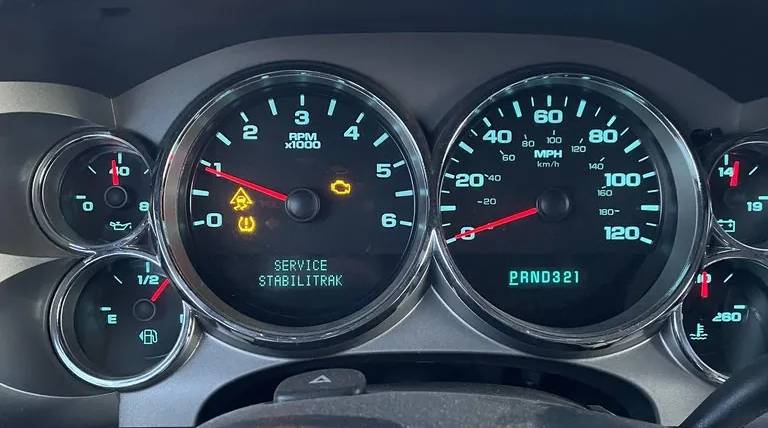
What Does the GMC Yukon Service StabiliTrak Message Mean?
The Service StabiliTrak message on a GMC Yukon indicates that the vehicle’s Electronic Stability Control (ESC) system has detected a fault that prevents it from operating correctly. Rather than identifying a single defective component, the warning informs the driver that one or more parts involved in the stability control system require diagnosis. In many cases, the problem originates from a sensor, electrical connection, or related system instead of the StabiliTrak module itself.
StabiliTrak is General Motors’ advanced stability control technology that helps drivers maintain control during sudden steering maneuvers or when driving on slippery surfaces. The system constantly compares the driver’s steering input with the vehicle’s actual movement. If it detects that the SUV is beginning to skid, understeer, or oversteer, it automatically applies braking force to individual wheels and, when necessary, reduces engine power to help restore stability.
To perform these corrections accurately, StabiliTrak relies on data from several critical components. Wheel speed sensors monitor the rotational speed of each wheel, allowing the system to detect traction loss. The steering angle sensor measures the direction the driver intends to travel, while the yaw rate sensor monitors how quickly the vehicle rotates around its vertical axis. Additional information from the brake pedal position sensor, ABS module, engine control module, and powertrain control module is continuously exchanged across the vehicle’s communication network.
If any of these sensors provide inaccurate data, lose communication, or fail completely, the system can no longer calculate vehicle stability with confidence. As a safety precaution, StabiliTrak disables itself and displays the Service StabiliTrak warning. Depending on the severity of the issue, additional dashboard indicators such as the ABS light, Traction Control light, or Check Engine Light may also illuminate.
Although the warning can be unsettling, it does not always indicate a serious mechanical failure. In many cases, replacing an inexpensive wheel speed sensor, repairing damaged wiring, correcting low battery voltage, or updating the vehicle’s software is enough to restore normal operation. However, because the stability control system plays an important role in maintaining traction during emergency situations, drivers should diagnose the problem as soon as possible rather than continuing to ignore the warning.
Symptoms That Often Appear With the Service StabiliTrak Message
The Service StabiliTrak warning rarely appears by itself. Since the stability control system communicates with multiple electronic control modules throughout the vehicle, a single fault can trigger several warning lights and noticeable changes in vehicle performance. Recognizing these symptoms can help narrow down the source of the problem before a professional diagnosis is performed.
The most obvious symptom is the appearance of the Service StabiliTrak message on the instrument cluster. This warning usually appears immediately after starting the engine or while driving, particularly if the system detects inconsistent sensor readings. Some drivers notice that the warning disappears after restarting the vehicle, only to return later when the fault is detected again.
Another common symptom is the illumination of the Traction Control indicator. Since traction control and StabiliTrak share many of the same sensors and control modules, a failure in one system often disables both. Without traction control, the Yukon may experience increased wheel spin during acceleration on wet pavement, snow, gravel, or other low-traction surfaces.
Many owners also report that the ABS warning light comes on at the same time. This is especially common when a wheel speed sensor or ABS module fails. In these situations, anti-lock braking performance may be reduced during emergency stops, increasing stopping distances on slippery roads.
Some vehicles enter Reduced Engine Power mode. This protective feature limits engine output to reduce the risk of losing control when the system detects a significant fault. Drivers may notice sluggish acceleration, delayed throttle response, or difficulty maintaining highway speeds. If this symptom occurs, the vehicle should be inspected as soon as possible because it often indicates a more serious issue affecting both the engine and stability control systems.
Another symptom involves the Check Engine Light. Although many engine-related problems have nothing to do with StabiliTrak, certain faults such as a malfunctioning throttle body, ignition misfire, or communication error between control modules can cause both warnings to appear simultaneously. Reading the diagnostic trouble codes with an OBD-II scanner is the fastest way to determine whether the issues are related.
Some drivers experience hard or delayed transmission shifting because the transmission control system depends on accurate vehicle speed information. If wheel speed sensors send incorrect data, the transmission may hesitate when shifting gears or behave unpredictably during acceleration.
In certain cases, cruise control automatically disengages. Since stability control systems require full control over engine torque and braking, cruise control is often disabled whenever a significant fault is detected.
Finally, steering may feel slightly different, particularly during sharp turns or sudden lane changes. Although the steering system itself may not be damaged, the absence of electronic stability assistance can make the vehicle feel less predictable, especially in poor weather conditions.
| Symptom | Possible Cause |
|---|---|
| Service StabiliTrak Message | Sensor failure, software issue, wiring fault |
| Traction Control Light | Wheel speed sensor, ABS malfunction |
| ABS Warning Light | Faulty ABS sensor or ABS control module |
| Check Engine Light | Throttle body, engine fault, communication error |
| Reduced Engine Power | Electronic throttle body, PCM issue |
| Cruise Control Disabled | Stability control system disabled |
| Hard Transmission Shifts | Incorrect wheel speed data |
| Poor Handling on Slippery Roads | StabiliTrak system inactive |
Understanding which symptoms appear together provides valuable clues during diagnosis. For example, a Service StabiliTrak warning accompanied by an ABS light often points toward a wheel speed sensor, while the addition of Reduced Engine Power may indicate a throttle body or engine management issue that requires immediate attention.
10 Common Causes of the GMC Yukon Service StabiliTrak Message
Several different components can trigger the GMC Yukon Service StabiliTrak Message, making proper diagnosis essential before replacing parts. Because the stability control system relies on information from multiple sensors and electronic modules, even a relatively minor electrical issue can disable the entire system. Below are the ten most common causes and how each one affects vehicle operation.
1. Faulty Wheel Speed Sensor
A defective wheel speed sensor is the leading cause of the Service StabiliTrak warning on many GMC Yukon models. Each wheel has its own sensor that measures rotational speed and sends data to the ABS and stability control systems. If one sensor produces inaccurate readings or stops communicating altogether, the system can no longer determine whether a wheel is slipping. As a result, StabiliTrak and traction control are disabled. Symptoms often include the ABS warning light, traction control light, and intermittent warning messages.
2. Steering Angle Sensor Failure
The steering angle sensor tells the control module where the driver intends to steer. Over time, the sensor may lose calibration or fail after suspension repairs or a wheel alignment. When the steering input does not match vehicle movement, the stability control system interprets the discrepancy as a fault and activates the Service StabiliTrak warning. Drivers may notice that the warning appears shortly after turning the steering wheel or following recent front-end repairs.
3. Brake Pedal Position Sensor
The brake pedal position sensor monitors brake application and helps coordinate the ABS and stability control systems. If the sensor provides incorrect information, the control module may not accurately determine when braking occurs, causing StabiliTrak to deactivate. This problem is relatively inexpensive to repair but can trigger multiple dashboard warnings if ignored.
4. ABS Module Failure
The Anti-lock Braking System control module serves as one of the primary communication centers for StabiliTrak. Internal electronic failures, corrosion, or communication errors can prevent the module from processing sensor information correctly. In addition to the Service StabiliTrak message, drivers often experience persistent ABS warnings and loss of anti-lock braking functionality. Repairs involving the ABS module are typically among the more expensive solutions.
5. Low Battery Voltage
Modern vehicles depend heavily on stable electrical voltage. A weak battery, failing alternator, or poor battery connections can cause multiple control modules to operate unpredictably. Voltage fluctuations may generate temporary Service StabiliTrak warnings even when no component has actually failed. Before replacing sensors or modules, technicians frequently test the battery and charging system to eliminate electrical supply issues.
6. Faulty Electronic Throttle Body
The electronic throttle body regulates engine airflow based on accelerator pedal input. If it becomes dirty or develops an internal fault, the engine control module may place the vehicle into Reduced Engine Power mode. Because engine torque management is closely integrated with the stability control system, throttle body problems often trigger both the Check Engine Light and the Service StabiliTrak message simultaneously.
7. Damaged Wiring or Corroded Connectors
Electrical wiring located near the wheels and under the vehicle is constantly exposed to water, road salt, dirt, and debris. Over time, damaged insulation, loose connectors, or corrosion can interrupt communication between sensors and control modules. Wiring problems are sometimes difficult to identify because they may cause intermittent warnings that appear only under certain driving conditions.
8. Faulty Yaw Rate Sensor
The yaw rate sensor measures how quickly the vehicle rotates around its center during cornering. If the sensor sends incorrect data, the control module cannot accurately determine whether the Yukon is beginning to skid. Although this failure is less common than wheel speed sensor issues, it can still disable StabiliTrak and significantly reduce stability control performance.
9. Blown Fuse
A blown fuse supplying power to the ABS or stability control system can immediately trigger warning messages. Fortunately, this is one of the simplest problems to diagnose and repair. However, replacing the fuse without identifying why it failed may only provide a temporary solution if an underlying electrical short exists.
10. PCM or Software Issues
Occasionally, the Service StabiliTrak warning results from outdated software or communication errors within the Powertrain Control Module. Manufacturers periodically release software updates that improve system reliability and correct known programming issues. In some cases, a dealership can resolve recurring warning messages by updating the vehicle’s control module software rather than replacing hardware components.
Because many of these issues produce similar symptoms, replacing parts based solely on dashboard warnings can become expensive and ineffective. A complete diagnostic scan, combined with a careful inspection of sensors, wiring, battery condition, and control modules, is the most reliable way to identify the true cause of the GMC Yukon Service StabiliTrak Message and avoid unnecessary repairs.
Is It Safe to Drive With the GMC Yukon Service StabiliTrak Message?
Whether you can continue driving after seeing the Service StabiliTrak message depends on the symptoms accompanying the warning. In some situations, the issue is relatively minor and does not immediately affect the vehicle’s drivability. In others, the warning signals a fault that could compromise braking performance, vehicle stability, or engine operation, making continued driving unsafe.
If the Service StabiliTrak message appears by itself and the vehicle behaves normally, it is generally safe to drive for a short distance to your home or a repair shop. You should still schedule a diagnostic inspection as soon as possible because the electronic stability control system will likely be disabled until the underlying problem is repaired. Without StabiliTrak, your Yukon may have reduced traction and stability during sudden maneuvers, heavy rain, snow, or icy road conditions.
Drivers should exercise additional caution if the warning appears together with the ABS Light or Traction Control Light. Although the vehicle can usually still be driven, emergency braking performance may be reduced because the anti-lock braking system may not function properly. On dry pavement, the difference may be minimal, but on wet or slippery roads, the loss of ABS and traction control can significantly increase stopping distances and make it more difficult to maintain directional control. Until repairs are completed, avoid aggressive acceleration, high-speed cornering, and driving in hazardous weather whenever possible.
The situation becomes much more serious if the Service StabiliTrak message is accompanied by Reduced Engine Power, severe engine hesitation, transmission problems, brake warnings, or steering issues. These symptoms often indicate a fault affecting multiple vehicle systems. Reduced Engine Power mode limits acceleration to protect the engine and drivetrain, which can make merging onto highways or climbing steep grades dangerous. If the vehicle struggles to accelerate, stalls unexpectedly, or exhibits abnormal braking behavior, it should be driven only if absolutely necessary. In many cases, having the vehicle towed is the safest option.
Drivers should stop immediately and arrange professional assistance if they experience any of the following conditions:
| Driving Condition | Recommendation |
|---|---|
| Only Service StabiliTrak message | Safe to drive carefully to a repair facility |
| Service StabiliTrak with ABS or Traction Control light | Drive cautiously and avoid slippery roads |
| Reduced Engine Power activated | Minimize driving and schedule immediate repairs |
| Brake performance noticeably reduced | Stop driving and have the vehicle inspected |
| Steering becomes difficult or unstable | Do not continue driving |
| Engine misfires or stalls | Pull over safely and seek assistance |
Although some drivers ignore the warning because the vehicle appears to operate normally, doing so increases the risk of losing electronic stability assistance during an emergency. A prompt diagnosis not only restores important safety features but can also prevent a relatively inexpensive sensor failure from developing into a more costly repair.
How to Diagnose the GMC Yukon Service StabiliTrak Problem
Diagnosing the GMC Yukon Service StabiliTrak Message requires a systematic approach because several different systems work together to provide stability control. Simply replacing the first component that seems suspicious often leads to unnecessary expenses and does not guarantee that the warning will disappear. A thorough inspection allows you to identify the true source of the problem before purchasing replacement parts.
The first step is to connect an OBD-II scan tool capable of reading both powertrain and chassis diagnostic trouble codes. Basic code readers may only display engine-related codes, while professional scanners can access ABS and stability control modules. Recording every stored and pending code provides valuable clues about which component has failed.
Common diagnostic codes include:
| Diagnostic Code | Possible Meaning |
|---|---|
| C0035 | Left Front Wheel Speed Sensor Circuit |
| C0040 | Right Front Wheel Speed Sensor Circuit |
| C0050 | Rear Wheel Speed Sensor Circuit |
| C0561 | System Disabled Due to Incorrect Information |
| U0100 | Lost Communication With ECM/PCM |
After reading the codes, inspect the wheel speed sensors and their wiring. Because these sensors are mounted near the wheels, they are frequently exposed to road debris, moisture, and corrosion. Look for broken wires, damaged connectors, excessive rust, or metal debris attached to the sensor’s magnetic tip. Even a loose electrical connector can generate intermittent Service StabiliTrak warnings.
Next, check the battery and charging system. A weak battery may produce unstable voltage that affects multiple control modules simultaneously. Measure battery voltage with the engine off and while the engine is running. If the voltage falls outside the manufacturer’s recommended range, resolve the electrical issue before replacing any sensors.
The ABS module and related wiring should also be inspected for corrosion or loose connections. Water intrusion around electrical connectors is a common cause of communication failures, particularly on older vehicles or those driven in regions with heavy rain or road salt.
If the vehicle recently underwent suspension repairs, steering component replacement, or wheel alignment, verify that the steering angle sensor has been properly calibrated. An incorrectly calibrated sensor may trigger the Service StabiliTrak warning even though no mechanical components are damaged.
Finally, perform a road test while monitoring live sensor data with a professional scan tool. Comparing wheel speed readings, steering angle, and yaw rate during normal driving can quickly identify sensors producing inaccurate information. Live data analysis is often the fastest way to isolate intermittent faults that may not be obvious during a visual inspection.
By following a structured diagnostic process, owners can avoid replacing perfectly functional components and focus repairs on the actual source of the fault. In many cases, investing in a proper diagnosis saves significantly more money than replacing multiple parts through trial and error.
GMC Yukon Service StabiliTrak Repair Costs
The cost of repairing a Service StabiliTrak warning varies considerably depending on which component has failed. Some problems involve inexpensive sensors that can be replaced within an hour, while others require advanced diagnostics or replacement of electronic control modules. Labor rates, vehicle model year, and geographic location also influence the final repair bill.
The most affordable repairs typically involve wheel speed sensors, brake pedal position sensors, or blown fuses. These components are relatively inexpensive, and installation usually requires minimal labor. In contrast, replacing an ABS control module or electronic throttle body can become significantly more expensive due to higher parts costs and additional programming requirements.
The table below provides typical repair cost ranges for common StabiliTrak-related issues.
| Repair | Estimated Cost (USD) |
|---|---|
| Diagnostic Scan | $80 to $180 |
| Wheel Speed Sensor Replacement | $150 to $350 |
| Steering Angle Sensor Replacement | $250 to $600 |
| Brake Pedal Position Sensor | $120 to $300 |
| Battery Replacement | $180 to $450 |
| Alternator Replacement | $500 to $900 |
| Electronic Throttle Body Replacement | $450 to $900 |
| ABS Control Module Replacement | $800 to $1,800 |
| Wiring Repair | $100 to $700 |
| PCM Software Update | $100 to $250 |
Keep in mind that replacing a part without confirming the diagnosis can lead to unnecessary expenses. For example, many owners assume the ABS module has failed when the actual problem is a damaged wheel speed sensor costing only a fraction of the price. Likewise, intermittent electrical issues caused by corroded connectors or low battery voltage may trigger the same warning without requiring major component replacement.
Vehicle age also plays a role in repair costs. Older GMC Yukon models are more likely to experience wiring deterioration, sensor wear, and corrosion, while newer models may require software updates or module programming after certain repairs. Choosing an experienced technician familiar with General Motors stability control systems can reduce diagnostic time and improve the likelihood of resolving the issue correctly on the first visit.
Although repair costs can vary widely, addressing the Service StabiliTrak warning promptly often prevents additional damage and helps maintain the vehicle’s braking performance, traction control, and overall driving safety.
How to Reset the GMC Yukon Service StabiliTrak Message
After repairing the underlying problem, many GMC Yukon owners expect the Service StabiliTrak message to disappear immediately. In some cases, it clears automatically after the vehicle completes a successful self-diagnostic cycle. In others, the warning remains stored in the control module until the diagnostic trouble codes are erased with a scan tool. It is important to understand that resetting the warning does not fix the actual problem. If the fault still exists, the message will return as soon as the system detects it again.
The simplest reset method is to restart the vehicle. Turn the ignition off, wait approximately five minutes, and restart the engine. During startup, the vehicle performs a system check on the ABS, traction control, and stability control systems. If the original problem was caused by a temporary communication error or voltage fluctuation, the warning may disappear.
Another common method is to complete a normal drive cycle. Drive the Yukon for 10 to 20 minutes under varying conditions, including city streets and moderate highway speeds. During this period, the control modules monitor wheel speed sensors, steering angle, throttle position, and other critical inputs. If all systems operate normally throughout the drive cycle, the warning may clear automatically without additional intervention.
Using an OBD-II scanner is the most reliable way to reset the Service StabiliTrak message. After connecting the scanner, retrieve and record all stored diagnostic trouble codes before clearing them. Recording the codes is important because they provide valuable information if the warning returns later. Once repairs have been completed, erase the codes and restart the engine. If the underlying fault has been corrected, the warning should remain off.
Some owners disconnect the battery in an attempt to reset dashboard warnings. While disconnecting the negative battery cable for 15 to 30 minutes may temporarily clear certain stored information on older GMC Yukon models, this method is generally not recommended for newer vehicles. Modern control modules retain many fault codes even after battery power is removed, and disconnecting the battery may erase adaptive memory, radio presets, and other system settings without resolving the actual issue.
If the warning returns immediately after being cleared, further diagnosis is required. Persistent warnings often indicate a faulty sensor, damaged wiring, or a communication problem between electronic control modules. Simply clearing the codes repeatedly will not eliminate the root cause and may delay necessary repairs.
Whenever a component such as the steering angle sensor, ABS module, or electronic throttle body has been replaced, additional calibration or programming may also be necessary. Certain repairs require dealer-level diagnostic equipment to complete the calibration process and restore normal StabiliTrak operation.
How to Prevent the Service StabiliTrak Warning From Returning
Although some StabiliTrak faults cannot be avoided, routine maintenance significantly reduces the likelihood of seeing the Service StabiliTrak message again. Since the system depends on dozens of sensors and electronic components working together, preventive maintenance helps identify small issues before they develop into more serious failures.
One of the most effective preventive measures is performing regular brake system inspections. Because StabiliTrak works closely with the anti-lock braking system, worn brake components, damaged wheel bearings, or contaminated brake fluid can indirectly affect system performance. During routine maintenance, technicians should inspect wheel speed sensors, brake wiring, and sensor mounting locations for signs of corrosion or physical damage.
Maintaining a healthy battery is equally important. Low system voltage is responsible for many intermittent electronic warning messages on modern vehicles. Testing the battery and charging system at least once a year helps ensure that all control modules receive stable electrical power. Replacing an aging battery before it fails can prevent unexpected communication errors between the ABS, engine control module, and stability control system.
Wheel alignment should also be checked whenever suspension or steering components are replaced. An improperly aligned steering angle sensor may provide inaccurate information to the StabiliTrak system, causing warning messages even when no mechanical failure exists. After certain repairs, recalibration of the steering angle sensor is essential for proper operation.
Keeping electrical connectors clean and protected from moisture is another effective maintenance practice. Vehicles driven in snowy climates or coastal regions are especially vulnerable to corrosion caused by road salt and humidity. Inspecting exposed wiring during routine service can help identify damaged insulation or loose connectors before intermittent electrical faults occur.
Software updates released by General Motors should not be overlooked. Manufacturers periodically improve system programming to address known issues affecting vehicle stability, communication networks, and electronic control modules. During routine dealership service, technicians can verify whether your GMC Yukon has received the latest available software updates.
Using an OBD-II scanner for occasional preventive scans is also beneficial, particularly for older vehicles. Some diagnostic trouble codes become stored as pending faults before dashboard warnings appear. Identifying these early warning signs allows owners to address developing problems before they affect vehicle performance.
Finally, avoid ignoring unusual driving symptoms such as intermittent ABS lights, inconsistent traction control operation, delayed throttle response, or unexpected transmission behavior. Addressing these issues promptly often prevents the Service StabiliTrak warning from appearing in the future and helps maintain the vehicle’s overall safety and reliability.
Frequently Asked Questions
Why does my GMC Yukon say “Service StabiliTrak”?
The message indicates that the electronic stability control system has detected a fault preventing it from operating correctly. The issue may involve a wheel speed sensor, steering angle sensor, ABS module, throttle body, damaged wiring, low battery voltage, or another component that communicates with the StabiliTrak system.
Can a bad battery cause the Service StabiliTrak message?
Yes. A weak battery or failing charging system can create unstable voltage that interferes with communication between electronic control modules. In some cases, replacing the battery or repairing the charging system eliminates the warning without requiring additional component replacement.
Is it safe to continue driving with the Service StabiliTrak warning?
If the warning appears by itself and the vehicle drives normally, you can usually drive carefully to a repair facility. However, if the warning is accompanied by Reduced Engine Power, ABS failures, brake problems, or steering issues, the vehicle should be inspected immediately, and towing may be the safest option.
Will replacing the wheel speed sensor fix the problem?
A faulty wheel speed sensor is one of the most common causes of the Service StabiliTrak message, but it is not the only possible cause. A diagnostic scan should always be performed before replacing any parts to confirm the source of the fault.
Can I reset the Service StabiliTrak warning myself?
You can clear the warning using a compatible OBD-II scanner after the underlying issue has been repaired. Simply erasing the warning without fixing the fault will usually result in the message returning during the next self-diagnostic cycle.
How much does it cost to repair the Service StabiliTrak system?
Repair costs vary depending on the failed component. Minor repairs such as replacing a wheel speed sensor or brake pedal position sensor may cost only a few hundred dollars, while replacing an ABS control module or electronic throttle body can exceed one thousand dollars, including parts and labor.
Does the Service StabiliTrak message indicate a transmission problem?
Not necessarily. Although some drivers notice harsh or delayed shifting when the warning appears, the transmission itself is often not the source of the problem. Incorrect wheel speed data or communication errors between electronic control modules can affect transmission behavior without indicating an internal transmission failure.
Can cold weather trigger the Service StabiliTrak warning?
Yes. Extremely cold temperatures can reduce battery performance, increase electrical resistance, and expose existing sensor or wiring issues. If the warning appears only during cold weather, inspecting the battery, charging system, and electrical connections is a good place to begin diagnosis.
Will the warning disappear on its own?
If the warning was triggered by a temporary condition such as a brief voltage drop, it may clear after several successful drive cycles. However, if a sensor or control module has failed, the message will remain or return until the underlying issue has been repaired.
Conclusion
The GMC Yukon Service StabiliTrak Message is more than just another dashboard warning. It is your vehicle’s way of informing you that the electronic stability control system has detected a problem that could affect traction, braking performance, or overall handling. While the warning may seem alarming, it does not always indicate a major mechanical failure. In many cases, the issue can be traced to relatively common components such as a faulty wheel speed sensor, steering angle sensor, low battery voltage, damaged wiring, or an electronic throttle body malfunction.
The key to resolving the problem efficiently is proper diagnosis. Instead of replacing parts based on guesswork, use a quality OBD-II scanner to retrieve diagnostic trouble codes and inspect the related components before making repairs. This approach not only saves money but also helps ensure that the actual cause of the warning is addressed rather than simply masking the symptoms.
If your Yukon displays the Service StabiliTrak message along with the ABS warning light, Check Engine Light, or Reduced Engine Power notification, do not ignore these signs. Continuing to drive with a disabled stability control system can reduce your vehicle’s ability to maintain traction during emergency maneuvers, particularly on wet, snowy, or icy roads. Prompt repairs will help restore important safety features and reduce the risk of more expensive damage in the future.
Routine maintenance also plays an important role in preventing the warning from returning. Regular inspections of the braking system, battery, electrical connections, suspension components, and wheel speed sensors can identify developing problems before they trigger dashboard alerts. Keeping your vehicle’s software up to date and addressing minor electrical issues early can further improve the long-term reliability of the StabiliTrak system.
By understanding how the GMC Yukon Service StabiliTrak Message works, recognizing its most common causes, and following the correct diagnostic and repair procedures, you can restore your vehicle’s stability control system with confidence. Whether the solution involves replacing a simple sensor or performing a more advanced repair, taking action early will help keep your GMC Yukon performing safely and reliably for years to come.