The GMC Terrain Service ESC message indicates that the vehicle’s Electronic Stability Control (ESC) system has detected a fault that may reduce its ability to maintain traction and directional stability. In many cases, the warning appears alongside messages such as Service StabiliTrak, Service Traction Control, or the ABS warning light because these systems share sensors and control modules. While the vehicle may remain drivable in some situations, the warning should never be ignored because it can affect braking assistance and vehicle stability, especially on wet, icy, or uneven roads.
The Service ESC message does not identify a single failed component. Instead, it signals that one or more parts of the stability control system—including the wheel speed sensors, steering angle sensor, ABS module, brake switch, battery, or electronic control modules—are no longer providing reliable data. Identifying the root cause requires a systematic diagnosis rather than replacing parts based on guesswork.
This guide explains what the GMC Terrain Service ESC message means, the symptoms that typically accompany it, the most common causes, proven diagnostic procedures, effective repair solutions, and typical repair costs. You’ll also learn when it is safe to continue driving, when immediate repairs are necessary, and how regular maintenance can help prevent the warning from returning.
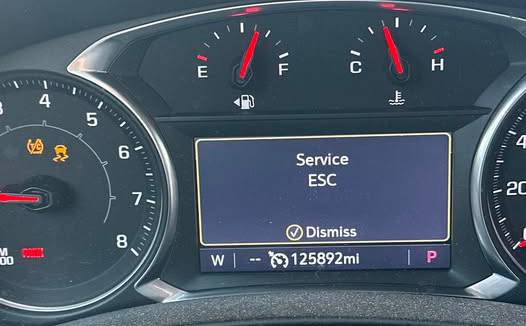
What Does the Service ESC Message Mean on a GMC Terrain?
What does Electronic Stability Control (ESC) do?
Electronic Stability Control (ESC) helps keep the GMC Terrain stable by detecting and correcting a loss of traction before the driver loses control of the vehicle. The system continuously compares the driver’s steering input with the vehicle’s actual movement using data from the steering angle sensor, wheel speed sensors, yaw rate sensor, and ABS module. When the system detects that the vehicle is understeering or oversteering, it selectively applies braking force to individual wheels and may reduce engine torque to help restore the intended driving path.
ESC works together with the Anti-lock Braking System (ABS) and Traction Control System (TCS). Because these systems share sensors and electronic control modules, a fault in one component can affect multiple safety features at the same time. As a result, the Service ESC message often appears together with the ABS warning light, the traction control indicator, or the Service StabiliTrak message.
The system is especially valuable during emergency maneuvers, slippery road conditions, heavy rain, snow, gravel roads, and sharp cornering. Even if the vehicle appears to drive normally, losing ESC functionality reduces the electronic assistance designed to help prevent skidding.
Why does the Service ESC warning appear?
The Service ESC message appears when the vehicle detects a fault that prevents the Electronic Stability Control system from operating as designed. The warning itself does not identify which component has failed. Instead, it indicates that the control module has detected abnormal sensor readings, communication errors, or electrical problems that make the stability control system unreliable.
Several faults can trigger the warning, including:
- A failed wheel speed sensor sending incorrect wheel rotation data.
- A steering angle sensor that has lost calibration or failed internally.
- An ABS control module malfunction.
- Low battery voltage or an unstable charging system.
- Damaged wiring, corroded connectors, or poor ground connections.
- Communication faults between the ECM, BCM, ABS module, and other control units through the CAN bus network.
When one of these faults occurs, the vehicle stores one or more Diagnostic Trouble Codes (DTCs). Retrieving these codes with an OBD-II scanner is the first step toward identifying the root cause instead of replacing parts by trial and error.
How is Service ESC different from Service StabiliTrak?
Service ESC and Service StabiliTrak are closely related warnings, but they are not always identical. ESC (Electronic Stability Control) refers to the overall stability control function that helps maintain vehicle direction, while StabiliTrak is General Motors’ proprietary name for its integrated stability control technology.
In many GMC Terrain model years, the two messages may appear interchangeably because StabiliTrak combines several systems, including:
- Electronic Stability Control (ESC)
- Traction Control System (TCS)
- Anti-lock Braking System (ABS)
A fault affecting any of these interconnected systems may trigger either warning depending on the vehicle’s software version and model year. For example, a defective wheel speed sensor can simultaneously disable ABS, traction control, and ESC, resulting in multiple dashboard warnings.
For this reason, technicians focus on diagnosing the underlying fault rather than relying on the wording of the dashboard message alone.
What Symptoms Usually Accompany a Service ESC Message?
Why does the ABS light or traction control light come on?
The ABS warning light and traction control indicator commonly illuminate because these systems share sensors and electronic control components with ESC. A single failed wheel speed sensor, damaged ABS wiring harness, or malfunctioning ABS control module can interrupt data required by all three systems.
When this happens, the vehicle may disable ESC and traction control as a protective measure until the fault is repaired. Although conventional braking usually remains available, advanced braking assistance and automatic traction management may no longer function.
Why does the vehicle lose stability control?
A vehicle displaying the Service ESC message may lose its automatic ability to correct skidding or wheel slip. During aggressive cornering or sudden obstacle avoidance, the system may no longer apply braking to individual wheels or reduce engine torque when traction decreases.
Most drivers will not notice a difference during normal driving on dry pavement. However, the lack of electronic stability intervention becomes more significant during emergency situations or when road conditions are wet, icy, or covered with loose gravel.
Why can engine performance be reduced?
Some GMC Terrain models may enter a reduced-performance mode when an ESC-related fault affects other control systems. If the fault involves engine management, throttle control, or communication between control modules, the vehicle may limit engine power to protect critical components and maintain predictable handling.
Drivers may notice:
- Slower acceleration.
- Reduced throttle response.
- Hesitation during acceleration.
- A “Reduced Engine Power” message alongside the Service ESC warning.
These symptoms often indicate that additional diagnostic trouble codes are present and should be investigated before replacing any components.
What steering or braking changes might you notice?
Drivers may experience subtle changes in steering feel or braking behavior when the ESC system is disabled. While the steering system itself typically continues to function normally, the vehicle no longer receives electronic assistance that helps maintain directional stability during sudden maneuvers.
Common observations include:
- Increased wheel spin on slippery roads.
- Reduced confidence during emergency lane changes.
- Longer stopping distances on low-traction surfaces.
- Loss of automatic brake intervention during skids.
- Multiple dashboard warning lights appearing simultaneously.
These symptoms do not always indicate a severe mechanical failure, but they should be treated as signs that the vehicle’s active safety systems require prompt diagnosis and repair.
Is It Safe to Drive a GMC Terrain With the Service ESC Message?
When is it safe to continue driving?
You can continue driving a GMC Terrain with the Service ESC message only if the vehicle operates normally and no critical warning lights or severe drivability issues are present. In many cases, the ESC system is disabled while the vehicle retains normal steering, braking, and engine performance. Under these conditions, you may drive cautiously to a repair shop, but you should avoid situations where stability control provides significant safety benefits, such as heavy rain, snow, icy roads, gravel surfaces, or emergency maneuvers.
Before continuing your trip, verify that the brake pedal feels normal, steering response is predictable, and the engine accelerates without hesitation. If the warning appears without any noticeable change in vehicle behavior, the fault may involve a sensor or communication issue rather than a major mechanical failure. However, the stored diagnostic trouble codes should be scanned as soon as possible because intermittent electrical faults often become permanent over time.
When should you stop driving immediately?
You should stop driving immediately if the Service ESC message appears together with serious warning signs that affect vehicle safety. The stability control system is only one part of the vehicle’s electronic safety network. When multiple systems fail simultaneously, the underlying problem may involve the ABS module, braking system, electrical supply, or powertrain control system.
Do not continue driving if you notice any of the following conditions:
- The ABS warning light and brake warning light remain illuminated together.
- The vehicle displays a Reduced Engine Power message.
- Steering becomes unusually heavy or unstable.
- The brake pedal feels soft, spongy, or requires excessive force.
- The engine misfires, stalls, or loses significant power.
- Multiple warning messages appear at the same time.
- Burning smells, electrical odors, or abnormal noises accompany the warning.
These symptoms indicate that the vehicle may no longer provide predictable braking or stability assistance. Driving under these conditions increases the risk of losing control, particularly during emergency braking or sudden lane changes.
What risks increase if you ignore the warning?
Ignoring the Service ESC message increases the likelihood of losing electronic stability assistance when road conditions become unpredictable. Although many drivers experience no immediate problems during routine driving, ESC is designed to intervene only when traction is compromised. Without it, the driver must rely entirely on manual steering and braking corrections.
The most significant risks include:
- Reduced traction during acceleration on slippery roads.
- Increased likelihood of understeer or oversteer when cornering.
- Longer stopping distances on wet or loose surfaces.
- Loss of automatic braking intervention during skids.
- Progressive electrical faults that may disable additional vehicle systems.
- Higher repair costs if a minor sensor failure damages related components over time.
Addressing the warning promptly also helps prevent unnecessary replacement of expensive parts. A simple wheel speed sensor fault, for example, can trigger several dashboard warnings even though the repair itself is relatively inexpensive.
What Causes the Service ESC Message on a GMC Terrain?
Can a faulty wheel speed sensor trigger the warning?
A faulty wheel speed sensor is one of the most common causes of the Service ESC message on a GMC Terrain. Each wheel is equipped with a sensor that continuously measures rotational speed and transmits that information to the ABS and ESC control modules. The system compares data from all four wheels to determine whether one wheel is slipping or rotating at a different speed.
If a sensor becomes contaminated with road debris, damaged by corrosion, or fails internally, the control module receives inaccurate data. Because ESC depends on precise wheel speed information to calculate vehicle stability, it disables the system and stores a diagnostic trouble code until the fault is repaired.
Typical symptoms of a failed wheel speed sensor include:
- Service ESC message.
- ABS warning light.
- Traction Control warning.
- Cruise control malfunction on some model years.
- Intermittent warning lights that disappear after restarting the engine.
Can a steering angle sensor fail?
A failed or improperly calibrated steering angle sensor can also trigger the Service ESC message. This sensor measures the exact position and rotation of the steering wheel, allowing the ESC module to compare the driver’s intended direction with the vehicle’s actual movement.
If the sensor loses calibration after a wheel alignment, steering component replacement, battery disconnection, or electronic control module reset, the ESC system may interpret normal driving as unstable behavior. In other cases, internal sensor wear or electrical failure produces inconsistent steering angle data that prevents the system from functioning correctly.
Drivers may notice that the warning appears immediately after starting the vehicle or shortly after turning the steering wheel. Recalibrating the sensor with a professional diagnostic scan tool often resolves the issue when no physical damage is present.
Can an ABS module malfunction cause Service ESC?
Yes. A defective ABS control module can disable the Electronic Stability Control system because the two systems share the same hydraulic and electronic control architecture. The ABS module processes wheel speed data, controls brake pressure during anti-lock braking, and communicates continuously with the ESC system.
When the module develops an internal fault, loses communication with other control units, or experiences power supply issues, it may stop transmitting reliable information. As a safety precaution, the vehicle disables ESC and traction control until the fault is corrected.
Common indicators of an ABS module problem include:
- Service ESC message.
- ABS warning light.
- Service StabiliTrak message.
- Communication-related diagnostic trouble codes.
- Inoperative ABS during hard braking.
Because ABS modules are considerably more expensive than sensors, technicians should always verify power supply, wiring integrity, and wheel speed sensor operation before replacing the module.
Can low battery voltage create false ESC warnings?
Low battery voltage is a frequently overlooked cause of intermittent Service ESC warnings. Modern GMC Terrain models rely on stable electrical voltage for communication between dozens of electronic control modules. A weak battery or failing alternator can interrupt this communication and generate false fault messages even when the ESC components are operating normally.
Voltage-related issues often become noticeable during cold starts or after the vehicle has been parked for an extended period. Drivers may experience multiple warning lights that disappear after the battery is recharged or replaced.
Testing battery voltage, charging system output, and terminal connections should always be part of the initial diagnostic process before replacing electronic components.
Can damaged wiring or poor ground connections cause intermittent faults?
Damaged wiring harnesses, corroded connectors, and poor ground connections are common electrical causes of intermittent Service ESC messages. Sensors may function correctly while the electrical circuit intermittently loses continuity due to vibration, moisture intrusion, road salt, or aging insulation.
Intermittent faults are often the most difficult to diagnose because the warning may disappear before the vehicle reaches a repair facility. A thorough visual inspection, voltage drop testing, and continuity testing are essential to identify damaged wiring that cannot be detected by simply replacing sensors.
Can PCM or BCM communication problems trigger the message?
Communication failures between the Powertrain Control Module (PCM), Body Control Module (BCM), ABS module, and other control units can also activate the Service ESC message. These modules exchange information through the Controller Area Network (CAN bus). If communication is interrupted by software errors, module failures, or network wiring problems, the ESC system may no longer receive the data required for safe operation.
Communication faults often generate U-series diagnostic trouble codes and may be accompanied by multiple dashboard warnings affecting unrelated vehicle systems. Proper diagnosis typically requires a professional scan tool capable of monitoring live module communication rather than reading engine fault codes alone.
How Do You Diagnose a GMC Terrain Service ESC Message?
Which diagnostic tools should you use?
An OBD-II scanner capable of reading ABS and chassis control modules is the most important tool for diagnosing a GMC Terrain Service ESC message. Basic code readers that only access engine-related diagnostic trouble codes (DTCs) often cannot communicate with the ABS, Electronic Stability Control (ESC), or Body Control Module (BCM). As a result, they may report no faults even though the Service ESC warning remains active.
Professional diagnostic tools such as GM MDI, GM Tech2 (for older models), or advanced aftermarket scanners can retrieve manufacturer-specific chassis codes, display live sensor data, and perform bidirectional tests. These functions allow technicians to monitor wheel speed sensor signals, steering angle sensor values, brake switch status, battery voltage, and CAN bus communication in real time.
Before replacing any component, connect a compatible scan tool and perform a complete vehicle scan rather than checking only the engine control module. Many ESC-related faults originate in other control modules that are invisible to entry-level scanners.
The Service ESC message is typically accompanied by Diagnostic Trouble Codes (DTCs) that identify the affected circuit or component. Reading these codes significantly reduces diagnostic time because they narrow the search to a specific subsystem instead of requiring technicians to inspect every ESC component.
Common code categories include:
| DTC Category | Typical Meaning | Possible Cause |
|---|---|---|
| C0035–C0051 | Wheel speed sensor circuit | Failed sensor, damaged wiring, corroded connector |
| C0040, C0045 | Front or rear wheel speed sensor fault | Open circuit, short circuit, contaminated sensor |
| C0196 | Yaw rate sensor performance | Sensor malfunction or calibration issue |
| C0242 | Engine torque communication problem | ECM or CAN bus communication fault |
| C0561 | Invalid information received | Module communication error or software issue |
| U0073 | CAN bus communication fault | Network wiring problem or module failure |
| U0100 | Lost communication with ECM | Faulty control module or interrupted network communication |
A DTC should always be interpreted together with freeze-frame data and live sensor readings. For example, a wheel speed sensor code may be caused by a damaged wiring harness rather than the sensor itself.
How do technicians isolate the root cause?
Professional technicians follow a structured diagnostic process to identify the root cause before replacing parts. Modern ESC systems depend on accurate data from multiple sensors and control modules, so guessing often leads to unnecessary repairs and higher costs.
A typical diagnostic workflow includes:
- Scan every vehicle control module for stored and pending DTCs.
- Record freeze-frame data to determine when the fault occurred.
- Clear the codes and perform a controlled road test.
- Monitor live wheel speed data to identify irregular sensor readings.
- Verify steering angle sensor calibration.
- Test battery voltage and charging system output.
- Inspect wiring harnesses, connectors, grounds, and fuse boxes.
- Confirm CAN bus communication between electronic control modules.
- Perform manufacturer-recommended pinpoint tests before replacing components.
Following this sequence allows technicians to eliminate simple electrical faults before considering expensive modules such as the ABS controller or BCM.
What should you inspect before replacing parts?
Several basic inspections should be completed before replacing any ESC component because many Service ESC warnings are caused by simple electrical or mechanical issues. Replacing sensors without confirming the actual fault frequently results in unnecessary expense while leaving the warning unchanged.
Inspect the following items first:
- Battery voltage and charging system performance.
- Battery terminals for corrosion or loose connections.
- Wheel speed sensor connectors for moisture or physical damage.
- Wiring harnesses near suspension components for abrasion.
- ABS fuse condition.
- Brake fluid level.
- Wheel bearing play that may affect wheel speed sensor readings.
- Tire size consistency across all four wheels.
- Recent suspension or wheel alignment repairs that may require steering angle sensor recalibration.
Many intermittent ESC faults originate from damaged wiring or poor electrical connections rather than failed electronic modules.
How Do You Fix the Service ESC Message?
When should a wheel speed sensor be replaced?
Replace a wheel speed sensor only after confirming that the sensor itself has failed. Wheel speed sensors are exposed to water, dirt, road salt, and constant vibration, making them one of the most common ESC-related failure points. However, similar symptoms can also result from damaged wiring, excessive wheel bearing play, or corrosion inside the electrical connector.
Replacement is appropriate when diagnostic testing confirms:
- No sensor output.
- Intermittent signal loss.
- Internal sensor resistance outside specifications.
- Physical damage to the sensor housing.
- Corrosion that cannot be cleaned safely.
After installation, clear all stored DTCs and verify proper operation during a road test by monitoring live wheel speed data from all four wheels.
When does the steering angle sensor require calibration?
A steering angle sensor often requires calibration after wheel alignment, steering component replacement, battery disconnection, or certain electronic repairs. The sensor must accurately identify the steering wheel’s straight-ahead position so the ESC module can compare driver input with actual vehicle movement.
If calibration values become inaccurate, the ESC system may incorrectly interpret normal steering as a loss of vehicle stability and trigger the Service ESC warning.
Calibration is normally completed using a professional scan tool that supports steering angle sensor reset procedures. Some GMC Terrain model years automatically relearn the steering position after driving, while others require manual calibration through diagnostic software.
When should the ABS module be repaired or replaced?
The ABS control module should only be repaired or replaced after confirming that power supply, ground circuits, wiring, sensors, and network communication are functioning correctly. Because the module coordinates ABS, traction control, and ESC operations, replacing it without proper diagnosis can become one of the most expensive repair mistakes.
Signs that may indicate an ABS module failure include:
- Persistent ABS and Service ESC warnings after sensor replacement.
- Internal module fault codes that return immediately after clearing.
- Loss of communication with the ABS module.
- Failure during manufacturer-specific functional tests.
Depending on the failure, some modules can be professionally rebuilt, while others require complete replacement followed by software programming.
How do you repair wiring issues?
Repairing damaged wiring involves identifying the exact location of the electrical fault rather than replacing complete harnesses unnecessarily. Wiring failures typically develop where harnesses bend repeatedly, rub against suspension components, or are exposed to moisture and road debris.
Technicians generally repair wiring by:
- Replacing damaged wire sections.
- Cleaning corroded terminals.
- Installing new electrical connectors.
- Restoring proper ground connections.
- Protecting repaired wiring with heat-shrink tubing and protective loom.
After completing the repair, continuity testing and voltage drop testing confirm that the circuit has been restored before clearing the diagnostic codes.
Can updating vehicle software solve the problem?
Yes. A software update can resolve certain Service ESC warnings if the problem is caused by outdated control module calibration rather than a hardware failure. Manufacturers periodically release updated software to improve communication between electronic modules, correct false diagnostic logic, and address known issues discovered after production.
Software updates are most effective when:
- No hardware faults are found.
- Communication-related DTCs are present.
- Technical Service Bulletins (TSBs) recommend updated programming.
- The warning returns without consistent sensor failures.
Programming should be performed using GM-approved diagnostic equipment because interrupting the update process can damage the control module and require replacement.
How Much Does It Cost to Repair a GMC Terrain Service ESC Message?
How much does it cost to repair the Service ESC message?
The cost to repair a GMC Terrain Service ESC message depends entirely on which component has failed. Some repairs require nothing more than cleaning a connector or recalibrating a sensor, while others involve replacing expensive electronic modules. A professional diagnosis is usually the most cost-effective first step because multiple components can trigger the same dashboard warning.
The table below shows typical repair costs in the U.S. market.
| Repair | Estimated Parts | Estimated Labor | Typical Total Cost |
|---|---|---|---|
| Diagnostic scan | $75–$150 | Included | $75–$150 |
| Wheel speed sensor replacement | $30–$120 | $80–$180 | $110–$300 |
| Steering angle sensor calibration | — | $80–$180 | $80–$180 |
| Steering angle sensor replacement | $150–$350 | $120–$250 | $270–$600 |
| Brake light switch replacement | $20–$60 | $70–$150 | $90–$210 |
| Battery replacement | $180–$350 | $20–$60 | $200–$410 |
| Wiring repair | Minimal–$150 | $100–$500 | $150–$650 |
| ABS control module replacement | $350–$900 | $200–$500 | $550–$1,400 |
| BCM or PCM programming | — | $120–$300 | $120–$300 |
| BCM or PCM replacement | $400–$1,200 | $200–$500 | $600–$1,700 |
Actual repair costs vary according to model year, geographic location, dealership pricing, and whether OEM or aftermarket parts are used. Vehicles requiring software programming or extensive electrical diagnosis generally have higher labor charges than those needing a simple sensor replacement.
Which repairs are the most common?
Wheel speed sensor replacement is the most common repair for a Service ESC message on the GMC Terrain. These sensors operate in harsh environments where they are exposed to dirt, water, road salt, and continuous vibration. Over time, contamination, corrosion, or internal electrical failure can interrupt the signal sent to the ABS and ESC modules.
Electrical problems rank second among common repairs. Damaged wiring, loose connectors, poor ground connections, and weak batteries frequently generate intermittent ESC warnings that disappear and reappear without warning. These faults often mimic failed sensors, making proper diagnosis essential before purchasing replacement parts.
Less frequently, technicians identify steering angle sensor calibration issues, defective brake light switches, ABS module failures, or communication problems between electronic control modules. Although these repairs are generally more expensive, they occur far less often than wheel speed sensor or wiring issues.
Which GMC Terrain Model Years Report Service ESC Problems Most Often?
Which model years experience the most reported ESC issues?
Service ESC complaints have been reported across multiple GMC Terrain generations, although the underlying causes vary by model year. Earlier models tend to experience more sensor and wiring failures as components age, while newer models are more likely to encounter software updates or communication-related faults.
The following overview summarizes common trends reported by owners and independent repair shops.
2010–2013 GMC Terrain
The first-generation Terrain commonly experiences failures involving wheel speed sensors, ABS modules, wiring harness corrosion, and steering angle sensor calibration. As these vehicles age, exposure to moisture and road salt increases the likelihood of electrical faults that trigger intermittent Service ESC warnings.
2014–2017 GMC Terrain
Mid-cycle models generally show improved reliability but may still develop wheel speed sensor failures, damaged wiring near suspension components, and occasional battery voltage issues that affect electronic control module communication.
2018–Present GMC Terrain
Second-generation models feature more advanced electronic architecture and additional driver assistance systems. While hardware failures remain possible, some Service ESC warnings are associated with software calibration, CAN bus communication, or module programming updates. Diagnosing these vehicles often requires manufacturer-level diagnostic equipment capable of communicating with every electronic control module.
Regardless of model year, routine maintenance and early diagnosis significantly reduce the likelihood of more expensive repairs later.
How Can You Prevent the Service ESC Message From Returning?
Maintain a healthy electrical system
A stable electrical system reduces the likelihood of false Service ESC warnings. Modern stability control systems rely on consistent battery voltage for communication between dozens of electronic modules. Weak batteries, failing alternators, and corroded battery terminals frequently create intermittent faults that appear unrelated to the charging system.
Test battery condition regularly, clean battery terminals, and verify charging voltage during routine maintenance, especially before winter when battery performance naturally declines.
Inspect wheel speed sensors and wiring
Regular inspection of wheel speed sensors and their wiring helps prevent many ESC-related problems. Dirt accumulation, physical damage, and corrosion gradually reduce signal quality until the ABS module detects an abnormal reading.
During brake service or tire rotation, inspect sensor wiring for abrasion, ensure connectors remain securely attached, and remove excessive debris from the sensor mounting area whenever possible.
Keep tires and suspension components in good condition
Proper tire maintenance supports accurate ESC operation because the system continuously compares wheel rotation speeds. Tires with significantly different diameters, uneven wear, or incorrect inflation pressure can affect wheel speed calculations under certain driving conditions.
Maintaining correct tire pressure, rotating tires at recommended intervals, and replacing tires as a complete matched set whenever practical helps preserve consistent wheel speed data.
Suspension repairs should also be followed by a wheel alignment when recommended, as steering geometry affects steering angle sensor calibration.
Follow recommended software updates
Installing manufacturer-recommended software updates helps eliminate known ESC calibration and communication issues. Automakers periodically release updated programming for the ABS module, BCM, PCM, and other electronic controllers to improve reliability and correct false warning messages.
During scheduled maintenance, ask whether Technical Service Bulletins (TSBs) or software updates apply to your specific GMC Terrain model year.
Frequently Asked Questions
Can I reset the Service ESC message myself?
You can clear the Service ESC message only if the underlying problem has been corrected. Disconnecting the battery or using a scan tool to erase diagnostic codes may temporarily remove the warning, but it usually returns once the control module detects the fault again. Permanent repairs require identifying and fixing the root cause rather than simply clearing stored codes.
Will disconnecting the battery clear the warning?
Disconnecting the battery may temporarily erase certain stored fault codes, but it rarely fixes the actual problem. Once the vehicle completes its self-diagnostic checks, the Service ESC message typically reappears if the failed sensor, wiring fault, or communication problem remains unresolved.
Will the Service ESC light cause a failed vehicle inspection?
It depends on local inspection regulations. In many regions, an illuminated ABS or ESC warning light may result in a failed safety inspection because these systems are considered essential safety equipment. Emissions-only inspections may follow different requirements.
Can bad tires trigger the Service ESC message?
Yes. Tires with different diameters, excessive wear, or incorrect inflation pressure can affect wheel speed calculations and contribute to ESC-related faults. Although tire issues are less common than sensor failures, maintaining four properly matched tires improves stability control performance and diagnostic accuracy.
Can a bad wheel bearing cause a Service ESC warning?
Yes. A worn wheel bearing can alter the air gap between the wheel speed sensor and the tone ring, producing inconsistent wheel speed signals. As bearing wear increases, the ABS module may interpret the fluctuating signal as a sensor failure and activate the Service ESC warning.
Does the Service ESC message affect fuel economy?
The Service ESC message itself does not directly reduce fuel economy. However, if the warning is accompanied by engine performance problems, reduced power mode, or drivetrain faults, fuel consumption may increase until the underlying issue is repaired.
Final Thoughts
The GMC Terrain Service ESC message is a warning that the Electronic Stability Control system has detected a fault requiring diagnosis, not necessarily a catastrophic mechanical failure. In many cases, the problem originates from a wheel speed sensor, steering angle sensor, low battery voltage, or damaged wiring rather than an expensive control module.
Following a systematic diagnostic process is the most effective way to identify the root cause and avoid unnecessary repairs. Reading manufacturer-specific diagnostic trouble codes, verifying live sensor data, and inspecting the vehicle’s electrical system before replacing components significantly improves repair accuracy.
Although some vehicles remain drivable after the warning appears, delaying repairs increases the risk of losing electronic stability assistance during emergency situations. Addressing the problem promptly helps maintain the safety systems designed to improve vehicle control while often reducing long-term repair costs.