Have you recently replaced the crankshaft position sensor on your GM vehicle, only to find that the Check Engine Light remains illuminated or the engine still doesn’t run as expected? If you’re searching for a way to perform a GM Crankshaft Position Sensor Relearn Without Scanner, you’re certainly not alone. Many Chevrolet, GMC, Cadillac, Buick, Pontiac, and Saturn owners encounter this issue after replacing the sensor, rebuilding the engine, or installing a new Powertrain Control Module (PCM).
The crankshaft position sensor (CKP) is one of the most critical components in your engine management system. It continuously monitors the crankshaft’s rotational speed and position, allowing the PCM to precisely control ignition timing, fuel injection, and engine performance. However, after certain repairs, the PCM may no longer recognize the crankshaft’s position accurately until it completes a process known as the Crankshaft Position Variation Learn, commonly referred to as a CKP relearn.
One of the biggest misconceptions circulating online is that every GM vehicle can complete this relearn procedure without a scan tool. While some models can gradually adapt through normal driving conditions, many others require a dedicated bi-directional scan tool to initiate the official relearn procedure. Understanding the difference can save you hours of frustration, unnecessary parts replacement, and expensive diagnostic fees.
In this comprehensive guide, you’ll learn whether a GM Crankshaft Position Sensor Relearn Without Scanner is actually possible, which GM models may support a limited self-learning process, and the exact steps you can safely follow before investing in specialized diagnostic equipment. We’ll also cover common mistakes, warning signs of a failed relearn, diagnostic trouble codes such as P0315 and P0335, and explain when using a professional scan tool becomes unavoidable.
Whether you drive a Chevrolet Silverado, GMC Sierra, Tahoe, Yukon, Camaro, Escalade, or another GM model, this guide will help you understand the relearn process and determine the most effective solution for your specific vehicle.
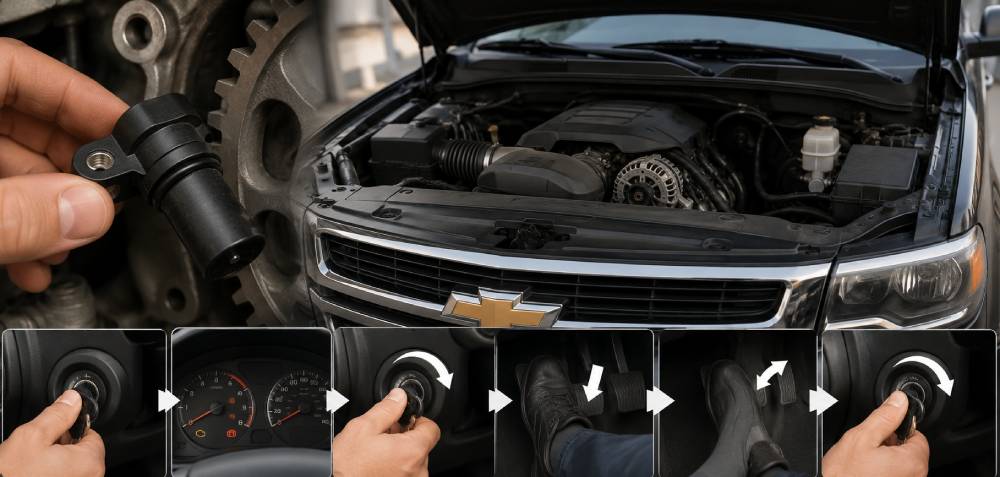
What Is a GM Crankshaft Position Sensor Relearn?
A GM crankshaft position sensor relearn is a calibration procedure that allows the Powertrain Control Module, commonly called the PCM, or the Engine Control Module, known as the ECM, to recognize the unique rotational characteristics of the engine’s crankshaft.
Although the crankshaft and reluctor wheel are manufactured to precise specifications, no two engines rotate in exactly the same way. Small differences in component tolerances, crankshaft balance, bearing wear, reluctor wheel alignment, and engine assembly can produce tiny variations in crankshaft speed. These variations are normal, but the control module must learn them so it can distinguish normal crankshaft movement from an actual engine misfire.
The crankshaft position sensor monitors the position and rotational speed of the crankshaft. It sends an electrical signal to the control module as the teeth of the reluctor wheel pass the sensor. The control module uses this information to manage ignition timing, fuel injection, engine speed, and misfire detection.
During the relearn process, the control module records the engine’s normal crankshaft speed variations and stores those values in memory. This calibration is commonly referred to as the Crankshaft Position Variation Learn, CKP Variation Learn, CASE Learn, or Crank Relearn.
The procedure does not physically adjust the crankshaft position sensor. It also does not change the engine’s mechanical timing. Instead, it updates the reference values used by the control module to interpret the signal from the crankshaft position sensor.
This distinction is important because many vehicle owners assume that replacing the sensor automatically completes the calibration. Installing a new sensor restores the hardware, but the control module may still rely on variation values learned from the previous sensor or engine configuration.
If those values are missing or inaccurate, the engine may continue to start and run. However, the control module may have difficulty monitoring misfires correctly. The Check Engine Light may remain illuminated, and diagnostic trouble code P0315 may appear.
P0315 generally indicates that the crankshaft position system variation has not been learned. GM service information also associates this code with an incomplete or unsuccessful variation learning process. In comparison, codes such as P0335 and P0336 are more directly related to crankshaft position sensor circuit or signal problems. This means a relearn should not be treated as a universal solution for every crankshaft sensor code.
A crankshaft relearn is therefore best understood as a software calibration rather than a mechanical repair. If the sensor, wiring, reluctor wheel, timing components, or control module has a physical fault, performing the relearn will not correct the underlying problem.
Can You Perform a GM Crankshaft Position Sensor Relearn Without a Scanner?
The honest answer is that it depends on the specific vehicle, engine, model year, control module, and type of repair performed.
Some GM vehicles may gradually update certain adaptive values during normal operation. A stable idle, several restart cycles, and a complete drive cycle may help the control module adjust to minor changes. This is sometimes described online as an automatic crankshaft relearn.
However, this adaptive behavior should not be confused with the official Crankshaft Position Variation Learn procedure.
On many GM vehicles, the formal variation learn must be initiated with a compatible bidirectional scan tool. A basic code reader usually cannot perform this function because it can only read data and clear diagnostic trouble codes. The required device must be capable of sending commands to the control module and accessing the vehicle’s special functions menu.
Official GM related service instructions frequently require a scan tool or dedicated programming interface to conduct or verify the variation learn. In one GM service procedure, successful completion was confirmed by a learned status message, while the continued presence of P0315 indicated that the process had failed.
This does not mean that every owner should immediately purchase an expensive professional scanner. Before doing so, you can confirm that the repair was completed correctly, inspect the connector and wiring, check battery voltage, clear unrelated problems, allow the engine to reach operating temperature, and complete a normal drive cycle.
In some cases, the vehicle may run normally and no relearn related code will return. This suggests that the control module either retained valid variation values or completed enough adaptation for normal operation.
In other cases, the engine may run well while P0315 remains stored. A drive cycle may not resolve that condition because the control module is waiting for the commanded variation learn procedure.
Several common internet methods are frequently mistaken for a genuine GM crankshaft relearn. These include disconnecting the battery, touching the battery cables together, turning the ignition on and off repeatedly, allowing the engine to idle for a specific number of minutes, and driving at a fixed speed.
These actions may reset some adaptive settings or help complete readiness monitors, but they do not reliably initiate the official CKP Variation Learn function. Disconnecting the battery may even erase useful diagnostic information and reset other learned values without solving the crankshaft calibration issue.
Owners should also be cautious about procedures that recommend revving the engine aggressively without first checking the required conditions. During a scan tool initiated relearn, some engines may need to accelerate rapidly toward a specified engine speed. The control module and scan tool supervise this process and confirm whether the required conditions have been met.
Attempting to imitate that procedure without vehicle specific instructions can place unnecessary stress on the engine and may not store any new variation values.
A practical answer is therefore:
A limited self learning process may occur on some GM vehicles, but there is no universal manual procedure that officially replaces a bidirectional scan tool on every Chevrolet, GMC, Cadillac, Buick, Pontiac, or Saturn model.
The safest approach is to try the non scanner preparation and drive cycle steps described later in this guide. If P0315 returns, misfire monitoring remains unreliable, or the vehicle’s service information specifies a commanded variation learn, a compatible scanner will be required.
When Is a Crankshaft Position Sensor Relearn Required?
A crankshaft position sensor relearn may be required whenever a repair changes the relationship between the crankshaft, the reluctor wheel, the crankshaft position sensor, or the control module interpreting the sensor signal.
The most obvious situation is crankshaft position sensor replacement. A new sensor may produce a slightly different signal because of manufacturing tolerances, mounting position, or the air gap between the sensor and reluctor wheel. Some GM vehicles retain the existing learned values without creating a problem, while others require a new variation learn after installation.
A relearn may also be necessary after replacing or reprogramming the PCM or ECM. A replacement control module may not contain the variation values previously learned by the vehicle. Software programming can also erase or alter stored calibration data. GM technical information has instructed technicians to perform a CKP sensor or reluctor variation learn after certain ECM calibration updates.
Major internal engine work is another common reason for performing the procedure. An engine rebuild can change the crankshaft’s rotational characteristics, even when all components are installed correctly. New bearings, pistons, connecting rods, crankshaft components, or a replacement engine assembly may create a variation pattern that differs from the values stored in the control module.
The relearn may be required after repairs involving:
• Crankshaft replacement
• Crankshaft position sensor replacement
• Reluctor wheel replacement or repositioning
• Engine replacement
• Short block or long block replacement
• Major engine rebuilding
• PCM or ECM replacement
• PCM or ECM reprogramming
• Certain timing chain or timing component repairs
• Repairs that disturb the relationship between the crankshaft and the crankshaft position sensor
GM service information specifically identifies engine repairs that disturb the relationship between the crankshaft and its position sensor as a reason to complete the variation learning procedure.
Diagnostic trouble code P0315 is another strong indication that the learn procedure may be needed. If P0315 appears after sensor replacement, module programming, or internal engine repair, the control module may not have valid crankshaft variation data.
However, P0315 should not automatically lead to a relearn attempt without further inspection. The code may remain unresolved if the sensor signal is unstable, the wiring is damaged, the reluctor wheel is cracked, or mechanical timing is incorrect.
Codes P0335 and P0336 require particular attention. They can indicate a missing, irregular, or implausible crankshaft position signal. GM technical guidance recommends checking sensor related connectors, wiring, and terminals when these codes are present. Performing a relearn before correcting an active signal problem is unlikely to succeed.
You may also need a relearn when the engine runs normally but the Check Engine Light appears shortly after a repair. The control module may detect that its stored variation data no longer matches the crankshaft signal. In this situation, replacing more parts without checking for P0315 can waste time and money.
A relearn is less likely to solve the problem when the vehicle has severe symptoms such as extended cranking, repeated stalling, no start, loud mechanical noise, persistent misfires, or a complete loss of engine speed data. These symptoms are more consistent with an installation error, wiring fault, defective sensor, damaged reluctor wheel, timing problem, or another mechanical issue.
Before attempting any relearn, confirm that the engine starts and runs safely, the sensor is installed correctly, the electrical connector is secure, battery voltage is stable, and no serious engine or transmission codes are active. The learning process should be the final calibration step after a successful repair, not a substitute for proper diagnosis.
Conditions Before Starting the Relearn
Before attempting a GM Crankshaft Position Sensor Relearn Without Scanner, it is essential to verify that the vehicle meets several operating conditions. Even if the relearn procedure is theoretically possible on your GM model, failing to satisfy these prerequisites can prevent the PCM from accepting new crankshaft variation data.
Start by checking the battery condition. Low battery voltage is one of the most common reasons electronic relearn procedures fail. The battery should measure at least 12.4 volts with the engine off and typically between 13.5 and 14.8 volts while the engine is running. An unstable electrical system may interrupt communication between the crankshaft position sensor and the control module.
Next, inspect the engine for any active Diagnostic Trouble Codes (DTCs). A crankshaft relearn should never be performed while unrelated engine faults remain unresolved. Misfire codes, camshaft position sensor faults, throttle body errors, ignition system problems, or fuel delivery issues can all interfere with the learning process. If codes such as P0300, P0340, or P0335 are present, diagnose and repair those issues before attempting a relearn.
Engine temperature is another critical factor. Most GM engines require the coolant to reach normal operating temperature before the control module will begin learning crankshaft variation values. Allow the engine to idle until the cooling fan cycles normally or until coolant temperature reaches approximately 185°F to 205°F (85°C to 96°C), depending on the vehicle.
Fuel level should also be considered. Although not every GM model specifies a minimum fuel requirement, maintaining at least one-quarter of a tank helps prevent fuel starvation during acceleration and deceleration tests. Extremely low fuel levels may trigger additional diagnostic codes or affect engine performance during the drive cycle.
Inspect the crankshaft position sensor installation carefully. Ensure the sensor is fully seated, the mounting bolt is tightened to the manufacturer’s specification, and the electrical connector is securely locked into place. Damaged terminals, corrosion, loose pins, or wiring harness damage can produce intermittent crankshaft signals that prevent successful calibration.
The engine itself should idle smoothly before beginning any relearn attempt. Rough idle, excessive vibration, random misfires, abnormal knocking, or unstable engine speed indicate mechanical or ignition problems that should be corrected first. A relearn cannot compensate for worn spark plugs, failing ignition coils, vacuum leaks, incorrect valve timing, or internal engine damage.
Throttle body cleanliness is another overlooked factor. Excessive carbon deposits can cause unstable idle speed, making it more difficult for the PCM to establish accurate baseline crankshaft variation values. If the throttle body is heavily contaminated, clean it according to GM service recommendations before continuing.
Transmission position also matters. Automatic transmission vehicles should be placed in Park with the parking brake fully engaged. Manual transmission vehicles should remain in Neutral with the clutch depressed if required by the service procedure. Always perform the relearn in a well-ventilated area away from traffic and obstacles.
Finally, verify that all recent repairs have been completed correctly. Double-check ignition timing where applicable, inspect engine grounds, confirm proper sensor installation, and ensure no connectors were accidentally left unplugged during the repair. Performing these simple inspections can save significant diagnostic time later.
Completing this checklist greatly increases the likelihood that the PCM can successfully recognize new crankshaft variation data. If any of these conditions are not met, the relearn may fail regardless of whether a scan tool is used.
GM Crankshaft Position Sensor Relearn Without Scanner: Step-by-Step Guide
Although many GM vehicles officially require a bidirectional scan tool to perform the Crankshaft Position Variation Learn, some models can adapt through normal operating conditions after repairs. The following procedure is not an official replacement for the factory relearn function, but it represents the safest method to encourage the PCM to update its adaptive values without specialized equipment.
Step 1: Verify the Repair
Begin by confirming that the crankshaft position sensor has been installed correctly. Inspect the wiring harness, electrical connector, mounting bolt, and surrounding components. If the sensor was replaced because of a fault code, verify that the original cause has actually been corrected rather than simply replacing the sensor.
Step 2: Clear Stored Diagnostic Trouble Codes
If you have access to even a basic OBD-II code reader, erase any stored trouble codes after completing the repair. Clearing old codes allows you to determine whether any faults return during the relearn process. If a code immediately reappears after clearing, additional diagnosis is required before continuing.
Step 3: Warm the Engine Completely
Start the engine and allow it to reach normal operating temperature. Keep the engine idling until coolant temperature stabilizes and idle speed becomes consistent. Avoid performing the procedure on a cold engine because fuel enrichment and elevated idle speed can interfere with the learning process.
Step 4: Allow the Engine to Idle
Leave the engine idling for approximately five to ten minutes with all major electrical accessories switched off. Turn off the air conditioning, headlights, rear defroster, and high electrical loads whenever possible. This allows the PCM to establish a stable idle baseline.
Step 5: Perform Gentle Acceleration
Drive the vehicle on a safe road and accelerate smoothly from low speed to highway speed using moderate throttle input. Avoid aggressive acceleration or full-throttle operation unless specifically instructed by the factory service information for your exact vehicle.
Step 6: Perform Controlled Deceleration
After reaching cruising speed, gradually release the accelerator and allow the vehicle to coast down without heavy braking whenever traffic conditions permit. This operating condition allows the PCM to observe crankshaft speed changes under deceleration.
Step 7: Complete a Normal Drive Cycle
Continue driving under a variety of operating conditions. Include city traffic, moderate acceleration, steady highway cruising, and several complete stops. A drive cycle lasting between fifteen and thirty minutes generally provides sufficient operating data for vehicles capable of limited self-adaptation.
Step 8: Shut Off and Restart the Engine
After completing the drive cycle, park the vehicle and switch off the engine for several minutes. Restart the engine and observe idle quality, starting performance, and engine response. Repeat this process two or three times if necessary.
Step 9: Monitor for Warning Lights
If the Check Engine Light remains off and no new fault codes appear, the control module may have accepted the updated operating conditions. However, if diagnostic code P0315 remains active, the vehicle likely requires the official crankshaft variation learn procedure using a compatible scan tool.
Step 10: Verify Vehicle Performance
Take the vehicle on another short road test and confirm that acceleration is smooth, idle remains stable, starting is consistent, and no hesitation or misfires are present. If drivability issues continue despite completing the above steps, further diagnosis should be performed before replacing additional components.
It is important to understand that this procedure does not force the PCM to perform an official CKP Variation Learn. Instead, it allows the control module to adapt naturally on vehicles that support limited self-learning. Many late-model GM vehicles will still require a professional scan tool capable of initiating the factory relearn command.
GM Models That May Allow Limited Self-Relearning
One of the most frequently asked questions is whether every GM vehicle can complete a crankshaft position sensor relearn without a scanner. The answer is no. GM has used multiple generations of engine management systems over the years, and the relearn requirements vary depending on the engine family, model year, and control module software.
Some older GM vehicles may retain previously learned crankshaft variation values after replacing the sensor, especially if battery power was not disconnected and the original PCM remains installed. In these cases, the engine may continue to operate normally without requiring any additional calibration.
Certain trucks and SUVs equipped with older Vortec engines have also been reported by technicians to adapt successfully after completing several drive cycles, provided that no diagnostic trouble codes remain and no major engine repairs were performed. However, this behavior should be viewed as an exception rather than the rule.
The following table provides a general reference based on common service experience. Individual vehicles may differ depending on engine option, calibration, and model year.
| GM Vehicle | Common Engine | Limited Self-Learning Possible | Official Scanner Often Required |
|---|---|---|---|
| Chevrolet Silverado | 4.8L, 5.3L, 6.0L Vortec | Sometimes | Yes |
| Chevrolet Tahoe | 5.3L V8 | Sometimes | Yes |
| Chevrolet Suburban | 5.3L, 6.0L | Sometimes | Yes |
| Chevrolet Colorado | 2.8L, 3.5L, 3.7L | Limited | Usually |
| Chevrolet Camaro | V6 and V8 | Rarely | Yes |
| GMC Sierra | 4.8L, 5.3L, 6.0L | Sometimes | Yes |
| GMC Yukon | 5.3L, 6.2L | Sometimes | Yes |
| GMC Acadia | V6 | Limited | Usually |
| Cadillac Escalade | 6.2L V8 | Rarely | Yes |
| Buick Enclave | 3.6L V6 | Limited | Usually |
| Pontiac G8 | V6 and V8 | Rarely | Yes |
| Saturn Outlook | 3.6L V6 | Limited | Usually |
Even when a vehicle appears to adapt successfully, that does not necessarily mean the official variation learn has been completed. The engine may run normally while the PCM continues using previously stored calibration data. Only a compatible diagnostic scanner can confirm whether the CKP Variation Learn status has been successfully completed on vehicles that support this function.
If your vehicle continues to display code P0315 after replacing the sensor and completing multiple drive cycles, the most likely solution is to perform the factory relearn procedure using a GM-compatible bidirectional scan tool. Continuing to drive indefinitely without resolving the calibration issue may prevent accurate misfire detection and could complicate future diagnostics.
Common Mistakes During Relearn
Even when the crankshaft position sensor has been installed correctly, the relearn procedure can still fail because of overlooked issues. Many vehicle owners assume that replacing the sensor alone will solve the problem, but the PCM relies on accurate engine operating conditions before it can recognize or store new crankshaft variation data.
One of the most common mistakes is attempting the relearn while other diagnostic trouble codes remain active. Codes related to ignition, fuel delivery, throttle control, camshaft position sensors, or engine misfires can prevent the control module from accepting new calibration values. Before beginning any relearn procedure, scan the vehicle and repair all relevant faults.
Another frequent mistake is using a weak or partially discharged battery. Modern GM engine control modules are sensitive to voltage fluctuations. If battery voltage drops during startup or while the engine is running, communication between sensors and the PCM may become unstable. Always verify battery condition before diagnosing electronic issues.
Poor quality aftermarket crankshaft position sensors are another common source of problems. Although many aftermarket sensors function properly, low-quality components may produce signal characteristics that differ from OEM specifications. This can result in intermittent fault codes, rough engine operation, or repeated relearn failures. When diagnosing persistent crankshaft sensor problems, many professional technicians recommend using genuine GM or high-quality OEM-equivalent replacement parts.
Incorrect sensor installation can also prevent a successful relearn. The sensor must be fully seated, correctly aligned, and securely fastened. A damaged mounting surface, incorrect air gap, or contamination around the reluctor wheel may distort the sensor signal.
Damaged wiring is often overlooked because the sensor itself receives most of the attention. Broken insulation, corroded connectors, stretched harnesses, loose terminals, or damaged ground circuits can interrupt communication between the sensor and the PCM. Always inspect the entire wiring circuit instead of replacing components based solely on fault codes.
Another mistake involves ignoring camshaft position sensor faults. The crankshaft and camshaft sensors work together to determine engine timing. If the camshaft position sensor is malfunctioning, the PCM may reject crankshaft variation data because the relationship between the two signals cannot be verified accurately.
Mechanical timing problems are another major cause of unsuccessful relearn attempts. A stretched timing chain, improperly installed timing components, damaged reluctor wheel, or incorrect crankshaft timing can produce irregular crankshaft speed variations that the control module interprets as faults rather than normal operating characteristics.
Some owners attempt to perform aggressive acceleration procedures immediately after replacing the sensor without allowing the engine to reach operating temperature. A cold engine operates under different fuel and ignition strategies, making it difficult for the PCM to establish accurate baseline data.
Another misconception is repeatedly disconnecting the battery to force the relearn process. While disconnecting battery power may reset certain adaptive memory values, it does not command the official Crankshaft Position Variation Learn. In some situations, it may actually erase useful adaptive information and require the PCM to relearn additional operating parameters unrelated to the crankshaft sensor.
Finally, many people continue replacing sensors after the relearn fails instead of diagnosing the actual cause. If wiring, timing components, reluctor wheels, ignition systems, or the control module itself are defective, installing another crankshaft position sensor is unlikely to solve the problem.
Carefully avoiding these mistakes can significantly improve the chances of a successful repair while reducing unnecessary parts replacement and diagnostic costs.
Signs the Relearn Was Successful
After completing the relearn procedure or allowing the vehicle to complete several drive cycles, it is important to verify whether the PCM has accepted the new crankshaft variation data. Fortunately, both the vehicle’s behavior and diagnostic information can provide valuable clues.
The first sign of a successful relearn is a stable engine idle. The engine should start smoothly, maintain a consistent idle speed, and operate without noticeable vibration or hesitation. Idle speed may vary slightly depending on engine temperature and accessory load, but significant fluctuations should not occur.
Improved starting performance is another positive indicator. If the engine previously required extended cranking after replacing the crankshaft position sensor, successful calibration may restore normal starting behavior. The engine should fire quickly and run smoothly without repeated attempts.
During acceleration, the engine should respond predictably with no hesitation, stumbling, or unexpected power loss. Moderate and highway-speed acceleration should feel smooth, while deceleration should occur without engine stalling or abnormal surging.
The Check Engine Light should remain off after several complete drive cycles. If the light does not return and no new crankshaft-related diagnostic trouble codes are stored, the repair has likely been successful.
Vehicles equipped with a professional scan tool offer an even more reliable confirmation. Many bidirectional diagnostic tools can display the CKP Variation Learn status directly. Depending on the software, the status may indicate that the learn procedure has been completed successfully or that no further calibration is required.
The absence of diagnostic code P0315 is another encouraging sign. Because this code specifically relates to crankshaft variation learning, its disappearance generally indicates that the PCM has accepted valid calibration data. However, the absence of P0315 does not necessarily guarantee that every engine operating issue has been resolved. Other unrelated faults may still exist.
Misfire detection should also operate normally after a successful relearn. Modern GM vehicles continuously monitor crankshaft speed changes to identify individual cylinder misfires. Once accurate crankshaft variation data has been stored, the PCM can distinguish between normal engine vibration and genuine combustion problems much more accurately.
Fuel economy and throttle response may also improve if the previous calibration error caused the PCM to operate with conservative timing strategies. Although these improvements are often subtle, many drivers report smoother engine performance following a successful repair.
The best confirmation comes from consistent performance over time. Drive the vehicle through several cold starts, city driving conditions, highway speeds, and normal operating cycles. If no warning lights return and engine performance remains consistent, the relearn process has likely been completed successfully.
Why the Relearn May Fail
If the crankshaft position sensor relearn does not complete successfully, it usually indicates that another problem exists within the engine management system. Understanding the possible causes can help prevent unnecessary parts replacement and reduce diagnostic time.
A defective crankshaft position sensor remains one of the most obvious possibilities. Even brand-new sensors can occasionally fail because of manufacturing defects or shipping damage. If symptoms persist despite correct installation, testing the sensor’s output with professional diagnostic equipment may be necessary.
Electrical wiring faults are equally common. High resistance, damaged insulation, poor ground connections, corroded terminals, or intermittent open circuits can distort the crankshaft signal before it reaches the PCM. Because these problems often occur only under vibration or heat, they may not be immediately visible during a simple visual inspection.
The reluctor wheel deserves careful attention as well. Cracked teeth, excessive rust, physical damage, improper installation, or movement on the crankshaft can produce irregular sensor signals. Since the PCM depends on precise tooth spacing for crankshaft position calculations, even minor reluctor wheel damage can prevent successful calibration.
Mechanical timing problems are another major cause of relearn failure. A stretched timing chain, incorrect timing chain installation, worn timing components, or camshaft timing errors can alter the relationship between crankshaft and camshaft signals. The control module may reject the variation data because the engine is no longer operating within expected specifications.
Engine misfires can also interrupt the learning process. Faulty spark plugs, worn ignition coils, fuel injector problems, vacuum leaks, low compression, or fuel delivery issues create crankshaft speed fluctuations that resemble abnormal combustion events. The PCM may interpret these irregularities as engine faults rather than normal crankshaft variation.
Control module issues, although less common, should not be overlooked. Outdated software, incomplete programming, corrupted calibration files, or internal PCM failures can interfere with the relearn process. In some cases, a software update or module reprogramming may be required before calibration can be completed successfully.
Battery and charging system problems are another contributing factor. Voltage instability can interrupt sensor communication or cause the PCM to abandon the relearn sequence. Always verify battery condition, charging voltage, and ground connections before performing advanced diagnostics.
Environmental conditions may also affect the procedure. Attempting the relearn with a cold engine, extremely high accessory loads, unstable idle speed, or insufficient operating temperature may prevent the PCM from collecting reliable crankshaft variation data.
Finally, the most important reason for relearn failure is attempting a manual procedure on a vehicle that officially requires a bidirectional scan tool. Many late-model GM vehicles simply will not complete the Crankshaft Position Variation Learn unless the PCM receives the appropriate command through a compatible diagnostic scanner. In these situations, repeating manual drive cycles is unlikely to produce different results.
When repeated relearn attempts fail, avoid replacing additional components without proper testing. A systematic diagnosis that includes scan tool data, live sensor readings, wiring inspection, and mechanical timing verification is usually the fastest and most cost-effective path to a permanent repair.
When You Absolutely Need a Scanner
Although some GM vehicles can adapt to minor changes through normal driving conditions, there are situations where a scanner is no longer optional. In these cases, a compatible bidirectional scan tool is the only reliable way to complete the Crankshaft Position Variation Learn procedure.
The clearest indication is the presence of Diagnostic Trouble Code P0315 after all repairs have been completed correctly. If the crankshaft position sensor has been replaced, the wiring has been inspected, the engine runs smoothly, and multiple drive cycles have failed to clear the code, the PCM is most likely waiting for a commanded variation learn. No amount of idling, battery disconnects, or highway driving will initiate the factory procedure.
Replacing the PCM or ECM almost always requires a scanner. A replacement control module typically does not contain the crankshaft variation data learned by the previous module. After programming the new module, GM service procedures commonly require technicians to perform a Crankshaft Position Variation Learn before returning the vehicle to the customer.
Major engine repairs also increase the likelihood that a scanner will be necessary. Replacing the crankshaft, reluctor wheel, timing chain, camshaft, or installing a rebuilt engine changes the relationship between rotating components. The PCM must record these new characteristics using the factory calibration process rather than relying on adaptive learning alone.
Professional scan tools communicate directly with the vehicle’s control modules and provide access to manufacturer-specific service functions that are unavailable on standard code readers. During a crankshaft variation learn, the scanner instructs the PCM to enter calibration mode, monitors engine operating conditions, and confirms whether the procedure has been completed successfully.
It is also important to understand the difference between a basic OBD-II scanner and a bidirectional diagnostic scanner. A basic scanner can read and erase diagnostic trouble codes, display live sensor data, and monitor emissions readiness. However, it cannot send commands to the PCM or activate special service functions such as the CKP Variation Learn.
Bidirectional scanners provide significantly more functionality. In addition to reading codes, they can initiate relearn procedures, perform module resets, activate individual components for testing, and communicate with multiple vehicle systems. These capabilities make them essential for advanced diagnostics on modern GM vehicles.
Common professional tools capable of supporting GM relearn procedures include the GM MDI interface, GM Tech 2 for older vehicles, GM GDS2 software for newer platforms, and several high-end aftermarket scanners from manufacturers such as Autel, Launch, Snap-on, Bosch, and TOPDON. The exact capability depends on the scanner model and the vehicle being serviced, so always verify that the tool specifically lists Crankshaft Position Variation Learn or CKP Relearn among its supported functions.
If you plan to perform your own maintenance regularly, investing in a quality bidirectional scanner may be more economical than paying for repeated dealership visits. However, if this is a one-time repair, many independent repair shops can perform the relearn procedure in only a few minutes using professional equipment.
In short, if your vehicle continues to display P0315 after proper repairs and multiple drive cycles, or if GM service information specifies a commanded CKP Variation Learn, a compatible scan tool is not simply recommended. It is required.
Frequently Asked Questions
Can I perform a GM crankshaft position sensor relearn without a scanner?
Sometimes. Certain GM vehicles may adapt to minor sensor changes after several complete drive cycles, but many models require a bidirectional scan tool to initiate the official Crankshaft Position Variation Learn. The exact requirement depends on the model year, engine, and control module.
Does disconnecting the battery perform a crankshaft relearn?
No. Disconnecting the battery may reset adaptive memory and clear some temporary settings, but it does not command the PCM to perform the official crankshaft variation learn.
How long does a crankshaft relearn take?
The scanner-initiated procedure usually takes only a few minutes once the engine reaches operating temperature. If the vehicle is capable of limited self-learning, several drive cycles over one or two days may be required before the PCM completes its adaptive learning.
Can I drive my GM vehicle without completing the relearn?
In many cases, yes. The engine may start and run normally, but the PCM may not accurately detect engine misfires until the variation learn is completed. If P0315 remains active, the relearn should be completed as soon as practical.
Will replacing the crankshaft position sensor automatically complete the relearn?
No. Replacing the sensor only restores the hardware. The control module may still require calibration to recognize the new crankshaft variation characteristics.
What does code P0315 mean?
P0315 indicates that the crankshaft position system variation has not been learned. It commonly appears after replacing the crankshaft position sensor, installing a new PCM, performing engine repairs, or when the variation learn procedure has failed.
What is the difference between P0315 and P0335?
P0315 indicates that the crankshaft variation learn has not been completed, while P0335 generally points to a fault in the crankshaft position sensor circuit or signal. P0335 usually requires diagnosis and repair before attempting any relearn procedure.
Can AutoZone or another parts store perform the relearn?
Most automotive parts stores can read and erase diagnostic trouble codes, but they generally do not perform manufacturer-specific relearn procedures. You will usually need a repair shop or dealership with a compatible bidirectional scanner.
Will a basic OBD-II scanner perform a CKP relearn?
No. Most basic code readers cannot access special service functions. You need a bidirectional scanner that specifically supports GM Crankshaft Position Variation Learn.
What happens if the relearn fails?
If the relearn fails, inspect the crankshaft position sensor, wiring, reluctor wheel, battery voltage, ignition system, mechanical timing, and camshaft position sensor. If no faults are found, the vehicle may require the factory relearn procedure using a professional scan tool.
Is the crankshaft relearn the same on every GM vehicle?
No. The procedure varies by engine family, model year, and control module software. Always consult the factory service information for your specific vehicle before performing any advanced diagnostic procedure.
Can a bad camshaft position sensor prevent the relearn?
Yes. The PCM compares signals from both the crankshaft and camshaft position sensors. If the camshaft sensor is faulty, the control module may reject the crankshaft variation data.
Conclusion
Performing a GM Crankshaft Position Sensor Relearn Without Scanner is possible in certain situations, but it is not a universal solution for every GM vehicle. While some Chevrolet, GMC, Cadillac, Buick, Pontiac, and Saturn models can gradually adapt after several complete drive cycles, many others require the factory Crankshaft Position Variation Learn procedure initiated through a compatible bidirectional scan tool.
Before assuming that the relearn has failed, verify that the crankshaft position sensor has been installed correctly, the wiring is in good condition, battery voltage is stable, the engine has reached normal operating temperature, and all related diagnostic trouble codes have been resolved. Completing these preliminary checks eliminates many of the common issues that prevent successful calibration.
If Diagnostic Trouble Code P0315 remains after multiple drive cycles, or if your vehicle has undergone major engine repairs or PCM replacement, the official scanner-based relearn is usually the only reliable solution. Continuing to repeat manual procedures without addressing the underlying cause can waste valuable time and lead to unnecessary parts replacement.
Understanding when a manual approach is appropriate and when professional diagnostic equipment is required will help you repair your GM vehicle more efficiently while avoiding common misconceptions found online.
If this guide helped you understand the GM Crankshaft Position Sensor Relearn Without Scanner process, consider bookmarking it for future reference and sharing it with other GM owners. If you still have questions about your specific Chevrolet, GMC, Cadillac, Buick, or other GM model, leave a comment with the vehicle’s year, make, model, engine size, and diagnostic trouble codes, and we’ll help you determine the most appropriate next step.