The Dodge Grand Caravan fuel filter is part of the vehicle’s fuel delivery system, but its exact location and serviceability depend on the model year and fuel-system design. On many Grand Caravan configurations, you will not find a conventional replaceable fuel filter mounted under the hood. The filter can instead be associated with the fuel pump module and fuel tank, which changes how you access and replace it.
Identifying the model year is therefore the first step before buying a replacement filter or removing fuel-system components. An older Grand Caravan may use a different fuel-system configuration from a later model, and a component listed as a “fuel filter” may refer to an in-tank filter, strainer, or part of the fuel pump assembly rather than a standalone inline filter.
This guide explains where the Dodge Grand Caravan fuel filter is located, how its location differs by model year, whether it is inside the fuel tank or integrated with the fuel pump, and whether the filter can be replaced separately. It also covers access, identification, clogged-filter symptoms, diagnosis, replacement considerations, and DIY repair so you can determine which fuel-system component actually requires attention.
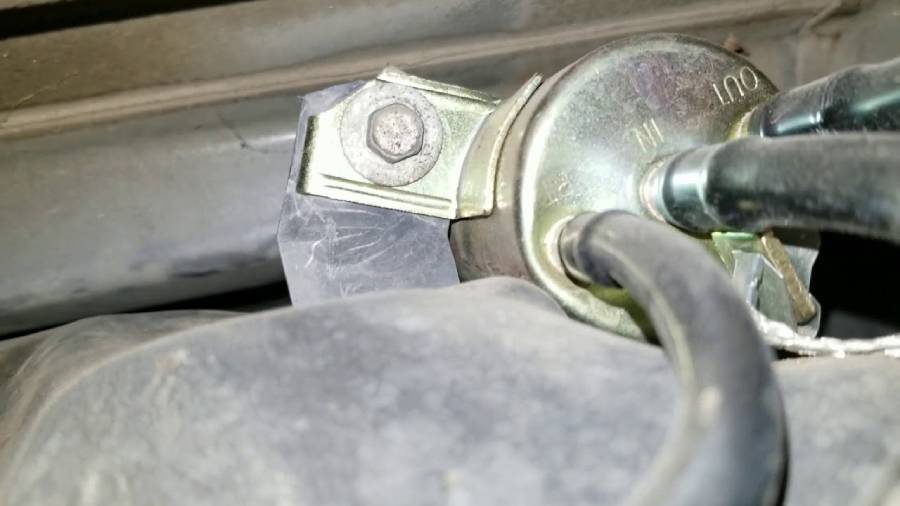
Where Is the Fuel Filter Located on a Dodge Grand Caravan?
The fuel filter on a Dodge Grand Caravan is located at or inside the fuel tank, depending on the model year and fuel-system design. Earlier models can use a separately mounted filter attached to the top of the fuel tank, while later models use a filter incorporated into the fuel pump module inside the tank. This is why searching under the hood for a conventional inline fuel filter often does not reveal one.
On a 2000 Dodge Grand Caravan, for example, service information places the fuel filter directly on top of the fuel tank. The filter has permanently attached inlet and outlet tubes and is retained to the tank with a mounting screw. Although this filter is a separate service component, its position above the tank makes access more difficult than an engine-bay or frame-mounted filter.
The design changed on later Grand Caravan configurations. For a 2008 model, service information identifies the fuel pump as being within the fuel pump module, while repair guidance for the same model describes the fuel filter as part of that module. Access requires removal of the fuel tank followed by removal of the fuel pump module from the tank.
Therefore, the correct answer to “Where is my Dodge Grand Caravan fuel filter?” starts with the vehicle’s model year. The fuel tank remains the primary location to inspect, but the filter may be a separate tank-mounted component or an integrated part of the in-tank fuel pump system.
Does the Dodge Grand Caravan Fuel Filter Location Change by Model Year?
Yes. The Dodge Grand Caravan fuel filter configuration changes by model year, so owners should identify the year before locating or purchasing a replacement filter. The key difference is not simply where the filter sits; it is also whether the filter exists as a separately serviceable component or is incorporated into the fuel pump system.
A 2000 Grand Caravan provides a clear example of the earlier arrangement. Factory-style service information specifies that the fuel filter mounts on top of the fuel tank and describes removing the filter from the tank after disconnecting its quick-connect fittings. This configuration makes the filter a distinct component even though it is positioned in a relatively inaccessible area.
Later configurations moved toward an integrated fuel pump module arrangement. For a 2008 Caravan, the filter is identified as part of the fuel pump module rather than the type of external filter found on older vehicles. The module itself is removed as an assembly from the fuel tank.
For this reason, a replacement filter listed for one Grand Caravan model year should not automatically be assumed to fit another. Check the exact model year, engine configuration, and applicable parts information before ordering a fuel filter or fuel pump module.
Where Is the Fuel Filter on Older Dodge Grand Caravan Models?
On older Dodge Grand Caravan models with a separately serviceable fuel filter, the filter can be mounted on top of the fuel tank rather than under the hood. The 2000 Grand Caravan service procedure specifically identifies the top of the fuel tank as the mounting location. Its fuel supply, return, and chassis supply connections attach through quick-connect fittings.
This location explains why the filter can be difficult to see during a basic inspection underneath the vehicle. A component mounted above the tank can be hidden between the tank and vehicle body. Access requirements should therefore be checked against service information for the exact year rather than assuming that a visible inline filter will be present along the fuel line.
There is also evidence of differences even among closely related older model years. Repair guidance for a 2001 Grand Caravan places the filter assembly underneath the van at the top of the fuel tank and states that the tank must be lowered for access. This reinforces the need to identify the specific year before beginning disassembly.
Where Is the Fuel Filter on Newer Dodge Grand Caravan Models?
On newer Dodge Grand Caravan configurations, the fuel filter is associated with the in-tank fuel pump module rather than a conventional external inline filter. For the 2008 model, repair information identifies the filter as part of the fuel pump module, which is removed as an assembly from the fuel tank.
This design changes the repair process substantially. Instead of following the fuel line until a removable canister-style filter is found, the technician works at the fuel tank and fuel pump module. Service documentation for the 2008 Grand Caravan also confirms that the electric fuel pump is located within the fuel pump module and warns that the fuel system remains under pressure even when the engine is off.
The practical distinction between the configurations can be summarized as follows:
| Model year example | Fuel filter location | Configuration | Access |
|---|---|---|---|
| 2000 Grand Caravan | Top of fuel tank | Separate tank-mounted filter | Access filter at fuel tank |
| 2001 Grand Caravan | Top of fuel tank | Fuel filter assembly | Fuel tank must be lowered for access |
| 2008 Caravan | Fuel tank | Part of fuel pump module | Remove tank and fuel pump module |
These examples demonstrate why model year matters when locating the filter. They should not be interpreted as proof that every vehicle within a broad generation uses an identical filter configuration; the exact application should be confirmed before service.
Is the Dodge Grand Caravan Fuel Filter Inside the Fuel Tank?
The Dodge Grand Caravan fuel filter is not always inside the fuel tank; its position depends on the model year and fuel-system configuration. Some earlier Grand Caravan models use a separate filter mounted on the fuel tank, while later configurations use a filter that is serviced as part of the in-tank fuel pump module.
For example, the 2000 Grand Caravan uses a replaceable inline fuel filter attached to a bracket on top of the fuel tank. Service information also identifies the fuel pump module as a separate assembly installed in the top of the tank. This means the main replaceable filter on this configuration is tank-mounted rather than physically contained inside the fuel pump module.
The 2002 Grand Caravan AWD provides another example. Its service information places the fuel filter on the fuel tank next to the fuel pump module. This distinction matters because a filter located on top of the tank can appear to be an “in-tank” component when viewed from underneath the vehicle even though the service documentation identifies it as a separate tank-mounted component.
Later Grand Caravan designs use a different arrangement. Service information for the 2007 Grand Caravan states that its fuel filter is replaceable only as part of the fuel pump module. The electric fuel pump is also contained in that in-tank module. Therefore, owners of these configurations should not expect to find a conventional standalone filter along the fuel line.
The practical rule is to check the exact model year before deciding whether the filter is outside or inside the tank assembly. “Located near the fuel tank,” “mounted on the fuel tank,” and “integrated into the fuel pump module” describe different configurations and can require different replacement procedures.
Is the Dodge Grand Caravan Fuel Filter Part of the Fuel Pump?
The fuel filter is part of the fuel pump module on some Dodge Grand Caravan model years, but earlier models can have a separate serviceable fuel filter. The fuel filter and fuel pump perform different functions even when both components are packaged within the same module.
The transition can be seen by comparing service information from different years. A 2000 Grand Caravan has a replaceable inline filter mounted on top of the tank, while the pump is serviced as part of the fuel pump module. By 2007, Grand Caravan service information states that the fuel filter is replaceable only as part of the fuel pump module.
An integrated module reduces the number of separately serviced fuel-delivery components. However, it also means that a failed or restricted filter may not have a standalone replacement procedure. The applicable service information and replacement-parts catalog should therefore be checked before purchasing a filter based only on the vehicle name.
What Is the Difference Between the Fuel Filter and Fuel Pump?
The fuel pump moves gasoline from the fuel tank toward the engine, while the fuel filter removes contaminants from the fuel before they reach downstream fuel-system components. They perform separate jobs even when Dodge packages them within the same fuel pump module.
The electric pump creates the flow needed to deliver fuel through the system. On the 2000 Grand Caravan, service documentation describes the pump as drawing fuel through a strainer before pushing it toward the outlet. The same fuel-delivery system includes fuel lines, quick-connect fittings, the injector rail, injectors, and the fuel tank.
The filter provides contamination control within that delivery path. This distinction is important during diagnosis because finding debris or a suspected restriction does not automatically prove that the electric pump itself has failed. Conversely, low fuel delivery cannot automatically be attributed to the filter without testing the fuel system.
A fuel strainer should also not automatically be treated as the same component as the main fuel filter. Service information for the 2000 Grand Caravan, for example, identifies an inlet strainer within the fuel pump module while also describing a separate replaceable inline fuel filter mounted on top of the tank.
Can the Dodge Grand Caravan Fuel Filter Be Replaced Separately?
A Dodge Grand Caravan fuel filter can be replaced separately on certain older configurations, but later configurations can require replacement of the fuel pump module because the filter is not serviced separately. Model year is therefore essential when determining the correct repair.
For the 2000 Grand Caravan, the service procedure specifically provides removal and installation instructions for the fuel filter. The process includes releasing fuel-system pressure, disconnecting the quick-connect fittings, removing the retaining screw, and removing the filter from the tank. This confirms that the filter is a separate service item on that application.
The situation is different on the 2007 Grand Caravan. Service documentation states that the fuel filter is replaceable only as part of the fuel pump module. Replacing a standalone inline filter would therefore not correspond to the factory-described configuration for that vehicle.
This difference can also affect repair cost and labor. Replacing a separately mounted filter involves a different parts requirement from replacing a complete fuel pump module. Verify the year, engine, and applicable part number before ordering components.
How Can You Access the Fuel Filter on a Dodge Grand Caravan?
Access the Dodge Grand Caravan fuel filter from the fuel-tank area, but use the service procedure for the exact model year because the amount of disassembly varies by configuration. A top-of-tank filter and an integrated fuel pump module are not accessed in exactly the same way.
For a 2000 Grand Caravan with the separate tank-mounted filter, factory-style instructions call for releasing fuel-system pressure before disconnecting the quick-connect fittings. The vehicle is then raised and supported before the filter retaining screw is removed. The procedure confirms that service takes place around the fuel tank rather than in the engine compartment.
Access becomes more involved when service requires removal of an in-tank module. The 2012 Grand Caravan fuel pump module procedure begins with fuel-tank removal. Once the tank is removed, the electrical connector and fuel-line quick connector are disconnected, the area surrounding the module is cleaned, the lock ring is removed, and the module is lifted from the tank as an assembly.
Fuel-system work requires specific safety precautions because gasoline and fuel vapor are flammable. Dodge service information instructs technicians to relieve fuel pressure before disconnecting components, work in a well-ventilated area, keep ignition sources away, disconnect the negative battery cable when appropriate, use a suitable fuel container, and inspect for leaks after repairs.
Do not begin by removing the tank simply because the filter cannot be seen under the hood. First identify the exact model year and confirm whether the vehicle uses a separately tank-mounted filter or an integrated fuel pump module. That step prevents unnecessary disassembly and reduces the risk of purchasing an incompatible component.
How Can You Identify the Fuel Filter on a Dodge Grand Caravan?
Identify the Dodge Grand Caravan fuel filter by its position, fuel-line connections, and relationship to the fuel pump module rather than by looking only for a conventional metal inline filter. The appearance and service configuration differ across model years.
On a 2000 Grand Caravan, the filter mounts to the top of the fuel tank and uses permanently attached inlet and outlet tubes. Quick-connect fittings connect the filter with the fuel pump module and chassis fuel supply tube. These characteristics distinguish the filter from the pump module itself.
The 2002 Grand Caravan AWD service information provides an additional positional reference: the fuel filter is on the fuel tank next to the fuel pump module. Therefore, locating the pump module on this configuration also helps identify the neighboring filter.
On configurations such as the 2007 Grand Caravan, looking for a separate filter can lead to confusion because service information identifies the filter as replaceable only with the fuel pump module. In this case, identification should focus on the module and the vehicle-specific parts information rather than searching the chassis for an external filter.
Use the model year, engine, drivetrain configuration when relevant, and vehicle-specific parts information to confirm the component before ordering a replacement. Two Grand Caravans carrying the same model name can use different fuel-filter arrangements, so visual similarity alone is not sufficient for reliable part identification.
What Are the Symptoms of a Bad Fuel Filter on a Dodge Grand Caravan?
A restricted Dodge Grand Caravan fuel filter can reduce fuel delivery and contribute to hard starting, hesitation, loss of power under load, sputtering, or stalling. These symptoms occur when the engine cannot receive the fuel flow and pressure required for its operating conditions. However, symptoms alone do not confirm a clogged filter because a weak fuel pump, restricted fuel line, electrical fault, or other engine problem can produce similar behavior.
Loss of power during acceleration is one of the more relevant signs of restricted fuel delivery. An engine requires more fuel as load increases, so a restriction that is less noticeable at idle can become apparent during acceleration or highway driving. The vehicle may hesitate, sputter, or struggle to maintain speed because the fuel system cannot maintain the required delivery rate. A reported 2007 Grand Caravan case, for example, described sputtering and an inability to accelerate normally, although that symptom by itself could not distinguish between a weak pump and a restricted filter.
Hard starting or a crank-no-start condition can also occur when fuel pressure is insufficient. The mechanism is straightforward: the pump must establish adequate pressure and deliver fuel to the injectors before normal combustion can occur. If pressure remains too low, the engine can crank without starting or require additional cranking time. These symptoms still require diagnosis because pump operation, electrical supply, pressure regulation, and fuel restriction can all affect available fuel pressure.
Stalling can occur when fuel delivery drops below engine demand. The engine may initially run and then lose power as demand increases, or it may operate intermittently if fuel supply is inconsistent. A clogged filter should therefore be treated as one possible cause within the fuel-delivery system rather than as the automatic diagnosis whenever a Grand Caravan stalls.
The relationship between restriction and fuel pressure is supported by older Dodge diagnostic procedures. A 1994 Grand Caravan diagnostic sequence instructs technicians to compare fuel-pressure readings before and upstream of the fuel filter. If pressure rises sufficiently when the gauge is moved between the tank and filter, the procedure directs replacement of the fuel filter. If it does not, diagnosis continues to other components such as the pressure regulator, fuel pump, and pump strainer.
How Can You Tell if the Dodge Grand Caravan Fuel Filter Is Clogged?
The most reliable way to identify a clogged Dodge Grand Caravan fuel filter is to diagnose fuel pressure and fuel flow according to the service procedure for the specific model year rather than relying on driving symptoms alone. A pressure test can establish whether the fuel-delivery system is operating within specification, while additional testing can help isolate a restriction from a weak pump or another fault.
Start by documenting the actual symptom. Hard starting, hesitation, sputtering, stalling, and loss of power under load can justify checking fuel delivery, but none specifically proves that the filter is clogged. The same symptoms can originate from components outside the filter, so replacing parts based solely on how the vehicle feels can result in an unnecessary repair.
Fuel-pressure testing provides objective information. The correct pressure specification and connection procedure must come from service information for the exact year and engine because Grand Caravan fuel systems changed during the model’s production life. For example, diagnostic information for a 1998 Grand Caravan lists approximately 49 psi with the key on and engine off for the application discussed. This number should not be applied automatically to every Grand Caravan model year.
Older Dodge diagnostic procedures demonstrate how pressure testing can isolate the filter itself. In one 1994 Grand Caravan procedure, the technician first checks system pressure and inspects the fuel lines for restrictions. If pressure is low, the gauge is repositioned between the fuel tank and fuel filter. A sufficiently higher upstream reading identifies the filter as the restriction and directs the technician to replace it. If the pressure does not increase as specified, the diagnostic path moves to the pressure regulator, fuel pump, or pump strainer.
This pressure difference is useful because a clogged filter creates resistance between the pump and the downstream fuel system. The pump can generate pressure on the inlet side of the restriction while insufficient pressure reaches the engine side. Measuring rather than guessing separates that condition from a pump that cannot generate adequate pressure in the first place.
Diagnosis becomes different on Grand Caravan models where the filter is integrated into the fuel pump module. A later integrated filter cannot necessarily be disconnected and tested in the same manner as an older external filter. The entire fuel delivery system must instead be evaluated using the procedure specified for that vehicle. This is another reason the model year and fuel-system configuration must be established before diagnosis.
Do not assume that low fuel pressure automatically means the filter is clogged. A weak fuel pump, restricted line, pressure-control problem, electrical supply issue, or pump-module fault can also produce inadequate pressure. The correct diagnostic sequence is verify the symptom → measure fuel pressure → compare the result with the model-specific specification → isolate the restriction or failing component.
How Often Should a Dodge Grand Caravan Fuel Filter Be Replaced?
There is no single Dodge Grand Caravan fuel filter replacement interval that should be applied to every model year because the filter design and serviceability changed across the vehicle’s production history. Older models can have a separately replaceable tank-mounted filter, while later configurations can incorporate the filter into the fuel pump module.
For a Grand Caravan with a separately serviceable filter, maintenance decisions should follow the schedule and service information for the exact model year rather than a generic mileage recommendation. The earlier sections show why this distinction matters: a 2000 Grand Caravan has a separately removable filter on top of the fuel tank, whereas service information for a 2007 Grand Caravan describes the fuel filter as replaceable only as part of the fuel pump module.
An integrated filter changes the maintenance strategy. If the manufacturer does not specify routine standalone filter replacement and the filter is part of the pump module, replacing an external “fuel filter” at an arbitrary mileage is not applicable because that separate component does not exist in the same form. Diagnosis becomes more important when fuel-delivery symptoms appear.
Fuel contamination can also affect filter condition independently of mileage. Dirt, debris, corrosion, or contaminated fuel entering the tank increases the material the filtration system must capture. A vehicle with contamination in the fuel system can therefore develop restriction-related problems without following a predictable mileage pattern.
The correct approach is to check the owner’s manual or service information for the exact year, identify whether the filter is separately serviceable, and diagnose the fuel system when restriction symptoms appear. Avoid universal recommendations such as replacing every 30,000 or 40,000 miles unless that interval is explicitly supported for the specific Dodge Grand Caravan being serviced.
How Much Does Dodge Grand Caravan Fuel Filter Replacement Cost?
Dodge Grand Caravan fuel filter replacement cost depends primarily on whether the vehicle has a separately serviceable filter or a filter integrated into the fuel pump module. These configurations require different parts and labor, so there is no reliable single replacement price that applies to every Grand Caravan model year.
Older configurations with a separately replaceable filter can require less expensive parts than an integrated fuel pump module. However, the filter’s location on or above the fuel tank can still increase labor because access is more difficult than replacing a conventional filter mounted in an exposed section of the fuel line. The final price therefore depends on the model year, filter design, accessibility, local labor rate, and whether additional fuel-system components require service.
The cost can rise substantially when the filter is serviced only with the fuel pump module. Current RepairPal estimates place average Dodge Grand Caravan fuel pump replacement at $1,756–$1,842, including approximately $169–$248 for labor and $1,587–$1,594 for parts. These figures exclude taxes, fees, location-based price differences, and related repairs.
Model year creates an even larger variation. RepairPal currently estimates approximately $679–$771 for a 2007 Grand Caravan, $1,953–$2,033 for a 2008 or 2009 model, $1,399–$1,586 for a 2010 model, and $1,983–$2,063 for 2011–2020 models. For example, its 2017 estimate is $1,983–$2,063, with about $171–$251 attributed to labor and approximately $1,812 to parts.
These prices should not be interpreted as the cost of replacing a standalone fuel filter. They are useful for later Grand Caravan configurations where solving a filter-related problem can involve servicing the fuel pump module. A diagnosis should confirm the failed or restricted component before an expensive module is replaced. RepairPal likewise notes that a clogged filter and fuel-pump electrical problems can produce symptoms similar to pump failure and recommends verifying the actual cause before pump replacement.
Get a vehicle-specific estimate using the exact model year and engine before approving the repair. The difference between a tank-mounted serviceable filter and an integrated pump-module design can change both the required part and the total repair cost.
Can You Replace a Dodge Grand Caravan Fuel Filter Yourself?
You can replace the fuel filter yourself on some Dodge Grand Caravan models, but the job becomes substantially more difficult when access requires lowering the fuel tank or removing the in-tank fuel pump module. DIY suitability therefore depends on the model year, fuel-filter configuration, available equipment, and the person’s experience working safely with gasoline fuel systems.
A separately serviceable filter does not automatically make the repair easy. On configurations where the filter is mounted on top of the fuel tank, the technician still needs safe access underneath the vehicle and must disconnect pressurized fuel-line fittings. The earlier service information discussed in this guide shows that a 2000 Grand Caravan requires fuel-pressure relief, vehicle lifting and support, disconnection of quick-connect fittings, and removal of the filter from the tank area.
An integrated fuel pump module adds more work. The procedure can require draining or supporting the fuel tank, disconnecting fuel and electrical connections, lowering the tank, cleaning around the module opening, removing its retaining ring, and extracting the module. The tank must then be reinstalled correctly and the system checked for fuel leaks. This is considerably more involved than changing an accessible engine-bay filter.
There are 4 practical requirements for a safe DIY repair: correct vehicle-specific service information, proper vehicle-support equipment, appropriate fuel-line or module tools, and a work area suitable for handling gasoline safely. Fuel vapor can ignite, and the fuel system can retain pressure after the engine is switched off. Avoid flames, sparks, smoking, and other ignition sources while the system is open.
Do not crawl beneath a vehicle supported only by a jack. Use appropriately rated support equipment on a stable surface and follow the lifting points specified for the vehicle. Fuel-tank removal also becomes harder when the tank contains a large quantity of gasoline because the additional weight makes the assembly more difficult to control.
A professional repair is the better option when the tank must be removed and you do not have suitable lifting equipment or fuel-system experience. The same applies when the actual fault has not been diagnosed. Replacing a pump module because the van hesitates, stalls, or has low power can become an expensive parts-swap if the underlying problem is electrical or elsewhere in the fuel-delivery system.
For experienced DIY owners, the correct workflow is identify the model year → confirm the filter configuration → diagnose the fuel-delivery problem → obtain the correct service procedure and parts → relieve fuel pressure → perform the repair → inspect the system for leaks. This sequence prevents the location question from turning into unnecessary fuel-tank or fuel-pump removal.
The most important distinction is therefore not simply whether a Dodge Grand Caravan has a fuel filter. It is which filter configuration that specific model year uses. Older Grand Caravans can have a separately serviceable filter on top of the fuel tank, while later configurations can incorporate filtration into the in-tank fuel pump module. Confirming that design first determines where to look, what part to buy, how difficult the repair will be, and whether DIY replacement is practical.