A Dodge Charger takes unleaded gasoline, but the correct octane rating depends on its engine, trim, transmission, and model year. Dodge Charger models equipped with different V6, HEMI V8, and supercharged HEMI V8 engines do not necessarily have the same fuel recommendation. As a result, choosing between regular, mid-grade, and premium gasoline requires identifying the specific Charger configuration first.
The fuel requirement is commonly expressed through an octane rating such as 87, 89, 91, or 93. Some Dodge Charger configurations can operate on regular unleaded gasoline, while performance-oriented versions may recommend or require higher-octane fuel. The distinction between “required” and “recommended” is important: a required octane establishes the fuel specification that should be followed, while a recommendation may identify the fuel that provides the intended engine performance.
This guide explains the Dodge Charger gas type by engine and trim, including the SXT, GT, R/T, Scat Pack, and SRT Hellcat. It also covers regular versus premium gas, octane ratings, incorrect fuel use, ethanol-blended gasoline, and how to verify the correct fuel for a specific Dodge Charger model year.
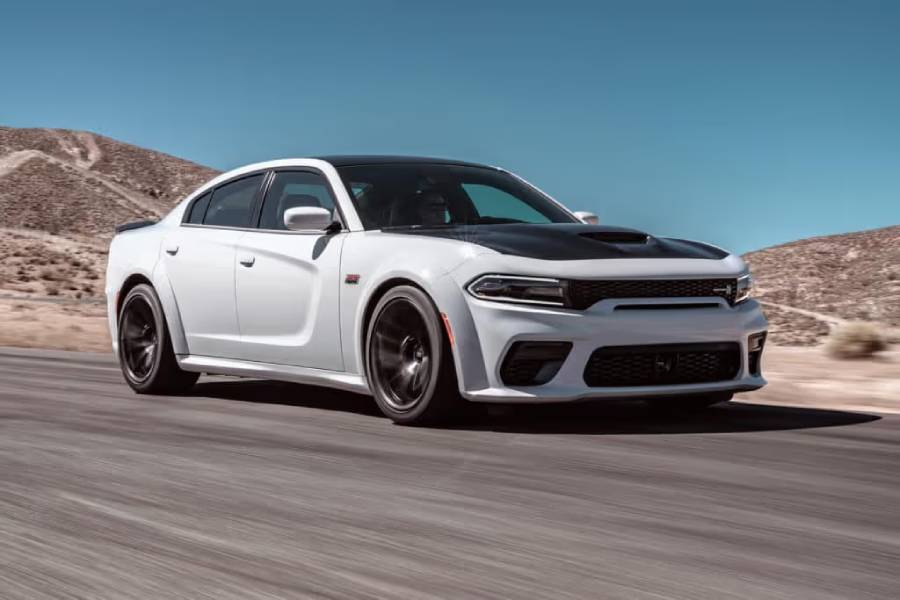
What Type of Gas Does a Dodge Charger Take?
A Dodge Charger takes unleaded gasoline, with the correct octane rating determined by its engine, trim, transmission, and model year. There is no single octane rating that applies to every Dodge Charger because the model has been offered with multiple powertrains, ranging from V6 engines to naturally aspirated and supercharged HEMI V8 engines.
The main gasoline choices are regular, mid-grade, and premium unleaded fuel. In the United States, these grades are commonly associated with 87, 89, and 91–93 octane, respectively. The octane number represents a fuel’s resistance to uncontrolled combustion or engine knock. An engine designed for a higher octane rating can use its intended ignition timing and operating parameters without the same tendency toward knock that lower-octane fuel may create under demanding conditions.
The specific engine is therefore more important than the Dodge Charger name when selecting gasoline. A Charger equipped with a V6 does not automatically have the same fuel recommendation as an R/T with a HEMI V8 or an SRT Hellcat with a supercharged HEMI V8. Model year also matters because Dodge changed the Charger engine and trim lineup across different generations.
Drivers should distinguish between a minimum acceptable octane, a recommended octane, and a required octane. These terms do not mean the same thing. A minimum rating identifies the lowest fuel grade permitted for a particular configuration, while a recommended rating identifies the gasoline intended to provide the manufacturer’s expected operation or performance. When a specific fuel grade is required, drivers should follow that requirement rather than treating a lower grade as an equivalent substitute.
The owner’s manual for the specific model year provides the final reference for fuel selection. This is particularly important when buying a used Charger because trim badges, engine swaps, modifications, or differences between model years can make a general online recommendation unreliable for an individual vehicle.
What Octane Gas Does a Dodge Charger Need?
A Dodge Charger may use 87, 89, 91, or higher-octane gasoline depending on its engine and configuration. The correct approach is to match the octane rating to the manufacturer’s specification for the engine rather than selecting fuel based only on whether the vehicle is labeled a Charger.
Octane requirements become more important as engine operating conditions increase the potential for knock. Higher compression, aggressive ignition strategies, forced induction, and high engine loads can increase the need for knock-resistant fuel. This helps explain why a gasoline recommendation for a standard Charger powertrain should not automatically be applied to a high-performance Charger.
Using the correct octane also allows the engine management system to operate within its intended calibration. Modern engines can monitor combustion through knock sensors and make adjustments when necessary, but this protection should not be interpreted as permission to routinely ignore the manufacturer’s fuel specification. The specified octane remains the appropriate baseline for normal operation.
Can a Dodge Charger Use 87 Octane Gas?
Some Dodge Charger configurations can use 87-octane regular unleaded gasoline, but 87 octane is not the correct choice for every Charger engine. Drivers must identify the engine and model year before treating regular gasoline as the default fuel.
This distinction matters because the Charger lineup includes engines with substantially different performance characteristics. A naturally aspirated V6 and a supercharged performance V8 operate under different combustion conditions. A fuel grade acceptable for one engine therefore does not establish the fuel requirement for another.
Drivers should also check whether 87 octane is listed as acceptable or actually recommended for their configuration. If Dodge specifies another octane as the recommended fuel, choosing that grade is the more appropriate way to obtain the engine operation and performance intended by the manufacturer.
Can a Dodge Charger Use 89 Octane Gas?
Certain Dodge Charger configurations may specify or recommend 89-octane mid-grade gasoline. This is particularly important for owners who assume the only choices are 87-octane regular and 91–93-octane premium.
Mid-grade gasoline provides greater resistance to knock than regular gasoline while remaining below the octane rating of premium fuel. Where Dodge recommends 89 octane for a particular engine and configuration, that recommendation reflects the engine calibration rather than a generic preference for more expensive gasoline.
Drivers should not replace a specific 89-octane recommendation with 87 octane simply because the engine appears to run normally after refueling. The engine control system can compensate for changing combustion conditions within limits, but the absence of an immediate warning light or obvious engine noise does not redefine the manufacturer’s recommended fuel.
Can a Dodge Charger Use 91 or 93 Octane Gas?
A Dodge Charger can use 91- or 93-octane premium gasoline when the engine permits it, and high-performance Charger configurations may specifically call for premium fuel. The exact requirement must still be checked against the engine and model year.
Premium gasoline has greater resistance to knock than lower-octane fuel. That characteristic becomes relevant in performance engines operating with conditions such as high cylinder pressures or forced induction. Supercharged Charger engines are an important example because their fuel requirements should not be inferred from the recommendations for standard V6 models.
Using 91 or 93 octane does not automatically increase horsepower, fuel economy, or engine life in a Charger designed to operate normally on a lower octane. Higher octane primarily provides greater knock resistance; it does not contain a universal performance upgrade that benefits every engine.
For this reason, the best octane for a Dodge Charger is not necessarily the highest number available at the pump. The best octane is the rating that matches the fuel specification for the Charger’s specific engine, configuration, and model year.
Does a Dodge Charger Need Premium Gas?
Not every Dodge Charger needs premium gas. Whether premium gasoline is required or recommended depends primarily on the engine, performance configuration, and model year.
This distinction is necessary because “Dodge Charger” represents a model family rather than one mechanical specification. Chargers have been sold with V6 engines, naturally aspirated HEMI V8 engines, and high-output supercharged HEMI V8 engines. Their combustion requirements differ, so a single regular-versus-premium answer cannot accurately describe the entire lineup.
Premium gasoline is most relevant when the engine is calibrated for higher-octane fuel. Higher octane resists knock under demanding combustion conditions, allowing an appropriately designed engine to operate according to its intended calibration. Performance-focused Charger models therefore require closer attention to the manufacturer’s octane specification than a blanket recommendation based on the vehicle name.
Drivers should also distinguish between premium recommended and premium required. If premium is recommended, another permitted grade may still allow the vehicle to operate, although performance or operating characteristics may differ. If the manufacturer requires a particular minimum octane, that specification should be followed.
Buying premium gasoline for a Charger that is designed for regular fuel does not automatically create additional horsepower or better fuel economy. Conversely, routinely selecting regular gasoline solely to reduce fuel costs is inappropriate when a particular Charger engine specifies a higher octane. Fuel should be selected according to the engine’s specification, not according to the assumption that premium is always better or regular is always sufficient.
What Gas Does a Dodge Charger SXT Take?
A Dodge Charger SXT generally uses regular unleaded gasoline because the SXT is primarily equipped with a naturally aspirated V6 engine rather than a high-output HEMI V8. The exact minimum octane specification should still be confirmed for the vehicle’s model year because Dodge Charger powertrain specifications have changed during the model’s production history.
For later seventh-generation Charger models equipped with the 3.6-liter Pentastar V6, 87-octane regular unleaded gasoline is the relevant fuel grade for normal operation. The engine is designed to operate without requiring the higher knock resistance associated with premium gasoline. This makes the SXT less dependent on higher-priced fuel than performance-focused Charger variants.
Using premium 91- or 93-octane gasoline in an SXT does not automatically increase engine output. Octane measures resistance to knock rather than the amount of energy contained in gasoline. An engine calibrated to operate on 87 octane cannot be assumed to produce additional horsepower simply because higher-octane fuel is added to the tank.
The practical fuel choice for an unmodified Charger SXT is therefore the octane grade specified by Dodge for its engine and model year. Owners of modified vehicles should follow the requirements of the engine calibration or tuner because changes to ignition timing, forced induction, compression, or engine management can alter the fuel requirement.
What Gas Does a Dodge Charger GT Take?
A Dodge Charger GT with the 3.6-liter Pentastar V6 generally uses 87-octane regular unleaded gasoline. Although the GT has sportier styling and performance-oriented features compared with some SXT configurations, the GT badge alone does not mean the vehicle requires premium gasoline.
Fuel requirements are determined primarily by the engine and its calibration rather than exterior styling, suspension equipment, wheels, or other trim-specific features. The GT’s V6 powertrain therefore has a different fuel requirement from Charger variants equipped with high-output HEMI V8 engines even though both vehicles belong to the same model family.
Putting 91- or 93-octane premium gasoline into a standard GT does not guarantee more horsepower or better fuel economy. Premium gasoline provides additional resistance to engine knock, but that characteristic creates a meaningful advantage only when the engine and its control strategy are designed to use the additional octane.
Owners should nevertheless verify the fuel specification in the owner’s manual for their exact model year. This prevents a common ownership mistake: selecting gasoline based on the trim name while ignoring the engine installed in the vehicle. For fuel selection, engine specification has greater relevance than the SXT or GT badge by itself.
What Gas Does a Dodge Charger R/T Take?
A Dodge Charger R/T with a 5.7-liter HEMI V8 can have a different octane recommendation from the V6-powered SXT and GT, so owners should not automatically fill an R/T with the same 87-octane gasoline used in those models. The correct fuel depends on the model year and powertrain specification, including the transmission where Dodge makes that distinction.
The 5.7-liter HEMI changes the fuel context because it is a V8 performance engine with a different combustion design and calibration from the 3.6-liter Pentastar V6. For relevant Charger R/T configurations, Dodge documentation has recommended mid-grade 89-octane gasoline while permitting a lower octane under specified conditions. Owners should treat the recommended grade and the minimum acceptable grade as separate specifications rather than assuming they are interchangeable.
This distinction explains why saying that the Charger R/T simply “takes regular gas” can be incomplete. If an owner’s manual identifies 89 octane as the recommended gasoline and 87 octane as acceptable, 87 octane represents an allowable lower grade rather than the manufacturer’s preferred fuel for that configuration. Following the recommended octane provides the operating conditions for which the engine calibration was intended.
The R/T also demonstrates why every Dodge Charger fuel guide should account for model year and transmission. Earlier Charger configurations and different powertrain combinations can have requirements that do not match later models. A recommendation taken from one R/T should therefore not be applied automatically to every R/T produced across the Charger nameplate’s history.
Using premium 91- or 93-octane gasoline in a Charger R/T also does not mean the engine will automatically produce substantially more power. Higher octane provides greater resistance to knock, but the benefit depends on whether the engine calibration can use that additional resistance through parameters such as ignition timing. Fuel with an octane rating above the manufacturer’s recommendation should not be treated as a substitute for other performance modifications.
For a stock Dodge Charger R/T, use the gasoline grade recommended in the owner’s manual for the exact model year, engine, and transmission combination. This method is more accurate than choosing fuel based on general rules such as “all V8s need premium” or “all Chargers can run on regular.”
What Gas Does a Dodge Charger Scat Pack Take?
A Dodge Charger Scat Pack with the 6.4-liter HEMI V8 is designed for premium unleaded gasoline, with 91 octane commonly specified as the appropriate minimum grade for this performance-oriented engine. Owners should confirm the requirement in the owner’s manual for their exact model year rather than applying the fuel recommendation of the 5.7-liter Charger R/T.
The Scat Pack’s fuel requirement differs from lower-output Charger configurations because its 6.4-liter HEMI operates under a different performance calibration. Higher-octane gasoline has greater resistance to uncontrolled combustion, allowing an engine designed around premium fuel to operate under demanding loads without the same knock tendency associated with lower-octane gasoline.
This is also why the fuel recommendation for the Charger R/T should not automatically be transferred to the Scat Pack. Both models use HEMI V8 engines, but engine displacement and calibration differ. The R/T’s 5.7-liter HEMI and the Scat Pack’s 6.4-liter HEMI are separate engine configurations with separate fuel specifications.
Using 93 octane instead of 91 octane is generally not the same as performing a performance modification. If the stock engine is designed to meet its performance targets on 91-octane gasoline, adding a higher-octane fuel does not guarantee an equivalent increase in horsepower. The extra knock resistance becomes more relevant when an engine calibration is specifically designed to take advantage of it.
Modified Scat Pack models require separate consideration. Changes such as aftermarket tuning, altered ignition timing, forced induction, or major engine modifications can change the required octane. In that situation, the stock owner’s manual no longer provides enough information by itself; the fuel must also meet the requirements of the modified engine calibration.
What Gas Does a Dodge Charger SRT Hellcat Take?
A Dodge Charger SRT Hellcat requires premium unleaded gasoline because its supercharged HEMI V8 operates under substantially different conditions from the naturally aspirated V6 and lower-output V8 engines used in other Charger trims. Owners should follow the minimum octane specified for their exact Hellcat model and model year rather than substituting regular gasoline as a routine fuel choice.
Forced induction is an important part of this requirement. The Hellcat’s supercharger forces additional air into the engine, allowing more fuel to be burned and producing substantially greater cylinder pressure and power. These operating conditions increase the importance of controlling knock, which makes the knock resistance provided by higher-octane gasoline relevant to the engine’s intended operation.
This difference creates a clear semantic distinction within the Charger lineup. A V6 Charger that is designed around regular gasoline, an R/T with a 5.7-liter HEMI, a Scat Pack with a 6.4-liter HEMI, and an SRT Hellcat with a supercharged HEMI should not be treated as four versions of the same fuel requirement. Engine configuration determines the fuel requirement more directly than the Dodge Charger name itself.
Drivers should not deliberately use 87-octane regular gasoline in a Hellcat simply because modern engine management systems can monitor knock and adjust operating parameters. Knock sensors and electronic controls are protective mechanisms; they do not convert lower-octane gasoline into the fuel grade specified for a high-performance engine. The correct practice is to meet the manufacturer’s minimum octane requirement.
The same principle applies when choosing between premium grades available at different gas stations. If the specified minimum is 91 octane, a higher grade such as 93 octane satisfies that minimum, but the higher number does not guarantee a proportional increase in horsepower. Engine calibration determines whether additional octane can produce a measurable performance benefit.
Does the Dodge Charger Gas Type Change by Model Year?
Yes, the correct Dodge Charger gas type can change by model year because the available engines, trims, transmissions, and manufacturer fuel specifications have changed throughout the Charger’s production history. A fuel recommendation for one model year should therefore not be treated as a universal specification for every Dodge Charger.
The relationship follows a specific sequence: model year determines the available powertrain configuration, and the powertrain configuration determines the applicable fuel specification. For example, two vehicles carrying the Charger name can have different gasoline requirements when one uses a naturally aspirated V6 and the other uses a high-output or supercharged HEMI V8.
Trim names alone can also create ambiguity when comparing different production years. Dodge has changed the Charger lineup over time, and the engines or performance packages associated with individual trims have not remained identical throughout the complete history of the nameplate. This makes the model year an essential qualifier whenever an octane recommendation is provided.
Transmission can also matter for specific Charger configurations when manufacturer documentation distinguishes fuel recommendations by powertrain combination. This is particularly relevant when researching older Charger R/T models. A generalized answer based only on engine displacement can omit a manufacturer qualification attached to a specific engine-and-transmission combination.
Owners can avoid this problem by identifying 4 pieces of information before selecting fuel: model year, trim, engine, and transmission. The owner’s manual can then be matched to the exact vehicle rather than to a generic Dodge Charger search result.
This approach is especially important for used vehicles. A badge may identify a trim, but it does not independently verify the complete mechanical configuration of a vehicle that has passed through previous owners. Engine swaps, aftermarket tuning, supercharger installations, and other modifications can make the original factory fuel recommendation incomplete for a modified car.
For a stock vehicle, the owner’s manual for the exact model year remains the primary reference. Use model-year-specific Dodge documentation whenever a general Dodge Charger gas recommendation conflicts with the specification provided for the vehicle itself.
What Happens If You Put the Wrong Gas in a Dodge Charger?
Putting the wrong octane gas in a Dodge Charger can reduce engine performance and alter combustion when the fuel does not meet the specification for that engine. The effect depends on which Charger engine is installed, how far the fuel falls below the specified octane, and whether the mistake happens once or repeatedly.
Octane measures gasoline’s resistance to knock. Engine knock occurs when combustion does not proceed as intended inside the cylinder. A Charger engine calibrated for higher-octane gasoline operates under conditions that assume a certain level of knock resistance, so replacing the specified fuel with a lower-octane grade can interfere with that operating strategy.
Modern Dodge Charger engines use electronic engine controls and knock detection to respond to changing combustion conditions. The engine management system can adjust parameters such as ignition timing when knock is detected. This protective response can reduce performance because the engine is moving away from the operating conditions used to produce its intended output.
One accidental fill-up is different from routinely using an octane below the manufacturer’s specification. A driver who accidentally adds a lower grade should avoid assuming that the vehicle has suffered immediate engine damage solely because of one tank. The appropriate response depends on the amount and grade of fuel added and the manufacturer’s instructions for that specific engine. Repeatedly using an incorrect grade, however, means repeatedly operating outside the intended fuel specification.
Using an octane rating higher than specified presents a different situation. Higher-octane gasoline has greater knock resistance, but that characteristic does not make it universally superior for every Charger. If an engine is calibrated for regular gasoline, premium fuel does not automatically create more power or improve fuel economy.
What Happens If You Put 87 Octane in a Dodge Charger That Needs Higher Octane?
Using 87-octane gasoline in a Dodge Charger that specifies a higher octane can cause the engine management system to compensate for reduced knock resistance, which may decrease performance. The practical consequences depend on the engine and whether the manufacturer identifies the higher grade as recommended or required.
This distinction is important for Charger owners. If Dodge permits 87 octane but recommends 89 for a particular configuration, using 87 is not equivalent to putting prohibited fuel into the vehicle. The lower grade may be acceptable under the manufacturer’s specification even though the recommended grade is preferred. A Charger requiring premium fuel represents a different case because 87 octane falls below the specified minimum.
Knock resistance becomes particularly relevant under high engine load. Conditions such as strong acceleration place greater demands on combustion than light-load cruising. An engine designed for higher-octane fuel therefore has more reason to rely on the specified gasoline when operating under demanding conditions.
Electronic knock control provides protection but should not be used as a fuel-selection strategy. Retarding ignition timing or making other engine-management adjustments can help respond to knock, but these actions can also prevent the engine from operating according to its intended performance calibration. The ability of an engine to compensate for unsuitable fuel does not make that fuel the correct choice.
If 87 octane is accidentally added to a Charger that specifies premium gasoline, the driver should check the owner’s manual for the exact model and follow the manufacturer’s instructions. The appropriate action can depend on how much lower-octane fuel entered the tank and how much correctly rated gasoline was already present.
Does Premium Gas Improve Dodge Charger Performance?
Premium gas improves Dodge Charger performance only when the engine is designed or calibrated to benefit from higher-octane fuel; it does not automatically increase performance in every Charger. The effect therefore depends on the engine rather than the premium label at the gas pump.
Higher-octane gasoline primarily increases resistance to knock. It should not be interpreted as gasoline containing a universal horsepower additive. If a Charger engine is designed to achieve its intended output on 87-octane gasoline, replacing 87 with 93 octane does not by itself guarantee additional horsepower.
The situation changes when an engine’s intended performance depends on premium fuel. A high-performance engine can use higher knock resistance as part of a calibration involving ignition timing, cylinder pressure, boost, or other operating parameters. In this context, premium gasoline supports the engine’s intended operating conditions rather than acting as an independent performance modification.
This distinction is especially relevant when comparing Charger trims. The fuel decision for a V6-powered SXT or GT should not be copied from an SRT Hellcat simply because both vehicles share the Charger name. Their engines operate under substantially different conditions and therefore have different relationships with octane.
Modified Chargers add another variable. An aftermarket tune can change ignition timing, boost pressure, air-fuel targets, or other parameters and may specify an octane higher than the original factory requirement. Once the engine calibration changes, owners should follow the fuel specification for that calibration instead of assuming the stock recommendation remains sufficient.
Can Higher-Octane Gas Damage a Dodge Charger?
Using gasoline with an octane rating higher than the minimum specified for a stock Dodge Charger is generally different from using gasoline with an octane rating that is too low. Higher octane primarily provides additional resistance to knock, so choosing 91 or 93 octane for an engine that accepts 87 does not create the same combustion concern as using 87 in an engine that requires premium.
The more relevant issue is whether the additional octane provides a useful benefit. A Charger designed and calibrated for regular gasoline may not be able to convert the extra knock resistance of premium fuel into meaningful additional performance. In that case, paying for higher-octane gasoline can increase fuel cost without producing a proportional improvement in horsepower or fuel economy.
Octane rating should also not be confused with overall fuel quality. A higher number at the pump describes knock resistance rather than every characteristic of the gasoline. Drivers should therefore avoid using octane alone as a measure of whether one fuel is universally “better” for an engine.
The correct rule is straightforward: meet the manufacturer’s minimum fuel specification and use the recommended octane when Dodge provides a specific recommendation for the engine. Higher octane can satisfy a lower minimum, but it should not be treated as a required upgrade unless the engine or its calibration calls for it.
Can a Dodge Charger Use Ethanol-Blended Gas?
A Dodge Charger can use ethanol-blended gasoline when the ethanol concentration and octane rating meet the fuel specifications for its engine and model year. Standard gasoline sold in the United States commonly contains ethanol, so the presence of ethanol alone does not make a fuel unsuitable for a Charger.
E10 gasoline contains up to 10% ethanol and represents a different fuel category from E85, which contains a substantially higher proportion of ethanol. This distinction matters because compatibility with conventional ethanol-blended gasoline does not automatically make a vehicle compatible with E85. The engine, fuel system, and engine-management calibration must be designed for the applicable fuel.
Drivers should therefore avoid assuming that every Dodge Charger is a flex-fuel vehicle. Flex-fuel compatibility is vehicle-specific and should be verified through the owner’s manual, manufacturer information, or vehicle identification before E85 is used. A Charger designed only for conventional gasoline should be fueled according to its specified gasoline and ethanol limits.
Ethanol content also does not replace the octane requirement. A fuel still needs to satisfy the minimum or recommended octane specified for the Charger’s engine. For example, a performance Charger requiring premium gasoline should not be filled with a lower-octane product merely because that fuel contains an approved concentration of ethanol.
The correct decision requires checking 2 separate fuel characteristics: octane rating and ethanol compatibility. Meeting one requirement does not automatically satisfy the other.
How Big Is a Dodge Charger Gas Tank?
Dodge Charger gas tank capacity varies by model year and configuration, so there is no single tank-size specification that accurately describes every Charger ever produced. Drivers should use the capacity listed for their specific model year when calculating fuel costs or estimated driving range.
Fuel tank capacity represents the maximum designed fuel volume, while the amount needed during a normal fill-up can be lower. A vehicle usually reaches the gas station before every usable portion of fuel has been consumed, so the number of gallons shown on the pump after refueling should not automatically be interpreted as the complete tank capacity.
Tank size also needs to be separated from fuel economy. A larger fuel tank allows a vehicle to carry more gasoline, but it does not make the engine more fuel-efficient. Fuel economy describes how far the vehicle travels for a given amount of fuel, while tank capacity describes how much fuel the vehicle can carry.
This distinction becomes particularly important when comparing Charger trims with different engines. A high-output V8 can have a similar physical fuel-storage context to another Charger while consuming gasoline at a different rate. Gas tank capacity and MPG must therefore be considered together when estimating how far a Dodge Charger can travel between fill-ups.
Owners who need the exact capacity should check the specifications for their model year rather than relying on a number taken from another Charger generation. This also creates a useful distinction between the questions “How much gas does a Dodge Charger hold?” and “How much gas does a Dodge Charger use?”
How Far Can a Dodge Charger Go on a Full Tank?
The distance a Dodge Charger can travel on a full tank depends primarily on its usable fuel capacity and fuel economy. A single full-tank range cannot accurately represent every Charger because MPG changes with engine, drivetrain, model year, driving conditions, and driving behavior.
Estimated range is derived from the relationship between available fuel and miles traveled per gallon. A Charger that achieves higher highway MPG can travel farther on the same quantity of gasoline than a configuration that consumes more fuel per mile. This is why a V6 Charger and a high-performance V8 Charger should not be expected to produce identical driving ranges simply because both belong to the same vehicle line.
Real-world range also differs from an ideal calculation. City traffic, repeated hard acceleration, extended idling, vehicle load, tire condition, ambient temperature, and high-speed driving can change fuel consumption. Performance-oriented driving is particularly relevant to V8 and supercharged Charger models because greater engine load requires more fuel.
The vehicle’s range display provides another estimate, but it should not be interpreted as a fixed promise of remaining mileage. The calculation responds to recent fuel-consumption patterns, so the displayed range can change when driving conditions change.
For accurate comparison, owners should evaluate tank capacity, city MPG, highway MPG, and combined MPG for the same model year and powertrain. This provides a more useful estimate than applying one generic “miles per tank” figure to every Dodge Charger.
How Do You Check the Correct Gas for Your Dodge Charger?
Check the owner’s manual for your exact Dodge Charger model year to determine the correct gasoline and octane rating. The manufacturer’s specification should take priority over a general recommendation for another Charger trim or engine.
Start by identifying the vehicle’s model year and engine. This separates configurations such as the 3.6-liter V6, 5.7-liter HEMI V8, 6.4-liter HEMI V8, and supercharged HEMI V8. The engine is a critical qualifier because these powertrains do not share one universal octane requirement.
Next, verify the trim and transmission where the manufacturer’s documentation makes those details relevant. SXT, GT, R/T, Scat Pack, and SRT Hellcat represent different positions within the Charger lineup, but the trim name should be used together with the mechanical specification rather than as a substitute for it.
Then, read the fuel information in the owner’s manual and inspect any applicable fuel label provided on the vehicle. Pay attention to the wording surrounding the octane number. “Minimum,” “recommended,” and “required” communicate different fuel instructions, so recording only the octane number can remove an important part of the manufacturer’s recommendation.
Owners should also determine whether the vehicle remains in its factory configuration. An aftermarket tune, supercharger, engine swap, or other major powertrain modification can change the fuel requirement. A modified engine may require a higher octane than the original owner’s manual specifies because the calibration and operating conditions are no longer stock.
For an unmodified Charger, use this verification sequence: model year → engine → trim and transmission where relevant → owner’s manual fuel specification → octane and ethanol requirements. This process provides a more reliable answer than selecting regular or premium gasoline solely from the Dodge Charger name.
What Gas Should You Put in Your Dodge Charger?
The correct gas for a Dodge Charger is the unleaded gasoline and octane rating specified for its engine, model year, and powertrain configuration. There is no single fuel grade that applies to every Charger because V6, naturally aspirated HEMI V8, and supercharged HEMI V8 engines have different fuel requirements.
For a stock Charger, use the owner’s manual as the primary reference and distinguish between the minimum acceptable octane and the manufacturer’s recommended or required grade. Regular 87-octane gasoline can be appropriate for specific Charger configurations, while other engines call for mid-grade or premium fuel. Performance models such as the Scat Pack and SRT Hellcat should therefore not inherit the fuel recommendation of an SXT, GT, or another Charger simply because the vehicles share the same nameplate.
Higher octane is also not automatically better. Premium gasoline provides greater resistance to knock, but a Charger designed for regular fuel does not necessarily gain additional horsepower or fuel economy from 91- or 93-octane gasoline. Conversely, routinely using fuel below the specified octane is not an appropriate way to reduce operating costs.
For the most accurate fuel choice, identify the model year, engine, trim, and transmission where applicable, then match those details to Dodge’s fuel specification. Modified Chargers should follow the octane requirements of their current engine calibration rather than relying exclusively on the original factory recommendation.