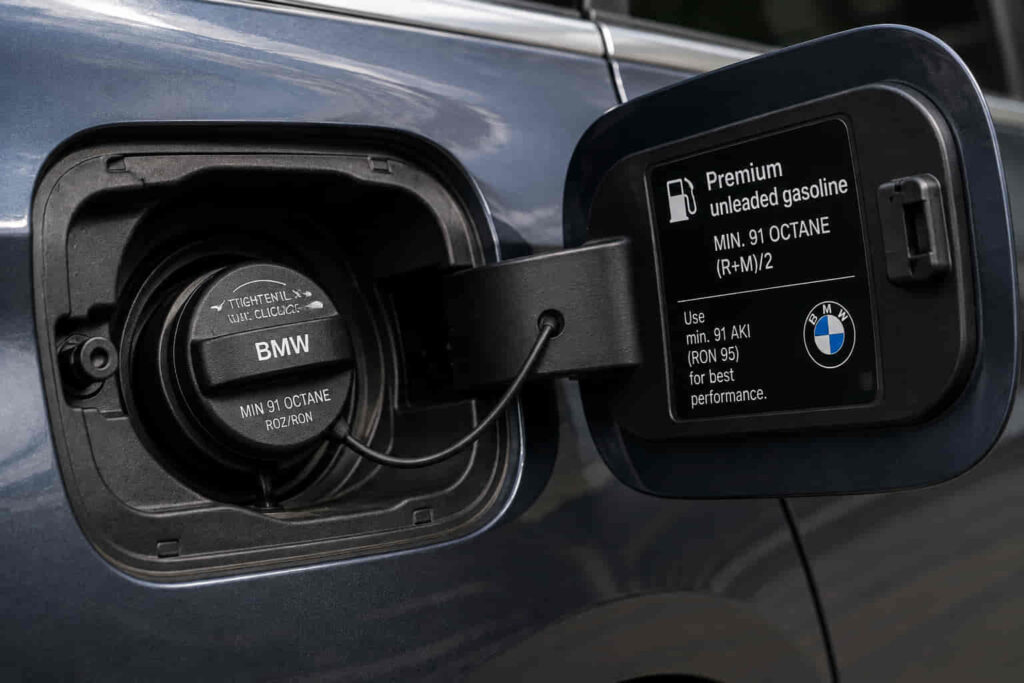
Not every BMW has the same premium-gas requirement. The correct gasoline depends on the specific BMW model, engine, model year, and the minimum or recommended octane rating specified for that vehicle. Some BMW applications specify premium-grade gasoline as the appropriate fuel, while the distinction between the minimum permitted octane and the recommended octane can affect how owners interpret whether premium gas is strictly required.
The key factor is octane rating rather than the word “premium” alone. Octane indicates a gasoline’s resistance to engine knock, and BMW engines must be operated with fuel that meets the applicable octane requirement. Using a higher octane rating does not automatically create more horsepower or better fuel economy, while using fuel below the specified requirement should not be treated as equivalent to using the recommended grade.
There are 7 things BMW owners should understand about premium gas requirements, including the difference between required and recommended fuel, minimum octane ratings, regular-gas use, engine response, performance, fuel economy, and model-specific specifications. The most reliable answer to “Do BMWs require premium gas?” therefore comes from the fuel requirements for the individual BMW rather than a single rule applied to every vehicle produced by the brand.
What Are the 7 Things to Know About BMW Premium Gas Requirements?
The 7 things to know about BMW premium gas requirements are that fuel requirements vary by vehicle, required and recommended octane are not identical concepts, octane matters more than the “premium” label, some applications may specify a lower minimum octane, regular gas does not have the same effect in every BMW, higher octane does not automatically create more power, and the vehicle-specific fuel information should determine which gasoline you use. These distinctions explain why the question “Do BMWs require premium gas?” does not have one universal answer for every BMW model and engine.
Not every BMW has the same fuel requirement because the correct gasoline is determined at the vehicle and engine level rather than by the BMW badge alone. Different engines can operate with different fuel specifications, and those specifications can also vary across model years and markets. A recommendation for one BMW should therefore not automatically be applied to another simply because both vehicles use gasoline engines. The relevant relationship is BMW model, engine, model year, and specified octane requirement. This vehicle-specific context should be established before deciding whether premium gas is mandatory, recommended, or unnecessary for a particular BMW.
Required and recommended premium gas are not the same concept. A minimum octane requirement establishes the lower fuel specification applicable to the vehicle, while a recommended octane can identify the fuel BMW intends owners to use for the expected operating characteristics of that application. Treating these terms as interchangeable creates two opposite errors: owners may believe a lower permitted octane is prohibited when it is not, or they may assume a permitted minimum provides the same operating context as the recommended fuel in every situation. The wording and octane values specified for the individual vehicle determine which interpretation is correct.
Octane rating matters more than the marketing term “premium” because octane describes the fuel characteristic relevant to resistance against knock. Gas stations classify gasoline as regular, mid-grade, or premium, but these category names are not the technical specification an engine uses. The applicable octane number is more useful because it can be compared with the vehicle’s stated requirement. This distinction also matters internationally because octane can be displayed using different rating systems, including AKI and RON. A driver should therefore compare the correct rating system rather than assuming that identical-looking octane numbers in different markets represent the same fuel.
Some BMW applications may distinguish between a recommended higher octane and a lower minimum permitted rating. When BMW provides both values for a specific vehicle, the lower value should be interpreted within that manufacturer’s stated operating context rather than converted into a universal rule that the vehicle “does not need premium.” The recommended grade remains relevant to the way the engine is intended to operate, while the minimum identifies the lower boundary specified for that application. This is why a precise answer should state whether a fuel is recommended, required, or merely within an allowed minimum instead of using those terms interchangeably.
Using regular gas does not have one universal effect on every BMW because “regular” must first be compared with the minimum octane requirement of the specific vehicle. If the available regular gasoline meets the applicable minimum requirement, that situation is fundamentally different from filling the vehicle with fuel below its specified minimum. Modern engine-management systems can monitor combustion and respond to operating conditions, but this capability should not be interpreted as permission to ignore the manufacturer’s fuel requirement. The correct question is not simply whether a BMW can physically run after being filled with regular gasoline; it is whether that gasoline meets the specification established for the vehicle.
Higher-octane gasoline does not automatically produce more horsepower simply because its octane number is higher. Octane primarily indicates resistance to knock rather than the amount of energy or performance contained in the fuel. An engine designed and calibrated around a particular fuel requirement can use the appropriate octane as part of achieving its intended operation, but continually increasing the octane number beyond what the engine can meaningfully use does not create a proportional increase in output. Premium gas therefore has the greatest relevance when it satisfies the engine’s specified or recommended octane requirement, not when it is purchased solely because a higher number appears more powerful.
The vehicle’s own fuel information is the final reference for determining whether a BMW requires premium gas. Generic statements such as “all BMWs need premium” or “modern BMWs can use regular” remove the model, engine, model year, and market context needed for an accurate answer. The applicable owner’s information and fuel-filler guidance can identify the relevant gasoline and octane requirements for the vehicle. When a minimum and recommended value are both provided, those values should retain their separate meanings rather than being reduced to one generic premium-versus-regular rule.
These 7 points lead to one practical conclusion: BMW premium gas requirements should be determined from the fuel specification of the individual vehicle, not from a brand-wide assumption. Premium gasoline may be required or recommended depending on the application, while the applicable minimum octane establishes an important boundary for fuel selection. Identifying those values first provides a more accurate answer than choosing gasoline based only on the BMW badge or the words regular and premium at the pump.
Read more: BMW Footwell Module Repair
What Octane Gas Does a BMW Need?
The octane gas a BMW needs depends on the specific model, engine, model year, and the fuel specification provided for that vehicle. There is no single octane rating that should be applied to every gasoline-powered BMW. The correct approach is to identify both the minimum permitted octane and the recommended octane, when BMW provides separate values, before deciding which fuel grade to use.
Octane rating describes gasoline’s resistance to knock, which is why the number matters more than whether the pump labels the fuel regular or premium. BMW engines that are designed around higher-octane fuel requirements need gasoline that satisfies the applicable specification for their combustion and engine-management strategy. A driver should therefore select fuel by its stated octane rating rather than assuming that every product sold as premium automatically represents the correct specification.
The rating system also matters when comparing octane numbers. Gasoline in the United States and Canada is commonly displayed using Anti-Knock Index, or AKI, while many other markets display Research Octane Number, or RON. The numbers from these systems should not be compared as though they use the same scale. This is why a BMW owner reading fuel recommendations from another market should first confirm which octane-rating method is being referenced.
Minimum and recommended octane should also retain their separate meanings. If the vehicle information provides a recommended grade and also identifies a lower permitted minimum, the lower figure establishes a different operating boundary from the recommended fuel. The existence of a lower minimum does not erase the manufacturer’s recommendation, just as the recommended higher value should not automatically be described as the absolute minimum required to operate the vehicle.
Using an octane rating higher than the applicable recommendation also does not automatically provide additional benefits. Once the fuel satisfies the engine’s requirements, additional knock resistance only has value if the engine’s calibration and operating conditions can make meaningful use of it. Choosing the highest number available at the pump is therefore less precise than choosing gasoline according to the specification of the individual BMW.
The correct BMW octane is ultimately the rating specified for the vehicle, interpreted using the appropriate AKI or RON system and with minimum and recommended values kept distinct. This vehicle-specific method provides a more reliable answer than applying one octane number to every BMW engine.
What Happens If You Put Regular Gas in a BMW?
What happens after putting regular gas in a BMW depends on whether that gasoline meets the minimum octane requirement specified for the vehicle. Regular gasoline is a retail fuel category rather than one universal technical specification, so its octane rating must be compared with the requirement of the individual BMW before its suitability can be determined.
If regular gasoline meets the vehicle’s stated minimum octane, using it creates a different situation from filling the tank with fuel below the minimum requirement. The vehicle may still have a higher recommended octane, which means the manufacturer distinguishes between the permitted lower rating and the fuel recommended for intended operation. In that case, saying that regular gas is either completely prohibited or completely equivalent to the recommended fuel removes an important part of the specification.
Fuel below the applicable minimum creates a more significant concern because the engine is being operated outside the stated fuel requirement. Engine-management systems can monitor combustion conditions and make adjustments when knock tendency changes, but these controls should be understood as part of engine protection and operation rather than as a replacement for using the specified fuel. The existence of electronic knock control does not turn every gasoline grade into an equally appropriate choice.
A driver should also avoid assuming that one tank of lower-octane gasoline automatically causes permanent engine damage. The outcome depends on the vehicle specification, the actual octane used, operating conditions, and how far the fuel is from the applicable requirement. At the same time, the absence of an immediate warning or obvious drivability problem does not establish that repeatedly using fuel below the specified minimum is appropriate.
Performance can also be part of the difference when the engine is designed to operate with a higher recommended octane. If engine management must respond to less favorable combustion conditions, the engine may not operate in exactly the same way it does with the recommended fuel under all loads and conditions. This is different from claiming that every BMW will experience a fixed horsepower loss whenever regular gasoline is used; the effect is application- and condition-dependent.
The practical rule is therefore straightforward: regular gas should be evaluated by its octane rating against the minimum and recommended fuel specifications of the specific BMW. If it meets an explicitly permitted minimum, it should be interpreted within that context. If it falls below the specified minimum, the correct response is not to rely on the engine-management system as permission to continue using it.
Does Premium Gas Improve BMW Performance?
Premium gas can help a BMW engine achieve its intended performance when the engine is designed or calibrated for the specified higher octane, but higher octane does not automatically increase performance in every BMW. The benefit depends on the engine’s fuel requirement and its ability to use the additional knock resistance under the applicable operating conditions. Premium gasoline should therefore be viewed first as a way to satisfy an engine’s octane specification rather than as a universal performance upgrade.
Octane affects resistance to knock rather than directly representing the amount of power contained in gasoline. Knock occurs when combustion does not proceed as intended, and modern engine-management systems monitor operating conditions so ignition and other parameters can be managed within the engine’s control strategy. An engine designed around higher-octane fuel can use the appropriate knock resistance as part of achieving the operating conditions intended by its calibration.
This relationship explains why using a lower permitted octane and using the recommended octane should not automatically be described as identical. If BMW specifies a higher recommended grade for a particular engine while permitting a lower minimum, the recommendation provides relevant context for intended engine operation. Under demanding conditions such as higher engine load, the difference in knock resistance can become more relevant than during light-load driving. The exact response remains dependent on the engine and operating conditions rather than one fixed performance change for every BMW.
The same principle explains why buying fuel with an octane rating higher than the engine can meaningfully use does not guarantee additional horsepower. A higher number at the pump does not force the engine to produce more power. If the engine is already operating as intended with the specified fuel and its calibration does not take advantage of additional octane, increasing the rating alone does not create a proportional performance gain.
Premium gas should consequently be selected according to the BMW’s fuel specification rather than as an aftermarket performance modification. When premium fuel is recommended or required for a specific BMW, its primary performance value is supporting the operating conditions for which that engine was designed; it should not be interpreted as a guaranteed horsepower increase simply because its octane rating is higher.
Does Premium Gas Improve BMW Fuel Economy?
Premium gas does not automatically improve BMW fuel economy, and a higher octane rating alone does not guarantee that the vehicle will travel farther on each gallon of fuel. Fuel economy depends on the engine, vehicle, driving conditions, speed, traffic, temperature, driving style, and other operating factors. The appropriate fuel grade can support intended engine operation, but octane should not be treated as a universal fuel-saving feature.
A BMW designed around a particular recommended octane may operate differently when a lower permitted grade is used under conditions where the engine-management system must respond to combustion characteristics. That creates a possible relationship between fuel grade and engine operation, but it does not establish a fixed percentage improvement in fuel economy from purchasing premium gasoline. The magnitude and even practical visibility of any difference depend on the specific vehicle and how it is driven.
Driving conditions can easily create larger changes in fuel consumption than a change in gasoline grade. Short trips, repeated acceleration, high speeds, heavy traffic, cold operation, vehicle load, and aggressive throttle use can all affect how much fuel a BMW consumes. Comparing one tank of regular gasoline with one tank of premium without controlling these variables does not establish that the fuel grade caused the observed mileage difference.
Cost per mile is also different from miles per gallon. Even if a particular BMW records a small fuel-economy difference under certain conditions, premium gasoline normally carries a higher purchase price than regular fuel. An improvement in measured fuel economy would therefore need to be large enough to offset the price difference before it could be described as a financial saving. Premium should not be purchased solely on the assumption that improved mileage will always recover its additional cost.
The correct priority remains the vehicle’s fuel requirement. Fuel that meets the specified or recommended octane supports the engine’s intended operating context, while fuel below the minimum should not be chosen simply in an attempt to reduce the price of each fill-up. Conversely, purchasing an octane rating above what the engine requires should not be justified by an unsupported expectation of better mileage.
Premium gas is therefore most relevant to BMW fuel economy when it is part of the vehicle’s specified operating requirements, not because premium gasoline inherently contains a fuel-economy advantage. BMW owners should choose the appropriate octane first and evaluate fuel consumption separately using consistent driving conditions rather than assuming that the premium label itself guarantees more miles per gallon.
Can Using the Wrong Gas Damage a BMW Engine?
Using gasoline below the minimum octane requirement specified for a BMW can create unfavorable combustion conditions and should not be treated as an acceptable long-term substitute for the required fuel. However, using an octane lower than the recommended grade is not automatically the same as using fuel below the permitted minimum. The distinction between minimum and recommended octane must remain part of the answer before the risk of a particular gasoline grade can be evaluated.
Octane matters because it represents the fuel’s resistance to knock. When operating conditions increase the tendency for knock, modern engine-management systems can monitor combustion and adjust engine operation within their available control strategy. These protective responses are useful, but they do not eliminate the manufacturer’s fuel specification. An engine’s ability to respond to lower-octane conditions should therefore not be interpreted as evidence that any gasoline grade is equally suitable for continuous use.
A BMW that specifies both a recommended octane and a lower permitted minimum creates a different situation. Using the stated minimum remains within the fuel information provided for that application, even though the recommended higher octane may better support the intended operating characteristics under applicable conditions. Describing both values simply as “required premium” removes this distinction and can make the fuel recommendation sound more restrictive than the vehicle information actually indicates.
Fuel below the specified minimum presents a different concern because it falls outside that stated boundary. The exact result depends on the engine, actual octane rating, operating load, temperature, and other conditions, so one fill-up should not automatically be described as causing permanent engine damage. At the same time, the absence of an immediate warning, audible symptom, or drivability problem does not make repeated use of below-specification fuel appropriate.
BMW owners should also distinguish an accidental fuel-grade selection from repeatedly ignoring the stated requirement. If the wrong octane is selected once, the appropriate response depends on the vehicle’s actual specification and the fuel that was added rather than a generic rule that applies to every BMW. Repeated fuel selection should return to the manufacturer’s specified minimum and recommended values instead of relying on the assumption that engine electronics will compensate indefinitely.
The meaningful boundary is therefore the BMW’s specified fuel requirement, not the premium or regular name printed on the pump. Fuel meeting an explicitly permitted minimum and fuel falling below that minimum represent different operating contexts. Maintaining that distinction provides a more accurate assessment of engine risk than claiming either that regular gasoline always damages BMW engines or that every modern BMW can safely use it without regard to octane.
How Do You Find the Correct Gas for Your BMW?
The correct gas for a BMW should be identified from the fuel information for the specific vehicle, including its model, engine, model year, market, and stated minimum or recommended octane rating. This vehicle-specific information should take priority over general advice about BMW as a brand because different gasoline engines and applications do not necessarily share one fuel requirement.
The first step is to identify the exact vehicle rather than relying only on a model-family name. A BMW 3 Series, X3, X5, or 5 Series can exist across multiple generations, engines, and model years, so the model badge alone does not establish the gasoline specification. Engine and production context narrow the requirement to the actual application being fueled.
The applicable BMW owner’s information and fuel-filler guidance should then be used to determine the stated octane requirement. If both a recommended rating and a minimum rating are provided, those values should be read separately. The recommended value identifies the gasoline BMW specifies for the intended operating context, while an explicitly permitted lower minimum defines a different boundary. Neither value should be silently substituted for the other.
The octane-rating system must also match the market. AKI and RON use different numerical scales, so an octane number taken from a discussion, manual, or fuel recommendation in another country can be misleading when its rating method is ignored. The relevant number is the one expressed in the system applicable to the vehicle information and the gasoline available in that market.
Pump terminology comes last rather than first. Once the required octane is known, the owner can select regular, mid-grade, or premium gasoline that actually meets that rating. This reverses a common but imprecise decision process in which a driver first asks whether BMW “takes premium” and only afterward considers the octane specification. The technical requirement should determine the retail grade, not the retail grade determine the assumed requirement.
Using this sequence also prevents unnecessary spending on octane the engine cannot meaningfully use. Selecting a rating above the specified or recommended level does not automatically increase power, fuel economy, or engine protection. The objective is to satisfy the applicable BMW fuel specification rather than purchase the highest octane number available.
The most reliable answer to “Do BMWs require premium gas?” is therefore vehicle-specific: identify the BMW, verify its fuel information, distinguish recommended octane from the permitted minimum, confirm whether the rating is expressed in AKI or RON, and then select gasoline that meets the applicable specification. This approach avoids both extremes of assuming every BMW requires premium and assuming regular gasoline is appropriate for every BMW.